

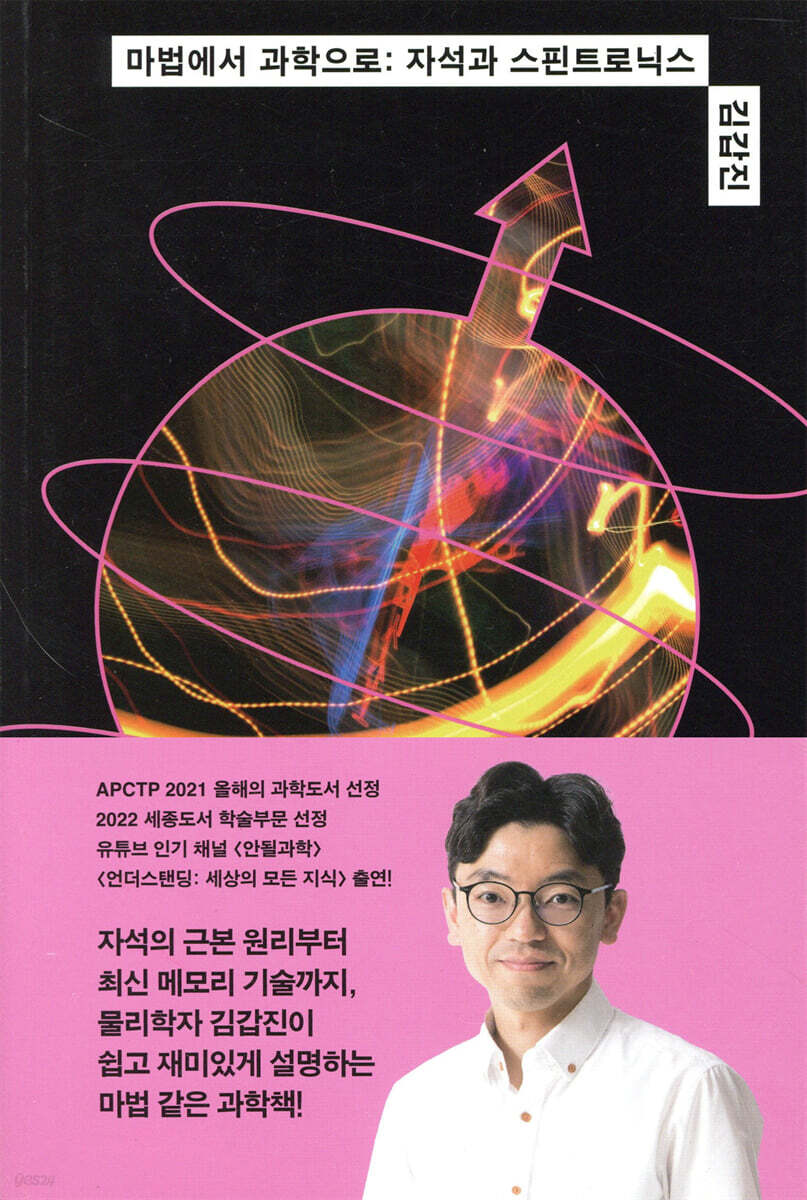
From Magic to Science: Magnets and Spintronics
 |
Description
Book Introduction
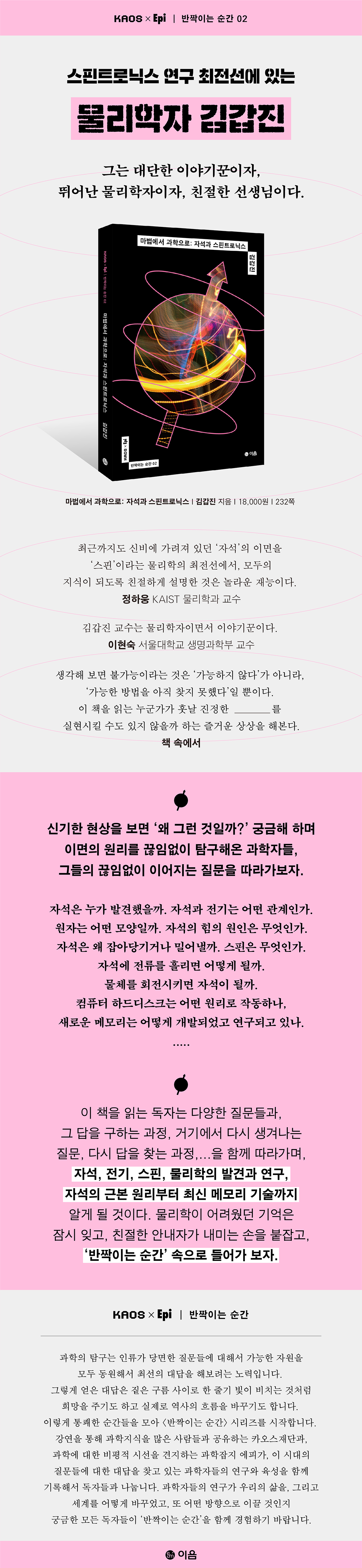
A magical science book that will help you discover the fun of physics, which used to be considered difficult!
Kim Gap-jin, a physicist who first demonstrated left-handed spin waves,
If you follow his journey of questions as if you were drawn to a magnet,
Before you know it, you'll understand magnets, electricity, and spin!
Who discovered the magnet?
What is the relationship between magnets and electricity?
What shape does an atom have?
How did Bohr's hypothesis emerge?
What causes the force of a magnet?
Why do magnets attract opposite poles and repel like poles?
What is spin?
What is the Pauli exclusion principle?
How are the properties of a magnet determined?
What is the action that aligns the spin?
What else is disrupting it?
How are the N and S poles of a magnet fixed?
What kind of magnets have humans created?
What happens when you run a current through a magnet?
What happens when you heat a spin?
If you rotate an object, will it become a magnet?
What is spintronics?
How do computer hard drives work? How are new memories developed and researched?
Readers of this book will follow the various questions, the process of finding answers, the questions that arise from them, and the process of finding answers. As they do so, they will gain an understanding of the discoveries and research in physics, from the principles of the ancient Chinese compass to the latest memory, Maxwell's equations, and quantum mechanics.
Let's forget about the difficulty of physics for a moment, take the hand extended by our friendly guide, and enter into a 'sparkling moment'.
Kim Gap-jin, a physicist who first demonstrated left-handed spin waves,
If you follow his journey of questions as if you were drawn to a magnet,
Before you know it, you'll understand magnets, electricity, and spin!
Who discovered the magnet?
What is the relationship between magnets and electricity?
What shape does an atom have?
How did Bohr's hypothesis emerge?
What causes the force of a magnet?
Why do magnets attract opposite poles and repel like poles?
What is spin?
What is the Pauli exclusion principle?
How are the properties of a magnet determined?
What is the action that aligns the spin?
What else is disrupting it?
How are the N and S poles of a magnet fixed?
What kind of magnets have humans created?
What happens when you run a current through a magnet?
What happens when you heat a spin?
If you rotate an object, will it become a magnet?
What is spintronics?
How do computer hard drives work? How are new memories developed and researched?
Readers of this book will follow the various questions, the process of finding answers, the questions that arise from them, and the process of finding answers. As they do so, they will gain an understanding of the discoveries and research in physics, from the principles of the ancient Chinese compass to the latest memory, Maxwell's equations, and quantum mechanics.
Let's forget about the difficulty of physics for a moment, take the hand extended by our friendly guide, and enter into a 'sparkling moment'.
index
Entering
Chapter 1.
Where do the north and south poles of a magnet come from?
Who first discovered the magnet?
Who discovered electricity?
Are electricity and magnetism related?
How are electricity and magnetism intertwined?
What is the source of electricity and magnetism?
What shape are atoms?
How to explain atoms
How did Bohr's hypothesis emerge?
Why are atomic line spectra affected by magnets?
What does a real atom look like?
Chapter 2.
Why do magnets exert a force of push and pull?
The cause of the force exerted by a magnet is
How should we understand magnetism?
Why do magnets repel each other with like poles?
Chapter 3.
What is spin?
What on earth is spin?
Can the existence of spin be experimentally proven?
How are the spins of electrons arranged in an atom?
Why can only one electron occupy a quantum state?
Chapter 4.
What is a magnet
When several atomic magnets come together,
The atomic interactions that determine the properties of a magnet are
The interaction that aligns the spins is
What Disrupts Spin Alignment
When a magnetic field is applied to a diamagnetic material,
Is iron really a magnet?
How are the north and south poles of a magnet fixed?
What kind of magnets have humans created?
Chapter 5.
Rediscovering the Magnet
Could we build artificial magnets by stacking atoms layer by layer?
When you pass current through a magnet
Can you change the direction of a magnet with an electric current?
If you move forward while rotating
How to define the flow of spin
How does spin react when heat is applied?
If you rotate an object, will it become a magnet?
Chapter 6.
The forefront of magnet research
How has spintronics contributed to human progress?
The limitations of hard disks
A new memory that uses spin current
Can racetrack memory be realized?
What is the ultimate memory?
The uses of magnets are endless.
Coming out
Chapter 1.
Where do the north and south poles of a magnet come from?
Who first discovered the magnet?
Who discovered electricity?
Are electricity and magnetism related?
How are electricity and magnetism intertwined?
What is the source of electricity and magnetism?
What shape are atoms?
How to explain atoms
How did Bohr's hypothesis emerge?
Why are atomic line spectra affected by magnets?
What does a real atom look like?
Chapter 2.
Why do magnets exert a force of push and pull?
The cause of the force exerted by a magnet is
How should we understand magnetism?
Why do magnets repel each other with like poles?
Chapter 3.
What is spin?
What on earth is spin?
Can the existence of spin be experimentally proven?
How are the spins of electrons arranged in an atom?
Why can only one electron occupy a quantum state?
Chapter 4.
What is a magnet
When several atomic magnets come together,
The atomic interactions that determine the properties of a magnet are
The interaction that aligns the spins is
What Disrupts Spin Alignment
When a magnetic field is applied to a diamagnetic material,
Is iron really a magnet?
How are the north and south poles of a magnet fixed?
What kind of magnets have humans created?
Chapter 5.
Rediscovering the Magnet
Could we build artificial magnets by stacking atoms layer by layer?
When you pass current through a magnet
Can you change the direction of a magnet with an electric current?
If you move forward while rotating
How to define the flow of spin
How does spin react when heat is applied?
If you rotate an object, will it become a magnet?
Chapter 6.
The forefront of magnet research
How has spintronics contributed to human progress?
The limitations of hard disks
A new memory that uses spin current
Can racetrack memory be realized?
What is the ultimate memory?
The uses of magnets are endless.
Coming out
Detailed image
Into the book
Now let's go on a journey to find the origin of magnetism.
The rules of travel are simple.
It's about asking questions and answering them.
As we answer, more questions will arise, and these endless questions will keep us going on our journey.
When there are no more questions, the journey will end there.
Okay, then let's set off together.
--- p.15
The red color of the bar magnet is the N pole and the blue color is the S pole, so let's cut through the middle of the red and blue.
So, will the N and S poles be separated? No.
A magnet cut in half will once again have a north and south pole... If you keep cutting and cutting, what will be left in the end? Perhaps a single atom will remain... Even within a single atom, the north and south poles still exist together.
Why on earth is that?
--- p.20
Human curiosity is endless.
Maybe that's why we need scientists.
Well, then, let's go on another journey to find the source of electricity and magnetism.
--- p.46
Some people called this newly born discipline ‘the discipline of youth.’
This is because a new field of study was completed by young scientists who appeared like comets.
Perhaps it is because existing scholars were so caught up in stereotypes that it was difficult for them to accept new disciplines, whereas young scholars found it relatively easy to accept new concepts.
--- p.55
Electrons not only orbit the nucleus, but also rotate on their own.
Since electrons are electrically charged, when they rotate, they can generate a magnetic field in the direction of their axis, and thus can respond to an external magnetic field.
Also, since the rotation of an electron is defined only in two directions, clockwise and counterclockwise, it can also explain the splitting of the spectrum into two... The concept of spin, which was born in this way, became the key to explaining the origin of magnetism.
--- p.68
Usually, when you look at textbooks or books, they draw Bohr's atomic model with the nucleus and electrons orbiting around it.
However, when trying to express it in a picture, the relative sizes of the nucleus and electrons are not properly expressed... It is like when a golf ball is placed at Seoul City Hall, a speck of dust is spinning at a distance from Seoul City Hall equivalent to the distance of Namsan Tower.
--- p.69
Among the many elements that exist in nature at room temperature, only four are magnets.
These are iron (atomic number 26), cobalt (atomic number 27), nickel (atomic number 28), and gadolinium (atomic number 64).
All other substances are non-magnetic at room temperature! Why is that?
--- p.110
This experiment (frog levitation) is known as the most dramatic experiment that confirmed the diamagnetism of water, and Professor Andre Geim, who attempted this experiment, won the Ig Nobel Prize in 2000 for this somewhat odd-looking experiment... but the interesting thing is that Professor Geim actually won the Nobel Prize in Physics 10 years later in 2010 for the discovery of graphene.
He remains the only person to have won both the Ig Nobel Prize and the Nobel Prize.
--- p.134
The very fact that a superconductor operating at room temperature has been discovered is significant.
Until now, many people thought that realizing a room-temperature superconductor was impossible, but if you think about it, impossible does not mean that 'it is not possible', but rather that 'a possible method has not yet been found'.
It's a delightful thought that someone reading this book might one day realize a true room-temperature superconductor.
--- p.136
When a magnet attached to a motor moves at high speed, a current is generated according to Faraday's law, and as that current flows, heat is generated.
This type of current is called an eddy current or an eddy current... The principle of induction is to generate a magnetic field by passing a current through a coil, and the generated magnetic field generates an eddy current in a special container, thereby generating heat.
Because of this, it is a unique heating device that does not get hot at all because electromagnetic induction does not occur unless it is in a dedicated container.
--- p.149
So far, we have traveled a journey from the origins and roots of magnets to the question, “How can we make stronger magnets?”
Now I feel like I understand magnets to some extent, and I'm starting to think, "Isn't this enough?"
But as with most things in life, just when you think you've figured it all out and that's the end, a real new beginning arrives.
Look at the history of physics.
Just when we thought everything in the world was understood through Newtonian mechanics and Maxwellian electromagnetism, didn't the theory of relativity and quantum mechanics appear?
So maybe the more you know, the more humble you should be.
--- p.153
In the history of science, revolutionary discoveries often start from trivial questions.
That is why we must constantly ask questions, and no question should be easily ignored.
With the emergence of the interlayer exchange coupling phenomenon described above, many scientists have been trying to find a 'stronger coupling'.
In this trend, French physicist Albert Fert and German physicist Peter Grünberg came up with a slightly different idea... It seems like anyone would think about it after hearing it, but it was a question that no one had thought about before.
--- p.160
To solve this curiosity, they heated one side of the magnet and discovered that the hot and cold sides attracted spins in different directions.
In other words, a temperature difference causes spin current to flow! This is what happened in 2008.
They named this phenomenon the 'spin Seebeck effect'... This discovery is even more exciting for scientists because it means that even energy that would otherwise be wasted as heat can now be harnessed to create spin.
--- p.181
A rather odd experiment was recently performed to confirm this... To determine whether a rotating object becomes a magnet or not, you basically need three experts: a theorist who calculates how fast it has to spin to produce a measurable magnetic field, an experimentalist who can measure very small magnetic fields, and a technician who can make any object spin at high speed.
In fact, in 2015, these three experts joined forces to conduct an experiment and discovered that “if you rotate it, it really does become a magnet.”
--- p.184
At this point, you can imagine even more fun things.
“If you apply heat or current, you can collect the spins aligned in one direction on both surfaces.
According to Einstein and de Haas's argument, if you align the spins, the object will rotate, so if you collect the aligned spins on both surfaces, shouldn't that surface rotate?" There was an experiment to actually confirm this, and it was found that this phenomenon really does occur.
It was 2019.
--- p.186
When humanity is in crisis and needs a solution, it is the job of scientists to provide scientific or technological support.
Some scientists are working to increase the amount of electricity used in a less polluting way by using solar energy, while others are trying to change the concept of computers themselves, performing calculations using quantum phenomena or imitating the human brain, in order to perform efficient calculations with less energy.
And interestingly, even magnet researchers are still staying up all night to prepare for this situation.
--- p.201
What scientists do is not much different from building a stone tower.
In most cases, we diligently analyze the stone tower built by senior scientists, and then try to add one more stone without destroying it.
Of course, there are some scientists who believe that the stone tower itself was built incorrectly from the beginning and tear it down and rebuild it, but most believe that the role of a scientist is to add one more stone.
And in fact, I feel a great sense of pride and satisfaction just by being able to dedicate my life to putting one more stone on the ground.
--- p.208
Magnets can exert force on each other even when they are not attached, and when they move, they generate electric current, so these electric currents can be measured and used as sensors.
If you think about it, the compass, mankind's first magnetic invention, is also a type of sensor that indicates direction, and such sensors have been further developed and are now used to control the attitude of artificial satellites.
They are also used for military purposes because magnetic sensors work better than other types of sensors in extreme environments.
--- p.220
We don't know what discoveries lie ahead of us or how they will change the world.
Just as Faraday, who created electricity, could not have imagined the cell phone.
But someone is still asking questions, and those questions will lead to new discoveries and change the world.
So we have to ask and ask again.
The rules of travel are simple.
It's about asking questions and answering them.
As we answer, more questions will arise, and these endless questions will keep us going on our journey.
When there are no more questions, the journey will end there.
Okay, then let's set off together.
--- p.15
The red color of the bar magnet is the N pole and the blue color is the S pole, so let's cut through the middle of the red and blue.
So, will the N and S poles be separated? No.
A magnet cut in half will once again have a north and south pole... If you keep cutting and cutting, what will be left in the end? Perhaps a single atom will remain... Even within a single atom, the north and south poles still exist together.
Why on earth is that?
--- p.20
Human curiosity is endless.
Maybe that's why we need scientists.
Well, then, let's go on another journey to find the source of electricity and magnetism.
--- p.46
Some people called this newly born discipline ‘the discipline of youth.’
This is because a new field of study was completed by young scientists who appeared like comets.
Perhaps it is because existing scholars were so caught up in stereotypes that it was difficult for them to accept new disciplines, whereas young scholars found it relatively easy to accept new concepts.
--- p.55
Electrons not only orbit the nucleus, but also rotate on their own.
Since electrons are electrically charged, when they rotate, they can generate a magnetic field in the direction of their axis, and thus can respond to an external magnetic field.
Also, since the rotation of an electron is defined only in two directions, clockwise and counterclockwise, it can also explain the splitting of the spectrum into two... The concept of spin, which was born in this way, became the key to explaining the origin of magnetism.
--- p.68
Usually, when you look at textbooks or books, they draw Bohr's atomic model with the nucleus and electrons orbiting around it.
However, when trying to express it in a picture, the relative sizes of the nucleus and electrons are not properly expressed... It is like when a golf ball is placed at Seoul City Hall, a speck of dust is spinning at a distance from Seoul City Hall equivalent to the distance of Namsan Tower.
--- p.69
Among the many elements that exist in nature at room temperature, only four are magnets.
These are iron (atomic number 26), cobalt (atomic number 27), nickel (atomic number 28), and gadolinium (atomic number 64).
All other substances are non-magnetic at room temperature! Why is that?
--- p.110
This experiment (frog levitation) is known as the most dramatic experiment that confirmed the diamagnetism of water, and Professor Andre Geim, who attempted this experiment, won the Ig Nobel Prize in 2000 for this somewhat odd-looking experiment... but the interesting thing is that Professor Geim actually won the Nobel Prize in Physics 10 years later in 2010 for the discovery of graphene.
He remains the only person to have won both the Ig Nobel Prize and the Nobel Prize.
--- p.134
The very fact that a superconductor operating at room temperature has been discovered is significant.
Until now, many people thought that realizing a room-temperature superconductor was impossible, but if you think about it, impossible does not mean that 'it is not possible', but rather that 'a possible method has not yet been found'.
It's a delightful thought that someone reading this book might one day realize a true room-temperature superconductor.
--- p.136
When a magnet attached to a motor moves at high speed, a current is generated according to Faraday's law, and as that current flows, heat is generated.
This type of current is called an eddy current or an eddy current... The principle of induction is to generate a magnetic field by passing a current through a coil, and the generated magnetic field generates an eddy current in a special container, thereby generating heat.
Because of this, it is a unique heating device that does not get hot at all because electromagnetic induction does not occur unless it is in a dedicated container.
--- p.149
So far, we have traveled a journey from the origins and roots of magnets to the question, “How can we make stronger magnets?”
Now I feel like I understand magnets to some extent, and I'm starting to think, "Isn't this enough?"
But as with most things in life, just when you think you've figured it all out and that's the end, a real new beginning arrives.
Look at the history of physics.
Just when we thought everything in the world was understood through Newtonian mechanics and Maxwellian electromagnetism, didn't the theory of relativity and quantum mechanics appear?
So maybe the more you know, the more humble you should be.
--- p.153
In the history of science, revolutionary discoveries often start from trivial questions.
That is why we must constantly ask questions, and no question should be easily ignored.
With the emergence of the interlayer exchange coupling phenomenon described above, many scientists have been trying to find a 'stronger coupling'.
In this trend, French physicist Albert Fert and German physicist Peter Grünberg came up with a slightly different idea... It seems like anyone would think about it after hearing it, but it was a question that no one had thought about before.
--- p.160
To solve this curiosity, they heated one side of the magnet and discovered that the hot and cold sides attracted spins in different directions.
In other words, a temperature difference causes spin current to flow! This is what happened in 2008.
They named this phenomenon the 'spin Seebeck effect'... This discovery is even more exciting for scientists because it means that even energy that would otherwise be wasted as heat can now be harnessed to create spin.
--- p.181
A rather odd experiment was recently performed to confirm this... To determine whether a rotating object becomes a magnet or not, you basically need three experts: a theorist who calculates how fast it has to spin to produce a measurable magnetic field, an experimentalist who can measure very small magnetic fields, and a technician who can make any object spin at high speed.
In fact, in 2015, these three experts joined forces to conduct an experiment and discovered that “if you rotate it, it really does become a magnet.”
--- p.184
At this point, you can imagine even more fun things.
“If you apply heat or current, you can collect the spins aligned in one direction on both surfaces.
According to Einstein and de Haas's argument, if you align the spins, the object will rotate, so if you collect the aligned spins on both surfaces, shouldn't that surface rotate?" There was an experiment to actually confirm this, and it was found that this phenomenon really does occur.
It was 2019.
--- p.186
When humanity is in crisis and needs a solution, it is the job of scientists to provide scientific or technological support.
Some scientists are working to increase the amount of electricity used in a less polluting way by using solar energy, while others are trying to change the concept of computers themselves, performing calculations using quantum phenomena or imitating the human brain, in order to perform efficient calculations with less energy.
And interestingly, even magnet researchers are still staying up all night to prepare for this situation.
--- p.201
What scientists do is not much different from building a stone tower.
In most cases, we diligently analyze the stone tower built by senior scientists, and then try to add one more stone without destroying it.
Of course, there are some scientists who believe that the stone tower itself was built incorrectly from the beginning and tear it down and rebuild it, but most believe that the role of a scientist is to add one more stone.
And in fact, I feel a great sense of pride and satisfaction just by being able to dedicate my life to putting one more stone on the ground.
--- p.208
Magnets can exert force on each other even when they are not attached, and when they move, they generate electric current, so these electric currents can be measured and used as sensors.
If you think about it, the compass, mankind's first magnetic invention, is also a type of sensor that indicates direction, and such sensors have been further developed and are now used to control the attitude of artificial satellites.
They are also used for military purposes because magnetic sensors work better than other types of sensors in extreme environments.
--- p.220
We don't know what discoveries lie ahead of us or how they will change the world.
Just as Faraday, who created electricity, could not have imagined the cell phone.
But someone is still asking questions, and those questions will lead to new discoveries and change the world.
So we have to ask and ask again.
--- p.226
Publisher's Review
Author Kim Gap-jin is a great storyteller.
Reading this book is like sitting next to a close friend, senior, or teacher as they excitedly discuss their scientific research.
I have a really interesting story to tell. It's about this strange phenomenon that happened, and people were curious about it, so they searched and tried to figure out why.
And then I started wondering about this again? As I followed his story, I found myself naturally rekindling forgotten or lost interests and becoming curious about science.
In that respect, the author is a great storyteller.
The author, Kim Gap-jin, is an outstanding physicist.
The author, who enjoys research 362 days out of 365, developed a technology to dramatically increase the speed of next-generation domain wall-based magnetic memory, which is considered a next-generation memory device, and was selected as one of the top 10 research achievements that shone at KAIST in 2018. He also won the KAIST 50th Anniversary Academic Award for proving left-handed spin waves, which had only been introduced theoretically in the 1960s, for the first time in the world, and published the results in 「Nature Materials」 in 2020.
He also received the Young Scientist Award from the Asian Magnetic Society.
The author, Kim Gap-jin, is a kind teacher.
Everyone has played with magnets, and everyone uses electricity every day, but few people are curious about the science behind the conveniences of everyday life.
Science has always been seen as something distant, difficult, and complex, but the author, like a curious boy, keeps asking questions with sparkling eyes.
Aren't you curious about this? What do you think? It's like this.
How about this? This is also amazing.
Amazingly, as you follow his story, your fear will disappear and you will come to understand that science is fun.
It feels like a young science teacher is beckoning us to follow him and learn about fun science together.
He revealed that he wrote this book in the hope that someone who comes after him will be able to understand the results of his intense study for over 10 years a little more easily, and that he wanted to help that person.
His lecture videos have already been viewed over 1.24 million times.
He is evaluated by students as a 'top professor with character, ability, and a professional mindset as an educator', and he actively communicates with elementary and middle school students who dream of becoming future scientists through lectures at science camps and other events.
Let's follow the never-ending series of questions.
Who discovered the magnet?
What is the relationship between magnets and electricity?
What shape does an atom have?
How did Bohr's hypothesis emerge?
What causes the force of a magnet?
Why do magnets attract opposite poles and repel like poles?
What is spin?
What is the Pauli exclusion principle?
How are the properties of a magnet determined?
What is the action that aligns the spin?
What else is disrupting it?
How are the N and S poles of a magnet fixed?
What kind of magnets have humans created?
What happens when you run a current through a magnet?
What happens when you heat a spin?
If you rotate an object, will it become a magnet?
What is spintronics?
How do computer hard drives work? How are new memories developed and researched?
Readers of this book will follow the various questions, the process of finding answers, the questions that arise from them, and the process of finding answers. As they do so, they will gain an understanding of the discoveries and research in physics, from the principles of the ancient Chinese compass to the latest memory, Maxwell's equations, and quantum mechanics.
Let's forget about the difficulty of physics for a moment, take the hand extended by our friendly guide, and enter into a 'sparkling moment'.
Series Introduction
KAOS×Epi Sparkling Moment
Scientific inquiry is an effort to find the best possible answers to the questions facing humanity by mobilizing all available resources.
The answers obtained in this way can give hope, like a ray of light shining through dark clouds, and can actually change the course of history.
We begin the [Sparkling Moments] series by collecting these exhilarating moments.
The Chaos Foundation, which shares scientific knowledge with many people through lectures, and Epiga, a science magazine that maintains a critical perspective on science, are sharing with readers the research and development of scientists seeking answers to the questions of our time.
We hope that all readers who are curious about how scientists' research has changed our lives and the world, and in what direction it will lead, will experience this "sparkling moment" together.
Reading this book is like sitting next to a close friend, senior, or teacher as they excitedly discuss their scientific research.
I have a really interesting story to tell. It's about this strange phenomenon that happened, and people were curious about it, so they searched and tried to figure out why.
And then I started wondering about this again? As I followed his story, I found myself naturally rekindling forgotten or lost interests and becoming curious about science.
In that respect, the author is a great storyteller.
The author, Kim Gap-jin, is an outstanding physicist.
The author, who enjoys research 362 days out of 365, developed a technology to dramatically increase the speed of next-generation domain wall-based magnetic memory, which is considered a next-generation memory device, and was selected as one of the top 10 research achievements that shone at KAIST in 2018. He also won the KAIST 50th Anniversary Academic Award for proving left-handed spin waves, which had only been introduced theoretically in the 1960s, for the first time in the world, and published the results in 「Nature Materials」 in 2020.
He also received the Young Scientist Award from the Asian Magnetic Society.
The author, Kim Gap-jin, is a kind teacher.
Everyone has played with magnets, and everyone uses electricity every day, but few people are curious about the science behind the conveniences of everyday life.
Science has always been seen as something distant, difficult, and complex, but the author, like a curious boy, keeps asking questions with sparkling eyes.
Aren't you curious about this? What do you think? It's like this.
How about this? This is also amazing.
Amazingly, as you follow his story, your fear will disappear and you will come to understand that science is fun.
It feels like a young science teacher is beckoning us to follow him and learn about fun science together.
He revealed that he wrote this book in the hope that someone who comes after him will be able to understand the results of his intense study for over 10 years a little more easily, and that he wanted to help that person.
His lecture videos have already been viewed over 1.24 million times.
He is evaluated by students as a 'top professor with character, ability, and a professional mindset as an educator', and he actively communicates with elementary and middle school students who dream of becoming future scientists through lectures at science camps and other events.
Let's follow the never-ending series of questions.
Who discovered the magnet?
What is the relationship between magnets and electricity?
What shape does an atom have?
How did Bohr's hypothesis emerge?
What causes the force of a magnet?
Why do magnets attract opposite poles and repel like poles?
What is spin?
What is the Pauli exclusion principle?
How are the properties of a magnet determined?
What is the action that aligns the spin?
What else is disrupting it?
How are the N and S poles of a magnet fixed?
What kind of magnets have humans created?
What happens when you run a current through a magnet?
What happens when you heat a spin?
If you rotate an object, will it become a magnet?
What is spintronics?
How do computer hard drives work? How are new memories developed and researched?
Readers of this book will follow the various questions, the process of finding answers, the questions that arise from them, and the process of finding answers. As they do so, they will gain an understanding of the discoveries and research in physics, from the principles of the ancient Chinese compass to the latest memory, Maxwell's equations, and quantum mechanics.
Let's forget about the difficulty of physics for a moment, take the hand extended by our friendly guide, and enter into a 'sparkling moment'.
Series Introduction
KAOS×Epi Sparkling Moment
Scientific inquiry is an effort to find the best possible answers to the questions facing humanity by mobilizing all available resources.
The answers obtained in this way can give hope, like a ray of light shining through dark clouds, and can actually change the course of history.
We begin the [Sparkling Moments] series by collecting these exhilarating moments.
The Chaos Foundation, which shares scientific knowledge with many people through lectures, and Epiga, a science magazine that maintains a critical perspective on science, are sharing with readers the research and development of scientists seeking answers to the questions of our time.
We hope that all readers who are curious about how scientists' research has changed our lives and the world, and in what direction it will lead, will experience this "sparkling moment" together.
GOODS SPECIFICS
- Date of issue: September 8, 2021
- Page count, weight, size: 232 pages | 284g | 135*200*20mm
- ISBN13: 9791190944311
- ISBN10: 1190944316
You may also like
카테고리
korean


korean

![GQ KOREA Mark (Monthly): December [2025]](http://librairie.coreenne.fr/cdn/shop/files/8ef265dbbfbf186523ed75ba7319009d.jpg?v=1765340328&width=3840)


