

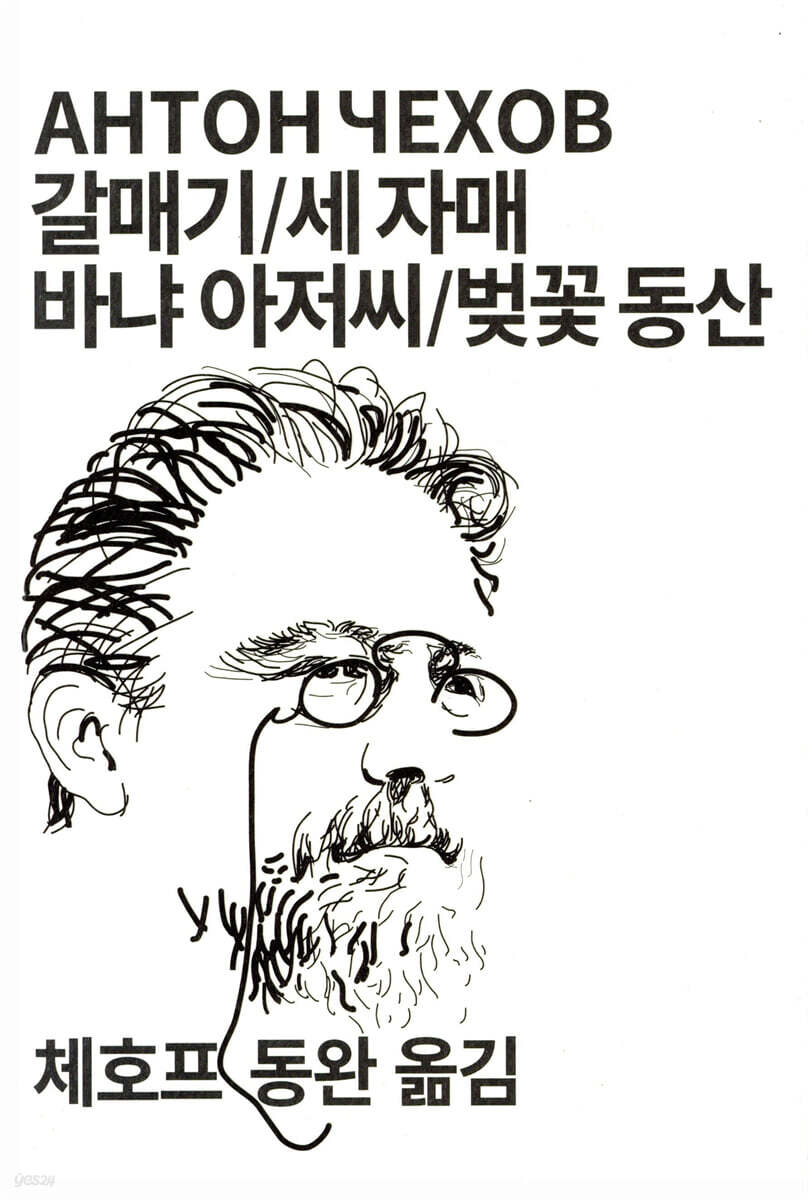
The Seagull/Three Sisters/Uncle Vanya/The Cherry Orchard
 |
Description
Book Introduction
The immortal great pioneer of modern drama!
Anton Chekhov, the last giant of 19th century Russian literature!
『The Seagull』『Three Sisters』『Uncle Vanya』『The Cherry Orchard』!
Four masterpieces in one volume!
Chekhov, establishing the direction of modern drama!
Anton Chekhov, the last giant of 19th-century Russian literature.
He is an outstanding short story writer who laid the foundation for modern short story literature, and is also a great playwright who established the direction of modern drama.
The impact of his art on modern literature is equally wide and deep.
Many great modern writers, including Gorky, James Joyce, Virginia Woolf, and Hemingway, learned literature from Chekhov and were influenced by him.
Raymond Carver, America's most popular writer and known as the 'American Chekhov', once evaluated Chekhov as the 'greatest short story writer'.
Chekhov, who is also considered the greatest playwright after Shakespeare, is the most read and performed writer in the world along with Shakespeare.
The playwright Chekhov demonstrated the pinnacle of what pre-modern dramaturgy could achieve in literature, and he can be said to have set a milestone for the unknown world that modern theater should pursue.
Anton Chekhov, the last giant of 19th century Russian literature!
『The Seagull』『Three Sisters』『Uncle Vanya』『The Cherry Orchard』!
Four masterpieces in one volume!
Chekhov, establishing the direction of modern drama!
Anton Chekhov, the last giant of 19th-century Russian literature.
He is an outstanding short story writer who laid the foundation for modern short story literature, and is also a great playwright who established the direction of modern drama.
The impact of his art on modern literature is equally wide and deep.
Many great modern writers, including Gorky, James Joyce, Virginia Woolf, and Hemingway, learned literature from Chekhov and were influenced by him.
Raymond Carver, America's most popular writer and known as the 'American Chekhov', once evaluated Chekhov as the 'greatest short story writer'.
Chekhov, who is also considered the greatest playwright after Shakespeare, is the most read and performed writer in the world along with Shakespeare.
The playwright Chekhov demonstrated the pinnacle of what pre-modern dramaturgy could achieve in literature, and he can be said to have set a milestone for the unknown world that modern theater should pursue.
- You can preview some of the book's contents.
Preview
index
Seagull… 9
Three Sisters… 77
Uncle Vanya… 161
Cherry Blossom Orchard… 223
Bear… 293
Proposal… 311
Like it or not, the tragic actor… 333
The Stork's Song… 343
Wedding reception… 355
Chekhov's Life and Works… 375
Chekhov Chronology … 411
Three Sisters… 77
Uncle Vanya… 161
Cherry Blossom Orchard… 223
Bear… 293
Proposal… 311
Like it or not, the tragic actor… 333
The Stork's Song… 343
Wedding reception… 355
Chekhov's Life and Works… 375
Chekhov Chronology … 411
Into the book
Medvedenko, why do you always wear black?
Marsha, this is the prize of my life.
Because it's unfortunate.
--- p.11 From "The Seagull"
When I was young, I wanted to be a writer, but I couldn't.
I wanted to be an orator, but as you can see, my speaking skills are terrible.
(Excited about himself) That's how it was all.
Whatever I wanted, I couldn't get it.
Sometimes when I think about that, I break out in a cold sweat.
I tried to get married, but that didn't work out, and I wanted to live in the city, but I'm ending my life in the countryside.
In the end, it turned out like this again.
You were trying to become a 4th class officer, and you became one.
Sorin (laughs) That wasn't really what I wanted, but somehow it turned out that way.
How can someone who has lived for 62 years find fault with life?
I can't understand what you're saying.
So what I'm saying is, I want to live more!
It's just a vain thought.
Because according to the laws of nature, anything that has life will have an end.
Mr. Sorin speaks as if he has attained enlightenment in life.
When I'm full, I have no desires for anything in life.
So, you can be at peace.
But even the teacher would be afraid of death.
--- p.62 From "The Seagull"
Irina (sobbing) Where? Where did they all go? Where are they? Oh, God! I've forgotten everything, I've forgotten...
My head is a mess… … .
I don't remember what that window or ceiling is called in Italian...
I forgot everything.
As the days go by, I forget more and more.
Life just keeps passing by, it never comes back again.
We will never, ever be able to go to Moscow… … .
I know… … .
Olga, Irina… … .
Irina (controlling her emotions) Ah, I'm unhappy...
I can't work anymore, and I won't work.
Okay, enough! I worked at the telegraph office, and now I work at City Hall, but every single task I've been given is equally horrible...
I'm already twenty-three years old and have been working for a long time.
My mind is getting dull, my body is getting thinner, my appearance is getting uglier, and I'm just getting older.
I feel no satisfaction and time just passes.
I feel like I'm getting further and further away from a beautiful and true life.
I'm falling deeper and deeper into the abyss.
I have no hope now.
I wonder how I'm still alive, how I haven't committed suicide until now...
--- p.134 From “Three Sisters”
Uncle Sonya Vanya, we have to live.
Live through the long, long days and nights.
It's about enduring the trials that fate sends us.
Let's work tirelessly for others.
In the future, even when I get old.
Then, when our final moment comes, we humbly accept our death.
And then I decided to go to the other world and tell them.
How miserable our lives have been, how much we have cried and been sad.
Then God will have mercy on us.
Ah, when that day comes, dear uncle, we will see a bright and beautiful world.
With a joyful heart, we will look back on the sorrows we have experienced in this world and smile warmly.
And finally we can rest.
I believe, I believe, I believe, I believe, I believe, I believe.
(Kneeling before him, resting her head on his hands, in a weary voice) We can rest there.
--- p.220 From "Uncle Vanya"
Epikhodov I am an intellectual and have read many high-level books, but I have no idea what path I should take.
I don't even know whether I should live like this or commit suicide.
Actually, I always carry a gun with me.
Okay, this is it… (takes out a gun and shows it)
Charlotte, I'm going to stop now.
(Pulls out a gun) Epikhodov, you are a clever and terrible man.
Women will be lining up to hang themselves on you.
Oh, that's creepy! (Leaves the scene) All the smart people are fools, you and I alike.
I have no one to talk to… … .
I'm always alone, a loner... I don't know who I am or what I live for...
(Exit slowly)
--- p.247 From "Cherry Blossom Orchard"
Trofimov: Yes, the moon has risen.
(Sai) I'm happy.
Happiness is coming.
I said it's getting closer and closer.
I can already hear the footsteps in my ears.
Even if we never find happiness, what's the problem? Even if we don't, someone else will!
--- p.261 From "Cherry Blossom Orchard"
Popova, this is so stupid and rude… … .
Smirnov (teasingly) Stupid and rude? You don't know how to behave properly around women? Madam, in my prime, I've known more women than you've ever seen in your life! I fought three duels over women, abandoned twelve, and been abandoned by nine! Yes, yes! I too have had my moments of foolishness.
She knew how to spray perfume on her body, adorn her clothes with jewels, and greet people elegantly with sweet words… … .
I've loved, I've suffered because of love, I've sighed while looking at the moon, I've felt indifferent, I've felt relieved, I've felt as cold as ice... ... I've always loved passionately, madly.
Damn it, back then I was always talking about liberation and all, and I wasted half my wealth on those fluffy feelings.
I'm sorry, but I'm sick of that! Yes, that's right! Dark eyes, passionate eyes, ruby-red lips, dimpled cheeks, the moon, whispers, shy breaths—Madam, I won't spend a single penny on any of that anymore!
Marsha, this is the prize of my life.
Because it's unfortunate.
--- p.11 From "The Seagull"
When I was young, I wanted to be a writer, but I couldn't.
I wanted to be an orator, but as you can see, my speaking skills are terrible.
(Excited about himself) That's how it was all.
Whatever I wanted, I couldn't get it.
Sometimes when I think about that, I break out in a cold sweat.
I tried to get married, but that didn't work out, and I wanted to live in the city, but I'm ending my life in the countryside.
In the end, it turned out like this again.
You were trying to become a 4th class officer, and you became one.
Sorin (laughs) That wasn't really what I wanted, but somehow it turned out that way.
How can someone who has lived for 62 years find fault with life?
I can't understand what you're saying.
So what I'm saying is, I want to live more!
It's just a vain thought.
Because according to the laws of nature, anything that has life will have an end.
Mr. Sorin speaks as if he has attained enlightenment in life.
When I'm full, I have no desires for anything in life.
So, you can be at peace.
But even the teacher would be afraid of death.
--- p.62 From "The Seagull"
Irina (sobbing) Where? Where did they all go? Where are they? Oh, God! I've forgotten everything, I've forgotten...
My head is a mess… … .
I don't remember what that window or ceiling is called in Italian...
I forgot everything.
As the days go by, I forget more and more.
Life just keeps passing by, it never comes back again.
We will never, ever be able to go to Moscow… … .
I know… … .
Olga, Irina… … .
Irina (controlling her emotions) Ah, I'm unhappy...
I can't work anymore, and I won't work.
Okay, enough! I worked at the telegraph office, and now I work at City Hall, but every single task I've been given is equally horrible...
I'm already twenty-three years old and have been working for a long time.
My mind is getting dull, my body is getting thinner, my appearance is getting uglier, and I'm just getting older.
I feel no satisfaction and time just passes.
I feel like I'm getting further and further away from a beautiful and true life.
I'm falling deeper and deeper into the abyss.
I have no hope now.
I wonder how I'm still alive, how I haven't committed suicide until now...
--- p.134 From “Three Sisters”
Uncle Sonya Vanya, we have to live.
Live through the long, long days and nights.
It's about enduring the trials that fate sends us.
Let's work tirelessly for others.
In the future, even when I get old.
Then, when our final moment comes, we humbly accept our death.
And then I decided to go to the other world and tell them.
How miserable our lives have been, how much we have cried and been sad.
Then God will have mercy on us.
Ah, when that day comes, dear uncle, we will see a bright and beautiful world.
With a joyful heart, we will look back on the sorrows we have experienced in this world and smile warmly.
And finally we can rest.
I believe, I believe, I believe, I believe, I believe, I believe.
(Kneeling before him, resting her head on his hands, in a weary voice) We can rest there.
--- p.220 From "Uncle Vanya"
Epikhodov I am an intellectual and have read many high-level books, but I have no idea what path I should take.
I don't even know whether I should live like this or commit suicide.
Actually, I always carry a gun with me.
Okay, this is it… (takes out a gun and shows it)
Charlotte, I'm going to stop now.
(Pulls out a gun) Epikhodov, you are a clever and terrible man.
Women will be lining up to hang themselves on you.
Oh, that's creepy! (Leaves the scene) All the smart people are fools, you and I alike.
I have no one to talk to… … .
I'm always alone, a loner... I don't know who I am or what I live for...
(Exit slowly)
--- p.247 From "Cherry Blossom Orchard"
Trofimov: Yes, the moon has risen.
(Sai) I'm happy.
Happiness is coming.
I said it's getting closer and closer.
I can already hear the footsteps in my ears.
Even if we never find happiness, what's the problem? Even if we don't, someone else will!
--- p.261 From "Cherry Blossom Orchard"
Popova, this is so stupid and rude… … .
Smirnov (teasingly) Stupid and rude? You don't know how to behave properly around women? Madam, in my prime, I've known more women than you've ever seen in your life! I fought three duels over women, abandoned twelve, and been abandoned by nine! Yes, yes! I too have had my moments of foolishness.
She knew how to spray perfume on her body, adorn her clothes with jewels, and greet people elegantly with sweet words… … .
I've loved, I've suffered because of love, I've sighed while looking at the moon, I've felt indifferent, I've felt relieved, I've felt as cold as ice... ... I've always loved passionately, madly.
Damn it, back then I was always talking about liberation and all, and I wasted half my wealth on those fluffy feelings.
I'm sorry, but I'm sick of that! Yes, that's right! Dark eyes, passionate eyes, ruby-red lips, dimpled cheeks, the moon, whispers, shy breaths—Madam, I won't spend a single penny on any of that anymore!
--- p.302 From "Bear"
Publisher's Review
Immortal masterpieces, Anton Chekhov's four major plays!
Chekhov wrote a total of seven full-length plays and ten one-act plays, but in particular, the four major plays written between 1896 and 1903, the year before his death: The Seagull, Uncle Vanya, Three Sisters, and The Cherry Orchard, are not only the pinnacle of Chekhov's plays but also immortal masterpieces that will remain in the history of world literature.
Chekhov's plays are also called 'atmosphere plays' or 'positive plays'.
Without any particular plot or dramatic events, the characters' daily lives, their conversations, and various relationships etched with human patterns gradually heighten the stage atmosphere, quietly unfolding the poetry of life.
Also, the lack of communication between characters, frequent silences, various lyrical sound effects, and the exquisite combination of tragic and comic elements are important characteristics of Chekhov's plays.
Chekhov's works, which focus on the truth of reality rather than grand ideas, are easy to read and leave a deep impression on anyone.
But if you try to interpret his work, it is more difficult than anyone else's.
This is because what he presents is not an abstract ideology, but the true life of ordinary daily life that exists side by side in life.
From Despair to Perseverance - The Seagull and Uncle Vanya
The Seagull, which depicts the passion, love, and heartbreaking frustration of a young artist, is one of the most popular plays.
The premiere at the Alexander Theatre in 1896 was a huge failure, but the second performance at the Moscow Art Theatre two years later was a great success, and Chekhov's plays began to receive serious recognition.
"The Seagull" strongly exudes the atmosphere of hopeless despair and melancholy that characterizes Chekhov's mid-period literature, including the gap between reality and dreams, frustrated hopes, and conflicted loves.
'The Seagull' symbolizes Nina, who failed to achieve her dream of becoming a great actress and was abandoned by her lover, and Treplev, who commits suicide in frustration over his lost love.
However, the theme of the transition from despair to perseverance, expressed by Nina in a few short lines in Act 4, shines even brighter in the gloomy and dark atmosphere characteristic of Chekhov's plays.
This also foreshadows the transformation of Chekhov's literary world, which is gradually moving from despair to hope.
This thematic consciousness, emphasizing the patience of life, is expressed more clearly and consciously in Uncle Vanya.
"Uncle Vanya" is an adaptation of "The Master of the Forest," a clumsy melodrama about rural life written six years before "The Seagull."
In the most touching finale, the scene where Sonya comforts Vanya while suppressing the pain of heartbreak makes us feel the nobility of the pure human soul that wants to live a human life even in despair.
From Patience to Hope—Three Sisters and The Cherry Orchard
"Three Sisters" is a static work that depicts the dramatic conflict between human dreams and reality, set in a family of military survivors living in a provincial city, and slowly becoming engulfed in fate.
The image of the three sisters, who are unable to leave the place but always dream of returning to Moscow, is also a self-portrait of all of us who must endure reality while yearning for an unattainable ideal.
The Cherry Orchard, the last of Chekhov's four major plays and the final masterpiece that adorns his literary career, sharply portrays the declining Russian landowner class.
Chekhov is famous for claiming that his work is a "comedy" even though it presents characters with sad fates, and the work that truly aligns with this claim is his greatest masterpiece, "The Cherry Orchard."
The Cherry Orchard is a world where life's tragedy and comedy intersect.
The poetic sentiment of the old life, symbolized by the cherry blossom orchard, is nothing more than an idealized desire that has been cruelly shattered in the face of reality.
Yet, when the cherry orchard was auctioned off, the Ranevskaya family vowed to create a new garden for themselves.
The reality is dark, but if we believe in progress, a bright and shining future will surely come. This hope was also the confident prayer for humanity that Chekhov held in his later years, when he was ailing.
It is also a shining spirit that runs through the four poles, moving from despair to perseverance, from perseverance to the origin of universal happiness, and finally to confidence in a bright future for humanity.
Chekhov wrote a total of seven full-length plays and ten one-act plays, but in particular, the four major plays written between 1896 and 1903, the year before his death: The Seagull, Uncle Vanya, Three Sisters, and The Cherry Orchard, are not only the pinnacle of Chekhov's plays but also immortal masterpieces that will remain in the history of world literature.
Chekhov's plays are also called 'atmosphere plays' or 'positive plays'.
Without any particular plot or dramatic events, the characters' daily lives, their conversations, and various relationships etched with human patterns gradually heighten the stage atmosphere, quietly unfolding the poetry of life.
Also, the lack of communication between characters, frequent silences, various lyrical sound effects, and the exquisite combination of tragic and comic elements are important characteristics of Chekhov's plays.
Chekhov's works, which focus on the truth of reality rather than grand ideas, are easy to read and leave a deep impression on anyone.
But if you try to interpret his work, it is more difficult than anyone else's.
This is because what he presents is not an abstract ideology, but the true life of ordinary daily life that exists side by side in life.
From Despair to Perseverance - The Seagull and Uncle Vanya
The Seagull, which depicts the passion, love, and heartbreaking frustration of a young artist, is one of the most popular plays.
The premiere at the Alexander Theatre in 1896 was a huge failure, but the second performance at the Moscow Art Theatre two years later was a great success, and Chekhov's plays began to receive serious recognition.
"The Seagull" strongly exudes the atmosphere of hopeless despair and melancholy that characterizes Chekhov's mid-period literature, including the gap between reality and dreams, frustrated hopes, and conflicted loves.
'The Seagull' symbolizes Nina, who failed to achieve her dream of becoming a great actress and was abandoned by her lover, and Treplev, who commits suicide in frustration over his lost love.
However, the theme of the transition from despair to perseverance, expressed by Nina in a few short lines in Act 4, shines even brighter in the gloomy and dark atmosphere characteristic of Chekhov's plays.
This also foreshadows the transformation of Chekhov's literary world, which is gradually moving from despair to hope.
This thematic consciousness, emphasizing the patience of life, is expressed more clearly and consciously in Uncle Vanya.
"Uncle Vanya" is an adaptation of "The Master of the Forest," a clumsy melodrama about rural life written six years before "The Seagull."
In the most touching finale, the scene where Sonya comforts Vanya while suppressing the pain of heartbreak makes us feel the nobility of the pure human soul that wants to live a human life even in despair.
From Patience to Hope—Three Sisters and The Cherry Orchard
"Three Sisters" is a static work that depicts the dramatic conflict between human dreams and reality, set in a family of military survivors living in a provincial city, and slowly becoming engulfed in fate.
The image of the three sisters, who are unable to leave the place but always dream of returning to Moscow, is also a self-portrait of all of us who must endure reality while yearning for an unattainable ideal.
The Cherry Orchard, the last of Chekhov's four major plays and the final masterpiece that adorns his literary career, sharply portrays the declining Russian landowner class.
Chekhov is famous for claiming that his work is a "comedy" even though it presents characters with sad fates, and the work that truly aligns with this claim is his greatest masterpiece, "The Cherry Orchard."
The Cherry Orchard is a world where life's tragedy and comedy intersect.
The poetic sentiment of the old life, symbolized by the cherry blossom orchard, is nothing more than an idealized desire that has been cruelly shattered in the face of reality.
Yet, when the cherry orchard was auctioned off, the Ranevskaya family vowed to create a new garden for themselves.
The reality is dark, but if we believe in progress, a bright and shining future will surely come. This hope was also the confident prayer for humanity that Chekhov held in his later years, when he was ailing.
It is also a shining spirit that runs through the four poles, moving from despair to perseverance, from perseverance to the origin of universal happiness, and finally to confidence in a bright future for humanity.
GOODS SPECIFICS
- Date of issue: September 9, 2016
- Page count, weight, size: 418 pages | 153*225*23mm
- ISBN13: 9788949714905
- ISBN10: 8949714906
You may also like
카테고리
korean


korean

![GQ KOREA Mark (Monthly): December [2025]](http://librairie.coreenne.fr/cdn/shop/files/8ef265dbbfbf186523ed75ba7319009d.jpg?v=1765340328&width=3840)


