

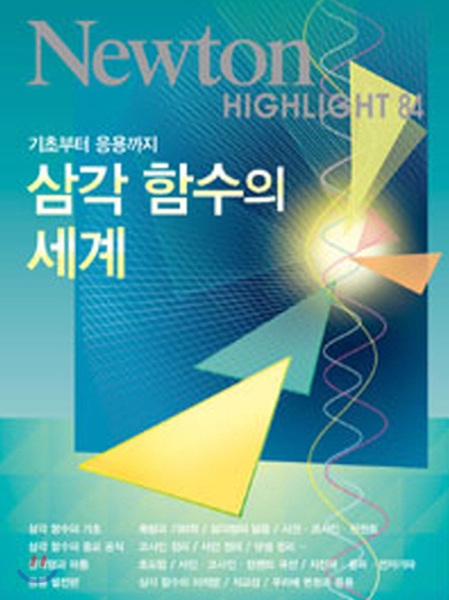
NEWTON HIGHLIGHT Newton Highlight: The World of Trigonometry
 |
Description
Book Introduction
Understand the principles of trigonometric functions through pictures!
This book, 'The World of Trigonometry Functions', clearly organizes how trigonometry functions were born and developed, what their basics and key contents are, and how they are currently utilized, using full-color illustrations.
In addition, the relationship between trigonometric functions and waves such as electromagnetic waves, sound waves, and seismic waves, as well as advanced fields such as trigonometric functions and calculus, orthogonality of trigonometric functions, and Fourier transforms are introduced in an easy-to-understand manner using visual aids.
The back of the book contains a separate collection of definitions of trigonometric functions, a collection of important formulas, and a table of trigonometric ratios, so that you can immediately check basic and important content at any time.
It develops the ability to deal with various application situations by deriving important formulas based on basic concepts and then deriving other formulas based on those formulas.
And it explains in detail through various learning reference materials how it is used in which scenes and based on which principles.
All content is based on detailed and easy-to-understand explanations by experts that hit the nail on the head and elaborate illustrations that allow you to see the principles with your own eyes.
This book, 'The World of Trigonometry Functions', clearly organizes how trigonometry functions were born and developed, what their basics and key contents are, and how they are currently utilized, using full-color illustrations.
In addition, the relationship between trigonometric functions and waves such as electromagnetic waves, sound waves, and seismic waves, as well as advanced fields such as trigonometric functions and calculus, orthogonality of trigonometric functions, and Fourier transforms are introduced in an easy-to-understand manner using visual aids.
The back of the book contains a separate collection of definitions of trigonometric functions, a collection of important formulas, and a table of trigonometric ratios, so that you can immediately check basic and important content at any time.
It develops the ability to deal with various application situations by deriving important formulas based on basic concepts and then deriving other formulas based on those formulas.
And it explains in detail through various learning reference materials how it is used in which scenes and based on which principles.
All content is based on detailed and easy-to-understand explanations by experts that hit the nail on the head and elaborate illustrations that allow you to see the principles with your own eyes.
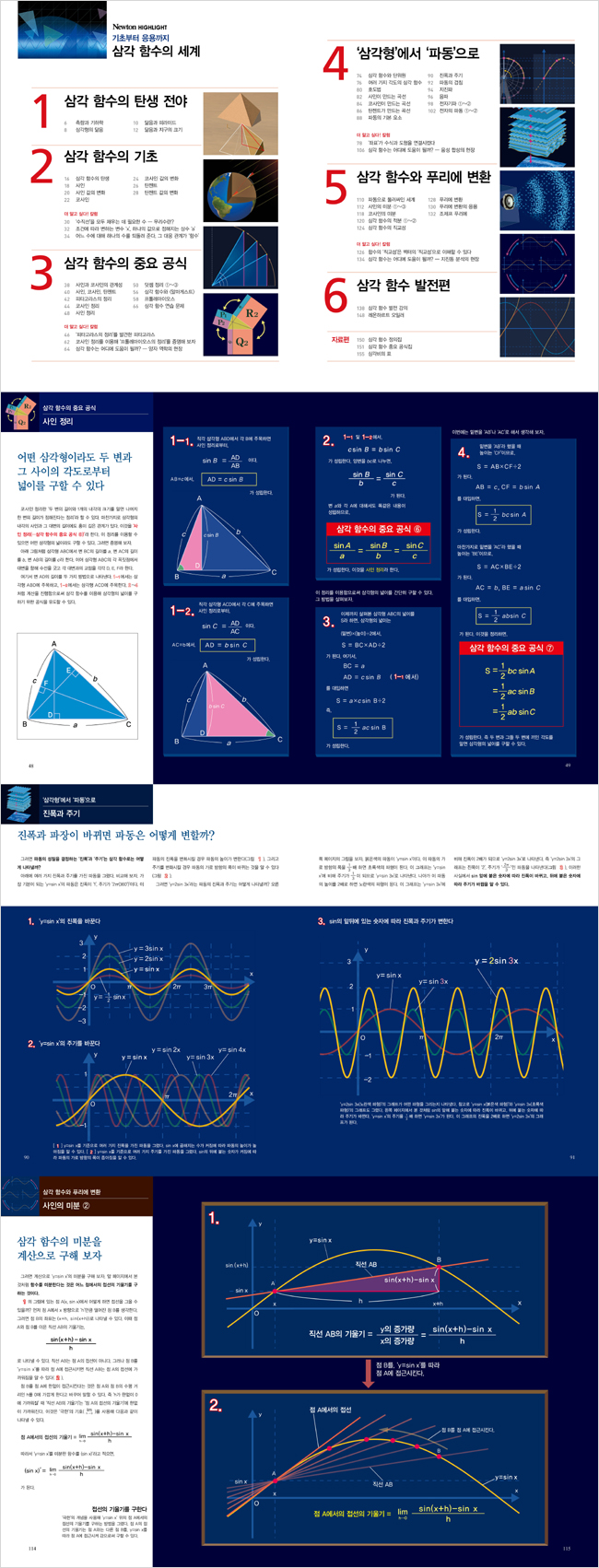
index
Part 1
The Eve of the Birth of Trigonometric Functions
Surveying and Geometry / Similarity of Triangles / Similarity and Pyramids / Similarity and the Size of the Earth
Part 2
Basics of Trigonometry
The Birth of Trigonometric Functions / Sine / Changes in Sine Values / Cosine / Changes in Cosine Values / Tangent / Changes in Tangent Values /
Want to know more? Column
- The number needed to fill the entire 'vertical line' - What is an irrational number?
- Variable 'x' that changes depending on conditions, constant 'a' that is determined by one value
- Returns one number for each number.
The corresponding relationship is a 'function'
Part 3
Important formulas of trigonometric functions
The relationship between sine and cosine / sine, cosine, and tangent / Pythagorean theorem / cosine theorem / sine theorem / addition theorem ①~③ / trigonometric functions and the Almagest / Ptolemy / trigonometric function practice problems
Want to know more? Column
- Who was Pythagoras, who discovered the cube theorem?
- Let's prove 'Ptolemy's theorem' using the cosine theorem.
- Where can trigonometric functions be useful? - The field of quantum mechanics
Part 4
From 'triangle' to 'wave'
Trigonometric functions and the unit circle / Trigonometric functions of various angles / Radial degrees / Curves made by sines / Curves made by cosines / Curves made by tangents / Basic elements of waves / Amplitude and period / Wave overlap / Seismic waves / Sound waves / Electromagnetic waves ①~② / Electron waves ①~②
Want to know more? Column
- 'Coordinates' connect formulas and shapes
- Where can trigonometric functions be useful? - The field of speech synthesis
Part 5
Trigonometric functions and Fourier transforms
The world surrounded by waves / Differentiation of sine ①~③ / Differentiation of cosine / Integration of trigonometric functions ①~② Orthogonality of trigonometric functions / Fourier transform / Applications of Fourier transform / Joseph Fourier
Want to know more? Column
- The 'orthogonality' of a function can be understood as the 'orthogonality' of a vector.
Where can trigonometric functions be helpful? - Earthquake analysis in action
Part 6
Development of trigonometric functions
Trigonometry Lecture / Leonhard Euler
- Data section
Trigonometric Function Definitions / Trigonometric Function Formulas / Table of Trigonometric Ratios
4.
Writing, editing, and collaboration
Koichi Kajiwara / Doctor of Engineering, Head of the Disaster Prevention Experimental Research Area, Japan National Institute of Disaster Prevention Science and Technology
Hitoshi Mizutani / Editor-in-Chief of Newton Japan, former professor of planetary research at the Institute of Space Science
Junichi Yamagishi / Associate Professor, Content Science Research Division, National Institute of Informatics, Japan; Doctor of Engineering
Wada Sumio 和田純夫 / Full-time lecturer, Graduate School of Interdisciplinary Cultural Studies, The University of Tokyo, Japan.
Doctor of Science
Kenji Ueno / Doctor of Science, Director, Sekikowa Mathematics Research Institute, Yokkaichi University, Japan
Masaaki Hiramatsu / Assistant Professor, National Astronomical Observatory of Japan, Chile Observatory, Doctor of Science
The Eve of the Birth of Trigonometric Functions
Surveying and Geometry / Similarity of Triangles / Similarity and Pyramids / Similarity and the Size of the Earth
Part 2
Basics of Trigonometry
The Birth of Trigonometric Functions / Sine / Changes in Sine Values / Cosine / Changes in Cosine Values / Tangent / Changes in Tangent Values /
Want to know more? Column
- The number needed to fill the entire 'vertical line' - What is an irrational number?
- Variable 'x' that changes depending on conditions, constant 'a' that is determined by one value
- Returns one number for each number.
The corresponding relationship is a 'function'
Part 3
Important formulas of trigonometric functions
The relationship between sine and cosine / sine, cosine, and tangent / Pythagorean theorem / cosine theorem / sine theorem / addition theorem ①~③ / trigonometric functions and the Almagest / Ptolemy / trigonometric function practice problems
Want to know more? Column
- Who was Pythagoras, who discovered the cube theorem?
- Let's prove 'Ptolemy's theorem' using the cosine theorem.
- Where can trigonometric functions be useful? - The field of quantum mechanics
Part 4
From 'triangle' to 'wave'
Trigonometric functions and the unit circle / Trigonometric functions of various angles / Radial degrees / Curves made by sines / Curves made by cosines / Curves made by tangents / Basic elements of waves / Amplitude and period / Wave overlap / Seismic waves / Sound waves / Electromagnetic waves ①~② / Electron waves ①~②
Want to know more? Column
- 'Coordinates' connect formulas and shapes
- Where can trigonometric functions be useful? - The field of speech synthesis
Part 5
Trigonometric functions and Fourier transforms
The world surrounded by waves / Differentiation of sine ①~③ / Differentiation of cosine / Integration of trigonometric functions ①~② Orthogonality of trigonometric functions / Fourier transform / Applications of Fourier transform / Joseph Fourier
Want to know more? Column
- The 'orthogonality' of a function can be understood as the 'orthogonality' of a vector.
Where can trigonometric functions be helpful? - Earthquake analysis in action
Part 6
Development of trigonometric functions
Trigonometry Lecture / Leonhard Euler
- Data section
Trigonometric Function Definitions / Trigonometric Function Formulas / Table of Trigonometric Ratios
4.
Writing, editing, and collaboration
Koichi Kajiwara / Doctor of Engineering, Head of the Disaster Prevention Experimental Research Area, Japan National Institute of Disaster Prevention Science and Technology
Hitoshi Mizutani / Editor-in-Chief of Newton Japan, former professor of planetary research at the Institute of Space Science
Junichi Yamagishi / Associate Professor, Content Science Research Division, National Institute of Informatics, Japan; Doctor of Engineering
Wada Sumio 和田純夫 / Full-time lecturer, Graduate School of Interdisciplinary Cultural Studies, The University of Tokyo, Japan.
Doctor of Science
Kenji Ueno / Doctor of Science, Director, Sekikowa Mathematics Research Institute, Yokkaichi University, Japan
Masaaki Hiramatsu / Assistant Professor, National Astronomical Observatory of Japan, Chile Observatory, Doctor of Science
Detailed image
Publisher's Review
1.
Significance of publication
Understand the principles of trigonometric functions through pictures!
What are trigonometric functions? Simply put, trigonometric functions are tools that clearly explain the relationship between the angle sizes and side lengths of a triangle.
A very basic use is to accurately determine objects that are difficult to measure directly, such as the height of a mountain.
However, trigonometric functions are not only used for triangles.
Since trigonometric functions are closely related to waves, they are also helpful in examining the properties of waves.
Therefore, trigonometric functions are absolutely necessary in physics and engineering, which deal with 'waves' such as electromagnetic waves and sound waves (voice).
However, when people hear the terms 'trigonometric functions' or 'sine, cosine, tangent', many of them think 'mathematics is difficult to understand even if you memorize all the complicated formulas and theorems'.
In fact, there are various formulas for trigonometric functions.
However, if you simply memorize the formula without understanding the background and basis for its creation, it will be difficult to fully utilize the formula.
In other words, if you clearly know the background and basis of a formula, it will be of great help in remembering and utilizing the formula.
This book, 'The World of Trigonometry Functions', clearly organizes how trigonometry functions were born and developed, what their basics and key contents are, and how they are currently utilized, using full-color illustrations.
In addition, the relationship between trigonometric functions and waves such as electromagnetic waves, sound waves, and seismic waves, as well as advanced fields such as trigonometric functions and calculus, orthogonality of trigonometric functions, and Fourier transforms are introduced in an easy-to-understand manner using visual aids.
The back of the book contains a separate collection of definitions of trigonometric functions, a collection of important formulas, and a table of trigonometric ratios, so that you can immediately check basic and important content at any time.
At first glance, trigonometric functions may seem like a list of difficult equations, but I believe that by examining their background step by step, you will surely be able to grasp their meaning and utilize them freely.
2.
Special feature
Top-notch pictorial material that helps you understand the principles of trigonometry with your eyes.
There are many formulas for trigonometric functions.
But more important than the formula is understanding the principles by which the formula is derived.
This is because you cannot properly deal with various application situations if you just memorize the content without understanding the principles.
This book, "The World of Trigonometric Functions," is structured so that anyone can easily understand the core principles by presenting precise illustrations that visually confirm the principles of mathematics.
A comprehensive summary of the origins, basic concepts, important formulas, and application examples of trigonometric functions.
It is said that trigonometry began with land surveying and astronomical observations in ancient Greece and Egypt, and developed in India and Arabia.
We will learn why chords, arcs, central angles, and central angles are important in trigonometric functions through the process of trigonometric functions' creation.
Also, the relationship between sine, cosine, and tangent is explained through understanding the basic concepts.
Based on these basic concepts, you will develop the ability to derive important formulas and then use those formulas to derive other formulas, thus dealing with various application situations.
Introduction to various learning resources, including trigonometric functions, speech synthesis, and earthquake analysis.
Trigonometric functions do not simply apply to triangles.
Trigonometric functions are fundamentally closely related to waves.
By comparing the curves created by sines, cosines, and tangents, and the characteristics of waves such as electromagnetic waves such as visible light, radio waves, and infrared waves, as well as sound waves and seismic waves, we explain in detail how they are used in what situations and based on what principles, using various learning reference materials.
Includes advanced content such as calculus of trigonometric functions, orthogonality, and Fourier transform.
After explaining the basics, important formulas, and applications of trigonometric functions, we introduce more advanced topics such as the calculus and orthogonality of trigonometric functions, Fourier transforms, and developments in astronomy.
All of this content is based on elaborate illustrations that allow you to see the principles with your own eyes, and easy-to-understand, detailed explanations by experts that get to the point.
The Best Science Books - The Newton Highlights Series
Newton, a monthly science magazine, delivers high-quality scientific articles to readers with the best photographs and illustrations.
The 'Newton Highlights Series' is a science series that publishes one volume every month by reorganizing articles from the magazine 'Newton' that have received particularly favorable reviews from readers, based on a specific topic.
The 80 or so sister volumes, including 'Periodic Table', 'Theory of Relativity', 'Quantum Theory', 'The Human Body - 21st Century Anatomy', and 'The Mysterious World of Mathematics', are also selling well.
Significance of publication
Understand the principles of trigonometric functions through pictures!
What are trigonometric functions? Simply put, trigonometric functions are tools that clearly explain the relationship between the angle sizes and side lengths of a triangle.
A very basic use is to accurately determine objects that are difficult to measure directly, such as the height of a mountain.
However, trigonometric functions are not only used for triangles.
Since trigonometric functions are closely related to waves, they are also helpful in examining the properties of waves.
Therefore, trigonometric functions are absolutely necessary in physics and engineering, which deal with 'waves' such as electromagnetic waves and sound waves (voice).
However, when people hear the terms 'trigonometric functions' or 'sine, cosine, tangent', many of them think 'mathematics is difficult to understand even if you memorize all the complicated formulas and theorems'.
In fact, there are various formulas for trigonometric functions.
However, if you simply memorize the formula without understanding the background and basis for its creation, it will be difficult to fully utilize the formula.
In other words, if you clearly know the background and basis of a formula, it will be of great help in remembering and utilizing the formula.
This book, 'The World of Trigonometry Functions', clearly organizes how trigonometry functions were born and developed, what their basics and key contents are, and how they are currently utilized, using full-color illustrations.
In addition, the relationship between trigonometric functions and waves such as electromagnetic waves, sound waves, and seismic waves, as well as advanced fields such as trigonometric functions and calculus, orthogonality of trigonometric functions, and Fourier transforms are introduced in an easy-to-understand manner using visual aids.
The back of the book contains a separate collection of definitions of trigonometric functions, a collection of important formulas, and a table of trigonometric ratios, so that you can immediately check basic and important content at any time.
At first glance, trigonometric functions may seem like a list of difficult equations, but I believe that by examining their background step by step, you will surely be able to grasp their meaning and utilize them freely.
2.
Special feature
Top-notch pictorial material that helps you understand the principles of trigonometry with your eyes.
There are many formulas for trigonometric functions.
But more important than the formula is understanding the principles by which the formula is derived.
This is because you cannot properly deal with various application situations if you just memorize the content without understanding the principles.
This book, "The World of Trigonometric Functions," is structured so that anyone can easily understand the core principles by presenting precise illustrations that visually confirm the principles of mathematics.
A comprehensive summary of the origins, basic concepts, important formulas, and application examples of trigonometric functions.
It is said that trigonometry began with land surveying and astronomical observations in ancient Greece and Egypt, and developed in India and Arabia.
We will learn why chords, arcs, central angles, and central angles are important in trigonometric functions through the process of trigonometric functions' creation.
Also, the relationship between sine, cosine, and tangent is explained through understanding the basic concepts.
Based on these basic concepts, you will develop the ability to derive important formulas and then use those formulas to derive other formulas, thus dealing with various application situations.
Introduction to various learning resources, including trigonometric functions, speech synthesis, and earthquake analysis.
Trigonometric functions do not simply apply to triangles.
Trigonometric functions are fundamentally closely related to waves.
By comparing the curves created by sines, cosines, and tangents, and the characteristics of waves such as electromagnetic waves such as visible light, radio waves, and infrared waves, as well as sound waves and seismic waves, we explain in detail how they are used in what situations and based on what principles, using various learning reference materials.
Includes advanced content such as calculus of trigonometric functions, orthogonality, and Fourier transform.
After explaining the basics, important formulas, and applications of trigonometric functions, we introduce more advanced topics such as the calculus and orthogonality of trigonometric functions, Fourier transforms, and developments in astronomy.
All of this content is based on elaborate illustrations that allow you to see the principles with your own eyes, and easy-to-understand, detailed explanations by experts that get to the point.
The Best Science Books - The Newton Highlights Series
Newton, a monthly science magazine, delivers high-quality scientific articles to readers with the best photographs and illustrations.
The 'Newton Highlights Series' is a science series that publishes one volume every month by reorganizing articles from the magazine 'Newton' that have received particularly favorable reviews from readers, based on a specific topic.
The 80 or so sister volumes, including 'Periodic Table', 'Theory of Relativity', 'Quantum Theory', 'The Human Body - 21st Century Anatomy', and 'The Mysterious World of Mathematics', are also selling well.
GOODS SPECIFICS
- Date of issue: July 10, 2014
- Page count, weight, size: 160 pages | 534g | 210*275*8mm
- ISBN13: 9788955378887
- ISBN10: 8955378882
You may also like
카테고리
korean


korean

![GQ KOREA Mark (Monthly): December [2025]](http://librairie.coreenne.fr/cdn/shop/files/8ef265dbbfbf186523ed75ba7319009d.jpg?v=1765340328&width=3840)


