

Heartless
 |
Description
Book Introduction
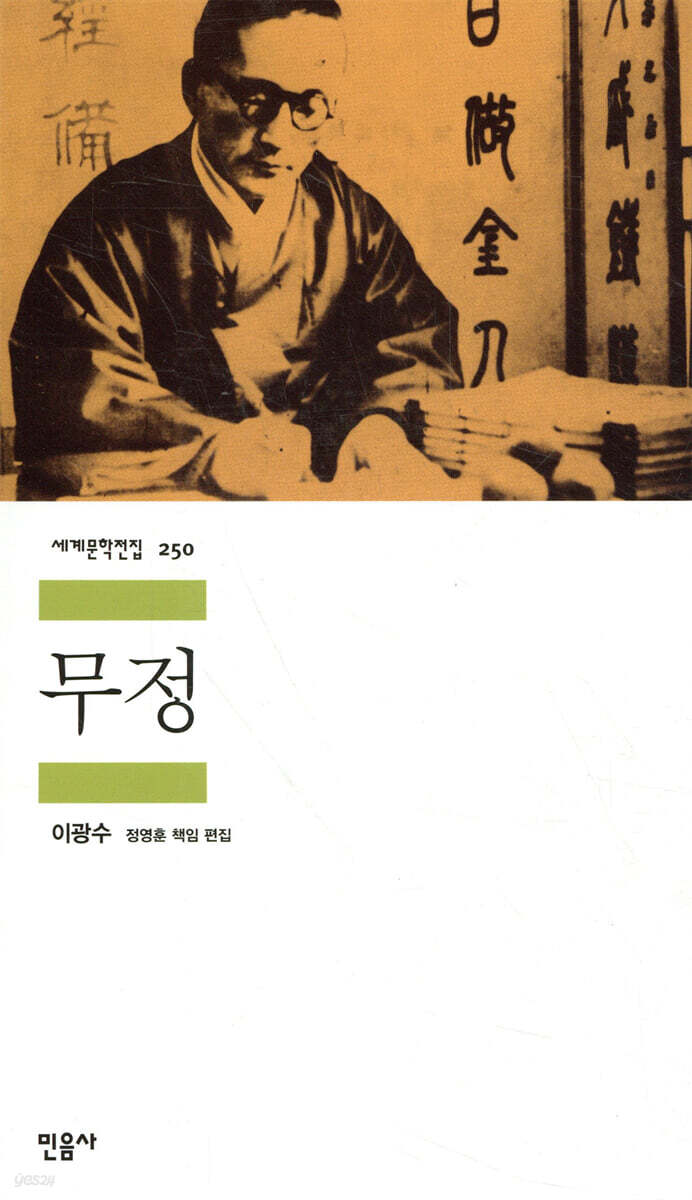
This book is a re-edit of the novel "Heartlessness," which caused both explosive popularity and social controversy while being serialized in the Maeil Shinbo in 1917, to match the current spelling, while preserving the feel of the original content by preserving dialects and archaic colloquial expressions.
Through the love triangle between Hyung-sik, Yeong-chae, and Seon-sang, Chun-won Lee Gwang-su portrays the helplessness of humans in the face of romantic emotions, and through characters who discover their own selves, he argues that we must strive for an enterprising future.
The way the characters in the novel contemplate the future of individuals and society is not unlike that of modern people, so it is not unfamiliar, and through them, we can understand the people of the Enlightenment Period, who can be said to be the prototypes of today's Koreans.
Lee Hyeong-sik, a young intellectual who returned from studying abroad in Tokyo and was teaching English at Gyeongseong School, gradually develops feelings for Seon-hyeong, a modern woman who was the daughter of an enlightened intellectual and received a modern education, as he gives her private English lessons.
In front of that form, Yeong-chae, the daughter of Park Jin-sa, a former teacher and intellectual of the late Joseon Dynasty, appears.
While Hyung-sik is wandering between his ex-fiancée Yeong-chae and his current lover Seon-sang, Yeong-chae is raped and she leaves Hyung-sik, leaving behind a will.
In the end, Hyungshik decides to marry Seon-seon and go to study abroad in the United States.
Meanwhile, Young-chae, who was about to commit suicide, meets Byeong-wook and finds new hope, and the three meet again by fate on a train.
Through the love triangle between Hyung-sik, Yeong-chae, and Seon-sang, Chun-won Lee Gwang-su portrays the helplessness of humans in the face of romantic emotions, and through characters who discover their own selves, he argues that we must strive for an enterprising future.
The way the characters in the novel contemplate the future of individuals and society is not unlike that of modern people, so it is not unfamiliar, and through them, we can understand the people of the Enlightenment Period, who can be said to be the prototypes of today's Koreans.
Lee Hyeong-sik, a young intellectual who returned from studying abroad in Tokyo and was teaching English at Gyeongseong School, gradually develops feelings for Seon-hyeong, a modern woman who was the daughter of an enlightened intellectual and received a modern education, as he gives her private English lessons.
In front of that form, Yeong-chae, the daughter of Park Jin-sa, a former teacher and intellectual of the late Joseon Dynasty, appears.
While Hyung-sik is wandering between his ex-fiancée Yeong-chae and his current lover Seon-sang, Yeong-chae is raped and she leaves Hyung-sik, leaving behind a will.
In the end, Hyungshik decides to marry Seon-seon and go to study abroad in the United States.
Meanwhile, Young-chae, who was about to commit suicide, meets Byeong-wook and finds new hope, and the three meet again by fate on a train.
- You can preview some of the book's contents.
Preview
Into the book
Even in this era when Lee Hyung-sik first met and greeted Kim Sun-hyung, the situation was quite different.
Free love was another name for autonomy, and autonomy was the very mark of modern man.
Modern humans, instead of immediately accepting various values given a priori, question and doubt them.
He becomes a legislator himself, creates values, and becomes the master of values.
Lee Gwang-su criticizes Confucian morality as a morality based on external factors that can be “made to follow but not to know (可使由之 不可使知之),” and free love is positioned in contrast to this.
The relationship in which one decides for oneself who to love rather than automatically accepting the person one's parents paired with regardless of one's will was a kind of example that concisely showed the moral law in the modern sense.
(......)
Looking at Lee Gwang-su's early arguments, we can see that he understood that being true to one's own desires not only did not conflict with the interests of the entire community, but was also naturally in harmony with them.
Lee Gwang-su's logic was that just as animals act purely out of biological desires, but through the invisible actions of the Creator, the species' propagation results, so too does the human world.
Lee Gwang-su later criticized putting personal desires first as a selfish attitude, a change that likely stemmed from his realization that personal desires and the interests of the community do not align.
For Lee Gwang-su, who was writing “Heartless,” there was no clear boundary between the private and public worlds.
Free love was another name for autonomy, and autonomy was the very mark of modern man.
Modern humans, instead of immediately accepting various values given a priori, question and doubt them.
He becomes a legislator himself, creates values, and becomes the master of values.
Lee Gwang-su criticizes Confucian morality as a morality based on external factors that can be “made to follow but not to know (可使由之 不可使知之),” and free love is positioned in contrast to this.
The relationship in which one decides for oneself who to love rather than automatically accepting the person one's parents paired with regardless of one's will was a kind of example that concisely showed the moral law in the modern sense.
(......)
Looking at Lee Gwang-su's early arguments, we can see that he understood that being true to one's own desires not only did not conflict with the interests of the entire community, but was also naturally in harmony with them.
Lee Gwang-su's logic was that just as animals act purely out of biological desires, but through the invisible actions of the Creator, the species' propagation results, so too does the human world.
Lee Gwang-su later criticized putting personal desires first as a selfish attitude, a change that likely stemmed from his realization that personal desires and the interests of the community do not align.
For Lee Gwang-su, who was writing “Heartless,” there was no clear boundary between the private and public worlds.
--- From "Work Commentary"
Publisher's Review
It was serialized in the Maeil Shinbo in 1917 and gained explosive popularity and social controversy.
Korea's first modern novel and romance novel
Lee Gwang-su's "Heartlessness," widely known as Korea's first modern novel and romance novel, has been published as the 250th volume in the World Literature Collection.
With this, Minumsa World Literature Collection, Korea's representative literary collection, has surpassed 250 volumes in just 12 years since its publication.
The recently published 『Heartlessness』 was edited by Professor Jeong Yeong-hun of the Department of Korean Literature at Gyeongsang National University, who majored in modern Korean literature, with reference to the serialized version in the Maeil Shinbo and the later published volumes, based on 『Heartlessness』, which was published as a single volume by Shinmun-gwan and Dongyang Seowon in July 1918.
In principle, the current 'Korean spelling' and 'foreign language notation' were followed, but dialects, archaic words, and colloquial expressions that were judged to affect the atmosphere of the work were preserved as they were, allowing readers to feel the linguistic sensibility of the time.
『Heartlessness』, serialized in the Maeil Shinbo in 1917, was the ‘hottest novel’ of its time, simultaneously generating explosive popularity and social controversy, and is a monumental work that discovered the modern ‘individual’ for the first time in Korean literature.
Through the relationships between Hyung-sik, Yeong-chae, and Seon-seon, Chun-won Lee Gwang-su portrayed the helplessness of humans in the face of romantic emotions, while also covering the process through which they, having discovered and awakened to themselves, seek an enterprising future as a national subject.
The image of the "awakened youth" who ponder the future of individuals and society together is not at all unfamiliar to us today, even after the 21st century has passed. Rather, it is a prototype of modern Koreans that vividly shows the conditions of our lives and resonates more and more with each passing year.
The first Korean novel to show the modern 'individual' and the 'discovery' of the self.
『Heartless』 revolves around a love triangle surrounding Hyeongsik, Yeongchae, and Seonhyeong.
Characters in novels feel excited when they see the opposite sex, worry about whether the other person will love them, lament their own insignificance, and feel jealous that the other person might have been looking at them.
The format of self-proclaimed and others-proclaimed 'awake' reveals Yeong-chae's agonizing over whether she has kept her chastity or lost it, and her desire for Seon-hyeong's body.
Youngchae, a quiet girl, finds her body burning hot whenever she thinks of a man.
Seon-seon, a proud new woman, is disappointed with Hyung-sik's appearance and unconsciously shows strong jealousy when Yeong-chae appears.
In a time when it was natural for parents to decide on their children's marriages, and even when dating, the pure and noble love of 'Chunhyang and Lee Mong-ryeong' was highlighted, this type of character was very unfamiliar.
In this way, the main characters of 『Heartless』 are not perfect, ideal people, but individuals who acknowledge their own imperfections and strive to develop themselves.
And in the process of experiencing 'free love' and feeling desire, an individual discovers and awakens the self.
This discovery of the 'individual' or 'self' can also be said to be the discovery of modernity.
In particular, the transformation of Yeong-chae, a classical female character, is surprising, unlike Hyeong-sik, a student studying abroad in Tokyo, or Seon-sang, who received a modern education.
Yeong-chae, who lost her chastity after being raped in an unexpected attack, makes the typical choice of 'suicide', but meets the enlightened new woman Byeong-wook and opens her eyes to a new world.
Byung-wook preaches to Yeong-chae about the fate of Joseon women, trapped in the false love forced upon them by their parents and Confucian morality, and urges her to live 'as she pleases.'
The process by which Yeong-chae, who was an obedient woman, comes into contact with new civilization and realizes her desires is extremely 'modern'.
The birth of modern Koreans who have learned to actively determine their own love and destiny.
Published as a single volume in 1918, "Heartlessness" became a bestseller, selling over 10,000 copies. This is because "Heartlessness" contains "entertaining fun" centered around love.
The love triangle between Hyungshik, Seonjeong, and Yeongchae unfolds in an exciting way, and the hearts of the main characters, swaying like reeds, are vividly depicted, raising curiosity about the ending.
Also, the way Seon-Hyun compares her 'ideal appearance' with Hyung-Sik's face, and the way Yeong-Chae's heart aches because she cannot hide her excitement for Byeong-Guk, Byeong-Wook's older brother, are not much different from modern women, and the way Hyung-Sik laments his lack of 'money' and 'beauty' and compares Seon-Hyun and Yeong-Chae here and there is not much different from modern men.
But what is more important is that 『Heartless』 is a work that breaks away from the conventional romantic entertainment novels that were popular in the 1910s and contains ‘modernity’ and ‘enlightenment.’
At the time he was writing "Heartlessness," Lee Gwang-su believed that as a weak and imperfect individual grows, he can find the path forward for the national subject.
In other words, it was seen that not only did private interests not conflict with public interests, but rather that public interests could be realized through private interests.
Lee Gwang-su hoped that young people who actively learn to decide their own love and destiny would rewrite the future of Joseon.
Hyung-sik, Seon-seon, and Yeong-chae, who meet by chance on trains departing for the United States and Japan, respectively, witness the horrific flood damage and worry about the future of Joseon.
And they come to the realization that they must enlighten the Joseon people 'through education and science'.
A 'civilized Joseon' awaits the protagonists who return from studying abroad, and Joseon will develop with their help.
The ending of 『Heartlessness』, which portrays Joseon's future with hope, was also Lee Gwang-su's earnest expectation.
Although Lee Gwang-su's dream did not become reality, the literary achievements he achieved within the limitations of his time are still vivid and alive to this day.
Korea's first modern novel and romance novel
Lee Gwang-su's "Heartlessness," widely known as Korea's first modern novel and romance novel, has been published as the 250th volume in the World Literature Collection.
With this, Minumsa World Literature Collection, Korea's representative literary collection, has surpassed 250 volumes in just 12 years since its publication.
The recently published 『Heartlessness』 was edited by Professor Jeong Yeong-hun of the Department of Korean Literature at Gyeongsang National University, who majored in modern Korean literature, with reference to the serialized version in the Maeil Shinbo and the later published volumes, based on 『Heartlessness』, which was published as a single volume by Shinmun-gwan and Dongyang Seowon in July 1918.
In principle, the current 'Korean spelling' and 'foreign language notation' were followed, but dialects, archaic words, and colloquial expressions that were judged to affect the atmosphere of the work were preserved as they were, allowing readers to feel the linguistic sensibility of the time.
『Heartlessness』, serialized in the Maeil Shinbo in 1917, was the ‘hottest novel’ of its time, simultaneously generating explosive popularity and social controversy, and is a monumental work that discovered the modern ‘individual’ for the first time in Korean literature.
Through the relationships between Hyung-sik, Yeong-chae, and Seon-seon, Chun-won Lee Gwang-su portrayed the helplessness of humans in the face of romantic emotions, while also covering the process through which they, having discovered and awakened to themselves, seek an enterprising future as a national subject.
The image of the "awakened youth" who ponder the future of individuals and society together is not at all unfamiliar to us today, even after the 21st century has passed. Rather, it is a prototype of modern Koreans that vividly shows the conditions of our lives and resonates more and more with each passing year.
The first Korean novel to show the modern 'individual' and the 'discovery' of the self.
『Heartless』 revolves around a love triangle surrounding Hyeongsik, Yeongchae, and Seonhyeong.
Characters in novels feel excited when they see the opposite sex, worry about whether the other person will love them, lament their own insignificance, and feel jealous that the other person might have been looking at them.
The format of self-proclaimed and others-proclaimed 'awake' reveals Yeong-chae's agonizing over whether she has kept her chastity or lost it, and her desire for Seon-hyeong's body.
Youngchae, a quiet girl, finds her body burning hot whenever she thinks of a man.
Seon-seon, a proud new woman, is disappointed with Hyung-sik's appearance and unconsciously shows strong jealousy when Yeong-chae appears.
In a time when it was natural for parents to decide on their children's marriages, and even when dating, the pure and noble love of 'Chunhyang and Lee Mong-ryeong' was highlighted, this type of character was very unfamiliar.
In this way, the main characters of 『Heartless』 are not perfect, ideal people, but individuals who acknowledge their own imperfections and strive to develop themselves.
And in the process of experiencing 'free love' and feeling desire, an individual discovers and awakens the self.
This discovery of the 'individual' or 'self' can also be said to be the discovery of modernity.
In particular, the transformation of Yeong-chae, a classical female character, is surprising, unlike Hyeong-sik, a student studying abroad in Tokyo, or Seon-sang, who received a modern education.
Yeong-chae, who lost her chastity after being raped in an unexpected attack, makes the typical choice of 'suicide', but meets the enlightened new woman Byeong-wook and opens her eyes to a new world.
Byung-wook preaches to Yeong-chae about the fate of Joseon women, trapped in the false love forced upon them by their parents and Confucian morality, and urges her to live 'as she pleases.'
The process by which Yeong-chae, who was an obedient woman, comes into contact with new civilization and realizes her desires is extremely 'modern'.
The birth of modern Koreans who have learned to actively determine their own love and destiny.
Published as a single volume in 1918, "Heartlessness" became a bestseller, selling over 10,000 copies. This is because "Heartlessness" contains "entertaining fun" centered around love.
The love triangle between Hyungshik, Seonjeong, and Yeongchae unfolds in an exciting way, and the hearts of the main characters, swaying like reeds, are vividly depicted, raising curiosity about the ending.
Also, the way Seon-Hyun compares her 'ideal appearance' with Hyung-Sik's face, and the way Yeong-Chae's heart aches because she cannot hide her excitement for Byeong-Guk, Byeong-Wook's older brother, are not much different from modern women, and the way Hyung-Sik laments his lack of 'money' and 'beauty' and compares Seon-Hyun and Yeong-Chae here and there is not much different from modern men.
But what is more important is that 『Heartless』 is a work that breaks away from the conventional romantic entertainment novels that were popular in the 1910s and contains ‘modernity’ and ‘enlightenment.’
At the time he was writing "Heartlessness," Lee Gwang-su believed that as a weak and imperfect individual grows, he can find the path forward for the national subject.
In other words, it was seen that not only did private interests not conflict with public interests, but rather that public interests could be realized through private interests.
Lee Gwang-su hoped that young people who actively learn to decide their own love and destiny would rewrite the future of Joseon.
Hyung-sik, Seon-seon, and Yeong-chae, who meet by chance on trains departing for the United States and Japan, respectively, witness the horrific flood damage and worry about the future of Joseon.
And they come to the realization that they must enlighten the Joseon people 'through education and science'.
A 'civilized Joseon' awaits the protagonists who return from studying abroad, and Joseon will develop with their help.
The ending of 『Heartlessness』, which portrays Joseon's future with hope, was also Lee Gwang-su's earnest expectation.
Although Lee Gwang-su's dream did not become reality, the literary achievements he achieved within the limitations of his time are still vivid and alive to this day.
GOODS SPECIFICS
- Date of issue: July 2, 2010
- Page count, weight, size: 557 pages | 646g | 130*224*35mm
- ISBN13: 9788937462504
- ISBN10: 8937462508
You may also like
카테고리
korean


korean

![GQ KOREA Mark (Monthly): December [2025]](http://librairie.coreenne.fr/cdn/shop/files/8ef265dbbfbf186523ed75ba7319009d.jpg?v=1765340328&width=3840)


