

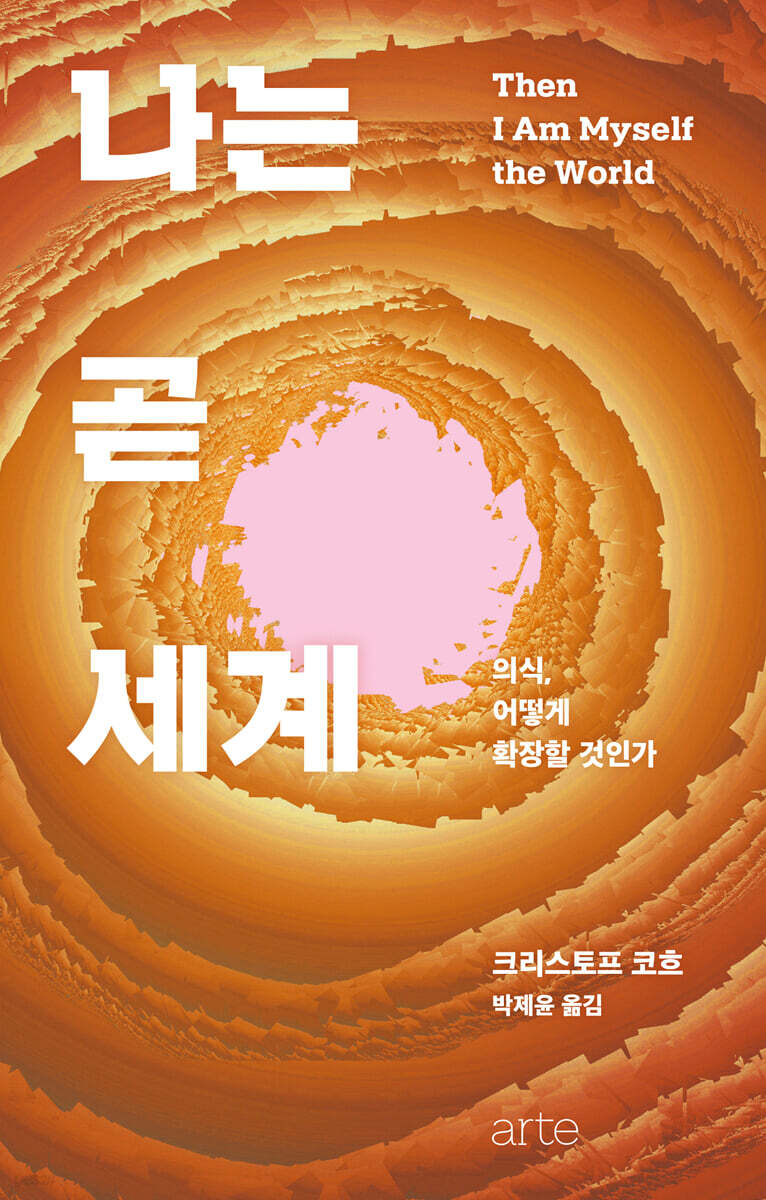
I am soon the world
 |
Description
Book Introduction
A world-renowned neuroscientist unfolds
Psychonaut's Journey: A Marvelous Map of Consciousness
Is life-changing immersion and 'self-loss' possible?
Does an 'artificial mind' of AI that surpasses ours exist?
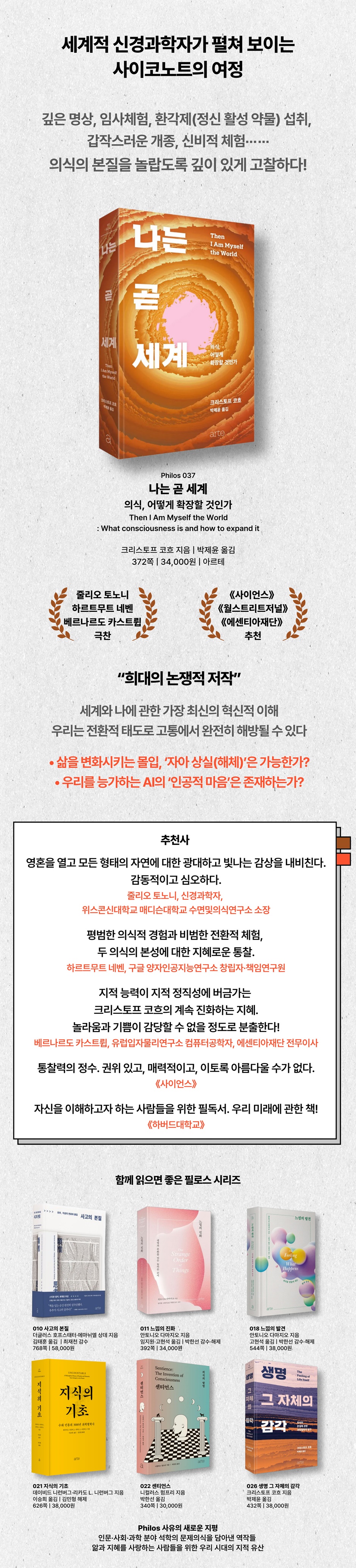
Christoph Koch, a world-renowned neuroscientist who leads research on neural cell modeling as an investigator at the Allen Institute for Brain Science in the United States, has published a new book titled “I Am the World: How to Expand Consciousness” (Philos Series No. 37).
Christoph Koch is a key figure who has led a major paradigm shift in the history of consciousness science.
Since the 1990s, he has conducted various studies on consciousness with Francis Crick and discovered the 'neural correlates of consciousness (NCC),' which is considered an innovative event that shook up the paradigm of consciousness science research.
In 2023, Koch was criticized as a "pseudo-science" for his Integrated Information Theory (IIT), which he presented in his book "The Sense of Life Itself" (Philos series, No. 26). However, the two major scientific journals, Nature and Science, put an end to the controversy by praising it as "a leading and 'validated' theory of consciousness that explains consciousness" and "completely solving the very difficult problem of consciousness!"
In 2024, the author once again found himself at the center of controversy with "I Am the World."
Science, the Wall Street Journal, and the Essentia Foundation praised it as “a truly controversial work of exceptional quality” and “a cutting-edge understanding of the world and myself.”
This book discusses the nature of consciousness by dealing with the 'psychedelic experience' that the author had longed for since childhood but only encountered in his 70s.
This book has been at the center of controversy because it is written by an authority in the field who has dedicated himself to the study of consciousness for over 40 years, and describes his insights into consciousness while walking the journey of a psychonaut. However, to borrow the words of addiction psychologist Judson Brewer, this book is as follows:
A romantic popular book about consciousness that “deals with the realm of highly personal experience, yet is infinitely applicable.”
That is, Christoph Koch closely combines neuroscientific research on consciousness with experiential insights, and describes in concrete and experiential language the connection between 'conscious experience and brain structure' and 'transformational experience and brain function.'
Insights gained through hallucinogenic experiences serve as a major motif in the book, but the author uses this as a springboard to emphasize the importance of “transformational experiences.”
The author's concept of "transformational experiences" includes "near-death experiences," "conversion," "deep meditation," and "shamanic rituals," which are common characteristics of each culture, as they can help us on the path to life-changing immersion, that is, "self-loss."
As the title of this book suggests, “I am the world,” this book examines neuroscientifically how to interpret the gravitational field of the self that remains in the mind.
It delves into the errors that science makes in trying to explain the 'world of subjective experience' as the 'objective world'.
He points out that explaining consciousness as arising from the “activity of countless molecules” can lead to metaphysical difficulties, and argues that “the priority lies with consciousness, not with the objective world.”
So what is consciousness? As the author states in the title of this book, "I am the world," "Then I Am Myself the World" (original title).
It speaks of a phenomenon in which the mental barriers that limit us to the individual blur, the mind becomes integrated with the universe itself, and the distinction between the individual and the world disappears.
This book explores how this vast and infinite feeling interacts with the world, leading to the examination of what consciousness is and how to expand it, as the subtitle suggests.
This book, which contains thorough research and experiential descriptions of consciousness and its expansion, will be of interest not only to those interested in the philosophy of science, but also to many who wish to achieve “complete liberation from suffering through a transformative attitude.”
Psychonaut's Journey: A Marvelous Map of Consciousness
Is life-changing immersion and 'self-loss' possible?
Does an 'artificial mind' of AI that surpasses ours exist?
Christoph Koch, a world-renowned neuroscientist who leads research on neural cell modeling as an investigator at the Allen Institute for Brain Science in the United States, has published a new book titled “I Am the World: How to Expand Consciousness” (Philos Series No. 37).
Christoph Koch is a key figure who has led a major paradigm shift in the history of consciousness science.
Since the 1990s, he has conducted various studies on consciousness with Francis Crick and discovered the 'neural correlates of consciousness (NCC),' which is considered an innovative event that shook up the paradigm of consciousness science research.
In 2023, Koch was criticized as a "pseudo-science" for his Integrated Information Theory (IIT), which he presented in his book "The Sense of Life Itself" (Philos series, No. 26). However, the two major scientific journals, Nature and Science, put an end to the controversy by praising it as "a leading and 'validated' theory of consciousness that explains consciousness" and "completely solving the very difficult problem of consciousness!"
In 2024, the author once again found himself at the center of controversy with "I Am the World."
Science, the Wall Street Journal, and the Essentia Foundation praised it as “a truly controversial work of exceptional quality” and “a cutting-edge understanding of the world and myself.”
This book discusses the nature of consciousness by dealing with the 'psychedelic experience' that the author had longed for since childhood but only encountered in his 70s.
This book has been at the center of controversy because it is written by an authority in the field who has dedicated himself to the study of consciousness for over 40 years, and describes his insights into consciousness while walking the journey of a psychonaut. However, to borrow the words of addiction psychologist Judson Brewer, this book is as follows:
A romantic popular book about consciousness that “deals with the realm of highly personal experience, yet is infinitely applicable.”
That is, Christoph Koch closely combines neuroscientific research on consciousness with experiential insights, and describes in concrete and experiential language the connection between 'conscious experience and brain structure' and 'transformational experience and brain function.'
Insights gained through hallucinogenic experiences serve as a major motif in the book, but the author uses this as a springboard to emphasize the importance of “transformational experiences.”
The author's concept of "transformational experiences" includes "near-death experiences," "conversion," "deep meditation," and "shamanic rituals," which are common characteristics of each culture, as they can help us on the path to life-changing immersion, that is, "self-loss."
As the title of this book suggests, “I am the world,” this book examines neuroscientifically how to interpret the gravitational field of the self that remains in the mind.
It delves into the errors that science makes in trying to explain the 'world of subjective experience' as the 'objective world'.
He points out that explaining consciousness as arising from the “activity of countless molecules” can lead to metaphysical difficulties, and argues that “the priority lies with consciousness, not with the objective world.”
So what is consciousness? As the author states in the title of this book, "I am the world," "Then I Am Myself the World" (original title).
It speaks of a phenomenon in which the mental barriers that limit us to the individual blur, the mind becomes integrated with the universe itself, and the distinction between the individual and the world disappears.
This book explores how this vast and infinite feeling interacts with the world, leading to the examination of what consciousness is and how to expand it, as the subtitle suggests.
This book, which contains thorough research and experiential descriptions of consciousness and its expansion, will be of interest not only to those interested in the philosophy of science, but also to many who wish to achieve “complete liberation from suffering through a transformative attitude.”
- You can preview some of the book's contents.
Preview
index
introduction
Chapter 1: The Beginning of Consciousness
First Light
fetal consciousness
Fall asleep for a chance to dream
Chapter 2: The Diversity of Conscious Experience
diverse perceptual experiences
The World of Emotions
stream of consciousness
Loss of self and mystical experiences
Chapter 3: We Each Experience Our Own Reality
Billions of personalized realities
Perception is the construction of narrative
The mind that rules over matter
Chapter 4: Consciousness and the Physical
What is mental?
Cartesian dualism
Everything is material
Calculating mind
Experience is everywhere
Chapter 5 What Really Exists?
Only things with causal power exist.
The nature of all experience
properties of physical existence
The great turning point of existence
Chapter 6 Consciousness and the Brain
Tracing traces of consciousness
Many brain regions do not support consciousness.
Look at the neocortex
A mind trapped in a damaged brain
Chapter 7: Expanding Consciousness
religious, mystical, and aesthetic experiences
hallucinogenic drug experience
Fading light
common neurobiological substrates
Chapter 8: A Life Transformed by Transformational Experiences
Hallucinogens and their life-changing potential
Expanding our perception box
Chapter 9: The End of Consciousness
Promise in Samarra
Modern Death
The unusual electrical turbulence of a dying brain
Chapter 10: The Future of Consciousness
Mind Uploading: It's All About Connectomics
About the difference between reality and simulation
Chapter 11: What Computers Can Never Do
Imitation alone is not enough
Only that which truly exists can freely decide.
Acknowledgements
Notes and References
Chapter 1: The Beginning of Consciousness
First Light
fetal consciousness
Fall asleep for a chance to dream
Chapter 2: The Diversity of Conscious Experience
diverse perceptual experiences
The World of Emotions
stream of consciousness
Loss of self and mystical experiences
Chapter 3: We Each Experience Our Own Reality
Billions of personalized realities
Perception is the construction of narrative
The mind that rules over matter
Chapter 4: Consciousness and the Physical
What is mental?
Cartesian dualism
Everything is material
Calculating mind
Experience is everywhere
Chapter 5 What Really Exists?
Only things with causal power exist.
The nature of all experience
properties of physical existence
The great turning point of existence
Chapter 6 Consciousness and the Brain
Tracing traces of consciousness
Many brain regions do not support consciousness.
Look at the neocortex
A mind trapped in a damaged brain
Chapter 7: Expanding Consciousness
religious, mystical, and aesthetic experiences
hallucinogenic drug experience
Fading light
common neurobiological substrates
Chapter 8: A Life Transformed by Transformational Experiences
Hallucinogens and their life-changing potential
Expanding our perception box
Chapter 9: The End of Consciousness
Promise in Samarra
Modern Death
The unusual electrical turbulence of a dying brain
Chapter 10: The Future of Consciousness
Mind Uploading: It's All About Connectomics
About the difference between reality and simulation
Chapter 11: What Computers Can Never Do
Imitation alone is not enough
Only that which truly exists can freely decide.
Acknowledgements
Notes and References
Detailed image
Publisher's Review
“A truly controversial work of all time”
We can be completely free from suffering through a transformative attitude.
Praise from Science, the Wall Street Journal, and the Essentia Foundation
Christoph Koch begins this book by addressing the dawn of consciousness, our first subjective experiences, and analyzes the various perceptual experiences, emotions, and streams of consciousness.
His narrative focuses on a phenomenological perspective on 'perceiving' experience (the way it appears or feels).
The author explores the various perceptual experiences that constitute the diverse feelings of life and examines the 'perception of reality' from a phenomenological perspective.
The example the author cites is the controversy over the color of “The Dress,” which became a hot topic online.
Even just looking at this photo, which appears to some as a combination of blue and black and to others as gold and white, we can see that we cannot access Kant's "thing-in-itself" (das Ding an sich), but rather "live within the experiences that our individual neural circuits allow."
This point can also be confirmed through phantom limb pain or the placebo effect.
As seen in cases where a person who has lost a body part in an accident or other accident suffers despite having no pathology in the peripheral tissues, or in cases where a 'belief in the efficacy of a drug' actually works despite taking an ineffective drug, our "perception is a narrative construction" [Daved Marr] and "mind governs matter."
“Mind that rules matter”
We each experience our own reality.
“Each of us is trapped in our own reality, surrounded by unbreakable walls, but that doesn’t mean it’s hopeless.
We can gain insight into our own limitations by reading books, watching movies about diverse experiences, talking to therapists, listening to friends, and reflecting on our own struggles.
Moreover, we can expand the (invisible) walls that make up our perceptual box through interventions and transformative experiences.
“Reality is fluid.” (p. 85)
To examine the relationship between mind and matter, Koch goes back through the history of philosophy.
Among the philosophers who dealt with the mind-body relationship, the most widely known was Descartes in the 17th century.
He argued for dualism, that the body (physical) and the soul (mental) belong to two fundamentally different realms of reality.
And to support this proposition, he presents various arguments, saying, “I think.
He developed the proposition “Cogito, ergo sum”.
Descartes doubted that his own body existed, but he could not doubt that he had a conscious mind that experienced things.
The author refers to the philosopher Leibniz, who argued that mind does not come from matter, and mentions the "mill thought experiment" argument that "if you were to go inside a sensing and perceiving machine, you would only see its parts and find nothing that would explain perception."
In other words, even if you look at the brain with an electron microscope, which is a high-resolution imaging technology today, you can see nerve cell membranes, synapses, and other cell organelles, but you can never see pain, pleasure, or discomfort there.
In the face of the above propositions of mind-body dualism, Koch poses this question:
“How does mind direct matter?” Mental causality is the Achilles’ heel of Cartesian dualism.
The author sees the mind as “a powerless entity that can do nothing but see, hear, and feel,” and says that “the real protagonist is the brain.”
“Consciousness has no purpose, it is merely an epiphenomenon.” According to “No brain, never mind,” which the author considers a “neuroscientist’s maxim,” consciousness cannot exist in a pure vacuum.
In other words, experience cannot exist without a substrate.
Even if we grant that experience depends on a substrate such as the brain, the question remains: how does a certain physical state produce a certain feeling?
Here, 'physicalism', which states that the mind and body can be reduced one-to-one, and 'computational functionalism', which reduces the state of consciousness to a function or calculation, are discussed.
As a counterargument, the author mentions the concept of a 'philosophical zombie'.
Introduced by Robert Kirk and refined and popularized by David Chalmers, zombies are imaginary creatures indistinguishable from us, differing only in that they lack any mind.
Zombies cannot have experiences, but they are physically identical to us.
If we can imagine philosophical zombies, then the physicalist or computational functionalist perspectives that seek to explain consciousness solely through the formation of the body become untenable.
Therefore, consciousness is “another aspect of reality that transcends physicalism.”
Consciousness, how can it be expanded?
The Expansion of the "Perception Box": The Mystery of Transformational Experience
Christoph Koch says that to approach the essence of consciousness, a complete understanding of existence is necessary.
According to him, existence is divided into ‘external existence’, which is the form observed by others, and ‘internal existence’, which senses and is aware of ‘being’.
The author explains that “the core of Integrated Information Theory (IIT) is to formalize the distinction between intrinsic and extrinsic existence in terms of causal power,” and through this theory, he affirms the metaphysical position that external objects exist independently of my experience.
This realism is the opposite of 'solipsism', which says that if I disappear, the world will disappear too.
Furthermore, integrated information theory assumes that things in the world exist to the extent that they have cause-effect power.
This means that if the existence of a thing cannot exert causal power on the world, it can be ignored from the perspective of existence.
It argues that we perceive existence through causal power, how we can measure it, and what the essential properties of experience are (immanence, information, integration, exclusion, and composition).
Through this theory, the author deals with the brain as the physical organ of experience and transformative experiences.
“Near-death experiences, which are religious and mystical, are profoundly transformative for individuals.” These special episodes can be triggered by an expansion of consciousness, a letting go of the meaning of the self, or even a complete denial.
It can also provide an awakening that brings about lasting and far-reaching changes in an individual's identity, core beliefs, and values.
Meditation, taking hallucinogens (psychoactive drugs), near-death experiences, conversion
How can worldview and outlook on life change?
The transmigration experience is one of self-dissolution (loss) or immersion.
Those who have experienced this once will have their world view and outlook on life changed permanently.
They become free from the fear of death and free from the obsession with material desires (possessions) and strive for a greater 'good'.
Another gift of transformational experiences is that they give us an experience of the 'thing itself'.
Transformational experiences with psychoactive drugs rewire and expand our minds, often confined to our perceptual boxes—mental structures that normally limit us—providing dramatic, effective, and captivating alternatives in the short term.
However, there is a sharp legal, ethical, and moral debate regarding the authenticity of the hallucinogenic effects and their allowability.
As noted in the 'Notes' section at the beginning of the book, the author does not provide any medical advice or advocate any illegal activity.
Therefore, it is reasonable to view the author's detailed account of his hallucinogenic experiences in this book as part of his scientific experimental spirit, seeking to substantiate his research topic through direct experience rather than relying on others' interpretations.
The authors state that “hallucinogens taken in a controlled environment are relatively safe and non-habit forming,” and that a clear distinction must be made between hallucinogens (such as psilocybin in magic mushrooms, lysergic acid diethylamide in LSD, and mescaline) and highly addictive and deadly drugs (such as cocaine, crack, heroin, oxycodone, fentanyl, and xylazine).
The author views the former as a substance similar to ethanol, nicotine, and caffeine, the most widely used psychoactive substances today, and takes a proactive stance toward its clinical use for therapeutic purposes.
Is mind uploading possible?
Does an 'artificial mind' of AI that surpasses ours exist?
Christoph Koch deals with the end of consciousness.
The end of consciousness is death.
He examines how modern science defines death (cardiopulmonary death, brain death), mentions cases where loss of consciousness does not directly lead to the end of life (the case of Jahi McMath, who was declared brain dead at age 13 but survived until age 17 with a ventilator), and discusses the possibility of artificial intelligence as the future of human consciousness trapped in the body.
How does Koch view mind uploading, a concept frequently discussed by the mass media and technocrats, and the possibility of consciousness existing in such uploaded digital minds? The author argues that for this technology to succeed, it must secure the blueprint (connectome) of human neural circuitry.
However, the current situation is limited to securing the connectome of fruit flies.
“The complete connectome of a mouse, consisting of 70 million neurons and hundreds of billions of synapses, is not expected to be available until 2030.”
Not only that, “the human brain is about a thousand times larger than a mouse brain and is connected by a whopping 500,000 kilometers of wiring.”
Therefore, whole-brain simulation to see the activity of this connectome is currently impossible with state-of-the-art technology. (p. 259) Let us assume that whole-brain simulation of the human brain becomes possible.
But can consciousness exist there? Computational functionalists believe that the mind can be realized in the brain if individual components of brain function are mimicked by software, but Koch, an integrated information theorist, argues that "consciousness is not a clever algorithm."
Consciousness lies in causal powers, not in computation, and therefore causal powers must be part of the physics of the system, built into the system.
This imitation of form does not guarantee consciousness, for the same reason that astrophysicists simulating black holes do not get sucked into the simulated gravitational field, or that rain does not fall inside a computer simulating heavy rain.
The author calls today's rapid technological advancements, represented by artificial intelligence, and the resulting human crisis the "dawn of the intelligent machine age," and while he acknowledges the ability of artificial intelligence to mimic human intelligence, he is skeptical about the possibility of artificial intelligence becoming conscious.
We are extremely linguistic creatures, so if ChatGPT starts writing literary works, it will be hard to resist the urge to give them a mind, but since they are imitative fakes, they cannot have consciousness.
“Subjectivity is not based on a faculty like speech, but on a disposition possessing enormous intrinsic causal power.” (p. 279)
The Essence of Consciousness in the AI Era
New possibilities opened by consciousness
He argues that only what truly exists has consciousness, and that only this conscious being can make free decisions, and that no matter how powerful digital computers become, they cannot make any real choices.
According to the author, human existence possesses a subjectivity that these imitations can never possess, and this is the light of humanity.
In an age where artificial intelligence surpasses human capabilities, Christoph Koch delivers a message of hope to humanity.
True consciousness and free will, the ability to decide which path to choose, are special abilities that only we humans possess.
There are things that even the most advanced artificial intelligence can never possess: our ‘mind’ and ‘consciousness.’
This book is an intellectual adventure exploring the wonders of human consciousness and will serve as a reference point on our journey to rediscover our own worth.
If you want to encounter his thoughtful yet ambitious insights, romantic metaphors of consciousness, and transformative mysteries with metaphysical implications, this book is a must-read.
You'll discover bold perspectives on what's happening at the forefront of consciousness and how to expand it further.
Translator's Note (excerpts)
This book is the story of a researcher who specializes in studying consciousness.
However, many of the questions and concerns he raises are topics of interest not only to researchers in the same field living in the present era, but also to researchers in other fields.
Therefore, this book guides researchers in various fields to think about various contemporary issues.
Even if a professional researcher reader disagrees with some of the author's perspectives and perspectives in this book, it at least provides a clear indication of what researchers should consider.
Moreover, any philosopher who disagrees with the author's views must be able to present new logic and evidence beyond his arguments and evidence.
Therefore, this book guides researchers in various fields to establish new research directions.
Non-expert readers living in today's world may also be confused by the diverse opinions and perspectives of various scholars.
This book can be of great help, especially to those who want to live with a keen awareness of the changing times, and to those who are citizens concerned about this era and the future.
Because each person can think about how to understand their own world, humanity, and themselves.
In that respect, it is necessary to slowly savor the questions raised in this book and the author's answers.
I would like to rephrase the question the author addresses in the book.
What is the true reason consciousness has provided an evolutionary advantage? What effect does consciousness have on the brain's neural networks to foster a transformative attitude? How does the expansion of consciousness—the expansion of the perceptual box—occur, and what is its relationship to creativity through critical thinking? So how can we understand consciousness?
We can be completely free from suffering through a transformative attitude.
Praise from Science, the Wall Street Journal, and the Essentia Foundation
Christoph Koch begins this book by addressing the dawn of consciousness, our first subjective experiences, and analyzes the various perceptual experiences, emotions, and streams of consciousness.
His narrative focuses on a phenomenological perspective on 'perceiving' experience (the way it appears or feels).
The author explores the various perceptual experiences that constitute the diverse feelings of life and examines the 'perception of reality' from a phenomenological perspective.
The example the author cites is the controversy over the color of “The Dress,” which became a hot topic online.
Even just looking at this photo, which appears to some as a combination of blue and black and to others as gold and white, we can see that we cannot access Kant's "thing-in-itself" (das Ding an sich), but rather "live within the experiences that our individual neural circuits allow."
This point can also be confirmed through phantom limb pain or the placebo effect.
As seen in cases where a person who has lost a body part in an accident or other accident suffers despite having no pathology in the peripheral tissues, or in cases where a 'belief in the efficacy of a drug' actually works despite taking an ineffective drug, our "perception is a narrative construction" [Daved Marr] and "mind governs matter."
“Mind that rules matter”
We each experience our own reality.
“Each of us is trapped in our own reality, surrounded by unbreakable walls, but that doesn’t mean it’s hopeless.
We can gain insight into our own limitations by reading books, watching movies about diverse experiences, talking to therapists, listening to friends, and reflecting on our own struggles.
Moreover, we can expand the (invisible) walls that make up our perceptual box through interventions and transformative experiences.
“Reality is fluid.” (p. 85)
To examine the relationship between mind and matter, Koch goes back through the history of philosophy.
Among the philosophers who dealt with the mind-body relationship, the most widely known was Descartes in the 17th century.
He argued for dualism, that the body (physical) and the soul (mental) belong to two fundamentally different realms of reality.
And to support this proposition, he presents various arguments, saying, “I think.
He developed the proposition “Cogito, ergo sum”.
Descartes doubted that his own body existed, but he could not doubt that he had a conscious mind that experienced things.
The author refers to the philosopher Leibniz, who argued that mind does not come from matter, and mentions the "mill thought experiment" argument that "if you were to go inside a sensing and perceiving machine, you would only see its parts and find nothing that would explain perception."
In other words, even if you look at the brain with an electron microscope, which is a high-resolution imaging technology today, you can see nerve cell membranes, synapses, and other cell organelles, but you can never see pain, pleasure, or discomfort there.
In the face of the above propositions of mind-body dualism, Koch poses this question:
“How does mind direct matter?” Mental causality is the Achilles’ heel of Cartesian dualism.
The author sees the mind as “a powerless entity that can do nothing but see, hear, and feel,” and says that “the real protagonist is the brain.”
“Consciousness has no purpose, it is merely an epiphenomenon.” According to “No brain, never mind,” which the author considers a “neuroscientist’s maxim,” consciousness cannot exist in a pure vacuum.
In other words, experience cannot exist without a substrate.
Even if we grant that experience depends on a substrate such as the brain, the question remains: how does a certain physical state produce a certain feeling?
Here, 'physicalism', which states that the mind and body can be reduced one-to-one, and 'computational functionalism', which reduces the state of consciousness to a function or calculation, are discussed.
As a counterargument, the author mentions the concept of a 'philosophical zombie'.
Introduced by Robert Kirk and refined and popularized by David Chalmers, zombies are imaginary creatures indistinguishable from us, differing only in that they lack any mind.
Zombies cannot have experiences, but they are physically identical to us.
If we can imagine philosophical zombies, then the physicalist or computational functionalist perspectives that seek to explain consciousness solely through the formation of the body become untenable.
Therefore, consciousness is “another aspect of reality that transcends physicalism.”
Consciousness, how can it be expanded?
The Expansion of the "Perception Box": The Mystery of Transformational Experience
Christoph Koch says that to approach the essence of consciousness, a complete understanding of existence is necessary.
According to him, existence is divided into ‘external existence’, which is the form observed by others, and ‘internal existence’, which senses and is aware of ‘being’.
The author explains that “the core of Integrated Information Theory (IIT) is to formalize the distinction between intrinsic and extrinsic existence in terms of causal power,” and through this theory, he affirms the metaphysical position that external objects exist independently of my experience.
This realism is the opposite of 'solipsism', which says that if I disappear, the world will disappear too.
Furthermore, integrated information theory assumes that things in the world exist to the extent that they have cause-effect power.
This means that if the existence of a thing cannot exert causal power on the world, it can be ignored from the perspective of existence.
It argues that we perceive existence through causal power, how we can measure it, and what the essential properties of experience are (immanence, information, integration, exclusion, and composition).
Through this theory, the author deals with the brain as the physical organ of experience and transformative experiences.
“Near-death experiences, which are religious and mystical, are profoundly transformative for individuals.” These special episodes can be triggered by an expansion of consciousness, a letting go of the meaning of the self, or even a complete denial.
It can also provide an awakening that brings about lasting and far-reaching changes in an individual's identity, core beliefs, and values.
Meditation, taking hallucinogens (psychoactive drugs), near-death experiences, conversion
How can worldview and outlook on life change?
The transmigration experience is one of self-dissolution (loss) or immersion.
Those who have experienced this once will have their world view and outlook on life changed permanently.
They become free from the fear of death and free from the obsession with material desires (possessions) and strive for a greater 'good'.
Another gift of transformational experiences is that they give us an experience of the 'thing itself'.
Transformational experiences with psychoactive drugs rewire and expand our minds, often confined to our perceptual boxes—mental structures that normally limit us—providing dramatic, effective, and captivating alternatives in the short term.
However, there is a sharp legal, ethical, and moral debate regarding the authenticity of the hallucinogenic effects and their allowability.
As noted in the 'Notes' section at the beginning of the book, the author does not provide any medical advice or advocate any illegal activity.
Therefore, it is reasonable to view the author's detailed account of his hallucinogenic experiences in this book as part of his scientific experimental spirit, seeking to substantiate his research topic through direct experience rather than relying on others' interpretations.
The authors state that “hallucinogens taken in a controlled environment are relatively safe and non-habit forming,” and that a clear distinction must be made between hallucinogens (such as psilocybin in magic mushrooms, lysergic acid diethylamide in LSD, and mescaline) and highly addictive and deadly drugs (such as cocaine, crack, heroin, oxycodone, fentanyl, and xylazine).
The author views the former as a substance similar to ethanol, nicotine, and caffeine, the most widely used psychoactive substances today, and takes a proactive stance toward its clinical use for therapeutic purposes.
Is mind uploading possible?
Does an 'artificial mind' of AI that surpasses ours exist?
Christoph Koch deals with the end of consciousness.
The end of consciousness is death.
He examines how modern science defines death (cardiopulmonary death, brain death), mentions cases where loss of consciousness does not directly lead to the end of life (the case of Jahi McMath, who was declared brain dead at age 13 but survived until age 17 with a ventilator), and discusses the possibility of artificial intelligence as the future of human consciousness trapped in the body.
How does Koch view mind uploading, a concept frequently discussed by the mass media and technocrats, and the possibility of consciousness existing in such uploaded digital minds? The author argues that for this technology to succeed, it must secure the blueprint (connectome) of human neural circuitry.
However, the current situation is limited to securing the connectome of fruit flies.
“The complete connectome of a mouse, consisting of 70 million neurons and hundreds of billions of synapses, is not expected to be available until 2030.”
Not only that, “the human brain is about a thousand times larger than a mouse brain and is connected by a whopping 500,000 kilometers of wiring.”
Therefore, whole-brain simulation to see the activity of this connectome is currently impossible with state-of-the-art technology. (p. 259) Let us assume that whole-brain simulation of the human brain becomes possible.
But can consciousness exist there? Computational functionalists believe that the mind can be realized in the brain if individual components of brain function are mimicked by software, but Koch, an integrated information theorist, argues that "consciousness is not a clever algorithm."
Consciousness lies in causal powers, not in computation, and therefore causal powers must be part of the physics of the system, built into the system.
This imitation of form does not guarantee consciousness, for the same reason that astrophysicists simulating black holes do not get sucked into the simulated gravitational field, or that rain does not fall inside a computer simulating heavy rain.
The author calls today's rapid technological advancements, represented by artificial intelligence, and the resulting human crisis the "dawn of the intelligent machine age," and while he acknowledges the ability of artificial intelligence to mimic human intelligence, he is skeptical about the possibility of artificial intelligence becoming conscious.
We are extremely linguistic creatures, so if ChatGPT starts writing literary works, it will be hard to resist the urge to give them a mind, but since they are imitative fakes, they cannot have consciousness.
“Subjectivity is not based on a faculty like speech, but on a disposition possessing enormous intrinsic causal power.” (p. 279)
The Essence of Consciousness in the AI Era
New possibilities opened by consciousness
He argues that only what truly exists has consciousness, and that only this conscious being can make free decisions, and that no matter how powerful digital computers become, they cannot make any real choices.
According to the author, human existence possesses a subjectivity that these imitations can never possess, and this is the light of humanity.
In an age where artificial intelligence surpasses human capabilities, Christoph Koch delivers a message of hope to humanity.
True consciousness and free will, the ability to decide which path to choose, are special abilities that only we humans possess.
There are things that even the most advanced artificial intelligence can never possess: our ‘mind’ and ‘consciousness.’
This book is an intellectual adventure exploring the wonders of human consciousness and will serve as a reference point on our journey to rediscover our own worth.
If you want to encounter his thoughtful yet ambitious insights, romantic metaphors of consciousness, and transformative mysteries with metaphysical implications, this book is a must-read.
You'll discover bold perspectives on what's happening at the forefront of consciousness and how to expand it further.
Translator's Note (excerpts)
This book is the story of a researcher who specializes in studying consciousness.
However, many of the questions and concerns he raises are topics of interest not only to researchers in the same field living in the present era, but also to researchers in other fields.
Therefore, this book guides researchers in various fields to think about various contemporary issues.
Even if a professional researcher reader disagrees with some of the author's perspectives and perspectives in this book, it at least provides a clear indication of what researchers should consider.
Moreover, any philosopher who disagrees with the author's views must be able to present new logic and evidence beyond his arguments and evidence.
Therefore, this book guides researchers in various fields to establish new research directions.
Non-expert readers living in today's world may also be confused by the diverse opinions and perspectives of various scholars.
This book can be of great help, especially to those who want to live with a keen awareness of the changing times, and to those who are citizens concerned about this era and the future.
Because each person can think about how to understand their own world, humanity, and themselves.
In that respect, it is necessary to slowly savor the questions raised in this book and the author's answers.
I would like to rephrase the question the author addresses in the book.
What is the true reason consciousness has provided an evolutionary advantage? What effect does consciousness have on the brain's neural networks to foster a transformative attitude? How does the expansion of consciousness—the expansion of the perceptual box—occur, and what is its relationship to creativity through critical thinking? So how can we understand consciousness?
GOODS SPECIFICS
- Date of issue: April 28, 2025
- Format: Hardcover book binding method guide
- Page count, weight, size: 372 pages | 135*218*30mm
- ISBN13: 9791173572425
- ISBN10: 1173572422
You may also like
카테고리
korean


korean

![GQ KOREA Mark (Monthly): December [2025]](http://librairie.coreenne.fr/cdn/shop/files/8ef265dbbfbf186523ed75ba7319009d.jpg?v=1765340328&width=3840)


