

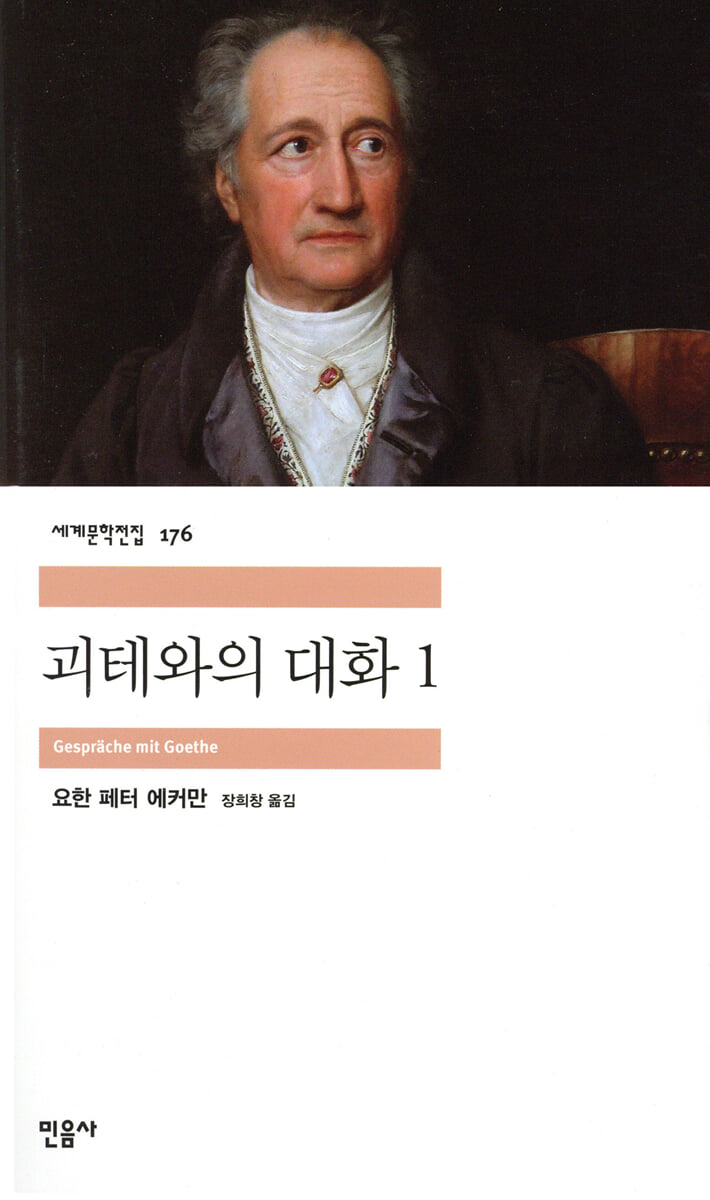
Conversation with Goethe 1
 |
Description
Book Introduction
Johann Peter Eckermann's prose 『Conversations with Goethe』, Volume 1.
This work is a meticulous record of the conversations that the young literary figure Eckermann had with Goethe over the course of about 1,000 meetings over the ten years until Goethe's death. It is filled with Goethe's original interpretations of the role of intellectuals in contemporary literature and art, biblical interpretation and religious issues, the flow of political world history, and masters of world literature, as well as proverbs containing the wisdom of life, and Goethe's life and philosophy are fully reflected in this work.
Since the publication of Parts I and II in 1836 and Part III in 1848, 150 years later, this book is still considered essential reading for Goethe studies and is the most widely read book on Goethe.
In this book, Ackermann conveys Goethe's words verbatim and follows Goethe's writing style, so Goethe's tone remains vivid.
The descriptions of the scenery of the Weimar region are so detailed that it feels as if we are walking through the city of Weimar and visiting Goethe's house.
Furthermore, this book, which mentions and cites all of Goethe's works without exception, will serve as a passageway to approach Goethe through his vivid voice at a different level from other literary works.
This work is a meticulous record of the conversations that the young literary figure Eckermann had with Goethe over the course of about 1,000 meetings over the ten years until Goethe's death. It is filled with Goethe's original interpretations of the role of intellectuals in contemporary literature and art, biblical interpretation and religious issues, the flow of political world history, and masters of world literature, as well as proverbs containing the wisdom of life, and Goethe's life and philosophy are fully reflected in this work.
Since the publication of Parts I and II in 1836 and Part III in 1848, 150 years later, this book is still considered essential reading for Goethe studies and is the most widely read book on Goethe.
In this book, Ackermann conveys Goethe's words verbatim and follows Goethe's writing style, so Goethe's tone remains vivid.
The descriptions of the scenery of the Weimar region are so detailed that it feels as if we are walking through the city of Weimar and visiting Goethe's house.
Furthermore, this book, which mentions and cites all of Goethe's works without exception, will serve as a passageway to approach Goethe through his vivid voice at a different level from other literary works.
index
preface
Part 1
Introduction
1823
1824
1825
1826
1827
Part 2
1828
1829
1830
1831~1832
Part 1
Introduction
1823
1824
1825
1826
1827
Part 2
1828
1829
1830
1831~1832
Publisher's Review
A timeless mentor, a precious message from Goethe to young people.
A conversation between Goethe and the young intellectual Eckermann about life, art, scholarship, and love.
Johann Peter Eckermann's prose work "Conversations with Goethe" was published in Minumsa's World Literature Collection (volumes 176 and 177).
This work is a meticulously compiled record of the conversations that the young literary scholar Eckermann had with Goethe over the course of about 1,000 meetings over the ten years leading up to his death.
This work, filled with Goethe's unique interpretations of contemporary literature and art, biblical interpretation and religious issues, the role of intellectuals in the flow of political world history, and the masters of world literature, as well as proverbs containing the wisdom of life, embodies Goethe's life and philosophy.
Since the publication of Parts I and II in 1836 and Part III in 1848, 150 years later, this book is still considered essential reading for Goethe studies and is the most widely read book on Goethe.
A poor young man meets the great writer Goethe and experiences spiritual growth.
Ackermann, who was Goethe's assistant and colleague in his later years, sent Goethe a manuscript titled "Tractatus Poeticus" in 1823, and Goethe, who was interested, invited him to visit Weimar.
Goethe, recognizing his talent, kept Eckermann in Weimar to publish his complete works.
From 1823 to 1832, Ackermann met Goethe approximately 1,000 times.
And each time, the conversations were recorded and compiled and published after Goethe's death, which became "Dialogues with Goethe," which Nietzsche called "the best German book in existence."
Ackermann, who was just a poor literary youth, was able to grow mentally and socially through his encounter with Goethe.
Goethe, who had already established himself as a world-renowned literary figure beyond Germany, left behind numerous lessons that helped the young Eckermann understand the essence of life and develop a perspective on the world.
For example, proverbs that are still useful today can be found throughout this book, such as, "Be a person who builds, not a person who destroys," "When you meet the best, your perspective changes," "It is useless to deny, do what is right," "Become competent in one field," "Be indifferent to your enemies," and "In the end, you only learn from those you love."
However, Goethe was not the only one who influenced Eckermann.
As Goethe's assistant, Eckermann organized Goethe's manuscripts, diaries, and letters to edit Goethe's complete works. In particular, it is known that when Goethe was finishing up the second part of Faust, Wilhelm Meister's Journeyman, and Poetry and Truth, he read and revised the manuscripts together with Eckermann.
Goethe's famous quotes heard vividly in his own voice
Here are some quotes from Goethe:
“The wise man restricts himself to one field, rejecting all distracting demands, and becomes competent in that one field.”
“If only thinking weren’t so difficult!” we say, but unfortunately, all thinking is of no use in itself.
The important thing is that you are honest by nature.
Only then will great ideas always appear before us, as if they were sons of God, and call out, 'Here we are!'
“The most prudent course of action is always to strive for what one is born with and what one has learned and mastered, and not to hinder others from carrying out their duties.
A shoemaker should always be in front of his shoebox, a farmer should always be behind his plow, and a monarch should only know how to govern his country.
Because politics is a profession that must be learned, and those who do not understand it should not presumptuously intervene.”
In this way, Eckermann's narrative style of conveying Goethe's words is simple, yet vivid and colorful.
Most of them convey Goethe's words as they are, and because they follow Goethe's writing style, Goethe's tone is vividly alive.
So much so that Goethe's daughter-in-law, Ottilie, said, "It's as if I can hear my father-in-law's voice."
This kind of realistic and concrete description is one of the strengths of this work.
The descriptions of the Weimar region's scenery are so detailed that it feels as if we are walking through the city of Weimar and visiting Goethe's house.
Furthermore, this book, which mentions and cites all of Goethe's works without exception, provides a passageway to approach Goethe through his vivid voice at a different level from Goethe's other literary works.
Goethe, an idealistic man who left behind outstanding achievements in various fields, including literature, philosophy, law, and natural science.
The overall structure of the work is mainly composed of a dialogue between Goethe and Eckermann.
In addition, the diary contains conversations Goethe had with his family, friends, artists, scholars, and foreigners who visited him from far away.
The people who had direct conversations with him were the great figures of that era, including Napoleon, Hegel, Schiller, and Beethoven.
Ackermann, who was also a poet, meticulously reconstructed this vast material and gave it literary form.
Goethe's voice, which expresses his thoughts across a vast range of topics, from commentaries on Greco-Roman classics to classical French tragedies, Molière's comedies, Shakespeare, Byron and Walter Scott, Italian literature, Serbian literature, Persian literature, and Chinese literature, immerses us in the rich flow of world literature.
In addition, the overall situations that Goethe had to go through are specifically described, including his worries as a politician that arose from his experience of being involved in politics at the Weimar court, his detailed confessions about theatrical techniques that he had organized based on his experience directing the Weimar theater, the agony he had to face at the crossroads of progress and conservatism in the midst of the chaos of Europe due to the French Revolution, and the situation in which he had to despair of the political situation and devote himself to the study of nature.
Also, the sub-topics of this book, such as 'On Freedom', 'Health and Productivity', 'Snobbery from Institutions', 'Beauty Growing from Struggle', 'Progress of Humanity', 'Biblical Stories', 'The Classical and the Romantic', 'On Faust', 'On the Sorrows of Werther', 'On Hegel's Philosophy', 'Religion and Philosophy', 'What is Originality?', 'The Idea of World Literature', and 'Writers are Martyrs', span a vast area that crosses the spectrum of truth, goodness, and beauty.
In that respect, Ackermann thought that this book should be 'a kind of textbook and dictionary of Goethe.'
『Conversations with Goethe』, written in voluminous volumes, is a literary treasure trove filled with creative imagination.
Goethe saw the world as being in a constant flow of creation.
Goethe's idea that the spirit fulfills its role by confronting and controlling the challenges of matter within this cyclical system of nature is communication with nature has great implications for modern history, which has been a history of rebellion aimed at dominating and possessing nature rather than communicating with it.
In short, the process of achieving the cultivation of the human spirit that Goethe speaks of, and the belief in the change of the world, was ultimately a long journey that confirmed the dominance of the spirit over matter.
Goethe was a well-rounded human being who achieved outstanding results in many fields, but what made him even greater was his love for nature and humanity, and his unwavering love for humanity that never let go of the thread of hope.
This book, which contains the voice of a true master preaching the principle of hope, will be a must-read for readers who love Goethe.
A conversation between Goethe and the young intellectual Eckermann about life, art, scholarship, and love.
Johann Peter Eckermann's prose work "Conversations with Goethe" was published in Minumsa's World Literature Collection (volumes 176 and 177).
This work is a meticulously compiled record of the conversations that the young literary scholar Eckermann had with Goethe over the course of about 1,000 meetings over the ten years leading up to his death.
This work, filled with Goethe's unique interpretations of contemporary literature and art, biblical interpretation and religious issues, the role of intellectuals in the flow of political world history, and the masters of world literature, as well as proverbs containing the wisdom of life, embodies Goethe's life and philosophy.
Since the publication of Parts I and II in 1836 and Part III in 1848, 150 years later, this book is still considered essential reading for Goethe studies and is the most widely read book on Goethe.
A poor young man meets the great writer Goethe and experiences spiritual growth.
Ackermann, who was Goethe's assistant and colleague in his later years, sent Goethe a manuscript titled "Tractatus Poeticus" in 1823, and Goethe, who was interested, invited him to visit Weimar.
Goethe, recognizing his talent, kept Eckermann in Weimar to publish his complete works.
From 1823 to 1832, Ackermann met Goethe approximately 1,000 times.
And each time, the conversations were recorded and compiled and published after Goethe's death, which became "Dialogues with Goethe," which Nietzsche called "the best German book in existence."
Ackermann, who was just a poor literary youth, was able to grow mentally and socially through his encounter with Goethe.
Goethe, who had already established himself as a world-renowned literary figure beyond Germany, left behind numerous lessons that helped the young Eckermann understand the essence of life and develop a perspective on the world.
For example, proverbs that are still useful today can be found throughout this book, such as, "Be a person who builds, not a person who destroys," "When you meet the best, your perspective changes," "It is useless to deny, do what is right," "Become competent in one field," "Be indifferent to your enemies," and "In the end, you only learn from those you love."
However, Goethe was not the only one who influenced Eckermann.
As Goethe's assistant, Eckermann organized Goethe's manuscripts, diaries, and letters to edit Goethe's complete works. In particular, it is known that when Goethe was finishing up the second part of Faust, Wilhelm Meister's Journeyman, and Poetry and Truth, he read and revised the manuscripts together with Eckermann.
Goethe's famous quotes heard vividly in his own voice
Here are some quotes from Goethe:
“The wise man restricts himself to one field, rejecting all distracting demands, and becomes competent in that one field.”
“If only thinking weren’t so difficult!” we say, but unfortunately, all thinking is of no use in itself.
The important thing is that you are honest by nature.
Only then will great ideas always appear before us, as if they were sons of God, and call out, 'Here we are!'
“The most prudent course of action is always to strive for what one is born with and what one has learned and mastered, and not to hinder others from carrying out their duties.
A shoemaker should always be in front of his shoebox, a farmer should always be behind his plow, and a monarch should only know how to govern his country.
Because politics is a profession that must be learned, and those who do not understand it should not presumptuously intervene.”
In this way, Eckermann's narrative style of conveying Goethe's words is simple, yet vivid and colorful.
Most of them convey Goethe's words as they are, and because they follow Goethe's writing style, Goethe's tone is vividly alive.
So much so that Goethe's daughter-in-law, Ottilie, said, "It's as if I can hear my father-in-law's voice."
This kind of realistic and concrete description is one of the strengths of this work.
The descriptions of the Weimar region's scenery are so detailed that it feels as if we are walking through the city of Weimar and visiting Goethe's house.
Furthermore, this book, which mentions and cites all of Goethe's works without exception, provides a passageway to approach Goethe through his vivid voice at a different level from Goethe's other literary works.
Goethe, an idealistic man who left behind outstanding achievements in various fields, including literature, philosophy, law, and natural science.
The overall structure of the work is mainly composed of a dialogue between Goethe and Eckermann.
In addition, the diary contains conversations Goethe had with his family, friends, artists, scholars, and foreigners who visited him from far away.
The people who had direct conversations with him were the great figures of that era, including Napoleon, Hegel, Schiller, and Beethoven.
Ackermann, who was also a poet, meticulously reconstructed this vast material and gave it literary form.
Goethe's voice, which expresses his thoughts across a vast range of topics, from commentaries on Greco-Roman classics to classical French tragedies, Molière's comedies, Shakespeare, Byron and Walter Scott, Italian literature, Serbian literature, Persian literature, and Chinese literature, immerses us in the rich flow of world literature.
In addition, the overall situations that Goethe had to go through are specifically described, including his worries as a politician that arose from his experience of being involved in politics at the Weimar court, his detailed confessions about theatrical techniques that he had organized based on his experience directing the Weimar theater, the agony he had to face at the crossroads of progress and conservatism in the midst of the chaos of Europe due to the French Revolution, and the situation in which he had to despair of the political situation and devote himself to the study of nature.
Also, the sub-topics of this book, such as 'On Freedom', 'Health and Productivity', 'Snobbery from Institutions', 'Beauty Growing from Struggle', 'Progress of Humanity', 'Biblical Stories', 'The Classical and the Romantic', 'On Faust', 'On the Sorrows of Werther', 'On Hegel's Philosophy', 'Religion and Philosophy', 'What is Originality?', 'The Idea of World Literature', and 'Writers are Martyrs', span a vast area that crosses the spectrum of truth, goodness, and beauty.
In that respect, Ackermann thought that this book should be 'a kind of textbook and dictionary of Goethe.'
『Conversations with Goethe』, written in voluminous volumes, is a literary treasure trove filled with creative imagination.
Goethe saw the world as being in a constant flow of creation.
Goethe's idea that the spirit fulfills its role by confronting and controlling the challenges of matter within this cyclical system of nature is communication with nature has great implications for modern history, which has been a history of rebellion aimed at dominating and possessing nature rather than communicating with it.
In short, the process of achieving the cultivation of the human spirit that Goethe speaks of, and the belief in the change of the world, was ultimately a long journey that confirmed the dominance of the spirit over matter.
Goethe was a well-rounded human being who achieved outstanding results in many fields, but what made him even greater was his love for nature and humanity, and his unwavering love for humanity that never let go of the thread of hope.
This book, which contains the voice of a true master preaching the principle of hope, will be a must-read for readers who love Goethe.
GOODS SPECIFICS
- Date of issue: May 2, 2008
- Page count, weight, size: 739 pages | 846g | 132*225*40mm
- ISBN13: 9788937461767
- ISBN10: 8937461765
You may also like
카테고리
korean


korean

![ELLE 엘르 스페셜 에디션 A형 : 12월 [2025]](http://librairie.coreenne.fr/cdn/shop/files/b8e27a3de6c9538896439686c6b0e8fb.jpg?v=1766436872&width=3840)


