

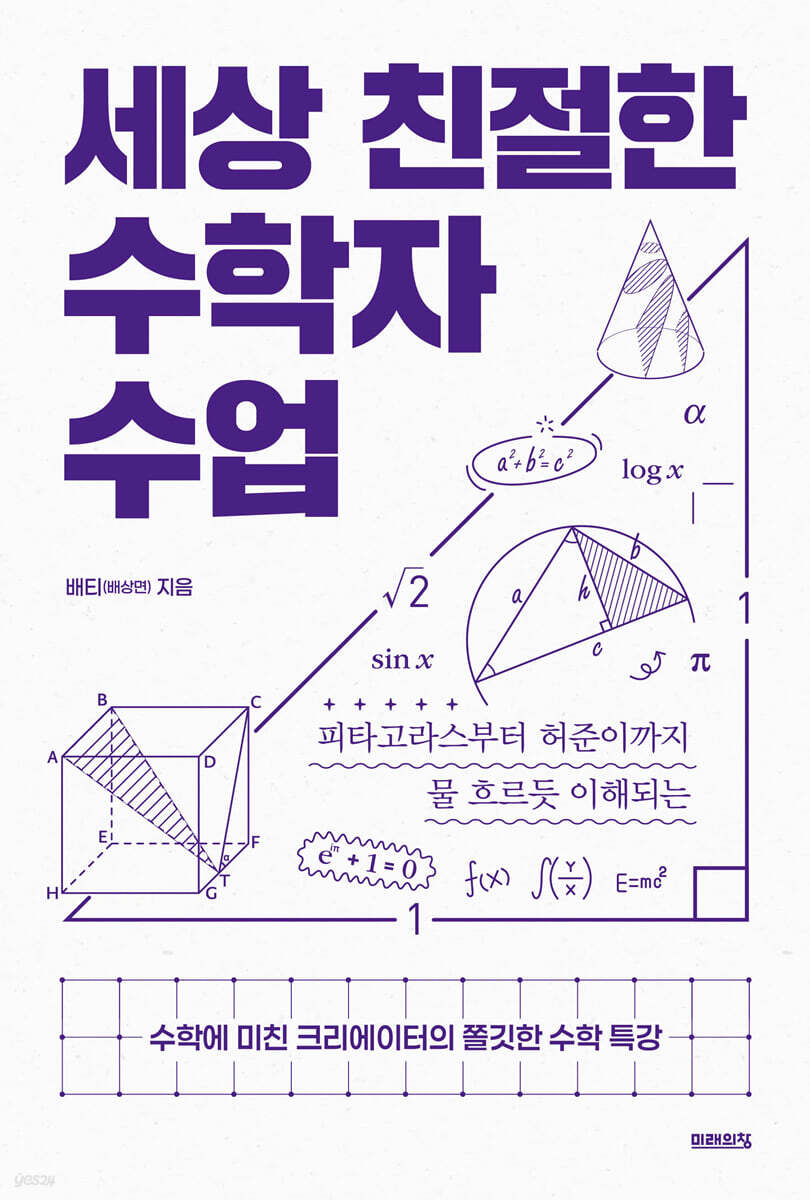
The World's Kindest Mathematician Class
 |
Description
Book Introduction
“Was math this fun?”
Mathematicians' life equations are more exciting than mathematical formulas.
"The World's Kindest Mathematicians," which covers the history of mathematics from ancient times to the present, doesn't rely on rigid formulas and proofs, but instead offers a captivating glimpse into the passion, struggles, and unique ways of thinking of 26 great mathematicians.
From Pythagoras' secret religious life to Heo Jun's Fields Medal, readers will discover a new charm of mathematics through the human drama created by mathematics.
This book is highly recommended for middle and high school students tired of memorizing formulas, students and college students who want to find the context of mathematics, parents who want to show their children the creative side of mathematics, and anyone who wants to break free from the prejudice that mathematics is difficult and approach it from a new perspective.
Mathematicians' life equations are more exciting than mathematical formulas.
"The World's Kindest Mathematicians," which covers the history of mathematics from ancient times to the present, doesn't rely on rigid formulas and proofs, but instead offers a captivating glimpse into the passion, struggles, and unique ways of thinking of 26 great mathematicians.
From Pythagoras' secret religious life to Heo Jun's Fields Medal, readers will discover a new charm of mathematics through the human drama created by mathematics.
This book is highly recommended for middle and high school students tired of memorizing formulas, students and college students who want to find the context of mathematics, parents who want to show their children the creative side of mathematics, and anyone who wants to break free from the prejudice that mathematics is difficult and approach it from a new perspective.
- You can preview some of the book's contents.
Preview
index
prolog
A cult leader disguised as a Pythagorean mathematician?
Euclid X Archimedes The Two-Horned Chariot of the Greek Golden Age
Hypatia, the first victim of the witch hunt
Tartaglia X Cardano Cubic Equation Battle
Descartes I think, therefore I am a mathematician.
The mathematician who appeared most often on Pascal News
The Boy on the Shoulders of Newton Giants
Leibniz calculus daily mathematician
Euler, the wise man who saw the universe with his eyes closed
Gauss's name is called Gott in mathematics.
Abel X Galois, two geniuses who died in their 20s
Bertrand Russell, an intellectual who integrated humanities and science
Von Neumann, YouTube's most popular scientist
Alan Turing, the real hero of World War II
Kurt Gödel, Einstein's soulmate
Human GPT, which published 1,500 Erdös papers
Groshendick, the runaway locomotive of modern mathematics
Fermat X Wilds Killer Question Maker and Solver
Poincaré X Perelman Super genius questioner vs.
Reclusive problem solver
Hironaka X Heo Jun Fields Medal Parallel Theory
Epilogue
A cult leader disguised as a Pythagorean mathematician?
Euclid X Archimedes The Two-Horned Chariot of the Greek Golden Age
Hypatia, the first victim of the witch hunt
Tartaglia X Cardano Cubic Equation Battle
Descartes I think, therefore I am a mathematician.
The mathematician who appeared most often on Pascal News
The Boy on the Shoulders of Newton Giants
Leibniz calculus daily mathematician
Euler, the wise man who saw the universe with his eyes closed
Gauss's name is called Gott in mathematics.
Abel X Galois, two geniuses who died in their 20s
Bertrand Russell, an intellectual who integrated humanities and science
Von Neumann, YouTube's most popular scientist
Alan Turing, the real hero of World War II
Kurt Gödel, Einstein's soulmate
Human GPT, which published 1,500 Erdös papers
Groshendick, the runaway locomotive of modern mathematics
Fermat X Wilds Killer Question Maker and Solver
Poincaré X Perelman Super genius questioner vs.
Reclusive problem solver
Hironaka X Heo Jun Fields Medal Parallel Theory
Epilogue
Detailed image

Into the book
Pythagoras, a mysterious figure who lived 2,500 years ago! He was so ancient, and even the records about him were written after his death, making them difficult to fully trust. However, from a modern perspective, he seems more like a religious leader than a mathematician.
Let us look into the meaning of the Pythagorean claim that “everything in the world is number.”
This means that when all things are expressed in numbers, they form a ratio of natural numbers, that is, “how many to how many.”
For example, the ratio of the weight of a young son and a large father could be expressed as 2:7 or 3:10, so the category of numbers they had in mind was the positive rational number of today.
--- p.18
If you calculate this, it is 3.1408 〈pi 〈3.1429 Surprisingly, there is not a large difference between the approximate value of pi that we learn in schools today, 3.14, and the actual pi.
It is even presumed that Archimedes knew that pi is an irrational number that cannot be expressed as a fraction.
Archimedes' ideas marked the birth of infinitesimal geometry and differentiation.
--- p.29
Meanwhile, Hypatia, an astronomer who loved stars, analyzed the trajectories of celestial bodies and proposed the heliocentric theory that the Earth revolves around the Sun in an elliptical orbit.
This was about 1100 years before Copernicus.
Hypatia's fame spread far and wide, and she became a famous person not only in Alexandria but also throughout the world, but a dark shadow was cast over her passion for truth.
--- p.37
Cardano has made many contributions to mathematics and other fields beyond equations.
When we think of 'probability', the mathematician that comes to mind is Pascal, but before him there was Cardano.
Cardano wrote a book called "The Book on Games of Chance" as part of his gambling strategy book, which is considered the first systematic book on probability.
It was also Cardano who introduced the concept of imaginary numbers to mathematics.
--- p.45
The games that modern people enjoy today involve positioning units on a coordinate plane and moving them with a mouse. Smartphones also operate by recognizing points touched on the coordinate plane, called the LCD, as coordinates.
Navigation, a driver's essential item, also uses coordinate geometry.
Without Descartes' coordinate geometry, modern science would be non-existent.
Today, the coordinate plane is also called the Cartesian coordinates, and the point (x, y) on the coordinate plane is called the Cartesian product.
--- p.52
As no parent can beat their child, the father immediately provided Pascal with the scientist's bible, Elements, and fully supported Pascal's mathematical studies.
As if to repay this, Pascal displayed his genius by discovering Pascal's triangle at the young age of 13, and finally became a full member of the Paris Academy. He began studying mathematics in earnest with his uncles, who were good at mathematics, under the tutelage of Father Mersenne.
--- p.58
Newton, a mathematician, scientist, civil servant, politician, alchemist, and theologian, achieved remarkable results in every field except alchemy. Yet, he spoke of his profession as being limited to one.
“A philosopher who seeks the truth of nature.” Newton, now 85 years old, used to say this to his students.
--- p.85
Even while working on various projects as a librarian and academic director, Leibniz left behind writings on various fields, and in philosophy, he made a mark with 『Monadry』, written in his later years.
Just as Euclid said that a point is something without parts, Leibniz argued that the smallest unit of indivisible matter and the primordial origin is the 'monad'.
--- p.92
Richard Feynman, the greatest physicist of the 20th century, praised it as “the most brilliant jewel of mathematics,” and in 1988, the American mathematics magazine 『Mathematical Intelligencer』 nominated 24 competitive formulas, including the Pythagorean theorem and the quadratic formula, as final candidates, and after a two-year voting process, reported some not-so-surprising news.
“The most beautiful formula in the world (the most beautiful formula in the world, as was said at the time) is Euler’s formula.” Euler is often called the ‘Mozart of Mathematics’ as he is considered one of the most creative geniuses in the world of mathematics.
--- p.110
Gauss was a cosmic genius from a young age.
When he was five, he found a calculation error in his father's ledger, and when he was nine years old and in elementary school, his math teacher, Büttner, wrote a problem on the blackboard to find the sum of the natural numbers from 1 to 100, and when he was about to take a break... "It's 5050." Gauss solved it without a second thought.
Later, whenever Gauss was told about his childhood genius, he would boast(?) that he learned to calculate before he learned to speak.
--- p.115
It was Neumann's answer that came out in no time.
This problem takes a long time to solve if you are not careful with an infinite series because the distance that the flies travel back and forth becomes increasingly shorter.
To put it simply, if the two trains collide after two hours, the distance Paris travels in two hours is:
75 × 2 = 150 (miles) This was actually a beginner level problem.
--- p.148
A Turing machine is a machine that calculates symbols written on each cell of a long tape, and Turing creates a new version of the 'incompleteness theorem' that states that there are problems that this machine cannot solve.
This led Turing to cross the Atlantic and enter Princeton, the world's best university.
--- p.155
Heo Jun, who decided to study abroad, applied to 12 doctoral programs at American universities with Hironaka's recommendation, but was only accepted to the University of Illinois, and began his doctoral program.
The late-blooming mathematician's achievements were remarkable.
Heo Jun-i became a rising star in the world of mathematics by proving the 'Reed Conjecture' and rose to fame as a world-renowned mathematician by proving 11 difficult problems, including the 'Rota Conjecture'.
Let us look into the meaning of the Pythagorean claim that “everything in the world is number.”
This means that when all things are expressed in numbers, they form a ratio of natural numbers, that is, “how many to how many.”
For example, the ratio of the weight of a young son and a large father could be expressed as 2:7 or 3:10, so the category of numbers they had in mind was the positive rational number of today.
--- p.18
If you calculate this, it is 3.1408 〈pi 〈3.1429 Surprisingly, there is not a large difference between the approximate value of pi that we learn in schools today, 3.14, and the actual pi.
It is even presumed that Archimedes knew that pi is an irrational number that cannot be expressed as a fraction.
Archimedes' ideas marked the birth of infinitesimal geometry and differentiation.
--- p.29
Meanwhile, Hypatia, an astronomer who loved stars, analyzed the trajectories of celestial bodies and proposed the heliocentric theory that the Earth revolves around the Sun in an elliptical orbit.
This was about 1100 years before Copernicus.
Hypatia's fame spread far and wide, and she became a famous person not only in Alexandria but also throughout the world, but a dark shadow was cast over her passion for truth.
--- p.37
Cardano has made many contributions to mathematics and other fields beyond equations.
When we think of 'probability', the mathematician that comes to mind is Pascal, but before him there was Cardano.
Cardano wrote a book called "The Book on Games of Chance" as part of his gambling strategy book, which is considered the first systematic book on probability.
It was also Cardano who introduced the concept of imaginary numbers to mathematics.
--- p.45
The games that modern people enjoy today involve positioning units on a coordinate plane and moving them with a mouse. Smartphones also operate by recognizing points touched on the coordinate plane, called the LCD, as coordinates.
Navigation, a driver's essential item, also uses coordinate geometry.
Without Descartes' coordinate geometry, modern science would be non-existent.
Today, the coordinate plane is also called the Cartesian coordinates, and the point (x, y) on the coordinate plane is called the Cartesian product.
--- p.52
As no parent can beat their child, the father immediately provided Pascal with the scientist's bible, Elements, and fully supported Pascal's mathematical studies.
As if to repay this, Pascal displayed his genius by discovering Pascal's triangle at the young age of 13, and finally became a full member of the Paris Academy. He began studying mathematics in earnest with his uncles, who were good at mathematics, under the tutelage of Father Mersenne.
--- p.58
Newton, a mathematician, scientist, civil servant, politician, alchemist, and theologian, achieved remarkable results in every field except alchemy. Yet, he spoke of his profession as being limited to one.
“A philosopher who seeks the truth of nature.” Newton, now 85 years old, used to say this to his students.
--- p.85
Even while working on various projects as a librarian and academic director, Leibniz left behind writings on various fields, and in philosophy, he made a mark with 『Monadry』, written in his later years.
Just as Euclid said that a point is something without parts, Leibniz argued that the smallest unit of indivisible matter and the primordial origin is the 'monad'.
--- p.92
Richard Feynman, the greatest physicist of the 20th century, praised it as “the most brilliant jewel of mathematics,” and in 1988, the American mathematics magazine 『Mathematical Intelligencer』 nominated 24 competitive formulas, including the Pythagorean theorem and the quadratic formula, as final candidates, and after a two-year voting process, reported some not-so-surprising news.
“The most beautiful formula in the world (the most beautiful formula in the world, as was said at the time) is Euler’s formula.” Euler is often called the ‘Mozart of Mathematics’ as he is considered one of the most creative geniuses in the world of mathematics.
--- p.110
Gauss was a cosmic genius from a young age.
When he was five, he found a calculation error in his father's ledger, and when he was nine years old and in elementary school, his math teacher, Büttner, wrote a problem on the blackboard to find the sum of the natural numbers from 1 to 100, and when he was about to take a break... "It's 5050." Gauss solved it without a second thought.
Later, whenever Gauss was told about his childhood genius, he would boast(?) that he learned to calculate before he learned to speak.
--- p.115
It was Neumann's answer that came out in no time.
This problem takes a long time to solve if you are not careful with an infinite series because the distance that the flies travel back and forth becomes increasingly shorter.
To put it simply, if the two trains collide after two hours, the distance Paris travels in two hours is:
75 × 2 = 150 (miles) This was actually a beginner level problem.
--- p.148
A Turing machine is a machine that calculates symbols written on each cell of a long tape, and Turing creates a new version of the 'incompleteness theorem' that states that there are problems that this machine cannot solve.
This led Turing to cross the Atlantic and enter Princeton, the world's best university.
--- p.155
Heo Jun, who decided to study abroad, applied to 12 doctoral programs at American universities with Hironaka's recommendation, but was only accepted to the University of Illinois, and began his doctoral program.
The late-blooming mathematician's achievements were remarkable.
Heo Jun-i became a rising star in the world of mathematics by proving the 'Reed Conjecture' and rose to fame as a world-renowned mathematician by proving 11 difficult problems, including the 'Rota Conjecture'.
--- p.228
Publisher's Review
"Eureka!" The Story Behind Mathematicians
From mathematician-disguised cult leaders to witch hunts, rediscovering the hidden history of mathematics.
"The World's Kindest Mathematicians" vividly tells the fascinating backstories of mathematicians that you won't find in textbooks.
Dramatic moments in the history of mathematics unfold, from Pythagoras, a cult leader disguised as a mathematician, to Hypatia, the first female mathematician sacrificed to a brutal mob, to the fierce competition between Tartaglia and Cardano over the solution to the cubic equation.
"This is the way of thinking!" A peek into the thinking of mathematicians.
From the bathroom to your smartphone, everyday miracles created by the magic of mathematics.
This book provides a glimpse into the unique way of thinking of mathematicians.
You can encounter the creative problem-solving method of Archimedes who shouted “Eureka!”, the insight of Descartes who combined geometry and algebra with the coordinate plane, and the intuition of Euler, the “Mozart of mathematics,” who discovered beautiful patterns between numbers.
We also introduce how this way of thinking is applied to modern life.
From the coordinate geometry of navigation, to the probability theory of big data, to the computational theory of AI, the book makes us realize that mathematics is at the core of modern civilization.
"It's not difficult!" A special class that makes math your friend.
A story about the world's kindest mathematicians, told by a renowned lecturer.
The author, who is also the director of a math academy, uses his many years of teaching experience to clearly explain complex mathematical concepts so that anyone can understand them.
Instead of rigid explanations, it naturally guides readers into the world of mathematics as if giving an interesting special lecture.
In particular, the story of Heo Jun-i, who won the Fields Medal after a long period of wandering, including dropping out of school and taking a leave of absence, makes mathematics feel more familiar to domestic readers.
"The World's Kindest Mathematician Class" will provide an intellectual adventure for all readers who want to experience the essence of mathematical thinking along with entertaining stories about mathematics.
From mathematician-disguised cult leaders to witch hunts, rediscovering the hidden history of mathematics.
"The World's Kindest Mathematicians" vividly tells the fascinating backstories of mathematicians that you won't find in textbooks.
Dramatic moments in the history of mathematics unfold, from Pythagoras, a cult leader disguised as a mathematician, to Hypatia, the first female mathematician sacrificed to a brutal mob, to the fierce competition between Tartaglia and Cardano over the solution to the cubic equation.
"This is the way of thinking!" A peek into the thinking of mathematicians.
From the bathroom to your smartphone, everyday miracles created by the magic of mathematics.
This book provides a glimpse into the unique way of thinking of mathematicians.
You can encounter the creative problem-solving method of Archimedes who shouted “Eureka!”, the insight of Descartes who combined geometry and algebra with the coordinate plane, and the intuition of Euler, the “Mozart of mathematics,” who discovered beautiful patterns between numbers.
We also introduce how this way of thinking is applied to modern life.
From the coordinate geometry of navigation, to the probability theory of big data, to the computational theory of AI, the book makes us realize that mathematics is at the core of modern civilization.
"It's not difficult!" A special class that makes math your friend.
A story about the world's kindest mathematicians, told by a renowned lecturer.
The author, who is also the director of a math academy, uses his many years of teaching experience to clearly explain complex mathematical concepts so that anyone can understand them.
Instead of rigid explanations, it naturally guides readers into the world of mathematics as if giving an interesting special lecture.
In particular, the story of Heo Jun-i, who won the Fields Medal after a long period of wandering, including dropping out of school and taking a leave of absence, makes mathematics feel more familiar to domestic readers.
"The World's Kindest Mathematician Class" will provide an intellectual adventure for all readers who want to experience the essence of mathematical thinking along with entertaining stories about mathematics.
GOODS SPECIFICS
- Date of issue: March 24, 2025
- Page count, weight, size: 232 pages | 152*225*20mm
- ISBN13: 9791193638972
- ISBN10: 1193638976
You may also like
카테고리
korean


korean

![GQ KOREA Mark (Monthly): December [2025]](http://librairie.coreenne.fr/cdn/shop/files/8ef265dbbfbf186523ed75ba7319009d.jpg?v=1765340328&width=3840)


