

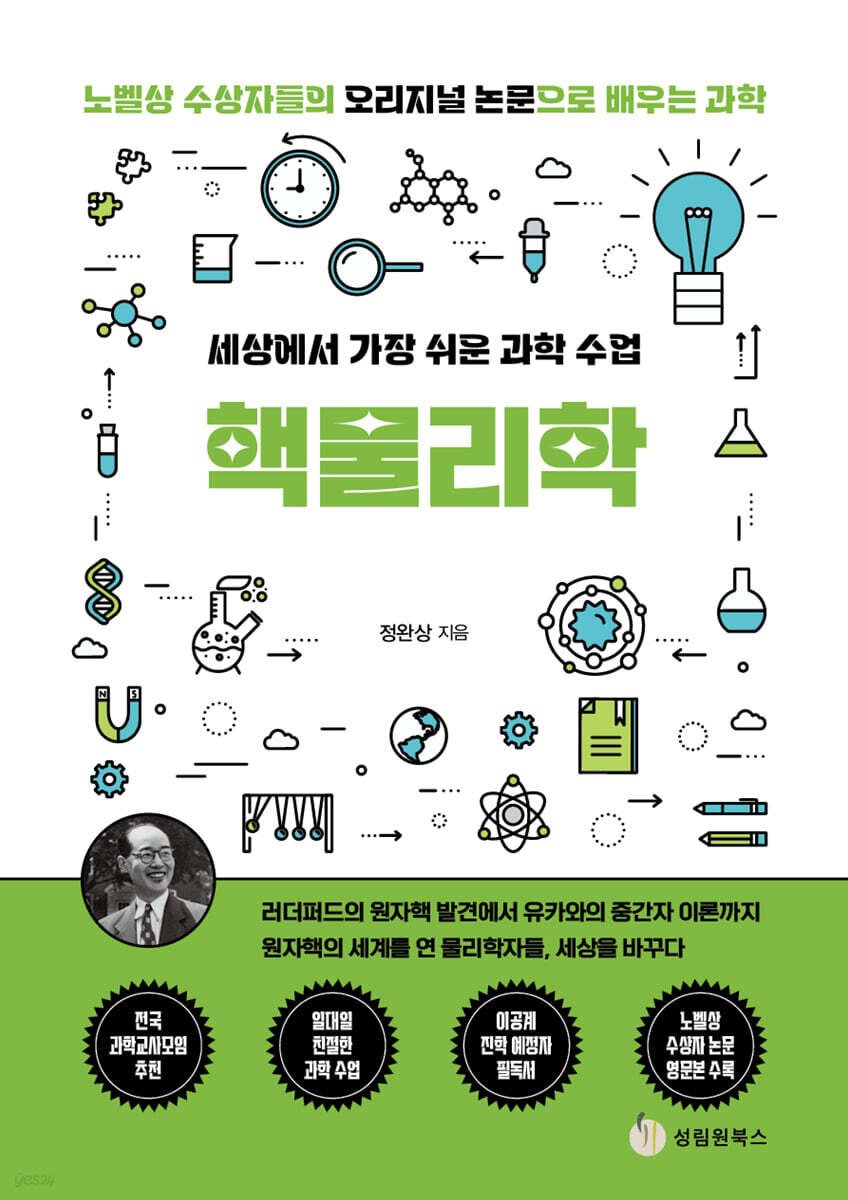
The World's Easiest Science Lesson: Nuclear Physics
 |
Description
Book Introduction
From Rutherford's discovery of the atomic nucleus to Yukawa's meson theory
Physicists Who Unlocked the World of Nuclear Energy Change the World
★ Recommended by the National Science Teachers Association
★ One-on-one friendly science classes
★ A must-read for those planning to pursue science and engineering majors
★ Includes English versions of Nobel Prize winners' papers
An exciting journey to unlock the secrets of the atomic nucleus!
This is the 12th book in the series, “Learning Science through Original Papers by Nobel Prize Winners.” From the birth of Rutherford’s atomic model to Chadwick’s discovery of the neutron, Yukawa’s meson prediction, and the Powell group’s discovery of the pi meson, the intense research process of physicists to unlock the secrets of the atomic nucleus unfolds in an exciting way along with the history of nuclear physics.
The author, Professor Jeong Wan-sang, is a theoretical physicist and professor of physics, and based on his experience of over 30 years, he offers this book to physics students, readers interested in physics, and the general public the special pleasure of accessing original papers by Nobel Prize winners.
The introduction, which borrows the format of an interview with Dr. Yoichiro Nambu of Japan, who won the 2008 Nobel Prize in Physics for spontaneous symmetry breaking, briefly explains the nuclear force theory of Hideki Yukawa, the first East Asian and first Japanese to win the Nobel Prize in Physics, and provides an overview of the book's flow.
Next, we introduce the evolution of Japanese physics, from the discovery of the atomic nucleus to the discovery of cosmic radiation, the theory of alpha and beta decay, and the Nobel Prize-winning work of Yukawa, as well as his research process and the contents of his thesis, which came to him from a children's game of catch.
Above all, this book is characterized by its friendly and elaborate structure, as if it were a one-on-one lesson, borrowing the format of a conversation between Professor Jeong, who represents the author, and the physics group, who pose questions to Professor Jeong from the reader's perspective.
The appendix includes the Mayer paper on nuclear magic numbers, the Gamow paper on alpha decay, the Yukawa paper on nuclear forces, and the Heisenberg paper.
The author describes the paper by Gamow, who is considered a genius in theoretical physics, as “beautiful.”
Along with this, we provide a list of Nobel Prize winners in Physics and Chemistry, guiding the world toward deeper exploration and understanding.
Physicists Who Unlocked the World of Nuclear Energy Change the World
★ Recommended by the National Science Teachers Association
★ One-on-one friendly science classes
★ A must-read for those planning to pursue science and engineering majors
★ Includes English versions of Nobel Prize winners' papers
An exciting journey to unlock the secrets of the atomic nucleus!
This is the 12th book in the series, “Learning Science through Original Papers by Nobel Prize Winners.” From the birth of Rutherford’s atomic model to Chadwick’s discovery of the neutron, Yukawa’s meson prediction, and the Powell group’s discovery of the pi meson, the intense research process of physicists to unlock the secrets of the atomic nucleus unfolds in an exciting way along with the history of nuclear physics.
The author, Professor Jeong Wan-sang, is a theoretical physicist and professor of physics, and based on his experience of over 30 years, he offers this book to physics students, readers interested in physics, and the general public the special pleasure of accessing original papers by Nobel Prize winners.
The introduction, which borrows the format of an interview with Dr. Yoichiro Nambu of Japan, who won the 2008 Nobel Prize in Physics for spontaneous symmetry breaking, briefly explains the nuclear force theory of Hideki Yukawa, the first East Asian and first Japanese to win the Nobel Prize in Physics, and provides an overview of the book's flow.
Next, we introduce the evolution of Japanese physics, from the discovery of the atomic nucleus to the discovery of cosmic radiation, the theory of alpha and beta decay, and the Nobel Prize-winning work of Yukawa, as well as his research process and the contents of his thesis, which came to him from a children's game of catch.
Above all, this book is characterized by its friendly and elaborate structure, as if it were a one-on-one lesson, borrowing the format of a conversation between Professor Jeong, who represents the author, and the physics group, who pose questions to Professor Jeong from the reader's perspective.
The appendix includes the Mayer paper on nuclear magic numbers, the Gamow paper on alpha decay, the Yukawa paper on nuclear forces, and the Heisenberg paper.
The author describes the paper by Gamow, who is considered a genius in theoretical physics, as “beautiful.”
Along with this, we provide a list of Nobel Prize winners in Physics and Chemistry, guiding the world toward deeper exploration and understanding.
- You can preview some of the book's contents.
Preview
index
Recommendation
I hope you can understand the original papers of these genius scientists.
A Surprise Interview with Dr. Yoichiro Nanbu, the First Asian to Win a Nobel Prize
First Encounter: The Shape of the Nucleus
Discovery of the atomic nucleus: a microscopic particle that makes up atoms along with electrons.
Radiation from space_Hess, who won the Nobel Prize for the discovery of cosmic radiation
Wilson's Cloud Chamber Invention and the Discovery of the Muon: What the Amazing Cloud Chamber Achieved
The invention of the bubble chamber: determining the mass of particles
The Era of New Particle Discovery: The Discovery of Protons and Neutrons
Nuclear binding energy: Four hydrogen nuclei are heavier than one helium nucleus.
The water droplet model of the nucleus: binding energy varies for each nucleus.
The Discovery of Magic Numbers: Mayer and Jensen Create a Perfect Nuclear Shell Model
Differential equation _ an equation that includes the derivative that satisfies the equation
Second Encounter: Alpha Decay Theory
Time-dependent and time-independent Schrödinger equations: Unraveling the secrets of quantum mechanics
Boundary Conditions of the Schrödinger Equation: Quantum Mechanics is a Game of Probabilities
Potential Staircase_Curious about the mystery of quantum!
Inside Gamow's Paper I: Explaining Alpha Decay Theory Through Quantum Tunneling
Inside Gamow's Paper II: Scientists Who Found Approximate Solutions to the Schrödinger Equation
Alpha Decay Theory: Alpha Particles Transmit Outward
Third Encounter: Beta Decay
The Discovery of Beta Decay: What Happens When a Neutron Turns into a Proton
Cherenkov Effect: A Beautiful Harmony Created by Three Scientists
The Discovery of Neutrinos: Scientists Who Won the Nobel Prize for Neutrinos
Fermi's Beta Decay Theory - What is the final energy value released in beta decay?
Fourth Encounter: Yukawa, the Discoverer of Nuclear Power
The Beginning of Japanese Physics: The Achievements of Genjiro, Hantaro, and Nishina
Hideki Yukawa, the first Asian Nobel laureate, published the meson theory.
Maxwell's Equations and Lorenz Gauge Vectors: Interesting Properties of Electric Potential
Yukawa's Meson Prophecy: Calculating the Mass of Mesons
Inside Yukawa's thesis_Curious about Yukawa's potential!
The Discovery of the Pi Meson: A Photograph Discovered in the Pyrenees
In addition to the meeting
Quantum Theory of the Atomic Nucleus_Gamow's paper in English
On Closed Shells in Nuclei II_English version of Mayer's paper
On the Interaction of Elementary Particles_Yukawa Nuclear Force Paper English Version
The Yukawa Theory of Nuclear Forces in the Light of Present Quantum
Theory of Wave Fields_English version of Heisenberg's paper
Concluding our meeting with a great paper
Papers referenced for this book
Introducing the Nobel Prize winners in Physics
Introducing the Nobel Prize winners in Chemistry
I hope you can understand the original papers of these genius scientists.
A Surprise Interview with Dr. Yoichiro Nanbu, the First Asian to Win a Nobel Prize
First Encounter: The Shape of the Nucleus
Discovery of the atomic nucleus: a microscopic particle that makes up atoms along with electrons.
Radiation from space_Hess, who won the Nobel Prize for the discovery of cosmic radiation
Wilson's Cloud Chamber Invention and the Discovery of the Muon: What the Amazing Cloud Chamber Achieved
The invention of the bubble chamber: determining the mass of particles
The Era of New Particle Discovery: The Discovery of Protons and Neutrons
Nuclear binding energy: Four hydrogen nuclei are heavier than one helium nucleus.
The water droplet model of the nucleus: binding energy varies for each nucleus.
The Discovery of Magic Numbers: Mayer and Jensen Create a Perfect Nuclear Shell Model
Differential equation _ an equation that includes the derivative that satisfies the equation
Second Encounter: Alpha Decay Theory
Time-dependent and time-independent Schrödinger equations: Unraveling the secrets of quantum mechanics
Boundary Conditions of the Schrödinger Equation: Quantum Mechanics is a Game of Probabilities
Potential Staircase_Curious about the mystery of quantum!
Inside Gamow's Paper I: Explaining Alpha Decay Theory Through Quantum Tunneling
Inside Gamow's Paper II: Scientists Who Found Approximate Solutions to the Schrödinger Equation
Alpha Decay Theory: Alpha Particles Transmit Outward
Third Encounter: Beta Decay
The Discovery of Beta Decay: What Happens When a Neutron Turns into a Proton
Cherenkov Effect: A Beautiful Harmony Created by Three Scientists
The Discovery of Neutrinos: Scientists Who Won the Nobel Prize for Neutrinos
Fermi's Beta Decay Theory - What is the final energy value released in beta decay?
Fourth Encounter: Yukawa, the Discoverer of Nuclear Power
The Beginning of Japanese Physics: The Achievements of Genjiro, Hantaro, and Nishina
Hideki Yukawa, the first Asian Nobel laureate, published the meson theory.
Maxwell's Equations and Lorenz Gauge Vectors: Interesting Properties of Electric Potential
Yukawa's Meson Prophecy: Calculating the Mass of Mesons
Inside Yukawa's thesis_Curious about Yukawa's potential!
The Discovery of the Pi Meson: A Photograph Discovered in the Pyrenees
In addition to the meeting
Quantum Theory of the Atomic Nucleus_Gamow's paper in English
On Closed Shells in Nuclei II_English version of Mayer's paper
On the Interaction of Elementary Particles_Yukawa Nuclear Force Paper English Version
The Yukawa Theory of Nuclear Forces in the Light of Present Quantum
Theory of Wave Fields_English version of Heisenberg's paper
Concluding our meeting with a great paper
Papers referenced for this book
Introducing the Nobel Prize winners in Physics
Introducing the Nobel Prize winners in Chemistry
Detailed image

Into the book
Among the atomic nuclei, the smallest particle that cannot be divided any further is the hydrogen nucleus, which is called a 'proton'.
The charge of a proton is the same as that of an electron, but while electrons have a negative charge, protons have a positive charge.
The mass of a proton is about 1,840 times that of an electron.
--- p.22~23
In 1932, while studying cosmic radiation through a cloud chamber, Anderson of the United States discovered a particle with the same mass and charge as an electron, but with the opposite sign of the charge.
This particle was discovered in 1928 by the British theoretical physicist Paul A.
It was a particle predicted by M. Dirac (1902-1984, British, Nobel Prize in Physics in 1933), and was named 'positron', meaning an electron with a positive charge.
--- p.34
The second important discovery of 1932 was the discovery of the neutron.
It was discovered by James Chadwick (1891-1974, British, Nobel Prize in Physics in 1935).
Neutrons are electrically neutral and slightly heavier than protons, but have roughly the same mass.
--- p.36
Yukawa discovered that nuclear force is a different type of force from electric force because nucleons include both electrically charged protons and uncharged neutrons.
Yukawa first conceived of nuclear force as a force between nucleons.
The force between nucleons is transmitted over short distances, so we only need to consider interactions between nucleons that are close together.
--- p.47
How can an atomic nucleus remain so stable despite the sheer number of protons and neutrons it contains? While pondering this question, Mayer became interested in the nuclear shell model proposed by Dmitri Dmitrievich Ivanenko (1904–1994) of the Soviet Union in 1932.
Ivatchenko thought that protons and neutrons could exist in specific orbits, similar to the orbits of electrons in Bohr's atomic model.
--- p.61
Two years after the publication of the Schrödinger equation, Gamow wondered if treating alpha particles as quanta might explain alpha decay, the emission of alpha particles from nuclei.
He came up with the amazing idea of quantum tunneling and came up with the theory of alpha decay.
--- p.96
While Cherenkov was conducting an experiment with radiation, he observed that a blue light was emitted from a bottle of water in the laboratory when it was irradiated with radiation.
Before Cherenkov, scientists knew that when radiation passes through liquids, it emits a faint blue glow.
Scientists considered this phenomenon to be a simple fluorescence phenomenon.
However, Cherenkov suspected that this light might not be due to fluorescence.
--- p.137
Yukawa used Heisenberg's uncertainty principle to predict a new particle that would act as a catchball for the nuclear force.
And the name of this particle was called 'meson'.
Yukawa found that the mass of the meson must be about 200 times the mass of the electron.
--- p.194
The Powell group chose the 2,877-meter-high Pic du Midi de Bigorre in the French Pyrenees as the site for their spacecraft experiments.
There was an observatory at the top of this place.
The Powell Group discovered a remarkable photograph here.
This photo was the photo of the intermediary that Yukawa had been waiting for.
They called this meson 'pion'.
The charge of a proton is the same as that of an electron, but while electrons have a negative charge, protons have a positive charge.
The mass of a proton is about 1,840 times that of an electron.
--- p.22~23
In 1932, while studying cosmic radiation through a cloud chamber, Anderson of the United States discovered a particle with the same mass and charge as an electron, but with the opposite sign of the charge.
This particle was discovered in 1928 by the British theoretical physicist Paul A.
It was a particle predicted by M. Dirac (1902-1984, British, Nobel Prize in Physics in 1933), and was named 'positron', meaning an electron with a positive charge.
--- p.34
The second important discovery of 1932 was the discovery of the neutron.
It was discovered by James Chadwick (1891-1974, British, Nobel Prize in Physics in 1935).
Neutrons are electrically neutral and slightly heavier than protons, but have roughly the same mass.
--- p.36
Yukawa discovered that nuclear force is a different type of force from electric force because nucleons include both electrically charged protons and uncharged neutrons.
Yukawa first conceived of nuclear force as a force between nucleons.
The force between nucleons is transmitted over short distances, so we only need to consider interactions between nucleons that are close together.
--- p.47
How can an atomic nucleus remain so stable despite the sheer number of protons and neutrons it contains? While pondering this question, Mayer became interested in the nuclear shell model proposed by Dmitri Dmitrievich Ivanenko (1904–1994) of the Soviet Union in 1932.
Ivatchenko thought that protons and neutrons could exist in specific orbits, similar to the orbits of electrons in Bohr's atomic model.
--- p.61
Two years after the publication of the Schrödinger equation, Gamow wondered if treating alpha particles as quanta might explain alpha decay, the emission of alpha particles from nuclei.
He came up with the amazing idea of quantum tunneling and came up with the theory of alpha decay.
--- p.96
While Cherenkov was conducting an experiment with radiation, he observed that a blue light was emitted from a bottle of water in the laboratory when it was irradiated with radiation.
Before Cherenkov, scientists knew that when radiation passes through liquids, it emits a faint blue glow.
Scientists considered this phenomenon to be a simple fluorescence phenomenon.
However, Cherenkov suspected that this light might not be due to fluorescence.
--- p.137
Yukawa used Heisenberg's uncertainty principle to predict a new particle that would act as a catchball for the nuclear force.
And the name of this particle was called 'meson'.
Yukawa found that the mass of the meson must be about 200 times the mass of the electron.
--- p.194
The Powell group chose the 2,877-meter-high Pic du Midi de Bigorre in the French Pyrenees as the site for their spacecraft experiments.
There was an observatory at the top of this place.
The Powell Group discovered a remarkable photograph here.
This photo was the photo of the intermediary that Yukawa had been waiting for.
They called this meson 'pion'.
--- p.211~212
Publisher's Review
★ Recommended by the National Science Teachers Association ★ A must-read for the era of citizen science
★ A must-read for those planning to pursue a science or engineering degree ★ The world's first book to feature original papers by a Nobel Prize winner
★ One-on-one friendly science classes ★ Original papers in English included
The idea of nuclear power came from a children's game of catch.
The first East Asian and first Japanese person to win the Nobel Prize in Physics
The most central theories in this book are the meson prediction and nuclear force theory of Hideki Yukawa, the first East Asian and first Japanese to receive the Nobel Prize in Physics.
Yukawa believed that force is an interaction and is therefore defined for two or more objects.
There is a famous anecdote that Yukawa got the idea for nuclear power while watching children playing catch on his way home from work.
When conducting such important research, it is surprising that valuable hints can be gleaned even from children's play.
Yukawa thought that the reason the two boys could continue playing was because they threw catch at each other.
Yukawa's idea was that the type of force was determined by the characteristics of the ball.
If the ball is light, the force acts over a long distance, but if the ball is heavy, the force acts only nearby.
Since nuclear forces act at close range, it was thought that the particle corresponding to the catch ball should be relatively heavy.
Yukawa called this particle a "meson."
And in 1947, Yukawa's theory of nuclear forces was proven when the meson was discovered by British physicist Powell.
For this, Yukawa received the 1949 Nobel Prize in Physics.
If we knew how many creative ideas and experiments scientists go through to discover new things before each theory is born, science would no longer be a subject to be memorized.
The author hopes that more people will take an interest in scientific research and, with an indomitable will, dive into it, leading to the production of a Nobel Prize winner in science from Korea. He hopes that this book will resonate with many readers.
From Rutherford, the father of nuclear physics, to Powell, who discovered the meson.
The frustrations, hardships, and moments of glory of scientists surrounding the atomic nucleus
Many scientists appear in this book.
Their birth story, their historical background, the trigger for their interest in science, the frustrations and hardships they encountered during their research, and the outstanding research results they ultimately achieved and their significance are captivating enough to draw in even those unfamiliar with science.
The process of looking at the lives of scientists includes their actual appearances and related photos to help readers understand.
The first scientist to appear is Rutherford, who published a paper on the atomic model.
He discovered the atomic nucleus through experiments, and since then, scientists have made successive attempts to unravel the mysteries of the atomic nucleus.
That is, nuclear physics began.
This is why he is called the father of nuclear physics.
The 1930s were a very important period in nuclear physics, when Anderson in the United States discovered the positron and Chadwick in the United Kingdom discovered the neutron.
A positron is an electron with a positive charge. It is a particle with the same mass and charge as an electron, but the sign of the charge is opposite.
Neutrons are also nucleons that are electrically neutral and slightly heavier than protons but have almost the same mass. The discovery of neutrons led to the precise knowledge of the shape of the atomic nucleus.
Mayer, the second female scientist to receive the Nobel Prize in Physics after Madame Curie, wondered, "How can the nucleus be so stable despite the enormous number of protons and neutrons it contains?"
And together with Jensen, he studied magic numbers and created a perfect nuclear shell model.
The physicist the author pays particular attention to is Gamow of Russia.
Gamow left behind numerous achievements, including the alpha decay theory, the theory of star birth, and the Big Bang theory, and also took the lead in popularizing physics.
Before the discovery of neutrons, he thought that the way nucleons come together to form an atomic nucleus would be similar to the way water molecules come together to form a drop of water.
The day Korea stands tall in the world as a scientific powerhouse
The first Korean Nobel Prize winner in science will also be born.
Although the author states that this book is aimed at people with high school-level mathematical skills, it has a wide readership, from elementary school students interested in science to middle and high school students, the general public, and even science experts.
Although many formulas appear, you can still understand the overall content without having to understand all of the formulas.
This is because the author emphasizes how nuclear physics has developed to this point through the sweat and determination of many scientists.
If readers who encounter this book develop an interest in nuclear physics and grow into leaders in this field, wouldn't the future of South Korea as a scientific powerhouse be bright?
Few Koreans would not feel heartbroken when they read that Japan, which has produced many Nobel Prize winners in science today, has been sending young people to the United States and Europe to study physics since the Meiji Restoration.
"Can Japanese people conduct original scientific research like Westerners? Westerners have been conducting scientific research for many years, while Japan has a short history of research. Is this possible?" Hantaro Nagaoka's concerns in the late 19th century led to remarkable advancements in Japanese physics, and led to Japan's first Nobel Prize in Physics in 1949.
As the saying goes, "The moment you think it's too late is the earliest moment," the remarkable growth of the Korean physics community may begin now.
Until the day when Korea stands tall as a scientific powerhouse, the series "Learning Science through Original Papers by Nobel Prize Winners" will serve as a solid foundation for everyone, including aspiring scientists.
★ A must-read for those planning to pursue a science or engineering degree ★ The world's first book to feature original papers by a Nobel Prize winner
★ One-on-one friendly science classes ★ Original papers in English included
The idea of nuclear power came from a children's game of catch.
The first East Asian and first Japanese person to win the Nobel Prize in Physics
The most central theories in this book are the meson prediction and nuclear force theory of Hideki Yukawa, the first East Asian and first Japanese to receive the Nobel Prize in Physics.
Yukawa believed that force is an interaction and is therefore defined for two or more objects.
There is a famous anecdote that Yukawa got the idea for nuclear power while watching children playing catch on his way home from work.
When conducting such important research, it is surprising that valuable hints can be gleaned even from children's play.
Yukawa thought that the reason the two boys could continue playing was because they threw catch at each other.
Yukawa's idea was that the type of force was determined by the characteristics of the ball.
If the ball is light, the force acts over a long distance, but if the ball is heavy, the force acts only nearby.
Since nuclear forces act at close range, it was thought that the particle corresponding to the catch ball should be relatively heavy.
Yukawa called this particle a "meson."
And in 1947, Yukawa's theory of nuclear forces was proven when the meson was discovered by British physicist Powell.
For this, Yukawa received the 1949 Nobel Prize in Physics.
If we knew how many creative ideas and experiments scientists go through to discover new things before each theory is born, science would no longer be a subject to be memorized.
The author hopes that more people will take an interest in scientific research and, with an indomitable will, dive into it, leading to the production of a Nobel Prize winner in science from Korea. He hopes that this book will resonate with many readers.
From Rutherford, the father of nuclear physics, to Powell, who discovered the meson.
The frustrations, hardships, and moments of glory of scientists surrounding the atomic nucleus
Many scientists appear in this book.
Their birth story, their historical background, the trigger for their interest in science, the frustrations and hardships they encountered during their research, and the outstanding research results they ultimately achieved and their significance are captivating enough to draw in even those unfamiliar with science.
The process of looking at the lives of scientists includes their actual appearances and related photos to help readers understand.
The first scientist to appear is Rutherford, who published a paper on the atomic model.
He discovered the atomic nucleus through experiments, and since then, scientists have made successive attempts to unravel the mysteries of the atomic nucleus.
That is, nuclear physics began.
This is why he is called the father of nuclear physics.
The 1930s were a very important period in nuclear physics, when Anderson in the United States discovered the positron and Chadwick in the United Kingdom discovered the neutron.
A positron is an electron with a positive charge. It is a particle with the same mass and charge as an electron, but the sign of the charge is opposite.
Neutrons are also nucleons that are electrically neutral and slightly heavier than protons but have almost the same mass. The discovery of neutrons led to the precise knowledge of the shape of the atomic nucleus.
Mayer, the second female scientist to receive the Nobel Prize in Physics after Madame Curie, wondered, "How can the nucleus be so stable despite the enormous number of protons and neutrons it contains?"
And together with Jensen, he studied magic numbers and created a perfect nuclear shell model.
The physicist the author pays particular attention to is Gamow of Russia.
Gamow left behind numerous achievements, including the alpha decay theory, the theory of star birth, and the Big Bang theory, and also took the lead in popularizing physics.
Before the discovery of neutrons, he thought that the way nucleons come together to form an atomic nucleus would be similar to the way water molecules come together to form a drop of water.
The day Korea stands tall in the world as a scientific powerhouse
The first Korean Nobel Prize winner in science will also be born.
Although the author states that this book is aimed at people with high school-level mathematical skills, it has a wide readership, from elementary school students interested in science to middle and high school students, the general public, and even science experts.
Although many formulas appear, you can still understand the overall content without having to understand all of the formulas.
This is because the author emphasizes how nuclear physics has developed to this point through the sweat and determination of many scientists.
If readers who encounter this book develop an interest in nuclear physics and grow into leaders in this field, wouldn't the future of South Korea as a scientific powerhouse be bright?
Few Koreans would not feel heartbroken when they read that Japan, which has produced many Nobel Prize winners in science today, has been sending young people to the United States and Europe to study physics since the Meiji Restoration.
"Can Japanese people conduct original scientific research like Westerners? Westerners have been conducting scientific research for many years, while Japan has a short history of research. Is this possible?" Hantaro Nagaoka's concerns in the late 19th century led to remarkable advancements in Japanese physics, and led to Japan's first Nobel Prize in Physics in 1949.
As the saying goes, "The moment you think it's too late is the earliest moment," the remarkable growth of the Korean physics community may begin now.
Until the day when Korea stands tall as a scientific powerhouse, the series "Learning Science through Original Papers by Nobel Prize Winners" will serve as a solid foundation for everyone, including aspiring scientists.
GOODS SPECIFICS
- Date of issue: December 16, 2024
- Page count, weight, size: 272 pages | 408g | 152*210*17mm
- ISBN13: 9791193357408
- ISBN10: 1193357403
You may also like
카테고리
korean


korean

![GQ KOREA Mark (Monthly): December [2025]](http://librairie.coreenne.fr/cdn/shop/files/8ef265dbbfbf186523ed75ba7319009d.jpg?v=1765340328&width=3840)


