

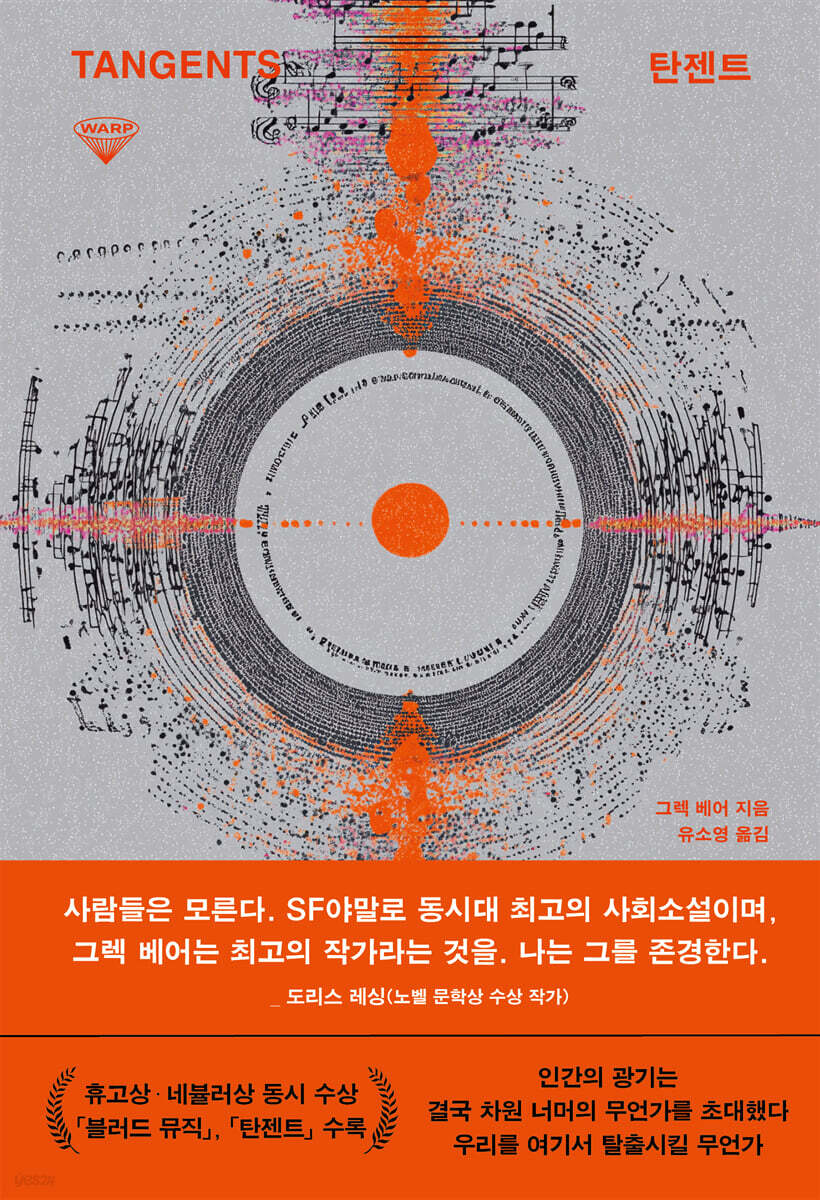
Tangent
 |
Description
Book Introduction
★Includes two Hugo and Nebula Award winners★
★Highly recommended by Nobel Prize-winning author Doris Lessing★
The first science fiction writer to deal with nanotechnology
A collection of Greg Bear's best novels
★ Includes two Hugo and Nebula Award winners!
★The publication of 『Tangent』, a collection of short stories by Greg Bear, a giant in the SF world, bringing together his best work!
“This author has a preternatural gift for writing big, grand science fiction, science fiction that makes you think with your head and feel with your heart.” —Alastair Reynolds (astrophysicist, science fiction writer)
Greg Bear, an author who is recognized for his insightful outlook on the future of science and technology and his persuasive predictions of the events that would occur when it clashes with the ideologies of the time, has published his novel Tangent, the ninth book in the Warp series, by Hubble.
Baer is the author of the official spin-off novels Corona and Rogue Planet, set in the Star Trek and Star Wars universes, the sequel to the Foundation series, Foundation and Chaos, and the Forerunner Saga trilogy (Cryptum, Primordium, and Silentium) set in the Halo universe.
He has won five Nebula Awards, two Hugo Awards, two Endeavour Awards, the China Galaxy Award, and the Japan Nebula Award, and has been nominated for most of the existing science fiction awards. He is particularly notable for being one of only two authors to have won every Nebula Award for fiction (Best Novella, Best Novella, Best Short Story, and Best Short Story) at the time.
Tangent is a collection of nine of Greg Bear's early representative short stories, and is considered by critics and readers at the time to be the pinnacle of his work.
Among the novels included in Tangent, particularly noteworthy works include "Blood Music" and the title work, "Tangent."
Published in 1985, "Blood Music" was the first science fiction novel to feature nanotechnology, and won the Hugo and Nebula Awards.
This novel, which depicts the process of science and technology first being introduced into society in a body horror style, appears at first to be a story about scientific arrogance, but through a twist in the latter half, it ethically examines the violence, such as mass murder, caused by the advancement of science and technology and the social justification for it.
The title work, "Tangent," deeply explores the human emotion of loneliness, and was praised for effectively incorporating dramatic elements into the hard science fiction format, which tends to focus on scientific logic, thus appealing to the general public.
"Tangent" received rave reviews for transcending genre fun and telling a story about "humanity," and won the Hugo Award, Nebula Award, and other awards.
What's unique about the short story collection Tangent is that hard science fiction writer Greg Bear focuses on what happens inside individuals when the realm of science and technology collides with human society.
In several short stories, Bear captures the loneliness, desire, and fear felt by humans when faced with an unreal world.
He deals with the microscopic changes in human daily life due to the advancement of science and technology, vividly showing how human relationships and history can change through this.
This allows readers to clearly understand the various ethical issues hidden behind technological advancements.
This is also a point where we can get a glimpse of Bear's interest in not only science but also politics and society.
★Highly recommended by Nobel Prize-winning author Doris Lessing★
The first science fiction writer to deal with nanotechnology
A collection of Greg Bear's best novels
★ Includes two Hugo and Nebula Award winners!
★The publication of 『Tangent』, a collection of short stories by Greg Bear, a giant in the SF world, bringing together his best work!
“This author has a preternatural gift for writing big, grand science fiction, science fiction that makes you think with your head and feel with your heart.” —Alastair Reynolds (astrophysicist, science fiction writer)
Greg Bear, an author who is recognized for his insightful outlook on the future of science and technology and his persuasive predictions of the events that would occur when it clashes with the ideologies of the time, has published his novel Tangent, the ninth book in the Warp series, by Hubble.
Baer is the author of the official spin-off novels Corona and Rogue Planet, set in the Star Trek and Star Wars universes, the sequel to the Foundation series, Foundation and Chaos, and the Forerunner Saga trilogy (Cryptum, Primordium, and Silentium) set in the Halo universe.
He has won five Nebula Awards, two Hugo Awards, two Endeavour Awards, the China Galaxy Award, and the Japan Nebula Award, and has been nominated for most of the existing science fiction awards. He is particularly notable for being one of only two authors to have won every Nebula Award for fiction (Best Novella, Best Novella, Best Short Story, and Best Short Story) at the time.
Tangent is a collection of nine of Greg Bear's early representative short stories, and is considered by critics and readers at the time to be the pinnacle of his work.
Among the novels included in Tangent, particularly noteworthy works include "Blood Music" and the title work, "Tangent."
Published in 1985, "Blood Music" was the first science fiction novel to feature nanotechnology, and won the Hugo and Nebula Awards.
This novel, which depicts the process of science and technology first being introduced into society in a body horror style, appears at first to be a story about scientific arrogance, but through a twist in the latter half, it ethically examines the violence, such as mass murder, caused by the advancement of science and technology and the social justification for it.
The title work, "Tangent," deeply explores the human emotion of loneliness, and was praised for effectively incorporating dramatic elements into the hard science fiction format, which tends to focus on scientific logic, thus appealing to the general public.
"Tangent" received rave reviews for transcending genre fun and telling a story about "humanity," and won the Hugo Award, Nebula Award, and other awards.
What's unique about the short story collection Tangent is that hard science fiction writer Greg Bear focuses on what happens inside individuals when the realm of science and technology collides with human society.
In several short stories, Bear captures the loneliness, desire, and fear felt by humans when faced with an unreal world.
He deals with the microscopic changes in human daily life due to the advancement of science and technology, vividly showing how human relationships and history can change through this.
This allows readers to clearly understand the various ethical issues hidden behind technological advancements.
This is also a point where we can get a glimpse of Bear's interest in not only science but also politics and society.
- You can preview some of the book's contents.
Preview
index
introduction
01 Blood Music
02 The Road of the Dead
03 Schrödinger's Plague
04 Tangent
05 Sisters
06 The road leads nowhere
07 Slipside Story
08 Webster
09 The Martian Reappears
Author's Note - The Pleasure Machine
01 Blood Music
02 The Road of the Dead
03 Schrödinger's Plague
04 Tangent
05 Sisters
06 The road leads nowhere
07 Slipside Story
08 Webster
09 The Martian Reappears
Author's Note - The Pleasure Machine
Detailed image

Into the book
“They’re talking to me.” He closed his eyes.
For an hour he seemed to be asleep.
I checked his pulse and it was clear and regular, and when I felt his forehead, it was slightly cool.
I brewed more coffee.
I was flipping through a magazine, not knowing what to do, when he opened his eyes again.
“I don’t know how time passes for them.
It took me three or four days to learn the main concepts of language and humanity.
Now they are getting down to business in earnest.
To me.
just now."
“What is that?”
He claimed that thousands of researchers were attached to his neurons.
No detailed explanation was added.
“It’s really efficient.
“It hasn’t broken me yet.”
--- p.37 From "Blood Music"
“I have nothing but them.
They are not afraid, Edward.
“I think this is the first time I’ve felt so close to something.” That gentle smile again.
“I am responsible for them.
“Because I’m their mother.”
“How do you know what they will do?”
He shook his head.
“No, I’m serious.
You say they are civilized….”
“Thousands of civilizations.”
“Yeah, civilizations usually end up being destroyed.
War, environment….”
I was desperate to grasp at anything to calm my growing fear.
I was not capable of handling this enormous situation.
It was the same with Virgil.
He was not at all what one would call insightful or wise when dealing with big problems.
“But I’m the only one in danger.”
“I don’t know.
“Oh my God, Virgil, look what the cells are doing to you!”
“Only for me, only for me!” he said.
“Not someone else.”
--- p.42 From "Blood Music"
The air grew increasingly gray, as if someone was adjusting the contrast on a television screen.
I turned on my high beams, but it didn't help.
I was now sitting in the driver's seat, shivering and muttering.
No one deserves to have this experience.
No matter what they have done, no one deserves to go to hell.
I was scared.
It was getting colder and colder.
--- p.86 From "The Path of the Dead"
At least you can keep your dignity while you're on the road and keep that dogshit out of my ears.
The train driver who transported people to Auschwitz probably thought the same thing.
Yeah, yeah.
I will just be the one to transport each of those engineers to their appropriate desert.
Damn, I just can't take a stance on any of this.
When the time comes for me to go, I will be just as angry, feel guilty, think about Jesus Christ, and complain like the authors.
Throw away all the Jesus stuff.
I stood next to the truck, waiting for further instructions or for the situation to change.
The cargo area became quiet after a while, but a loud noise could be heard from the road.
It was mostly screams coming from afar.
“Nothing,” I muttered to myself, even though I don’t smoke, lighting Bill’s cigarette and taking a deep drag.
“Nothing is worth going to such lengths for.”
I swore I would quit after this delivery.
--- p.81 From "The Road of the Dead"
The camp is run by lunatics.
We have corrupted hell.
If I get caught, I'll end up in the cargo hold too.
If you're reading this, chances are you're in the same situation.
Until then, I want to try my best.
What about you?
--- p.105 From “The Road of the Dead”
“Cobb doesn’t ‘hate’ them either,” I said.
“No, I hate that guy.” Linker nodded inside his large helmet.
“He is afraid of losing his life.
“I’m afraid of losing my pride.”
I shook my helmet to show that I didn't understand.
“Because I can’t understand them.
They are irrational.
It's like they can't 'see' us.
They just run around us, trying to complete some mission... regardless of whether we live or die.
But I have to respect them.
Because he's an alien.
“Because we are the first intelligent life forms we have ever encountered.”
“If they were intelligent,” I reminded him.
“What are you talking about, Mercer, it’s definitely true.
“It’s under construction.”
“They did this too,” I said, waving my gloved hand toward the field littered with broken green bottles.
“Let me be more specific,” he said, his voice tinged with irritation.
“When I was in Mexico, I didn’t understand the nationalists.
Communists too.
Both sides were willing to kill or starve their own people to achieve some petty goal.
It was disgusting.
“Even the faction we supported was disgusting.”
“Martians are not Africans,” I said.
“We can’t expect to understand their motives.”
--- p.344 From "The Martian Who Reappeared"
All of this seemed so absurd to me.
Physicists have always been skeptical, and now I think I know why.
--- p.119 From "Schrödinger's Plague"
“I thought you were just intuitively picturing that direction in your head.
So what you're saying now is... you can actually see the outside world?"
“Yes, there are people there.
No, I can't say exactly what a person is.
It's not my eyes that see them.
The eyes are like muscles, but muscles cannot move in that direction.
Instead, look at my head.
“Probably the brain.”
“Fuck, damn it.” Tusi blinked, calming himself down.
"sorry.
That was harsh.
“Can you show me those people? On the screen?”
“It’s just a shadow.
“It’s something we talked about before,” Pal said.
--- p.139 From "Tangent"
How far would a 4th dimensional being have to travel to get here?
How far have I come to get here?
Before he even realized he had fallen asleep, he was dreaming.
In my dream, the figure of Pal appeared, his eyes wide open, and he flapped his arms as if he was swimming.
I'm fine.
The boy spoke without moving his lips.
Don't worry about me... I'm fine.
I went there because I was curious about what Korea was like.
It's not bad, but I like this place better… .
--- p.146 From "Tangent"
“Don’t do that,” said Leticia.
“Dad and Mom had us…” she hiccuped.
“It’s not that we have to take risks that way.
“Don’t talk to these people as if there’s something wrong with them.”
“Isn’t that so?” My father’s eyes suddenly turned cold.
“It has flaws.”
“They’re my friends!” Leticia screamed.
“Leticia.” Her father flinched.
Leticia knelt on the bed and sat up.
Tears flowed again.
“There’s nothing wrong with those kids! They’re people! They’re just sick.
That's all!”
“That’s nonsense,” said Donald.
“I talked to Lina.
Lina knew it too.
You can't just say that there's something wrong with that person.
“That’s not enough!”
“That kid’s parents should have known sooner.”
--- p.204 From "Sisters"
“You are flesh.
“I gave you substance.”
“You gave me existence, but you didn’t give me substance.”
--- p.318 From "Webster"
They said, "You have to grab everything you can while you have the chance."
For an hour he seemed to be asleep.
I checked his pulse and it was clear and regular, and when I felt his forehead, it was slightly cool.
I brewed more coffee.
I was flipping through a magazine, not knowing what to do, when he opened his eyes again.
“I don’t know how time passes for them.
It took me three or four days to learn the main concepts of language and humanity.
Now they are getting down to business in earnest.
To me.
just now."
“What is that?”
He claimed that thousands of researchers were attached to his neurons.
No detailed explanation was added.
“It’s really efficient.
“It hasn’t broken me yet.”
--- p.37 From "Blood Music"
“I have nothing but them.
They are not afraid, Edward.
“I think this is the first time I’ve felt so close to something.” That gentle smile again.
“I am responsible for them.
“Because I’m their mother.”
“How do you know what they will do?”
He shook his head.
“No, I’m serious.
You say they are civilized….”
“Thousands of civilizations.”
“Yeah, civilizations usually end up being destroyed.
War, environment….”
I was desperate to grasp at anything to calm my growing fear.
I was not capable of handling this enormous situation.
It was the same with Virgil.
He was not at all what one would call insightful or wise when dealing with big problems.
“But I’m the only one in danger.”
“I don’t know.
“Oh my God, Virgil, look what the cells are doing to you!”
“Only for me, only for me!” he said.
“Not someone else.”
--- p.42 From "Blood Music"
The air grew increasingly gray, as if someone was adjusting the contrast on a television screen.
I turned on my high beams, but it didn't help.
I was now sitting in the driver's seat, shivering and muttering.
No one deserves to have this experience.
No matter what they have done, no one deserves to go to hell.
I was scared.
It was getting colder and colder.
--- p.86 From "The Path of the Dead"
At least you can keep your dignity while you're on the road and keep that dogshit out of my ears.
The train driver who transported people to Auschwitz probably thought the same thing.
Yeah, yeah.
I will just be the one to transport each of those engineers to their appropriate desert.
Damn, I just can't take a stance on any of this.
When the time comes for me to go, I will be just as angry, feel guilty, think about Jesus Christ, and complain like the authors.
Throw away all the Jesus stuff.
I stood next to the truck, waiting for further instructions or for the situation to change.
The cargo area became quiet after a while, but a loud noise could be heard from the road.
It was mostly screams coming from afar.
“Nothing,” I muttered to myself, even though I don’t smoke, lighting Bill’s cigarette and taking a deep drag.
“Nothing is worth going to such lengths for.”
I swore I would quit after this delivery.
--- p.81 From "The Road of the Dead"
The camp is run by lunatics.
We have corrupted hell.
If I get caught, I'll end up in the cargo hold too.
If you're reading this, chances are you're in the same situation.
Until then, I want to try my best.
What about you?
--- p.105 From “The Road of the Dead”
“Cobb doesn’t ‘hate’ them either,” I said.
“No, I hate that guy.” Linker nodded inside his large helmet.
“He is afraid of losing his life.
“I’m afraid of losing my pride.”
I shook my helmet to show that I didn't understand.
“Because I can’t understand them.
They are irrational.
It's like they can't 'see' us.
They just run around us, trying to complete some mission... regardless of whether we live or die.
But I have to respect them.
Because he's an alien.
“Because we are the first intelligent life forms we have ever encountered.”
“If they were intelligent,” I reminded him.
“What are you talking about, Mercer, it’s definitely true.
“It’s under construction.”
“They did this too,” I said, waving my gloved hand toward the field littered with broken green bottles.
“Let me be more specific,” he said, his voice tinged with irritation.
“When I was in Mexico, I didn’t understand the nationalists.
Communists too.
Both sides were willing to kill or starve their own people to achieve some petty goal.
It was disgusting.
“Even the faction we supported was disgusting.”
“Martians are not Africans,” I said.
“We can’t expect to understand their motives.”
--- p.344 From "The Martian Who Reappeared"
All of this seemed so absurd to me.
Physicists have always been skeptical, and now I think I know why.
--- p.119 From "Schrödinger's Plague"
“I thought you were just intuitively picturing that direction in your head.
So what you're saying now is... you can actually see the outside world?"
“Yes, there are people there.
No, I can't say exactly what a person is.
It's not my eyes that see them.
The eyes are like muscles, but muscles cannot move in that direction.
Instead, look at my head.
“Probably the brain.”
“Fuck, damn it.” Tusi blinked, calming himself down.
"sorry.
That was harsh.
“Can you show me those people? On the screen?”
“It’s just a shadow.
“It’s something we talked about before,” Pal said.
--- p.139 From "Tangent"
How far would a 4th dimensional being have to travel to get here?
How far have I come to get here?
Before he even realized he had fallen asleep, he was dreaming.
In my dream, the figure of Pal appeared, his eyes wide open, and he flapped his arms as if he was swimming.
I'm fine.
The boy spoke without moving his lips.
Don't worry about me... I'm fine.
I went there because I was curious about what Korea was like.
It's not bad, but I like this place better… .
--- p.146 From "Tangent"
“Don’t do that,” said Leticia.
“Dad and Mom had us…” she hiccuped.
“It’s not that we have to take risks that way.
“Don’t talk to these people as if there’s something wrong with them.”
“Isn’t that so?” My father’s eyes suddenly turned cold.
“It has flaws.”
“They’re my friends!” Leticia screamed.
“Leticia.” Her father flinched.
Leticia knelt on the bed and sat up.
Tears flowed again.
“There’s nothing wrong with those kids! They’re people! They’re just sick.
That's all!”
“That’s nonsense,” said Donald.
“I talked to Lina.
Lina knew it too.
You can't just say that there's something wrong with that person.
“That’s not enough!”
“That kid’s parents should have known sooner.”
--- p.204 From "Sisters"
“You are flesh.
“I gave you substance.”
“You gave me existence, but you didn’t give me substance.”
--- p.318 From "Webster"
They said, "You have to grab everything you can while you have the chance."
--- p.227 From "Slipside Story"
Publisher's Review
A new dimension of ecosystem where non-humans and humans coexist
The first science fiction film to feature nanotechnology
“People don’t know that science fiction is the greatest social novel of our time, and Greg Bear is the greatest writer.
“I admire him.” - Doris Lessing (Nobel Prize-winning author)
Humanity, which has survived by controlling the environment through the accumulation of knowledge and technological development, has ruled as the top predator on Earth, excluding other species.
In his short story collection Tangent, Bear draws attention to the imbalance between human culture and ideology, which changes more slowly than the pace of scientific and technological advancement.
“I am being reassembled from the inside out.”
"Blood Music" is a body horror/SF film that deals with a tragedy that begins with curiosity about cells that have become intelligent through experiments.
The story unfolds as genetic engineer Virgil injects a colony of cells into his body that have gained their own will through computer-learned instructions to "proliferate and improve freely." He seeks out a doctor to prevent the microscopic ecosystem inside his body from developing out of control and taking over his brain.
The short story was revised and republished as a novella the year after winning the Hugo Award, and won France's Apollo Prize.
“Because I’m trapped here.
“Because no one in the outside world cares about me.”
The short story "Tangent," a tribute to Alan Turing, explores the solidarity between two characters suffering from isolated loneliness.
Boy Pal is a character who was adopted from Korea to the United States, and mathematician Tusi is a character who traveled through time from the past to the present.
Two characters, longing to escape this three-dimensional world where no one knows them, discover that there is a civilization in the fourth dimension and attempt to cross over there.
"Tangent" won the Hugo, Nebula, and Nebula Awards, and was nominated for the Locus Award and Germany's Kurd Laswicz Prize.
“How does it feel to look like your grandmother?”
"Sisters," which deals with a future in which children can be designed through genetic engineering, was published in 1990 and was nominated for the Locus Award and the Nebula Award.
Baer's pioneering vision stands out in that it was published before the film Gattaca, which sparked public interest and debate about genetic engineering.
Leticia, a natural child who envies her designed friends, calls herself a "defect."
But as the side effects of the technology start to cause his friends to die one after another, the adults around him start treating the pre-designed children as 'defective'...
In a world turned upside down, among children whose egos are shaken, the final steps of the protagonist Leticia emphasize the moving growth and solidarity between humans and non-humans.
A writer who dedicated his life to the genre of science fiction
Something Beyond Dimensions, Invited by Greg Bear
“What I love most about Greg Bear is that he freely embraces all the realms that science fiction has to offer.
“With his boundless imagination, he led us on a grand journey.”_Robert J.
Sawyer (Hugo Award, Nebula Award, Campbell Award-winning author)
Greg Bear has expanded the possibilities of science fiction by combining the terror of horror, the mystery of fantasy, and the lyricism of fairy tales.
By combining cool-headed scientific narratives with deep characterization, it proved that hard science fiction can embrace emotion and thought.
This combination led us to delve deeper into the meaning of human existence, living in a world where technology functions as civilization, rather than technology itself.
As one of the co-founders of San Diego Comic-Con International, he has contributed significantly to the popularization of science fiction. He served as president of the Science Fiction Writers of America (now known as the Science Fiction and Fantasy Writers Association) for two years, encouraging and consistently supporting artistic talent on science fiction and fantasy topics.
Baer, who was named the "Best Hard SF Writer" by The Ultimate Encyclopedia of Science Fiction, is a person who dreams of a future where SF can transcend genres and media.
The short story collection "Tangent" contains many short stories that will appeal to both science fiction and mystery readers, revealing the author's inclinations, and has since become a source of inspiration for countless science fiction works.
Among the included works, "Dead Man's Road," which deals with the story of a truck driver who takes dead souls to heaven or hell, was produced as an episode of the drama series "Twilight Zone," which was a hit in the 1960s in the United States and served as the origin of "Stranger Things," "Amazing Stories," and "Black Mirror."
"Schrödinger's Plague," which presents a physicist's crazy experiment with the intention of human extinction, has been cited as an inspiration by John Gribbin, author of the classic quantum mechanics science fiction work "In Search of Schrödinger's Cat."
Set in a future where Germany has won World War II, the short story "The Road Leads Nowhere" is a philosophical examination of human karma from an apocalyptic perspective, and was selected and included in "The Best Alternate History Stories of the 20th Century."
Just as the 1968 film 2001: A Space Odyssey, which was criticized for its absurd subject matter of interstellar travel, is now being re-evaluated with a view to space exploration, science fiction may no longer be an unfamiliar subject matter to modern readers.
Greg Bear, on the minority nature of contemporary science fiction, which is inevitably consumed by popular perception, says, “We tend to forget that we stand on bones and muscle.
“A brain without bones and muscles cannot function properly,” he said.
Greg Bear's novels are a tribute to humanity's legacy, a legacy passed down through ever-changing knowledge.
As current knowledge is always changing, our perspectives must have changed a lot as well.
Aren't you curious to see how Greg Bear's science fiction, which attempts to view the world from a wide and diverse perspective, would be perceived by us today?
Author's Note
For many people, printed material is difficult to digest.
Although it has many uses and advantages, it often fails to convey information as quickly and efficiently as other media.
The dilemma is clear.
Print media offers diversity and individual expression, and the active participation of readers who imagine and concretize the message the text is trying to convey.
However, it cannot reach as many people as television or movies.
Television and movies actively appeal to the masses, but often end up spoon-fed cliches to unthinking viewers.
By combining print and visual media, computers will break the monopoly of money and enable more people to work with “pictorial narrative,” a term that will inevitably lead to the development of various art forms.
(…) If it weren’t too late now… .
Let's take a deep breath.
We're entering a possible future, and it's going to take some getting used to.
The first science fiction film to feature nanotechnology
“People don’t know that science fiction is the greatest social novel of our time, and Greg Bear is the greatest writer.
“I admire him.” - Doris Lessing (Nobel Prize-winning author)
Humanity, which has survived by controlling the environment through the accumulation of knowledge and technological development, has ruled as the top predator on Earth, excluding other species.
In his short story collection Tangent, Bear draws attention to the imbalance between human culture and ideology, which changes more slowly than the pace of scientific and technological advancement.
“I am being reassembled from the inside out.”
"Blood Music" is a body horror/SF film that deals with a tragedy that begins with curiosity about cells that have become intelligent through experiments.
The story unfolds as genetic engineer Virgil injects a colony of cells into his body that have gained their own will through computer-learned instructions to "proliferate and improve freely." He seeks out a doctor to prevent the microscopic ecosystem inside his body from developing out of control and taking over his brain.
The short story was revised and republished as a novella the year after winning the Hugo Award, and won France's Apollo Prize.
“Because I’m trapped here.
“Because no one in the outside world cares about me.”
The short story "Tangent," a tribute to Alan Turing, explores the solidarity between two characters suffering from isolated loneliness.
Boy Pal is a character who was adopted from Korea to the United States, and mathematician Tusi is a character who traveled through time from the past to the present.
Two characters, longing to escape this three-dimensional world where no one knows them, discover that there is a civilization in the fourth dimension and attempt to cross over there.
"Tangent" won the Hugo, Nebula, and Nebula Awards, and was nominated for the Locus Award and Germany's Kurd Laswicz Prize.
“How does it feel to look like your grandmother?”
"Sisters," which deals with a future in which children can be designed through genetic engineering, was published in 1990 and was nominated for the Locus Award and the Nebula Award.
Baer's pioneering vision stands out in that it was published before the film Gattaca, which sparked public interest and debate about genetic engineering.
Leticia, a natural child who envies her designed friends, calls herself a "defect."
But as the side effects of the technology start to cause his friends to die one after another, the adults around him start treating the pre-designed children as 'defective'...
In a world turned upside down, among children whose egos are shaken, the final steps of the protagonist Leticia emphasize the moving growth and solidarity between humans and non-humans.
A writer who dedicated his life to the genre of science fiction
Something Beyond Dimensions, Invited by Greg Bear
“What I love most about Greg Bear is that he freely embraces all the realms that science fiction has to offer.
“With his boundless imagination, he led us on a grand journey.”_Robert J.
Sawyer (Hugo Award, Nebula Award, Campbell Award-winning author)
Greg Bear has expanded the possibilities of science fiction by combining the terror of horror, the mystery of fantasy, and the lyricism of fairy tales.
By combining cool-headed scientific narratives with deep characterization, it proved that hard science fiction can embrace emotion and thought.
This combination led us to delve deeper into the meaning of human existence, living in a world where technology functions as civilization, rather than technology itself.
As one of the co-founders of San Diego Comic-Con International, he has contributed significantly to the popularization of science fiction. He served as president of the Science Fiction Writers of America (now known as the Science Fiction and Fantasy Writers Association) for two years, encouraging and consistently supporting artistic talent on science fiction and fantasy topics.
Baer, who was named the "Best Hard SF Writer" by The Ultimate Encyclopedia of Science Fiction, is a person who dreams of a future where SF can transcend genres and media.
The short story collection "Tangent" contains many short stories that will appeal to both science fiction and mystery readers, revealing the author's inclinations, and has since become a source of inspiration for countless science fiction works.
Among the included works, "Dead Man's Road," which deals with the story of a truck driver who takes dead souls to heaven or hell, was produced as an episode of the drama series "Twilight Zone," which was a hit in the 1960s in the United States and served as the origin of "Stranger Things," "Amazing Stories," and "Black Mirror."
"Schrödinger's Plague," which presents a physicist's crazy experiment with the intention of human extinction, has been cited as an inspiration by John Gribbin, author of the classic quantum mechanics science fiction work "In Search of Schrödinger's Cat."
Set in a future where Germany has won World War II, the short story "The Road Leads Nowhere" is a philosophical examination of human karma from an apocalyptic perspective, and was selected and included in "The Best Alternate History Stories of the 20th Century."
Just as the 1968 film 2001: A Space Odyssey, which was criticized for its absurd subject matter of interstellar travel, is now being re-evaluated with a view to space exploration, science fiction may no longer be an unfamiliar subject matter to modern readers.
Greg Bear, on the minority nature of contemporary science fiction, which is inevitably consumed by popular perception, says, “We tend to forget that we stand on bones and muscle.
“A brain without bones and muscles cannot function properly,” he said.
Greg Bear's novels are a tribute to humanity's legacy, a legacy passed down through ever-changing knowledge.
As current knowledge is always changing, our perspectives must have changed a lot as well.
Aren't you curious to see how Greg Bear's science fiction, which attempts to view the world from a wide and diverse perspective, would be perceived by us today?
Author's Note
For many people, printed material is difficult to digest.
Although it has many uses and advantages, it often fails to convey information as quickly and efficiently as other media.
The dilemma is clear.
Print media offers diversity and individual expression, and the active participation of readers who imagine and concretize the message the text is trying to convey.
However, it cannot reach as many people as television or movies.
Television and movies actively appeal to the masses, but often end up spoon-fed cliches to unthinking viewers.
By combining print and visual media, computers will break the monopoly of money and enable more people to work with “pictorial narrative,” a term that will inevitably lead to the development of various art forms.
(…) If it weren’t too late now… .
Let's take a deep breath.
We're entering a possible future, and it's going to take some getting used to.
GOODS SPECIFICS
- Date of issue: November 10, 2025
- Page count, weight, size: 384 pages | 514g | 145*212*20mm
- ISBN13: 9791193078686
You may also like
카테고리
korean


korean

![ELLE 엘르 스페셜 에디션 A형 : 12월 [2025]](http://librairie.coreenne.fr/cdn/shop/files/b8e27a3de6c9538896439686c6b0e8fb.jpg?v=1766436872&width=3840)


