

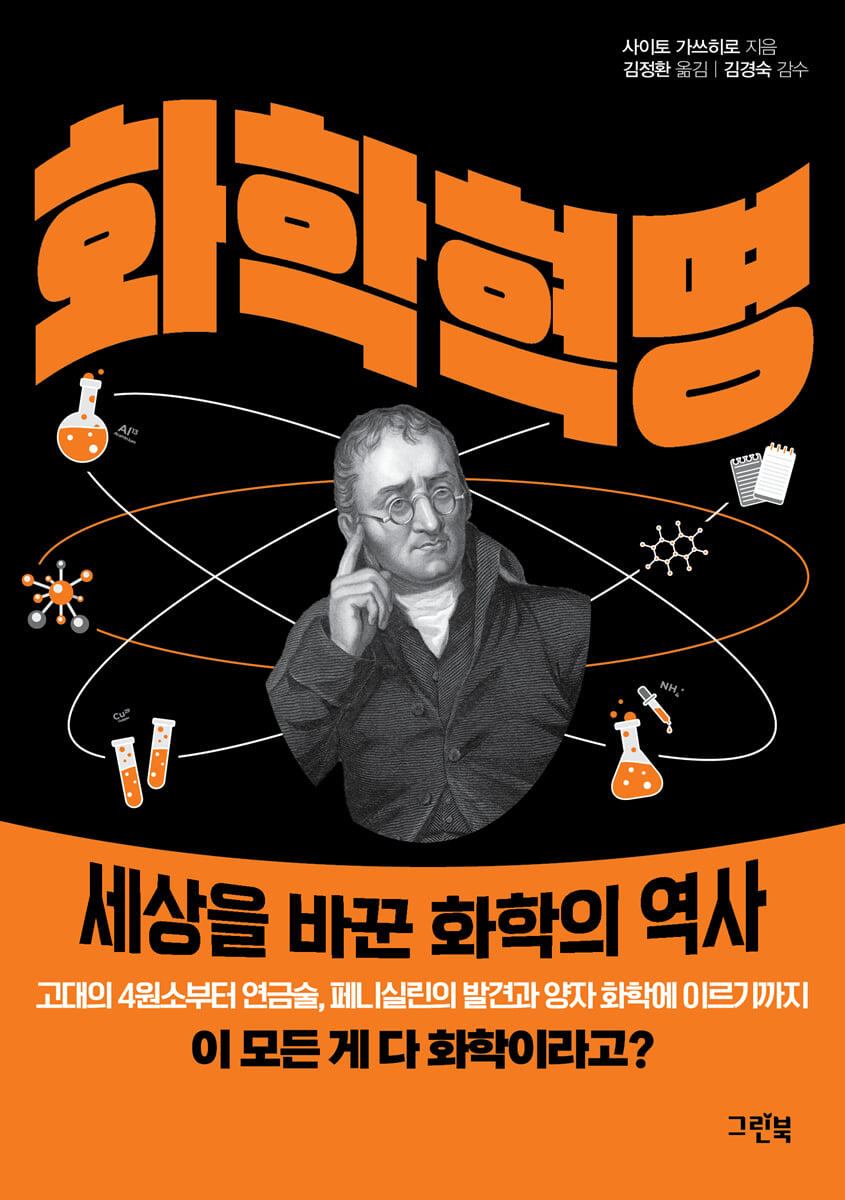
chemical revolution
 |
Description
Book Introduction
Chemistry, the study of all 'materials' in this world
Everything about chemistry through history!
Revolutionary discoveries in chemistry that moved and changed the world.
A book has been published that makes chemistry, a field of science with a particularly high barrier to entry and often perceived as distant, accessible to everyone through a humanistic approach to history.
Green Book's new book, "The Chemical Revolution," provides a comprehensive look into the history of science and the flow of human history through chemistry.
"The Chemical Revolution" delves deeply into the historical development of chemistry and comprehensively examines the impact chemistry has had on human civilization.
Beginning with ancient conceptual chemistry, through medieval alchemy, the Age of Exploration and the Industrial Revolution, and continuing to modern quantum chemistry and the chemistry of life, it examines in detail the important turning points in chemistry.
As we follow the path of the great chemists who emerged like comets and the revolutionary theories they presented to the world, we come to realize that chemistry, a scientific field, is not simply confined to laboratory research, but is deeply rooted in human life.
This book systematically presents important chemical discoveries of each era and how they changed the world.
The scientific content and knowledge covered in the book can be complex and difficult, but one of the book's greatest strengths is that it conveys it in a way that even the general reader can understand.
While the well-placed tables and photographs thoroughly cover the fundamental concepts of chemistry, the witty illustrations relieve tension and further stimulate interest.
For readers who want a comprehensive overview of chemistry and those who want to rediscover the joy of chemistry, "The Chemical Revolution" is the perfect general science book.
Enter a new world of chemistry with Green Book's "Chemical Revolution," which serves as both a basic science introduction and an in-depth chemistry textbook.
Everything about chemistry through history!
Revolutionary discoveries in chemistry that moved and changed the world.
A book has been published that makes chemistry, a field of science with a particularly high barrier to entry and often perceived as distant, accessible to everyone through a humanistic approach to history.
Green Book's new book, "The Chemical Revolution," provides a comprehensive look into the history of science and the flow of human history through chemistry.
"The Chemical Revolution" delves deeply into the historical development of chemistry and comprehensively examines the impact chemistry has had on human civilization.
Beginning with ancient conceptual chemistry, through medieval alchemy, the Age of Exploration and the Industrial Revolution, and continuing to modern quantum chemistry and the chemistry of life, it examines in detail the important turning points in chemistry.
As we follow the path of the great chemists who emerged like comets and the revolutionary theories they presented to the world, we come to realize that chemistry, a scientific field, is not simply confined to laboratory research, but is deeply rooted in human life.
This book systematically presents important chemical discoveries of each era and how they changed the world.
The scientific content and knowledge covered in the book can be complex and difficult, but one of the book's greatest strengths is that it conveys it in a way that even the general reader can understand.
While the well-placed tables and photographs thoroughly cover the fundamental concepts of chemistry, the witty illustrations relieve tension and further stimulate interest.
For readers who want a comprehensive overview of chemistry and those who want to rediscover the joy of chemistry, "The Chemical Revolution" is the perfect general science book.
Enter a new world of chemistry with Green Book's "Chemical Revolution," which serves as both a basic science introduction and an in-depth chemistry textbook.
- You can preview some of the book's contents.
Preview
index
Part 1 Why was ancient chemistry conceptual?
Part 2: The Medieval Chemistry Behind the Witch
Part 3: The Alchemy That Grew Chemistry
Part 4 Chemistry in the Age of Exploration and the Industrial Revolution
Part 5: The Age of Chemistry: The Explosion of Laws and Theorems
Part 6: A New Chemistry Embracing Quantum Mechanics
Part 7: Peace or War? The Age of Experimental Chemistry
Part 8: The Chemistry of Life Unlocked by Genes
Part 2: The Medieval Chemistry Behind the Witch
Part 3: The Alchemy That Grew Chemistry
Part 4 Chemistry in the Age of Exploration and the Industrial Revolution
Part 5: The Age of Chemistry: The Explosion of Laws and Theorems
Part 6: A New Chemistry Embracing Quantum Mechanics
Part 7: Peace or War? The Age of Experimental Chemistry
Part 8: The Chemistry of Life Unlocked by Genes
Detailed image

Publisher's Review
Looking at the history of chemistry is like looking at the history of the world.
Readers of this book will look back on the path chemistry has taken and consider the path it should take in the future.
If you find yourself thinking about the future of modern chemistry,
There can be no greater joy for me than that.
Katsuhiro Saito (Author, Doctor of Science)
From the four ancient elements to modern life chemistry,
All of this is chemistry?
Part 1 Why was ancient chemistry conceptual?
At that time, people relied on philosophical thinking and abstract concepts to understand the material world, and interpreted natural phenomena from mythological or religious perspectives.
In ancient Greece, the prevailing idea was that all matter was composed of four elements: earth, water, air, and fire, which formed the basis of alchemy.
This conceptual approach contrasts with modern chemical research through experimentation and observation, and shows how the development of science has shifted from philosophical thinking to empirical research.
Part 2: The Medieval Chemistry Behind the Witch
Chapter 2 covers the development of medieval chemistry and the stories behind it.
It illuminates how medieval chemistry was connected to society, culture, and politics through the influence of Arabian science on modern Western science, the development of chemistry in India and China, the use of drugs in religion, the military use of stimulants, the truth about witch trials, and the culture of poison and assassination during the Renaissance.
Part 3: The Alchemy That Grew Chemistry
Alchemy developed through experimentation based on ancient Greek learning, and led to various inventions and discoveries.
This process gave birth to a new scientific discipline called chemistry, which would not have been possible without the important contributions of the alchemists of the past.
Alchemists believed that various minerals were originally one type and that transmutation was possible.
This belief led to research into converting cheap metals into valuable ones, which ultimately laid the foundation for modern chemistry.
Alchemical research and experimentation provided the essential technical and philosophical foundation for the development of chemistry.
Part 4 Chemistry in the Age of Exploration and the Industrial Revolution
The Age of Exploration and the Industrial Revolution saw significant scientific advances, including the exploration of new trade routes for gold and spices, the energy revolution fueled by coal, Newton's scientific discoveries, the creation of vaccines, and the development of general anesthesia.
In particular, the Industrial Revolution made possible new production activities powered by machines, which spread across the globe and brought about widespread changes in social and economic structures.
These changes laid an important foundation for the development of modern chemistry.
Part 5: The Age of Chemistry: The Explosion of Laws and Theorems
Chapter 5 covers the major chemical laws along with the importance of quantitative analysis in chemistry.
The use of various measuring tools has made quantitative analysis possible, and Lavoisier's law of conservation of mass, Proust's law of definite proportions, Dalton's law of multiple proportions and atomic theory, and Gay-Lussac's laws of gaseous reactions are introduced in order.
The discoveries of this era played a decisive role in transforming chemistry into a quantitative science.
Next, we will learn about the differences between atoms, molecules, and elements, as well as the early atomic models.
Part 6: A New Chemistry Embracing Quantum Mechanics
In the early 20th century, the emergence of relativity and quantum mechanics ushered in a new era in science, laying the foundation for quantum chemistry, which explains both the wave and particle nature of matter.
With the advent of quantum chemistry, which forms the foundation of modern chemistry, mathematics became necessary in chemistry, providing scientists with a new perspective on matter.
Chapter 6 shows how quantum theory has had a fundamental impact on chemistry.
You can also organize concepts such as quantization, uncertainty principle, and electron clouds.
Part 7: Peace or War? The Age of Experimental Chemistry
The discovery of the Haber-Bosch process benefited mankind by improving agricultural productivity, but it was also used as a means of war in the form of weapons and bombs.
The discovery of antibiotics like penicillin revolutionized medicine, and advances in polymer chemistry led to the creation of synthetic materials like nylon.
The structural determination and synthesis of natural products demonstrate how scientific challenges can be overcome, while supramolecular chemistry has revealed innovative technological advances at the molecular level.
Chapter 7 provides a broad overview of the benefits and challenges chemistry has brought to humanity, as well as the ethical aspects of scientific discovery.
Part 8: The Chemistry of Life Unlocked by Genes
Chapter 8 covers advances in genetic engineering and biochemistry, with a particular focus on advances in gene editing and recombinant DNA technology.
These technologies have opened up new horizons in biological research, contributing to a greater understanding of diseases and the development of new treatments through the addition, deletion, or modification of specific genes.
Next, we explain how the immune system works and the history of modern immunology, and introduce the development and characteristics of mRNA vaccines.
Finally, we examine the ethical and social challenges of artificial life forms and the risks of their military use.
This will allow us to understand how biochemistry manipulates genetic information to explore the nature of life, and what opportunities and challenges these advances present to humanity.
A New Way to Experience Chemistry, "The Chemical Revolution"
What makes chemistry different from other scientific fields is that it deals with matter.
Chemistry is the science that studies all substances by reducing them to the level of atoms and molecules.
There's chemistry in nylon, in vaccines, and even in the transparent touch panels of ATMs.
Chemistry is active in many aspects of our daily lives and industry.
This book explains, in the simplest possible terms, how chemistry was born and developed, how the medieval chemical techniques known as alchemy contributed to the development of modern and contemporary chemistry, and what laws and theorems chemists have created. It continues the story to present-day experimental chemistry, quantum chemistry, and even the chemistry of life opened up by genes.
It covers a wide range of eras and topics, and contains everything about chemistry.
Beyond being a simple chemistry book, "The Chemical Revolution" offers a profound exploration of how science has interacted with humanity throughout history.
It also provides food for thought about the impact of scientific advancement on human civilization.
Through this book, readers will gain insight into the historical development of chemistry, as well as its present and future, and gain a new perspective on the world through the lens of chemistry.
Readers of this book will look back on the path chemistry has taken and consider the path it should take in the future.
If you find yourself thinking about the future of modern chemistry,
There can be no greater joy for me than that.
Katsuhiro Saito (Author, Doctor of Science)
From the four ancient elements to modern life chemistry,
All of this is chemistry?
Part 1 Why was ancient chemistry conceptual?
At that time, people relied on philosophical thinking and abstract concepts to understand the material world, and interpreted natural phenomena from mythological or religious perspectives.
In ancient Greece, the prevailing idea was that all matter was composed of four elements: earth, water, air, and fire, which formed the basis of alchemy.
This conceptual approach contrasts with modern chemical research through experimentation and observation, and shows how the development of science has shifted from philosophical thinking to empirical research.
Part 2: The Medieval Chemistry Behind the Witch
Chapter 2 covers the development of medieval chemistry and the stories behind it.
It illuminates how medieval chemistry was connected to society, culture, and politics through the influence of Arabian science on modern Western science, the development of chemistry in India and China, the use of drugs in religion, the military use of stimulants, the truth about witch trials, and the culture of poison and assassination during the Renaissance.
Part 3: The Alchemy That Grew Chemistry
Alchemy developed through experimentation based on ancient Greek learning, and led to various inventions and discoveries.
This process gave birth to a new scientific discipline called chemistry, which would not have been possible without the important contributions of the alchemists of the past.
Alchemists believed that various minerals were originally one type and that transmutation was possible.
This belief led to research into converting cheap metals into valuable ones, which ultimately laid the foundation for modern chemistry.
Alchemical research and experimentation provided the essential technical and philosophical foundation for the development of chemistry.
Part 4 Chemistry in the Age of Exploration and the Industrial Revolution
The Age of Exploration and the Industrial Revolution saw significant scientific advances, including the exploration of new trade routes for gold and spices, the energy revolution fueled by coal, Newton's scientific discoveries, the creation of vaccines, and the development of general anesthesia.
In particular, the Industrial Revolution made possible new production activities powered by machines, which spread across the globe and brought about widespread changes in social and economic structures.
These changes laid an important foundation for the development of modern chemistry.
Part 5: The Age of Chemistry: The Explosion of Laws and Theorems
Chapter 5 covers the major chemical laws along with the importance of quantitative analysis in chemistry.
The use of various measuring tools has made quantitative analysis possible, and Lavoisier's law of conservation of mass, Proust's law of definite proportions, Dalton's law of multiple proportions and atomic theory, and Gay-Lussac's laws of gaseous reactions are introduced in order.
The discoveries of this era played a decisive role in transforming chemistry into a quantitative science.
Next, we will learn about the differences between atoms, molecules, and elements, as well as the early atomic models.
Part 6: A New Chemistry Embracing Quantum Mechanics
In the early 20th century, the emergence of relativity and quantum mechanics ushered in a new era in science, laying the foundation for quantum chemistry, which explains both the wave and particle nature of matter.
With the advent of quantum chemistry, which forms the foundation of modern chemistry, mathematics became necessary in chemistry, providing scientists with a new perspective on matter.
Chapter 6 shows how quantum theory has had a fundamental impact on chemistry.
You can also organize concepts such as quantization, uncertainty principle, and electron clouds.
Part 7: Peace or War? The Age of Experimental Chemistry
The discovery of the Haber-Bosch process benefited mankind by improving agricultural productivity, but it was also used as a means of war in the form of weapons and bombs.
The discovery of antibiotics like penicillin revolutionized medicine, and advances in polymer chemistry led to the creation of synthetic materials like nylon.
The structural determination and synthesis of natural products demonstrate how scientific challenges can be overcome, while supramolecular chemistry has revealed innovative technological advances at the molecular level.
Chapter 7 provides a broad overview of the benefits and challenges chemistry has brought to humanity, as well as the ethical aspects of scientific discovery.
Part 8: The Chemistry of Life Unlocked by Genes
Chapter 8 covers advances in genetic engineering and biochemistry, with a particular focus on advances in gene editing and recombinant DNA technology.
These technologies have opened up new horizons in biological research, contributing to a greater understanding of diseases and the development of new treatments through the addition, deletion, or modification of specific genes.
Next, we explain how the immune system works and the history of modern immunology, and introduce the development and characteristics of mRNA vaccines.
Finally, we examine the ethical and social challenges of artificial life forms and the risks of their military use.
This will allow us to understand how biochemistry manipulates genetic information to explore the nature of life, and what opportunities and challenges these advances present to humanity.
A New Way to Experience Chemistry, "The Chemical Revolution"
What makes chemistry different from other scientific fields is that it deals with matter.
Chemistry is the science that studies all substances by reducing them to the level of atoms and molecules.
There's chemistry in nylon, in vaccines, and even in the transparent touch panels of ATMs.
Chemistry is active in many aspects of our daily lives and industry.
This book explains, in the simplest possible terms, how chemistry was born and developed, how the medieval chemical techniques known as alchemy contributed to the development of modern and contemporary chemistry, and what laws and theorems chemists have created. It continues the story to present-day experimental chemistry, quantum chemistry, and even the chemistry of life opened up by genes.
It covers a wide range of eras and topics, and contains everything about chemistry.
Beyond being a simple chemistry book, "The Chemical Revolution" offers a profound exploration of how science has interacted with humanity throughout history.
It also provides food for thought about the impact of scientific advancement on human civilization.
Through this book, readers will gain insight into the historical development of chemistry, as well as its present and future, and gain a new perspective on the world through the lens of chemistry.
GOODS SPECIFICS
- Date of issue: March 18, 2024
- Page count, weight, size: 232 pages | 372g | 148*210*15mm
- ISBN13: 9788955884623
- ISBN10: 8955884621
You may also like
카테고리
korean


korean

![GQ KOREA Mark (Monthly): December [2025]](http://librairie.coreenne.fr/cdn/shop/files/8ef265dbbfbf186523ed75ba7319009d.jpg?v=1765340328&width=3840)


