

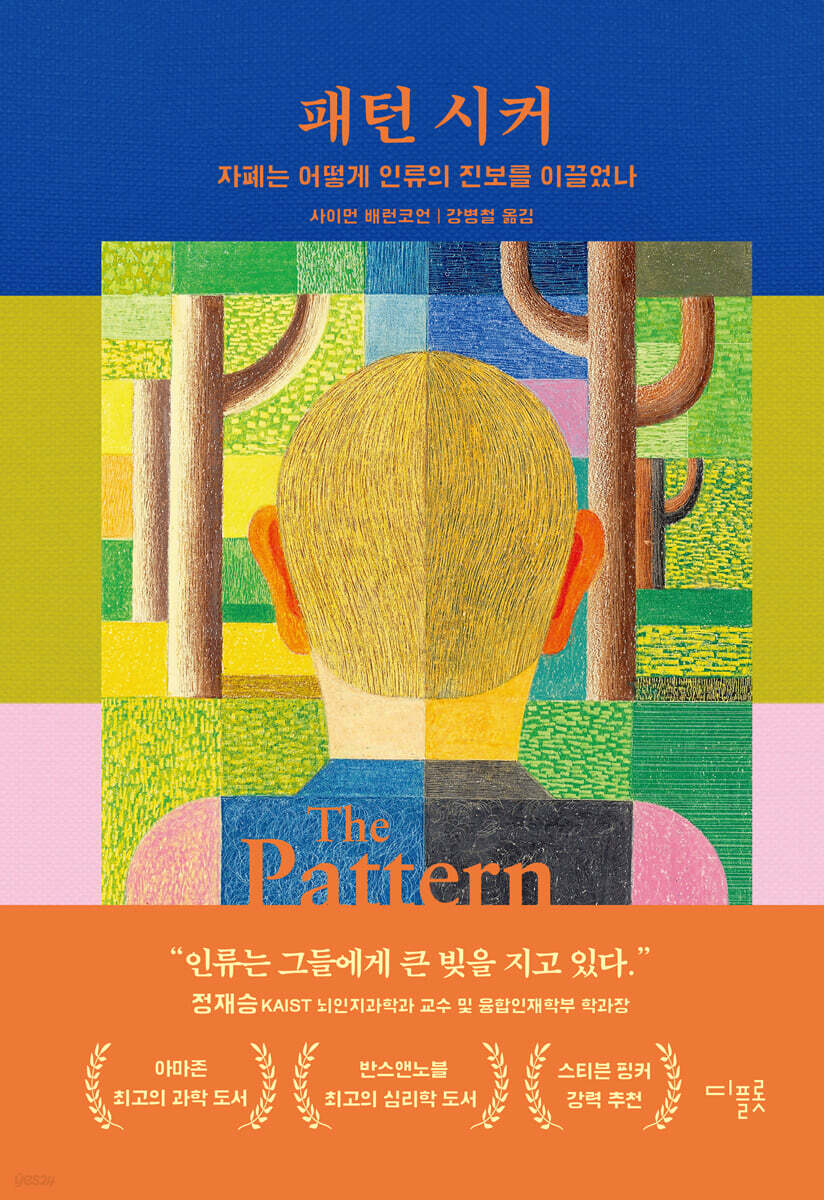
Pattern Seeker
 |
Description
Book Introduction
About another force that created modern humans, along with the ability to empathize.
“After reading this book, you will realize that humanity owes a great debt to people with autism.
Autism is a unique characteristic of people who have a different way of looking at the world.
“It is thanks to this special quality that human civilization was able to become systematized and develop.”
- Professor Jaeseung Jeong (Professor of Brain and Cognitive Sciences and Head of the Department of Convergence Studies, KAIST)
How did Homo sapiens, before ushering in a great civilizational transition through artificial intelligence, leap forward to become a being that dominates the entire planet? The twin pillars of human progress, as seen through the lens of science, are empathy and systematization.
Empathy explains cooperation and many forms of social relationships, but this ability alone did not bring humanity to where we are today.
People with a superior ability to 'systematize', to meticulously analyze objects and nature according to certain standards and rules, were able to create almost everything in civilization, including tools, language, institutions, and laws.
And the author's revelation is that the minds of people with highly developed systematization abilities and those with autism are very similar. This is the secret of human progress.
In short, this book provides a clear answer to the refreshing question: "How did autism foster human invention?"
“After reading this book, you will realize that humanity owes a great debt to people with autism.
Autism is a unique characteristic of people who have a different way of looking at the world.
“It is thanks to this special quality that human civilization was able to become systematized and develop.”
- Professor Jaeseung Jeong (Professor of Brain and Cognitive Sciences and Head of the Department of Convergence Studies, KAIST)
How did Homo sapiens, before ushering in a great civilizational transition through artificial intelligence, leap forward to become a being that dominates the entire planet? The twin pillars of human progress, as seen through the lens of science, are empathy and systematization.
Empathy explains cooperation and many forms of social relationships, but this ability alone did not bring humanity to where we are today.
People with a superior ability to 'systematize', to meticulously analyze objects and nature according to certain standards and rules, were able to create almost everything in civilization, including tools, language, institutions, and laws.
And the author's revelation is that the minds of people with highly developed systematization abilities and those with autism are very similar. This is the secret of human progress.
In short, this book provides a clear answer to the refreshing question: "How did autism foster human invention?"
- You can preview some of the book's contents.
Preview
index
Recommendation
1. Natural pattern seeker
2 Systematization Mechanism
3 Five Types of Brain
4 The Inventor's Mind
5 Revolution in the Brain
6 System Blindness - Why can't monkeys skateboard?
7 Battle of the Giants
8 Sex in the Valley
9 Raising Future Inventors
Acknowledgements
Translator's Note
Appendix 1: SQ and EQ Tests to Find Your Brain Type
Appendix 2: Identifying Autistic Tendencies with the AQ Test
annotation
Image caption and source
Search
1. Natural pattern seeker
2 Systematization Mechanism
3 Five Types of Brain
4 The Inventor's Mind
5 Revolution in the Brain
6 System Blindness - Why can't monkeys skateboard?
7 Battle of the Giants
8 Sex in the Valley
9 Raising Future Inventors
Acknowledgements
Translator's Note
Appendix 1: SQ and EQ Tests to Find Your Brain Type
Appendix 2: Identifying Autistic Tendencies with the AQ Test
annotation
Image caption and source
Search
Detailed image

Into the book
One teacher, overcome with anger and despair, said that Al's brain had "gone bad."
Although it meant to be a jumbled mess, Al's mind was far from being confused.
It was the exact opposite.
The endless questioning was a quest for clarity.
People's explanations of how things worked were vague to Al.
I wanted to portray a world that was orderly and well-grounded.
From the egg's perspective, people's thinking was sloppy and inaccurate.
--- From "1 Natural Pattern Seeker"
How do we invent? What happens in the human mind when we invent? Are humans the only species with the ability to invent? At what point in our evolutionary history did our ancestors begin to invent? What, if any, intriguing connection exists between invention and autism? Does this connection hold true across the entire autism spectrum, even in those with learning disabilities or severely limited language skills?
--- From "1 Natural Pattern Seeker"
Even from the age of two, humans use rudimentary if-and-then logic to organize things.
This ability is not found in any other animal species, and is evidence that brain cells are wired to detect these patterns to some degree, innately.
Even before they start school, children ask why objects they see for the first time move differently than expected and try to find explanations (causes) for them on their own.
--- From "2 Systematization Mechanisms"
The cognitive revolution was a defining event that transformed the way we see the world and empowered us to invent.
But the remarkable changes that have occurred in the human brain are not due solely to systematization mechanisms.
The second change, the empathy circuit, is also a mechanism that exists only in the human brain and has become the driving force for Homo sapiens to evolve in a different direction from other animals.
--- From "2 Systematization Mechanisms"
Let's take a closer look at highly systematized people.
According to my theory, these are the central figures in the grand narrative of humanity's invention.
Because we pursue systematization without resting for even a moment.
Over the past 70,000 to 100,000 years, they have created new instruments, discovered new foods, developed new technologies, and invented new tools.
The reason for this assumption is that many modern inventors exhibit highly systematized characteristics.
--- From "The Five Types of the Brain"
Is the mind of a highly organized person the same type as that of an autistic person? To answer this question, we must return to the British brain type study.
With over 36,000 participants with autism, it is the largest psychological study of autism ever conducted.
Among autistic people, there were unusually many with type S or extreme type S.
The two brain types combined accounted for 62 percent of autistic males, compared with 44 percent of non-autistic males, and for 50 percent of autistic females, nearly twice the rate for non-autistic females.
--- From "The Five Types of the Brain"
We already know that autism is partly genetic.
For the following three reasons:
First, although only 1 to 2 percent of the general population is diagnosed with autism, a child born into a family with a sibling diagnosed with autism has a 10 to 20 percent chance of being autistic.
Second, if one twin has autism, the likelihood that the other will also have autism is much greater in identical twins than in fraternal twins.
Finally, there are over 100 rare genetic variations or mutations associated with autism.
--- From "The Five Types of the Brain"
A survey of 400 autistic adults who visited our clinic in Cambridge, like Jonah, revealed a disheartening two-thirds had considered suicide and a third had actually attempted it.
Could there be a clearer indicator to society that autistic people are suffering and vulnerable enough to need immediate intervention?
--- From "The Mind of the Four Inventors"
Difficulties with cognitive empathy are a typical problem experienced by people with autism.
Yet, those who know Jonah agree that he is always considerate of others.
When Jonah hears that someone is sick, he thinks hard about what he can do for them.
When I hear that someone has been treated unfairly or is suffering, I feel deeply hurt and try to do what I can.
Like many people with autism, his emotional empathy is intact.
In this sense, autistic people are the exact opposite of psychopaths, who have very high cognitive empathy but dull emotional empathy.
Unlike autistic people, psychopaths have no interest in how others feel.
--- From "The Mind of the Four Inventors"
If you define 'invention' as the ability to create new tools more than once, then I would argue that none of these hominids had the ability to invent.
The reason for using such a strict definition is that animals sometimes use new tools as a result of a combination of chance and associative learning.
Associative learning means repeating actions in a certain order when a reward is given.
Associative learning is widespread in the animal kingdom and requires a certain level of intelligence, but I argue that associative learning is not the same as generative invention.
--- From "5 Revolutions in the Brain"
There are various theories about the cause of Neanderthal extinction, but in any case, they could not have survived Homo sapiens, who had developed complex tools through newly evolved systematization mechanisms and developed complex social interactions and deception through empathy circuits.
The absence of true inventions before modern humans, and the fact that evidence of such inventions appears in the archaeological record of modern humans, clearly demonstrates that systematization mechanisms have evolved.
--- From "5 Revolutions in the Brain"
Unlike us, animals don't experiment, pursue, or play with if-and-then patterns because they're "overwhelmed by curiosity."
Even though monkeys and apes see the same information as we do, such as the changing shape of waves or the up and down movement of a seesaw, they simply ignore it.
Because there is no systematization mechanism in the brain.
They are system blind.
There is no systematic thinking whatsoever.
--- From "6 System Blindness - Why Can't Monkeys Skateboard?"
Could this recurrent nature of language be a competing theory explaining human inventiveness? I don't think so.
There are several reasons.
(…) First, regression is not a phenomenon observed only in language.
It is also a core characteristic of music.
(…) Second, people who have lost their language skills due to a stroke or who have not developed their language skills to begin with can also become excellent musicians.
(…) Third, mothers can capture their babies’ attention with simple games and various rhythmic patterns, such as “Baby Shark, doo doo doo doo doo,” long before their babies understand linguistic regression.
--- From "The Battle of the Seven Giants"
Eindhoven was a hub where two giant magnets attracted highly organized people.
It was the Eindhoven University of Technology (the Dutch equivalent of MIT) and the Philips factory that had been protecting the city for over 100 years.
(…) designed the ‘Eindhoven Study’ together with the epidemiology team.
The study looked at how many children with autism there were in Eindhoven compared to two other Dutch cities, Utrecht and Haarlem.
We contacted all elementary and secondary schools in three cities to determine how many children had been diagnosed with autism and were on special education registries.
More than half of the schools participated, providing information on over 60,000 children.
The results came in one after another and were tallied.
I couldn't help but be surprised.
The prediction was spot on.
In Eindhoven, 229 out of 10,000 children were diagnosed with autism, compared to 84 in Haarlem and 57 in Utrecht.
Autism was more than twice as common in Eindhoven.
--- From "8 Sex in the Valley"
The concept of neurodiversity offers a refreshingly different perspective on the different types of brains that exist in the world.
Because we recognize that there is more than just one way the brain develops.
Neurodiversity is a truly revolutionary concept because it fundamentally introduces a whole new worldview.
In the world of neurodiversity, there are naturally countless, diverse types of brains.
It is completely different from the old and inaccurate view that there are only two things: normal and abnormal.
--- From "9 Raising Future Inventors"
It is clear that the minds of autistic people are different.
There is no way to say which freshwater fish are normal and which are abnormal.
Because we have evolved in different ways to survive and thrive in specific environments, we simply cannot survive in environments that do not suit us.
People are physically different, like blue eyes and brown eyes, or tall and short.
Of course, it is also different psychologically.
Because they are so different, they each have their own strengths and weaknesses.
It's not at all surprising that some people have exceptionally good memories, others have remarkable attention to detail, and others feel uncomfortable with casual conversation but comfortable with structured, systematic activities.
Although it meant to be a jumbled mess, Al's mind was far from being confused.
It was the exact opposite.
The endless questioning was a quest for clarity.
People's explanations of how things worked were vague to Al.
I wanted to portray a world that was orderly and well-grounded.
From the egg's perspective, people's thinking was sloppy and inaccurate.
--- From "1 Natural Pattern Seeker"
How do we invent? What happens in the human mind when we invent? Are humans the only species with the ability to invent? At what point in our evolutionary history did our ancestors begin to invent? What, if any, intriguing connection exists between invention and autism? Does this connection hold true across the entire autism spectrum, even in those with learning disabilities or severely limited language skills?
--- From "1 Natural Pattern Seeker"
Even from the age of two, humans use rudimentary if-and-then logic to organize things.
This ability is not found in any other animal species, and is evidence that brain cells are wired to detect these patterns to some degree, innately.
Even before they start school, children ask why objects they see for the first time move differently than expected and try to find explanations (causes) for them on their own.
--- From "2 Systematization Mechanisms"
The cognitive revolution was a defining event that transformed the way we see the world and empowered us to invent.
But the remarkable changes that have occurred in the human brain are not due solely to systematization mechanisms.
The second change, the empathy circuit, is also a mechanism that exists only in the human brain and has become the driving force for Homo sapiens to evolve in a different direction from other animals.
--- From "2 Systematization Mechanisms"
Let's take a closer look at highly systematized people.
According to my theory, these are the central figures in the grand narrative of humanity's invention.
Because we pursue systematization without resting for even a moment.
Over the past 70,000 to 100,000 years, they have created new instruments, discovered new foods, developed new technologies, and invented new tools.
The reason for this assumption is that many modern inventors exhibit highly systematized characteristics.
--- From "The Five Types of the Brain"
Is the mind of a highly organized person the same type as that of an autistic person? To answer this question, we must return to the British brain type study.
With over 36,000 participants with autism, it is the largest psychological study of autism ever conducted.
Among autistic people, there were unusually many with type S or extreme type S.
The two brain types combined accounted for 62 percent of autistic males, compared with 44 percent of non-autistic males, and for 50 percent of autistic females, nearly twice the rate for non-autistic females.
--- From "The Five Types of the Brain"
We already know that autism is partly genetic.
For the following three reasons:
First, although only 1 to 2 percent of the general population is diagnosed with autism, a child born into a family with a sibling diagnosed with autism has a 10 to 20 percent chance of being autistic.
Second, if one twin has autism, the likelihood that the other will also have autism is much greater in identical twins than in fraternal twins.
Finally, there are over 100 rare genetic variations or mutations associated with autism.
--- From "The Five Types of the Brain"
A survey of 400 autistic adults who visited our clinic in Cambridge, like Jonah, revealed a disheartening two-thirds had considered suicide and a third had actually attempted it.
Could there be a clearer indicator to society that autistic people are suffering and vulnerable enough to need immediate intervention?
--- From "The Mind of the Four Inventors"
Difficulties with cognitive empathy are a typical problem experienced by people with autism.
Yet, those who know Jonah agree that he is always considerate of others.
When Jonah hears that someone is sick, he thinks hard about what he can do for them.
When I hear that someone has been treated unfairly or is suffering, I feel deeply hurt and try to do what I can.
Like many people with autism, his emotional empathy is intact.
In this sense, autistic people are the exact opposite of psychopaths, who have very high cognitive empathy but dull emotional empathy.
Unlike autistic people, psychopaths have no interest in how others feel.
--- From "The Mind of the Four Inventors"
If you define 'invention' as the ability to create new tools more than once, then I would argue that none of these hominids had the ability to invent.
The reason for using such a strict definition is that animals sometimes use new tools as a result of a combination of chance and associative learning.
Associative learning means repeating actions in a certain order when a reward is given.
Associative learning is widespread in the animal kingdom and requires a certain level of intelligence, but I argue that associative learning is not the same as generative invention.
--- From "5 Revolutions in the Brain"
There are various theories about the cause of Neanderthal extinction, but in any case, they could not have survived Homo sapiens, who had developed complex tools through newly evolved systematization mechanisms and developed complex social interactions and deception through empathy circuits.
The absence of true inventions before modern humans, and the fact that evidence of such inventions appears in the archaeological record of modern humans, clearly demonstrates that systematization mechanisms have evolved.
--- From "5 Revolutions in the Brain"
Unlike us, animals don't experiment, pursue, or play with if-and-then patterns because they're "overwhelmed by curiosity."
Even though monkeys and apes see the same information as we do, such as the changing shape of waves or the up and down movement of a seesaw, they simply ignore it.
Because there is no systematization mechanism in the brain.
They are system blind.
There is no systematic thinking whatsoever.
--- From "6 System Blindness - Why Can't Monkeys Skateboard?"
Could this recurrent nature of language be a competing theory explaining human inventiveness? I don't think so.
There are several reasons.
(…) First, regression is not a phenomenon observed only in language.
It is also a core characteristic of music.
(…) Second, people who have lost their language skills due to a stroke or who have not developed their language skills to begin with can also become excellent musicians.
(…) Third, mothers can capture their babies’ attention with simple games and various rhythmic patterns, such as “Baby Shark, doo doo doo doo doo,” long before their babies understand linguistic regression.
--- From "The Battle of the Seven Giants"
Eindhoven was a hub where two giant magnets attracted highly organized people.
It was the Eindhoven University of Technology (the Dutch equivalent of MIT) and the Philips factory that had been protecting the city for over 100 years.
(…) designed the ‘Eindhoven Study’ together with the epidemiology team.
The study looked at how many children with autism there were in Eindhoven compared to two other Dutch cities, Utrecht and Haarlem.
We contacted all elementary and secondary schools in three cities to determine how many children had been diagnosed with autism and were on special education registries.
More than half of the schools participated, providing information on over 60,000 children.
The results came in one after another and were tallied.
I couldn't help but be surprised.
The prediction was spot on.
In Eindhoven, 229 out of 10,000 children were diagnosed with autism, compared to 84 in Haarlem and 57 in Utrecht.
Autism was more than twice as common in Eindhoven.
--- From "8 Sex in the Valley"
The concept of neurodiversity offers a refreshingly different perspective on the different types of brains that exist in the world.
Because we recognize that there is more than just one way the brain develops.
Neurodiversity is a truly revolutionary concept because it fundamentally introduces a whole new worldview.
In the world of neurodiversity, there are naturally countless, diverse types of brains.
It is completely different from the old and inaccurate view that there are only two things: normal and abnormal.
--- From "9 Raising Future Inventors"
It is clear that the minds of autistic people are different.
There is no way to say which freshwater fish are normal and which are abnormal.
Because we have evolved in different ways to survive and thrive in specific environments, we simply cannot survive in environments that do not suit us.
People are physically different, like blue eyes and brown eyes, or tall and short.
Of course, it is also different psychologically.
Because they are so different, they each have their own strengths and weaknesses.
It's not at all surprising that some people have exceptionally good memories, others have remarkable attention to detail, and others feel uncomfortable with casual conversation but comfortable with structured, systematic activities.
--- From "9 Raising Future Inventors"
Publisher's Review
★ Amazon's Best Science Books, Barnes & Noble's Best Psychology Books ★
★ Highly recommended by Steven Pinker and Frans de Waal! ★
Pattern Seeker is an ambitious book filled with excellent practical suggestions for how to nurture future inventors and integrate people with autism into society.
In particular, the part that vividly portrays the appearance of several autistic people and conveys their voices is deeply moving and captivating.
- The Washington Post
It is thoughtfully argued that creativity and autism share many characteristics.
A book full of insight.
- Kirkus Review
This book provides a solid argument that many aspects of autism can be positive, and that some people with autism can, with thoughtful guidance, use their abilities to achieve productive and meaningful things.
Readers who are interested in an accessible yet innovative look at the human mind, like Yuval Harari's books, will be completely captivated.
- Publisher's Weekly
From Edison, Einstein, and Wittgenstein to Andy Warhol and Glenn Gould
They are all highly systematized people.
Simon Baron-Cohen is a world-renowned authority on psychology and brain science who has studied the human mind for over 40 years.
He argues that the cognitive revolution 70,000 to 100,000 years ago was triggered by two engines in the human brain.
One is the 'empathy circuit', which operates in two ways: cognitive empathy and emotional empathy.
Among them, cognitive empathy is another word for 'theory of mind', which means the ability to imagine the thoughts and feelings of other people or animals.
This ability has enabled Homo sapiens to develop human civilization through complex interactions between individuals.
Up to this point, Baron-Cohen has echoed the arguments of the authors of "The Affectionate Survives," who emphasize the importance of friendliness and cooperation, but he adds one more point.
The 'systematization mechanism' is the driving force behind the creation of almost all aspects of human civilization, and it is thanks to those with highly developed abilities that civilization was able to emerge.
This ability is also something that only humans have.
Non-human animals do not experiment or apply repetitive patterns to play out of 'curiosity'.
Because it does not have a systematization mechanism.
The essence of systematization mechanisms is the 'if-and-then' pattern.
'If you bury a grain seed in the ground and keep the ground moist, then the seed will sprout and produce a lot of fruit.' By verifying this systematization, mankind was able to enter an agricultural society.
Following the same pattern, humans domesticated livestock and created numerous tools.
People with highly developed systematizing abilities can be found in a variety of fields, including science, art, sports, literature, and philosophy.
Edison discovered and re-examined his if-and-then patterns 10,000 times, identifying major mistakes and discovering new patterns, resulting in countless inventions.
Piano virtuoso Glenn Gould also found calming power in repeating this pattern.
Basketball star Kobe Bryant also practiced endlessly to find patterns in his play and then followed strict rules.
Other examples include Andy Warhol, Ludwig Wittgenstein, Hans Christian Andersen, and Henry Cavendish.
The clear thinking and solid logical development that Woo Young-woo displayed when handling cases in the drama “The Strange Lawyer Woo Young-woo” is also a perfect example of this pattern.
For example, the logic that solved the 'iron incident' in episode 1 can also be explained with 'if-and-then.'
'If the grandfather had complained of severe headaches, and if he was an elderly dementia patient with no signs of fractures and had had headaches since before the incident, then his death could have been caused by something other than the iron that the grandmother swung.' Woo Young-woo's appearance throughout the drama was a model of a master of what-ifs-and-thens, a highly systematized person.
We are confident
The minds of autistic people and highly systematized people are similar.
Baron Cohen asks an odd question.
Could the minds of highly organized individuals resemble those of autistic individuals? He explores a vast range of topics intertwined with autism and invention, including brain types, evolution, genes and sex hormones, and competing theories of invention. He raises numerous questions, backs up each theory with experiments, and develops his arguments.
Through the British Brain Type Study, which analyzed the brains of 600,000 people, the largest study ever conducted, Baron-Cohen finds answers to his questions.
In this study, subjects completed two types of questionnaires: the Systematic Quotient (SQ) and the Empathy Quotient (EQ).
People with developed systemizing mechanisms are measured to have high SQ, and people with developed empathy circuits are measured to have high EQ.
Based on this, he divided the brain into five types: type B, which has a balanced ability to systematize and empathize, type E and extreme E, which have relatively high empathy, and type S and extreme S, which have high ability to systematize.
What was interesting here was that the majority were specialized in either empathy or systematization.
These results suggest that humans evolved under the pressure of natural selection, meaning that brains specialized for each type were advantageous for survival.
This doesn't mean that one type is better or worse than another; it just means that every brain is different and has evolved to excel in different environments.
So what's the connection between brain type and autism? It's well known that Edison, Albert Einstein, Ludwig Wittgenstein, and Andy Warhol all had autistic tendencies.
There are also fictional characters who well portray the characteristics of autistic people, such as the genius lawyer Woo Young-woo, who was mentioned in the introduction, Moon Sang-tae (in the drama “It’s Okay to Not Be Okay”) who had a special talent for art, and Park Si-on (in the drama “Good Doctor”), a talented surgeon.
One wonders if there is some bridge between their strengths—the meticulousness that doesn't miss a single detail, the insight that penetrates the essence and principles, and the unwavering focus—and their autism.
Baron-Cohen cites research by Laurent Motron that found that autistic people were 40 percent faster at recognizing patterns on nonverbal visual intelligence tests than non-autistic people, and a 2013 Silicon Valley study that found that autistic people are more likely to study STEM (science, technology, engineering, and math) than other people.
The aforementioned 'British Brain Type Study' is also the largest autism psychology study ever conducted, with over 36,000 autistic participants, and its conclusions are similar.
There are many people with autism who are highly systematized.
He also verifies the opposite case.
The Cambridge University Autism Traits Study, which involved over 1,000 students, found that students majoring in STEM subjects showed more autistic traits than those majoring in the humanities.
It has also been proven that the concentration of sex hormones exposed before birth and genetic factors affect autism.
The finding that children born to people with high levels of systemization, and more specifically, those with talent in STEM fields, have a relatively higher incidence of autism provides excellent evidence supporting the genetic component of autism.
We can also add the case of Stephen Hawking and Elon Musk having children with autism.
The Science of Neurodiversity: Defending Human Cognitive Abilities
So how should we understand and explain autism?
Baron Cohen looks at autism from a neurodiversity perspective.
Neurodiversity is a worldview that is radically different from the outdated and inaccurate view that there are only two types of things: normal and abnormal, and it does not confine autism to the framework of disability.
I believe that everyone is different and has their own strengths and weaknesses.
They simply adapted to survive in specific environments through different paths.
He said, “Everyone is a genius.
He makes his point by quoting Einstein: “But if you judge a fish by its ability to climb a tree, it will live its whole life thinking it is stupid.”
Filled with the warmth of a longtime advocate for people with autism, this book will help us better understand ourselves and the diverse and unique personalities of those around us.
At the crossroads of 'different' and 'wrong'
I come from a family with autism.
For a very long time, since I officially found out that he was special, I never told anyone about it.
He also felt sorry for those who asked about his well-being.
I would pretend to be okay and answer nonchalantly, saying I was doing well, but I felt intimidated.
I know that what I said was said without any ill intention.
I knew it, but I couldn't help it.
It seems that he did not want to be the object of pity and sympathy even though he was not a party to the matter.
Then I came across this book.
It gave me the courage to live in a world that is accustomed to interpreting differences as mistakes and equating non-disability with normality.
It's a solidly written science book, but I don't think it can turn the world upside down.
Not everyone will be able to welcome and cherish 'Woo Young-woo'.
But at least I've changed.
We have taken a step forward into a world that breaks down the standards of superiority and inferiority and advocates for a diverse life.
It can protect me and him from the voice that secretly forces the stereotype.
You can face it with dignity.
Being different doesn't mean being wrong.
We are all equal in that we are different, in that no one is the same.
I want to convey this feeling to my readers.
★ Highly recommended by Steven Pinker and Frans de Waal! ★
Pattern Seeker is an ambitious book filled with excellent practical suggestions for how to nurture future inventors and integrate people with autism into society.
In particular, the part that vividly portrays the appearance of several autistic people and conveys their voices is deeply moving and captivating.
- The Washington Post
It is thoughtfully argued that creativity and autism share many characteristics.
A book full of insight.
- Kirkus Review
This book provides a solid argument that many aspects of autism can be positive, and that some people with autism can, with thoughtful guidance, use their abilities to achieve productive and meaningful things.
Readers who are interested in an accessible yet innovative look at the human mind, like Yuval Harari's books, will be completely captivated.
- Publisher's Weekly
From Edison, Einstein, and Wittgenstein to Andy Warhol and Glenn Gould
They are all highly systematized people.
Simon Baron-Cohen is a world-renowned authority on psychology and brain science who has studied the human mind for over 40 years.
He argues that the cognitive revolution 70,000 to 100,000 years ago was triggered by two engines in the human brain.
One is the 'empathy circuit', which operates in two ways: cognitive empathy and emotional empathy.
Among them, cognitive empathy is another word for 'theory of mind', which means the ability to imagine the thoughts and feelings of other people or animals.
This ability has enabled Homo sapiens to develop human civilization through complex interactions between individuals.
Up to this point, Baron-Cohen has echoed the arguments of the authors of "The Affectionate Survives," who emphasize the importance of friendliness and cooperation, but he adds one more point.
The 'systematization mechanism' is the driving force behind the creation of almost all aspects of human civilization, and it is thanks to those with highly developed abilities that civilization was able to emerge.
This ability is also something that only humans have.
Non-human animals do not experiment or apply repetitive patterns to play out of 'curiosity'.
Because it does not have a systematization mechanism.
The essence of systematization mechanisms is the 'if-and-then' pattern.
'If you bury a grain seed in the ground and keep the ground moist, then the seed will sprout and produce a lot of fruit.' By verifying this systematization, mankind was able to enter an agricultural society.
Following the same pattern, humans domesticated livestock and created numerous tools.
People with highly developed systematizing abilities can be found in a variety of fields, including science, art, sports, literature, and philosophy.
Edison discovered and re-examined his if-and-then patterns 10,000 times, identifying major mistakes and discovering new patterns, resulting in countless inventions.
Piano virtuoso Glenn Gould also found calming power in repeating this pattern.
Basketball star Kobe Bryant also practiced endlessly to find patterns in his play and then followed strict rules.
Other examples include Andy Warhol, Ludwig Wittgenstein, Hans Christian Andersen, and Henry Cavendish.
The clear thinking and solid logical development that Woo Young-woo displayed when handling cases in the drama “The Strange Lawyer Woo Young-woo” is also a perfect example of this pattern.
For example, the logic that solved the 'iron incident' in episode 1 can also be explained with 'if-and-then.'
'If the grandfather had complained of severe headaches, and if he was an elderly dementia patient with no signs of fractures and had had headaches since before the incident, then his death could have been caused by something other than the iron that the grandmother swung.' Woo Young-woo's appearance throughout the drama was a model of a master of what-ifs-and-thens, a highly systematized person.
We are confident
The minds of autistic people and highly systematized people are similar.
Baron Cohen asks an odd question.
Could the minds of highly organized individuals resemble those of autistic individuals? He explores a vast range of topics intertwined with autism and invention, including brain types, evolution, genes and sex hormones, and competing theories of invention. He raises numerous questions, backs up each theory with experiments, and develops his arguments.
Through the British Brain Type Study, which analyzed the brains of 600,000 people, the largest study ever conducted, Baron-Cohen finds answers to his questions.
In this study, subjects completed two types of questionnaires: the Systematic Quotient (SQ) and the Empathy Quotient (EQ).
People with developed systemizing mechanisms are measured to have high SQ, and people with developed empathy circuits are measured to have high EQ.
Based on this, he divided the brain into five types: type B, which has a balanced ability to systematize and empathize, type E and extreme E, which have relatively high empathy, and type S and extreme S, which have high ability to systematize.
What was interesting here was that the majority were specialized in either empathy or systematization.
These results suggest that humans evolved under the pressure of natural selection, meaning that brains specialized for each type were advantageous for survival.
This doesn't mean that one type is better or worse than another; it just means that every brain is different and has evolved to excel in different environments.
So what's the connection between brain type and autism? It's well known that Edison, Albert Einstein, Ludwig Wittgenstein, and Andy Warhol all had autistic tendencies.
There are also fictional characters who well portray the characteristics of autistic people, such as the genius lawyer Woo Young-woo, who was mentioned in the introduction, Moon Sang-tae (in the drama “It’s Okay to Not Be Okay”) who had a special talent for art, and Park Si-on (in the drama “Good Doctor”), a talented surgeon.
One wonders if there is some bridge between their strengths—the meticulousness that doesn't miss a single detail, the insight that penetrates the essence and principles, and the unwavering focus—and their autism.
Baron-Cohen cites research by Laurent Motron that found that autistic people were 40 percent faster at recognizing patterns on nonverbal visual intelligence tests than non-autistic people, and a 2013 Silicon Valley study that found that autistic people are more likely to study STEM (science, technology, engineering, and math) than other people.
The aforementioned 'British Brain Type Study' is also the largest autism psychology study ever conducted, with over 36,000 autistic participants, and its conclusions are similar.
There are many people with autism who are highly systematized.
He also verifies the opposite case.
The Cambridge University Autism Traits Study, which involved over 1,000 students, found that students majoring in STEM subjects showed more autistic traits than those majoring in the humanities.
It has also been proven that the concentration of sex hormones exposed before birth and genetic factors affect autism.
The finding that children born to people with high levels of systemization, and more specifically, those with talent in STEM fields, have a relatively higher incidence of autism provides excellent evidence supporting the genetic component of autism.
We can also add the case of Stephen Hawking and Elon Musk having children with autism.
The Science of Neurodiversity: Defending Human Cognitive Abilities
So how should we understand and explain autism?
Baron Cohen looks at autism from a neurodiversity perspective.
Neurodiversity is a worldview that is radically different from the outdated and inaccurate view that there are only two types of things: normal and abnormal, and it does not confine autism to the framework of disability.
I believe that everyone is different and has their own strengths and weaknesses.
They simply adapted to survive in specific environments through different paths.
He said, “Everyone is a genius.
He makes his point by quoting Einstein: “But if you judge a fish by its ability to climb a tree, it will live its whole life thinking it is stupid.”
Filled with the warmth of a longtime advocate for people with autism, this book will help us better understand ourselves and the diverse and unique personalities of those around us.
At the crossroads of 'different' and 'wrong'
I come from a family with autism.
For a very long time, since I officially found out that he was special, I never told anyone about it.
He also felt sorry for those who asked about his well-being.
I would pretend to be okay and answer nonchalantly, saying I was doing well, but I felt intimidated.
I know that what I said was said without any ill intention.
I knew it, but I couldn't help it.
It seems that he did not want to be the object of pity and sympathy even though he was not a party to the matter.
Then I came across this book.
It gave me the courage to live in a world that is accustomed to interpreting differences as mistakes and equating non-disability with normality.
It's a solidly written science book, but I don't think it can turn the world upside down.
Not everyone will be able to welcome and cherish 'Woo Young-woo'.
But at least I've changed.
We have taken a step forward into a world that breaks down the standards of superiority and inferiority and advocates for a diverse life.
It can protect me and him from the voice that secretly forces the stereotype.
You can face it with dignity.
Being different doesn't mean being wrong.
We are all equal in that we are different, in that no one is the same.
I want to convey this feeling to my readers.
GOODS SPECIFICS
- Date of issue: February 28, 2024
- Format: Hardcover book binding method guide
- Page count, weight, size: 408 pages | 564g | 135*195*30mm
- ISBN13: 9791193591079
- ISBN10: 1193591074
You may also like
카테고리
korean


korean

![GQ KOREA Mark (Monthly): December [2025]](http://librairie.coreenne.fr/cdn/shop/files/8ef265dbbfbf186523ed75ba7319009d.jpg?v=1765340328&width=3840)


