

Subversive Black Blood
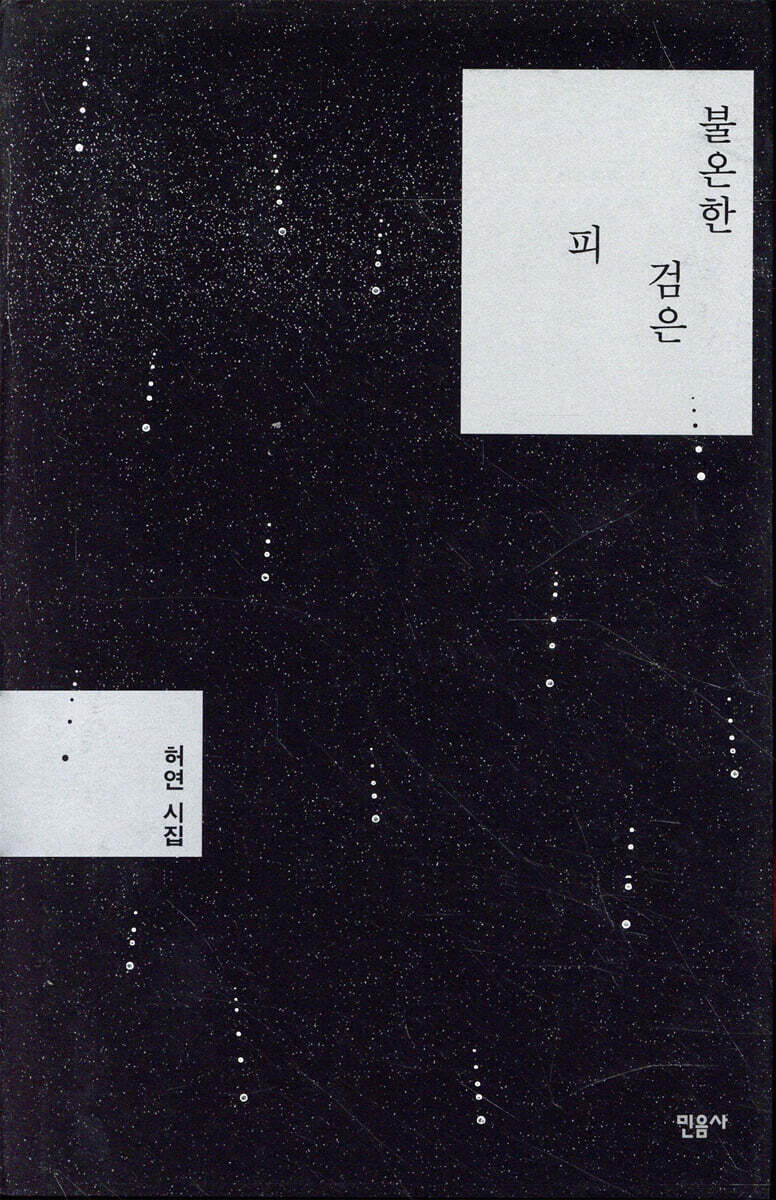 |
Description
Book Introduction
Quasar's oracle delivered by a bad boy
A poetry collection from the future that will infuse you with new sensibilities.
A beautiful nervousness of love and bitter discord with the absurd world
Rumors were rife that the critic who wrote the commentary had died, and the poet who wrote the poem had disappeared.
Many rebellious youths, including poet Kim Kyung-ju, suffered from “the disease of circulatory collapse” while copying this collection of poems.
The story behind the poetry collection can also be read as a poem. While some young people read the 'red book', others secretly read the 'black book'.
The legendary poetry collection, 『Unsettling Black Blood』, has been revived after 20 years of publication.
When poet Heo Yeon's first poetry collection, 『Unsettling Black Blood』, was published, it received rave reviews, such as, "It resembles no one else, is not of any kind, and has its own republic" and "created a terrifyingly beautiful aesthetic called 'the meaning of meaninglessness' through the straightforward method of self-affirmation through self-denial" (literary critic, the late Hwang Byeong-ha).
He constantly transfuses us with “unclean black blood” by confronting us with ugliness, meanness, extinction, and futility, things we try so hard to avoid.
This collection of poems, filled with sorrow, sings of sadness as a universal form of human existence, while fiercely exploring love while embracing the vanishing.
He confesses that he “loves” you because “there is no hope anywhere” while constantly at odds and clashing with the world he lives in.
The dark, sinister blood of that bad boy still flows through our veins and warms our hearts.
The 62 poems, drawn drop by drop with black blood as if writing a blood oath, plunge us into the undeniable, helpless emotion of our first poetry collection.
This is not a collection of poems from the past 20 years ago, but from the future, 20 years ahead of us.
That is why we must reread this collection of poems today and tomorrow.
A poetry collection from the future that will infuse you with new sensibilities.
A beautiful nervousness of love and bitter discord with the absurd world
Rumors were rife that the critic who wrote the commentary had died, and the poet who wrote the poem had disappeared.
Many rebellious youths, including poet Kim Kyung-ju, suffered from “the disease of circulatory collapse” while copying this collection of poems.
The story behind the poetry collection can also be read as a poem. While some young people read the 'red book', others secretly read the 'black book'.
The legendary poetry collection, 『Unsettling Black Blood』, has been revived after 20 years of publication.
When poet Heo Yeon's first poetry collection, 『Unsettling Black Blood』, was published, it received rave reviews, such as, "It resembles no one else, is not of any kind, and has its own republic" and "created a terrifyingly beautiful aesthetic called 'the meaning of meaninglessness' through the straightforward method of self-affirmation through self-denial" (literary critic, the late Hwang Byeong-ha).
He constantly transfuses us with “unclean black blood” by confronting us with ugliness, meanness, extinction, and futility, things we try so hard to avoid.
This collection of poems, filled with sorrow, sings of sadness as a universal form of human existence, while fiercely exploring love while embracing the vanishing.
He confesses that he “loves” you because “there is no hope anywhere” while constantly at odds and clashing with the world he lives in.
The dark, sinister blood of that bad boy still flows through our veins and warms our hearts.
The 62 poems, drawn drop by drop with black blood as if writing a blood oath, plunge us into the undeniable, helpless emotion of our first poetry collection.
This is not a collection of poems from the past 20 years ago, but from the future, 20 years ahead of us.
That is why we must reread this collection of poems today and tomorrow.
index
Part 1
The sound of rain in hell
war memorial
I think I'm a butterfly
Fly Away - Rain (Song of Sorrow)
Rainy season? Rainy season? Rainy season - Remembering K
Sanggye-dong
dawn
unaccompanied
Gyeongwon Line
I walk away from the light
K
Come to the door and cry
That day
thursday
Rain, save me
Part 2
Kwon Jin-gyu's funeral
tan
Concept
Peacock City - In the painting of Son Sang-gi
You are the most hopeful person I've met recently.
The damage is not a hunchback
print
Where the Wind Blows, by Oh Yoon
GOGH
In the movie
Railroad Man - Movie
conversation
Oh Champs-Élysées
Midnight Special?1
Midnight Special?2
film
No shoes on that street fit my feet.
road
I have another day
move
Part 3
You said you would stay by my side until you disappeared
Evening, one side of the chest
Confessions
To the reed
Star song? 1
Star song 2
proofreading
Railroadside dirge
July
My love always comes back like a torrent
Jinburyeong
Don't lock me up
bouquet
My love is
Part 4
Spider and Me
muzzle
Can fall asleep
Wall-mounted
letter
go to work
tree
hope
Heavy snowfall that year
Partisans
non-interference
That day too, my father
Cheongnyangni Dusk - Oil on Canvas
Preface | Kim Kyung-joo
The Oracle of Quasar
The sound of rain in hell
war memorial
I think I'm a butterfly
Fly Away - Rain (Song of Sorrow)
Rainy season? Rainy season? Rainy season - Remembering K
Sanggye-dong
dawn
unaccompanied
Gyeongwon Line
I walk away from the light
K
Come to the door and cry
That day
thursday
Rain, save me
Part 2
Kwon Jin-gyu's funeral
tan
Concept
Peacock City - In the painting of Son Sang-gi
You are the most hopeful person I've met recently.
The damage is not a hunchback
Where the Wind Blows, by Oh Yoon
GOGH
In the movie
Railroad Man - Movie
conversation
Oh Champs-Élysées
Midnight Special?1
Midnight Special?2
film
No shoes on that street fit my feet.
road
I have another day
move
Part 3
You said you would stay by my side until you disappeared
Evening, one side of the chest
Confessions
To the reed
Star song? 1
Star song 2
proofreading
Railroadside dirge
July
My love always comes back like a torrent
Jinburyeong
Don't lock me up
bouquet
My love is
Part 4
Spider and Me
muzzle
Can fall asleep
Wall-mounted
letter
go to work
tree
hope
Heavy snowfall that year
Partisans
non-interference
That day too, my father
Cheongnyangni Dusk - Oil on Canvas
Preface | Kim Kyung-joo
The Oracle of Quasar
Publisher's Review
■ The seditious black blood still flows hotly
In a world where everything is uncertain, irrational, and absurd, what kind of poetry can a poet write?
In a meaningless world where no meaning can be combined, hope for the poet is like a milestone where “both the arrows and the numbers have been erased” (“Hope”).
It is so dangerous that it seems like it might disappear, as if “all the salt lumps in the world are getting rained on” (“Rainy season? Rainy season? Rainy season”).
Poet Heo Yeon said this about his poetry writing in the autobiography of the first edition of 『Unsettling Black Blood』 20 years ago.
“When I was tired of the futile effort to escape from pain, when I was nodding my head in agreement with the vices and fascination of that pain, I wrote poetry.
“The combination of countless unpleasant words, isolated and isolated—the thing called poetry—was to me a wall or a joy.”
He confessed again in a revised autobiography 20 years later:
“It was a defeated republic, but I didn’t want to bury it.”
Even if it is a world filled with suffering, even if it is a defeated republic, to live without avoiding or burying it, but embracing and living in those dusty ruins, that is poetry and life to him.
As poet and literary critic Cha Chang-ryong said, “Poets are those who have long ago come to know the meaning of nothingness, who have come to know the meaning of nothingness but have no solution, and who know that they themselves are without a solution.” Heo Yeon is a poet who has come to know the meaning of nothingness through his own body.
For Heo Yeon, poetry is a rebellion.
The denial of salvation and the challenge and rebellious attitude toward the world are most prominent in this first collection of poems.
We can glimpse the purest childhood of poet Heo Yeon as a “bad boy,” before he became “a tainted age” and “an age that was congenial to sin.”
The horizon that people have broken
When I was twelve, I used to imagine running.
Late winter, when dry forsythia stood out in the sunlight
Buy some snacks with your Sunday offering
Touching my swollen calf
The embankment road that was crawling up
If you get upset and pick up a stone and throw it into the sky,
All that came to life was tears.
More than forgiving
Always following first and being trampled
A road full of dust
The lit windows that held my ankles
-"road"
“Buying snacks with the Sunday offering” and “throwing up and throwing rocks at the sky” are all the rebellions he can do as a young child, but he innately knows that the result of this helpless rebellion can only be futile.
Still, he doesn't stop rebelling.
I'm risking my life now.
The world we face, the women, the price of alcohol, and the coal gas.
My dreams are always islands, the red flags on the docks, and my hometown that has disappeared like fate.
Why is poverty always a genius, and why is loneliness and distress always a genius?
I don't even have time to love.
I am no different from a dragon dancing in a circus.
What, you damn poets, you call me student, Mr. Heo, and sometimes you call me young poet.
Germany is plagued by violence and drugs, and everyone who wants to go is going, but I'm going to work now.
I was dragged along without understanding.
Since when have you been holding out wherever I go?
Why am I taking my life?
Why on earth do I resemble my father?
I'm going to the hospital now.
Because I risk my life, because I must go like the wind, because I must erase my footprints, I risk my life now.
Because I wasn't born in the Mediterranean.
-"go to work"
In this way, the twelve-year-old boy's rebellion continues even after he becomes a freshman in society, leading to a rebellion against common sense and customs.
His poetry is straightforward and honest.
It shows heartbreaking lyricism in raw, everyday language.
His idiosyncratic language, described as “rugby-ball leaps, unpredictable twists of context,” is fully revealed.
This collection of poems is full of sorrow.
Singing sorrow as a universal form of human existence, he fiercely explores love while embracing things that are disappearing.
He confesses that he “loves” you because “there is no hope anywhere” while constantly at odds and clashing with the world he lives in.
Looking back
Only the tears that haven't even been wiped away are frozen
Among the distant lights
Stand tall, like destiny
I love you
Because there is no hope anywhere
―「Jinbu-ryeong」
Every time the window shook, I thought of the things that were rebelling against my life.
Things that smell of misfortune, but hold me just long enough not to die, my taste buds of shame
Like a synthetic human, my love is like my appetite, I loved to death last night and hated to death this morning, it's like living, it's like it's surging up tirelessly without an arm or a leg
Unholy black blood, my love will not be heaven
―My love
Self-affirmation through this self-denial creates the beautiful aesthetic of “the meaning of meaninglessness.”
In this collection of poems, a father who gets drunk and overturns the table, a mother who collapses in a daze, a bruised fourth-round boxer, a person with aphasia, a boy selling blood, a vocational trainee who gets slapped, young men who return from detention and get tattoos at a Chinese restaurant, and people leaning against a wall and crying are all wallowing in anger and pity.
Despite being full of loneliness, sadness, pain, despair, and death, his world is so beautiful because he feels pity for those who are left to “sit down and get up / and live again,” those who live “to cry,” those who “must live / and walk slowly,” and he confesses to them an eternal promise to “stay by their side until they disappear.”
I will not ask you, who has returned, about the loneliness of standing beside me in silent snow, until one day I lose you again on the desolate riverside road and place a love letter in the window crack saying I will wait for you, until I tremble knowing you are not by my side.
As I wound the old clock, I said that I would stay by your side until you disappeared.
―“You said you would stay by my side until you disappeared.”
In a world where everything is uncertain, irrational, and absurd, what kind of poetry can a poet write?
In a meaningless world where no meaning can be combined, hope for the poet is like a milestone where “both the arrows and the numbers have been erased” (“Hope”).
It is so dangerous that it seems like it might disappear, as if “all the salt lumps in the world are getting rained on” (“Rainy season? Rainy season? Rainy season”).
Poet Heo Yeon said this about his poetry writing in the autobiography of the first edition of 『Unsettling Black Blood』 20 years ago.
“When I was tired of the futile effort to escape from pain, when I was nodding my head in agreement with the vices and fascination of that pain, I wrote poetry.
“The combination of countless unpleasant words, isolated and isolated—the thing called poetry—was to me a wall or a joy.”
He confessed again in a revised autobiography 20 years later:
“It was a defeated republic, but I didn’t want to bury it.”
Even if it is a world filled with suffering, even if it is a defeated republic, to live without avoiding or burying it, but embracing and living in those dusty ruins, that is poetry and life to him.
As poet and literary critic Cha Chang-ryong said, “Poets are those who have long ago come to know the meaning of nothingness, who have come to know the meaning of nothingness but have no solution, and who know that they themselves are without a solution.” Heo Yeon is a poet who has come to know the meaning of nothingness through his own body.
For Heo Yeon, poetry is a rebellion.
The denial of salvation and the challenge and rebellious attitude toward the world are most prominent in this first collection of poems.
We can glimpse the purest childhood of poet Heo Yeon as a “bad boy,” before he became “a tainted age” and “an age that was congenial to sin.”
The horizon that people have broken
When I was twelve, I used to imagine running.
Late winter, when dry forsythia stood out in the sunlight
Buy some snacks with your Sunday offering
Touching my swollen calf
The embankment road that was crawling up
If you get upset and pick up a stone and throw it into the sky,
All that came to life was tears.
More than forgiving
Always following first and being trampled
A road full of dust
The lit windows that held my ankles
-"road"
“Buying snacks with the Sunday offering” and “throwing up and throwing rocks at the sky” are all the rebellions he can do as a young child, but he innately knows that the result of this helpless rebellion can only be futile.
Still, he doesn't stop rebelling.
I'm risking my life now.
The world we face, the women, the price of alcohol, and the coal gas.
My dreams are always islands, the red flags on the docks, and my hometown that has disappeared like fate.
Why is poverty always a genius, and why is loneliness and distress always a genius?
I don't even have time to love.
I am no different from a dragon dancing in a circus.
What, you damn poets, you call me student, Mr. Heo, and sometimes you call me young poet.
Germany is plagued by violence and drugs, and everyone who wants to go is going, but I'm going to work now.
I was dragged along without understanding.
Since when have you been holding out wherever I go?
Why am I taking my life?
Why on earth do I resemble my father?
I'm going to the hospital now.
Because I risk my life, because I must go like the wind, because I must erase my footprints, I risk my life now.
Because I wasn't born in the Mediterranean.
-"go to work"
In this way, the twelve-year-old boy's rebellion continues even after he becomes a freshman in society, leading to a rebellion against common sense and customs.
His poetry is straightforward and honest.
It shows heartbreaking lyricism in raw, everyday language.
His idiosyncratic language, described as “rugby-ball leaps, unpredictable twists of context,” is fully revealed.
This collection of poems is full of sorrow.
Singing sorrow as a universal form of human existence, he fiercely explores love while embracing things that are disappearing.
He confesses that he “loves” you because “there is no hope anywhere” while constantly at odds and clashing with the world he lives in.
Looking back
Only the tears that haven't even been wiped away are frozen
Among the distant lights
Stand tall, like destiny
I love you
Because there is no hope anywhere
―「Jinbu-ryeong」
Every time the window shook, I thought of the things that were rebelling against my life.
Things that smell of misfortune, but hold me just long enough not to die, my taste buds of shame
Like a synthetic human, my love is like my appetite, I loved to death last night and hated to death this morning, it's like living, it's like it's surging up tirelessly without an arm or a leg
Unholy black blood, my love will not be heaven
―My love
Self-affirmation through this self-denial creates the beautiful aesthetic of “the meaning of meaninglessness.”
In this collection of poems, a father who gets drunk and overturns the table, a mother who collapses in a daze, a bruised fourth-round boxer, a person with aphasia, a boy selling blood, a vocational trainee who gets slapped, young men who return from detention and get tattoos at a Chinese restaurant, and people leaning against a wall and crying are all wallowing in anger and pity.
Despite being full of loneliness, sadness, pain, despair, and death, his world is so beautiful because he feels pity for those who are left to “sit down and get up / and live again,” those who live “to cry,” those who “must live / and walk slowly,” and he confesses to them an eternal promise to “stay by their side until they disappear.”
I will not ask you, who has returned, about the loneliness of standing beside me in silent snow, until one day I lose you again on the desolate riverside road and place a love letter in the window crack saying I will wait for you, until I tremble knowing you are not by my side.
As I wound the old clock, I said that I would stay by your side until you disappeared.
―“You said you would stay by my side until you disappeared.”
GOODS SPECIFICS
- Date of publication: April 28, 2014
- Format: Hardcover book binding method guide
- Page count, weight, size: 124 pages | 285g | 143*218*20mm
- ISBN13: 9788937489105
- ISBN10: 8937489104
You may also like
카테고리
korean


korean

![ELLE 엘르 스페셜 에디션 A형 : 12월 [2025]](http://librairie.coreenne.fr/cdn/shop/files/b8e27a3de6c9538896439686c6b0e8fb.jpg?v=1766436872&width=3840)


