

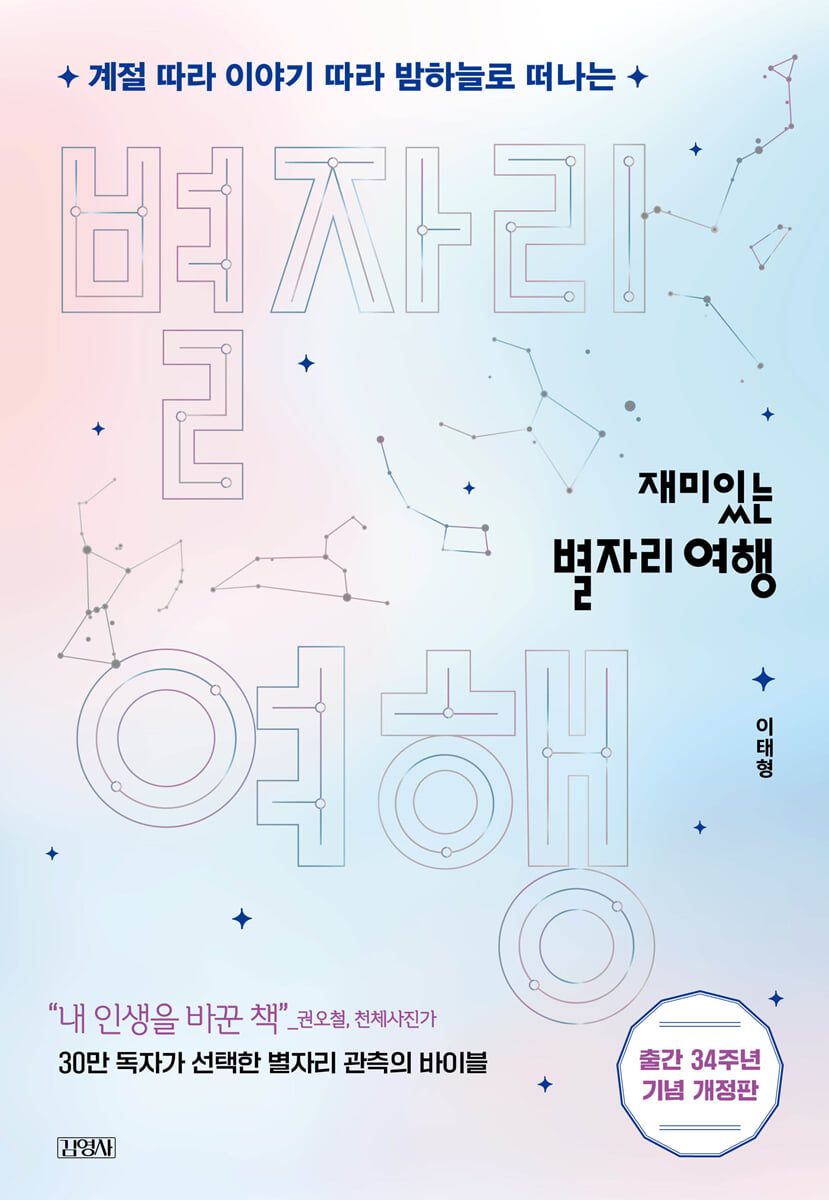
Fun constellation journey
 |
Description
Book Introduction
The bible of constellation observation chosen by 300,000 readers
Everything you need to know about constellations in one book
Over 200 star maps and images to help you find your own constellations!
The ultimate guide to a journey into the night sky, the first screen humans ever encountered.
This is a newly refined and definitive edition of a book that was published 34 years ago, read by 300,000 readers, and left a mark on the history of amateur stargazing in Korea.
Contains everything you need to know about finding and enjoying the constellations, including the locations, appearances, how to find them, and stories behind the 52 constellations, categorized by season and location.
Whether you already love stargazing or have never seen stars before, this book will help you learn more about and love every corner of the night sky.
Everything you need to know about constellations in one book
Over 200 star maps and images to help you find your own constellations!
The ultimate guide to a journey into the night sky, the first screen humans ever encountered.
This is a newly refined and definitive edition of a book that was published 34 years ago, read by 300,000 readers, and left a mark on the history of amateur stargazing in Korea.
Contains everything you need to know about finding and enjoying the constellations, including the locations, appearances, how to find them, and stories behind the 52 constellations, categorized by season and location.
Whether you already love stargazing or have never seen stars before, this book will help you learn more about and love every corner of the night sky.
- You can preview some of the book's contents.
Preview
index
[Appendix] Astronomical Pictorial
Preface to the Revised Edition
Preface to the first edition
Before leaving on a trip
Part 1.
Constellations of the northern sky
1.
Ursa Major
2.
Ursa Minor
3.
Draco
4.
Cassiopeia
5.
Cepheus
6.
Giraffe constellation
Part 2.
Constellations of Spring
1.
Leo
2.
Boötes
3.
Virgo
4.
Hydra
5.
Canes Venatici
6.
Coma Berenices
7.
Sextant
8.
Crown
9.
Libra
10.
Corvus | Cups
11.
Leo Minor | Lynx
Part 3.
Constellations of summer
1.
Lyra
2.
Aquila
3.
Cygnus
4.
Hercules
5.
Ophiuchus (Ophiuchus) | Serpens
6.
Dolphin
7.
Scorpio
8.
Sagittarius
9.
Capricorn (Sea Capricorn)
10.
Scutum | Vulpecula | Sagittarius
Part 4.
Autumn constellations
1.
Pegasus
2.
Cetus
3.
Pisces the Southern
4.
Pisces
5.
Aquarius
6.
Andromeda constellation
7.
Perseus
8.
Lacerta | Equus
9.
Triangulum | Aries
Part 5.
Winter constellations
1.
Taurus
2.
Auriga
3.
Orion
4.
Canis Major
5.
Canis Minor
6.
Rabbit
7.
Eridanus
8.
Monoceros
9.
Gemini
10.
Cancer
In conclusion
supplement
1.
star chart
2.
Stars and constellations
3.
celestial bodies that make up the solar system
4.
Things to know when observing
5.
Measuring angular distances on the celestial sphere
6.
How to use the Saint
7.
Zodiac and zodiac belt
8.
Me according to my birth constellation
9.
Learn the constellations through songs
Search
[Appendix] All Saints of Heaven
Preface to the Revised Edition
Preface to the first edition
Before leaving on a trip
Part 1.
Constellations of the northern sky
1.
Ursa Major
2.
Ursa Minor
3.
Draco
4.
Cassiopeia
5.
Cepheus
6.
Giraffe constellation
Part 2.
Constellations of Spring
1.
Leo
2.
Boötes
3.
Virgo
4.
Hydra
5.
Canes Venatici
6.
Coma Berenices
7.
Sextant
8.
Crown
9.
Libra
10.
Corvus | Cups
11.
Leo Minor | Lynx
Part 3.
Constellations of summer
1.
Lyra
2.
Aquila
3.
Cygnus
4.
Hercules
5.
Ophiuchus (Ophiuchus) | Serpens
6.
Dolphin
7.
Scorpio
8.
Sagittarius
9.
Capricorn (Sea Capricorn)
10.
Scutum | Vulpecula | Sagittarius
Part 4.
Autumn constellations
1.
Pegasus
2.
Cetus
3.
Pisces the Southern
4.
Pisces
5.
Aquarius
6.
Andromeda constellation
7.
Perseus
8.
Lacerta | Equus
9.
Triangulum | Aries
Part 5.
Winter constellations
1.
Taurus
2.
Auriga
3.
Orion
4.
Canis Major
5.
Canis Minor
6.
Rabbit
7.
Eridanus
8.
Monoceros
9.
Gemini
10.
Cancer
In conclusion
supplement
1.
star chart
2.
Stars and constellations
3.
celestial bodies that make up the solar system
4.
Things to know when observing
5.
Measuring angular distances on the celestial sphere
6.
How to use the Saint
7.
Zodiac and zodiac belt
8.
Me according to my birth constellation
9.
Learn the constellations through songs
Search
[Appendix] All Saints of Heaven
Detailed image

Into the book
“Things to remember
① The area occupied by the constellations of one season is approximately half of the night sky (hemisphere), or one-quarter of the celestial sphere.
The angle is about 90 degrees.
② The constellation of a specific season is the constellation located on the celestial sphere opposite the sun during that season.
That is, they are what you see in the zenith and southern sky at midnight around the middle of that season.
[Example] The summer constellations are visible in the zenith and center of the southern sky just after midnight in June, at midnight in July, and just before midnight in August.
③ The stars move from east to west at a rate of 15 degrees per hour (360 degrees in 24 hours).
④ You need to know which side the constellation of the season you are looking for is on at the time of observation.
[Example] If it is around 9:00 PM in July, there are still about 3 hours left until the summer constellations rise to the center of the southern sky.
That is, we can see that the center of the summer constellation is about 45 degrees from the center of the southern sky.
So the summer constellations (90 degrees) would stretch from the eastern horizon to the middle of the southern sky, and the spring constellations (90 degrees) would stretch from the middle of the southern sky to the western horizon.
⑤ Find the guiding star of that season among the bright stars that stand out.”
--- p.21, from “Before Going on a Trip”
“There is an interesting star in the Big Dipper.
If you look closely at Mizar, the second star in the handle, you will notice a smaller star right next to it.
This star is Alcor, known as the 'Test-Star of the eyesight'.
Alcor got its nickname because only those with good eyesight could distinguish between Mizar and Alcor, so this star was used in an eye test to select soldiers in ancient Rome.
Although the two stars are now a bit further apart than they were then, it is still not easy to tell them apart.
“Since being a soldier was a popular profession in Rome, many young men would have turned away from this star, resenting it.”
--- p.45, 「1-1.
From "The Big Dipper"
“The pentagon represents the upper body of the shepherd, and a series of stars extending to the right (west) from the side represent the left arm holding the leather strap.
Let's take a closer look at the upper pentagon and the surrounding stars.
Looking at it this way, it is clearly a hunter, not a shepherd, but if we consider the Big Dipper as a cart pulled by three oxen, we can see this constellation as a shepherd driving oxen.
If you follow the curve of the Big Dipper's handle, you will come across Arcturus, the leading star of the constellation Boötes.
Arcturus will be easy to find as it is incredibly bright and orange.
[Image: How to find the constellation Boötes using the Big Dipper]
There are also different ways to look at the appearance of a shepherd.
This is when you connect the stars like on the right.
When you connect them like this, it reminds you of a shepherd sitting on a tree stump and blowing a horn (the triangle formed by lambda λ, theta θ, and kappa κ).
In this case, Arcturus becomes the star corresponding to the front of the shepherd's buttocks.
It is the appearance that best suits the name of the constellation.
[Image: A shepherd blowing a horn]”
--- p.100~101, 「2-2.
From "Boots"
“… Among scholars, this star may have been Samtaeseong (三台星), but here I would like to talk about Samtaeseong (三太星), which has been widely known among the common people since ancient times.
In Korea, there are constellations from the celestial map that nobles and scholars were familiar with, and separately, there are constellations from folk tales that were passed down among the common people.
Many constellations from folk tales that had been passed down orally disappeared during the Japanese colonial period and due to religious influence.
Among them, the Samtaeseong of the remaining folk tales literally means three bright stars gathered together, because the common people would have simply seen them with their eyes.
The sentence in the preface of Samtaeseong, which records the tale, “If you look up at the night sky, you will see three unusually bright stars slowly drifting from the eastern sky to the western sky. Our people call these stars Samtaeseong,” also supports this fact.
--- p.372~373, 「5-3.
From "Orion"
“When looking at the stars, there are times when light is needed to find the saints or to make notes.
However, bright light causes the pupils to contract again, causing the eyes, which have had difficulty adjusting to the dark, to return to their original state.
One way to prevent this is to use lights covered with red cellophane, as red light has less of an effect on the pupils than other types of light.
It is for the same reason that we work in a darkroom with red lights on to develop photographs.
However, it is recommended to reduce the use of red lights as much as possible.”
① The area occupied by the constellations of one season is approximately half of the night sky (hemisphere), or one-quarter of the celestial sphere.
The angle is about 90 degrees.
② The constellation of a specific season is the constellation located on the celestial sphere opposite the sun during that season.
That is, they are what you see in the zenith and southern sky at midnight around the middle of that season.
[Example] The summer constellations are visible in the zenith and center of the southern sky just after midnight in June, at midnight in July, and just before midnight in August.
③ The stars move from east to west at a rate of 15 degrees per hour (360 degrees in 24 hours).
④ You need to know which side the constellation of the season you are looking for is on at the time of observation.
[Example] If it is around 9:00 PM in July, there are still about 3 hours left until the summer constellations rise to the center of the southern sky.
That is, we can see that the center of the summer constellation is about 45 degrees from the center of the southern sky.
So the summer constellations (90 degrees) would stretch from the eastern horizon to the middle of the southern sky, and the spring constellations (90 degrees) would stretch from the middle of the southern sky to the western horizon.
⑤ Find the guiding star of that season among the bright stars that stand out.”
--- p.21, from “Before Going on a Trip”
“There is an interesting star in the Big Dipper.
If you look closely at Mizar, the second star in the handle, you will notice a smaller star right next to it.
This star is Alcor, known as the 'Test-Star of the eyesight'.
Alcor got its nickname because only those with good eyesight could distinguish between Mizar and Alcor, so this star was used in an eye test to select soldiers in ancient Rome.
Although the two stars are now a bit further apart than they were then, it is still not easy to tell them apart.
“Since being a soldier was a popular profession in Rome, many young men would have turned away from this star, resenting it.”
--- p.45, 「1-1.
From "The Big Dipper"
“The pentagon represents the upper body of the shepherd, and a series of stars extending to the right (west) from the side represent the left arm holding the leather strap.
Let's take a closer look at the upper pentagon and the surrounding stars.
Looking at it this way, it is clearly a hunter, not a shepherd, but if we consider the Big Dipper as a cart pulled by three oxen, we can see this constellation as a shepherd driving oxen.
If you follow the curve of the Big Dipper's handle, you will come across Arcturus, the leading star of the constellation Boötes.
Arcturus will be easy to find as it is incredibly bright and orange.
[Image: How to find the constellation Boötes using the Big Dipper]
There are also different ways to look at the appearance of a shepherd.
This is when you connect the stars like on the right.
When you connect them like this, it reminds you of a shepherd sitting on a tree stump and blowing a horn (the triangle formed by lambda λ, theta θ, and kappa κ).
In this case, Arcturus becomes the star corresponding to the front of the shepherd's buttocks.
It is the appearance that best suits the name of the constellation.
[Image: A shepherd blowing a horn]”
--- p.100~101, 「2-2.
From "Boots"
“… Among scholars, this star may have been Samtaeseong (三台星), but here I would like to talk about Samtaeseong (三太星), which has been widely known among the common people since ancient times.
In Korea, there are constellations from the celestial map that nobles and scholars were familiar with, and separately, there are constellations from folk tales that were passed down among the common people.
Many constellations from folk tales that had been passed down orally disappeared during the Japanese colonial period and due to religious influence.
Among them, the Samtaeseong of the remaining folk tales literally means three bright stars gathered together, because the common people would have simply seen them with their eyes.
The sentence in the preface of Samtaeseong, which records the tale, “If you look up at the night sky, you will see three unusually bright stars slowly drifting from the eastern sky to the western sky. Our people call these stars Samtaeseong,” also supports this fact.
--- p.372~373, 「5-3.
From "Orion"
“When looking at the stars, there are times when light is needed to find the saints or to make notes.
However, bright light causes the pupils to contract again, causing the eyes, which have had difficulty adjusting to the dark, to return to their original state.
One way to prevent this is to use lights covered with red cellophane, as red light has less of an effect on the pupils than other types of light.
It is for the same reason that we work in a darkroom with red lights on to develop photographs.
However, it is recommended to reduce the use of red lights as much as possible.”
--- p.442~443, 「Appendix 4.
From “Things to know when observing”
From “Things to know when observing”
Publisher's Review
Look up and see the night sky!
A to Z journey through the constellations, taking you on the first screen humans ever encountered.
"The Book That Changed My Life" - Kwon Oh-cheol (astrophotographer)
The bible of constellation observation chosen by 300,000 readers
Republished in a completely revised edition after 34 years!
《The Fun Constellation Journey》, which has been loved by 300,000 readers and established itself as the bible of stargazing, has been republished in a revised edition to commemorate its 34th anniversary.
When this book was first published in 1989, it received an explosive response and sparked a nationwide boom in astronomy observation.
The book's influence led to the creation of astronomy clubs in many schools.
Although this book went out of print and was not read by readers for a long time, there were many who remembered and sought it out.
To meet those expectations and share the joy of stargazing with more people, we are publishing a revised edition.
This book contains all of the author's observation know-how gained from observing the night sky for the past 30 years and working to popularize stargazing.
The author, Lee Tae-hyung, director of the Chungju Goguryeo Astronomical Science Museum, decided to pursue astronomy as a career after the first edition of this book sold over 300,000 copies and became the bible of amateur astronomical observation.
He planned several citizen observatories, including the Daejeon Citizen Observatory, the first citizen observatory in Korea, and the Yeongwol Byeolmaro Observatory, and has consistently conducted lectures and programs for citizens.
This book is a product of the author's concentrated experience and effort.
In this revised edition, at the beginning of each section, we created a story featuring the main characters of each constellation and illustrated the content to make it easier to remember the constellations of each season.
Another feature is the accompanying illustrated night sky photos that allow you to find stars yourself by following the book's guide, as well as a portable, one-page map of the entire sky.
Information about stars has been revised based on recent observation data, and detailed explanations have been added for Korean constellations that appear in celestial maps and folk tales.
Packed with updated information and a wealth of resources, this revised edition is a gift for anyone seeking a better understanding of the night sky.
The locations, shapes, constellations, and stories of the 52 constellations
This one book is enough to find and enjoy constellations.
At some point, when we say 'stars', it seems that the first thing that comes to mind is space photos taken using the latest technology rather than the sky seen with our own eyes.
This is partly due to artificial lighting, but the bigger reason is that we have forgotten the joy of looking at the starry sky for too long.
《The Fun Constellation Journey》 is the best guide to help you rediscover that lost joy.
The night sky has long inspired people's imagination, giving rise to stories and scientific knowledge.
People looked at the sky, remembered the relative positions of the stars, connected the stars to form constellations, and wrote stories of human history on them.
This book contains everything you need to enjoy looking at the stars with your own eyes.
In five parts, divided into the constellations of the northern sky visible in all four seasons and the constellations visible in each season, most of the constellations are introduced one by one on each page.
Each chapter is packed with information about the shape and location of the constellation, the stars that make up the constellation, myths, legends, and folktales that ancient people created based on the constellations, and interesting episodes related to the constellations.
Among these, the method of finding constellations is introduced with different illustrations for each chapter, including the surrounding guide stars.
There are a total of 52 constellations introduced in this way, and if you just learn this information, you will be able to know almost all the constellations visible in the Northern Hemisphere.
In this book, readers will find a variety of resources necessary to enjoy the stars not only scientifically but also humanistically, and will discover that there is more than one way to become familiar with the constellations.
And once you become familiar with the constellations, you will feel that wherever you see the night sky is your home.
Over 200 star maps and images to help you find your own constellations!
A book that offers a new experience of viewing the night sky with rich visuals.
This book contains over 200 colorful visual aids for those unfamiliar with the starry sky.
The 32-page color picture book that opens when you open the book is great for practicing after learning how to find each constellation in the text.
As mentioned earlier, the subtitles contain a single scene from the story of the main characters of the constellations in each section, making it easy to remember the constellations in each section as a single image.
After a general description of the sky for each season, I've included a schematic two-dimensional star chart, both with and without constellation lines, to help you learn the relative positions and sizes of each constellation.
In this way, each section's intro is followed by a detailed and friendly guide to the constellation journey.
The appendix includes basic astronomy knowledge needed to find and learn constellations, practical guides for stargazing, how to use star charts, and songs to easily memorize constellations.
The celestial map that the author found most useful when actually finding constellations is included as a separate sheet.
This book, filled with sincerity and expertise, will help both those who already enjoy stargazing and those who have never seen stars before to learn more about and love every corner of the night sky.
A to Z journey through the constellations, taking you on the first screen humans ever encountered.
"The Book That Changed My Life" - Kwon Oh-cheol (astrophotographer)
The bible of constellation observation chosen by 300,000 readers
Republished in a completely revised edition after 34 years!
《The Fun Constellation Journey》, which has been loved by 300,000 readers and established itself as the bible of stargazing, has been republished in a revised edition to commemorate its 34th anniversary.
When this book was first published in 1989, it received an explosive response and sparked a nationwide boom in astronomy observation.
The book's influence led to the creation of astronomy clubs in many schools.
Although this book went out of print and was not read by readers for a long time, there were many who remembered and sought it out.
To meet those expectations and share the joy of stargazing with more people, we are publishing a revised edition.
This book contains all of the author's observation know-how gained from observing the night sky for the past 30 years and working to popularize stargazing.
The author, Lee Tae-hyung, director of the Chungju Goguryeo Astronomical Science Museum, decided to pursue astronomy as a career after the first edition of this book sold over 300,000 copies and became the bible of amateur astronomical observation.
He planned several citizen observatories, including the Daejeon Citizen Observatory, the first citizen observatory in Korea, and the Yeongwol Byeolmaro Observatory, and has consistently conducted lectures and programs for citizens.
This book is a product of the author's concentrated experience and effort.
In this revised edition, at the beginning of each section, we created a story featuring the main characters of each constellation and illustrated the content to make it easier to remember the constellations of each season.
Another feature is the accompanying illustrated night sky photos that allow you to find stars yourself by following the book's guide, as well as a portable, one-page map of the entire sky.
Information about stars has been revised based on recent observation data, and detailed explanations have been added for Korean constellations that appear in celestial maps and folk tales.
Packed with updated information and a wealth of resources, this revised edition is a gift for anyone seeking a better understanding of the night sky.
The locations, shapes, constellations, and stories of the 52 constellations
This one book is enough to find and enjoy constellations.
At some point, when we say 'stars', it seems that the first thing that comes to mind is space photos taken using the latest technology rather than the sky seen with our own eyes.
This is partly due to artificial lighting, but the bigger reason is that we have forgotten the joy of looking at the starry sky for too long.
《The Fun Constellation Journey》 is the best guide to help you rediscover that lost joy.
The night sky has long inspired people's imagination, giving rise to stories and scientific knowledge.
People looked at the sky, remembered the relative positions of the stars, connected the stars to form constellations, and wrote stories of human history on them.
This book contains everything you need to enjoy looking at the stars with your own eyes.
In five parts, divided into the constellations of the northern sky visible in all four seasons and the constellations visible in each season, most of the constellations are introduced one by one on each page.
Each chapter is packed with information about the shape and location of the constellation, the stars that make up the constellation, myths, legends, and folktales that ancient people created based on the constellations, and interesting episodes related to the constellations.
Among these, the method of finding constellations is introduced with different illustrations for each chapter, including the surrounding guide stars.
There are a total of 52 constellations introduced in this way, and if you just learn this information, you will be able to know almost all the constellations visible in the Northern Hemisphere.
In this book, readers will find a variety of resources necessary to enjoy the stars not only scientifically but also humanistically, and will discover that there is more than one way to become familiar with the constellations.
And once you become familiar with the constellations, you will feel that wherever you see the night sky is your home.
Over 200 star maps and images to help you find your own constellations!
A book that offers a new experience of viewing the night sky with rich visuals.
This book contains over 200 colorful visual aids for those unfamiliar with the starry sky.
The 32-page color picture book that opens when you open the book is great for practicing after learning how to find each constellation in the text.
As mentioned earlier, the subtitles contain a single scene from the story of the main characters of the constellations in each section, making it easy to remember the constellations in each section as a single image.
After a general description of the sky for each season, I've included a schematic two-dimensional star chart, both with and without constellation lines, to help you learn the relative positions and sizes of each constellation.
In this way, each section's intro is followed by a detailed and friendly guide to the constellation journey.
The appendix includes basic astronomy knowledge needed to find and learn constellations, practical guides for stargazing, how to use star charts, and songs to easily memorize constellations.
The celestial map that the author found most useful when actually finding constellations is included as a separate sheet.
This book, filled with sincerity and expertise, will help both those who already enjoy stargazing and those who have never seen stars before to learn more about and love every corner of the night sky.
GOODS SPECIFICS
- Date of issue: September 15, 2023
- Page count, weight, size: 502 pages | 708g | 150*217*25mm
- ISBN13: 9788934956396
- ISBN10: 8934956399
You may also like
카테고리
korean


korean

![GQ KOREA Mark (Monthly): December [2025]](http://librairie.coreenne.fr/cdn/shop/files/8ef265dbbfbf186523ed75ba7319009d.jpg?v=1765340328&width=3840)


