

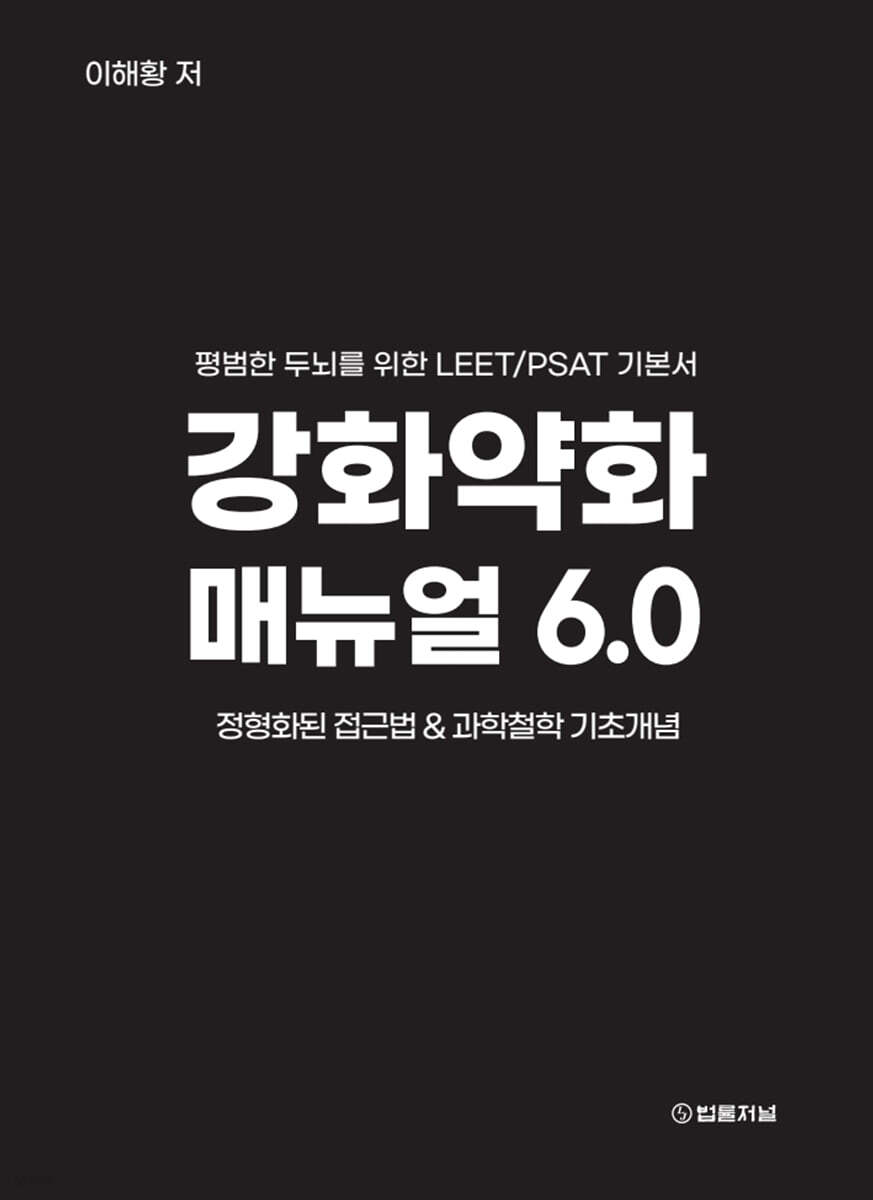
Reinforcement/Weakening Manual 6.0
 |
Description
Book Introduction
You can learn a flowchart of simple judgment criteria that can be applied consistently in the testing room.
By studying the difficult LEET and PSAT strengthening and weakening problems, you can internalize the judgment criteria flow chart.
You can summarize the basic concepts of philosophy of science that have been covered previously.
By studying the difficult LEET and PSAT strengthening and weakening problems, you can internalize the judgment criteria flow chart.
You can summarize the basic concepts of philosophy of science that have been covered previously.
- You can preview some of the book's contents.
Preview
index
I.
Strengthening/Weakening Judgment Criteria
T1.
Strengthening and Weakening Flowchart 8
T2.
Hypothesis Inference 19
T3.
Research Design 35
T4.
Auxiliary hypothesis 76
T5.
Eliminationism 110
T6.
Probability 147
T7.
Bayesianism 166
II.
A Complete Guide to Inductive Reasoning
T8.
Type 199 of Inductive Reasoning
T9.
Inductive Generalization 201
T10.
Ubiquitous Reasoning 231
T11.
Method for Finding the Cause of Wheat 260
III.
A Complete Summary of Causal Theory
T12.
Regularity Causal Theory 278
T13.
Estimation of necessary causes 299
T14.
Counterfactual Causal Theory 307
T15.
Probabilistic Causal Theory 333
T16.
Causal Process Theory 341
T17.
Manipulative Causality Theory 344
IV.
Key Concepts in Philosophy of Science
T18.
Hempel's Explanatory Theory 358
T19.
Paradigm 369
T20.
Paradoxes in the Philosophy of Science 383
T21.
Scientific Realism 406
T22.
Reduction 414
T23.
FireAvent 420
T24.
Experimental Philosophy 423
T25.
Quantum Mechanics 434
V.
supplement
T26.
Prediction 454
T27.
Matrix 513
T28.
Statistics 584
Strengthening/Weakening Judgment Criteria
T1.
Strengthening and Weakening Flowchart 8
T2.
Hypothesis Inference 19
T3.
Research Design 35
T4.
Auxiliary hypothesis 76
T5.
Eliminationism 110
T6.
Probability 147
T7.
Bayesianism 166
II.
A Complete Guide to Inductive Reasoning
T8.
Type 199 of Inductive Reasoning
T9.
Inductive Generalization 201
T10.
Ubiquitous Reasoning 231
T11.
Method for Finding the Cause of Wheat 260
III.
A Complete Summary of Causal Theory
T12.
Regularity Causal Theory 278
T13.
Estimation of necessary causes 299
T14.
Counterfactual Causal Theory 307
T15.
Probabilistic Causal Theory 333
T16.
Causal Process Theory 341
T17.
Manipulative Causality Theory 344
IV.
Key Concepts in Philosophy of Science
T18.
Hempel's Explanatory Theory 358
T19.
Paradigm 369
T20.
Paradoxes in the Philosophy of Science 383
T21.
Scientific Realism 406
T22.
Reduction 414
T23.
FireAvent 420
T24.
Experimental Philosophy 423
T25.
Quantum Mechanics 434
V.
supplement
T26.
Prediction 454
T27.
Matrix 513
T28.
Statistics 584
Publisher's Review
preface
1.
Why did you write the "Strengthening and Weakening Manual"?
- LEET/PSAT high-difficulty questions will include strengthening and weakening of hypotheses and related scientific philosophy concepts.
However, most test takers do not have a basic understanding of this.
Because I never learned it properly in middle and high school.
- Many test takers are confused because the explanations for individual past exam questions vary slightly depending on the answer book and instructor. In particular, there were many cases where the strengthening and weakening of hypotheses were solved incorrectly using T1, so it was necessary to correct it.
2.
After studying the 『Strengthening and Weakening Manual』?
- You can learn a flowchart of simple judgment criteria that can be applied consistently in the testing room.
- By studying the difficult LEET and PSAT strengthening and weakening problems, you can internalize the judgment criteria flow chart.
- You can summarize the basic concepts of philosophy of science that have been covered previously.
For example, proof, falsifiability, frequentist probability, paradigm, INUS causation, counterfactual causation, incommensurability, etc. have appeared on the LEET and PSAT many times, and will appear again.
You must keep it organized.
3.
What are the differences from existing textbooks/lectures?
Self-study is possible. The course is explained in detail so that even students who find on-site lectures difficult can understand it. The course is explained in depth so that even students who find on-site lectures inconvenient can find it satisfying.
- We aim to provide accurate explanations. Therefore, we have had some questions and explanations reviewed by professors specializing in the philosophy of science and analytic philosophy.
In the process, we discovered errors in the PSAT questions.
2009 5th grade civil service exam PSAT verbal logic question 19☞T1 question 4, which deals with the Lorenz hypothesis imprinting theory, should have been recognized as having multiple correct answers.
Unfortunately, most textbooks/reference books treat this error question as a model example (without errors).* However, you need to be able to determine this question as an error to be able to consistently solve other difficult LEET/PSAT questions.
I sincerely hope that this book will be a good companion to those who are learning on their own, and that it will help them establish criteria for judging whether something is strengthened or weakened.
In Haeundae, Lee Hae-hwang
1.
Why did you write the "Strengthening and Weakening Manual"?
- LEET/PSAT high-difficulty questions will include strengthening and weakening of hypotheses and related scientific philosophy concepts.
However, most test takers do not have a basic understanding of this.
Because I never learned it properly in middle and high school.
- Many test takers are confused because the explanations for individual past exam questions vary slightly depending on the answer book and instructor. In particular, there were many cases where the strengthening and weakening of hypotheses were solved incorrectly using T1, so it was necessary to correct it.
2.
After studying the 『Strengthening and Weakening Manual』?
- You can learn a flowchart of simple judgment criteria that can be applied consistently in the testing room.
- By studying the difficult LEET and PSAT strengthening and weakening problems, you can internalize the judgment criteria flow chart.
- You can summarize the basic concepts of philosophy of science that have been covered previously.
For example, proof, falsifiability, frequentist probability, paradigm, INUS causation, counterfactual causation, incommensurability, etc. have appeared on the LEET and PSAT many times, and will appear again.
You must keep it organized.
3.
What are the differences from existing textbooks/lectures?
Self-study is possible. The course is explained in detail so that even students who find on-site lectures difficult can understand it. The course is explained in depth so that even students who find on-site lectures inconvenient can find it satisfying.
- We aim to provide accurate explanations. Therefore, we have had some questions and explanations reviewed by professors specializing in the philosophy of science and analytic philosophy.
In the process, we discovered errors in the PSAT questions.
2009 5th grade civil service exam PSAT verbal logic question 19☞T1 question 4, which deals with the Lorenz hypothesis imprinting theory, should have been recognized as having multiple correct answers.
Unfortunately, most textbooks/reference books treat this error question as a model example (without errors).* However, you need to be able to determine this question as an error to be able to consistently solve other difficult LEET/PSAT questions.
I sincerely hope that this book will be a good companion to those who are learning on their own, and that it will help them establish criteria for judging whether something is strengthened or weakened.
In Haeundae, Lee Hae-hwang
GOODS SPECIFICS
- Date of issue: January 6, 2025
- Page count, weight, size: 592 pages | 190*260*35mm
- ISBN13: 9788963369716
- ISBN10: 8963369714
You may also like
카테고리
korean


korean

![GQ KOREA Mark (Monthly): December [2025]](http://librairie.coreenne.fr/cdn/shop/files/8ef265dbbfbf186523ed75ba7319009d.jpg?v=1765340328&width=3840)


