

Judge Zelkova
 |
Description
Book Introduction
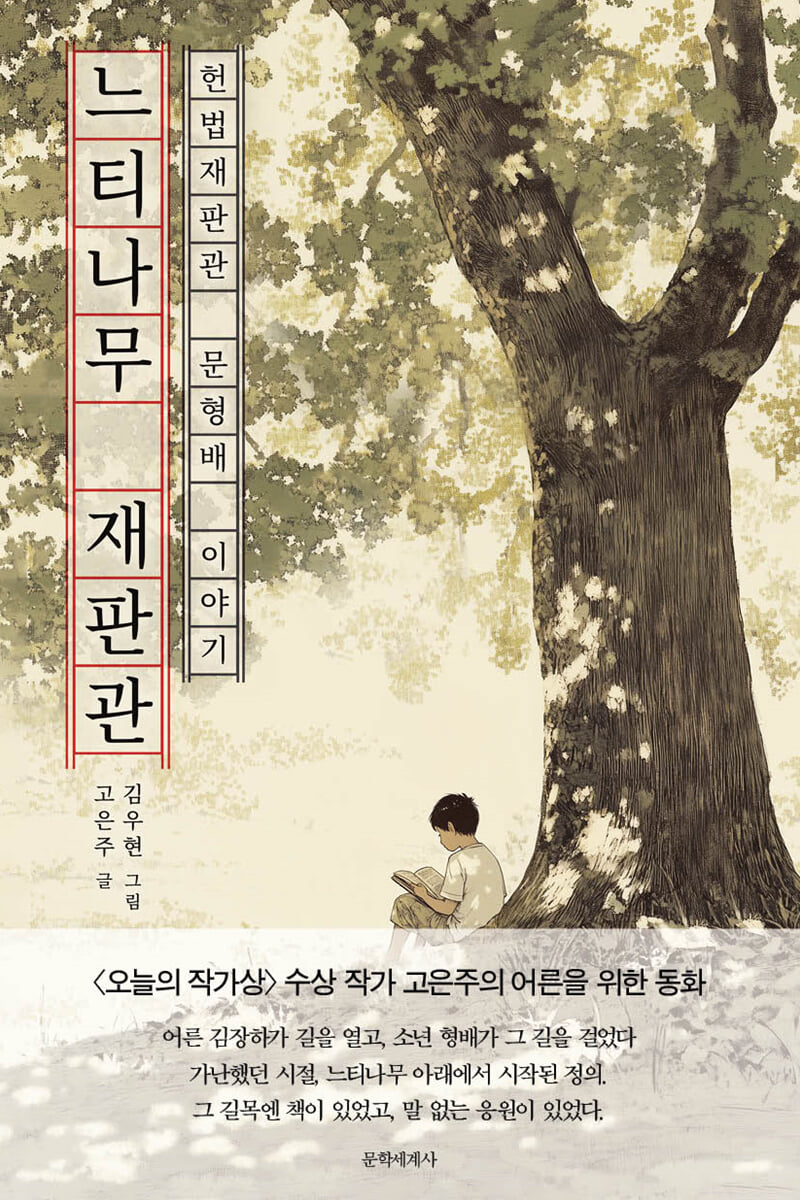
The adult Kim Jang-ha opened the way, and the boy Moon Hyung-bae walked that path. In those poor times,
Justice began under the zelkova tree. At that crossroads, there were books and silent encouragement.
[Today's Author Award] Award-winning author Eunju Ko's fairy tales for adults
A Child Who Learned People Before Law Became a Constitutional Court Justice
"Judge Zelkova" is a touching, original fairy tale based on a true story that depicts the journey of Moon Hyung-bae, a country boy who only knew books, to become a Constitutional Court justice, through the eyes of his closest friend.
This work, based on the childhood and adolescence of the real-life Constitutional Court Justice Moon Hyung-bae, speaks of law and justice, but fundamentally, it warmly illuminates people, friendship, and the dignity inherent in the ordinary.
The narrator, 'I', is Moon Hyung-bae's (play name 'Hyung-bae') childhood friend.
Looking back on the past from the present perspective, I fondly recall the image of Hyung-bae borrowing a book and memorizing it in its entirety, the afternoon we read together under the zelkova tree at the village entrance, the day I was delighted to see someone else's name tag on my hand-me-down school uniform, and the turning point in my life when I received a scholarship from Mr. Kim Jang-ha.
All these memories are simple and quiet, but they contain a deep resonance of life and human warmth.
Although Hyungbae was poor, he was a child with a quiet personality and a burning passion for books.
For him, books were more than just a tool for acquiring knowledge; they were a support to endure a difficult life and a window to understand the world.
I borrowed the book, memorized it, and shared the joy by sharing its contents with my friends.
Even in a situation where even going to middle school was uncertain due to difficult family circumstances, he never gave up on learning, and when he was able to continue his studies with the help of teacher Kim Jang-ha, he engraved that meaning in his heart with more sincere gratitude than anyone else.
Justice began under the zelkova tree. At that crossroads, there were books and silent encouragement.
[Today's Author Award] Award-winning author Eunju Ko's fairy tales for adults
A Child Who Learned People Before Law Became a Constitutional Court Justice
"Judge Zelkova" is a touching, original fairy tale based on a true story that depicts the journey of Moon Hyung-bae, a country boy who only knew books, to become a Constitutional Court justice, through the eyes of his closest friend.
This work, based on the childhood and adolescence of the real-life Constitutional Court Justice Moon Hyung-bae, speaks of law and justice, but fundamentally, it warmly illuminates people, friendship, and the dignity inherent in the ordinary.
The narrator, 'I', is Moon Hyung-bae's (play name 'Hyung-bae') childhood friend.
Looking back on the past from the present perspective, I fondly recall the image of Hyung-bae borrowing a book and memorizing it in its entirety, the afternoon we read together under the zelkova tree at the village entrance, the day I was delighted to see someone else's name tag on my hand-me-down school uniform, and the turning point in my life when I received a scholarship from Mr. Kim Jang-ha.
All these memories are simple and quiet, but they contain a deep resonance of life and human warmth.
Although Hyungbae was poor, he was a child with a quiet personality and a burning passion for books.
For him, books were more than just a tool for acquiring knowledge; they were a support to endure a difficult life and a window to understand the world.
I borrowed the book, memorized it, and shared the joy by sharing its contents with my friends.
Even in a situation where even going to middle school was uncertain due to difficult family circumstances, he never gave up on learning, and when he was able to continue his studies with the help of teacher Kim Jang-ha, he engraved that meaning in his heart with more sincere gratitude than anyone else.
- You can preview some of the book's contents.
Preview
index
Author's Note: Boys grow, and adults pave the way.
My friend on TV
Child Under the Moonlight
Inherited school uniform and name tag
Meet Mr. Kim Jang-ha
The judge who gives books as gifts
What Law and Baseball Have in Common
Average person becomes a Constitutional Court justice
Like dandelion seeds
Towards the zelkova tree in spring
My friend on TV
Child Under the Moonlight
Inherited school uniform and name tag
Meet Mr. Kim Jang-ha
The judge who gives books as gifts
What Law and Baseball Have in Common
Average person becomes a Constitutional Court justice
Like dandelion seeds
Towards the zelkova tree in spring
Detailed image

Publisher's Review
Quiet Justice, a Judge Who Embraces People
Hyung-Bae, who has become a judge, makes decisions in court that put people first.
He hands a book to the defendant, who tried to commit suicide because of credit card debt but ended up setting fires, and says:
“The word ‘suicide’ sounds like ‘let’s live’ to us.”
This one sentence shows the philosophy that runs through Hyungbae's entire life.
He was a human being before he was a lawyer, and he considered people's circumstances before the strictness of the law.
The justice he learned under the zelkova tree as a child and through the life of Mr. Kim Jang-ha was not a path that began with a cold law book, but with a warm person.
At his confirmation hearing when he was appointed as a Constitutional Court justice in 2019, Justice Moon Hyung-bae stated, “I have pursued the life of an average person.”
In fact, he was the candidate with the least wealth at the time and had no special political interests.
However, the verdicts of Judge Moon Hyung-bae, who put people first, always embraced people, and his words conveyed warm comfort and hope.
"The Zelkova Judge" is a fairy tale like the "shade of a zelkova tree" that conveys the values of hope and justice to young people and deep comfort and emotion to adults weary of the times.
Rather than a heroic narrative of an individual, it warmly portrays the coming-of-age story of an ordinary boy, living in the memories of a friend. The story of Hyung-bae, an "average" man, who spent his childhood reading books and walking with friends under a zelkova tree during a time of poverty, without a TV and wearing hand-me-down school uniforms, shows how a person can grow through the warmth of someone's hand and unwavering friendship.
Fairy tales for adults, a time of growth for all of us.
The greatest virtue of this work lies in its unadorned 'quietness' and sincerity.
It proves that stories can deeply move people's hearts without grand events or intense drama.
Rather than addressing the heavy topics of law and justice, it offers readers a gentle and moving message through everyday scenes of books, people, friendship, and waiting.
"The Oak Judge" is a fairy tale for adults, but it is neither childish nor sentimental.
The landscapes and emotions of childhood are vividly captured in restrained sentences, and the illustrations are as clear and lyrical as watercolors, making it a book that can be read and resonated with by all generations, from teenagers to adults.
After reading this book, the reader will suddenly recall someone's face.
A friend who shared dreams with me as a child, a child who loved books, a person who was quiet but had a deep heart.
And maybe I'll look back on my own growth period, not that of my brother.
This book is one person's special story, but at the same time, it is a universal coming-of-age story for all of us.
The little-known story of "Hyeongbae" comes to life in fairy tales.
In "Judge Zelkova," specific memories of Constitutional Court Justice Moon Hyung-bae's childhood, little-known beyond his official career, are vividly brought to life in the form of a touching fairy tale.
Hyungbae, who has an introverted personality, was a shy child who couldn't finish singing "With You" during a middle school field trip due to embarrassment.
The story of the graduation photo taken during middle school, when I wore a hand-me-down uniform and wore someone else's name tag, is a story that still touches many people to this day.
Also, this book honestly depicts the innocent boy who had never been to a public bathhouse until high school and was flustered by the fact that he had to take off all his clothes, including his underwear, in the bathhouse.
Even while watching a TV comedy program that everyone else was laughing at, he carefully observed the characters' expressions and speech patterns, his passion for dreaming of a "just trial" while reading books from the school library almost by heart, and even the image of Judge Hyung-bae as a kind person who explained the fairness of rulings and home runs at the baseball field at a child's level - his life was always filled with quiet justice and a warm gaze toward people.
Above all, the scene where Hyung-bae, who was considering giving up his studies due to poverty, receives a scholarship from Mr. Kim Jang-ha and begins a new path is the emotional center of this book and the moment that most powerfully conveys the message of “the dignified growth of an average person.”
All of these episodes are not mere recollections, but the roots of a quiet and solid narrative that created the Judge Moon Hyung-bae we know today.
"The Zelkova Judge" is a precious story of our time, written honestly and warmly from the perspective of a friend.
The knots of language in the work - Hyungbae's time brought to life in the Gyeongsang dialect
Author Eun-ju Ko was born in Busan and worked as an announcer at MBC Jinju, where she personally learned the language, life, and emotions of the Gyeongnam region.
In 『Judge Zelkova』, the taste and sentiment of Gyeongsang-do that he has long cherished comes alive naturally throughout the sentences.
The narrator of this book is Hyungbae's childhood friend, and the story unfolds through his eyes and voice.
The speaker's speech incorporates Gyeongsang dialect vocabulary and unique rhythms throughout the sentences. This goes beyond simply using dialect; it serves as an effective device for vividly conveying the texture of memory and the warmth between people.
"The Zelkova Judge" is a story in which words and memories, land and emotions are closely intertwined.
The unique Gyeongsang dialect expressions that are found throughout the work convey to the reader the childhood of Hyungbae and the narrator, the village and people they lived in, and the atmosphere of that time.
“But there is a zelkova tree, child!”
(The relief and joy that even though everything has changed, the zelkova tree, the center of my hometown, is still there)
“The book is alive.
“There is no wet spot.”
(Hyungbae's earnest love and obsession with books, running through the mud with books in his arms in the sudden rain)
“A dog hit.
“Mom also prepares side dishes for me.”
(Warm comfort and consideration from an adult who understands a friend's difficult circumstances)
“Will a child who only knows books be able to eat properly while living alone?”
(A mother's heartfelt and realistic concern about her son's meals while living alone)
The question, “Does your school have a library?” naturally conveys a fervent desire for learning and growth, and the answer, “I know.
The phrase, “Our Hadong child,” contains pride in the region, a strong sense of community, and the deep resonance of the word “hometown.”
The dialects that appear in this book are not simply dialects; they are the language of memory and evidence of emotion.
When the voice of a friend remembering Hyungbae flows out in a sentimental dialect, the reader will be able to feel beyond the tone of voice the passage of time, the affection between people, the preciousness of relationships, and even the true meaning of justice.
Eun-ju Ko, a writer who transforms memories into narratives, combining literary quality with contemporary significance.
In this installment, "Judge Zelkova," author Eun-ju Ko quietly and deeply follows the childhood and adolescence of the real-life Constitutional Court Justice Hyung-bae Moon, as he learns justice and grows into an adult who embraces others.
In this work, he avoids flashy dramas or epic heroic narratives. Instead, he delicately depicts the dignity and humanity contained within the "ordinary," and how each scene in memory shapes the direction of life, using warm language and restrained sentences.
The themes that author Eun-ju Ko has long explored—“memory and growth,” “the inner workings of silent characters,” and “quiet solidarity between people”—are deeply revealed in this work, and while based on a true story, it has been completed as a fairy tale for adults that retains its literary sensibility and emotional resonance.
The Illustration of "The Zelkova Judge": Depicting the Emotions of Memory
The illustrations for "The Zelkova Judge" were created by artist Woohyun Kim, who majored in graphic design at Tama Art University in Japan and is active in Korea and Japan under the name "Kim Burger."
Drawing on his diverse visual experience as an animation director and advertising creative director, he presents emotional illustrations that combine the lyricism of pencil drawing and watercolor.
Rather than simply describing a scene, his paintings visually and delicately express the temperature and emotions of memories.
In a scene that brings to life the soft spread of watercolor and the warm texture of pencil lines, rather than exaggerated emotions or sharp details, a character's old memories are conveyed to the reader through quiet colors and airy margins.
Hyung-bae memorizing a book under the moonlight, the boy running barefoot through a puddle while holding a book in his arms, Hyung-bae singing “With You” at a spring picnic talent show when he suddenly stops and fidgets, looking embarrassed and as if he’s about to cry – pictures sometimes portray emotions in memory more accurately than words, and they seep into the reader’s heart.
In this work, author Woohyun Kim breathes visual lingering emotion and narrative life into these fairytale scenes that speak of law, people, growth, and justice.
The painting goes beyond a simple 'illustration' and exists as a 'reminiscence' in itself, visually beautifully completing the quiet emotion of 'The Zelkova Judge'.
Author's Note
'Poverty could not stop life, books could change people, and laws could finally be warm.
Like the clear face of Mr. Kim Jang-ha, who is over 80 years old, and like his heart that spread like dandelion seeds, I want to share a fairy tale of our time that is hard to believe, but certainly exists. - Go Eun-ju (from "Author's Note")
Hyung-Bae, who has become a judge, makes decisions in court that put people first.
He hands a book to the defendant, who tried to commit suicide because of credit card debt but ended up setting fires, and says:
“The word ‘suicide’ sounds like ‘let’s live’ to us.”
This one sentence shows the philosophy that runs through Hyungbae's entire life.
He was a human being before he was a lawyer, and he considered people's circumstances before the strictness of the law.
The justice he learned under the zelkova tree as a child and through the life of Mr. Kim Jang-ha was not a path that began with a cold law book, but with a warm person.
At his confirmation hearing when he was appointed as a Constitutional Court justice in 2019, Justice Moon Hyung-bae stated, “I have pursued the life of an average person.”
In fact, he was the candidate with the least wealth at the time and had no special political interests.
However, the verdicts of Judge Moon Hyung-bae, who put people first, always embraced people, and his words conveyed warm comfort and hope.
"The Zelkova Judge" is a fairy tale like the "shade of a zelkova tree" that conveys the values of hope and justice to young people and deep comfort and emotion to adults weary of the times.
Rather than a heroic narrative of an individual, it warmly portrays the coming-of-age story of an ordinary boy, living in the memories of a friend. The story of Hyung-bae, an "average" man, who spent his childhood reading books and walking with friends under a zelkova tree during a time of poverty, without a TV and wearing hand-me-down school uniforms, shows how a person can grow through the warmth of someone's hand and unwavering friendship.
Fairy tales for adults, a time of growth for all of us.
The greatest virtue of this work lies in its unadorned 'quietness' and sincerity.
It proves that stories can deeply move people's hearts without grand events or intense drama.
Rather than addressing the heavy topics of law and justice, it offers readers a gentle and moving message through everyday scenes of books, people, friendship, and waiting.
"The Oak Judge" is a fairy tale for adults, but it is neither childish nor sentimental.
The landscapes and emotions of childhood are vividly captured in restrained sentences, and the illustrations are as clear and lyrical as watercolors, making it a book that can be read and resonated with by all generations, from teenagers to adults.
After reading this book, the reader will suddenly recall someone's face.
A friend who shared dreams with me as a child, a child who loved books, a person who was quiet but had a deep heart.
And maybe I'll look back on my own growth period, not that of my brother.
This book is one person's special story, but at the same time, it is a universal coming-of-age story for all of us.
The little-known story of "Hyeongbae" comes to life in fairy tales.
In "Judge Zelkova," specific memories of Constitutional Court Justice Moon Hyung-bae's childhood, little-known beyond his official career, are vividly brought to life in the form of a touching fairy tale.
Hyungbae, who has an introverted personality, was a shy child who couldn't finish singing "With You" during a middle school field trip due to embarrassment.
The story of the graduation photo taken during middle school, when I wore a hand-me-down uniform and wore someone else's name tag, is a story that still touches many people to this day.
Also, this book honestly depicts the innocent boy who had never been to a public bathhouse until high school and was flustered by the fact that he had to take off all his clothes, including his underwear, in the bathhouse.
Even while watching a TV comedy program that everyone else was laughing at, he carefully observed the characters' expressions and speech patterns, his passion for dreaming of a "just trial" while reading books from the school library almost by heart, and even the image of Judge Hyung-bae as a kind person who explained the fairness of rulings and home runs at the baseball field at a child's level - his life was always filled with quiet justice and a warm gaze toward people.
Above all, the scene where Hyung-bae, who was considering giving up his studies due to poverty, receives a scholarship from Mr. Kim Jang-ha and begins a new path is the emotional center of this book and the moment that most powerfully conveys the message of “the dignified growth of an average person.”
All of these episodes are not mere recollections, but the roots of a quiet and solid narrative that created the Judge Moon Hyung-bae we know today.
"The Zelkova Judge" is a precious story of our time, written honestly and warmly from the perspective of a friend.
The knots of language in the work - Hyungbae's time brought to life in the Gyeongsang dialect
Author Eun-ju Ko was born in Busan and worked as an announcer at MBC Jinju, where she personally learned the language, life, and emotions of the Gyeongnam region.
In 『Judge Zelkova』, the taste and sentiment of Gyeongsang-do that he has long cherished comes alive naturally throughout the sentences.
The narrator of this book is Hyungbae's childhood friend, and the story unfolds through his eyes and voice.
The speaker's speech incorporates Gyeongsang dialect vocabulary and unique rhythms throughout the sentences. This goes beyond simply using dialect; it serves as an effective device for vividly conveying the texture of memory and the warmth between people.
"The Zelkova Judge" is a story in which words and memories, land and emotions are closely intertwined.
The unique Gyeongsang dialect expressions that are found throughout the work convey to the reader the childhood of Hyungbae and the narrator, the village and people they lived in, and the atmosphere of that time.
“But there is a zelkova tree, child!”
(The relief and joy that even though everything has changed, the zelkova tree, the center of my hometown, is still there)
“The book is alive.
“There is no wet spot.”
(Hyungbae's earnest love and obsession with books, running through the mud with books in his arms in the sudden rain)
“A dog hit.
“Mom also prepares side dishes for me.”
(Warm comfort and consideration from an adult who understands a friend's difficult circumstances)
“Will a child who only knows books be able to eat properly while living alone?”
(A mother's heartfelt and realistic concern about her son's meals while living alone)
The question, “Does your school have a library?” naturally conveys a fervent desire for learning and growth, and the answer, “I know.
The phrase, “Our Hadong child,” contains pride in the region, a strong sense of community, and the deep resonance of the word “hometown.”
The dialects that appear in this book are not simply dialects; they are the language of memory and evidence of emotion.
When the voice of a friend remembering Hyungbae flows out in a sentimental dialect, the reader will be able to feel beyond the tone of voice the passage of time, the affection between people, the preciousness of relationships, and even the true meaning of justice.
Eun-ju Ko, a writer who transforms memories into narratives, combining literary quality with contemporary significance.
In this installment, "Judge Zelkova," author Eun-ju Ko quietly and deeply follows the childhood and adolescence of the real-life Constitutional Court Justice Hyung-bae Moon, as he learns justice and grows into an adult who embraces others.
In this work, he avoids flashy dramas or epic heroic narratives. Instead, he delicately depicts the dignity and humanity contained within the "ordinary," and how each scene in memory shapes the direction of life, using warm language and restrained sentences.
The themes that author Eun-ju Ko has long explored—“memory and growth,” “the inner workings of silent characters,” and “quiet solidarity between people”—are deeply revealed in this work, and while based on a true story, it has been completed as a fairy tale for adults that retains its literary sensibility and emotional resonance.
The Illustration of "The Zelkova Judge": Depicting the Emotions of Memory
The illustrations for "The Zelkova Judge" were created by artist Woohyun Kim, who majored in graphic design at Tama Art University in Japan and is active in Korea and Japan under the name "Kim Burger."
Drawing on his diverse visual experience as an animation director and advertising creative director, he presents emotional illustrations that combine the lyricism of pencil drawing and watercolor.
Rather than simply describing a scene, his paintings visually and delicately express the temperature and emotions of memories.
In a scene that brings to life the soft spread of watercolor and the warm texture of pencil lines, rather than exaggerated emotions or sharp details, a character's old memories are conveyed to the reader through quiet colors and airy margins.
Hyung-bae memorizing a book under the moonlight, the boy running barefoot through a puddle while holding a book in his arms, Hyung-bae singing “With You” at a spring picnic talent show when he suddenly stops and fidgets, looking embarrassed and as if he’s about to cry – pictures sometimes portray emotions in memory more accurately than words, and they seep into the reader’s heart.
In this work, author Woohyun Kim breathes visual lingering emotion and narrative life into these fairytale scenes that speak of law, people, growth, and justice.
The painting goes beyond a simple 'illustration' and exists as a 'reminiscence' in itself, visually beautifully completing the quiet emotion of 'The Zelkova Judge'.
Author's Note
'Poverty could not stop life, books could change people, and laws could finally be warm.
Like the clear face of Mr. Kim Jang-ha, who is over 80 years old, and like his heart that spread like dandelion seeds, I want to share a fairy tale of our time that is hard to believe, but certainly exists. - Go Eun-ju (from "Author's Note")
GOODS SPECIFICS
- Date of issue: June 3, 2025
- Page count, weight, size: 128 pages | 228g | 140*210*10mm
- ISBN13: 9791193001691
- ISBN10: 1193001692
You may also like
카테고리
korean


korean

![ELLE 엘르 스페셜 에디션 A형 : 12월 [2025]](http://librairie.coreenne.fr/cdn/shop/files/b8e27a3de6c9538896439686c6b0e8fb.jpg?v=1766436872&width=3840)


