

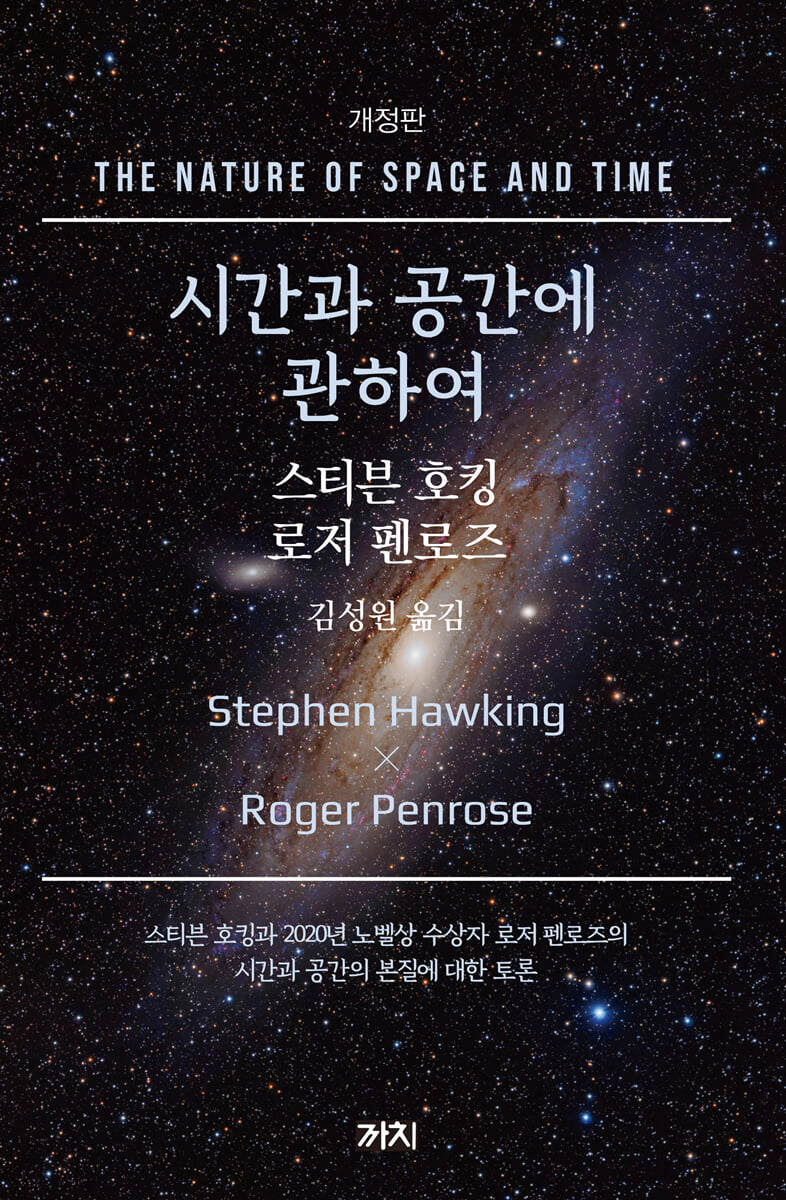
About time and space
 |
Description
Book Introduction
The best physicist Stephen Hawking and Nobel Prize winner Roger Penrose
A great debate on the nature of time and space
Revised edition with new “postscript” added in 2010
Einstein said that the most incomprehensible thing in the universe is that we can understand it.
But was he right? Can two of the most accurate and successful theories in physics—quantum field theory and Einstein's general theory of relativity—be unified into a single theory of quantum gravity? Can quantum mechanics and the universe be unified? Two of the world's most renowned physicists, Stephen Hawking and Roger Penrose (Nobel Prize winner in Physics), disagree on this issue.
They explain their position in this book, On Space and Time, which records six lectures and a final discussion given at the Isaac Newton Institute for Mathematical Sciences at the University of Cambridge.
A great debate on the nature of time and space
Revised edition with new “postscript” added in 2010
Einstein said that the most incomprehensible thing in the universe is that we can understand it.
But was he right? Can two of the most accurate and successful theories in physics—quantum field theory and Einstein's general theory of relativity—be unified into a single theory of quantum gravity? Can quantum mechanics and the universe be unified? Two of the world's most renowned physicists, Stephen Hawking and Roger Penrose (Nobel Prize winner in Physics), disagree on this issue.
They explain their position in this book, On Space and Time, which records six lectures and a final discussion given at the Isaac Newton Institute for Mathematical Sciences at the University of Cambridge.
- You can preview some of the book's contents.
Preview
index
At the beginning of the book
Acknowledgements
Chapter 1 Classical Theory ∥ Stephen Hawking
Chapter 2: The Structure of Spacetime Singularities ∥ Roger Penrose
Chapter 3: Quantum Black Holes ∥ Stephen Hawking
Chapter 4: Quantum Theory and Spacetime ∥ Roger Penrose
Chapter 5: Quantum Cosmology ∥ Stephen Hawking
Chapter 6 Treating Spacetime as a Twister ∥ Roger Penrose
Chapter 7 Discussion ∥ Stephen Hawking and Roger Penrose
2010 Edition Review: The Continued Debate
Glossary of Terms
References
Translator's Note on the Revised Edition
Translator's Note on the First Edition
Biographical Index
Acknowledgements
Chapter 1 Classical Theory ∥ Stephen Hawking
Chapter 2: The Structure of Spacetime Singularities ∥ Roger Penrose
Chapter 3: Quantum Black Holes ∥ Stephen Hawking
Chapter 4: Quantum Theory and Spacetime ∥ Roger Penrose
Chapter 5: Quantum Cosmology ∥ Stephen Hawking
Chapter 6 Treating Spacetime as a Twister ∥ Roger Penrose
Chapter 7 Discussion ∥ Stephen Hawking and Roger Penrose
2010 Edition Review: The Continued Debate
Glossary of Terms
References
Translator's Note on the Revised Edition
Translator's Note on the First Edition
Biographical Index
Publisher's Review
How might quantum gravity, a theory that could explain the early moments of the Big Bang and the physics of enigmatic objects known as black holes, be constructed? Why does our universe appear to conform to Einstein's predictions, showing no sign of quantum effects? What strange quantum process could evaporate a black hole, and what happens to all the information it swallows? Why does time move forward, not backward?
In this book, two discussants address all these questions.
Penrose, like Einstein, does not believe that quantum mechanics is the final theory.
Hawking, on the other hand, argues that general relativity alone cannot explain how the universe began.
Only quantum gravity theory combined with the no-boundary hypothesis has any hope of adequately explaining what we can barely observe about the universe.
Penrose, who plays the realist role to the positivist Hawking, believes that the universe is infinite and will continue to expand forever.
He argues that the universe can be understood using the geometry of light cones, the compression and distortion of space-time, and twister theory.
Through their final discussion, the reader will come to realize how Hawking and Penrose differed on the ultimate quest to unite quantum mechanics and relativity, and how differently they attempted to understand the incomprehensible.
In this book, two discussants address all these questions.
Penrose, like Einstein, does not believe that quantum mechanics is the final theory.
Hawking, on the other hand, argues that general relativity alone cannot explain how the universe began.
Only quantum gravity theory combined with the no-boundary hypothesis has any hope of adequately explaining what we can barely observe about the universe.
Penrose, who plays the realist role to the positivist Hawking, believes that the universe is infinite and will continue to expand forever.
He argues that the universe can be understood using the geometry of light cones, the compression and distortion of space-time, and twister theory.
Through their final discussion, the reader will come to realize how Hawking and Penrose differed on the ultimate quest to unite quantum mechanics and relativity, and how differently they attempted to understand the incomprehensible.
GOODS SPECIFICS
- Date of issue: May 20, 2021
- Page count, weight, size: 228 pages | 392g | 145*225*14mm
- ISBN13: 9788972917366
- ISBN10: 8972917362
You may also like
카테고리
korean


korean

![GQ KOREA Mark (Monthly): December [2025]](http://librairie.coreenne.fr/cdn/shop/files/8ef265dbbfbf186523ed75ba7319009d.jpg?v=1765340328&width=3840)


