

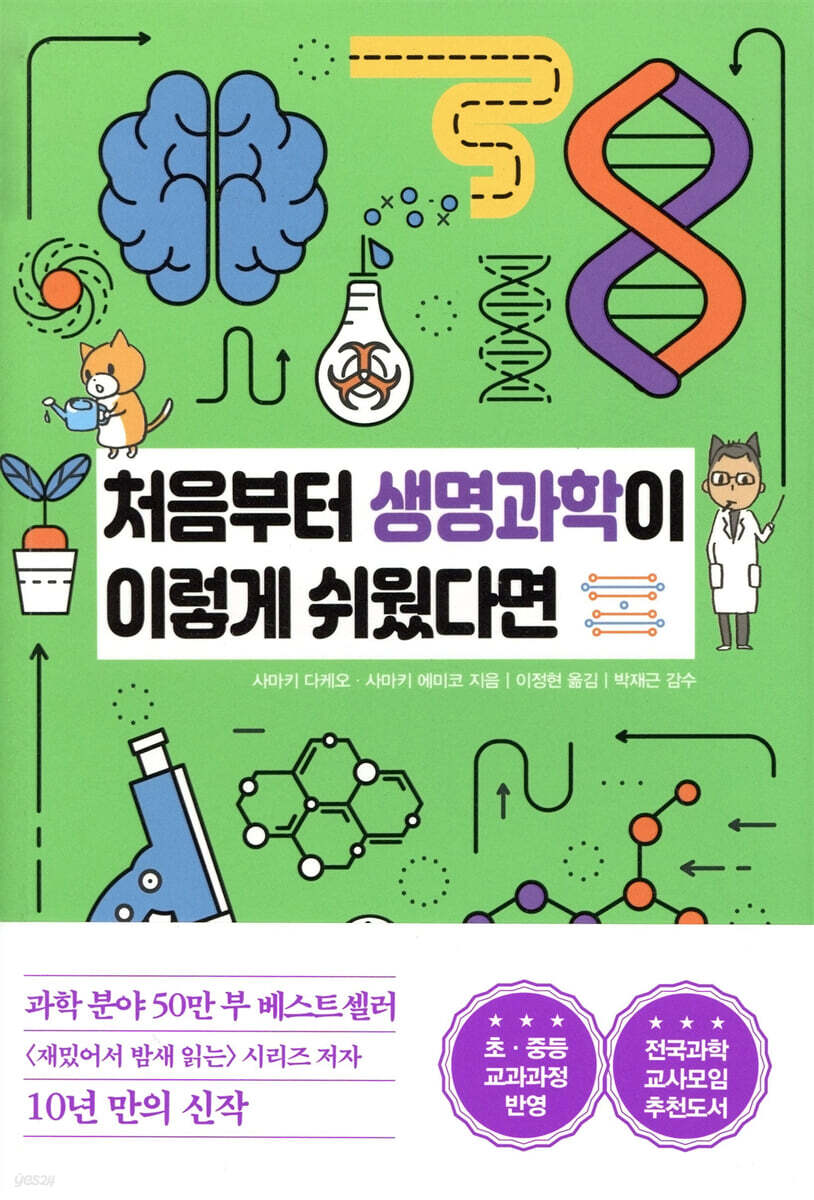
If only life science had been this easy from the beginning
 |
Description
Book Introduction
“This is the first time I’ve seen such simple life science!”
A bestseller in the science field with 500,000 copies sold
The author of the "Fun to Read All Night" series has released a new book after 10 years!
Books recommended by the National Science Teachers Association
Reflection of elementary and secondary school curriculum
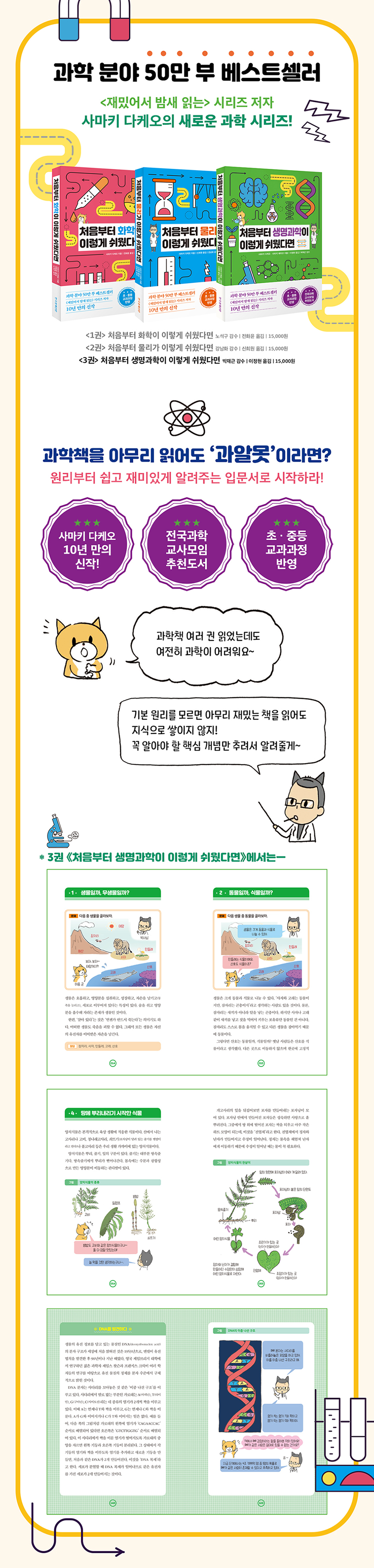
Takeo Samaki, the bestselling author of 『Fun Chemistry Stories That Will Keep You Reading All Night』 and 『Fun Physics Stories That Will Keep You Reading All Night』, is back with a new science series.
The "If Science Were This Easy from the Start" series, now available for the first time in 10 years, focuses on introducing the fundamental principles of chemistry, physics, and life sciences in an easy and fun way.
While other popular science books that deal with everyday scientific stories often offer fragmented knowledge, this series distinguishes itself by establishing a framework for scientific thinking by organically connecting the content and carefully selecting the core principles that readers must know.
Volume 3, “If Life Science Were This Easy From the Beginning,” covers the definition of living things, the differences between plants and animals, the structure of cells, the principles of heredity, and the history of how the first living things evolved into humans.
Are corals animals or plants? Are there creatures with blue blood? Do plants survive solely on water? How do animals without spines survive? How many cells are there in the human body? Through the rich illustrations presented by the adorable Meow and the friendly doctor, you'll learn the fundamental principles in a fun and engaging way, naturally finding answers to these questions.
Let's embark on a journey into the world of life science, which becomes even more fun once you understand the principles.
A bestseller in the science field with 500,000 copies sold
The author of the "Fun to Read All Night" series has released a new book after 10 years!
Books recommended by the National Science Teachers Association
Reflection of elementary and secondary school curriculum
Takeo Samaki, the bestselling author of 『Fun Chemistry Stories That Will Keep You Reading All Night』 and 『Fun Physics Stories That Will Keep You Reading All Night』, is back with a new science series.
The "If Science Were This Easy from the Start" series, now available for the first time in 10 years, focuses on introducing the fundamental principles of chemistry, physics, and life sciences in an easy and fun way.
While other popular science books that deal with everyday scientific stories often offer fragmented knowledge, this series distinguishes itself by establishing a framework for scientific thinking by organically connecting the content and carefully selecting the core principles that readers must know.
Volume 3, “If Life Science Were This Easy From the Beginning,” covers the definition of living things, the differences between plants and animals, the structure of cells, the principles of heredity, and the history of how the first living things evolved into humans.
Are corals animals or plants? Are there creatures with blue blood? Do plants survive solely on water? How do animals without spines survive? How many cells are there in the human body? Through the rich illustrations presented by the adorable Meow and the friendly doctor, you'll learn the fundamental principles in a fun and engaging way, naturally finding answers to these questions.
Let's embark on a journey into the world of life science, which becomes even more fun once you understand the principles.
- You can preview some of the book's contents.
Preview
index
Author's Note
Chapter 1: How do plants live?
1.
Is it living or non-living?
2.
Is it an animal or a plant?
3.
Do plants survive on water alone?
4.
Photosynthesis: The Secret to Making Your Own Nutrients
5.
What does a plant's body look like?
6.
I want to get more sunlight!
7.
How are leaves structured?
8.
Plants breathe too?
9.
What happens in the stem?
10.
What role do roots play?
11.
Why do flowers bloom and why do fruits form?
Chapter 2 How did plants develop?
1.
Long ago, plants lived in the sea.
2.
Birds, the ancestors of plants
3.
Plants come up onto land
4.
A plant that has begun to take root in the ground
5.
Plants that survive even in dry places appear
6.
How to classify plants
Chapter 3: How do animals live?
1.
How to classify animals
2.
How do carnivores survive?
3.
How do herbivores survive?
4.
How is the human body different from other animals?
5.
How do humans get nutrients?
6.
Why does my heart beat without stopping?
7.
How do waste products in the body get rid of themselves?
8.
The immune system that protects our body
9.
Nervous system, the body's command center
Chapter 4: How did animals develop?
1.
What are the characteristics of vertebrates?
2.
ancestors of vertebrates, the storage period
3.
What are the characteristics of invertebrates?
Chapter 5 All living things are made up of cells
1.
What is a cell?
2.
Cells in our body
3.
How to increase cell number
4.
How do animals reproduce?
5.
Development, the process by which cells grow
6.
How do plants reproduce?
Chapter 6: Characteristics of Living Things Are Inherited
1.
What is heredity?
Chapter 7: What kind of relationships do living things have with each other?
1.
Food chain, the relationship between eating and being eaten
2.
Food webs that create stable ecosystems
3.
The meaning of the ecological pyramid
4.
To maintain ecological balance
5.
The wonderful creatures that break down organic matter
Chapter 8: How have living things evolved?
1.
What is evolution?
2.
The beginning of evolution, mutation
3.
natural selection theory
Chapter 9: How were humans born?
1.
The first life forms emerge from the primordial sea
2.
Photosynthetic organisms appear
3.
Explosive increase in life in the ocean
4.
Why was there no life on land for so long?
5.
Plants emerge above ground
6.
Animals also appeared on land following the plants.
7.
Reptiles rule the Earth
8.
Mammals thrive
9.
human evolution
Search
Chapter 1: How do plants live?
1.
Is it living or non-living?
2.
Is it an animal or a plant?
3.
Do plants survive on water alone?
4.
Photosynthesis: The Secret to Making Your Own Nutrients
5.
What does a plant's body look like?
6.
I want to get more sunlight!
7.
How are leaves structured?
8.
Plants breathe too?
9.
What happens in the stem?
10.
What role do roots play?
11.
Why do flowers bloom and why do fruits form?
Chapter 2 How did plants develop?
1.
Long ago, plants lived in the sea.
2.
Birds, the ancestors of plants
3.
Plants come up onto land
4.
A plant that has begun to take root in the ground
5.
Plants that survive even in dry places appear
6.
How to classify plants
Chapter 3: How do animals live?
1.
How to classify animals
2.
How do carnivores survive?
3.
How do herbivores survive?
4.
How is the human body different from other animals?
5.
How do humans get nutrients?
6.
Why does my heart beat without stopping?
7.
How do waste products in the body get rid of themselves?
8.
The immune system that protects our body
9.
Nervous system, the body's command center
Chapter 4: How did animals develop?
1.
What are the characteristics of vertebrates?
2.
ancestors of vertebrates, the storage period
3.
What are the characteristics of invertebrates?
Chapter 5 All living things are made up of cells
1.
What is a cell?
2.
Cells in our body
3.
How to increase cell number
4.
How do animals reproduce?
5.
Development, the process by which cells grow
6.
How do plants reproduce?
Chapter 6: Characteristics of Living Things Are Inherited
1.
What is heredity?
Chapter 7: What kind of relationships do living things have with each other?
1.
Food chain, the relationship between eating and being eaten
2.
Food webs that create stable ecosystems
3.
The meaning of the ecological pyramid
4.
To maintain ecological balance
5.
The wonderful creatures that break down organic matter
Chapter 8: How have living things evolved?
1.
What is evolution?
2.
The beginning of evolution, mutation
3.
natural selection theory
Chapter 9: How were humans born?
1.
The first life forms emerge from the primordial sea
2.
Photosynthetic organisms appear
3.
Explosive increase in life in the ocean
4.
Why was there no life on land for so long?
5.
Plants emerge above ground
6.
Animals also appeared on land following the plants.
7.
Reptiles rule the Earth
8.
Mammals thrive
9.
human evolution
Search
Detailed image
Into the book
People in ancient times thought coral was a plant.
Because it does not move to other places, but lives fixedly in one place and looks like a flower in bloom.
It was around 1800 that scholars began to recognize coral as an animal.
What many people thought was a flower turned out to be a part of the body with a structure similar to a sea snail.
Corals mainly eat small zooplankton or phytoplankton in the water, but some corals settle phytoplankton on their bodies and obtain nutrients from it.
--- From "Is it an animal or a plant?"
Human blood is red because of the hemoglobin in the blood.
But there are animals with blue blood.
This includes arthropods such as shrimp and crabs, and mollusks such as clams, squid, and octopuses.
The reason these animals have blue blood is because they have hemocyanin, a respiratory pigment containing copper atoms, in their blood.
Hemocyanin itself is colorless and transparent, but when combined with oxygen, copper ions react and turn blue.
Like hemoglobin, it plays a role in transporting oxygen, but rather than being contained within blood cells, it is dissolved in hemolymph, which functions as both blood and lymph.
--- From "Red Blood and Blue Blood"
In the 17th century, the Belgian physician Jan Baptista van Helmont surmised that if plants absorbed all the nutrients they needed to survive from the soil, the soil would lose weight as the plants grew.
So, we conducted an experiment where we only watered willow trees for five years and observed their growth.
The willow tree, which weighed 2.27 kg at the beginning of the experiment, grew to 76.74 kg after five years.
I gained more than 70kg in weight over 5 years.
Plants are made up of 80-90% water.
The remaining 10-20% is non-water substances.
So, if we do a rough calculation, we can see that the willow trees Helmont grew had an increase of 7 to 14 kg of substances other than water.
So, did the weight of the soil decrease by that much? No.
The soil only decreased by 0.056 kg.
Helmont concluded that 'since the willow tree was only given water, the weight of the tree increased because of the water absorbed by the roots.'
Today we know that this conclusion was wrong.
It was not until 1804, 150 years after Helmont's experiment, that it was discovered that plants grow by absorbing carbon dioxide from the air.
And it wasn't until 1862 that it was discovered that carbon dioxide absorbed by plants turns into starch.
--- From "Do plants live only on water?"
The body of a living thing is truly magnificent.
Cells that are only a few tens of micrometers in size repeatedly divide to increase in number, and each cell sends signals to each other to properly perform its own role.
For example, if we eat too much food, the remaining nutrients turn into fat and are stored in fat cells.
Obese people have more fat cells than thin people, and the fat cells are filled with fat, so they are also larger.
Osteoblasts, the cells that build bones, produce a strong fibrous substance called collagen inside the cells and export it outside the cells.
Then, collagen meets calcium phosphate carried in the blood to form strong bones.
Everything that happens in a living body, such as storing fat, building bones, sweating, and breaking down alcohol, is handled by cells.
Because it does not move to other places, but lives fixedly in one place and looks like a flower in bloom.
It was around 1800 that scholars began to recognize coral as an animal.
What many people thought was a flower turned out to be a part of the body with a structure similar to a sea snail.
Corals mainly eat small zooplankton or phytoplankton in the water, but some corals settle phytoplankton on their bodies and obtain nutrients from it.
--- From "Is it an animal or a plant?"
Human blood is red because of the hemoglobin in the blood.
But there are animals with blue blood.
This includes arthropods such as shrimp and crabs, and mollusks such as clams, squid, and octopuses.
The reason these animals have blue blood is because they have hemocyanin, a respiratory pigment containing copper atoms, in their blood.
Hemocyanin itself is colorless and transparent, but when combined with oxygen, copper ions react and turn blue.
Like hemoglobin, it plays a role in transporting oxygen, but rather than being contained within blood cells, it is dissolved in hemolymph, which functions as both blood and lymph.
--- From "Red Blood and Blue Blood"
In the 17th century, the Belgian physician Jan Baptista van Helmont surmised that if plants absorbed all the nutrients they needed to survive from the soil, the soil would lose weight as the plants grew.
So, we conducted an experiment where we only watered willow trees for five years and observed their growth.
The willow tree, which weighed 2.27 kg at the beginning of the experiment, grew to 76.74 kg after five years.
I gained more than 70kg in weight over 5 years.
Plants are made up of 80-90% water.
The remaining 10-20% is non-water substances.
So, if we do a rough calculation, we can see that the willow trees Helmont grew had an increase of 7 to 14 kg of substances other than water.
So, did the weight of the soil decrease by that much? No.
The soil only decreased by 0.056 kg.
Helmont concluded that 'since the willow tree was only given water, the weight of the tree increased because of the water absorbed by the roots.'
Today we know that this conclusion was wrong.
It was not until 1804, 150 years after Helmont's experiment, that it was discovered that plants grow by absorbing carbon dioxide from the air.
And it wasn't until 1862 that it was discovered that carbon dioxide absorbed by plants turns into starch.
--- From "Do plants live only on water?"
The body of a living thing is truly magnificent.
Cells that are only a few tens of micrometers in size repeatedly divide to increase in number, and each cell sends signals to each other to properly perform its own role.
For example, if we eat too much food, the remaining nutrients turn into fat and are stored in fat cells.
Obese people have more fat cells than thin people, and the fat cells are filled with fat, so they are also larger.
Osteoblasts, the cells that build bones, produce a strong fibrous substance called collagen inside the cells and export it outside the cells.
Then, collagen meets calcium phosphate carried in the blood to form strong bones.
Everything that happens in a living body, such as storing fat, building bones, sweating, and breaking down alcohol, is handled by cells.
--- From "Cells in Our Body"
Publisher's Review
What if I still don't know much about science no matter how much I read?
An introductory book to life science that explains basic principles in an easy and fun way.
Bestselling author Takeo Samaki, who received much love from readers for 『Fun Chemistry Stories That Will Keep You Reading All Night』 and 『Fun Physics Stories That Will Keep You Reading All Night』, is back with a new science series.
While the existing 『Fun to Read All Night』 series covered science stories from everyday life, the newly published 『If Science Were This Easy from the Beginning』 series covers the basic principles of each field of science in order.
There is a special reason why the author focused on basic principles this time.
No matter how widely read my previous books and other popular science books are, many people still find science unfamiliar and difficult.
Since most books focus on telling stories about science in everyday life through case studies, they only briefly introduce fragmented knowledge and do not help in building up organized knowledge.
Then, no matter how enjoyable the content is to read, it will easily evaporate.
This is why science still feels difficult even after reading many science books filled with interesting stories.
Understanding the principles makes science more exciting.
The core of life science explained by a bestselling author!
Born from this awareness of the problem, the "If Science Were This Easy from the Beginning" series divides the core content covered in elementary and middle school science curricula into chemistry, physics, and life science, and then explains the basic principles step by step.
The book is enriched with illustrations featuring cute Meow and Doctor characters, making it even more fun to read.
Is coral an animal or a plant? Are there creatures with blue blood? Do plants survive solely on water? How do animals without spines survive? How many cells are there in the human body? Volume 3, "If Life Science Were This Easy from the Beginning," covers the definition of life, the differences between plants and animals, cell structure, the principles of heredity, and even the history of how the first living organisms evolved into humans.
As you learn these principles in a fun way, you will naturally find answers to the questions above, and you will also gain the insight to read numerous general science books more deeply.
This book will serve as an introductory book that provides a solid foundation in life sciences for both young people who want to become familiar with life sciences and adult readers interested in general science.
An introductory book to life science that explains basic principles in an easy and fun way.
Bestselling author Takeo Samaki, who received much love from readers for 『Fun Chemistry Stories That Will Keep You Reading All Night』 and 『Fun Physics Stories That Will Keep You Reading All Night』, is back with a new science series.
While the existing 『Fun to Read All Night』 series covered science stories from everyday life, the newly published 『If Science Were This Easy from the Beginning』 series covers the basic principles of each field of science in order.
There is a special reason why the author focused on basic principles this time.
No matter how widely read my previous books and other popular science books are, many people still find science unfamiliar and difficult.
Since most books focus on telling stories about science in everyday life through case studies, they only briefly introduce fragmented knowledge and do not help in building up organized knowledge.
Then, no matter how enjoyable the content is to read, it will easily evaporate.
This is why science still feels difficult even after reading many science books filled with interesting stories.
Understanding the principles makes science more exciting.
The core of life science explained by a bestselling author!
Born from this awareness of the problem, the "If Science Were This Easy from the Beginning" series divides the core content covered in elementary and middle school science curricula into chemistry, physics, and life science, and then explains the basic principles step by step.
The book is enriched with illustrations featuring cute Meow and Doctor characters, making it even more fun to read.
Is coral an animal or a plant? Are there creatures with blue blood? Do plants survive solely on water? How do animals without spines survive? How many cells are there in the human body? Volume 3, "If Life Science Were This Easy from the Beginning," covers the definition of life, the differences between plants and animals, cell structure, the principles of heredity, and even the history of how the first living organisms evolved into humans.
As you learn these principles in a fun way, you will naturally find answers to the questions above, and you will also gain the insight to read numerous general science books more deeply.
This book will serve as an introductory book that provides a solid foundation in life sciences for both young people who want to become familiar with life sciences and adult readers interested in general science.
GOODS SPECIFICS
- Publication date: March 26, 2021
- Page count, weight, size: 216 pages | 412g | 140*205*16mm
- ISBN13: 9788947546959
- ISBN10: 894754695X
You may also like
카테고리
korean


korean

![GQ KOREA Mark (Monthly): December [2025]](http://librairie.coreenne.fr/cdn/shop/files/8ef265dbbfbf186523ed75ba7319009d.jpg?v=1765340328&width=3840)


