

More Than a Novel: Spring 2025
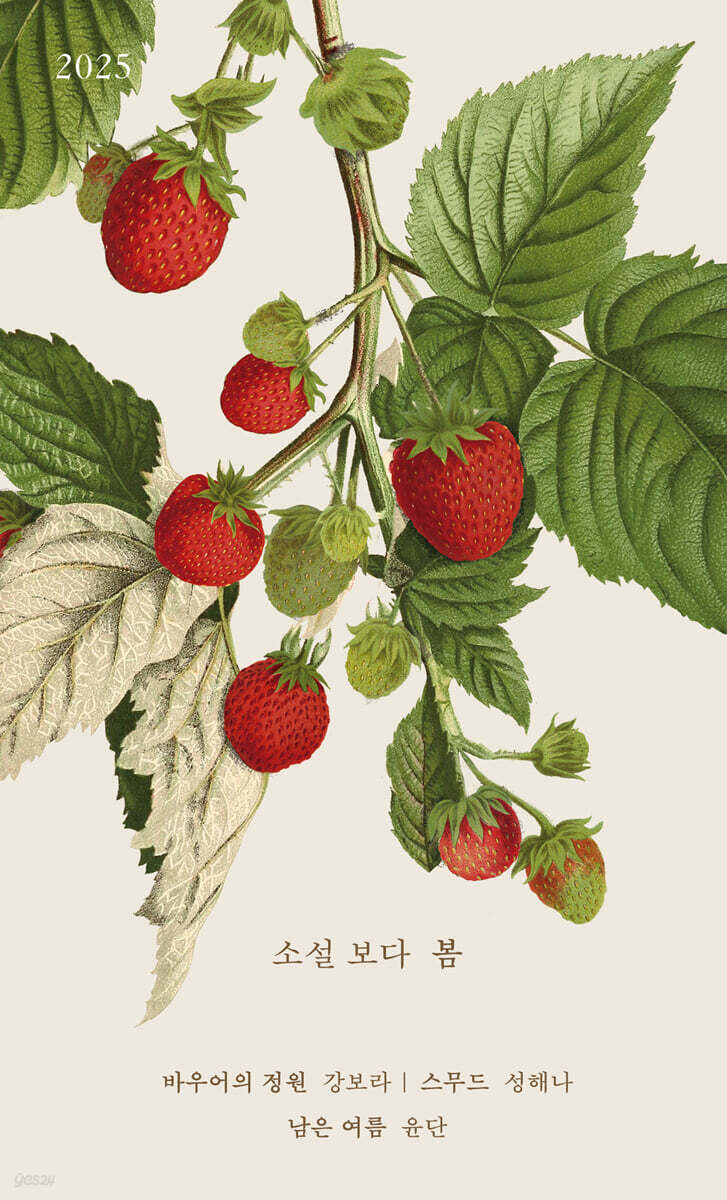 |
Description
Book Introduction
A novelistic spring landscape drawn by a new generation
A special project that always delivers value beyond readers' expectations, 『Novels: Spring 2025』, has been published.
"Novels" is a project that began in 2018 where Munhak-kwa-Jiseongsa selects a "novel of the season" every quarter, publishes the results on its website, and compiles and publishes a book of the results each season.
The selected works will be nominated for the Munji Literary Award.
The "Novels" series has been receiving great responses from readers for eight years, featuring novels by young writers as well as interviews with authors directly participated by the selection committee.
Going forward, “Novels,” published each season, will faithfully fulfill its role as a bridge connecting promising young writers and readers in the most rapid and intimate way.
『Novels: Spring 2025』 contains three novels selected for the Spring 2025 ‘Novel of the Season’: Kang Bo-ra’s “Bauer’s Garden,” Seong Hae-na’s “Smooth,” and Yoon Dan’s “The Remains of Summer,” along with interviews with the authors.
This work is a candidate for the 15th Munji Literary Award.
The reviews of the works selected through free discussion by the selection committee (Kang Dong-ho, So Yoo-jeong, Lee So, Lee Hee-woo, Jo Yeon-jeong, Hong Seong-hee) can be found on the Munhak-kwa-Jiseongsa website.
* The book will be sold for a limited time of one year.
A special project that always delivers value beyond readers' expectations, 『Novels: Spring 2025』, has been published.
"Novels" is a project that began in 2018 where Munhak-kwa-Jiseongsa selects a "novel of the season" every quarter, publishes the results on its website, and compiles and publishes a book of the results each season.
The selected works will be nominated for the Munji Literary Award.
The "Novels" series has been receiving great responses from readers for eight years, featuring novels by young writers as well as interviews with authors directly participated by the selection committee.
Going forward, “Novels,” published each season, will faithfully fulfill its role as a bridge connecting promising young writers and readers in the most rapid and intimate way.
『Novels: Spring 2025』 contains three novels selected for the Spring 2025 ‘Novel of the Season’: Kang Bo-ra’s “Bauer’s Garden,” Seong Hae-na’s “Smooth,” and Yoon Dan’s “The Remains of Summer,” along with interviews with the authors.
This work is a candidate for the 15th Munji Literary Award.
The reviews of the works selected through free discussion by the selection committee (Kang Dong-ho, So Yoo-jeong, Lee So, Lee Hee-woo, Jo Yeon-jeong, Hong Seong-hee) can be found on the Munhak-kwa-Jiseongsa website.
* The book will be sold for a limited time of one year.
- You can preview some of the book's contents.
Preview
index
Bauer's Garden Kang Bo-ra
Interview with Kang Bo-ra and Hong Seong-hee
Smooth Seong Hae-na
Interview with Seong Hae-na and Lee So
The remaining summer solstice
Interview with Yoon Dan and So Yu-jeong
Interview with Kang Bo-ra and Hong Seong-hee
Smooth Seong Hae-na
Interview with Seong Hae-na and Lee So
The remaining summer solstice
Interview with Yoon Dan and So Yu-jeong
Into the book
Snowflakes dancing under the streetlights.
Colorful light bulbs decorate the windows.
The clear bell of the Salvation Army.
The smell of fish cake wafting from the street stall.
The sound of people's laughter... As she passed through the snowy streets of the end of the year, Eunhwa sensed the beauty of the world one by one, and as she did so, she slowly became more miserable.
Young Eun-hwa decided to preserve that misery as an actress.
Because that was something that belonged to her and no one could touch it.
A small blue spark burned quietly in her garden.
--- From "Kang Bo-ra, Bauer's Garden"
Mr. Kim took out a 'Tai Geuk Gi' from his bag and handed it to me.
And shook it vigorously.
Shake it.
Shake together.
At first, it was a little embarrassing and funny, but I soon got used to the situation and waved my 'Tai Geuk Gi' to the music like Mr. Kim.
I also took pictures of Mr. Kim and the 'martyrs' with my cell phone camera.
Mr. Kim smiled at the camera, and the elderly people standing on both sides of us and in front and behind us made V signs with their fingers or waved without hesitation.
There were also old people who stroked my hand, patted my back, and said something in Korean.
Mr. Kim said they were proud of me.
You are also a 'martyr'.
Just like us.
--- From "Seong Hae-na, Smooth"
After a while, the blue sofa disappeared.
Seohyun didn't see the moment the sofa disappeared and ultimately didn't know who took it.
It was sudden, but this time I didn't think about why.
Rather, it was closer to the feeling of “finally… …”.
The roadside without a sofa looked like a landscape that had lost its blue color.
Seohyun discovered that there were subtle traces left where the sofa had been.
Like the empty space of a demolished building, like skin that is not burned except for the part that is covered.
Does the ground also change color without us knowing as it is exposed to the sun?
Seohyun could clearly see where the sofa had been.
Colorful light bulbs decorate the windows.
The clear bell of the Salvation Army.
The smell of fish cake wafting from the street stall.
The sound of people's laughter... As she passed through the snowy streets of the end of the year, Eunhwa sensed the beauty of the world one by one, and as she did so, she slowly became more miserable.
Young Eun-hwa decided to preserve that misery as an actress.
Because that was something that belonged to her and no one could touch it.
A small blue spark burned quietly in her garden.
--- From "Kang Bo-ra, Bauer's Garden"
Mr. Kim took out a 'Tai Geuk Gi' from his bag and handed it to me.
And shook it vigorously.
Shake it.
Shake together.
At first, it was a little embarrassing and funny, but I soon got used to the situation and waved my 'Tai Geuk Gi' to the music like Mr. Kim.
I also took pictures of Mr. Kim and the 'martyrs' with my cell phone camera.
Mr. Kim smiled at the camera, and the elderly people standing on both sides of us and in front and behind us made V signs with their fingers or waved without hesitation.
There were also old people who stroked my hand, patted my back, and said something in Korean.
Mr. Kim said they were proud of me.
You are also a 'martyr'.
Just like us.
--- From "Seong Hae-na, Smooth"
After a while, the blue sofa disappeared.
Seohyun didn't see the moment the sofa disappeared and ultimately didn't know who took it.
It was sudden, but this time I didn't think about why.
Rather, it was closer to the feeling of “finally… …”.
The roadside without a sofa looked like a landscape that had lost its blue color.
Seohyun discovered that there were subtle traces left where the sofa had been.
Like the empty space of a demolished building, like skin that is not burned except for the part that is covered.
Does the ground also change color without us knowing as it is exposed to the sun?
Seohyun could clearly see where the sofa had been.
--- From "Yundan, the Remains of Summer"
Publisher's Review
Spring, the novel of this season
The spring we encounter after passing through the long tunnel of winter is short but splendid.
Even the frozen soul melts before the innocent scenery that reveals its tender heart.
『Novels: Spring 2025』 introduces three novels that move toward healing through the extremely ordinary event of a ‘chance encounter (or reunion).’
As we pass through the world of others, which is as changeable as the weather, old wounds break the silence.
A stranger who suddenly appears in a place where there is no sunlight and speaks to you.
A stranger who sneaks up on you.
A person like me who has lost his place as 'me' and whom I cannot hate at all.
A companionship that is made without a plan heralds a new beginning.
The prelude to change that will ease the sorrow I have been holding on to alone may have been waiting for me ahead of time.
Kang Bo-ra, "Bauer's Garden"
“They seemed to be alive only in that moment.
“Like people who, if you take away the scars from their lives, would have nothing left.”
We meet Kang Bo-ra, who began her career through the 2021 Hankook Ilbo New Year's Literary Contest and won the 2023 Lee Hyo-seok Literary Award for Excellence, for the second time in 'Novel of This Season' following the spring of 2023.
In his previous work, "Landscape with Snakes and Cabbages," the artist delved into the psychology of subtle relationships by examining the tastes and hierarchies surrounding art. In this selected work, "Bauer's Garden," the artist once again sharply touches on the contradictory nature of art.
Eun-hwa, a well-known actress, decides to resume her career after a long hiatus.
At the audition for a play where the actress's real story is adapted and the monologue is about "the wounds she has experienced as a woman" and "the pain that has not been digested in her heart", Eun-hwa encounters Jeong-rim, a former close junior.
Each person has to go through the deepest depths of suffering to pass the audition, and after countless revisions, the few sentences they put out into the world cannot be a play, but they end up encountering the irony that it is a play.
After the audition, the road to Jeonglim, where the Daehakro performance was held, was taken by car.
They chat about their time together in Eunhwa's mint-colored Morning, a car that has been around for a long time.
The way two people who have shared the experience of losing a child in the womb summon up their wounds through the format of a drama therapy workshop resonates vividly.
The deep empathy and communication that are formed outside the stage, at a point where art and reality are not separated, leave a lasting impression.
After meeting Jeong-rim, Eun-hwa and the aspiring actor Cho-won, who are looking forward to meeting, are characters who stand in a future that is one step ahead.
Although the meadow does not appear directly in the novel, it remains a possibility that tests the limits of art as representation, leaving behind a link to the silver coin.
Kang Bo-ra's novels "hold readers captive for a long time at the subtle point where theater and life obscure each other yet remain inseparable" (literary critic Lee Hee-woo).
So where do all the personal stories that haven't been told yet (or that simply refuse to be told) go?
I think the poetic image that came to mind in response to that was 'Satin Bower's Garden'.
Looking at the bird's nest, a haphazard collection of objects that lack consistency except for the color blue, I imagined an inner place where the unique pain of an individual who has not found a proper narrative blazes blue like a flame.
- From "Interview Kang Bo-ra x Hong Seong-hee"
Seong Hae-na, "Smooth"
“There was still an inexplicable hot feeling in my heart.
“It feels like both pleasure and pain”
Since her debut, she has garnered attention from critics and readers alike for her sharp portrayal of contemporary society, winning the 15th Young Writer Award in 2024 and being selected as the 'No. 1 Young Writer Who Will Be the Future of Korean Literature in 2024 (Yes24)'. We meet Seong Hae-na for the second time in 'This Season's Novel' following her first appearance in the spring of 2023.
Dewey (me), the agent of world-renowned artist Jeff, is a third-generation Korean American, but he is so ignorant about Korea that he is setting foot on Korean soil for the first time for work reasons.
He took advantage of his busy schedule to find some personal time and coincidentally ended up in the middle of Gwanghwamun, where the heat of the protests was blazing.
The phone, which had been ringing incessantly with urgent notifications, turns off while I am lost for a moment.
Dewey, who was seeking help, is gradually sucked into the crowd.
The unfamiliar taste of seaweed, reached through a luxury apartment with a gallery and a Michelin chef's cooking, and then by the elderly people in the square armed with 'Tai Geuk Gi'.
As a foreigner, I am armed with another attribute, a rigid sense of vigilance, but I experience a sense of connection and belonging through the interference and protection of those who unknowingly intervene.
The world of the smooth-spoken 'No Problem' and the clumsy but affectionate 'No Problem' (the author made a strict distinction between the differences in pronunciation).
As I wander through two separate worlds, my impression of Korea gradually takes shape.
However, it is closer to a movement of the mind trying to fill a deficiency rather than a result of rational judgment.
The first affection I felt for these “warm-hearted people who gave me kindness without asking for anything in return, who spared no effort, and who even gave me their hearts” became a powerful experience that erased my awareness of the world’s problems.
Seong Hae-na's novels, through the eyes of a narrator with an ambiguous identity, offer an unfamiliar view of Korean society, revealing the current state of affairs in which past and present, individuals and groups, are confusedly coherent.
“The psychoanalytic origins of the increasingly widespread political claims today are keenly captured in the desire for oneself, which can be defined as the knowledge of ignorance” (literary critic Kang Dong-ho).
Understanding can build and advance relationships, but sometimes it seems that understanding can cause people to break down, fall into fear, or become frustrated.
So I think complete understanding is impossible.
Sometimes, saying that you understand someone can be seen as a deception, so you may be careful with your words.
Still, I believe that the desperate process of trying to understand humans makes us a little more human.
- From "Interview Seong Hae-na x Lee So"
Yoon Dan, "The Remains of Summer"
"Seo-hyeon gazed at the world the sofa had seen at night, and as she did so, she gradually encountered a deep, somber sadness."
We first meet Yoon Dan, who began her career as a writer through the 2024 Munhak-kwa-sahoe New Writer's Award, receiving praise for her "surprising skill in creating a transformation that can be lived through small moments" (Judge Im Sol-ah), in 'Novels of This Season' with "The Remains of Summer."
The death of a friend in the middle of winter and resignation from work.
The novel's narrator, Seo-hyeon, spends her days receiving unemployment benefits and living an unremarkable life.
On a sunny spring day, Seo-hyeon goes to a used bookstore to sell the books left behind by her dead friend. On the way back, she changes her mind and carries the books on her back, and discovers a blue sofa lying there.
Since that day, I sit on a sofa in a corner of the outskirts of the city and read a book every day.
There are some people who glance at that sight.
The person who broke the peace that was barely maintained was Seo-hyeon's former boss, Team Leader Chu.
Although the resignation was due to restructuring, there is a part of Seo-hyeon's mind that Team Leader Chu may have had an influence on the process.
Although Seo-hyeon herself was unaware of it, the sofa was located near her former workplace, and Team Leader Chu, who misunderstood Seo-hyeon, began to visit her once every two days to express his discomfort.
Having failed to kick Seohyun out, he ends up sitting next to her on the sofa and confesses various details about his personal life.
As Seo-hyeon goes back and forth between home and the sofa, the scenery and relationships she encounters gradually change.
One day, the sofa suddenly disappears, leaving only a faint trace that suggests it was there.
Seohyun belatedly realizes the loneliness her friend felt when he went to catch a soccer ball that flew towards him one day but no one followed him.
The soccer ball my friend brought me and my friend have both left me, but what remains in the end is the memory of their existence.
In the last scene of the novel, Seo-hyeon's heart is filled with "hoping that the ball will never fly towards her, but at the same time waiting for it to fly towards her."
After a long and slow mourning, Seohyun stares straight into the future, a future she both hopes for and fears.
“This novel speaks melancholy about a life that seems to exist but does not, and thus ultimately feels like it does not exist.
Of course, this is not all.
“It contains the desperate effort to think about ‘presence’ that can never be completely erased from the place of absence” (Cho Yeon-jeong, literary critic).
It would be difficult to explain it in words, but anyway, I go through each day confirming that there is a sofa there.
Above all, when I sit on the sofa, I feel a 'sense of life' that is different from when I lie alone in my room.
The gaze of others that you mentioned is one of them.
I think it's connected to the will to live in many ways.
- From "Interview Yoon Dan x So Yu-jeong"
The spring we encounter after passing through the long tunnel of winter is short but splendid.
Even the frozen soul melts before the innocent scenery that reveals its tender heart.
『Novels: Spring 2025』 introduces three novels that move toward healing through the extremely ordinary event of a ‘chance encounter (or reunion).’
As we pass through the world of others, which is as changeable as the weather, old wounds break the silence.
A stranger who suddenly appears in a place where there is no sunlight and speaks to you.
A stranger who sneaks up on you.
A person like me who has lost his place as 'me' and whom I cannot hate at all.
A companionship that is made without a plan heralds a new beginning.
The prelude to change that will ease the sorrow I have been holding on to alone may have been waiting for me ahead of time.
Kang Bo-ra, "Bauer's Garden"
“They seemed to be alive only in that moment.
“Like people who, if you take away the scars from their lives, would have nothing left.”
We meet Kang Bo-ra, who began her career through the 2021 Hankook Ilbo New Year's Literary Contest and won the 2023 Lee Hyo-seok Literary Award for Excellence, for the second time in 'Novel of This Season' following the spring of 2023.
In his previous work, "Landscape with Snakes and Cabbages," the artist delved into the psychology of subtle relationships by examining the tastes and hierarchies surrounding art. In this selected work, "Bauer's Garden," the artist once again sharply touches on the contradictory nature of art.
Eun-hwa, a well-known actress, decides to resume her career after a long hiatus.
At the audition for a play where the actress's real story is adapted and the monologue is about "the wounds she has experienced as a woman" and "the pain that has not been digested in her heart", Eun-hwa encounters Jeong-rim, a former close junior.
Each person has to go through the deepest depths of suffering to pass the audition, and after countless revisions, the few sentences they put out into the world cannot be a play, but they end up encountering the irony that it is a play.
After the audition, the road to Jeonglim, where the Daehakro performance was held, was taken by car.
They chat about their time together in Eunhwa's mint-colored Morning, a car that has been around for a long time.
The way two people who have shared the experience of losing a child in the womb summon up their wounds through the format of a drama therapy workshop resonates vividly.
The deep empathy and communication that are formed outside the stage, at a point where art and reality are not separated, leave a lasting impression.
After meeting Jeong-rim, Eun-hwa and the aspiring actor Cho-won, who are looking forward to meeting, are characters who stand in a future that is one step ahead.
Although the meadow does not appear directly in the novel, it remains a possibility that tests the limits of art as representation, leaving behind a link to the silver coin.
Kang Bo-ra's novels "hold readers captive for a long time at the subtle point where theater and life obscure each other yet remain inseparable" (literary critic Lee Hee-woo).
So where do all the personal stories that haven't been told yet (or that simply refuse to be told) go?
I think the poetic image that came to mind in response to that was 'Satin Bower's Garden'.
Looking at the bird's nest, a haphazard collection of objects that lack consistency except for the color blue, I imagined an inner place where the unique pain of an individual who has not found a proper narrative blazes blue like a flame.
- From "Interview Kang Bo-ra x Hong Seong-hee"
Seong Hae-na, "Smooth"
“There was still an inexplicable hot feeling in my heart.
“It feels like both pleasure and pain”
Since her debut, she has garnered attention from critics and readers alike for her sharp portrayal of contemporary society, winning the 15th Young Writer Award in 2024 and being selected as the 'No. 1 Young Writer Who Will Be the Future of Korean Literature in 2024 (Yes24)'. We meet Seong Hae-na for the second time in 'This Season's Novel' following her first appearance in the spring of 2023.
Dewey (me), the agent of world-renowned artist Jeff, is a third-generation Korean American, but he is so ignorant about Korea that he is setting foot on Korean soil for the first time for work reasons.
He took advantage of his busy schedule to find some personal time and coincidentally ended up in the middle of Gwanghwamun, where the heat of the protests was blazing.
The phone, which had been ringing incessantly with urgent notifications, turns off while I am lost for a moment.
Dewey, who was seeking help, is gradually sucked into the crowd.
The unfamiliar taste of seaweed, reached through a luxury apartment with a gallery and a Michelin chef's cooking, and then by the elderly people in the square armed with 'Tai Geuk Gi'.
As a foreigner, I am armed with another attribute, a rigid sense of vigilance, but I experience a sense of connection and belonging through the interference and protection of those who unknowingly intervene.
The world of the smooth-spoken 'No Problem' and the clumsy but affectionate 'No Problem' (the author made a strict distinction between the differences in pronunciation).
As I wander through two separate worlds, my impression of Korea gradually takes shape.
However, it is closer to a movement of the mind trying to fill a deficiency rather than a result of rational judgment.
The first affection I felt for these “warm-hearted people who gave me kindness without asking for anything in return, who spared no effort, and who even gave me their hearts” became a powerful experience that erased my awareness of the world’s problems.
Seong Hae-na's novels, through the eyes of a narrator with an ambiguous identity, offer an unfamiliar view of Korean society, revealing the current state of affairs in which past and present, individuals and groups, are confusedly coherent.
“The psychoanalytic origins of the increasingly widespread political claims today are keenly captured in the desire for oneself, which can be defined as the knowledge of ignorance” (literary critic Kang Dong-ho).
Understanding can build and advance relationships, but sometimes it seems that understanding can cause people to break down, fall into fear, or become frustrated.
So I think complete understanding is impossible.
Sometimes, saying that you understand someone can be seen as a deception, so you may be careful with your words.
Still, I believe that the desperate process of trying to understand humans makes us a little more human.
- From "Interview Seong Hae-na x Lee So"
Yoon Dan, "The Remains of Summer"
"Seo-hyeon gazed at the world the sofa had seen at night, and as she did so, she gradually encountered a deep, somber sadness."
We first meet Yoon Dan, who began her career as a writer through the 2024 Munhak-kwa-sahoe New Writer's Award, receiving praise for her "surprising skill in creating a transformation that can be lived through small moments" (Judge Im Sol-ah), in 'Novels of This Season' with "The Remains of Summer."
The death of a friend in the middle of winter and resignation from work.
The novel's narrator, Seo-hyeon, spends her days receiving unemployment benefits and living an unremarkable life.
On a sunny spring day, Seo-hyeon goes to a used bookstore to sell the books left behind by her dead friend. On the way back, she changes her mind and carries the books on her back, and discovers a blue sofa lying there.
Since that day, I sit on a sofa in a corner of the outskirts of the city and read a book every day.
There are some people who glance at that sight.
The person who broke the peace that was barely maintained was Seo-hyeon's former boss, Team Leader Chu.
Although the resignation was due to restructuring, there is a part of Seo-hyeon's mind that Team Leader Chu may have had an influence on the process.
Although Seo-hyeon herself was unaware of it, the sofa was located near her former workplace, and Team Leader Chu, who misunderstood Seo-hyeon, began to visit her once every two days to express his discomfort.
Having failed to kick Seohyun out, he ends up sitting next to her on the sofa and confesses various details about his personal life.
As Seo-hyeon goes back and forth between home and the sofa, the scenery and relationships she encounters gradually change.
One day, the sofa suddenly disappears, leaving only a faint trace that suggests it was there.
Seohyun belatedly realizes the loneliness her friend felt when he went to catch a soccer ball that flew towards him one day but no one followed him.
The soccer ball my friend brought me and my friend have both left me, but what remains in the end is the memory of their existence.
In the last scene of the novel, Seo-hyeon's heart is filled with "hoping that the ball will never fly towards her, but at the same time waiting for it to fly towards her."
After a long and slow mourning, Seohyun stares straight into the future, a future she both hopes for and fears.
“This novel speaks melancholy about a life that seems to exist but does not, and thus ultimately feels like it does not exist.
Of course, this is not all.
“It contains the desperate effort to think about ‘presence’ that can never be completely erased from the place of absence” (Cho Yeon-jeong, literary critic).
It would be difficult to explain it in words, but anyway, I go through each day confirming that there is a sofa there.
Above all, when I sit on the sofa, I feel a 'sense of life' that is different from when I lie alone in my room.
The gaze of others that you mentioned is one of them.
I think it's connected to the will to live in many ways.
- From "Interview Yoon Dan x So Yu-jeong"
GOODS SPECIFICS
- Date of issue: March 14, 2025
- Page count, weight, size: 172 pages | 168g | 114*188*10mm
- ISBN13: 9788932043531
You may also like
카테고리
korean


korean

![ELLE 엘르 스페셜 에디션 A형 : 12월 [2025]](http://librairie.coreenne.fr/cdn/shop/files/b8e27a3de6c9538896439686c6b0e8fb.jpg?v=1766436872&width=3840)


