

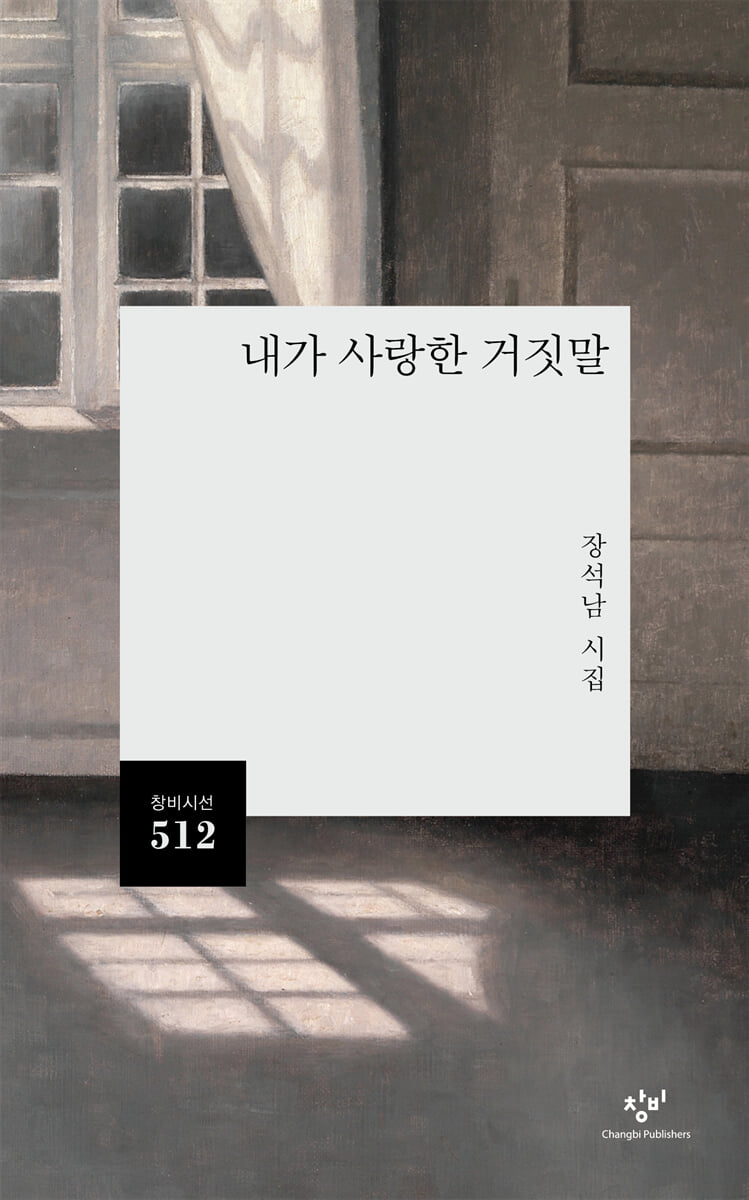
The Lie I Loved
 |
Description
Book Introduction
“He is trying to invent a clear revolution.
“I’m wiping the night away”
A solid harmony of peak sensory thinking and sharp perception of reality
The sound of the exiled spring returning
Poet Jang Seok-nam, who has broadened the horizons of lyric poetry with his outstanding linguistic sense and delicate sensibility, has published a new poetry collection, “The Lie I Loved.”
This is the poet's ninth poetry collection, and the first poetry collection to mark the start of the Changbi Poetry Series in 2025.
In this collection of poetry, published eight years after winning the Pyeonun Literary Award, Jihoon Award, and Woohyun Art Award with his award-winning work, “Worried About Stepping on Flowers” (Changbi, 2017), the poet unfolds a world of extraordinary new lyricism that shines with “the maturity to actively develop the poetic realm reached through long-term practice” (Choi Won-sik, commentary) and deep and transparent philosophical thought.
A sincere gaze toward nature leads far into a profound exploration of the self and the true nature of humanity.
In addition, it presents a political poem with a cool-headed awareness of reality.
Satire and allegory, which seem to anticipate the current reality, are intricately intertwined with the poet's unique personality based on lyricism, giving readers a thunderous resonance.
“I’m wiping the night away”
A solid harmony of peak sensory thinking and sharp perception of reality
The sound of the exiled spring returning
Poet Jang Seok-nam, who has broadened the horizons of lyric poetry with his outstanding linguistic sense and delicate sensibility, has published a new poetry collection, “The Lie I Loved.”
This is the poet's ninth poetry collection, and the first poetry collection to mark the start of the Changbi Poetry Series in 2025.
In this collection of poetry, published eight years after winning the Pyeonun Literary Award, Jihoon Award, and Woohyun Art Award with his award-winning work, “Worried About Stepping on Flowers” (Changbi, 2017), the poet unfolds a world of extraordinary new lyricism that shines with “the maturity to actively develop the poetic realm reached through long-term practice” (Choi Won-sik, commentary) and deep and transparent philosophical thought.
A sincere gaze toward nature leads far into a profound exploration of the self and the true nature of humanity.
In addition, it presents a political poem with a cool-headed awareness of reality.
Satire and allegory, which seem to anticipate the current reality, are intricately intertwined with the poet's unique personality based on lyricism, giving readers a thunderous resonance.
- You can preview some of the book's contents.
Preview
index
Part 1
hill
Back to the hill
Zelkova
Speaking to the October Sea
Sunset
The last thing I'll have is
When planting lotus flowers
Autumn lotus field
A flower tree with heavy flowers
Song of Flowers, Water, and Clouds
Clean the window
Bamboo forest morning sun
narrow spring
Autumn Port
Sanggang (霜降)
Part 2
Mokdojang
bean
poetry writing class
White porridge
move furniture
key
folding screen
Father's clothes
flower delivery
Part 3
Self-portrait
Rainbow House
Drinking on the train
The Lie I Loved
Epitaph
Drinking alone
Ask for a song
At Sasongam
Drawing a bird
Autumn Hands
Mask theory
Life of a Mask
Do you write lyric poetry?
Autumn Carpenter
Longing for the desert
Give me your face
In front of a pile of magnolia flowers at the old house
Clear weather
From the winter holly tree
The tree that goes to talk
flower
One day I was standing in front of a musical instrument store.
In the dressing room
I am a wanderer
My scenery
Picture diary
Which room
waiting room
cold wave
Put your name down
Part 4
Jo Gwang-jo
At Cheongnyangni Station
The entrance to summer
Which rainy season
A visit from a revolution
In the flower garden
Seoul, Spring 2023
Autobiography of the Law
About the scale
Magic Theater Preface
Magic Theater 1
Magic Theater 2
Magic Theater 3
scale
Some spring
Daeseo-so 1
Daeseo-so 2
inventor
homework
A flower fell
Commentary | Choi Won-sik
Poet's words
hill
Back to the hill
Zelkova
Speaking to the October Sea
Sunset
The last thing I'll have is
When planting lotus flowers
Autumn lotus field
A flower tree with heavy flowers
Song of Flowers, Water, and Clouds
Clean the window
Bamboo forest morning sun
narrow spring
Autumn Port
Sanggang (霜降)
Part 2
Mokdojang
bean
poetry writing class
White porridge
move furniture
key
folding screen
Father's clothes
flower delivery
Part 3
Self-portrait
Rainbow House
Drinking on the train
The Lie I Loved
Epitaph
Drinking alone
Ask for a song
At Sasongam
Drawing a bird
Autumn Hands
Mask theory
Life of a Mask
Do you write lyric poetry?
Autumn Carpenter
Longing for the desert
Give me your face
In front of a pile of magnolia flowers at the old house
Clear weather
From the winter holly tree
The tree that goes to talk
flower
One day I was standing in front of a musical instrument store.
In the dressing room
I am a wanderer
My scenery
Picture diary
Which room
waiting room
cold wave
Put your name down
Part 4
Jo Gwang-jo
At Cheongnyangni Station
The entrance to summer
Which rainy season
A visit from a revolution
In the flower garden
Seoul, Spring 2023
Autobiography of the Law
About the scale
Magic Theater Preface
Magic Theater 1
Magic Theater 2
Magic Theater 3
scale
Some spring
Daeseo-so 1
Daeseo-so 2
inventor
homework
A flower fell
Commentary | Choi Won-sik
Poet's words
Into the book
hill
Hills like blue eyebrows
I can't help but love hills
Whatever came over that hill
Because I was one of those who came over the hill
I don't know what to call that one person
So I never called
I wish I was the song of that hill
If there is no owner, the song is not trapped
In the sunset like that hill
Love is visible in the distance, the red sunset is burning brightly
I love that long hill where love is visible
--- From "The Hill"
Planting a song in water
That's not a song now, but in the future
You're planting that song during the summer solstice?
Losing a father every day, losing a mother every new moon
You're planting a song, not a cry
A flower that blooms in water?
A song from a flower
--- From "When Planting Lotus Flowers"
Under the cobwebs in the drawer
Father's wooden stamp
Three letters of the name
I looked for pearls and stamped them on paper.
The name and surname are worn like a threshold
What did you do with this seal?
Something hot passes before my eyes
My name is worn out from passing down this cloudy country.
This country, with its loose borders, is constantly expanding.
I guess I should call it evening twilight
In the twilight corner, I stamped my father's blurry name in red.
It turned out to be a pretty decent frame, but
The picture is empty
--- From "Mokdojang"
I have lived I have lived
I am alive and will live for some more time
lie
But the lie I love
One day I got my groin crushed and my skull broken.
My shoulder was split, I was abandoned by someone, and I was rescued by someone.
Lies, facts… …
But the lie I loved
I am so in love with the lies that I have told
I'm writing an autobiography
--- From "The Lie I Loved"
Draw a bird and a cage next to it.
Then it seems like you drew freedom
A bird doesn't know its cage
The cage slowly approaches the bird.
As if a sin I don't know about is coming towards me
As if a bee we don't know is coming towards us
Write my name and draw a bird above it.
It seems like a bird will fly with my name
I feel like I'm going to let go of it while flying
Draw a bird
A bird that sits for a long time
The red sky slowly approaches the bird.
--- From "Drawing Birds"
Do you write lyric poetry?
No, I use lightning
Have you ever heard the saying, "You'll get struck by lightning"?
About people who do things that deserve to be struck by lightning
I am writing this letter in the face of lightning.
A message from a lightning bolt
I want to write peaceful lyric poetry.
Hypocrisy, meanness, shamelessness, vulgarity, and even cunning
Lock those masks in the light of the moment
hitting
Do you write lyric poetry?
No, I write 'lyric poetry'
lightning-like
--- From "Do you write lyric poetry?"
I am equal before everyone hehe
It's another way of saying that it's sinister.
There are principles, but they are only needed very occasionally.
I like gain and vested interests. They are values worth protecting.
If it goes against that, I will definitely inform you of the principle.
I say I am clear and equal like water.
Guilty or innocent, they're all my bread.
I'm so busy. You keep calling me so much that I don't have time to rest.
I am the law
Conscience is a joke in the face of profit.
Throw that away right away. It's against the times.
Ah, I'm so glad it's like this
There were times when it was really difficult.
Because I had to kill too many people
Dusk is coming
I hate that the most
The dusk is coming soon
The proud footsteps hidden within that axis
I cover my ears
I have poor hearing, but I'll plug it again.
--- From "Autobiography of the Law"
His light is not meant to illuminate the window.
I just happened to see the light outside the window.
His light illuminates the silences that appear one after another.
It's shining brightly
He is neat, clean and pulsating
He is trying to invent a clear revolution.
I'm wiping the night away
His coffin will pass along a path where fallen leaves instead of flowers and pollen roll.
Hills like blue eyebrows
I can't help but love hills
Whatever came over that hill
Because I was one of those who came over the hill
I don't know what to call that one person
So I never called
I wish I was the song of that hill
If there is no owner, the song is not trapped
In the sunset like that hill
Love is visible in the distance, the red sunset is burning brightly
I love that long hill where love is visible
--- From "The Hill"
Planting a song in water
That's not a song now, but in the future
You're planting that song during the summer solstice?
Losing a father every day, losing a mother every new moon
You're planting a song, not a cry
A flower that blooms in water?
A song from a flower
--- From "When Planting Lotus Flowers"
Under the cobwebs in the drawer
Father's wooden stamp
Three letters of the name
I looked for pearls and stamped them on paper.
The name and surname are worn like a threshold
What did you do with this seal?
Something hot passes before my eyes
My name is worn out from passing down this cloudy country.
This country, with its loose borders, is constantly expanding.
I guess I should call it evening twilight
In the twilight corner, I stamped my father's blurry name in red.
It turned out to be a pretty decent frame, but
The picture is empty
--- From "Mokdojang"
I have lived I have lived
I am alive and will live for some more time
lie
But the lie I love
One day I got my groin crushed and my skull broken.
My shoulder was split, I was abandoned by someone, and I was rescued by someone.
Lies, facts… …
But the lie I loved
I am so in love with the lies that I have told
I'm writing an autobiography
--- From "The Lie I Loved"
Draw a bird and a cage next to it.
Then it seems like you drew freedom
A bird doesn't know its cage
The cage slowly approaches the bird.
As if a sin I don't know about is coming towards me
As if a bee we don't know is coming towards us
Write my name and draw a bird above it.
It seems like a bird will fly with my name
I feel like I'm going to let go of it while flying
Draw a bird
A bird that sits for a long time
The red sky slowly approaches the bird.
--- From "Drawing Birds"
Do you write lyric poetry?
No, I use lightning
Have you ever heard the saying, "You'll get struck by lightning"?
About people who do things that deserve to be struck by lightning
I am writing this letter in the face of lightning.
A message from a lightning bolt
I want to write peaceful lyric poetry.
Hypocrisy, meanness, shamelessness, vulgarity, and even cunning
Lock those masks in the light of the moment
hitting
Do you write lyric poetry?
No, I write 'lyric poetry'
lightning-like
--- From "Do you write lyric poetry?"
I am equal before everyone hehe
It's another way of saying that it's sinister.
There are principles, but they are only needed very occasionally.
I like gain and vested interests. They are values worth protecting.
If it goes against that, I will definitely inform you of the principle.
I say I am clear and equal like water.
Guilty or innocent, they're all my bread.
I'm so busy. You keep calling me so much that I don't have time to rest.
I am the law
Conscience is a joke in the face of profit.
Throw that away right away. It's against the times.
Ah, I'm so glad it's like this
There were times when it was really difficult.
Because I had to kill too many people
Dusk is coming
I hate that the most
The dusk is coming soon
The proud footsteps hidden within that axis
I cover my ears
I have poor hearing, but I'll plug it again.
--- From "Autobiography of the Law"
His light is not meant to illuminate the window.
I just happened to see the light outside the window.
His light illuminates the silences that appear one after another.
It's shining brightly
He is neat, clean and pulsating
He is trying to invent a clear revolution.
I'm wiping the night away
His coffin will pass along a path where fallen leaves instead of flowers and pollen roll.
--- From "Inventor"
Publisher's Review
"Planting a song in water
That's not a song now, but in the future
“You are planting that song during the summer solstice?”
Jang Seok-nam's poetry, which depicts beautiful lyrical landscapes in communion with nature, seems to have now reached a state of indifference.
“The last day of March seems to welcome the first day of April, as if it were pure” (“Neuti”), and in the tranquil scenery where the morning sun “pours in like a hungry tiger” (“Morning Sun in the Bamboo Forest”), the divine rhythm of life comes to life.
In the detailed landscapes embroidered with concise language, traces of the poet's ceaseless self-questioning since he began writing poetry are clearly visible.
The scenery captured in the poet's eyes is gentle and beautiful, like a 'song planted in water.'
The poet, moving between life and poetry, earnestly asks what the true nature of humanity is, and nature never ignores the poet's questions. The poems in Part 1, including "Hill," "Nettle," and "Sunset," are imbued with the poet's lingering thoughts, brilliantly expressed through long reflection.
Meanwhile, the poet also sings calmly about “the story of my life mixed with tears” (“Neuti”).
The poet, who discovered his father's wooden seal, with only "his surname and name worn down like a threshold" left in an old desk drawer, suddenly feels moved by his father's arduous life of toiling "to the point where his name was worn down in the process of passing down this murky country" ("Wooden Seal"), and recalls the memory of when he tried on his father's clothes in middle school and "the yellow Chinese characters for my father's name embroidered on the front of the left inside pocket/touched my heart and made it sting," and reflects on his life here and now, becoming immersed in memories "like a faint ember" ("Father's Clothes").
In these poems, which reflect on the history of life and reunite with memories spanning generations, the poet's aesthetic achievement in sensually capturing the moment when past and present intersect is dazzling.
Ruins stained by the irrationality of power
A shrill voice echoes through the gap
What is particularly noteworthy in this collection of poems are the 'political poems' that stand out with their sharp perception of reality and sharp satire that seem to foresee today's reality.
“Seoul, 2023, Spring,” which begins with “Spring, coming/as if embracing an urn/this unpleasant warmth,” is a poetic prophecy that is chilling enough to send shivers down one’s spine.
The "Magic Theater" series, which likens the courtroom that seeks out the truth to a theater that performs the magic of lies and manipulation, and "Autobiography of the Law," which parodies electronic music with a new poetic style, show the pinnacle of satire, skillfully ridiculing "the ruins of today where the judiciary of politics has become a cornerstone" (commentary) and sharply criticizing the "sham laws of the judiciary" ("On the Scale") that "love profit and vested interests" and "think of things like conscience as ridiculous" ("Autobiography of the Law").
Facing the absurd reality where “Crimes run rampant in every government document/While making corpses” (“Seoul, 2023, Spring”) and “Lies endlessly gather lies” (“I am a Wanderer”), the poet “licks his blue lips” and shouts “Revolution, not Kim Su-yeong’s room” and “Choi Je-woo’s new era, freedom, freedom, freedom” (“Waiting Room”).
“Do you write lyric poetry?
No, I write 'lyric poetry'
“Like a bolt from the blue”
The poet, who has repeatedly questioned the self and humanity based on outstanding lyricism, is now taking a step closer to reality.
In an age where “even the soul is a mask” (“Life of a Mask”), the poet keenly realizes that “being alive is painful” (“Cold Wave”), and vows to write poetry that “imprisons and meanness, shamelessness and vulgarity, even cunning/and imprisons them in the light of a moment” and “lightning-like lyric poetry” that “reports to lightning/about people who do things worthy of being struck by lightning.”
While fearing that “I will never be able to solve the questions and homework/about the ruined reality” (“Homework”), he moves toward the world, “the land where people live” (“Clear Sky”), “while also singing some terrifyingly sad songs.”
The figure of a poet, a person, coming over “the long hill where love is visible” (“Hill”) with slow, “gray steps” (“Hill Again”), is solemn.
This collection of poems, embroidered with the poet's unwavering belief in moving toward a better reality through poetry, along with its unique lyricism, will instantly quench the thirst of readers thirsty for the sound of poetry grounded in reality.
Poet's words
In the winter garden, footsteps stop in front of the pine trees.
A location that was not available in spring and summer
Now, life is at a stage where there is a lot of 'retrospection'
Do I have that 'Sol'?
It is a time of severe winter when we ask ourselves questions.
Is it fortunate that the callus on my index finger hasn't worn off?
January 2025
Jang Seok-nam
That's not a song now, but in the future
“You are planting that song during the summer solstice?”
Jang Seok-nam's poetry, which depicts beautiful lyrical landscapes in communion with nature, seems to have now reached a state of indifference.
“The last day of March seems to welcome the first day of April, as if it were pure” (“Neuti”), and in the tranquil scenery where the morning sun “pours in like a hungry tiger” (“Morning Sun in the Bamboo Forest”), the divine rhythm of life comes to life.
In the detailed landscapes embroidered with concise language, traces of the poet's ceaseless self-questioning since he began writing poetry are clearly visible.
The scenery captured in the poet's eyes is gentle and beautiful, like a 'song planted in water.'
The poet, moving between life and poetry, earnestly asks what the true nature of humanity is, and nature never ignores the poet's questions. The poems in Part 1, including "Hill," "Nettle," and "Sunset," are imbued with the poet's lingering thoughts, brilliantly expressed through long reflection.
Meanwhile, the poet also sings calmly about “the story of my life mixed with tears” (“Neuti”).
The poet, who discovered his father's wooden seal, with only "his surname and name worn down like a threshold" left in an old desk drawer, suddenly feels moved by his father's arduous life of toiling "to the point where his name was worn down in the process of passing down this murky country" ("Wooden Seal"), and recalls the memory of when he tried on his father's clothes in middle school and "the yellow Chinese characters for my father's name embroidered on the front of the left inside pocket/touched my heart and made it sting," and reflects on his life here and now, becoming immersed in memories "like a faint ember" ("Father's Clothes").
In these poems, which reflect on the history of life and reunite with memories spanning generations, the poet's aesthetic achievement in sensually capturing the moment when past and present intersect is dazzling.
Ruins stained by the irrationality of power
A shrill voice echoes through the gap
What is particularly noteworthy in this collection of poems are the 'political poems' that stand out with their sharp perception of reality and sharp satire that seem to foresee today's reality.
“Seoul, 2023, Spring,” which begins with “Spring, coming/as if embracing an urn/this unpleasant warmth,” is a poetic prophecy that is chilling enough to send shivers down one’s spine.
The "Magic Theater" series, which likens the courtroom that seeks out the truth to a theater that performs the magic of lies and manipulation, and "Autobiography of the Law," which parodies electronic music with a new poetic style, show the pinnacle of satire, skillfully ridiculing "the ruins of today where the judiciary of politics has become a cornerstone" (commentary) and sharply criticizing the "sham laws of the judiciary" ("On the Scale") that "love profit and vested interests" and "think of things like conscience as ridiculous" ("Autobiography of the Law").
Facing the absurd reality where “Crimes run rampant in every government document/While making corpses” (“Seoul, 2023, Spring”) and “Lies endlessly gather lies” (“I am a Wanderer”), the poet “licks his blue lips” and shouts “Revolution, not Kim Su-yeong’s room” and “Choi Je-woo’s new era, freedom, freedom, freedom” (“Waiting Room”).
“Do you write lyric poetry?
No, I write 'lyric poetry'
“Like a bolt from the blue”
The poet, who has repeatedly questioned the self and humanity based on outstanding lyricism, is now taking a step closer to reality.
In an age where “even the soul is a mask” (“Life of a Mask”), the poet keenly realizes that “being alive is painful” (“Cold Wave”), and vows to write poetry that “imprisons and meanness, shamelessness and vulgarity, even cunning/and imprisons them in the light of a moment” and “lightning-like lyric poetry” that “reports to lightning/about people who do things worthy of being struck by lightning.”
While fearing that “I will never be able to solve the questions and homework/about the ruined reality” (“Homework”), he moves toward the world, “the land where people live” (“Clear Sky”), “while also singing some terrifyingly sad songs.”
The figure of a poet, a person, coming over “the long hill where love is visible” (“Hill”) with slow, “gray steps” (“Hill Again”), is solemn.
This collection of poems, embroidered with the poet's unwavering belief in moving toward a better reality through poetry, along with its unique lyricism, will instantly quench the thirst of readers thirsty for the sound of poetry grounded in reality.
Poet's words
In the winter garden, footsteps stop in front of the pine trees.
A location that was not available in spring and summer
Now, life is at a stage where there is a lot of 'retrospection'
Do I have that 'Sol'?
It is a time of severe winter when we ask ourselves questions.
Is it fortunate that the callus on my index finger hasn't worn off?
January 2025
Jang Seok-nam
GOODS SPECIFICS
- Date of issue: January 31, 2025
- Page count, weight, size: 148 pages | 176g | 125*200*9mm
- ISBN13: 9788936425128
You may also like
카테고리
korean


korean

![ELLE 엘르 스페셜 에디션 A형 : 12월 [2025]](http://librairie.coreenne.fr/cdn/shop/files/b8e27a3de6c9538896439686c6b0e8fb.jpg?v=1766436872&width=3840)


