

teenage brain
 |
Description
Book Introduction
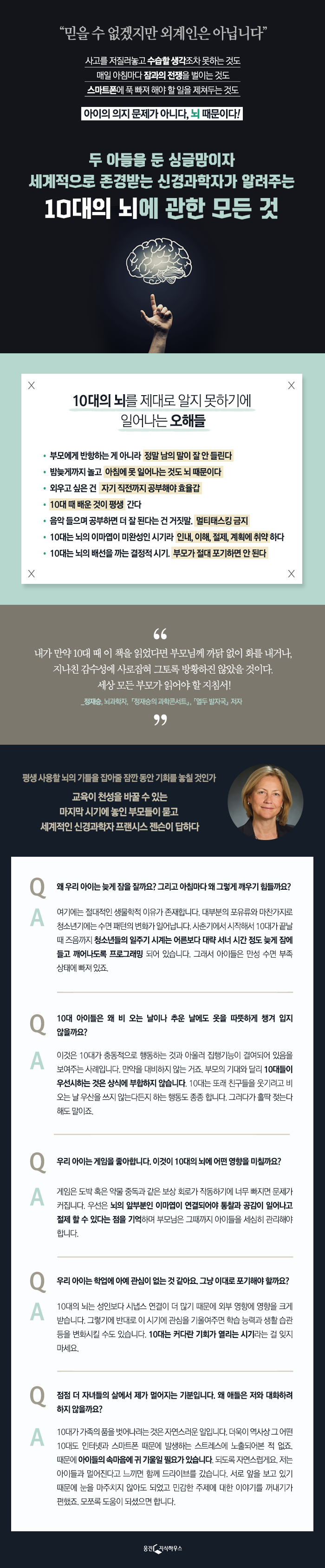
Our ignorance and misunderstandings about the teenage brain
- The human brain develops and connects from back to front.
That is why 'teens are a period when the frontal lobe, the front part of the brain, is not fully developed'
- The front part of the brain is responsible for insight, empathy, judgment, and risk-taking behavior control.
So, 'the teenage brain is vulnerable to patience, understanding, moderation, and planning'
- It's not that I'm rebelling against my parents, but I 'really' can't hear what other people say.
- Playing late at night and not being able to wake up in the morning is also 'because of the brain'
- If you sleep well, you will remember better.
"For anything you want to memorize, you need to study right up until bedtime to be most effective."
- Lack of sleep increases the likelihood of smoking, and smoking increases the likelihood of drinking.
Lack of sleep is the beginning of a vicious cycle.
- Your memory is at its best during your teens, and 'what you learn then will last a lifetime'
- It's a lie that studying while listening to music makes you study better.
No multitasking
- 'The teenage years are a crucial period for unraveling the wiring of the brain.' Rather than spending time thinking of it as a waste of time,
Must be properly assisted and managed.
When Parents Shouldn't Give Up
The word 'teenager' first appeared in a magazine published in 1941.
That was also only mentioned briefly in passing.
Even in the 19th century, children were treated as little adults because they needed help to sow fields, split firewood, and run factories.
It was only after World War II that teen culture began to be respected, sharing the sentiments of characters like James Dean in the film "Rebel Without a Cause" and Holden Caulfield in the novel "The Catcher in the Rye."
For a long time, scientists believed that the adolescent brain was no different from the adult brain.
However, neurology and neuroscience have discovered over the past decade that the teenage years are a critical period for brain development, a time when crucial changes occur.
The scholar at the forefront of this is Dr. Francis Jensen, author of THE TEENAGE BRAIN.
Francis Jensen, professor and chair of the Department of Neurology at the University of Pennsylvania School of Medicine, has studied human brain development from birth to adulthood.
He has earned a world-renowned reputation as a neuroscientist, having served as a professor of neurology at Harvard Medical School, director of translational neuroscience and epilepsy research at Boston Children's Hospital, and chief neurologist at Brigham and Women's Hospital.
At the same time, he has been giving lectures to a wide range of audiences at schools, public institutions, TEDMED, etc., broadening the understanding of the teenage brain.
Based on this understanding of brain science and clinical experience in neurology, Jensen introduces in 15 chapters of “The Teenage Brain” the developmental process of the human brain, what it means to be a teenager from a neuroscientific perspective, what happens in the brains of teenagers when they rebel, desire, feel frustrated and worried, and why they have no choice but to behave that way, focusing on issues such as learning, sleep, smoking, drinking, stress, smartphones, and gender.
It also debunks common myths and misconceptions about teenagers and offers practical advice for parents and teens.
The Guardian, which called it the most notable popular book on understanding the teenage brain, said, “A book that makes you look back on the teenage years, a crucial stage in brain development, full of unique vulnerabilities and surprising resilience, and a kind of textbook or cheat sheet for understanding teenagers.” and “The brain science for understanding our children with late-onset development.
Today's teenagers are the first generation to benefit from this book - The Huffington Post" and other media outlets have praised it, and it has been a New York Times bestseller and continues to be loved by readers to this day.
This book has been introduced in over 20 countries around the world, including the UK, France, Germany, Sweden, China, and Japan, and has become a bible on the teenage brain.
- The human brain develops and connects from back to front.
That is why 'teens are a period when the frontal lobe, the front part of the brain, is not fully developed'
- The front part of the brain is responsible for insight, empathy, judgment, and risk-taking behavior control.
So, 'the teenage brain is vulnerable to patience, understanding, moderation, and planning'
- It's not that I'm rebelling against my parents, but I 'really' can't hear what other people say.
- Playing late at night and not being able to wake up in the morning is also 'because of the brain'
- If you sleep well, you will remember better.
"For anything you want to memorize, you need to study right up until bedtime to be most effective."
- Lack of sleep increases the likelihood of smoking, and smoking increases the likelihood of drinking.
Lack of sleep is the beginning of a vicious cycle.
- Your memory is at its best during your teens, and 'what you learn then will last a lifetime'
- It's a lie that studying while listening to music makes you study better.
No multitasking
- 'The teenage years are a crucial period for unraveling the wiring of the brain.' Rather than spending time thinking of it as a waste of time,
Must be properly assisted and managed.
When Parents Shouldn't Give Up
The word 'teenager' first appeared in a magazine published in 1941.
That was also only mentioned briefly in passing.
Even in the 19th century, children were treated as little adults because they needed help to sow fields, split firewood, and run factories.
It was only after World War II that teen culture began to be respected, sharing the sentiments of characters like James Dean in the film "Rebel Without a Cause" and Holden Caulfield in the novel "The Catcher in the Rye."
For a long time, scientists believed that the adolescent brain was no different from the adult brain.
However, neurology and neuroscience have discovered over the past decade that the teenage years are a critical period for brain development, a time when crucial changes occur.
The scholar at the forefront of this is Dr. Francis Jensen, author of THE TEENAGE BRAIN.
Francis Jensen, professor and chair of the Department of Neurology at the University of Pennsylvania School of Medicine, has studied human brain development from birth to adulthood.
He has earned a world-renowned reputation as a neuroscientist, having served as a professor of neurology at Harvard Medical School, director of translational neuroscience and epilepsy research at Boston Children's Hospital, and chief neurologist at Brigham and Women's Hospital.
At the same time, he has been giving lectures to a wide range of audiences at schools, public institutions, TEDMED, etc., broadening the understanding of the teenage brain.
Based on this understanding of brain science and clinical experience in neurology, Jensen introduces in 15 chapters of “The Teenage Brain” the developmental process of the human brain, what it means to be a teenager from a neuroscientific perspective, what happens in the brains of teenagers when they rebel, desire, feel frustrated and worried, and why they have no choice but to behave that way, focusing on issues such as learning, sleep, smoking, drinking, stress, smartphones, and gender.
It also debunks common myths and misconceptions about teenagers and offers practical advice for parents and teens.
The Guardian, which called it the most notable popular book on understanding the teenage brain, said, “A book that makes you look back on the teenage years, a crucial stage in brain development, full of unique vulnerabilities and surprising resilience, and a kind of textbook or cheat sheet for understanding teenagers.” and “The brain science for understanding our children with late-onset development.
Today's teenagers are the first generation to benefit from this book - The Huffington Post" and other media outlets have praised it, and it has been a New York Times bestseller and continues to be loved by readers to this day.
This book has been introduced in over 20 countries around the world, including the UK, France, Germany, Sweden, China, and Japan, and has become a bible on the teenage brain.
- You can preview some of the book's contents.
Preview
index
A Guidebook Every Parent in the World Should Read _ Jaeseung Jeong
You may not believe the introduction, but I am not an alien.
Chapter 1: What it Means to Be a Teenager
Chapter 2: Brain Development That Determines Maturity and Immaturity
Chapter 3: What's Happening in the Brains of Teenagers Today?
Chapter 4: The Teenage Brain Learns All Day Long
Chapter 5: The Absolute Influence of Sleep on the Brain
Chapter 6: Why Teenagers Take Risks and Act Recklessly
Chapter 7: What Smoking Imprints on the Brain
Chapter 8: What Long-Term Harm Does Alcohol Do to the Brain?
Chapter 9: How Stress Changes the Teenage Brain
Chapter 10: The Emotionally Vulnerable Adolescence
Chapter 11: The Invasion of Smartphones and Digital Technology
Chapter 12: What's the Difference Between the Brains of Teenage Boys and Teenage Girls?
Chapter 13: If you suffer brain damage in your teens
Chapter 14: Punishment for Lack of Understanding of the Teenage Brain
Chapter 15: The Brain Is Still Growing
The final words are that you and your child are a team.
Acknowledgements
annotation
References
You may not believe the introduction, but I am not an alien.
Chapter 1: What it Means to Be a Teenager
Chapter 2: Brain Development That Determines Maturity and Immaturity
Chapter 3: What's Happening in the Brains of Teenagers Today?
Chapter 4: The Teenage Brain Learns All Day Long
Chapter 5: The Absolute Influence of Sleep on the Brain
Chapter 6: Why Teenagers Take Risks and Act Recklessly
Chapter 7: What Smoking Imprints on the Brain
Chapter 8: What Long-Term Harm Does Alcohol Do to the Brain?
Chapter 9: How Stress Changes the Teenage Brain
Chapter 10: The Emotionally Vulnerable Adolescence
Chapter 11: The Invasion of Smartphones and Digital Technology
Chapter 12: What's the Difference Between the Brains of Teenage Boys and Teenage Girls?
Chapter 13: If you suffer brain damage in your teens
Chapter 14: Punishment for Lack of Understanding of the Teenage Brain
Chapter 15: The Brain Is Still Growing
The final words are that you and your child are a team.
Acknowledgements
annotation
References
Detailed image
Into the book
As a mother and a neurologist, I thought I knew enough about what was going on in my teenager's heads.
But it wasn't.
Does that mean you knew what was going on outside your child's head? Obviously not.
So, as a mother and a scientist, I decided I needed to, no, I had to find out what the heck was going on.
_p.17
The more I studied the new scientific literature on adolescents, the more I realized how misguided it was to view the teenage brain through the prism of adult neurobiology.
The adolescent brain differs from the adult brain in every way: function, wiring, and abilities.
And we found that most parents are unaware of this new scientific information about the teenage brain.
It is true that it is difficult to access, at least for parents like me who do not have a background in neuroscience.
But these parents are the ones who absolutely need to know about the new science about the adolescent brain.
Educators who are confused, discouraged, and angry about their teenagers' behavior also need to know this.
_p.19
If your child wants to change their appearance, you may not be able to find a hairdresser to dye their hair red stripes, but you can at least buy them some at-home hair dye.
It's better to let your child experiment with harmless things like this rather than letting him rebel and get into more serious trouble.
We must not make the mistake of focusing only on small battles and then losing the entire war.
Children have an instinctive need to experiment, and our ultimate goal is to help them do so safely and without long-term side effects.
The teenage years are a great time to test out what your child's strengths are and what weaknesses need attention.
_p.27
As our children pass through childhood, we inevitably lose physical control over them.
Advice, explanation, and example are the best tools you have as your children go through their teenage years.
If there's one thing I've learned from raising my two sons, it's that no matter how distracted, disorganized, or forgetting to pick up their homework from school one day, they're always watching me.
Children are constantly judging not only their mothers but also all the adults around them.
_p.31
Why would a child who had been cute, calm, happy, and well-behaved for over a decade suddenly turn into a stranger? In such cases, there are a few things parents should immediately tell their child.
The fact is that the shock you feel is not uncommon.
Your child is changing and trying to figure out who he or she is.
Children's brains and bodies are undergoing extensive reorganization.
And the outward recklessness, rudeness, and stupidity of these children are not at all their fault.
Most of these phenomena can be explained neurologically, psychologically, and physiologically.
_p.35
In 2007, researchers at the State University of New York Downstate Medical Center reported that THP, which is normally secreted in response to stress to regulate anxiety, had the opposite effect in adolescents, increasing anxiety rather than relieving it.
In adults, this stress hormone acts like a tranquilizer in the brain, producing a calming effect about 30 minutes after the anxiety-provoking event.
However, when tested on adolescent rats, THP was ineffective in suppressing anxiety.
So in teenagers, anxiety causes more anxiety.
There actually are biological reasons behind this phenomenon.
_p.43
Of all the organs in the human body, the brain is the least developed structure at birth.
The size is only 40% of that of an adult.
But it's not just the size that changes.
During development, all the wiring inside the brain changes.
Brain growth is a process that takes a considerable amount of time.
But the adolescent brain is nothing short of a paradox.
This brain is overflowing with gray matter (nerve cells, the brain's basic building blocks) but lacking white matter (the wiring that helps information flow efficiently from one area of the brain to another).
This is why the brain of a teenager is like a Ferrari that just came out of the factory.
It looks like it's ready to run anywhere, but it hasn't been tested yet.
In other words, it's like idling around making a loud noise, but not knowing where to go.
_p.48
In fact, there is very little space between the billions of cells in the brain.
Evolution has not wasted even a single scrap of space.
Cells are the smallest structural units in the body, and each has its own command center called the nucleus.
The nucleus is a round structure in the center of the cell.
There are over 200 types of cells that make up our body's organs, tissues, muscles, etc.
Among them, a unique type of cell that exists in the brain is called a neuron.
The cell that is frequently mentioned in this book is this neuron.
Thoughts, feelings, movements, and moods are ultimately nothing more than communication between neurons, sending electrical signals to each other.
_p.73
The human brain contains 100 billion neurons.
These cells are so small that only 30,000 could fit on the head of a pin, but if all the neurons in a person's cortex were lined up in a row, they would stretch 160,000 km.
That's enough distance to circle the Earth four times.
The number of neurons is highest at birth.
In fact, our brains are at their densest between the third and sixth months of pregnancy, before birth.
There is intensive pruning of this gray matter between late pregnancy and the first year of life.
Yet, by the time a baby is born, its brain is still full of neurons.
Why is this? Infants have an overabundance of neurons, a response to the stimuli that begin to flood their minds the moment they step foot into the world.
In response to all those new sights, sounds, smells, and sensations, neurons branch out within the baby's brain, forming dense neural networks.
So why aren't all babies geniuses like Mozart or Einstein? It's because, while babies are born with an abundance of neurons, only a small percentage of them are interconnected.
_p.74
According to scientists, insight is the ability to look at yourself from an outside perspective.
And because such abilities arise in the frontal and prefrontal lobes, they take time to develop fully.
The dynamic changes that occur in the brain are one of the factors that make adolescence such an energetic time.
But the fact that the brain is still in the maturing stage and thus flexible can be a very scary condition.
Because it means anything can happen.
And most of those things are not good.
_p.93
Sleep patterns are controlled by a complex network of brain signals and hormones, both of which are modulated by maturational stages.
In most species, this pattern of staying up late temporarily occurs during adolescence and then reverts to going to bed early and waking up early as adults.
So teenagers are being forced to wake up early for school, conforming to the adult sleep patterns.
[…] However, as shown in Figure 14, waking up for school causes adolescents to chronically lose about 2.75 hours of sleep per day.
This appears to contribute to chronic sleep deprivation syndrome.
Teenagers need more sleep than their parents or younger siblings because there's so much going on in their brains and they're learning so much at such a rapid pace.
We've talked before about the pruning that takes place in the teenage brain during puberty.
When do you think that kind of pruning will actually happen? Yes, it does.
While you are sleeping.
_p.121-122
It's hard enough to figure out what your child ate at school for lunch, let alone get them to admit to having depression or anxiety.
[…] Since teenagers are not yet capable of using their frontal lobe to solve problems, you are responsible for filtering and regulating their emotions and providing them with a sense of calm.
Then, there may be emotional outbursts, ups and downs, impulsive behavior, or serious
How can we know if discouragement is normal teenage behavior or something to be concerned about, like an early sign of depression or anxiety? Before we can understand this, we must first understand what constitutes an emotion and what doesn't in adolescent development.
_p.183
Young adulthood is also an excellent time for learning.
Even during this time, just like during adolescence, the brain's plasticity is very high, and because the brain's connectivity has improved, the ability to multitask also improves.
Many young adults feel that their learning abilities are much improved now than when they were in high school.
Your organizing skills will improve, and your abstract thinking skills will also improve.
As access to the frontal lobe becomes easier, judgment, insight, and balance are all improved.
_p.308-309
If your child, who has graduated from college and is now living on his or her own, doesn't know how to do laundry, budget, or pay the utilities in his or her new apartment, remember that while he or she may not be a teenager anymore, white matter is still forming in the frontal lobe, connecting the brain's systems together.
Young adults, like teenagers, sometimes fall victim to it because their brains are still changing.
The fact that white matter continues to connect after adolescence carries significant risks.
_p.316-317
But it wasn't.
Does that mean you knew what was going on outside your child's head? Obviously not.
So, as a mother and a scientist, I decided I needed to, no, I had to find out what the heck was going on.
_p.17
The more I studied the new scientific literature on adolescents, the more I realized how misguided it was to view the teenage brain through the prism of adult neurobiology.
The adolescent brain differs from the adult brain in every way: function, wiring, and abilities.
And we found that most parents are unaware of this new scientific information about the teenage brain.
It is true that it is difficult to access, at least for parents like me who do not have a background in neuroscience.
But these parents are the ones who absolutely need to know about the new science about the adolescent brain.
Educators who are confused, discouraged, and angry about their teenagers' behavior also need to know this.
_p.19
If your child wants to change their appearance, you may not be able to find a hairdresser to dye their hair red stripes, but you can at least buy them some at-home hair dye.
It's better to let your child experiment with harmless things like this rather than letting him rebel and get into more serious trouble.
We must not make the mistake of focusing only on small battles and then losing the entire war.
Children have an instinctive need to experiment, and our ultimate goal is to help them do so safely and without long-term side effects.
The teenage years are a great time to test out what your child's strengths are and what weaknesses need attention.
_p.27
As our children pass through childhood, we inevitably lose physical control over them.
Advice, explanation, and example are the best tools you have as your children go through their teenage years.
If there's one thing I've learned from raising my two sons, it's that no matter how distracted, disorganized, or forgetting to pick up their homework from school one day, they're always watching me.
Children are constantly judging not only their mothers but also all the adults around them.
_p.31
Why would a child who had been cute, calm, happy, and well-behaved for over a decade suddenly turn into a stranger? In such cases, there are a few things parents should immediately tell their child.
The fact is that the shock you feel is not uncommon.
Your child is changing and trying to figure out who he or she is.
Children's brains and bodies are undergoing extensive reorganization.
And the outward recklessness, rudeness, and stupidity of these children are not at all their fault.
Most of these phenomena can be explained neurologically, psychologically, and physiologically.
_p.35
In 2007, researchers at the State University of New York Downstate Medical Center reported that THP, which is normally secreted in response to stress to regulate anxiety, had the opposite effect in adolescents, increasing anxiety rather than relieving it.
In adults, this stress hormone acts like a tranquilizer in the brain, producing a calming effect about 30 minutes after the anxiety-provoking event.
However, when tested on adolescent rats, THP was ineffective in suppressing anxiety.
So in teenagers, anxiety causes more anxiety.
There actually are biological reasons behind this phenomenon.
_p.43
Of all the organs in the human body, the brain is the least developed structure at birth.
The size is only 40% of that of an adult.
But it's not just the size that changes.
During development, all the wiring inside the brain changes.
Brain growth is a process that takes a considerable amount of time.
But the adolescent brain is nothing short of a paradox.
This brain is overflowing with gray matter (nerve cells, the brain's basic building blocks) but lacking white matter (the wiring that helps information flow efficiently from one area of the brain to another).
This is why the brain of a teenager is like a Ferrari that just came out of the factory.
It looks like it's ready to run anywhere, but it hasn't been tested yet.
In other words, it's like idling around making a loud noise, but not knowing where to go.
_p.48
In fact, there is very little space between the billions of cells in the brain.
Evolution has not wasted even a single scrap of space.
Cells are the smallest structural units in the body, and each has its own command center called the nucleus.
The nucleus is a round structure in the center of the cell.
There are over 200 types of cells that make up our body's organs, tissues, muscles, etc.
Among them, a unique type of cell that exists in the brain is called a neuron.
The cell that is frequently mentioned in this book is this neuron.
Thoughts, feelings, movements, and moods are ultimately nothing more than communication between neurons, sending electrical signals to each other.
_p.73
The human brain contains 100 billion neurons.
These cells are so small that only 30,000 could fit on the head of a pin, but if all the neurons in a person's cortex were lined up in a row, they would stretch 160,000 km.
That's enough distance to circle the Earth four times.
The number of neurons is highest at birth.
In fact, our brains are at their densest between the third and sixth months of pregnancy, before birth.
There is intensive pruning of this gray matter between late pregnancy and the first year of life.
Yet, by the time a baby is born, its brain is still full of neurons.
Why is this? Infants have an overabundance of neurons, a response to the stimuli that begin to flood their minds the moment they step foot into the world.
In response to all those new sights, sounds, smells, and sensations, neurons branch out within the baby's brain, forming dense neural networks.
So why aren't all babies geniuses like Mozart or Einstein? It's because, while babies are born with an abundance of neurons, only a small percentage of them are interconnected.
_p.74
According to scientists, insight is the ability to look at yourself from an outside perspective.
And because such abilities arise in the frontal and prefrontal lobes, they take time to develop fully.
The dynamic changes that occur in the brain are one of the factors that make adolescence such an energetic time.
But the fact that the brain is still in the maturing stage and thus flexible can be a very scary condition.
Because it means anything can happen.
And most of those things are not good.
_p.93
Sleep patterns are controlled by a complex network of brain signals and hormones, both of which are modulated by maturational stages.
In most species, this pattern of staying up late temporarily occurs during adolescence and then reverts to going to bed early and waking up early as adults.
So teenagers are being forced to wake up early for school, conforming to the adult sleep patterns.
[…] However, as shown in Figure 14, waking up for school causes adolescents to chronically lose about 2.75 hours of sleep per day.
This appears to contribute to chronic sleep deprivation syndrome.
Teenagers need more sleep than their parents or younger siblings because there's so much going on in their brains and they're learning so much at such a rapid pace.
We've talked before about the pruning that takes place in the teenage brain during puberty.
When do you think that kind of pruning will actually happen? Yes, it does.
While you are sleeping.
_p.121-122
It's hard enough to figure out what your child ate at school for lunch, let alone get them to admit to having depression or anxiety.
[…] Since teenagers are not yet capable of using their frontal lobe to solve problems, you are responsible for filtering and regulating their emotions and providing them with a sense of calm.
Then, there may be emotional outbursts, ups and downs, impulsive behavior, or serious
How can we know if discouragement is normal teenage behavior or something to be concerned about, like an early sign of depression or anxiety? Before we can understand this, we must first understand what constitutes an emotion and what doesn't in adolescent development.
_p.183
Young adulthood is also an excellent time for learning.
Even during this time, just like during adolescence, the brain's plasticity is very high, and because the brain's connectivity has improved, the ability to multitask also improves.
Many young adults feel that their learning abilities are much improved now than when they were in high school.
Your organizing skills will improve, and your abstract thinking skills will also improve.
As access to the frontal lobe becomes easier, judgment, insight, and balance are all improved.
_p.308-309
If your child, who has graduated from college and is now living on his or her own, doesn't know how to do laundry, budget, or pay the utilities in his or her new apartment, remember that while he or she may not be a teenager anymore, white matter is still forming in the frontal lobe, connecting the brain's systems together.
Young adults, like teenagers, sometimes fall victim to it because their brains are still changing.
The fact that white matter continues to connect after adolescence carries significant risks.
_p.316-317
--- From the text
Publisher's Review
“You may not believe it, but I’m not an alien.”
I am a single mother of two sons.
A world-renowned neuroscientist explains:
All About the Teenage Brain
As a single mother of two sons and a neuroscientist, clinician, and researcher, Frances Jensen realized that her children's erratic behavior was becoming increasingly unmanageable as they entered their teen years.
Then I looked around and realized that while there were many books on teenage psychology and parenting, none properly explained the connections between neurons and the brain, which are the root of adolescent confusion.
So, as a neuroscientist and as a mom, I started giving lectures on the teenage brain, and I got an enthusiastic response from parents, teachers, and teens.
Encouraged by this, Jensen decided to write a book about the teenage brain.
At the time, I was primarily researching the infant brain, and the lab I ran was primarily dealing with epilepsy and brain development.
[…] Then, out of the blue, a new scientific experiment and research project arose for me.
They were my sons.
Will, the second son, was only two years younger than Andrew.
What awaits me when this child reaches my brother's age? There are so many things I can't understand.
I watched Andrew transform into a completely different person almost overnight.
But deep inside, I knew that the kind and bright child I knew still remained.
What on earth happened? To find out, I decided to dive into the study of this somewhat unfamiliar subject: teenagers.
And with that knowledge, I decided to help my sons transition more smoothly into adulthood.
_p.17-18
The National Institutes of Health conducted a landmark decade-long study examining how brain regions activate each other during the first 21 years of life.
This experiment revealed a surprising fact.
Connectivity in the brain moves slowly from the back of the brain to the front.
The last area where the connection occurred was the frontal lobe.
The frontal lobe is where the abilities of insight, judgment, abstract thinking, and planning arise.
The frontal lobe is the source of self-awareness and the ability to assess risk and risk factors.
In fact, a teenager's brain is only about 80% mature.
This remaining 20%, where wiring is at its most fragile, is a crucial gap and largely explains why teenagers exhibit such bewildering behaviors: mood swings, anger, impulsivity, outbursts, difficulty concentrating, difficulty finishing tasks, difficulty relating to adults, succumbing to the temptations of cigarettes and alcohol, and engaging in risky behavior.
This is also the reason why children act self-centeredly, without considering what is in front, behind, or next to them, and turning a deaf ear to what their parents say.
The brain has more areas that process positive information, while areas that process negative information are more concentrated in the prefrontal cortex, an area that develops late in teenagers.
In other words, adolescents are less able to process negative information than adults, so they tend to jump into risky activities and are less able to learn from the mistakes or accidents that follow.
“How can he be so stupid?” When a teenager misbehaves, parents often quickly blame themselves.
Even though I don't know exactly why I should blame myself.
If they were the parents who gave birth to the child, they might be guilty of passing on defective DNA.
And whether it's the birth parents, the parents who raised the child, or the guardian, there may be something wrong with the way they raised the child, so there may be guilt.
But the thing is, when your teen misbehaves, it's not because of their genes, it's not because of something you did or didn't do, and it's not because they got a head injury and suddenly woke up one day as an alien from the planet "teenager."
The reason teenagers are different is because of their brains.
_p.96
Throughout the book, Jensen emphasizes that teenagers are not aliens, but merely misunderstood beings, and that even children need to recognize that they are bewildered by their own capricious instruments, the brains.
The reason children don't tell their parents about this is because they don't yet have the ability to understand such confusion.
We must first recognize this fact and broaden our understanding.
To briefly introduce the current status of Jensen's two "former teenage" sons, the eldest son, Andrew, graduated from Wesleyan University with a degree in quantum physics and is working on his doctorate.
His second son, Will, graduated from Harvard and got a job as a management consultant in New York.
Yes, that's right.
You and your teen can survive this challenging adolescence.
“There is a time for studying”,
“I can concentrate better when I study while listening to music.”
Does this make sense from a neuroscientific perspective?
We've long believed that once we receive our IQ scores, like a stamped on us after taking an aptitude test in elementary school, that's the final word on our intellectual fate.
This is obviously not true.
When researchers conducted experiments on adult and adolescent rats, the signals that appeared after the stimulus were significantly larger and lasted longer in the adolescent rats.
Additionally, the synapses of adolescent mice increased by about 1.5 times.
This means that it is easier to remember things as a teenager than as an adult, and once remembered, the memory lasts longer.
This is the time when you can achieve the best learning outcomes with proper education and support.
The saying, "There's a time for studying," is scientifically proven to support the idea that teenagers have superior learning abilities than adults.
John Eccles, who would later receive a Nobel Prize for his early work on synapses, was puzzled by how much stimulation was needed to cause synaptic changes.
He wrote:
“Perhaps the most frustrating aspect of trying to explain the phenomenon of learning is that it takes a very long period of overuse or underuse to produce detectable synaptic changes.” That’s what Eccles misses.
The repetitive, excessive time he had been watching with such frustration was actually the time when the brain was learning, acquiring knowledge, and doing work.
If a stimulus is repeated, the brain cells will respond to the stimulus more strongly than the first time.
This is how ‘learning’ of brain circuits takes place.
And the more deeply ingrained the knowledge is, the easier it is to recall and use it again.
When skiers compete in downhill, the fastest route is paved because the skiers pass over it repeatedly.
[…] Thanks to the deep grooves, players don’t have to find a quick route; they just have to follow the line.
_p.108
Of course, it's important to remember that while teenagers' brains are peak learning efficiency, they're less efficient in other areas, including attention, self-control, task completion, and emotions.
Can we trust children who say, "Mom, I can concentrate better when I listen to music while studying?" Are teenagers really better at multitasking than adults? Most teenagers believe they're good at multitasking and believe it helps them achieve more.
On the other hand, research results confirm that multitasking hinders learning in adolescents.
When multitasking, it takes teens 25 to 400 percent longer to complete tasks.
So why do teens find multitasking beneficial? In one survey, researchers found that students who read reports while watching television reported greater satisfaction than those who didn't watch television and instead read.
Dr. Wang Jeong of Ohio State University explains:
“The reason they feel satisfied is not because studying was effective, but because studying became enjoyable by adding television watching.
“I felt good because I combined activities.” The emotional satisfaction that multitasking provides makes me feel like it increases my learning efficiency.
Scientists say multitasking not only interferes with learning, but can also trigger the release of stress hormones like cortisol and adrenaline.
Chronically high cortisol levels can increase aggression and impulsivity, cause short-term memory loss, and even lead to cardiovascular disease.
In other words, multitasking gradually weakens us, causing confusion, fatigue, and loss of flexibility.
The reason we continue to multitask is mostly due to habit.
And teenagers' habits are especially hard to break.
This is also why once teenagers become accustomed to multitasking, they are more likely to continue doing it.
Would you miss this brief opportunity to lay the foundation for a brain you'll use for a lifetime?
Education can change nature
10 Things You Need to Know About Teenagers in Their Final Years
The brain is the last organ in our body to mature.
The brain is actually shaped by specific experiences.
In neuroscience, the brain's unique ability to shape itself is called "plasticity."
According to the theory of neuroplasticity, a term first coined by Harvard University's David Hubel and Torsten Wiesel, thinking, planning, learning, and acting all affect the physical structure and functional organization of the brain.
The types of cues and stimuli a person receives during the period of brain development actually change how the brain functions later in life.
The author also conducted a plasticity experiment with his two sons.
Every time I held my kitten Jill, I massaged her paws to see if she would be able to use them better.
As expected, Jill began using her paws more than any other cat the author had ever raised.
Jill used her paws in a way most cats wouldn't.
It has become a very 'foot-centric' cat.
As I watched, I realized that this cat almost always used its left paw when doing something.
Jill was a left-handed cat.
Since the author and his two sons are both right-handed, this result was achieved because the left foot was stimulated much more often than the right foot.
If we could look into the brain of a cat, we would see that the area of the brain devoted to the paws, especially the left paw, is much larger than that of a normal cat.
This phenomenon of brain space being reallocated based on experiences throughout life also occurs in humans.
We call this period of life a critical period.
This is when nurture, or education, can change nature.
There is good reason why plasticity is concentrated in the early years of life, during childhood and adolescence.
Because survival depends on how well you know your environment.
So, the young brain must be able to change flexibly to suit the type of environment in which it grows up.
While the growth of synapses makes teenagers sensory-driven learning machines, this rapid growth has its risks, as brain signals can easily go off the rails.
Evolutionarily speaking, being open to new ideas and having something new to learn leads to useful experiences necessary for survival.
_p.116
As a parent, knowing why your teen is acting the way they are is part of maintaining your own sense of balance and can help reduce the frustration and anger of parenting, helping you maintain a healthy relationship with your child and prevent them from growing apart.
In fact, we must not forget that a child's teenage years are not a time of suffering to be endured, but rather a time of amazing changes taking place in the child.
It's a brief opportunity to lay the foundation for the brain your children will use throughout their lives.
Why do teenagers often engage in behavior that turns their stomachs upside down?
It's not a child's will problem, it's just the brain.
What is needed to get through puberty smoothly and without ups and downs?
A revolutionary perspective on the adolescent brain!
The fact that children often sleep in late and have to fight a battle to get to school every morning is not simply due to a lack of willpower, but because the brain that performs the relevant function is less developed than that of adults.
From about age 10 to 12, our biological clock slows down and we become more energetic around 7 or 8 p.m.
So, a 'sleepless' time zone is created around 9-10 PM.
But this is exactly when parents start to feel a little sleepy.
This is because melatonin, a hormone that plays a crucial role in inducing sleep, is secreted about two hours later at night in the brains of adolescents than in adults.
Moreover, these hormones persist longer in adolescents.
This is why it's so hard to wake up your teenager in the morning.
Adults, on the other hand, do not feel as sleepy as teenagers because they have little melatonin in their bodies when they wake up.
Because of this lack of social understanding, school start times are still early in the morning, which does not fit with teenagers' sleep patterns.
So children are always in a state of chronic sleep deprivation.
Research over the past decade has confirmed the link between sleep and learning during adolescence.
One study found that delaying school start times by exactly 70 minutes, from 7:30 a.m. to 8:40 a.m., had a statistically significant effect on the academic performance of 7,000 high school students in Minneapolis and Edina, Minnesota.
Compared to students in schools that maintained earlier start times, students in schools that delayed start times reported getting more sleep, better grades, and experiencing less depression.
When high schools in Jessamine County, Kentucky, moved their school hours back an hour, attendance and standardized test scores both increased. When high schools in Fayette County, Kentucky, did the same, the number of students involved in car crashes decreased dramatically, unlike in other areas where the number of students involved in car crashes increased.
_p.129
So, is sleep really related to learning ability?
Sleep not only allows us to recall our experiences, but also acts as a glue that allows us to remember everything we learned that day.
Because memories and learning are solidified during sleep, sleep is as essential to health for adolescents as air or food.
An experiment conducted on high school students at Harvard Medical School and Trent University in Canada found that memory consolidation occurs in two stages during sleep.
There are two stages of sleep: slow-wave sleep and REM sleep. In the early stages of a teenager's sleep cycle, the brain enters the slow-wave sleep stage.
Slow wave sleep is the deepest state of sleep.
During REM sleep, which occurs later in the sleep cycle, the brain puts on a show of sorts.
The brain replays learned information through dreams and further consolidates the information so that it can be stored in the brain's memory area.
Sleep gives your brain time to convert what you've studied into memory.
That's why the time before going to sleep is the time when the brain can easily learn new things, and the effect is better if you sleep with the learned content in your head.
Here's why teenagers should study for the exam before going to bed instead of going straight to sleep the night before.
So what happens when teenagers don't get enough sleep? Sleep deprivation disrupts essential processes like synaptic pruning and prioritizing information.
And if you don't develop the habit of getting enough sleep, it doesn't just end with physical and mental fatigue.
This can have serious and lasting effects on teenagers, leading to all sorts of negative outcomes, including juvenile delinquency, depression, obesity, high blood pressure, and cardiovascular disease.
Studies show that teens who don't get enough sleep are more likely to consume soft drinks, fried foods, sugary foods, and caffeine.
These youth also have reduced physical activity and spend more time in front of the television or computer.
[…] Japanese researchers found that teenagers who use their phones after lights out not only get less sleep, but also have a higher risk of mental health problems such as self-harm and suicide.
_p.131-132
One surprising finding from studies of sleep deprivation in teenagers is that it may lead to increased smoking.
What's even more surprising is that smoking can cause a variety of cognitive and behavioral problems, including attention deficit hyperactivity disorder and memory loss, and trigger a decline in IQ in teenagers.
Moreover, the more a teenager smokes, the less activity there is in the prefrontal cortex. Poor or defective development of the prefrontal cortex can result in a teenager's poor decision-making ability.
Additionally, people who start smoking in their teens are three times more likely to start drinking, and long-term nicotine use has been shown to increase tolerance to alcohol.
This means that you need to consume more alcohol to feel the same level of intoxication.
Therefore, smokers are 10 times more likely to develop alcohol dependence than non-smokers.
Teens who smoke also experience a much greater urge to drink again compared to adults who have recently started smoking.
Dr. Susan Tapert, a psychiatrist at the University of California, says the difference between teens who drink and those who don't is about 10 percent.
She likened it to the difference between getting an A and a B on a school test.
Contrary to popular belief, a person's rational abilities are almost fully developed by the age of 15.
Their ability to logically judge whether a certain behavior is dangerous or not is no less than that of adults.
This is why teenagers score highly on aptitude tests like the SAT, which require them to rely entirely on logic and rational reasoning.
So why do teenagers sometimes engage in such crazy behavior? Teenage brains are generally more sensitive to rewards than adults, and their dopamine release and responses are heightened.
This is also why puberty is associated with stimulation seeking.
During adolescence, the neural systems that regulate arousal and reward become particularly sensitive.
However, because the frontal lobe of a teenager's brain is still loosely connected to other brain regions, it may be more difficult for adolescents to exercise cognitive control over potentially dangerous situations.
_p.142
Knowing that the relationship between parents and their teenagers is one of the most frustrating things in family life, parents do everything they can to repair the relationship.
But sometimes these efforts only backfire.
If we knew what was going on in the brains of teenagers, would living with them be any easier? Jensen says yes, of course.
“We expect a little more from our young people than their brains can handle,” Jensen said, prompting parents and teachers to reflect on their own words and actions.
After reading this book, we will no longer be able to blame the children we jokingly criticized as having "middle school syndrome."
On the contrary, I feel sorry because I think I didn't understand you properly until now.
Readers of 『The Teenage Brain』 have praised it with unanimous praise, saying, “Trust this book!” and “After reading this book, I understand that it may not be true that students forget to do their homework” (Amazon reader Donald D.
Fraser), “A book that brings back childhood memories that grown adults have forgotten and corrects misconceptions about teenagers” (Amazon reader Kiwiflora), “This book is a great way to resolve cases where simply talking to your child can lead to a bigger fight or make the situation worse” (Amazon reader SBV) expressed their gratitude to the author and the book.
I am a single mother of two sons.
A world-renowned neuroscientist explains:
All About the Teenage Brain
As a single mother of two sons and a neuroscientist, clinician, and researcher, Frances Jensen realized that her children's erratic behavior was becoming increasingly unmanageable as they entered their teen years.
Then I looked around and realized that while there were many books on teenage psychology and parenting, none properly explained the connections between neurons and the brain, which are the root of adolescent confusion.
So, as a neuroscientist and as a mom, I started giving lectures on the teenage brain, and I got an enthusiastic response from parents, teachers, and teens.
Encouraged by this, Jensen decided to write a book about the teenage brain.
At the time, I was primarily researching the infant brain, and the lab I ran was primarily dealing with epilepsy and brain development.
[…] Then, out of the blue, a new scientific experiment and research project arose for me.
They were my sons.
Will, the second son, was only two years younger than Andrew.
What awaits me when this child reaches my brother's age? There are so many things I can't understand.
I watched Andrew transform into a completely different person almost overnight.
But deep inside, I knew that the kind and bright child I knew still remained.
What on earth happened? To find out, I decided to dive into the study of this somewhat unfamiliar subject: teenagers.
And with that knowledge, I decided to help my sons transition more smoothly into adulthood.
_p.17-18
The National Institutes of Health conducted a landmark decade-long study examining how brain regions activate each other during the first 21 years of life.
This experiment revealed a surprising fact.
Connectivity in the brain moves slowly from the back of the brain to the front.
The last area where the connection occurred was the frontal lobe.
The frontal lobe is where the abilities of insight, judgment, abstract thinking, and planning arise.
The frontal lobe is the source of self-awareness and the ability to assess risk and risk factors.
In fact, a teenager's brain is only about 80% mature.
This remaining 20%, where wiring is at its most fragile, is a crucial gap and largely explains why teenagers exhibit such bewildering behaviors: mood swings, anger, impulsivity, outbursts, difficulty concentrating, difficulty finishing tasks, difficulty relating to adults, succumbing to the temptations of cigarettes and alcohol, and engaging in risky behavior.
This is also the reason why children act self-centeredly, without considering what is in front, behind, or next to them, and turning a deaf ear to what their parents say.
The brain has more areas that process positive information, while areas that process negative information are more concentrated in the prefrontal cortex, an area that develops late in teenagers.
In other words, adolescents are less able to process negative information than adults, so they tend to jump into risky activities and are less able to learn from the mistakes or accidents that follow.
“How can he be so stupid?” When a teenager misbehaves, parents often quickly blame themselves.
Even though I don't know exactly why I should blame myself.
If they were the parents who gave birth to the child, they might be guilty of passing on defective DNA.
And whether it's the birth parents, the parents who raised the child, or the guardian, there may be something wrong with the way they raised the child, so there may be guilt.
But the thing is, when your teen misbehaves, it's not because of their genes, it's not because of something you did or didn't do, and it's not because they got a head injury and suddenly woke up one day as an alien from the planet "teenager."
The reason teenagers are different is because of their brains.
_p.96
Throughout the book, Jensen emphasizes that teenagers are not aliens, but merely misunderstood beings, and that even children need to recognize that they are bewildered by their own capricious instruments, the brains.
The reason children don't tell their parents about this is because they don't yet have the ability to understand such confusion.
We must first recognize this fact and broaden our understanding.
To briefly introduce the current status of Jensen's two "former teenage" sons, the eldest son, Andrew, graduated from Wesleyan University with a degree in quantum physics and is working on his doctorate.
His second son, Will, graduated from Harvard and got a job as a management consultant in New York.
Yes, that's right.
You and your teen can survive this challenging adolescence.
“There is a time for studying”,
“I can concentrate better when I study while listening to music.”
Does this make sense from a neuroscientific perspective?
We've long believed that once we receive our IQ scores, like a stamped on us after taking an aptitude test in elementary school, that's the final word on our intellectual fate.
This is obviously not true.
When researchers conducted experiments on adult and adolescent rats, the signals that appeared after the stimulus were significantly larger and lasted longer in the adolescent rats.
Additionally, the synapses of adolescent mice increased by about 1.5 times.
This means that it is easier to remember things as a teenager than as an adult, and once remembered, the memory lasts longer.
This is the time when you can achieve the best learning outcomes with proper education and support.
The saying, "There's a time for studying," is scientifically proven to support the idea that teenagers have superior learning abilities than adults.
John Eccles, who would later receive a Nobel Prize for his early work on synapses, was puzzled by how much stimulation was needed to cause synaptic changes.
He wrote:
“Perhaps the most frustrating aspect of trying to explain the phenomenon of learning is that it takes a very long period of overuse or underuse to produce detectable synaptic changes.” That’s what Eccles misses.
The repetitive, excessive time he had been watching with such frustration was actually the time when the brain was learning, acquiring knowledge, and doing work.
If a stimulus is repeated, the brain cells will respond to the stimulus more strongly than the first time.
This is how ‘learning’ of brain circuits takes place.
And the more deeply ingrained the knowledge is, the easier it is to recall and use it again.
When skiers compete in downhill, the fastest route is paved because the skiers pass over it repeatedly.
[…] Thanks to the deep grooves, players don’t have to find a quick route; they just have to follow the line.
_p.108
Of course, it's important to remember that while teenagers' brains are peak learning efficiency, they're less efficient in other areas, including attention, self-control, task completion, and emotions.
Can we trust children who say, "Mom, I can concentrate better when I listen to music while studying?" Are teenagers really better at multitasking than adults? Most teenagers believe they're good at multitasking and believe it helps them achieve more.
On the other hand, research results confirm that multitasking hinders learning in adolescents.
When multitasking, it takes teens 25 to 400 percent longer to complete tasks.
So why do teens find multitasking beneficial? In one survey, researchers found that students who read reports while watching television reported greater satisfaction than those who didn't watch television and instead read.
Dr. Wang Jeong of Ohio State University explains:
“The reason they feel satisfied is not because studying was effective, but because studying became enjoyable by adding television watching.
“I felt good because I combined activities.” The emotional satisfaction that multitasking provides makes me feel like it increases my learning efficiency.
Scientists say multitasking not only interferes with learning, but can also trigger the release of stress hormones like cortisol and adrenaline.
Chronically high cortisol levels can increase aggression and impulsivity, cause short-term memory loss, and even lead to cardiovascular disease.
In other words, multitasking gradually weakens us, causing confusion, fatigue, and loss of flexibility.
The reason we continue to multitask is mostly due to habit.
And teenagers' habits are especially hard to break.
This is also why once teenagers become accustomed to multitasking, they are more likely to continue doing it.
Would you miss this brief opportunity to lay the foundation for a brain you'll use for a lifetime?
Education can change nature
10 Things You Need to Know About Teenagers in Their Final Years
The brain is the last organ in our body to mature.
The brain is actually shaped by specific experiences.
In neuroscience, the brain's unique ability to shape itself is called "plasticity."
According to the theory of neuroplasticity, a term first coined by Harvard University's David Hubel and Torsten Wiesel, thinking, planning, learning, and acting all affect the physical structure and functional organization of the brain.
The types of cues and stimuli a person receives during the period of brain development actually change how the brain functions later in life.
The author also conducted a plasticity experiment with his two sons.
Every time I held my kitten Jill, I massaged her paws to see if she would be able to use them better.
As expected, Jill began using her paws more than any other cat the author had ever raised.
Jill used her paws in a way most cats wouldn't.
It has become a very 'foot-centric' cat.
As I watched, I realized that this cat almost always used its left paw when doing something.
Jill was a left-handed cat.
Since the author and his two sons are both right-handed, this result was achieved because the left foot was stimulated much more often than the right foot.
If we could look into the brain of a cat, we would see that the area of the brain devoted to the paws, especially the left paw, is much larger than that of a normal cat.
This phenomenon of brain space being reallocated based on experiences throughout life also occurs in humans.
We call this period of life a critical period.
This is when nurture, or education, can change nature.
There is good reason why plasticity is concentrated in the early years of life, during childhood and adolescence.
Because survival depends on how well you know your environment.
So, the young brain must be able to change flexibly to suit the type of environment in which it grows up.
While the growth of synapses makes teenagers sensory-driven learning machines, this rapid growth has its risks, as brain signals can easily go off the rails.
Evolutionarily speaking, being open to new ideas and having something new to learn leads to useful experiences necessary for survival.
_p.116
As a parent, knowing why your teen is acting the way they are is part of maintaining your own sense of balance and can help reduce the frustration and anger of parenting, helping you maintain a healthy relationship with your child and prevent them from growing apart.
In fact, we must not forget that a child's teenage years are not a time of suffering to be endured, but rather a time of amazing changes taking place in the child.
It's a brief opportunity to lay the foundation for the brain your children will use throughout their lives.
Why do teenagers often engage in behavior that turns their stomachs upside down?
It's not a child's will problem, it's just the brain.
What is needed to get through puberty smoothly and without ups and downs?
A revolutionary perspective on the adolescent brain!
The fact that children often sleep in late and have to fight a battle to get to school every morning is not simply due to a lack of willpower, but because the brain that performs the relevant function is less developed than that of adults.
From about age 10 to 12, our biological clock slows down and we become more energetic around 7 or 8 p.m.
So, a 'sleepless' time zone is created around 9-10 PM.
But this is exactly when parents start to feel a little sleepy.
This is because melatonin, a hormone that plays a crucial role in inducing sleep, is secreted about two hours later at night in the brains of adolescents than in adults.
Moreover, these hormones persist longer in adolescents.
This is why it's so hard to wake up your teenager in the morning.
Adults, on the other hand, do not feel as sleepy as teenagers because they have little melatonin in their bodies when they wake up.
Because of this lack of social understanding, school start times are still early in the morning, which does not fit with teenagers' sleep patterns.
So children are always in a state of chronic sleep deprivation.
Research over the past decade has confirmed the link between sleep and learning during adolescence.
One study found that delaying school start times by exactly 70 minutes, from 7:30 a.m. to 8:40 a.m., had a statistically significant effect on the academic performance of 7,000 high school students in Minneapolis and Edina, Minnesota.
Compared to students in schools that maintained earlier start times, students in schools that delayed start times reported getting more sleep, better grades, and experiencing less depression.
When high schools in Jessamine County, Kentucky, moved their school hours back an hour, attendance and standardized test scores both increased. When high schools in Fayette County, Kentucky, did the same, the number of students involved in car crashes decreased dramatically, unlike in other areas where the number of students involved in car crashes increased.
_p.129
So, is sleep really related to learning ability?
Sleep not only allows us to recall our experiences, but also acts as a glue that allows us to remember everything we learned that day.
Because memories and learning are solidified during sleep, sleep is as essential to health for adolescents as air or food.
An experiment conducted on high school students at Harvard Medical School and Trent University in Canada found that memory consolidation occurs in two stages during sleep.
There are two stages of sleep: slow-wave sleep and REM sleep. In the early stages of a teenager's sleep cycle, the brain enters the slow-wave sleep stage.
Slow wave sleep is the deepest state of sleep.
During REM sleep, which occurs later in the sleep cycle, the brain puts on a show of sorts.
The brain replays learned information through dreams and further consolidates the information so that it can be stored in the brain's memory area.
Sleep gives your brain time to convert what you've studied into memory.
That's why the time before going to sleep is the time when the brain can easily learn new things, and the effect is better if you sleep with the learned content in your head.
Here's why teenagers should study for the exam before going to bed instead of going straight to sleep the night before.
So what happens when teenagers don't get enough sleep? Sleep deprivation disrupts essential processes like synaptic pruning and prioritizing information.
And if you don't develop the habit of getting enough sleep, it doesn't just end with physical and mental fatigue.
This can have serious and lasting effects on teenagers, leading to all sorts of negative outcomes, including juvenile delinquency, depression, obesity, high blood pressure, and cardiovascular disease.
Studies show that teens who don't get enough sleep are more likely to consume soft drinks, fried foods, sugary foods, and caffeine.
These youth also have reduced physical activity and spend more time in front of the television or computer.
[…] Japanese researchers found that teenagers who use their phones after lights out not only get less sleep, but also have a higher risk of mental health problems such as self-harm and suicide.
_p.131-132
One surprising finding from studies of sleep deprivation in teenagers is that it may lead to increased smoking.
What's even more surprising is that smoking can cause a variety of cognitive and behavioral problems, including attention deficit hyperactivity disorder and memory loss, and trigger a decline in IQ in teenagers.
Moreover, the more a teenager smokes, the less activity there is in the prefrontal cortex. Poor or defective development of the prefrontal cortex can result in a teenager's poor decision-making ability.
Additionally, people who start smoking in their teens are three times more likely to start drinking, and long-term nicotine use has been shown to increase tolerance to alcohol.
This means that you need to consume more alcohol to feel the same level of intoxication.
Therefore, smokers are 10 times more likely to develop alcohol dependence than non-smokers.
Teens who smoke also experience a much greater urge to drink again compared to adults who have recently started smoking.
Dr. Susan Tapert, a psychiatrist at the University of California, says the difference between teens who drink and those who don't is about 10 percent.
She likened it to the difference between getting an A and a B on a school test.
Contrary to popular belief, a person's rational abilities are almost fully developed by the age of 15.
Their ability to logically judge whether a certain behavior is dangerous or not is no less than that of adults.
This is why teenagers score highly on aptitude tests like the SAT, which require them to rely entirely on logic and rational reasoning.
So why do teenagers sometimes engage in such crazy behavior? Teenage brains are generally more sensitive to rewards than adults, and their dopamine release and responses are heightened.
This is also why puberty is associated with stimulation seeking.
During adolescence, the neural systems that regulate arousal and reward become particularly sensitive.
However, because the frontal lobe of a teenager's brain is still loosely connected to other brain regions, it may be more difficult for adolescents to exercise cognitive control over potentially dangerous situations.
_p.142
Knowing that the relationship between parents and their teenagers is one of the most frustrating things in family life, parents do everything they can to repair the relationship.
But sometimes these efforts only backfire.
If we knew what was going on in the brains of teenagers, would living with them be any easier? Jensen says yes, of course.
“We expect a little more from our young people than their brains can handle,” Jensen said, prompting parents and teachers to reflect on their own words and actions.
After reading this book, we will no longer be able to blame the children we jokingly criticized as having "middle school syndrome."
On the contrary, I feel sorry because I think I didn't understand you properly until now.
Readers of 『The Teenage Brain』 have praised it with unanimous praise, saying, “Trust this book!” and “After reading this book, I understand that it may not be true that students forget to do their homework” (Amazon reader Donald D.
Fraser), “A book that brings back childhood memories that grown adults have forgotten and corrects misconceptions about teenagers” (Amazon reader Kiwiflora), “This book is a great way to resolve cases where simply talking to your child can lead to a bigger fight or make the situation worse” (Amazon reader SBV) expressed their gratitude to the author and the book.
GOODS SPECIFICS
- Date of issue: January 3, 2019
- Page count, weight, size: 360 pages | 468g | 152*215*30mm
- ISBN13: 9788901228761
- ISBN10: 8901228769
You may also like
카테고리
korean


korean

![GQ KOREA Mark (Monthly): December [2025]](http://librairie.coreenne.fr/cdn/shop/files/8ef265dbbfbf186523ed75ba7319009d.jpg?v=1765340328&width=3840)


