

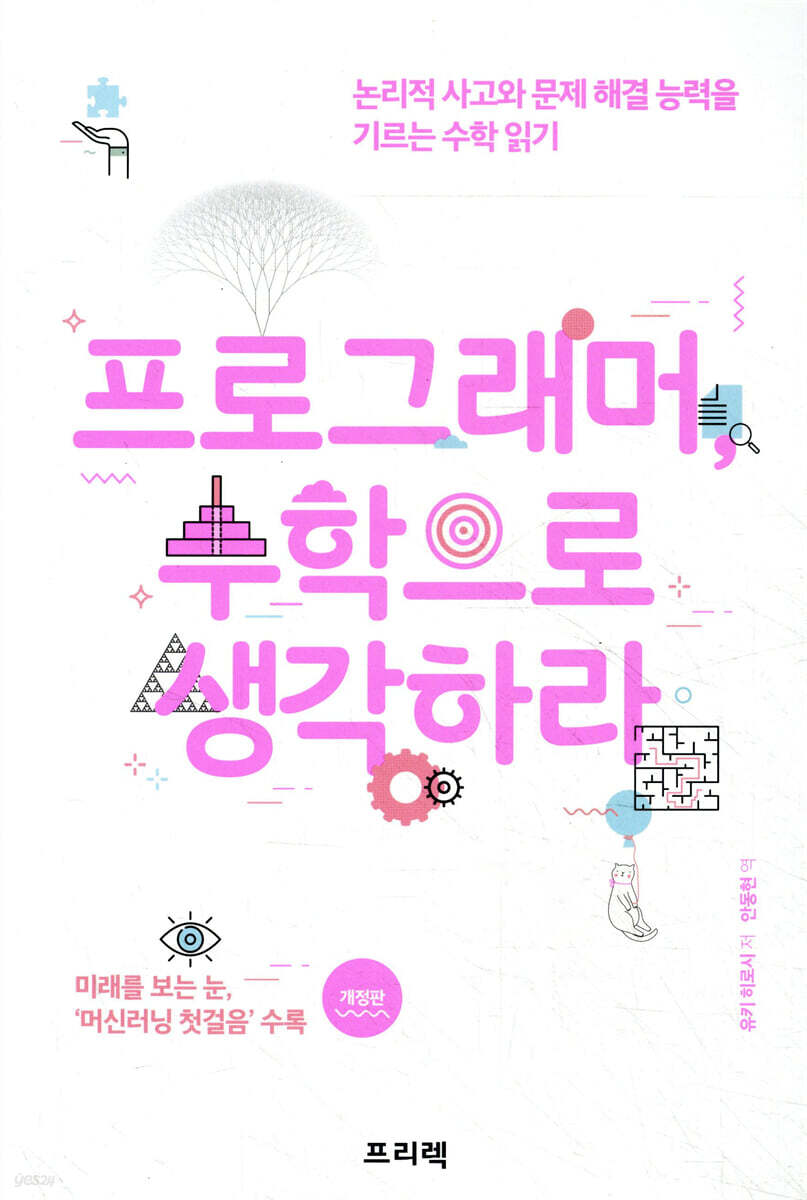
Programmers, think in math
 |
Description
Book Introduction
Let's learn mathematical thinking
The era of artificial intelligence and the Fourth Industrial Revolution.
What matters is logical thinking and problem-solving skills.
This book explains the mathematical principles behind programming in a fun way, using high school-level mathematical knowledge and arithmetic operations without using complex formulas.
Learning a 'mathematical way of thinking' will allow you to respond creatively to a variety of situations, not just programming.
Additionally, this revised edition includes the mathematics that forms the basis of the recently popular 'machine learning' technology.
The era of artificial intelligence and the Fourth Industrial Revolution.
What matters is logical thinking and problem-solving skills.
This book explains the mathematical principles behind programming in a fun way, using high school-level mathematical knowledge and arithmetic operations without using complex formulas.
Learning a 'mathematical way of thinking' will allow you to respond creatively to a variety of situations, not just programming.
Additionally, this revised edition includes the mathematics that forms the basis of the recently popular 'machine learning' technology.
- You can preview some of the book's contents.
Preview
index
To begin with
Mathematical thinking covered in this book
A united front between people and computers
Target audience for this book
Structure of this book
A letter of gratitude
On the occasion of the publication of the 2nd edition
Chapter 01 0 Story: 'Nothing' Means 'There Is'
Memories of first grade
Decimal system
binary
Place notation
Law of exponents
The role of 0
Discovery of human limitations and structure
What you learned in this chapter
Chapter 02 Logic: Splitting into true and false
What you will learn in this chapter
Why is logic important?
Fare Problem: On Exhaustive and Non-Overlapping Splits
Creating complex propositions
De Morgan's Law
Karnaugh map
Logic including undefined
What you learned in this chapter
Chapter 03 The Rest: Periodicity and Grouping
What you will learn in this chapter
Day of the Week Quiz (1)
Day of the Week Quiz (2)
Power Quiz
Communication using the Othello game
Friend Finder Quiz
Tile Laying Quiz
One-stroke drawing quiz
What you learned in this chapter
Chapter 04 Mathematical Induction: How to knock down a large number of dominoes
What you will learn in this chapter
Boy Gauss discovers addition
Mathematical Induction: How to knock down a large number of dominoes
Finding the Sum of Odd Numbers: An Example of Mathematical Induction
Othello Quiz: Faulty Mathematical Induction
Programs and mathematical induction
What you learned in this chapter
Chapter 05 Permutations and Combinations: The Rule for Not Counting
What you will learn in this chapter
Sendan: Correspondence with integers
Counting Trees: Don't Forget the Zero
addition rule
Multiplication rule
substitution
permutation
mixture
Practice with quizzes
What you learned in this chapter
Chapter 06 Recursion: Defining Yourself as Yourself
What you will learn in this chapter
Tower of Hanoi
Second succession
Fibonacci sequence
Pascal's triangle
recursive shapes
What you learned in this chapter
Chapter 07 Exponential Explosion: Fighting Tough Problems
What you will learn in this chapter
What is exponential explosion?
Double the Game: The Problem with Exponential Explosion
Binary Search: Exponential Explosion
Logarithms: A tool for dealing with exponential explosions
Cryptography: Keeping Secrets with Exponential Explosion
To cope with exponential explosion
What you learned in this chapter
Chapter 08 Uncountable Problems: Uncountable Numbers, Unprogrammable Programs
What you will learn in this chapter
The law of reductio ad absurdum
Can be counted
Diagonal argument
Incalculable problem
Stop judgment problem
What you learned in this chapter
Chapter 09: First Steps in Machine Learning: Prediction and Classification Problems
What you will learn in this chapter
What is machine learning?
Prediction problems and classification problems
perceptron
'Learning' in machine learning
neural network
Are humans becoming unnecessary?
What you learned in this chapter
Chapter 10 What is Programmer's Mathematics?: Instead of Theorems
Looking back on this book
Solving the problem
Search
Mathematical thinking covered in this book
A united front between people and computers
Target audience for this book
Structure of this book
A letter of gratitude
On the occasion of the publication of the 2nd edition
Chapter 01 0 Story: 'Nothing' Means 'There Is'
Memories of first grade
Decimal system
binary
Place notation
Law of exponents
The role of 0
Discovery of human limitations and structure
What you learned in this chapter
Chapter 02 Logic: Splitting into true and false
What you will learn in this chapter
Why is logic important?
Fare Problem: On Exhaustive and Non-Overlapping Splits
Creating complex propositions
De Morgan's Law
Karnaugh map
Logic including undefined
What you learned in this chapter
Chapter 03 The Rest: Periodicity and Grouping
What you will learn in this chapter
Day of the Week Quiz (1)
Day of the Week Quiz (2)
Power Quiz
Communication using the Othello game
Friend Finder Quiz
Tile Laying Quiz
One-stroke drawing quiz
What you learned in this chapter
Chapter 04 Mathematical Induction: How to knock down a large number of dominoes
What you will learn in this chapter
Boy Gauss discovers addition
Mathematical Induction: How to knock down a large number of dominoes
Finding the Sum of Odd Numbers: An Example of Mathematical Induction
Othello Quiz: Faulty Mathematical Induction
Programs and mathematical induction
What you learned in this chapter
Chapter 05 Permutations and Combinations: The Rule for Not Counting
What you will learn in this chapter
Sendan: Correspondence with integers
Counting Trees: Don't Forget the Zero
addition rule
Multiplication rule
substitution
permutation
mixture
Practice with quizzes
What you learned in this chapter
Chapter 06 Recursion: Defining Yourself as Yourself
What you will learn in this chapter
Tower of Hanoi
Second succession
Fibonacci sequence
Pascal's triangle
recursive shapes
What you learned in this chapter
Chapter 07 Exponential Explosion: Fighting Tough Problems
What you will learn in this chapter
What is exponential explosion?
Double the Game: The Problem with Exponential Explosion
Binary Search: Exponential Explosion
Logarithms: A tool for dealing with exponential explosions
Cryptography: Keeping Secrets with Exponential Explosion
To cope with exponential explosion
What you learned in this chapter
Chapter 08 Uncountable Problems: Uncountable Numbers, Unprogrammable Programs
What you will learn in this chapter
The law of reductio ad absurdum
Can be counted
Diagonal argument
Incalculable problem
Stop judgment problem
What you learned in this chapter
Chapter 09: First Steps in Machine Learning: Prediction and Classification Problems
What you will learn in this chapter
What is machine learning?
Prediction problems and classification problems
perceptron
'Learning' in machine learning
neural network
Are humans becoming unnecessary?
What you learned in this chapter
Chapter 10 What is Programmer's Mathematics?: Instead of Theorems
Looking back on this book
Solving the problem
Search
Detailed image
.jpg)
Publisher's Review
Develop your logical thinking and problem-solving skills by taking quizzes.
These days, programming education is hot due to mandatory coding education.
The underlying idea here is that even if you don't become a programmer, learning programming (coding) helps develop logical thinking and problem-solving skills.
Learning to program is more than just acquiring knowledge and skills; it's learning to think mathematically, along with the underlying operating principles.
I hope that this book will provide a foundation for not only programmers but also students to acquire mathematical problem-solving skills.
Features of this book
≫ The mathematical principles and thinking methods that can be utilized when programming are explained in an easy-to-understand manner without using complex formulas.
≫ Even if you don't know any computer language, you can learn mathematical thinking and the basics of programming through fun quizzes and puzzles.
≫ Contains the mathematical principles that form the basis of machine learning, which has recently been attracting attention.
Target audience for this book
Programmers or students who dream of becoming programmers:
You can learn the fundamentals of mathematics required for programming and learn how to program logically.
Anyone who wants to develop logical thinking and problem-solving skills:
The mathematics covered in this book isn't just for programming.
Anyone who is interested in mathematics and wants to solve problems logically in their daily lives will enjoy this book.
- Planning Intention -
A shortcut to making programming easier
We teach programming principles that anyone with even a high school math background can understand.
Even if you don't study a computer language, learning how to think logically makes programming easier.
In the field of children's coding education, unplugged teaching methods that use games to explain programming principles have been introduced early on.
However, coding education suitable for elementary school students is too easy, and those who need to learn coding but lack basic knowledge cannot find systematic educational guidelines on how to learn coding.
The Key to Developing Computational Thinking
Many celebrities have mentioned the importance of coding education.
Learning programming isn't just about becoming a programmer; it's also about learning the basics of coding to survive in the digital world.
By thinking in terms of algorithms and solving quizzes according to mathematical logic, you can develop problem-solving skills.
These days, programming education is hot due to mandatory coding education.
The underlying idea here is that even if you don't become a programmer, learning programming (coding) helps develop logical thinking and problem-solving skills.
Learning to program is more than just acquiring knowledge and skills; it's learning to think mathematically, along with the underlying operating principles.
I hope that this book will provide a foundation for not only programmers but also students to acquire mathematical problem-solving skills.
Features of this book
≫ The mathematical principles and thinking methods that can be utilized when programming are explained in an easy-to-understand manner without using complex formulas.
≫ Even if you don't know any computer language, you can learn mathematical thinking and the basics of programming through fun quizzes and puzzles.
≫ Contains the mathematical principles that form the basis of machine learning, which has recently been attracting attention.
Target audience for this book
Programmers or students who dream of becoming programmers:
You can learn the fundamentals of mathematics required for programming and learn how to program logically.
Anyone who wants to develop logical thinking and problem-solving skills:
The mathematics covered in this book isn't just for programming.
Anyone who is interested in mathematics and wants to solve problems logically in their daily lives will enjoy this book.
- Planning Intention -
A shortcut to making programming easier
We teach programming principles that anyone with even a high school math background can understand.
Even if you don't study a computer language, learning how to think logically makes programming easier.
In the field of children's coding education, unplugged teaching methods that use games to explain programming principles have been introduced early on.
However, coding education suitable for elementary school students is too easy, and those who need to learn coding but lack basic knowledge cannot find systematic educational guidelines on how to learn coding.
The Key to Developing Computational Thinking
Many celebrities have mentioned the importance of coding education.
Learning programming isn't just about becoming a programmer; it's also about learning the basics of coding to survive in the digital world.
By thinking in terms of algorithms and solving quizzes according to mathematical logic, you can develop problem-solving skills.
GOODS SPECIFICS
- Date of issue: July 2, 2018
- Page count, weight, size: 344 pages | 512g | 152*225*30mm
- ISBN13: 9788965402183
- ISBN10: 8965402182
You may also like
카테고리
korean


korean

![GQ KOREA Mark (Monthly): December [2025]](http://librairie.coreenne.fr/cdn/shop/files/8ef265dbbfbf186523ed75ba7319009d.jpg?v=1765340328&width=3840)


