

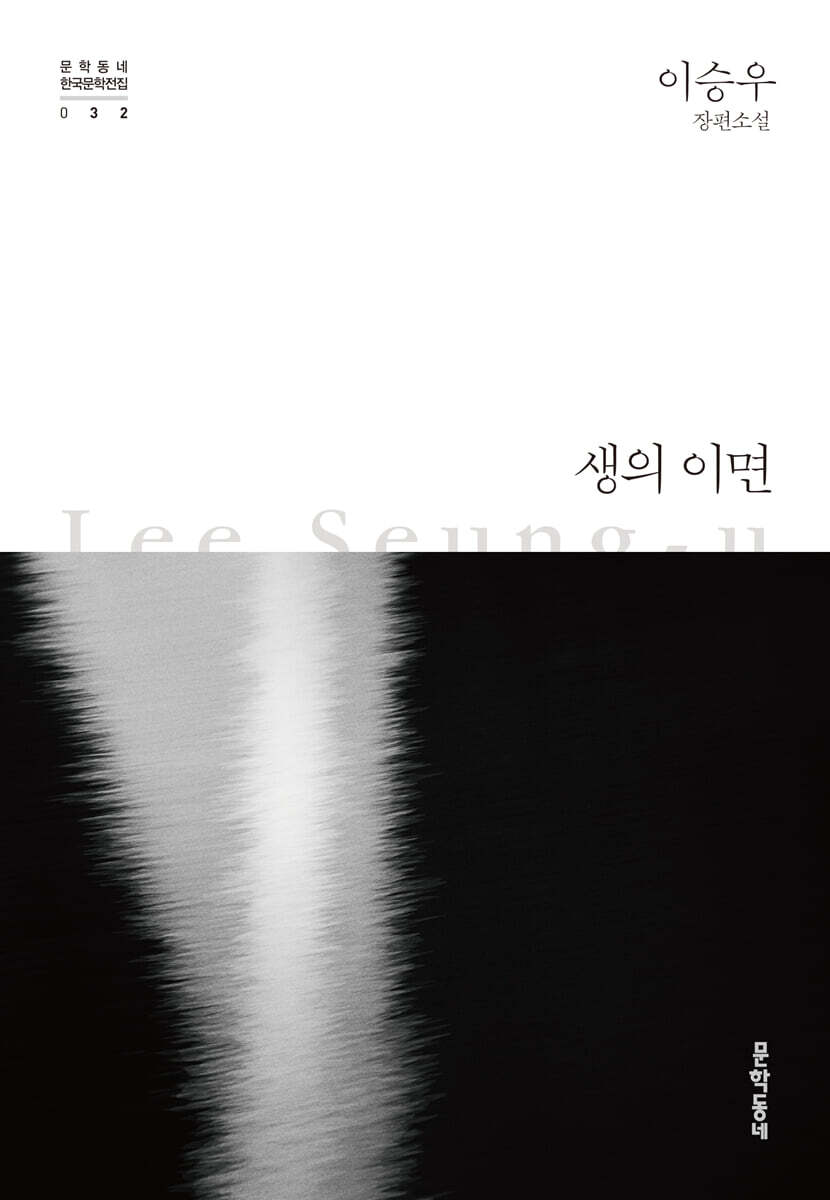
The other side of life
 |
Description
Book Introduction
- A word from MD
- [A classic of our time presented by novelist Seungwoo Lee] 『The Other Side of Life』, the masterpiece of novelist Seungwoo Lee and winner of the first Daesan Literary Award.
The protagonist, who was commissioned to write a biography of the writer 'Park Bu-gil', shows through his work how metafiction is used, such as narrator-writer, writer-reader, and reality-story.
Even after 30 years, it is full of immortal sentences that still make you want to savor them.
- Novel/Poetry PD Kim Yu-ri
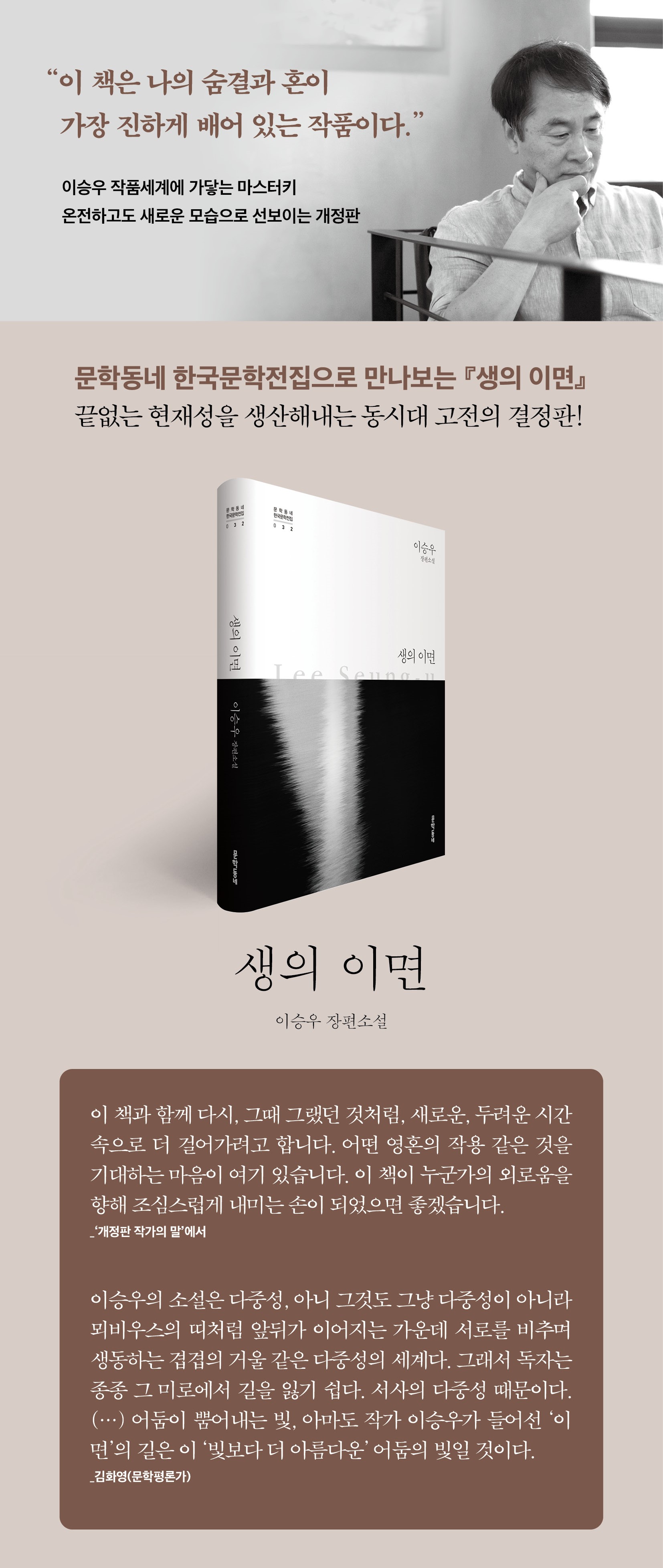
“This book is the work that most deeply imbues me with my breath and soul.”
The True Classic of Our Time: The Other Side of Life
A revised edition presented with a complete new look
Lee Seung-woo's early masterpiece, 『The Other Side of Life』, is presented in a carefully curated edition as the 32nd volume of the Munhakdongne Korean Literature Collection.
『The Other Side of Life』, which also won the first Daesan Literary Award, has been continuously reprinted since its publication in 1992, establishing itself as a rare steady seller in Korean literature.
Now, more than 30 years later, the revised edition, which can truly be called the "definitive edition," is presented to readers with a comprehensive revision of sentences without altering the content, and with commentary by Kim Hwa-young, a French literature scholar and literary critic, along with a new author's note.
The author also stated, “This book is the work that most deeply contains my breath and soul,” and it is no exaggeration to say that “The Other Side of Life” is “a single book that penetrates all the layers of his world of work, like a harpoon” (p. 128).
If you want to fully experience the essence and spirit of the master Lee Seung-woo, and his passionate and dynamic youth, 『The Other Side of Life』 will definitely be your master key.
"The Other Side of Life" begins from the perspective of the novelist 'I' who was asked to write about the life of the author 'Park Bu-gil'.
"To understand him" "To complete the chronology 1" "Bread on Earth" "A familiar ending" "To complete the chronology 2".
This novel, composed of five parts, exposes the process of writing the biography of ‘Park Bu-gil,’ inserts Park Bu-gil’s novel in its entirety, develops the literary theory of the narrator ‘I’ who writes it, and inserts the voice of the author ‘Lee Seung-woo’ who encompasses all of this, creating a world of “multiplicity like a living, layered mirror” (Kim Hwa-young).
These multi-layered voices come together and, combined with motifs of 'novel within a novel,' 'narrator and author,' 'author and reader,' and 'reality and story,' create a 'novel' and 'world' called 'The Other Side of Life.'
A novel by a novelist who doggedly pursues the life of a man who says, “Instead of saying I love you, I will study theology and become a pastor” (p. 212), and dreams “a futile attempt to restore the writer’s reality before the novel” (p. 221).
『The Other Side of Life』, which is both an 'autofiction' featuring numerous 'I's' and a place for 'metafiction' with layered interactions, is preparing to be reborn with new readers at this very moment through traces of deep reflection on literature and religion, wide-ranging allusions to myths and symbols, seething pathos, and enigma (riddles) that cannot be resolved into a single thing.
A story with endless presentness - a story with self-producing power.
Another way to put it would be "immortality," and wouldn't a book possessing that energy be considered a "classic"? In that sense, "The Other Side of Life" is undoubtedly a "contemporary classic" of Korean literature.
The True Classic of Our Time: The Other Side of Life
A revised edition presented with a complete new look
Lee Seung-woo's early masterpiece, 『The Other Side of Life』, is presented in a carefully curated edition as the 32nd volume of the Munhakdongne Korean Literature Collection.
『The Other Side of Life』, which also won the first Daesan Literary Award, has been continuously reprinted since its publication in 1992, establishing itself as a rare steady seller in Korean literature.
Now, more than 30 years later, the revised edition, which can truly be called the "definitive edition," is presented to readers with a comprehensive revision of sentences without altering the content, and with commentary by Kim Hwa-young, a French literature scholar and literary critic, along with a new author's note.
The author also stated, “This book is the work that most deeply contains my breath and soul,” and it is no exaggeration to say that “The Other Side of Life” is “a single book that penetrates all the layers of his world of work, like a harpoon” (p. 128).
If you want to fully experience the essence and spirit of the master Lee Seung-woo, and his passionate and dynamic youth, 『The Other Side of Life』 will definitely be your master key.
"The Other Side of Life" begins from the perspective of the novelist 'I' who was asked to write about the life of the author 'Park Bu-gil'.
"To understand him" "To complete the chronology 1" "Bread on Earth" "A familiar ending" "To complete the chronology 2".
This novel, composed of five parts, exposes the process of writing the biography of ‘Park Bu-gil,’ inserts Park Bu-gil’s novel in its entirety, develops the literary theory of the narrator ‘I’ who writes it, and inserts the voice of the author ‘Lee Seung-woo’ who encompasses all of this, creating a world of “multiplicity like a living, layered mirror” (Kim Hwa-young).
These multi-layered voices come together and, combined with motifs of 'novel within a novel,' 'narrator and author,' 'author and reader,' and 'reality and story,' create a 'novel' and 'world' called 'The Other Side of Life.'
A novel by a novelist who doggedly pursues the life of a man who says, “Instead of saying I love you, I will study theology and become a pastor” (p. 212), and dreams “a futile attempt to restore the writer’s reality before the novel” (p. 221).
『The Other Side of Life』, which is both an 'autofiction' featuring numerous 'I's' and a place for 'metafiction' with layered interactions, is preparing to be reborn with new readers at this very moment through traces of deep reflection on literature and religion, wide-ranging allusions to myths and symbols, seething pathos, and enigma (riddles) that cannot be resolved into a single thing.
A story with endless presentness - a story with self-producing power.
Another way to put it would be "immortality," and wouldn't a book possessing that energy be considered a "classic"? In that sense, "The Other Side of Life" is undoubtedly a "contemporary classic" of Korean literature.
index
To understand him _007
To complete the chronology 1 _089
Food on Earth _124
A Familiar Ending _213
To complete the chronology 2_345
Commentary | Kim Hwa-young (literary critic)
Finding Myths in Search of Myself _353
First Edition Author's Note _385
Revised Edition Author's Note _388
To complete the chronology 1 _089
Food on Earth _124
A Familiar Ending _213
To complete the chronology 2_345
Commentary | Kim Hwa-young (literary critic)
Finding Myths in Search of Myself _353
First Edition Author's Note _385
Revised Edition Author's Note _388
Detailed image
Into the book
What if we started by saying that the novelist already had a novel before he started writing it?
--- p.12
“Well then, goodbye now, my times of shame.
“I will never return to you again.”
--- p.88
What matters is not the degree of love, or its presence or absence, but its direction.
--- p.103
All past is only a remembered past, and all memories are only censored or selective memories.
Time is poisonous, and my self is a huge, tiny universe surrounded by too many layers.
There is truth in every layer, and that truth is true only in that layer.
--- p.128
We cannot show destiny.
But fate can be shown in any number of ways.
Destiny is not here or there, it is where you pronounce it.
--- p.174
But when readers encounter overlap between the work and the author's life, they naturally feel curious.
Of course, the author does not copy his own life as it is.
Not only do they not try to do that, they cannot.
(…) You write it down as it is? Who could possibly do that? Facts remembered or spoken are ultimately just excerpts.
‘Facts’ are constructed through selection and exclusion.
There is refraction and distortion involved.
That's the work.
--- pp.218~219
Without life, without facts, there is no fiction.
Therefore, what we must discover in the novel is the author's intimate voice hidden in the fragments, not the restoration of facts pieced together from the fragments.
But the reader is outside the book, and the writer's writings are trapped inside the book.
The reader must enter the book to meet the author.
By reading the novels written by an author, the reader discovers fragments revealed or hidden in each novel and combines them based on his or her own experiences and imagination, thereby creating a writer of his or her own.
In that sense, without fiction, there is no life, that is, no facts.
--- pp.220~221
What gives meaning to selfishness if not love?
What else but love could give us such an unexpected and unimaginable thrill?
--- p.248
Love also requires skill.
If there is a skill to be learned and mastered in life, it must be love.
Because there is nothing more precious and valuable than love.
When we don't learn to love, love often becomes a weapon that hurts people.
--- p.303
His writing was, so to speak, like a prayer.
--- p.12
“Well then, goodbye now, my times of shame.
“I will never return to you again.”
--- p.88
What matters is not the degree of love, or its presence or absence, but its direction.
--- p.103
All past is only a remembered past, and all memories are only censored or selective memories.
Time is poisonous, and my self is a huge, tiny universe surrounded by too many layers.
There is truth in every layer, and that truth is true only in that layer.
--- p.128
We cannot show destiny.
But fate can be shown in any number of ways.
Destiny is not here or there, it is where you pronounce it.
--- p.174
But when readers encounter overlap between the work and the author's life, they naturally feel curious.
Of course, the author does not copy his own life as it is.
Not only do they not try to do that, they cannot.
(…) You write it down as it is? Who could possibly do that? Facts remembered or spoken are ultimately just excerpts.
‘Facts’ are constructed through selection and exclusion.
There is refraction and distortion involved.
That's the work.
--- pp.218~219
Without life, without facts, there is no fiction.
Therefore, what we must discover in the novel is the author's intimate voice hidden in the fragments, not the restoration of facts pieced together from the fragments.
But the reader is outside the book, and the writer's writings are trapped inside the book.
The reader must enter the book to meet the author.
By reading the novels written by an author, the reader discovers fragments revealed or hidden in each novel and combines them based on his or her own experiences and imagination, thereby creating a writer of his or her own.
In that sense, without fiction, there is no life, that is, no facts.
--- pp.220~221
What gives meaning to selfishness if not love?
What else but love could give us such an unexpected and unimaginable thrill?
--- p.248
Love also requires skill.
If there is a skill to be learned and mastered in life, it must be love.
Because there is nothing more precious and valuable than love.
When we don't learn to love, love often becomes a weapon that hurts people.
--- p.303
His writing was, so to speak, like a prayer.
--- p.347
Publisher's Review
“How breathless must it be for someone to make a path where there is no path and walk.”
A novel that reaches from the surface to the back, and finally to the front.
Lee Seung-woo's novels are a world of multiplicity, no, not just multiplicity, but a multiplicity of layers of mirrors that reflect each other and come to life, like a Möbius strip.
So readers often get lost in that maze.
The expression labyrinth is too concise.
To borrow a phrase repeated in the author's note at the end of the book, perhaps it should be called a 'swamp'.
Readers of this novel gradually feel as if they are sinking into some kind of swamp.
Because of the multiplicity of narratives.
(…) The light that darkness emits, perhaps the path of ‘the other side’ that author Seungwoo Lee has entered is the light of this darkness that is ‘more beautiful than light.’
Kim Hwa-young (literary critic)
So I was barely able to get across to the other side by riding this book.
It gave me the strength to keep writing.
That's why I was a bit taken aback at first by the fact that quite a few people sympathized with the "techniques" this book employed to save me.
But soon I learned that everyone has their own swamps, and I slowly began to feel a little less alone as I slowly accepted that some people were using my clumsy tricks as a way to navigate their own unique swamps, just as I had.
Being a reader of a book is like being a comrade.
It's like walking hand in hand into 'chaos, emptiness, and darkness', cautiously and with the utmost care.
I feel affection for those who held my hand.
_From the author's note in the revised edition
■ Author's Note
And now, I'm rereading this book, thirty years old, and revising the sentences.
As much time has passed, there were quite a few places to touch.
However, the content did not change.
It's not that it's perfect, but it's like fate, and I feel like there are things that cannot be changed regardless of time.
This book is like that for me.
(…) With this book, I intend to walk again, as I did then, into a new, fearful time.
There is a sense of anticipation here for some kind of soul-work.
I hope this book can be a hand that gently reaches out to someone's loneliness.
Summer 2024
Lee Seung-woo
A novel that reaches from the surface to the back, and finally to the front.
Lee Seung-woo's novels are a world of multiplicity, no, not just multiplicity, but a multiplicity of layers of mirrors that reflect each other and come to life, like a Möbius strip.
So readers often get lost in that maze.
The expression labyrinth is too concise.
To borrow a phrase repeated in the author's note at the end of the book, perhaps it should be called a 'swamp'.
Readers of this novel gradually feel as if they are sinking into some kind of swamp.
Because of the multiplicity of narratives.
(…) The light that darkness emits, perhaps the path of ‘the other side’ that author Seungwoo Lee has entered is the light of this darkness that is ‘more beautiful than light.’
Kim Hwa-young (literary critic)
So I was barely able to get across to the other side by riding this book.
It gave me the strength to keep writing.
That's why I was a bit taken aback at first by the fact that quite a few people sympathized with the "techniques" this book employed to save me.
But soon I learned that everyone has their own swamps, and I slowly began to feel a little less alone as I slowly accepted that some people were using my clumsy tricks as a way to navigate their own unique swamps, just as I had.
Being a reader of a book is like being a comrade.
It's like walking hand in hand into 'chaos, emptiness, and darkness', cautiously and with the utmost care.
I feel affection for those who held my hand.
_From the author's note in the revised edition
■ Author's Note
And now, I'm rereading this book, thirty years old, and revising the sentences.
As much time has passed, there were quite a few places to touch.
However, the content did not change.
It's not that it's perfect, but it's like fate, and I feel like there are things that cannot be changed regardless of time.
This book is like that for me.
(…) With this book, I intend to walk again, as I did then, into a new, fearful time.
There is a sense of anticipation here for some kind of soul-work.
I hope this book can be a hand that gently reaches out to someone's loneliness.
Summer 2024
Lee Seung-woo
GOODS SPECIFICS
- Date of issue: September 6, 2024
- Format: Hardcover book binding method guide
- Page count, weight, size: 392 pages | 458g | 128*188*25mm
- ISBN13: 9791141601218
- ISBN10: 1141601214
You may also like
카테고리
korean


korean

![GQ KOREA Mark (Monthly): December [2025]](http://librairie.coreenne.fr/cdn/shop/files/8ef265dbbfbf186523ed75ba7319009d.jpg?v=1765340328&width=3840)


