

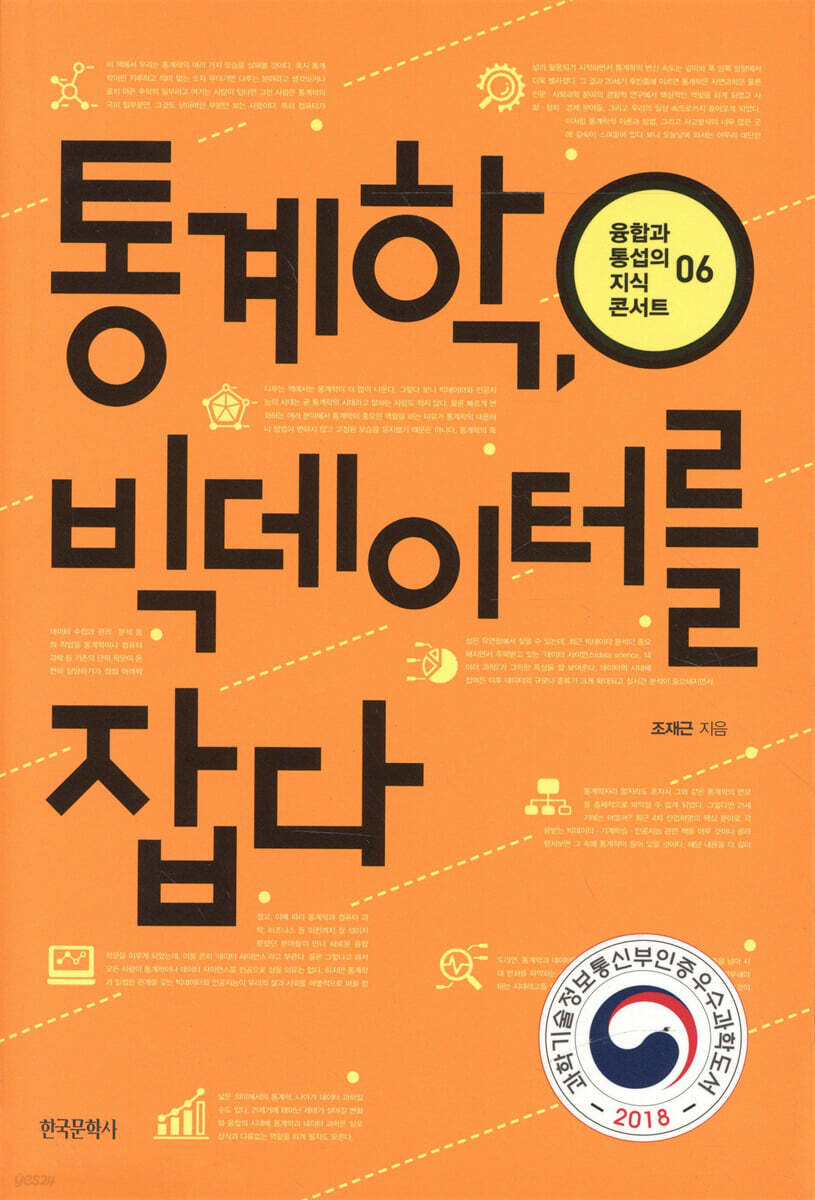
Statistics, Grasping Big Data
 |
Description
Book Introduction
Following the intersection of humanities and economics, architecture, mathematics, medicine, and science, the sixth volume of the "Concert of Knowledge on Convergence and Integration" series, "Statistics, Grasping Big Data," which explores the intersection of statistics and other disciplines, has been published.
This book, which unravels the true nature of statistics, the foundation of big data and artificial intelligence, which occupy a crucial position in the era of the Fourth Industrial Revolution, from a humanistic perspective, vividly demonstrates the interdisciplinary nature of statistics, which transcends various fields such as society, economics, medicine, science, biology, and finance.
Through this, readers will realize that statistics is no longer just a subject of tedious numbers, but rather a very fascinating discipline closely related to our lives.
This book, which unravels the true nature of statistics, the foundation of big data and artificial intelligence, which occupy a crucial position in the era of the Fourth Industrial Revolution, from a humanistic perspective, vividly demonstrates the interdisciplinary nature of statistics, which transcends various fields such as society, economics, medicine, science, biology, and finance.
Through this, readers will realize that statistics is no longer just a subject of tedious numbers, but rather a very fascinating discipline closely related to our lives.
- You can preview some of the book's contents.
Preview
index
Entering
Chapter 1: Statistics: Leading the Big Data Era
The Fourth Industrial Revolution: Will it be revolutionary because jobs will disappear?: The Fourth Industrial Revolution is a convergence revolution | Opening the barn of big data: Data Lab and Engram | TIP: Cloud computing and big data | Let's draw a cloud with words: Text analysis and data visualization | Does statistics have a history?: The history and types of data | Statistics, turning data into information and knowledge: Statistics in the era of big data | Statistics is also changing in the era of big data: The convergence of statistics
Chapter 2: The Age of Big Data or the Age of Machine Learning?
Studying is now done by machines | Tip: Human or machine? How to tell the difference: Turing test and captcha | Deep learning is deep learning: Machine learning and deep learning | Does machine learning need teachers too?: Machine learning algorithms | Collecting, sharing, and predicting data: Examples of machine learning algorithms | Google predicts flu with big data and statistical models: Big data and infectious diseases | Big data and machine learning that find matches
Chapter 3: Probability and Statistics: Taming Chance with Science
Betting and gambling: Greed, instinct, or science | Lotto, the only way out, or a foolish game? | Lottery viewed through probability and expected value | Probability, a guide to rational decisions in an uncertain world: Chance and science | TIP: Should I drive a car or a goat?: The Monty Hall problem | Does anyone in my class have the same birthday as me?: Birthday problems and probability | Will sufficiently low-probability events not occur?: Borel's law | To be or not to be, that's the question of probability!: Insurance and probability | Can subjective probability also be a science?: Bayesian inference | TIP: Turing uses Bayes' theorem to break the German code
Chapter 4: Statistics and Medicine Join Hands to Save Lives
Medicine at the Crossroads of Science and Art: Medicine and Statistics | Statistics and Medicine, Advancing Together Throughout History: The History of Medicine and Statistics | Preventing Cholera and Smallpox with Statistics: Statistics and Infectious Diseases | Can We Trust Clinical Trial Results?: Bias and Randomization Methods | Tip: Pascal's Number Triangle and the Number of Cases in "The Woman Tasting Tea" | Developing New Drugs Through Statistical Verification: Statistics and New Drugs | How Accurate Are Hospital Tests?: False Positives and False Negatives
Chapter 5: The Power to Read Real Society: Statistics and Big Data
Are rally attendance numbers rubber-band statistics?: Statistics that vary depending on political stance | Tip: The Iraq War and Child Mortality: Statistics and Politics | Statistics, Measuring People's Thoughts: Public Opinion Polls | Quetelet, Analyzing 19th-Century Society: Social Statistics | Tip: Are Humans Social Atoms? Social Physics and Big Data | Can Anything Be Scored?: The Reality Created by Statistics | South Korea's Population Will Soon Naturally Disappear: Demography | Why Am I Not Unemployed?: Employment Statistics
Chapter 6: Statistics, Measuring the Economy: GDP and Financial Risk
How did economics become a science?: Economics, mathematics, and statistics | How well does GDP represent our lives?: Gross domestic product and happiness index | Tip: GDP transformed Ghana, a poor African country, into a middle-income country | How well do statistical indicators represent reality?: Price index and stock index | What's in a stock chart?: Candlestick chart and moving average | All financial investments involve risk: Financial risk and statistics | Both countries and individuals have credit ratings: Credit rating
Chapter 7: Statistics: Counting and Caring for Living Things
Can we count all the whales and rats?: Biological research and sampling methods | Are all living things the same family?: Finding the genealogy of living things with statistics | How many living things have lived and disappeared on Earth?: Extinction and statistics | Who will ride the Snowpiercer?: Conservation biology and statistics | Do tall parents have tall children?: Genetics and statistics | What can we learn from the Hwang Woo-suk incident?: Data manipulation and scientific research | Tip: Ecology is a study of context: Biodiversity and big data
annotation
Search
Chapter 1: Statistics: Leading the Big Data Era
The Fourth Industrial Revolution: Will it be revolutionary because jobs will disappear?: The Fourth Industrial Revolution is a convergence revolution | Opening the barn of big data: Data Lab and Engram | TIP: Cloud computing and big data | Let's draw a cloud with words: Text analysis and data visualization | Does statistics have a history?: The history and types of data | Statistics, turning data into information and knowledge: Statistics in the era of big data | Statistics is also changing in the era of big data: The convergence of statistics
Chapter 2: The Age of Big Data or the Age of Machine Learning?
Studying is now done by machines | Tip: Human or machine? How to tell the difference: Turing test and captcha | Deep learning is deep learning: Machine learning and deep learning | Does machine learning need teachers too?: Machine learning algorithms | Collecting, sharing, and predicting data: Examples of machine learning algorithms | Google predicts flu with big data and statistical models: Big data and infectious diseases | Big data and machine learning that find matches
Chapter 3: Probability and Statistics: Taming Chance with Science
Betting and gambling: Greed, instinct, or science | Lotto, the only way out, or a foolish game? | Lottery viewed through probability and expected value | Probability, a guide to rational decisions in an uncertain world: Chance and science | TIP: Should I drive a car or a goat?: The Monty Hall problem | Does anyone in my class have the same birthday as me?: Birthday problems and probability | Will sufficiently low-probability events not occur?: Borel's law | To be or not to be, that's the question of probability!: Insurance and probability | Can subjective probability also be a science?: Bayesian inference | TIP: Turing uses Bayes' theorem to break the German code
Chapter 4: Statistics and Medicine Join Hands to Save Lives
Medicine at the Crossroads of Science and Art: Medicine and Statistics | Statistics and Medicine, Advancing Together Throughout History: The History of Medicine and Statistics | Preventing Cholera and Smallpox with Statistics: Statistics and Infectious Diseases | Can We Trust Clinical Trial Results?: Bias and Randomization Methods | Tip: Pascal's Number Triangle and the Number of Cases in "The Woman Tasting Tea" | Developing New Drugs Through Statistical Verification: Statistics and New Drugs | How Accurate Are Hospital Tests?: False Positives and False Negatives
Chapter 5: The Power to Read Real Society: Statistics and Big Data
Are rally attendance numbers rubber-band statistics?: Statistics that vary depending on political stance | Tip: The Iraq War and Child Mortality: Statistics and Politics | Statistics, Measuring People's Thoughts: Public Opinion Polls | Quetelet, Analyzing 19th-Century Society: Social Statistics | Tip: Are Humans Social Atoms? Social Physics and Big Data | Can Anything Be Scored?: The Reality Created by Statistics | South Korea's Population Will Soon Naturally Disappear: Demography | Why Am I Not Unemployed?: Employment Statistics
Chapter 6: Statistics, Measuring the Economy: GDP and Financial Risk
How did economics become a science?: Economics, mathematics, and statistics | How well does GDP represent our lives?: Gross domestic product and happiness index | Tip: GDP transformed Ghana, a poor African country, into a middle-income country | How well do statistical indicators represent reality?: Price index and stock index | What's in a stock chart?: Candlestick chart and moving average | All financial investments involve risk: Financial risk and statistics | Both countries and individuals have credit ratings: Credit rating
Chapter 7: Statistics: Counting and Caring for Living Things
Can we count all the whales and rats?: Biological research and sampling methods | Are all living things the same family?: Finding the genealogy of living things with statistics | How many living things have lived and disappeared on Earth?: Extinction and statistics | Who will ride the Snowpiercer?: Conservation biology and statistics | Do tall parents have tall children?: Genetics and statistics | What can we learn from the Hwang Woo-suk incident?: Data manipulation and scientific research | Tip: Ecology is a study of context: Biodiversity and big data
annotation
Search
Into the book
People say that we live in an era where lifelong study is essential regardless of major. If there's one common theme that applies to all such studies, it could be statistics in a broad sense, or even data science.
In the era of change and convergence that the generation born in the 21st century will live in, statistics and data science may become practically common sense.
(p.19)
We often encounter optimistic views about the future brought about by big data and cloud computing.
But there are also warning voices that point out serious problems, though not as loud.
One of them is the problem of global concentration of information power.
(p.30)
Overestimating one's abilities beyond one's limits is not beneficial for statistics and big data.
Despite their distinct advantages and potential, statistics and big data analytics are not, and never will be, omnipotent technologies.
(p.53)
When artificial intelligence researchers model the human brain, what they want to imitate is not the brain's memory capacity, but rather its ability to string beads, the brain's ability to connect and bind the data it remembers.
This is what Funes could not do.
Memories alone can never be strength.
(p.59)
Statistics is not only a highly interdisciplinary discipline in itself, but it is also more active than any other discipline in creating new, larger interdisciplinary fields by combining with other fields.
(p.63)
The 2012 US presidential election went down in history as the first successful application of big data and machine learning.
We have entered an era where I am moved and respond only when someone learns about me as an individual and calls me by name, rather than as a large group to which I belong.
(p.71~72)
Google's AlphaGo also only performs the tasks it is told to do, so it is classified as a weak artificial intelligence, like Watson created by IBM.
So where does one find a powerful AI capable of human-like thinking and self-awareness? Fortunately or unfortunately, there isn't one yet.
(p.90)
Until now, the important role of science has been to free people from the wheel of fate turned by Fortuna, and to do so, 'chance' had to be replaced by 'cause'.
Fortuna, on the other hand, transformed the face of science by creating an empire of probability and statistics instead of certainty.
(p.137)
Although humans have tamed chance through probability and statistics, we have only just come to understand probability and regularity at the group level.
Ultimately, it is still the fortune teller's job to predict an individual's fate.
(p.166)
For example, even though all the causes of malaria have been identified, statistics from the World Health Organization and other sources show that millions of people die from malaria every year.
Although various preventive drugs and vaccines have been developed, can malaria truly be conquered if the poor cannot afford them? (p.208)
The average person clearly represents one of the zeitgeists of the mid-19th century: the zeitgeist of 'equality.'
In a society with a strict caste system, it would have been difficult to think that an average that included even the lower classes could represent a country.
(p.259)
The fact that statistics are different means that social issues can be viewed from various perspectives, so the production of different statistics can be a source of energy for seeking new changes, both for society and for statistics.
Ultimately, statistics are also the product of political and social conflict and compromise.
Statistics do not necessarily have to be unified to be good.
(p.288)
The real world often goes its own way, mocking sophisticated mathematical theories, abundant data, and statistical models, far surpassing all the discussions of the narrow academic world.
It is also difficult for social sciences to resemble natural sciences.
(p.294)
Even though we live in an era of globalization, the standards of happiness cannot be the same in every country and region.
Although not widely used internationally, Bhutan's Gross Happiness Index has sparked a number of attempts to measure happiness in different regions.
(p.309)
Once something is expressed in numbers, we easily fall into the delusion that those numbers are accurate, objective, and fair. However, to compare and properly interpret statistics, we must carefully examine not only the numbers but also the qualitative data.
(p.313)
We can see that statistics is not a science that provides a single, rigorous answer through proof, like mathematics, but rather a discipline that often produces different conclusions depending on the data and model.
If so, the problems that statistical experts will have to grapple with will remain endless, and this aspect is both the limitation and the charm of statistics.
(p.345)
The era of big data is said to be “an era where everything becomes data.”
There are so many new things we learn through big data, but perhaps we lose something in the process of turning everything into data.
(p.394)
In the era of change and convergence that the generation born in the 21st century will live in, statistics and data science may become practically common sense.
(p.19)
We often encounter optimistic views about the future brought about by big data and cloud computing.
But there are also warning voices that point out serious problems, though not as loud.
One of them is the problem of global concentration of information power.
(p.30)
Overestimating one's abilities beyond one's limits is not beneficial for statistics and big data.
Despite their distinct advantages and potential, statistics and big data analytics are not, and never will be, omnipotent technologies.
(p.53)
When artificial intelligence researchers model the human brain, what they want to imitate is not the brain's memory capacity, but rather its ability to string beads, the brain's ability to connect and bind the data it remembers.
This is what Funes could not do.
Memories alone can never be strength.
(p.59)
Statistics is not only a highly interdisciplinary discipline in itself, but it is also more active than any other discipline in creating new, larger interdisciplinary fields by combining with other fields.
(p.63)
The 2012 US presidential election went down in history as the first successful application of big data and machine learning.
We have entered an era where I am moved and respond only when someone learns about me as an individual and calls me by name, rather than as a large group to which I belong.
(p.71~72)
Google's AlphaGo also only performs the tasks it is told to do, so it is classified as a weak artificial intelligence, like Watson created by IBM.
So where does one find a powerful AI capable of human-like thinking and self-awareness? Fortunately or unfortunately, there isn't one yet.
(p.90)
Until now, the important role of science has been to free people from the wheel of fate turned by Fortuna, and to do so, 'chance' had to be replaced by 'cause'.
Fortuna, on the other hand, transformed the face of science by creating an empire of probability and statistics instead of certainty.
(p.137)
Although humans have tamed chance through probability and statistics, we have only just come to understand probability and regularity at the group level.
Ultimately, it is still the fortune teller's job to predict an individual's fate.
(p.166)
For example, even though all the causes of malaria have been identified, statistics from the World Health Organization and other sources show that millions of people die from malaria every year.
Although various preventive drugs and vaccines have been developed, can malaria truly be conquered if the poor cannot afford them? (p.208)
The average person clearly represents one of the zeitgeists of the mid-19th century: the zeitgeist of 'equality.'
In a society with a strict caste system, it would have been difficult to think that an average that included even the lower classes could represent a country.
(p.259)
The fact that statistics are different means that social issues can be viewed from various perspectives, so the production of different statistics can be a source of energy for seeking new changes, both for society and for statistics.
Ultimately, statistics are also the product of political and social conflict and compromise.
Statistics do not necessarily have to be unified to be good.
(p.288)
The real world often goes its own way, mocking sophisticated mathematical theories, abundant data, and statistical models, far surpassing all the discussions of the narrow academic world.
It is also difficult for social sciences to resemble natural sciences.
(p.294)
Even though we live in an era of globalization, the standards of happiness cannot be the same in every country and region.
Although not widely used internationally, Bhutan's Gross Happiness Index has sparked a number of attempts to measure happiness in different regions.
(p.309)
Once something is expressed in numbers, we easily fall into the delusion that those numbers are accurate, objective, and fair. However, to compare and properly interpret statistics, we must carefully examine not only the numbers but also the qualitative data.
(p.313)
We can see that statistics is not a science that provides a single, rigorous answer through proof, like mathematics, but rather a discipline that often produces different conclusions depending on the data and model.
If so, the problems that statistical experts will have to grapple with will remain endless, and this aspect is both the limitation and the charm of statistics.
(p.345)
The era of big data is said to be “an era where everything becomes data.”
There are so many new things we learn through big data, but perhaps we lose something in the process of turning everything into data.
(p.394)
--- From the text
Publisher's Review
Big data and statistics that create a new future and new values
Reading the era of convergence and integration with "big data" and forecasting it with "statistics"!
We live in an era where the power of big data and the struggles of artificial intelligence are becoming increasingly dazzling.
Big data has been used to predict election results, and artificial intelligence AlphaGo has been used to play Go. In our society, the terms big data and artificial intelligence have gone beyond mere buzzwords to become practical social mechanisms that govern our lives.
Recently, statistics has been receiving a lot of attention thanks to big data and artificial intelligence, which play a crucial role in the Fourth Industrial Revolution, which can be called a convergence revolution.
However, many of the core machine learning and big data analysis methods of artificial intelligence are based on statistics, so some people even say that while the present and future may seem like the era of artificial intelligence, it is actually the era of statistics.
Statistics is a young discipline that emerged alongside modern society, with a history spanning only a few hundred years. However, a cursory examination of its history reveals that it is connected to virtually all fields classified as social sciences or natural sciences, including philosophy and the humanities.
Such entangled relationships have become even more abundant today, and in that sense, statistics can be said to be a representative discipline of the era of convergence and integration.
So what is statistics?
Statistics, which has become a representative discipline in the era of convergence and integration, can be broadly said to be a combination of data and probability theory.
Statistics was born as a modern discipline when population data, which had long been managed by the church, met with probability theory developed by mathematicians studying gambling. In that sense, statistics, which was born from the meeting of social data and mathematics, was a convergence from the beginning.
This book presents various aspects of statistics that span across various fields, including medicine, biology, and finance, as well as social and economic statistics managed by national institutions, including Statistics Korea.
Of course, it is important to look at the current state of big data and artificial intelligence.
Based on the author's rich humanistic perspective, "statistics," previously perceived as nothing more than rigid numbers, are portrayed in a variety of fascinating ways. This allows readers to easily fall in love with the allure of "statistics" and discover its "thousand faces."
We come to appreciate statistics as a 'force' that moves the world.
Statistics: The "Thousand Faces" Leading the Big Data Era
Now everything in the world is analyzed and predicted with statistics!
Statistics is the study of inferring unknown information using data obtained through research or experiments, and serves as a scientific guide when making decisions in uncertain situations.
Over the past few centuries, statistics has become a highly interdisciplinary field, encompassing not only the natural sciences but also the social sciences and humanities, as it has been widely used to analyze data across a wide range of fields.
Recently, especially with the rise of artificial intelligence and big data analysis, the social role of statistics has become increasingly important, and it has emerged as a powerful force leading the big data era.
We live in an era where it's difficult to create new social value in any field without statistical knowledge, which is precisely why a humanistic interest in "statistics" is so desperately needed.
The text of "Statistics, Grasping Big Data," which explores "statistics" as a new, emerging force in a new era from a humanistic perspective, is comprised of seven chapters.
First, Chapter 1, "Statistics, Leading the Big Data Era," provides a general overview of statistics and explores the emerging field of data science in modern society. It also examines both optimistic and critical perspectives on big data.
Chapter 2, "Is This the Age of Big Data or the Age of Machine Learning?" explores the relationship between big data and machine learning, key machine learning algorithms, and key statistical methods. We then examine specific examples of how big data and learning methods can be used to solve everyday problems.
Chapter 3, "Probability and Statistics: Taming Chance with Science," examines probabilistic thinking, which has become essential for understanding today's world full of uncertainty. We explore the various aspects of probability through famous probability problems such as probability and expected value in lotteries and gambling, birthdays, Monty Hall, and the St. Petersburg problem, as well as the types of probability and Bayes' theorem.
Chapter 4, "Statistics and Medicine Join Hands to Save Lives," examines the role played by probability and statistics in the development of medicine as a science.
Statistics and medicine have developed together over the past several centuries, influencing each other. Medicine is one of the fields most actively utilizing big data and artificial intelligence.
Chapter 5, "The Power to Read Real Society: Statistics and Big Data," examines the reality of statistics, which has become an essential element in understanding today's social realities, predicting the direction of social change, and establishing appropriate policies accordingly. It begins with the problem of counting the number of participants in large-scale rallies and explores opinion polls, population statistics, and employment statistics.
Chapter 6, "Statistics, Measuring the Economy: GDP and Financial Risk," examines the role of statistics in transforming economics into a scientific discipline. It explores the various aspects of GDP, a representative economic indicator, and new indicators that could replace it. It also examines the role of statistics in various economic phenomena, such as price indices and stock indices.
Finally, Chapter 7, "Statistics: Counting and Caring for Living Things," explores statistical surveys of living things, extinction, classification systems of living things, conservation activities, and genetics, and examines the scientific community's controversies surrounding data, focusing on the Hwang Woo-suk scandal in Korea.
Reading the era of convergence and integration with "big data" and forecasting it with "statistics"!
We live in an era where the power of big data and the struggles of artificial intelligence are becoming increasingly dazzling.
Big data has been used to predict election results, and artificial intelligence AlphaGo has been used to play Go. In our society, the terms big data and artificial intelligence have gone beyond mere buzzwords to become practical social mechanisms that govern our lives.
Recently, statistics has been receiving a lot of attention thanks to big data and artificial intelligence, which play a crucial role in the Fourth Industrial Revolution, which can be called a convergence revolution.
However, many of the core machine learning and big data analysis methods of artificial intelligence are based on statistics, so some people even say that while the present and future may seem like the era of artificial intelligence, it is actually the era of statistics.
Statistics is a young discipline that emerged alongside modern society, with a history spanning only a few hundred years. However, a cursory examination of its history reveals that it is connected to virtually all fields classified as social sciences or natural sciences, including philosophy and the humanities.
Such entangled relationships have become even more abundant today, and in that sense, statistics can be said to be a representative discipline of the era of convergence and integration.
So what is statistics?
Statistics, which has become a representative discipline in the era of convergence and integration, can be broadly said to be a combination of data and probability theory.
Statistics was born as a modern discipline when population data, which had long been managed by the church, met with probability theory developed by mathematicians studying gambling. In that sense, statistics, which was born from the meeting of social data and mathematics, was a convergence from the beginning.
This book presents various aspects of statistics that span across various fields, including medicine, biology, and finance, as well as social and economic statistics managed by national institutions, including Statistics Korea.
Of course, it is important to look at the current state of big data and artificial intelligence.
Based on the author's rich humanistic perspective, "statistics," previously perceived as nothing more than rigid numbers, are portrayed in a variety of fascinating ways. This allows readers to easily fall in love with the allure of "statistics" and discover its "thousand faces."
We come to appreciate statistics as a 'force' that moves the world.
Statistics: The "Thousand Faces" Leading the Big Data Era
Now everything in the world is analyzed and predicted with statistics!
Statistics is the study of inferring unknown information using data obtained through research or experiments, and serves as a scientific guide when making decisions in uncertain situations.
Over the past few centuries, statistics has become a highly interdisciplinary field, encompassing not only the natural sciences but also the social sciences and humanities, as it has been widely used to analyze data across a wide range of fields.
Recently, especially with the rise of artificial intelligence and big data analysis, the social role of statistics has become increasingly important, and it has emerged as a powerful force leading the big data era.
We live in an era where it's difficult to create new social value in any field without statistical knowledge, which is precisely why a humanistic interest in "statistics" is so desperately needed.
The text of "Statistics, Grasping Big Data," which explores "statistics" as a new, emerging force in a new era from a humanistic perspective, is comprised of seven chapters.
First, Chapter 1, "Statistics, Leading the Big Data Era," provides a general overview of statistics and explores the emerging field of data science in modern society. It also examines both optimistic and critical perspectives on big data.
Chapter 2, "Is This the Age of Big Data or the Age of Machine Learning?" explores the relationship between big data and machine learning, key machine learning algorithms, and key statistical methods. We then examine specific examples of how big data and learning methods can be used to solve everyday problems.
Chapter 3, "Probability and Statistics: Taming Chance with Science," examines probabilistic thinking, which has become essential for understanding today's world full of uncertainty. We explore the various aspects of probability through famous probability problems such as probability and expected value in lotteries and gambling, birthdays, Monty Hall, and the St. Petersburg problem, as well as the types of probability and Bayes' theorem.
Chapter 4, "Statistics and Medicine Join Hands to Save Lives," examines the role played by probability and statistics in the development of medicine as a science.
Statistics and medicine have developed together over the past several centuries, influencing each other. Medicine is one of the fields most actively utilizing big data and artificial intelligence.
Chapter 5, "The Power to Read Real Society: Statistics and Big Data," examines the reality of statistics, which has become an essential element in understanding today's social realities, predicting the direction of social change, and establishing appropriate policies accordingly. It begins with the problem of counting the number of participants in large-scale rallies and explores opinion polls, population statistics, and employment statistics.
Chapter 6, "Statistics, Measuring the Economy: GDP and Financial Risk," examines the role of statistics in transforming economics into a scientific discipline. It explores the various aspects of GDP, a representative economic indicator, and new indicators that could replace it. It also examines the role of statistics in various economic phenomena, such as price indices and stock indices.
Finally, Chapter 7, "Statistics: Counting and Caring for Living Things," explores statistical surveys of living things, extinction, classification systems of living things, conservation activities, and genetics, and examines the scientific community's controversies surrounding data, focusing on the Hwang Woo-suk scandal in Korea.
GOODS SPECIFICS
- Date of issue: July 5, 2017
- Page count, weight, size: 412 pages | 590g | 152*225*30mm
- ISBN13: 9788987527598
- ISBN10: 898752759X
You may also like
카테고리
korean


korean

![GQ KOREA Mark (Monthly): December [2025]](http://librairie.coreenne.fr/cdn/shop/files/8ef265dbbfbf186523ed75ba7319009d.jpg?v=1765340328&width=3840)


