

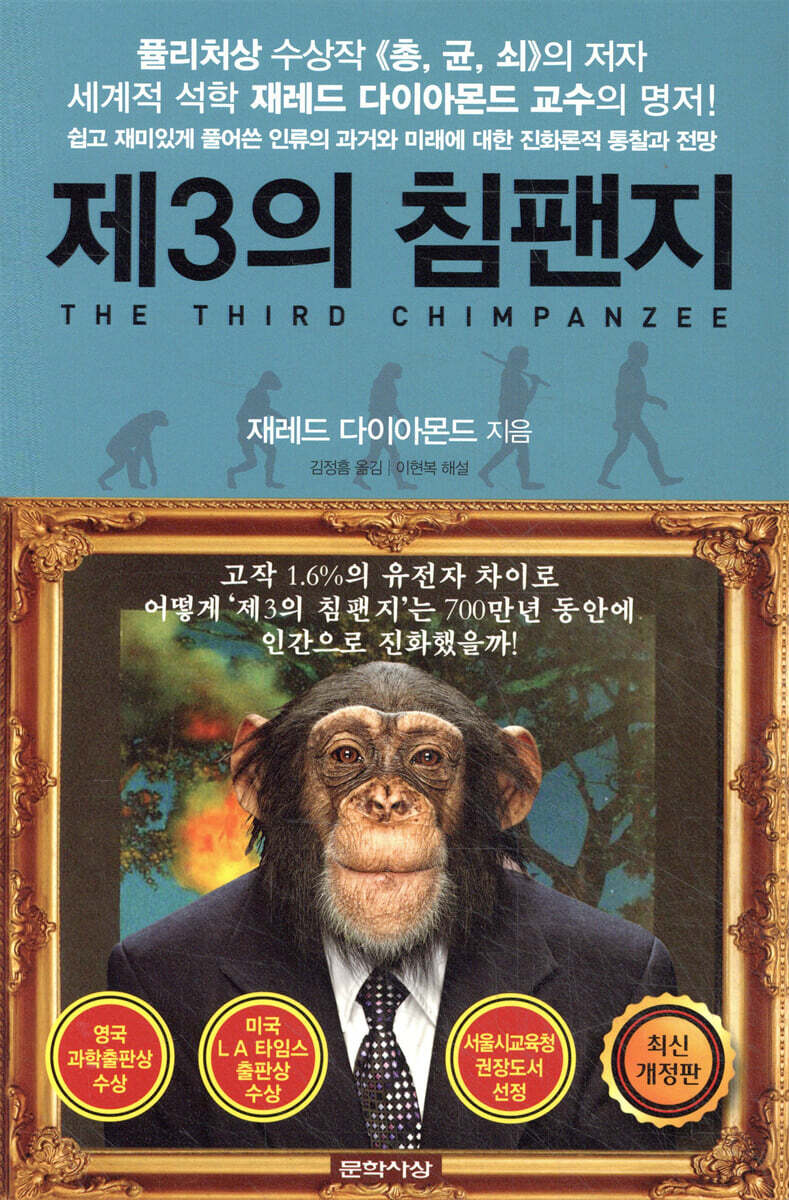
The Third Chimpanzee
 |
Description
Book Introduction
The process of human nature and the development of civilization
A Clearly Unraveled Report on Human Evolution
The new edition of "The Third Chimpanzee," which clearly and entertainingly explains the history of human evolution, starting from the "genetic difference between humans and chimpanzees of only 1.6%," was published in October 2015.
This book is a revised and published version of the first edition published in 1996 to suit the 21st century. The terms have been organized to conform to the notation, spacing, and foreign language notation rules of the current Standard Korean Dictionary of 2013, and the tables and figures have been reworked to give it a more sophisticated design.
In this masterpiece, which can be considered a classic in evolutionary anthropology, world-renowned scholar Jared Diamond offers a cool-headed and sharp insight into the history of human evolution.
Starting from the biological approach that the genetic difference between humans and chimpanzees is only 1.6%, the book covers evolution, geography, botany, zoology, archaeology, and history from the birth of humanity to the present and future, with witty explanations and various examples that make the story fun and easy for anyone to read.
A Clearly Unraveled Report on Human Evolution
The new edition of "The Third Chimpanzee," which clearly and entertainingly explains the history of human evolution, starting from the "genetic difference between humans and chimpanzees of only 1.6%," was published in October 2015.
This book is a revised and published version of the first edition published in 1996 to suit the 21st century. The terms have been organized to conform to the notation, spacing, and foreign language notation rules of the current Standard Korean Dictionary of 2013, and the tables and figures have been reworked to give it a more sophisticated design.
In this masterpiece, which can be considered a classic in evolutionary anthropology, world-renowned scholar Jared Diamond offers a cool-headed and sharp insight into the history of human evolution.
Starting from the biological approach that the genetic difference between humans and chimpanzees is only 1.6%, the book covers evolution, geography, botany, zoology, archaeology, and history from the birth of humanity to the present and future, with witty explanations and various examples that make the story fun and easy for anyone to read.
- You can preview some of the book's contents.
Preview
index
A letter to our Korean readers:
Humanity faces a serious existential crisis.
prolog:
Will the prophecy that humanity is coming to an end come true?
Part 1: Humans are a species of large mammal
Chapter 1: The Story of Three Kinds of Chimpanzees
Chapter 2 The Great Leap Forward
Part 2: Animals with Curious Life Cycles
Chapter 3: The Evolution of Human Sexual Behavior
Chapter 4: The Science of Extramarital Sex
Chapter 5 How to Find a Sex Partner
Chapter 6: Sexual Selection and the Origin of Race
Chapter 7 Why do we grow old and die?
Part 3: Human Specialness
Chapter 8: A Bridge to Human Language
Chapter 9: The Origins of Art
Chapter 10: Is Agriculture a Blessing for Humanity?
Chapter 11 Why do people smoke, drink, and use drugs?
Chapter 12: A Lonely Man in the Vast Universe
Part 4: Conqueror of the World
Chapter 13: The Final First Encounter
Chapter 14: The Humans Who Accidentally Became Conquerors
Chapter 15: Horses, Hittite, and History
Chapter 16: The Tendency of Genocide
Part 5: The sudden reversal of progress
Chapter 17: The Illusion of the Golden Age
Chapter 18: Blitzkrieg and Thanksgiving in the New World
Chapter 19: The Second Cloud
Epilogue:
Will we forget everything without learning any lessons?
Recommendation: A masterpiece of scientific writing - Edward O.
Wilson
Commentary: "The Third Chimpanzee," Who Became Human by a 1.6 Percent Difference - Lee Hyun-bok
Translator's Note: A delightful and accessible account of human history, written like a novel - Kim Jeong-heum
References
Search
Humanity faces a serious existential crisis.
prolog:
Will the prophecy that humanity is coming to an end come true?
Part 1: Humans are a species of large mammal
Chapter 1: The Story of Three Kinds of Chimpanzees
Chapter 2 The Great Leap Forward
Part 2: Animals with Curious Life Cycles
Chapter 3: The Evolution of Human Sexual Behavior
Chapter 4: The Science of Extramarital Sex
Chapter 5 How to Find a Sex Partner
Chapter 6: Sexual Selection and the Origin of Race
Chapter 7 Why do we grow old and die?
Part 3: Human Specialness
Chapter 8: A Bridge to Human Language
Chapter 9: The Origins of Art
Chapter 10: Is Agriculture a Blessing for Humanity?
Chapter 11 Why do people smoke, drink, and use drugs?
Chapter 12: A Lonely Man in the Vast Universe
Part 4: Conqueror of the World
Chapter 13: The Final First Encounter
Chapter 14: The Humans Who Accidentally Became Conquerors
Chapter 15: Horses, Hittite, and History
Chapter 16: The Tendency of Genocide
Part 5: The sudden reversal of progress
Chapter 17: The Illusion of the Golden Age
Chapter 18: Blitzkrieg and Thanksgiving in the New World
Chapter 19: The Second Cloud
Epilogue:
Will we forget everything without learning any lessons?
Recommendation: A masterpiece of scientific writing - Edward O.
Wilson
Commentary: "The Third Chimpanzee," Who Became Human by a 1.6 Percent Difference - Lee Hyun-bok
Translator's Note: A delightful and accessible account of human history, written like a novel - Kim Jeong-heum
References
Search
Into the book
How can we estimate the genetic distance between humans and chimpanzees? This problem has been solved by molecular biologists.
The answer is not only intellectually interesting, but has practical and ethical implications for how we treat chimpanzees as creatures.
That is, while the genetic differences between humans and chimpanzees may be large compared to the differences between dog breeds, they are much smaller than the differences between other similar species.
Certainly, a change of just a few percent in the chimpanzee's genetic program has had a profound impact on our human behavior.
Molecular biologists have roughly figured out when humans and chimpanzees diverged from their common ancestor.
That period is estimated to be approximately 7 million years ago.
--- p.33
To discuss the unique human life cycle, we must first discuss our characteristic social structure, sexual anatomy, physiology, and behavior.
As I explained earlier, what makes us so strange and peculiar among animals is our seemingly monogamous society, our reproductive structures, and our ability to have sex whenever and wherever it is not visible.
The characteristics of human sexuality are well reflected not only in the genitals, but also in the relative body sizes of men and women.
--- p.105
In fact, there are countless signs of language in the animal kingdom.
The vocal communication system has evolved in numerous species.
We are only just beginning to understand the complexity of these systems.
If these are the first steps, the second step is the recent experiments that have revealed the innate language ability of apes by teaching them language.
The next step is for children to learn to speak.
We will also discover that among the simple languages that modern people have unconsciously invented, there are some that are surprisingly educational.
--- p.216
Thanks to science, humans have undergone many changes.
As astronomy developed, it became known that the Earth was not the center of the universe, but rather just one of nine planets orbiting one of billions of stars.
Advances in biology also taught us that humans were not specially created by God, but evolved alongside millions of other species.
Meanwhile, as archaeology advances, another sacred belief is crumbling: that humanity has been steadily progressing for the past million years.
Recent discoveries have shown that agriculture (including livestock farming), which could be considered a crucial stepping stone to a better life, is actually both a monument to progress and the origin of evil.
The advent of agriculture increased food production and made food accumulation possible, but it also created great social and sexual inequality and became the starting point for many of the evils that plague modern humanity, such as disease and dictatorship.
The answer is not only intellectually interesting, but has practical and ethical implications for how we treat chimpanzees as creatures.
That is, while the genetic differences between humans and chimpanzees may be large compared to the differences between dog breeds, they are much smaller than the differences between other similar species.
Certainly, a change of just a few percent in the chimpanzee's genetic program has had a profound impact on our human behavior.
Molecular biologists have roughly figured out when humans and chimpanzees diverged from their common ancestor.
That period is estimated to be approximately 7 million years ago.
--- p.33
To discuss the unique human life cycle, we must first discuss our characteristic social structure, sexual anatomy, physiology, and behavior.
As I explained earlier, what makes us so strange and peculiar among animals is our seemingly monogamous society, our reproductive structures, and our ability to have sex whenever and wherever it is not visible.
The characteristics of human sexuality are well reflected not only in the genitals, but also in the relative body sizes of men and women.
--- p.105
In fact, there are countless signs of language in the animal kingdom.
The vocal communication system has evolved in numerous species.
We are only just beginning to understand the complexity of these systems.
If these are the first steps, the second step is the recent experiments that have revealed the innate language ability of apes by teaching them language.
The next step is for children to learn to speak.
We will also discover that among the simple languages that modern people have unconsciously invented, there are some that are surprisingly educational.
--- p.216
Thanks to science, humans have undergone many changes.
As astronomy developed, it became known that the Earth was not the center of the universe, but rather just one of nine planets orbiting one of billions of stars.
Advances in biology also taught us that humans were not specially created by God, but evolved alongside millions of other species.
Meanwhile, as archaeology advances, another sacred belief is crumbling: that humanity has been steadily progressing for the past million years.
Recent discoveries have shown that agriculture (including livestock farming), which could be considered a crucial stepping stone to a better life, is actually both a monument to progress and the origin of evil.
The advent of agriculture increased food production and made food accumulation possible, but it also created great social and sexual inequality and became the starting point for many of the evils that plague modern humanity, such as disease and dictatorship.
--- pp.276-277
Publisher's Review
The biological foundation on which human culture flourishes
We use DNA analysis to find out why humans separated from chimpanzees and developed into a unique species called humanity.
Human genetic makeup is 98.4% identical to that of bonobos and other African chimpanzees, with a difference of only 1.6%.
We will intensively analyze and resolve the question of how this small difference has enabled humanity to make such remarkable progress, using archaeological and biological evidence.
Next, we will cover the changes in human life that had a great influence on the development of language and art, along with changes in the skeleton.
This book presents the uniquely bizarre human life history, seen through the eyes of the first and second chimpanzees, in relation to the progress of humanity, including joint childcare between men and women, marriage customs, the purpose of sexual intercourse, human-only ethical laws that violate evolutionary competition, and the meaning of aging and menopause in women.
Cultural characteristics that distinguish humans from animals
Language, art, and agriculture are the proud characteristics that distinguish humans from animals.
So, do other animals lack language or artistic abilities? How did art arise? The advent of agriculture, another crucial human characteristic, was a groundbreaking event for humanity.
However, the author argues that agriculture was both a monumental event of progress and the beginning of evil.
In addition to the proud traits presented above, one of the widely known human traits is being addicted to harmful chemicals such as drinking and smoking.
Why do people resort to harmful drugs? The author introduces Zahavi's handicap theory, which argues that smoking, drinking, and using drugs are all display behaviors intended to demonstrate strength and superiority.
On the one hand, it expresses concern about the dark side of humans, which shortens lifespans through chemical abuse and leads to self-destructive behavior beyond self-promotion.
Threats to humanity's survival
The author looks back on the history of human evolution and the development of civilization and constantly warns of a dark future that could come to humanity.
Here, environmental destruction, mass genocide, and nuclear threats are presented as threats to human survival.
With the advent of agriculture and the beginning of human settlement, the original diversity of the ecosystem was standardized and destroyed to suit human tastes.
Additionally, as migrations began to seek better environments and wider lands for settlement, indigenous species that had been isolated until then were slaughtered.
This behavior is not unique to humans, but it is more systematic and cruel than in animals.
In addition to this, humanity stands on the brink of destruction due to a trait unique to humans, in addition to the cruelty that even animals can have.
It's nuclear.
Despite the fact that the world realized the power and threat of nuclear weapons after the Nagasaki bombing, which signaled the end of the Pacific War, people cling to the existence of nuclear weapons.
So, is the future ultimately bleak? This book, through a sober analysis of human history, argues that humanity can prevent repeating past mistakes and move toward a better future.
Recommendation
In many ways, humans are just another species of primate, sharing more than 98% of our genes with chimpanzees.
In this fascinating and compelling book, Jared Diamond offers a clever answer to the question of how less than 2% of our genes make us different.
The Third Chimpanzee is a rich, informative, and valuable book that will provide readers with an opportunity to reflect on humanity's past and look forward to its future.
- Edward O.
Wilson (Professor Emeritus of Biology, Harvard University)
The Third Chimpanzee shows human violence.
Therefore, the author emphasizes that what humans need is to reflect on the destructive acts committed by mankind in the past.
The very act of reading a book using language means understanding science and the environment, and the possibility of correcting past mistakes.
I would like to recommend this book widely as it is an interesting and educational book that should be read by both young students and intellectuals.
-Lee Hyeon-bok (Professor Emeritus, Department of Linguistics, Seoul National University)
We use DNA analysis to find out why humans separated from chimpanzees and developed into a unique species called humanity.
Human genetic makeup is 98.4% identical to that of bonobos and other African chimpanzees, with a difference of only 1.6%.
We will intensively analyze and resolve the question of how this small difference has enabled humanity to make such remarkable progress, using archaeological and biological evidence.
Next, we will cover the changes in human life that had a great influence on the development of language and art, along with changes in the skeleton.
This book presents the uniquely bizarre human life history, seen through the eyes of the first and second chimpanzees, in relation to the progress of humanity, including joint childcare between men and women, marriage customs, the purpose of sexual intercourse, human-only ethical laws that violate evolutionary competition, and the meaning of aging and menopause in women.
Cultural characteristics that distinguish humans from animals
Language, art, and agriculture are the proud characteristics that distinguish humans from animals.
So, do other animals lack language or artistic abilities? How did art arise? The advent of agriculture, another crucial human characteristic, was a groundbreaking event for humanity.
However, the author argues that agriculture was both a monumental event of progress and the beginning of evil.
In addition to the proud traits presented above, one of the widely known human traits is being addicted to harmful chemicals such as drinking and smoking.
Why do people resort to harmful drugs? The author introduces Zahavi's handicap theory, which argues that smoking, drinking, and using drugs are all display behaviors intended to demonstrate strength and superiority.
On the one hand, it expresses concern about the dark side of humans, which shortens lifespans through chemical abuse and leads to self-destructive behavior beyond self-promotion.
Threats to humanity's survival
The author looks back on the history of human evolution and the development of civilization and constantly warns of a dark future that could come to humanity.
Here, environmental destruction, mass genocide, and nuclear threats are presented as threats to human survival.
With the advent of agriculture and the beginning of human settlement, the original diversity of the ecosystem was standardized and destroyed to suit human tastes.
Additionally, as migrations began to seek better environments and wider lands for settlement, indigenous species that had been isolated until then were slaughtered.
This behavior is not unique to humans, but it is more systematic and cruel than in animals.
In addition to this, humanity stands on the brink of destruction due to a trait unique to humans, in addition to the cruelty that even animals can have.
It's nuclear.
Despite the fact that the world realized the power and threat of nuclear weapons after the Nagasaki bombing, which signaled the end of the Pacific War, people cling to the existence of nuclear weapons.
So, is the future ultimately bleak? This book, through a sober analysis of human history, argues that humanity can prevent repeating past mistakes and move toward a better future.
Recommendation
In many ways, humans are just another species of primate, sharing more than 98% of our genes with chimpanzees.
In this fascinating and compelling book, Jared Diamond offers a clever answer to the question of how less than 2% of our genes make us different.
The Third Chimpanzee is a rich, informative, and valuable book that will provide readers with an opportunity to reflect on humanity's past and look forward to its future.
- Edward O.
Wilson (Professor Emeritus of Biology, Harvard University)
The Third Chimpanzee shows human violence.
Therefore, the author emphasizes that what humans need is to reflect on the destructive acts committed by mankind in the past.
The very act of reading a book using language means understanding science and the environment, and the possibility of correcting past mistakes.
I would like to recommend this book widely as it is an interesting and educational book that should be read by both young students and intellectuals.
-Lee Hyeon-bok (Professor Emeritus, Department of Linguistics, Seoul National University)
GOODS SPECIFICS
- Date of publication: October 23, 2015
- Format: Hardcover book binding method guide
- Page count, weight, size: 608 pages | 919g | 150*230*35mm
- ISBN13: 9788970129341
- ISBN10: 8970129340
You may also like
카테고리
korean


korean

![GQ KOREA Mark (Monthly): December [2025]](http://librairie.coreenne.fr/cdn/shop/files/8ef265dbbfbf186523ed75ba7319009d.jpg?v=1765340328&width=3840)


