

Reading the periodic table in comics
 |
Description
Book Introduction
"Reading the Periodic Table in Comics" is a popular chemistry book that tightly combines text and comics.
As you turn the pages, lost in the cute illustrations, you will find yourself happily going through the periodic table as elements whose names you didn't even know well enter your head.
Useful information and colorful stories about the 118 elements that were not covered in textbooks are pouring out.
From hydrogen, the lightest element created first in the Big Bang, to zirconium, an element that sparkles like a diamond, to lead, the element suspected of being the cause of Nero's tyranny and Beethoven's hearing loss, to cesium and radium, deadly radioactive elements that raise awareness about nuclear power, and einsteinium and fermium, twin elements separated from the "ashes of death" during the world's first hydrogen bomb test, we highlight every single element in the world.
This book is for teenagers who struggle with the periodic table of elements and for those who desperately need information on chemistry starting from the elements.
As you turn the pages, lost in the cute illustrations, you will find yourself happily going through the periodic table as elements whose names you didn't even know well enter your head.
Useful information and colorful stories about the 118 elements that were not covered in textbooks are pouring out.
From hydrogen, the lightest element created first in the Big Bang, to zirconium, an element that sparkles like a diamond, to lead, the element suspected of being the cause of Nero's tyranny and Beethoven's hearing loss, to cesium and radium, deadly radioactive elements that raise awareness about nuclear power, and einsteinium and fermium, twin elements separated from the "ashes of death" during the world's first hydrogen bomb test, we highlight every single element in the world.
This book is for teenagers who struggle with the periodic table of elements and for those who desperately need information on chemistry starting from the elements.
- You can preview some of the book's contents.
Preview
index
Reviewer's Note
To begin with
Chapter 1: Properties of Elements
1.
Atomic structure
2.
Atomic number Z and mass number A
3.
nuclear reactions
4.
Nuclear decay and radiation
5.
Nuclear decay and half-life
6.
Other indicators
Chapter 2 Understanding Elements 1-100 through Comics
Hydrogen / Helium / Lithium / Beryllium / Boron / Carbon / Nitrogen / Oxygen / Fluorine / Neon / Sodium / Magnesium / Aluminum / Silicon / Phosphorus / Sulfur / Chlorine / Argon / Potassium / Calcium / Scandium / Titanium / Vanadium / Chromium / Manganese / Iron / Cobalt / Nickel / Copper / Zinc / Gallium / Germanium / Arsenic / Selenium / Bromine / Krypton / Rubidium / Strontium / Yttrium / Zirconium / Niobium / Molybdenum / Technetium / Ruthenium / Rhodium / Palladium / Silver / Cadmium / Indium / Tin / Antimony / Tellurium / Iodine / Xenon / Cesium / Barium / Lanthanum / Cerium / Praseodymium / Neodymium / Promethium / Samarium / Europium / Gadolinium / Terbium / Dysprosium / Holmium / Erbium / Thulium / Ytterbium / Lutetium / Hafnium / Tantalum / Tungsten / Rhenium / Osmium / Iridium / Platinum / Gold / Mercury / Thallium / Lead / Bismuth / Polonium / Astatine / Radon / Francium / Radium / Actinium / Thorium / Protactinium / Uranium / Neptunium / Plutonium / Americium / Curium / Berkelium / Californium / Einsteinium / Fermium
Chapter 3: Elements 101-112
Mendelevium / Nobelium / Lawrencium / Rutherfordium / Dubnium / Siborium / Bohrium / Hassium / Meitnerium / Darmstadtium / Roentgenium / Copernicium
Chapter 4: Nameless Elements 113–118
Ununtrium / Ununquadium (Flerovium) / Ununpentium / Ununhexium (Livermorium) / Ununseptium / Ununoctium
References
Search
To begin with
Chapter 1: Properties of Elements
1.
Atomic structure
2.
Atomic number Z and mass number A
3.
nuclear reactions
4.
Nuclear decay and radiation
5.
Nuclear decay and half-life
6.
Other indicators
Chapter 2 Understanding Elements 1-100 through Comics
Hydrogen / Helium / Lithium / Beryllium / Boron / Carbon / Nitrogen / Oxygen / Fluorine / Neon / Sodium / Magnesium / Aluminum / Silicon / Phosphorus / Sulfur / Chlorine / Argon / Potassium / Calcium / Scandium / Titanium / Vanadium / Chromium / Manganese / Iron / Cobalt / Nickel / Copper / Zinc / Gallium / Germanium / Arsenic / Selenium / Bromine / Krypton / Rubidium / Strontium / Yttrium / Zirconium / Niobium / Molybdenum / Technetium / Ruthenium / Rhodium / Palladium / Silver / Cadmium / Indium / Tin / Antimony / Tellurium / Iodine / Xenon / Cesium / Barium / Lanthanum / Cerium / Praseodymium / Neodymium / Promethium / Samarium / Europium / Gadolinium / Terbium / Dysprosium / Holmium / Erbium / Thulium / Ytterbium / Lutetium / Hafnium / Tantalum / Tungsten / Rhenium / Osmium / Iridium / Platinum / Gold / Mercury / Thallium / Lead / Bismuth / Polonium / Astatine / Radon / Francium / Radium / Actinium / Thorium / Protactinium / Uranium / Neptunium / Plutonium / Americium / Curium / Berkelium / Californium / Einsteinium / Fermium
Chapter 3: Elements 101-112
Mendelevium / Nobelium / Lawrencium / Rutherfordium / Dubnium / Siborium / Bohrium / Hassium / Meitnerium / Darmstadtium / Roentgenium / Copernicium
Chapter 4: Nameless Elements 113–118
Ununtrium / Ununquadium (Flerovium) / Ununpentium / Ununhexium (Livermorium) / Ununseptium / Ununoctium
References
Search
Detailed image
Publisher's Review
Don't just memorize the troublesome periodic table; enjoy it in comic form!
“I think ‘Reading the Periodic Table in Comics’ is the perfect introductory book to chemistry that is easy to read, as it unfolds the hidden stories behind the characteristics and discoveries of various elements in the periodic table in the form of comics.
“For those who have lost interest in chemistry due to unfamiliar element symbols, I recommend this book to help them shake off their fear of chemistry and rediscover the mystery and excitement of chemical changes.”
-Jang Woo-dong, Professor of Chemistry at Yonsei University
Is there a way to study the periodic table easily and enjoyably? "The Periodic Table in Comics" is a popular chemistry book that combines informative text with lively comics.
The comic vividly presents the profiles and background stories of the people who discovered elements from atomic number 1 to 100, their applications, products, rarity, and history.
The periodic table, which arranges elements with similar properties such as their characteristics, reactivity, and atomic weight in a repetitive and regular manner, is the history of the development of chemistry and the basic principles of chemistry that allow us to understand and predict changes in all things.
Although the periodic table is fundamentally important, for students facing exams, it is not something to understand, but rather a painful thing to memorize.
This book will serve as a periodic table guide that will help those who absolutely must memorize the periodic table enjoy it.
Breathing life into every element
The world's most useful chemistry book
Not only can you feel the lingering joy of the cute illustrations that keep you turning the pages, but even just reading the comics can help you learn.
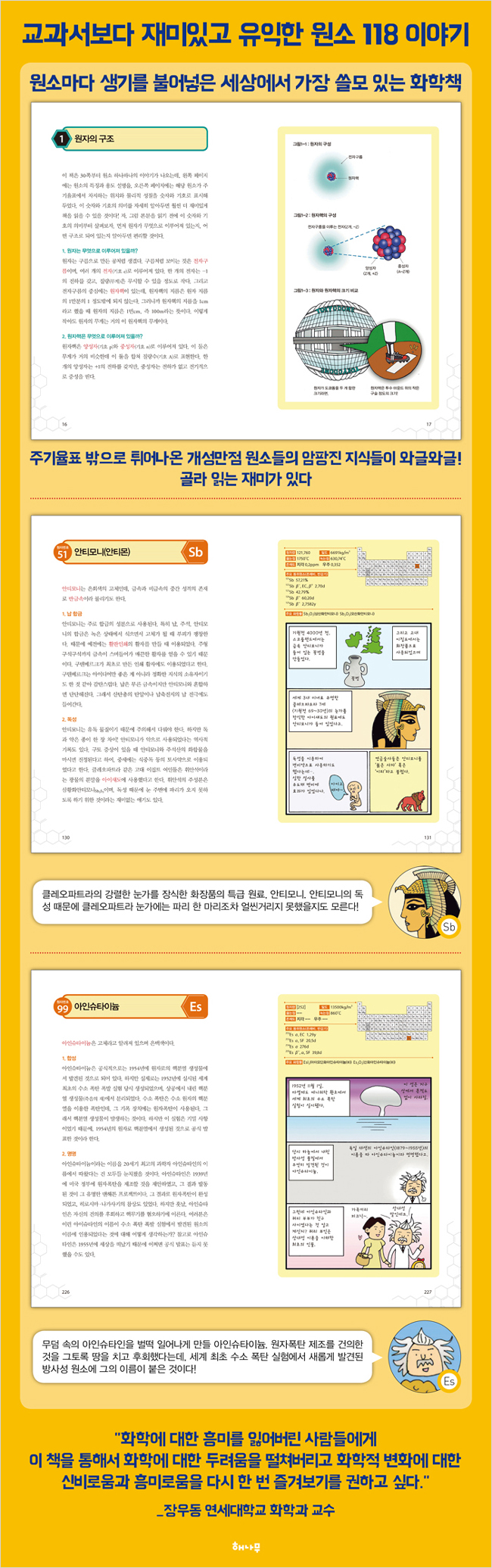
In particular, this book is structured so that each element is presented in two pages at a time, increasing immersion in the content and preventing boredom.
The left page explains, in a concise and clear style, how elements exist in nature based on their chemical properties, what roles they play, how they affect us, and how they are used in our daily lives and modern science.
The right page identifies the element's position on the periodic table, provides precise numerical values for physical parameters such as atomic weight, density, boiling point, melting point, and isotopic abundance, and concludes with a colorful cartoon covering the history of science.
It contains the latest information on artificially synthesized and discovered elements from 101 to 118.
Furthermore, to help readers understand, difficult technical terms are explained in footnotes, and an index centered on element names and compound names is provided for readers' convenience.
This is a truly useful chemistry book, full of useful information about 118 elements that textbooks don't cover, and it will be a valuable resource to keep by your side for years to come.
A flurry of fungal knowledge about unique elements that popped out of the periodic table!
It's fun to choose and read
Shelley, who unfairly lost the title of 'discoverer of oxygen'.
Fortunately, he earns the title of 'Goat Discoverer', but dies young. What is his deadly habit?
If Scheele was the unfortunate son of chemistry, Abelson was the fortunate son of chemistry.
He happened to help Macmillan with his work for just three days while on vacation, but he ended up discovering neptunium, the first transuranium element!
Phosphorus is a two-faced element that is directly related to life as it is a major component of DNA and ATP, but is also essential for the development of lethal weapons.
Zinc, the world's kindest element, sacrificially rusts in place of iron, promotes cell division, and allows us to enjoy the happiness that comes from delicious food.
Antimony, a special ingredient in cosmetics that adorned Cleopatra's intense eyes.
Because of the toxicity of antimony, not even a single fly might have been able to get close to Cleopatra's eyes!
Einsteinium, which would make Einstein rise from his grave.
He is said to have regretted so much for suggesting the creation of the atomic bomb, yet the newly discovered radioactive element from the world's first hydrogen bomb test is named after him!
"Reading the Periodic Table in Comics" doesn't attempt to cram the entire periodic table into your head, but rather starts with an understanding of individual elements and then unfolds essential information and useful chemistry stories.
By pulling out the elements locked in square cells one by one, we delve into the fascinating history of science and cutting-edge applications, highlighting each element.
As you accumulate knowledge about each element, you will gain wisdom that spans the entire periodic table.
“I think ‘Reading the Periodic Table in Comics’ is the perfect introductory book to chemistry that is easy to read, as it unfolds the hidden stories behind the characteristics and discoveries of various elements in the periodic table in the form of comics.
“For those who have lost interest in chemistry due to unfamiliar element symbols, I recommend this book to help them shake off their fear of chemistry and rediscover the mystery and excitement of chemical changes.”
-Jang Woo-dong, Professor of Chemistry at Yonsei University
Is there a way to study the periodic table easily and enjoyably? "The Periodic Table in Comics" is a popular chemistry book that combines informative text with lively comics.
The comic vividly presents the profiles and background stories of the people who discovered elements from atomic number 1 to 100, their applications, products, rarity, and history.
The periodic table, which arranges elements with similar properties such as their characteristics, reactivity, and atomic weight in a repetitive and regular manner, is the history of the development of chemistry and the basic principles of chemistry that allow us to understand and predict changes in all things.
Although the periodic table is fundamentally important, for students facing exams, it is not something to understand, but rather a painful thing to memorize.
This book will serve as a periodic table guide that will help those who absolutely must memorize the periodic table enjoy it.
Breathing life into every element
The world's most useful chemistry book
Not only can you feel the lingering joy of the cute illustrations that keep you turning the pages, but even just reading the comics can help you learn.
In particular, this book is structured so that each element is presented in two pages at a time, increasing immersion in the content and preventing boredom.
The left page explains, in a concise and clear style, how elements exist in nature based on their chemical properties, what roles they play, how they affect us, and how they are used in our daily lives and modern science.
The right page identifies the element's position on the periodic table, provides precise numerical values for physical parameters such as atomic weight, density, boiling point, melting point, and isotopic abundance, and concludes with a colorful cartoon covering the history of science.
It contains the latest information on artificially synthesized and discovered elements from 101 to 118.
Furthermore, to help readers understand, difficult technical terms are explained in footnotes, and an index centered on element names and compound names is provided for readers' convenience.
This is a truly useful chemistry book, full of useful information about 118 elements that textbooks don't cover, and it will be a valuable resource to keep by your side for years to come.
A flurry of fungal knowledge about unique elements that popped out of the periodic table!
It's fun to choose and read
Shelley, who unfairly lost the title of 'discoverer of oxygen'.
Fortunately, he earns the title of 'Goat Discoverer', but dies young. What is his deadly habit?
If Scheele was the unfortunate son of chemistry, Abelson was the fortunate son of chemistry.
He happened to help Macmillan with his work for just three days while on vacation, but he ended up discovering neptunium, the first transuranium element!
Phosphorus is a two-faced element that is directly related to life as it is a major component of DNA and ATP, but is also essential for the development of lethal weapons.
Zinc, the world's kindest element, sacrificially rusts in place of iron, promotes cell division, and allows us to enjoy the happiness that comes from delicious food.
Antimony, a special ingredient in cosmetics that adorned Cleopatra's intense eyes.
Because of the toxicity of antimony, not even a single fly might have been able to get close to Cleopatra's eyes!
Einsteinium, which would make Einstein rise from his grave.
He is said to have regretted so much for suggesting the creation of the atomic bomb, yet the newly discovered radioactive element from the world's first hydrogen bomb test is named after him!
"Reading the Periodic Table in Comics" doesn't attempt to cram the entire periodic table into your head, but rather starts with an understanding of individual elements and then unfolds essential information and useful chemistry stories.
By pulling out the elements locked in square cells one by one, we delve into the fascinating history of science and cutting-edge applications, highlighting each element.
As you accumulate knowledge about each element, you will gain wisdom that spans the entire periodic table.
GOODS SPECIFICS
- Date of issue: August 11, 2014
- Page count, weight, size: 259 pages | 426g | 140*220*15mm
- ISBN13: 9788956057576
- ISBN10: 8956057575
You may also like
카테고리
korean


korean

![GQ KOREA Mark (Monthly): December [2025]](http://librairie.coreenne.fr/cdn/shop/files/8ef265dbbfbf186523ed75ba7319009d.jpg?v=1765340328&width=3840)


