

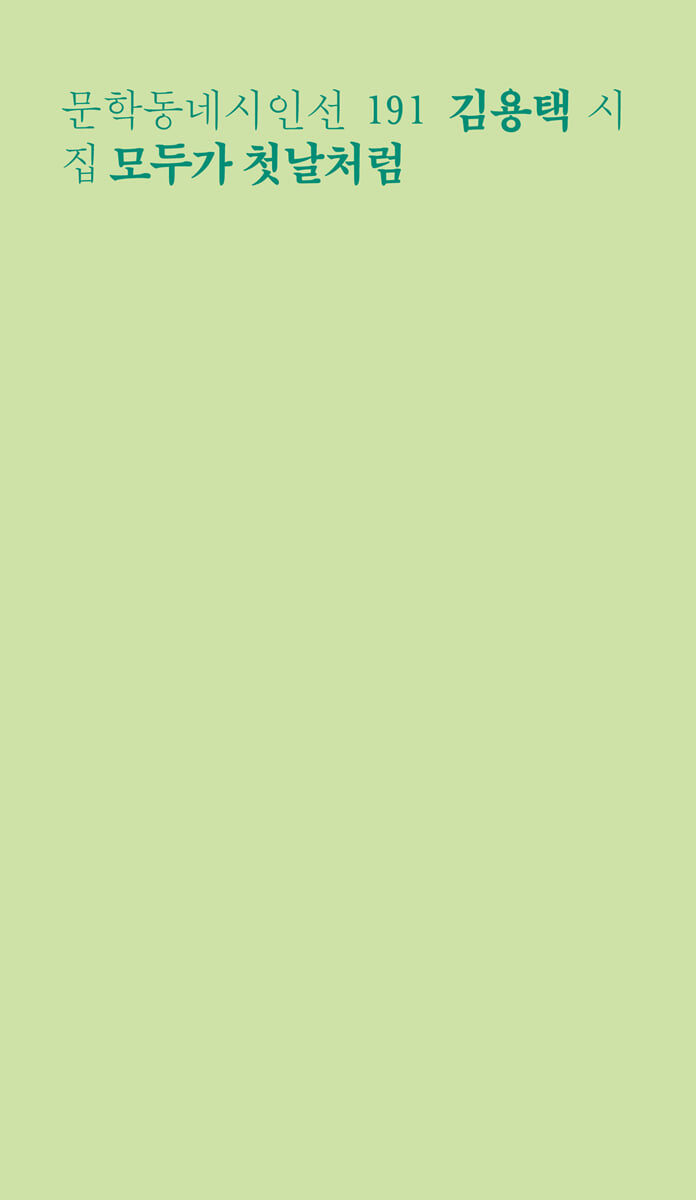
Everyone is like the first day
 |
Description
Book Introduction
Poet Yongtaek Kim has long been a gentle touch to readers' lives, capturing the beauty of nature and the universal aspects of life within it with restrained language and lyrical perception.
His fourteenth poetry collection, “Everyone Like the First Day,” was published as the 191st poetry collection in the Munhakdongne Poetry Collection.
Since his first poetry collection, 『Seomjin River』, which is evaluated as a monumental achievement of Korean literature, he has been known as the ‘Seomjin River Poet’ and has been a representative name of Korean lyric poetry for 41 years. His not-so-short poetry career is densely filled with lists that allow a glimpse into his life as a person who ‘writes’ poetry, ‘lives’ and ‘makes known’ poetry, such as 14 volumes of poetry collections, as well as children’s collections such as 『You Knew I Would Do That』 and 『Bean, You Are Dead』, the 8-volume prose collection 『Poetry Came to Me』, which lowers the genre threshold of poetry by including sharp poetry reviews, and the handwritten poetry collection 『Maybe the Stars Will Take Your Sorrow Away』.
In this poetry collection, published two years after 『The Young Tree Where the Butterfly Hides』, you can encounter a deeper insight into the life and knowledge of the poet, who is well over 70 years old.
The 55 Psalms, which sometimes sound like soliloquies, sometimes like letters, and sometimes like prayers, teach us that becoming deeper is not so far from becoming truthful, simple, and free.
His fourteenth poetry collection, “Everyone Like the First Day,” was published as the 191st poetry collection in the Munhakdongne Poetry Collection.
Since his first poetry collection, 『Seomjin River』, which is evaluated as a monumental achievement of Korean literature, he has been known as the ‘Seomjin River Poet’ and has been a representative name of Korean lyric poetry for 41 years. His not-so-short poetry career is densely filled with lists that allow a glimpse into his life as a person who ‘writes’ poetry, ‘lives’ and ‘makes known’ poetry, such as 14 volumes of poetry collections, as well as children’s collections such as 『You Knew I Would Do That』 and 『Bean, You Are Dead』, the 8-volume prose collection 『Poetry Came to Me』, which lowers the genre threshold of poetry by including sharp poetry reviews, and the handwritten poetry collection 『Maybe the Stars Will Take Your Sorrow Away』.
In this poetry collection, published two years after 『The Young Tree Where the Butterfly Hides』, you can encounter a deeper insight into the life and knowledge of the poet, who is well over 70 years old.
The 55 Psalms, which sometimes sound like soliloquies, sometimes like letters, and sometimes like prayers, teach us that becoming deeper is not so far from becoming truthful, simple, and free.
- You can preview some of the book's contents.
Preview
index
Poet's words
Part 1: Birds Don't Fly to Broken Branches
Until my back gets warm/ A love letter written because I thought it was worth writing/ To the tree/ Wild cherry blossoms/ It rained in the afternoon/ A happy farmer's song/ It's like a certain thought/ Picking and eating apricots/ The flowers are looking at me/ Walking with my heart/ Your star will get hurt/ The current temperature/ The poet's house/ Our house/ My face/ A thought that went a little further/ No, I can't say that a butterfly sleeps/ An unknown face/ Winter has come
Part 2 My daughter reads the poems I read at night in the morning.
I couldn't say it was autumn, so I came to winter / Poetry of birds / Where moss lives / Moments of life / I know the expressions of stars that can explain beauty with sadness / Greetings in the morning / A person from autumn / A cheerful table / Send me a smile so I can fly / Saying so / Everyone takes a step forward while smiling like the first day / If not now, when will we love this world we live in again / Yellow wings of memory / Kant's background / Umbrella / Hitting with a sparrow's head / The path the moon walks
Part 3: I hate poetry, it's beautiful
Spring rain/ This heart/ Our flower garden/ Poet/ Poetry collection/ Beautiful balance/ Independent freedom/ Sad history/ Playing with butterflies/ Until the inner wings dry/ Where shall I build my beloved home/ The result of justice/ It is a beautiful change/ Walking beside them/ There is no day like today/ That side of my morning/ Walking with the moon/ Never again, never again
Preface│Na─Capturing the Natural Law of Non-Non-Non_Oh Eun (Poet)
Part 1: Birds Don't Fly to Broken Branches
Until my back gets warm/ A love letter written because I thought it was worth writing/ To the tree/ Wild cherry blossoms/ It rained in the afternoon/ A happy farmer's song/ It's like a certain thought/ Picking and eating apricots/ The flowers are looking at me/ Walking with my heart/ Your star will get hurt/ The current temperature/ The poet's house/ Our house/ My face/ A thought that went a little further/ No, I can't say that a butterfly sleeps/ An unknown face/ Winter has come
Part 2 My daughter reads the poems I read at night in the morning.
I couldn't say it was autumn, so I came to winter / Poetry of birds / Where moss lives / Moments of life / I know the expressions of stars that can explain beauty with sadness / Greetings in the morning / A person from autumn / A cheerful table / Send me a smile so I can fly / Saying so / Everyone takes a step forward while smiling like the first day / If not now, when will we love this world we live in again / Yellow wings of memory / Kant's background / Umbrella / Hitting with a sparrow's head / The path the moon walks
Part 3: I hate poetry, it's beautiful
Spring rain/ This heart/ Our flower garden/ Poet/ Poetry collection/ Beautiful balance/ Independent freedom/ Sad history/ Playing with butterflies/ Until the inner wings dry/ Where shall I build my beloved home/ The result of justice/ It is a beautiful change/ Walking beside them/ There is no day like today/ That side of my morning/ Walking with the moon/ Never again, never again
Preface│Na─Capturing the Natural Law of Non-Non-Non_Oh Eun (Poet)
Into the book
Until your back is warm
Sitting by the river
come
I feel like I left something behind
Across the river there
once
I looked across
---From "Until Your Back Gets Warm"
Tree
Spring is coming
I look up at you
I am seventy-six years old.
Now that I think about it
I am small and ugly
And by the way
He had a bad temper
Tree
But I am the one
What should I do?
---From "To the Tree"
Wild strawberry blossoms, wild cherry blossoms, wild cherry blossoms, wild peach blossoms, the wild violets that bloomed yesterday,
White thorns will bloom soon
They don't determine my life in spring, though
Among them, the cherry blossoms with morning dew on them
That adorable concentration
It's worth changing me
Now
---From "Mountain Cherry Blossoms"
I have been teaching children for a long time.
I failed to live up to my teachings
As children grew up, they did not live as they had been taught.
I was struggling with learning and teaching.
---From "It Rained in the Afternoon"
I think while watering the flowers
I'm watering the flowers now.
Let's do it faithfully
If you think about what to do next now,
I find myself rushing to water the flowers
Watering the flowers becomes sloppy.
So, now I'm watering the flowers
Me thinking about something else
It's teasing me
Because the flowers are looking at me
---From "Flowers Are Looking at Me"
A path that came to mind
I followed the path of the world and followed that path
I left the house, walked, stood by the river, and looked back.
There is a way back
At the end of the road is an old village that has continued my life
A few houses sit quietly beneath the mountain that may have been my entire life.
---From "Walking with Your Heart"
Whenever I see a tree
It's finished
It's different every time I see it
Trees have no boundaries
Everything that comes to you
Accept and establish a new government
---From "The Poem of Birds"
What I'm suffering from right now is
I'm not doing what I want to do
Because it exists.
Let go of what you are holding in both hands.
Then the world will be mine.
Time goes by.
Fear it.
---From "If not now, when will we ever love this world we live in again?"
My hands are still
The world is so quiet
---From "Spring Rain"
It helps us let go of fear, like birds flying, wind blowing, and snow falling. There is no place in the world that hurts the most. There are places that hurt. Somewhere in the world, there are stars that soothe unbearable loneliness. When we are in pain, the stars move. It helps young apricot trees grow into apricot trees on the hill of peace and liberation, releasing the sharp competitive posture of suppression, strict vigilance, and angry attacks. It helps us let go of hostility. It helps young apricot trees grow into apricot trees. It helps us let go of cruel indifference, sadness, rage, and the consumption of the soul. What will make us angry? War, the fearful eyes of children suffering, abandoned adults, the cries of insects caught between the rocks at a construction site. The world is a world of suffering. Poetry has nothing, so it can walk silently beside them.
---From "Walking Alongside Them"
The butterfly was born in poetry
The butterfly that knows the suffering of those who have wings with words
I will never sit in poetry again
Sitting by the river
come
I feel like I left something behind
Across the river there
once
I looked across
---From "Until Your Back Gets Warm"
Tree
Spring is coming
I look up at you
I am seventy-six years old.
Now that I think about it
I am small and ugly
And by the way
He had a bad temper
Tree
But I am the one
What should I do?
---From "To the Tree"
Wild strawberry blossoms, wild cherry blossoms, wild cherry blossoms, wild peach blossoms, the wild violets that bloomed yesterday,
White thorns will bloom soon
They don't determine my life in spring, though
Among them, the cherry blossoms with morning dew on them
That adorable concentration
It's worth changing me
Now
---From "Mountain Cherry Blossoms"
I have been teaching children for a long time.
I failed to live up to my teachings
As children grew up, they did not live as they had been taught.
I was struggling with learning and teaching.
---From "It Rained in the Afternoon"
I think while watering the flowers
I'm watering the flowers now.
Let's do it faithfully
If you think about what to do next now,
I find myself rushing to water the flowers
Watering the flowers becomes sloppy.
So, now I'm watering the flowers
Me thinking about something else
It's teasing me
Because the flowers are looking at me
---From "Flowers Are Looking at Me"
A path that came to mind
I followed the path of the world and followed that path
I left the house, walked, stood by the river, and looked back.
There is a way back
At the end of the road is an old village that has continued my life
A few houses sit quietly beneath the mountain that may have been my entire life.
---From "Walking with Your Heart"
Whenever I see a tree
It's finished
It's different every time I see it
Trees have no boundaries
Everything that comes to you
Accept and establish a new government
---From "The Poem of Birds"
What I'm suffering from right now is
I'm not doing what I want to do
Because it exists.
Let go of what you are holding in both hands.
Then the world will be mine.
Time goes by.
Fear it.
---From "If not now, when will we ever love this world we live in again?"
My hands are still
The world is so quiet
---From "Spring Rain"
It helps us let go of fear, like birds flying, wind blowing, and snow falling. There is no place in the world that hurts the most. There are places that hurt. Somewhere in the world, there are stars that soothe unbearable loneliness. When we are in pain, the stars move. It helps young apricot trees grow into apricot trees on the hill of peace and liberation, releasing the sharp competitive posture of suppression, strict vigilance, and angry attacks. It helps us let go of hostility. It helps young apricot trees grow into apricot trees. It helps us let go of cruel indifference, sadness, rage, and the consumption of the soul. What will make us angry? War, the fearful eyes of children suffering, abandoned adults, the cries of insects caught between the rocks at a construction site. The world is a world of suffering. Poetry has nothing, so it can walk silently beside them.
---From "Walking Alongside Them"
The butterfly was born in poetry
The butterfly that knows the suffering of those who have wings with words
I will never sit in poetry again
---From "Never Again, Never Again"
Publisher's Review
“If not now, when will we ever love this world we live in again?”
Bowing down, lowering oneself, becoming humble…
About the work that poet Kim Yong-taek has devoted his entire life to, with 41 years of poetry experience.
Poet Yongtaek Kim has long been a gentle touch to readers' lives, capturing the beauty of nature and the universal aspects of life within it with restrained language and lyrical perception.
His fourteenth poetry collection, “Everyone Like the First Day,” was published as the 191st poetry collection in the Munhakdongne Poetry Collection.
Since his first poetry collection, 『Seomjin River』, which is evaluated as a monumental achievement of Korean literature, he has been known as the ‘Seomjin River Poet’ and has been a representative name of Korean lyric poetry for 41 years. His not-so-short poetry career is densely filled with lists that allow a glimpse into his life as a person who ‘writes’ poetry, ‘lives’ and ‘makes known’ poetry, such as 14 volumes of poetry collections, as well as children’s collections such as 『You Knew I Would Do That』 and 『Bean, You Are Dead』, the 8-volume prose collection 『Poetry Came to Me』, which lowers the genre threshold of poetry by including sharp poetry reviews, and the handwritten poetry collection 『Maybe the Stars Will Take Your Sorrow Away』.
In this poetry collection, published two years after 『The Young Tree Where the Butterfly Hides』, you can encounter a deeper insight into the life and knowledge of the poet, who is well over 70 years old.
The 55 Psalms, which sometimes sound like soliloquies, sometimes like letters, and sometimes like prayers, teach us that becoming deeper is not so far from becoming truthful, simple, and free.
Don't wait for poetry
I'm worried about the spring rain
Sharing the worries of our neighbors
Beside the good farmer who is leveling the field
Stand and go
He stood up straight
Ask me if I write poetry well
Ask
Just stand there for a moment
Waiting for the message of rain
Take a rest
did
_Full text of 'The Poet's Words'
From the time when he wrote, “Why don’t people know/ That when spring comes/ Things out of reach become flowers” (“Why Don’t People Know,” winner of the 1998 Sowol Poetry Award), which well reflected the frivolity of human history, to the present day, when he wrote, “Tree/ Spring is coming/ I look up at you/ I’m seventy-six years old/ Now that I think about it/ I was small and ugly/ And on top of that/ I had a bad temper/ Tree/ But what should I do/ as a kind person?” (“To a Tree”), the poet has focused on depicting humans as small beings before the sublime nature and their short lives.
As time passes and we grow older, we feel a sense of humility, but this collection of poems, filled with the various worries that arise from time to time, ultimately makes us realize that what is most important is to "know" that we "don't know" about life and the world, and that life truly begins from there.
“When you lean toward what you know, contemplation ends in a bland reaffirmation, but when you turn toward what you don’t know, contemplation leads to a brilliant discovery.
The poet gathers scenes he thought he knew but didn't, landscapes he pretended not to know, and riddles that seem to be known but not.
Picking up is a bending down, a lowering of the body, a humility.
This is why his psalms are full of questions that come after enlightenment, and enlightenment that comes from questions.
“A life of repeated questions and realizations is never boring.”
_Poet Oh Eun, from the preface, “Capturing the Law of the Non-Non ...
A life filled with a humble attitude of “I don’t know” brings new discoveries and overwhelming emotions.
If we can humble ourselves and realize that “there is no day like today” (“There is no day like today”), if we can face this life “as if it were the first day,” then we can live like a tree that “is complete no matter when you look at it, and is different no matter when you look at it,” and “has no boundaries, so it accepts everything that comes to it and establishes a new government.”
In that way, it could become “a poem of the wind, of snowflakes, of birds.” (Poem of Birds)
The four seasons that have repeated dozens of times and the day that has come tens of thousands of times are faced anew, 'as if it were the first day for everyone.'
Perhaps it is a skill, a talent that can be developed through effort and training.
The first stage of that training consists of the three elements of “bowing down, lowering the body, and being humble.” This involves observing the “lonely and solitary time” of a snail crossing the road and then explaining that it is “because I do not know the details of their long history, so I spoke as I thought” (“Sad History”), preserving in poetry the specific and vivid scenery that may have been trampled by someone’s feet by writing that “young mugworts sprout beside the pebbles in the dry grass” and “the frost melted and wet both the stones and the mugwort” (“Until Your Back Becomes Warm”), and accepting the daily repetition of “the moon coming over the mountain, crossing the river, and coming to the village” as “the path of poetry” (“The Path the Moon Walks”). This feels all the more humane because it is not the result of asceticism or the state of enlightenment.
From the slow snail to the rising and setting moon, the distance between the beings that permeate this collection of poems is beautifully expanded and secured as an individual through the poet's clear sensibility and voice.
When you realize that today you have gone a little further than yesterday
I stopped walking
Come back to the village
When I return to the village
I regret it
We live and die like this, and many years pass by.
Even then, birds will be flying and tree branches will be swaying in the wind.
Knowing what love is, I look back and feel sad
I know the expressions of the stars that can explain beauty with sadness
I know that life is the pain of burying a sigh in the ground and sprouting new shoots.
_From “I know the expressions of the stars that can explain beauty with sadness”
The finiteness and inevitable transience of life bring sadness and regret.
How should we avoid living fleetingly in this fleeting world?
The poet wishes to “explain beauty through sadness.”
I encourage you to accept that there is pain in “sprouting” and that that is life.
Only then will the poet, who desperately clings to the impossible wish of 'everything being like the first day', feel the warmth of Chao, and that warmth is what he wants to convey to the readers.
◎ Mini-Interview with Poet Kim Yong-taek
1.
A new poetry collection titled 'Everyone Like It's the First Day' has been published.
Please tell us why you chose this title.
I'm curious about what kind of heart and thoughts are contained in the title.
The social distancing caused by COVID-19 has led to a lot of time spent alone.
In addition to keeping a diary, I started writing one article a day.
I wrote the article briefly.
I wrote one piece a day, freely, without being bound by format or content, and over the course of two years, I wrote over 500 pieces.
I was surprised by how many articles there were.
I started reading those articles last November.
The poems found in those writings are the poems in this collection.
We all want to live a day different from yesterday, a present different from before.
When you see trees you've always seen in a new light, that's love.
Or maybe a breakup.
It wouldn't be too much of a stretch to say that all the poems in this collection are titled "Everything Like the First Day."
If you think about it, our daily lives and everything in the world are efforts to make a 'new first day', or rather, 'our first day together'.
2.
There are many poems that feature ‘butterflies’.
Poet Oh Eun also pointed out that part in the preface. Is there a special reason why 'butterfly' particularly caught your eye?
I want to write poetry in which my words are my words, and at the same time, they are the words of all of us.
I want my poetry to be 'on the same side' as the world.
I always want to faithfully follow the words of the small town where I live.
Think of the wings of a butterfly that spreads its wings without using power.
One day, I walked into a group of butterflies playing together.
Butterflies fluttered around me instead of flying away.
Then the breeze of a butterfly's wings touched the soft skin between my fingers.
I can't forget that cool breeze.
I also stood there watching the butterfly stop flapping its wings, lie down in the wind, and drift for a while, and then when the wind died down, it spread its four wings again and went back up the path it had been flowing along.
I thought that butterflies knew the peculiarities of the wind.
The title of my last poetry collection was also ‘The Young Tree Where the Butterfly Hides.’
I like to live a life that is autonomous and without any background, like a butterfly spreading its wings.
'Independent freedom' is my only dream.
I look into my life and feel sad.
This small town where I was born, raised, and live is my school and my study, and the trees and old farmers who write new poems every year are my teachers.
On a sunset day, I stand for a long time beside a straight tree.
The river flows under the trees.
I feel sad.
I write poetry, leaning on the sadness of life and death, like pieces of moonlight breaking in the flowing river.
When the moon rises and crosses the river to come to the village, I walk the path the moon follows.
I know the moon's path as well as the birds in our village.
3.
After experiencing COVID-19, we look at the world and life with different eyes than before.
You live close to nature, and in your poetry, you often portray people humbled before nature. I'd like to ask you how you view and perceive this era.
It would take a lot of time to tell the story of this era.
I was delighted to see glimpses of the words of this era that I wanted to express here and there in the poems of this collection.
These are not words I took from somewhere and made up, but words that came from my life.
I'm still clumsy.
I see the true face of capital, growling and terrifying right before our very eyes.
If you drive people out with capital, what will be left in this world?
The day will come when we will fight with machines for useless things.
I even dared to speak of humanity's incompetence.
I once read the term 'illusory future' in a book.
The moment I saw those words, I suddenly felt as if my heart had been emptied into darkness, and I collapsed.
I am now watching with both hands in despair at this absurd run of capital.
People's anxiety started with those who monopolized capital.
There will be no end or top.
I can't forget the faces of the black-eyed birds sitting in the dry grass and looking at me.
They had been looking at me for a long time.
I want to live loving the world we live in.
I want to hold the warm hand of someone I respect.
We live and die like this, and even after many years have passed, the wind will blow, clouds will float, birds will fly, and my trees will write poetry with the sunset. If not now, when will we ever love this world we live in again?
The things I love are beautiful and infinite.
But I love them because they have no power to change the world.
I am a little bird living in those countless grasses.
I want my poetry to be a gust of wind that shakes the world.
4.
I'm curious to know if there's a poem in this collection that you particularly cherish.
Please tell me the reason too.
I like "Love Letters Written Because I Thought They Would Be Written".
This poem is a new one that I found while searching through poems I wrote a long time ago.
The title is good.
I had a happy thought that there was a 'worthwhile' relationship.
"Our Flower Garden" is a poem I wrote after the pandemic began, and it's one I kept looking at and working on until the very end.
I like the 'laundry' part.
I like hanging laundry, walking, and dog walking.
I also looked at "I know the expressions of the stars that can explain beauty with sadness" for a long time.
I believe that a world where we can explain joy with sadness and sadness with beauty is a beautiful world.
Because beauty is an effort to preserve humanity.
A world where one word can make another word understandable and another word can persuade another word would be a good world.
The empathy of words takes us to a world we never imagined.
I also like "Beautiful Balance".
This is a poem that has been cared for and nurtured like a persimmon tree in the yard.
It was a long poem, but it was refined to be simple and concise.
I especially like the comment that the birds were watching me for a long time.
It is a poem that I have become attached to, with affection and sensitivity.
I remember writing “The Happy Farmer’s Song” and “It’s a Beautiful Change” and sharing those moments of joy with my family.
I saw my wife's eyes getting moist.
"My Face" gets funnier and sadder the more you read it.
(As I write, I find myself cherishing more and more poems.) Butterfly poems are also good.
When I say that my poetry is good, my poetry really makes me cry and I keep liking it more and more.
I'm not saying it's a well-written poem, I'm just saying it's getting better.
I know those pure and tearful feelings when writing poetry.
Come to think of it, the poems in this collection are poems I wrote little by little as I began to trust myself.
When the meaning of language is inserted into the right place and it acquires an infinite world, when the meaning of the word stops somewhere and builds a 'house of poetry' to expand its family, and when my love does not settle there but moves toward a new world, I began to think that poetry goes toward infinity.
I am glad that I wrote my poetry while learning a little about myself and the world.
I'm still not sure if these are the right clothes for me.
I don't have any desire to be successful, but I plan to study hard.
In this world, in this age, I love myself. How foolish, how absurd.
Please just forgive me widely.
5.
Please say a word to the readers who will encounter this poetry collection.
For years we lived only looking at the two eyes, the forehead above the eyes, and the hair.
If you think about it, you've lived well with your face covered with your nose and mouth.
We have keenly experienced the limitations of expressing life through words that cover our noses, which we must breathe through, and our mouths, which we must eat through.
We had 'my face'.
We often use the term "human community," but the virus has tightly bound us together as one village.
The poet's worries grew.
There were good farmers in the village who lived by following nature's words and doing what nature told them to do.
The villagers always said that people should be kind to others.
I wanted to write poetry ‘nicely’.
I tried not to write poetry that would be insulting to the world we live in, to the birds, or to the wind that carries the clouds.
We commit too many of the 'things that people shouldn't do' and easily follow them.
We must continue our arduous daily lives of having to win, take, and protect.
Hostile words that arouse hostility are rampant, tormenting the soul and causing it to wither quickly.
Sometimes I think that we as a human race have come too far to awaken.
Sometimes life's fears become a shared social language, but the resolution of those fears is left to us alone.
As you read my poetry, I hope you will have a refreshing face that explains the beauty of 'you' with the sadness of 'you'.
It's May, the month when purple paulownia flowers bloom.
How dazzling and brilliant would May be if I could win your love by persuading the world with paulownia flowers.
I hope this May will be that kind of May.
This morning, the cuckoo sang for the first time in the chestnut forest behind our house.
I looked at him in surprise.
I believe that the cuckoo sings when the paulownia flowers fall, so I wait for the cuckoo around that time.
I sincerely hope that the world will always be new, mysterious, and exciting, and that our 'first days' will be like that for all of us.
I wrote poems with all my might, wanting to explain to you that your life is splendid through my sorrow.
Walking along the path that each month takes throughout the year.
The path of the moon teaches me all things love.
Bowing down, lowering oneself, becoming humble…
About the work that poet Kim Yong-taek has devoted his entire life to, with 41 years of poetry experience.
Poet Yongtaek Kim has long been a gentle touch to readers' lives, capturing the beauty of nature and the universal aspects of life within it with restrained language and lyrical perception.
His fourteenth poetry collection, “Everyone Like the First Day,” was published as the 191st poetry collection in the Munhakdongne Poetry Collection.
Since his first poetry collection, 『Seomjin River』, which is evaluated as a monumental achievement of Korean literature, he has been known as the ‘Seomjin River Poet’ and has been a representative name of Korean lyric poetry for 41 years. His not-so-short poetry career is densely filled with lists that allow a glimpse into his life as a person who ‘writes’ poetry, ‘lives’ and ‘makes known’ poetry, such as 14 volumes of poetry collections, as well as children’s collections such as 『You Knew I Would Do That』 and 『Bean, You Are Dead』, the 8-volume prose collection 『Poetry Came to Me』, which lowers the genre threshold of poetry by including sharp poetry reviews, and the handwritten poetry collection 『Maybe the Stars Will Take Your Sorrow Away』.
In this poetry collection, published two years after 『The Young Tree Where the Butterfly Hides』, you can encounter a deeper insight into the life and knowledge of the poet, who is well over 70 years old.
The 55 Psalms, which sometimes sound like soliloquies, sometimes like letters, and sometimes like prayers, teach us that becoming deeper is not so far from becoming truthful, simple, and free.
Don't wait for poetry
I'm worried about the spring rain
Sharing the worries of our neighbors
Beside the good farmer who is leveling the field
Stand and go
He stood up straight
Ask me if I write poetry well
Ask
Just stand there for a moment
Waiting for the message of rain
Take a rest
did
_Full text of 'The Poet's Words'
From the time when he wrote, “Why don’t people know/ That when spring comes/ Things out of reach become flowers” (“Why Don’t People Know,” winner of the 1998 Sowol Poetry Award), which well reflected the frivolity of human history, to the present day, when he wrote, “Tree/ Spring is coming/ I look up at you/ I’m seventy-six years old/ Now that I think about it/ I was small and ugly/ And on top of that/ I had a bad temper/ Tree/ But what should I do/ as a kind person?” (“To a Tree”), the poet has focused on depicting humans as small beings before the sublime nature and their short lives.
As time passes and we grow older, we feel a sense of humility, but this collection of poems, filled with the various worries that arise from time to time, ultimately makes us realize that what is most important is to "know" that we "don't know" about life and the world, and that life truly begins from there.
“When you lean toward what you know, contemplation ends in a bland reaffirmation, but when you turn toward what you don’t know, contemplation leads to a brilliant discovery.
The poet gathers scenes he thought he knew but didn't, landscapes he pretended not to know, and riddles that seem to be known but not.
Picking up is a bending down, a lowering of the body, a humility.
This is why his psalms are full of questions that come after enlightenment, and enlightenment that comes from questions.
“A life of repeated questions and realizations is never boring.”
_Poet Oh Eun, from the preface, “Capturing the Law of the Non-Non ...
A life filled with a humble attitude of “I don’t know” brings new discoveries and overwhelming emotions.
If we can humble ourselves and realize that “there is no day like today” (“There is no day like today”), if we can face this life “as if it were the first day,” then we can live like a tree that “is complete no matter when you look at it, and is different no matter when you look at it,” and “has no boundaries, so it accepts everything that comes to it and establishes a new government.”
In that way, it could become “a poem of the wind, of snowflakes, of birds.” (Poem of Birds)
The four seasons that have repeated dozens of times and the day that has come tens of thousands of times are faced anew, 'as if it were the first day for everyone.'
Perhaps it is a skill, a talent that can be developed through effort and training.
The first stage of that training consists of the three elements of “bowing down, lowering the body, and being humble.” This involves observing the “lonely and solitary time” of a snail crossing the road and then explaining that it is “because I do not know the details of their long history, so I spoke as I thought” (“Sad History”), preserving in poetry the specific and vivid scenery that may have been trampled by someone’s feet by writing that “young mugworts sprout beside the pebbles in the dry grass” and “the frost melted and wet both the stones and the mugwort” (“Until Your Back Becomes Warm”), and accepting the daily repetition of “the moon coming over the mountain, crossing the river, and coming to the village” as “the path of poetry” (“The Path the Moon Walks”). This feels all the more humane because it is not the result of asceticism or the state of enlightenment.
From the slow snail to the rising and setting moon, the distance between the beings that permeate this collection of poems is beautifully expanded and secured as an individual through the poet's clear sensibility and voice.
When you realize that today you have gone a little further than yesterday
I stopped walking
Come back to the village
When I return to the village
I regret it
We live and die like this, and many years pass by.
Even then, birds will be flying and tree branches will be swaying in the wind.
Knowing what love is, I look back and feel sad
I know the expressions of the stars that can explain beauty with sadness
I know that life is the pain of burying a sigh in the ground and sprouting new shoots.
_From “I know the expressions of the stars that can explain beauty with sadness”
The finiteness and inevitable transience of life bring sadness and regret.
How should we avoid living fleetingly in this fleeting world?
The poet wishes to “explain beauty through sadness.”
I encourage you to accept that there is pain in “sprouting” and that that is life.
Only then will the poet, who desperately clings to the impossible wish of 'everything being like the first day', feel the warmth of Chao, and that warmth is what he wants to convey to the readers.
◎ Mini-Interview with Poet Kim Yong-taek
1.
A new poetry collection titled 'Everyone Like It's the First Day' has been published.
Please tell us why you chose this title.
I'm curious about what kind of heart and thoughts are contained in the title.
The social distancing caused by COVID-19 has led to a lot of time spent alone.
In addition to keeping a diary, I started writing one article a day.
I wrote the article briefly.
I wrote one piece a day, freely, without being bound by format or content, and over the course of two years, I wrote over 500 pieces.
I was surprised by how many articles there were.
I started reading those articles last November.
The poems found in those writings are the poems in this collection.
We all want to live a day different from yesterday, a present different from before.
When you see trees you've always seen in a new light, that's love.
Or maybe a breakup.
It wouldn't be too much of a stretch to say that all the poems in this collection are titled "Everything Like the First Day."
If you think about it, our daily lives and everything in the world are efforts to make a 'new first day', or rather, 'our first day together'.
2.
There are many poems that feature ‘butterflies’.
Poet Oh Eun also pointed out that part in the preface. Is there a special reason why 'butterfly' particularly caught your eye?
I want to write poetry in which my words are my words, and at the same time, they are the words of all of us.
I want my poetry to be 'on the same side' as the world.
I always want to faithfully follow the words of the small town where I live.
Think of the wings of a butterfly that spreads its wings without using power.
One day, I walked into a group of butterflies playing together.
Butterflies fluttered around me instead of flying away.
Then the breeze of a butterfly's wings touched the soft skin between my fingers.
I can't forget that cool breeze.
I also stood there watching the butterfly stop flapping its wings, lie down in the wind, and drift for a while, and then when the wind died down, it spread its four wings again and went back up the path it had been flowing along.
I thought that butterflies knew the peculiarities of the wind.
The title of my last poetry collection was also ‘The Young Tree Where the Butterfly Hides.’
I like to live a life that is autonomous and without any background, like a butterfly spreading its wings.
'Independent freedom' is my only dream.
I look into my life and feel sad.
This small town where I was born, raised, and live is my school and my study, and the trees and old farmers who write new poems every year are my teachers.
On a sunset day, I stand for a long time beside a straight tree.
The river flows under the trees.
I feel sad.
I write poetry, leaning on the sadness of life and death, like pieces of moonlight breaking in the flowing river.
When the moon rises and crosses the river to come to the village, I walk the path the moon follows.
I know the moon's path as well as the birds in our village.
3.
After experiencing COVID-19, we look at the world and life with different eyes than before.
You live close to nature, and in your poetry, you often portray people humbled before nature. I'd like to ask you how you view and perceive this era.
It would take a lot of time to tell the story of this era.
I was delighted to see glimpses of the words of this era that I wanted to express here and there in the poems of this collection.
These are not words I took from somewhere and made up, but words that came from my life.
I'm still clumsy.
I see the true face of capital, growling and terrifying right before our very eyes.
If you drive people out with capital, what will be left in this world?
The day will come when we will fight with machines for useless things.
I even dared to speak of humanity's incompetence.
I once read the term 'illusory future' in a book.
The moment I saw those words, I suddenly felt as if my heart had been emptied into darkness, and I collapsed.
I am now watching with both hands in despair at this absurd run of capital.
People's anxiety started with those who monopolized capital.
There will be no end or top.
I can't forget the faces of the black-eyed birds sitting in the dry grass and looking at me.
They had been looking at me for a long time.
I want to live loving the world we live in.
I want to hold the warm hand of someone I respect.
We live and die like this, and even after many years have passed, the wind will blow, clouds will float, birds will fly, and my trees will write poetry with the sunset. If not now, when will we ever love this world we live in again?
The things I love are beautiful and infinite.
But I love them because they have no power to change the world.
I am a little bird living in those countless grasses.
I want my poetry to be a gust of wind that shakes the world.
4.
I'm curious to know if there's a poem in this collection that you particularly cherish.
Please tell me the reason too.
I like "Love Letters Written Because I Thought They Would Be Written".
This poem is a new one that I found while searching through poems I wrote a long time ago.
The title is good.
I had a happy thought that there was a 'worthwhile' relationship.
"Our Flower Garden" is a poem I wrote after the pandemic began, and it's one I kept looking at and working on until the very end.
I like the 'laundry' part.
I like hanging laundry, walking, and dog walking.
I also looked at "I know the expressions of the stars that can explain beauty with sadness" for a long time.
I believe that a world where we can explain joy with sadness and sadness with beauty is a beautiful world.
Because beauty is an effort to preserve humanity.
A world where one word can make another word understandable and another word can persuade another word would be a good world.
The empathy of words takes us to a world we never imagined.
I also like "Beautiful Balance".
This is a poem that has been cared for and nurtured like a persimmon tree in the yard.
It was a long poem, but it was refined to be simple and concise.
I especially like the comment that the birds were watching me for a long time.
It is a poem that I have become attached to, with affection and sensitivity.
I remember writing “The Happy Farmer’s Song” and “It’s a Beautiful Change” and sharing those moments of joy with my family.
I saw my wife's eyes getting moist.
"My Face" gets funnier and sadder the more you read it.
(As I write, I find myself cherishing more and more poems.) Butterfly poems are also good.
When I say that my poetry is good, my poetry really makes me cry and I keep liking it more and more.
I'm not saying it's a well-written poem, I'm just saying it's getting better.
I know those pure and tearful feelings when writing poetry.
Come to think of it, the poems in this collection are poems I wrote little by little as I began to trust myself.
When the meaning of language is inserted into the right place and it acquires an infinite world, when the meaning of the word stops somewhere and builds a 'house of poetry' to expand its family, and when my love does not settle there but moves toward a new world, I began to think that poetry goes toward infinity.
I am glad that I wrote my poetry while learning a little about myself and the world.
I'm still not sure if these are the right clothes for me.
I don't have any desire to be successful, but I plan to study hard.
In this world, in this age, I love myself. How foolish, how absurd.
Please just forgive me widely.
5.
Please say a word to the readers who will encounter this poetry collection.
For years we lived only looking at the two eyes, the forehead above the eyes, and the hair.
If you think about it, you've lived well with your face covered with your nose and mouth.
We have keenly experienced the limitations of expressing life through words that cover our noses, which we must breathe through, and our mouths, which we must eat through.
We had 'my face'.
We often use the term "human community," but the virus has tightly bound us together as one village.
The poet's worries grew.
There were good farmers in the village who lived by following nature's words and doing what nature told them to do.
The villagers always said that people should be kind to others.
I wanted to write poetry ‘nicely’.
I tried not to write poetry that would be insulting to the world we live in, to the birds, or to the wind that carries the clouds.
We commit too many of the 'things that people shouldn't do' and easily follow them.
We must continue our arduous daily lives of having to win, take, and protect.
Hostile words that arouse hostility are rampant, tormenting the soul and causing it to wither quickly.
Sometimes I think that we as a human race have come too far to awaken.
Sometimes life's fears become a shared social language, but the resolution of those fears is left to us alone.
As you read my poetry, I hope you will have a refreshing face that explains the beauty of 'you' with the sadness of 'you'.
It's May, the month when purple paulownia flowers bloom.
How dazzling and brilliant would May be if I could win your love by persuading the world with paulownia flowers.
I hope this May will be that kind of May.
This morning, the cuckoo sang for the first time in the chestnut forest behind our house.
I looked at him in surprise.
I believe that the cuckoo sings when the paulownia flowers fall, so I wait for the cuckoo around that time.
I sincerely hope that the world will always be new, mysterious, and exciting, and that our 'first days' will be like that for all of us.
I wrote poems with all my might, wanting to explain to you that your life is splendid through my sorrow.
Walking along the path that each month takes throughout the year.
The path of the moon teaches me all things love.
GOODS SPECIFICS
- Date of issue: May 10, 2023
- Page count, weight, size: 104 pages | 130*224*20mm
- ISBN13: 9788954692250
- ISBN 10: 8954692257
You may also like
카테고리
korean


korean

![GQ KOREA Mark (Monthly): December [2025]](http://librairie.coreenne.fr/cdn/shop/files/8ef265dbbfbf186523ed75ba7319009d.jpg?v=1765340328&width=3840)


