

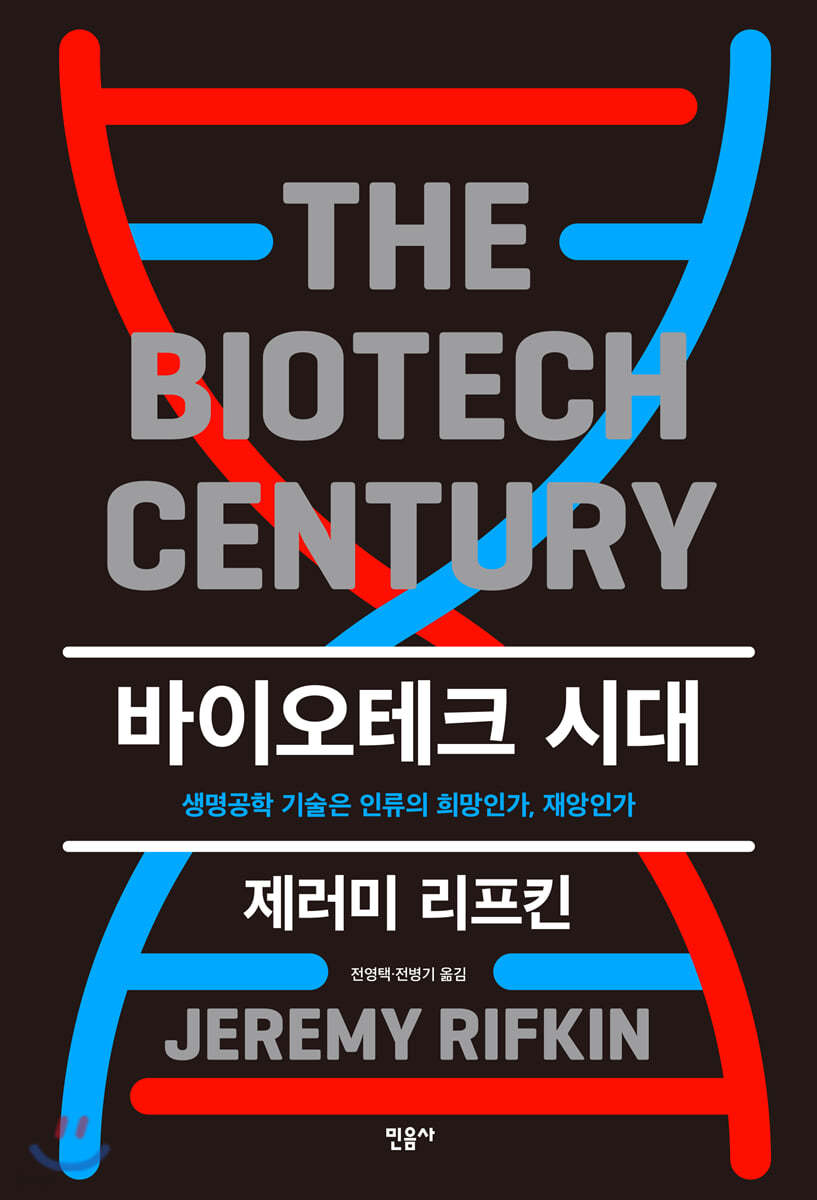
The biotech era
 |
Description
Book Introduction
Is biotechnology humanity's hope or disaster?
The era of the bio industry that is completely changing the world
What are the hopes and dangers of the new era that Rifkin captured early on?
"The Biotech Age" deals with the grand combination of computer technology and genetic engineering and the historic transition to the biotechnology era.
Rifkin, who has shown keen insight into future technological changes and the resulting paradigm shifts in works such as “The End of Work” and “The End of Ownership,” explains that the industrial age is rapidly declining and we are entering an era in which giant life science companies are forming the bio-industrial world, and that the global economy is already undergoing such changes.
This book clearly shows that if the 20th century was the age of physics and nuclear technology, the 21st century will be the age of biology, and that biotechnology will be the greatest issue facing humanity.
As we step into a new era, we must consider the benefits and costs of the biotechnology revolution.
And it demands our responsibility and awakening by presenting a comprehensive range of social, economic, technological, and ethical issues related to biotechnology.
The era of the bio industry that is completely changing the world
What are the hopes and dangers of the new era that Rifkin captured early on?
"The Biotech Age" deals with the grand combination of computer technology and genetic engineering and the historic transition to the biotechnology era.
Rifkin, who has shown keen insight into future technological changes and the resulting paradigm shifts in works such as “The End of Work” and “The End of Ownership,” explains that the industrial age is rapidly declining and we are entering an era in which giant life science companies are forming the bio-industrial world, and that the global economy is already undergoing such changes.
This book clearly shows that if the 20th century was the age of physics and nuclear technology, the 21st century will be the age of biology, and that biotechnology will be the greatest issue facing humanity.
As we step into a new era, we must consider the benefits and costs of the biotechnology revolution.
And it demands our responsibility and awakening by presenting a comprehensive range of social, economic, technological, and ethical issues related to biotechnology.
- You can preview some of the book's contents.
Preview
index
Acknowledgements
introduction
Chapter 1: The Century of Biotechnology
The End of the Industrial Age / The Biotechnology Century's Underpinnings / Gene Isolation and Recombinant Technologies / Reshaping the World / Transforming Ourselves / From Alchemy to Embryology
Chapter 2 Biological Patents
The race to secure the final frontier / Creatures as objects of invention / Biopiracy / Humans as intellectual property / The counterattack on attempts to patent living organisms
Chapter 3: The Second Genesis
New Threats to the Environment / Advances in Predictive Ecology / Roulette Game Targeting Ecosystems / The Conspirator: Genetic Weapons / Animal Suffering / Other Living Things' Rights / Human Health / The Depleting Gene Pool
Chapter 4: Eugenic Civilization
A History of the Eugenics Movement in the United States / Importing the Best Bloodlines / A New User-Oriented Eugenics Movement / The Ultimate Treatment / A Precarious Choice / The Responsibility of Genetics / Babies Made to Order / Modifying the Genetic Code
Chapter 5 Genetic Sociology
Nativism vs. Nurture / Genetic Politics / Gene-Based Racism / Hard Choices
Chapter 6 DNA Computers
Printing and the Industrial Age / A New Language for Describing Biology / The Combination of Computers and Genes
Chapter 7: Reinventing Nature
Darwin's view of nature and the spirit of the industrial age / The evolution of information / Postmodern cosmology
Chapter 8 Author's Note
References
Search
introduction
Chapter 1: The Century of Biotechnology
The End of the Industrial Age / The Biotechnology Century's Underpinnings / Gene Isolation and Recombinant Technologies / Reshaping the World / Transforming Ourselves / From Alchemy to Embryology
Chapter 2 Biological Patents
The race to secure the final frontier / Creatures as objects of invention / Biopiracy / Humans as intellectual property / The counterattack on attempts to patent living organisms
Chapter 3: The Second Genesis
New Threats to the Environment / Advances in Predictive Ecology / Roulette Game Targeting Ecosystems / The Conspirator: Genetic Weapons / Animal Suffering / Other Living Things' Rights / Human Health / The Depleting Gene Pool
Chapter 4: Eugenic Civilization
A History of the Eugenics Movement in the United States / Importing the Best Bloodlines / A New User-Oriented Eugenics Movement / The Ultimate Treatment / A Precarious Choice / The Responsibility of Genetics / Babies Made to Order / Modifying the Genetic Code
Chapter 5 Genetic Sociology
Nativism vs. Nurture / Genetic Politics / Gene-Based Racism / Hard Choices
Chapter 6 DNA Computers
Printing and the Industrial Age / A New Language for Describing Biology / The Combination of Computers and Genes
Chapter 7: Reinventing Nature
Darwin's view of nature and the spirit of the industrial age / The evolution of information / Postmodern cosmology
Chapter 8 Author's Note
References
Search
Into the book
We are entering a new century.
The new century is filled with hope and expectation, but also with growing worry and concern.
I hope this book will contribute to a serious discussion about the possibilities and options that lie before us.
--- p.16
The combination of computers and genes completely changes the real world at the most fundamental level of human experience.
To understand the immense changes taking place in human civilization, it is important to look back and understand the historical significance of the many changes that are occurring around us as we enter a new century at a turning point.
These changes represent a turning point in civilization.
We are experiencing one of the greatest changes in world history.
--- pp.25~26
We are now trying to transform ourselves and nature.
Yet, we have little preparation for this, and there is not even a discussion about where it will end up.
However, it is clear that the coming century of biotechnology will fundamentally change our concept of living things.
--- p.73
But as history has shown, every new technological revolution brings both benefits and costs.
As technologies that exploit and control the elements of nature become more powerful, they bring about the destruction and ruin of the ecosystems and social systems that support living things.
Therefore, the cost we have to pay also increases.
--- p.79
Nevertheless, the uncontrolled spread of superweeds, the creation of resistant bacterial strains and new super-insects, the creation of new viruses, and the destabilization of entire ecosystems are no longer trivial matters to consider, nor are they merely the grumblings of a few disgruntled critics.
Ignoring these warnings will lead us down a path that will harm the biosphere and civilization in the future.
--- p.171
Market forces in both developed and developing countries have conspired to force farmers to abandon traditional crop cultivation and switch to high-yielding monoculture methods.
By abandoning the cultivation of vast quantities of conventional crops in favor of new species, we have become overly reliant on a small number of plant genomes, severely damaging genetic diversity.
--- p.205
As human genetic testing and therapeutics advance, we may, for the first time in human history, have the ability to re-engineer our genetic makeup, directly controlling the course of human biological evolution on Earth.
The creation of a new, eugenically improved human species is no longer just the dream of reckless political agitators.
--- p.215
In the coming decades, we humans may sell ourselves and our genes for temporary happiness.
Ultimately, the very safety of individuals and groups that we have fought so hard to preserve for so long may be irretrievably compromised in the process of genetic engineering in pursuit of the perfect human.
--- p.316
The biotechnology revolution is forcing each of us to rethink the values we hold deeply in our hearts.
In other words, it makes us reconsider the ultimate question about the purpose and meaning of existence.
This may be the greatest contribution of the biotechnology revolution.
The rest is our responsibility.
The new century is filled with hope and expectation, but also with growing worry and concern.
I hope this book will contribute to a serious discussion about the possibilities and options that lie before us.
--- p.16
The combination of computers and genes completely changes the real world at the most fundamental level of human experience.
To understand the immense changes taking place in human civilization, it is important to look back and understand the historical significance of the many changes that are occurring around us as we enter a new century at a turning point.
These changes represent a turning point in civilization.
We are experiencing one of the greatest changes in world history.
--- pp.25~26
We are now trying to transform ourselves and nature.
Yet, we have little preparation for this, and there is not even a discussion about where it will end up.
However, it is clear that the coming century of biotechnology will fundamentally change our concept of living things.
--- p.73
But as history has shown, every new technological revolution brings both benefits and costs.
As technologies that exploit and control the elements of nature become more powerful, they bring about the destruction and ruin of the ecosystems and social systems that support living things.
Therefore, the cost we have to pay also increases.
--- p.79
Nevertheless, the uncontrolled spread of superweeds, the creation of resistant bacterial strains and new super-insects, the creation of new viruses, and the destabilization of entire ecosystems are no longer trivial matters to consider, nor are they merely the grumblings of a few disgruntled critics.
Ignoring these warnings will lead us down a path that will harm the biosphere and civilization in the future.
--- p.171
Market forces in both developed and developing countries have conspired to force farmers to abandon traditional crop cultivation and switch to high-yielding monoculture methods.
By abandoning the cultivation of vast quantities of conventional crops in favor of new species, we have become overly reliant on a small number of plant genomes, severely damaging genetic diversity.
--- p.205
As human genetic testing and therapeutics advance, we may, for the first time in human history, have the ability to re-engineer our genetic makeup, directly controlling the course of human biological evolution on Earth.
The creation of a new, eugenically improved human species is no longer just the dream of reckless political agitators.
--- p.215
In the coming decades, we humans may sell ourselves and our genes for temporary happiness.
Ultimately, the very safety of individuals and groups that we have fought so hard to preserve for so long may be irretrievably compromised in the process of genetic engineering in pursuit of the perfect human.
--- p.316
The biotechnology revolution is forcing each of us to rethink the values we hold deeply in our hearts.
In other words, it makes us reconsider the ultimate question about the purpose and meaning of existence.
This may be the greatest contribution of the biotechnology revolution.
The rest is our responsibility.
--- p.416
Publisher's Review
The biotechnology revolution that will determine the future of humanity
A cautious and powerful warning for a new era
"The Biotech Age" deals with the grand combination of computer technology and genetic engineering and the historic transition to the biotechnology era.
Rifkin explains that we are now entering an era where the industrial age is rapidly declining and giant life sciences companies are shaping the bioindustry, and that the global economy is already undergoing such a transformation.
The manipulation of life is expanding in ways previously unimaginable, including the birth of humans, the production of food, and the genetic modification of children.
But as we take each step into this new era, we must consider the benefits the biotechnology revolution will bring and the costs we will have to pay.
Because all the hopes and despair of biotechnology, which makes us rethink the value of humanity and life, are our responsibility.
In his books, “The End of Work” and “The End of Ownership,” Rifkin has shown keen insight into future technological changes and the resulting paradigm shifts.
This book clearly shows that if the 20th century was the age of physics and nuclear technology, the 21st century will be the age of biology, and that biotechnology will be the greatest issue facing humanity.
Rifkin points out the benefits and costs of the biotech revolution that we must consider as we step into a new era.
It demands our responsibility and awakening by comprehensively presenting the social, economic, technological, and ethical issues related to biotechnology.
A turning point for the global economy
The challenges facing humanity in the age of biotechnology
Rifkin, who has extensively studied the impact of changes in science and technology on the economy, labor, society, and the environment, cites genes as the basis for new resources and new manipulation techniques, new patent protection to facilitate commerce, a global trading market that releases artificial second creations all over the planet, the emergence of a new eugenics, the combination of computer technology and genetic engineering to manage genetic information, and a new cosmology of evolution that rationalizes the basic framework of biotechnology as the operating base of the biotechnology era.
On this basis, great scientific and commercial experiments on genetic engineering and life are actually being carried out.
In this way, biotechnology is becoming a stimulus for economic and technological opportunities and challenges greater than any previous change in human history, while simultaneously dominating all areas of our lives and posing a serious threat to bioethics.
Many companies seeking to secure a dominant position in the global market are shifting their business to areas where biotechnology can create commercial value, such as agriculture/pesticides/seeds, pharmaceuticals, medical care, and healthcare.
In other words, we have entered an era where giant life science companies are shaping the bioindustry world, with the rapid decline of the industrial age, and the global economy is already undergoing such changes.
As the foundations of the world economy are shaken, new problems are also surfacing.
As the importance of genetic resources grows, so does the conflict surrounding them.
Several countries, companies, and other stakeholders are already engaged in disputes over biological patents.
The competition for genetic resources will only intensify in the future.
An even more serious problem is the question of human dignity and bioethics that will be raised by genetic engineering technology.
Religious, moral, and philosophical debates have already erupted in various countries regarding attempts to patent biological products.
Our biggest problem is that the political, economic, and ethical threats surrounding new technologies are only growing, yet there is insufficient discussion about them.
In other words, we only accept biotechnology as a given, and we lack the awareness that it can be adjusted through our own voluntary choices.
The problem of choice facing humanity
How will biotechnology be used?
When we use new technologies designed for society, the question will always be whether the power we exercise is appropriate or excessive in scale and scope.
The important question is not whether you are for or against the use of technology itself.
The important thing is what kind of biotechnology we will choose in the coming century of biotechnology.
For example, will our knowledge of the workings of plant and animal genomes be used to create genetically engineered "supercrops" and transgenic animals? Or will new technologies be used to develop ecological farming methods or more humane animal husbandry? Will we use the information we gain about the human genome to alter our own genetic makeup? Or will we use it for sophisticated preventative health therapeutics? Of the two competing visions of biotechnology—genetic engineering versus ecological and preventative health—which is more risky and likely to lead to imbalances? And which is the more prudent approach, minimizing unintended harm?
Rifkin ultimately argues that we must shift our technological priorities.
That is, ecological approaches or biotechnology for preventive health are given higher priority, some biotechnology technologies are abandoned, and others are used only in a limited manner or as a last resort.
The challenge of new technology
And the unavoidable responsibility
Our individual realities, and the realities we share together, will now be profoundly impacted by the new technologies of the biotechnological century.
Before this technology related to personality can permeate our daily lives, it is inevitable that it will have to undergo extensive discussion among the general public.
The biotechnology revolution is forcing each of us to rethink the values we hold deep in our hearts.
In other words, it makes us reconsider the ultimate question about the purpose and meaning of existence.
This may be the greatest contribution of the biotechnology revolution.
The rest is our responsibility.
In this book, Rifkin does his best to draw our attention to the growing real and potential risks and ethical challenges that biotechnology poses.
By awakening our society to ethical questions about biotechnology, we seek to provide a means of understanding and regulating scientific endeavors in the next century.
This is precisely why both optimists and pessimists about biotechnology should heed Rifkin's cautious warning.
A cautious and powerful warning for a new era
"The Biotech Age" deals with the grand combination of computer technology and genetic engineering and the historic transition to the biotechnology era.
Rifkin explains that we are now entering an era where the industrial age is rapidly declining and giant life sciences companies are shaping the bioindustry, and that the global economy is already undergoing such a transformation.
The manipulation of life is expanding in ways previously unimaginable, including the birth of humans, the production of food, and the genetic modification of children.
But as we take each step into this new era, we must consider the benefits the biotechnology revolution will bring and the costs we will have to pay.
Because all the hopes and despair of biotechnology, which makes us rethink the value of humanity and life, are our responsibility.
In his books, “The End of Work” and “The End of Ownership,” Rifkin has shown keen insight into future technological changes and the resulting paradigm shifts.
This book clearly shows that if the 20th century was the age of physics and nuclear technology, the 21st century will be the age of biology, and that biotechnology will be the greatest issue facing humanity.
Rifkin points out the benefits and costs of the biotech revolution that we must consider as we step into a new era.
It demands our responsibility and awakening by comprehensively presenting the social, economic, technological, and ethical issues related to biotechnology.
A turning point for the global economy
The challenges facing humanity in the age of biotechnology
Rifkin, who has extensively studied the impact of changes in science and technology on the economy, labor, society, and the environment, cites genes as the basis for new resources and new manipulation techniques, new patent protection to facilitate commerce, a global trading market that releases artificial second creations all over the planet, the emergence of a new eugenics, the combination of computer technology and genetic engineering to manage genetic information, and a new cosmology of evolution that rationalizes the basic framework of biotechnology as the operating base of the biotechnology era.
On this basis, great scientific and commercial experiments on genetic engineering and life are actually being carried out.
In this way, biotechnology is becoming a stimulus for economic and technological opportunities and challenges greater than any previous change in human history, while simultaneously dominating all areas of our lives and posing a serious threat to bioethics.
Many companies seeking to secure a dominant position in the global market are shifting their business to areas where biotechnology can create commercial value, such as agriculture/pesticides/seeds, pharmaceuticals, medical care, and healthcare.
In other words, we have entered an era where giant life science companies are shaping the bioindustry world, with the rapid decline of the industrial age, and the global economy is already undergoing such changes.
As the foundations of the world economy are shaken, new problems are also surfacing.
As the importance of genetic resources grows, so does the conflict surrounding them.
Several countries, companies, and other stakeholders are already engaged in disputes over biological patents.
The competition for genetic resources will only intensify in the future.
An even more serious problem is the question of human dignity and bioethics that will be raised by genetic engineering technology.
Religious, moral, and philosophical debates have already erupted in various countries regarding attempts to patent biological products.
Our biggest problem is that the political, economic, and ethical threats surrounding new technologies are only growing, yet there is insufficient discussion about them.
In other words, we only accept biotechnology as a given, and we lack the awareness that it can be adjusted through our own voluntary choices.
The problem of choice facing humanity
How will biotechnology be used?
When we use new technologies designed for society, the question will always be whether the power we exercise is appropriate or excessive in scale and scope.
The important question is not whether you are for or against the use of technology itself.
The important thing is what kind of biotechnology we will choose in the coming century of biotechnology.
For example, will our knowledge of the workings of plant and animal genomes be used to create genetically engineered "supercrops" and transgenic animals? Or will new technologies be used to develop ecological farming methods or more humane animal husbandry? Will we use the information we gain about the human genome to alter our own genetic makeup? Or will we use it for sophisticated preventative health therapeutics? Of the two competing visions of biotechnology—genetic engineering versus ecological and preventative health—which is more risky and likely to lead to imbalances? And which is the more prudent approach, minimizing unintended harm?
Rifkin ultimately argues that we must shift our technological priorities.
That is, ecological approaches or biotechnology for preventive health are given higher priority, some biotechnology technologies are abandoned, and others are used only in a limited manner or as a last resort.
The challenge of new technology
And the unavoidable responsibility
Our individual realities, and the realities we share together, will now be profoundly impacted by the new technologies of the biotechnological century.
Before this technology related to personality can permeate our daily lives, it is inevitable that it will have to undergo extensive discussion among the general public.
The biotechnology revolution is forcing each of us to rethink the values we hold deep in our hearts.
In other words, it makes us reconsider the ultimate question about the purpose and meaning of existence.
This may be the greatest contribution of the biotechnology revolution.
The rest is our responsibility.
In this book, Rifkin does his best to draw our attention to the growing real and potential risks and ethical challenges that biotechnology poses.
By awakening our society to ethical questions about biotechnology, we seek to provide a means of understanding and regulating scientific endeavors in the next century.
This is precisely why both optimists and pessimists about biotechnology should heed Rifkin's cautious warning.
GOODS SPECIFICS
- Date of issue: May 31, 1999
- Format: Hardcover book binding method guide
- Page count, weight, size: 432 pages | 600g | 153*224*30mm
- ISBN13: 9788937424274
- ISBN10: 8937424274
You may also like
카테고리
korean


korean

![GQ KOREA Mark (Monthly): December [2025]](http://librairie.coreenne.fr/cdn/shop/files/8ef265dbbfbf186523ed75ba7319009d.jpg?v=1765340328&width=3840)


