

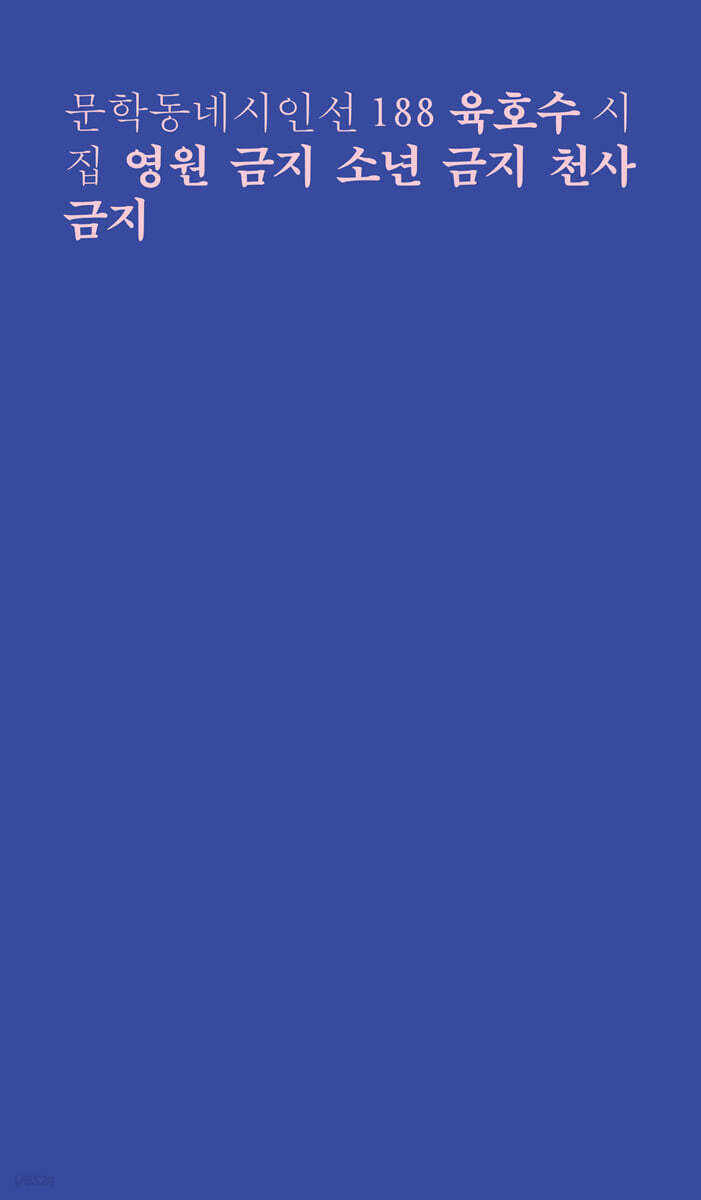
Forbidden forever, forbidden boy, forbidden angel
 |
Description
Book Introduction
Poet Yuk Ho-su's second poetry collection is published as the 188th issue of the Munhakdongne Poet Selection.
The poet, who began her literary career by winning the Daesan University Literary Award in 2016 with the comment that she “has an excellent sense for capturing the nuances of things” (judges Park Seong-woo, Ahn Hyeon-mi, and Yoo Jong-in), received favorable reviews for possessing “an exquisite and strange balance of sensation and thought” (poet Kim Eon) in her first poetry collection, “I Can Go to the Sea Alone Today” (Achimdal, 2018), published two years after her debut.
It took him a considerable amount of time, six years, to publish his second collection of poetry after his first.
That time makes us guess that the poet's concerns about poetry have deepened.
In addition, the poet began his career as a critic when his essay, “A Study of Poet Heo Su-gyeong,” was selected for the Segye Ilbo New Year’s Literary Contest last year, and this shows his efforts to examine contemporary poetry in detail and depth.
In his first collection of poems, the poet retraced the wounds of his childhood and overlapped the landscapes of reality and heaven with delicately sparkling sensations and images like light, dreams, birds, the sea, and sandcastles. In this collection of poems, the poet displays an even stronger sense of thought and language.
The poet looks back at the place where he is, hoping to reach a world that can never be reached by simply writing “eternity,” “boy,” and “angel” with “nails on the wall” (“Danae”).
The poet, who began her literary career by winning the Daesan University Literary Award in 2016 with the comment that she “has an excellent sense for capturing the nuances of things” (judges Park Seong-woo, Ahn Hyeon-mi, and Yoo Jong-in), received favorable reviews for possessing “an exquisite and strange balance of sensation and thought” (poet Kim Eon) in her first poetry collection, “I Can Go to the Sea Alone Today” (Achimdal, 2018), published two years after her debut.
It took him a considerable amount of time, six years, to publish his second collection of poetry after his first.
That time makes us guess that the poet's concerns about poetry have deepened.
In addition, the poet began his career as a critic when his essay, “A Study of Poet Heo Su-gyeong,” was selected for the Segye Ilbo New Year’s Literary Contest last year, and this shows his efforts to examine contemporary poetry in detail and depth.
In his first collection of poems, the poet retraced the wounds of his childhood and overlapped the landscapes of reality and heaven with delicately sparkling sensations and images like light, dreams, birds, the sea, and sandcastles. In this collection of poems, the poet displays an even stronger sense of thought and language.
The poet looks back at the place where he is, hoping to reach a world that can never be reached by simply writing “eternity,” “boy,” and “angel” with “nails on the wall” (“Danae”).
- You can preview some of the book's contents.
Preview
index
Prelude
No hope content
Part 1: Losing the wall in the middle of a wall
Sleeping hands, waking hands / Gaze, summer / Danae / Fern rainy season / Avoiding the eyes of children watching, trying to postpone the future to the future / Rainy season / Access / No boys, no eternity, no angels / Burre / Filling the window with words that were taken for granted at dawn / Midnight prayer / Resting waterside
Interlude
Even when I was snorkeling in Koh Chang and saw a sea squirt, I thought of you.
Part 2 Until you learn how to say goodbye to yourself
Enclosed - Handle with care / Hometown, sleep / If you try to write everything down, the blank page will get wet / In the exception of winter / Play safely / The corner of light / Memories in the backpack, trash in the heart / A ticket to Gorakhpur / Even when I saw a sea anemone while snorkeling in Koh Chang, I thought of you / No angels, no boys, no eternity / Crying game / Even if you write fool on my back, I will know it as the sea / There is no manuscript fee for poetry / Into the nightmare of へㅏㄹΓ The soul of ㉡ㅓ ёnŧrØpħy ?ㅐgen Ølrun 문ㅈБO1 Łй己l?... / Waiting for the signal / In the dream of the dream of the dream of the heart
Wipe the wall in part 3 to get a mirror
Prelude/ Side by side/ Once I fall asleep, I can never wake up as myself/ Exile/ Twist of noon and twist of afternoon, sob of midnight and gasp of dawn/ Working holiday/ Ghosts look for me like ghosts and I am like me/ Perimeter/ Ansu/ Santitham Friend/ Wipe the wall to get a mirror/ Intercession/ Eternity and a day/ Forbidden forever, forbidden boys, forbidden angels/ Connection─together/ Prayer at noon/ I thought it was a landscape photograph/ Recovery
Postlude
The Personification of Innocence - The Angels of Sodom
Commentary | A Dream of the Low Night
Kim Jun-hyun (poet, literary critic)
No hope content
Part 1: Losing the wall in the middle of a wall
Sleeping hands, waking hands / Gaze, summer / Danae / Fern rainy season / Avoiding the eyes of children watching, trying to postpone the future to the future / Rainy season / Access / No boys, no eternity, no angels / Burre / Filling the window with words that were taken for granted at dawn / Midnight prayer / Resting waterside
Interlude
Even when I was snorkeling in Koh Chang and saw a sea squirt, I thought of you.
Part 2 Until you learn how to say goodbye to yourself
Enclosed - Handle with care / Hometown, sleep / If you try to write everything down, the blank page will get wet / In the exception of winter / Play safely / The corner of light / Memories in the backpack, trash in the heart / A ticket to Gorakhpur / Even when I saw a sea anemone while snorkeling in Koh Chang, I thought of you / No angels, no boys, no eternity / Crying game / Even if you write fool on my back, I will know it as the sea / There is no manuscript fee for poetry / Into the nightmare of へㅏㄹΓ The soul of ㉡ㅓ ёnŧrØpħy ?ㅐgen Ølrun 문ㅈБO1 Łй己l?... / Waiting for the signal / In the dream of the dream of the dream of the heart
Wipe the wall in part 3 to get a mirror
Prelude/ Side by side/ Once I fall asleep, I can never wake up as myself/ Exile/ Twist of noon and twist of afternoon, sob of midnight and gasp of dawn/ Working holiday/ Ghosts look for me like ghosts and I am like me/ Perimeter/ Ansu/ Santitham Friend/ Wipe the wall to get a mirror/ Intercession/ Eternity and a day/ Forbidden forever, forbidden boys, forbidden angels/ Connection─together/ Prayer at noon/ I thought it was a landscape photograph/ Recovery
Postlude
The Personification of Innocence - The Angels of Sodom
Commentary | A Dream of the Low Night
Kim Jun-hyun (poet, literary critic)
Into the book
Multiple layers of body
Countless ghosts overlapping over the body
Leave it as a ruin
Let's go somewhere where we don't have to endure the beauty of the night.
Blue sky, Milky Way, endless handwork
To the place where the night inevitably breaks the night
---From "No Content of Hope"
In some dreams, I met someone who was very loving.
Than the place I want to go alive with him
There were more places I wanted to go after I died.
(…)
In some dreams, steps remain
I couldn't get out of the dream zone
Which direction did you lie before coming here?
Who did you fall asleep next to?
I didn't remember
---From "Danae"
POST CARD
Hi, yesterday I was collecting shells with the four year olds at the beach.
As the sun set, the seashells we hadn't picked up yet sparkled like silver coins.
Last night I woke up with fine sand pouring into my ears and mouth.
(…)
POST CARD
Hi, have you heard of the term "bracken rainy season"? They call spring rainy season "bracken rainy season" here.
I'm sitting in front of the fireplace, drying the shade I've picked up along the walk.
It's the season when clouds crawl across the world.
You asked me if I could make the memories of the past that never passed disappear.
---From "Bracken Rain"
Sending greetings from outside the dream
At the stream of dreams that were fading away again and again
We covered each other's ears
The silence that we nurture together
To be the perimeter
(…)
Crossing the submerged stepping stones
Get out of the summer then
Don't listen to the sound that's in your ears
The rain has passed here
After the rain news passed
rain.
The sound has passed
---From "Rainy Season"
Thinking while breaking open a human-shaped cookie
It was a hand that was extended because I wanted to lose it
It didn't snow.
It's not snowing
In between
Outside the window on Monday
Monday's Snowman
On Tuesday
Tuesday's Snowman Loses His Body
---From "The Exception of Winter"
reflected on the transparent ice floor
Trapped in my transparent eyes
transparent angel body
---From "Crying Game"
“I can’t wake up from my dream of becoming a LE┫r If that happens, I’ll become a LE┫”
---「Łй Into the nightmare of へㅏㄹΓjin ㉡ㅓ's soul ёnŧrØpħy?ㅐgen Ølrun 문ㅈБO1 Łй己l?...」from
The story gathers time, time gathers shadows, shadows gather night, night gathers nightmares, nightmares gather prayers, prayers gather silence, silence gathers sorrow, sorrow gathers faces… …
---From "The Twist of Noon and the Twist of Afternoon, the Sobs of Midnight and the Panting of Dawn"
If you walk on the snow footprints,
I think I know the heart of the person who walked on it
(…)
A person clear with sorrow
It would be nicer if he came in the summer
Countless ghosts overlapping over the body
Leave it as a ruin
Let's go somewhere where we don't have to endure the beauty of the night.
Blue sky, Milky Way, endless handwork
To the place where the night inevitably breaks the night
---From "No Content of Hope"
In some dreams, I met someone who was very loving.
Than the place I want to go alive with him
There were more places I wanted to go after I died.
(…)
In some dreams, steps remain
I couldn't get out of the dream zone
Which direction did you lie before coming here?
Who did you fall asleep next to?
I didn't remember
---From "Danae"
POST CARD
Hi, yesterday I was collecting shells with the four year olds at the beach.
As the sun set, the seashells we hadn't picked up yet sparkled like silver coins.
Last night I woke up with fine sand pouring into my ears and mouth.
(…)
POST CARD
Hi, have you heard of the term "bracken rainy season"? They call spring rainy season "bracken rainy season" here.
I'm sitting in front of the fireplace, drying the shade I've picked up along the walk.
It's the season when clouds crawl across the world.
You asked me if I could make the memories of the past that never passed disappear.
---From "Bracken Rain"
Sending greetings from outside the dream
At the stream of dreams that were fading away again and again
We covered each other's ears
The silence that we nurture together
To be the perimeter
(…)
Crossing the submerged stepping stones
Get out of the summer then
Don't listen to the sound that's in your ears
The rain has passed here
After the rain news passed
rain.
The sound has passed
---From "Rainy Season"
Thinking while breaking open a human-shaped cookie
It was a hand that was extended because I wanted to lose it
It didn't snow.
It's not snowing
In between
Outside the window on Monday
Monday's Snowman
On Tuesday
Tuesday's Snowman Loses His Body
---From "The Exception of Winter"
reflected on the transparent ice floor
Trapped in my transparent eyes
transparent angel body
---From "Crying Game"
“I can’t wake up from my dream of becoming a LE┫r If that happens, I’ll become a LE┫”
---「Łй Into the nightmare of へㅏㄹΓjin ㉡ㅓ's soul ёnŧrØpħy?ㅐgen Ølrun 문ㅈБO1 Łй己l?...」from
The story gathers time, time gathers shadows, shadows gather night, night gathers nightmares, nightmares gather prayers, prayers gather silence, silence gathers sorrow, sorrow gathers faces… …
---From "The Twist of Noon and the Twist of Afternoon, the Sobs of Midnight and the Panting of Dawn"
If you walk on the snow footprints,
I think I know the heart of the person who walked on it
(…)
A person clear with sorrow
It would be nicer if he came in the summer
---From "Santitam Friend"
Publisher's Review
“When I lost my name, my corners became precise.
“For angels could fly only by removing their wings.”
Beyond 'eternity', beyond 'boy', beyond 'angel'
When the real world explodes like a firecracker, it pours down
Poetry written with fragments of dreams
Poet Yuk Ho-su's second poetry collection is published as the 188th issue of the Munhakdongne Poet Selection.
The poet, who began her literary career by winning the Daesan University Literary Award in 2016 with the comment that she “has an excellent sense for capturing the nuances of things” (judges Park Seong-woo, Ahn Hyeon-mi, and Yoo Jong-in), received favorable reviews for possessing “an exquisite and strange balance of sensation and thought” (poet Kim Eon) in her first poetry collection, “I Can Go to the Sea Alone Today” (Achimdal, 2018), published two years after her debut.
It took him a considerable amount of time, six years, to publish his second collection of poetry after his first.
That time makes us guess that the poet's concerns about poetry have deepened.
In addition, the poet began his career as a critic when his essay, “A Study of Poet Heo Su-gyeong,” was selected for the Segye Ilbo New Year’s Literary Contest last year, and this shows his efforts to examine contemporary poetry in detail and depth.
In his first collection of poems, the poet retraced the wounds of his childhood and overlapped the landscapes of reality and heaven with delicately sparkling sensations and images like light, dreams, birds, the sea, and sandcastles. In this collection of poems, the poet displays an even stronger sense of thought and language.
The poet looks back at the place where he is, hoping to reach a world that can never be reached by simply writing “eternity,” “boy,” and “angel” with “nails on the wall” (“Danae”).
If someone sets fire to the entrance of the room
Just the thought of not being able to go anywhere
I had to wake up engulfed in flames several times.
I've been kicked out of the narrow entrance of a wide dream many times.
(…)
I woke up startled by the pouring light
It was in many layers of darkness
(…)
In some dreams, steps remain
I couldn't get out of the dream zone
Which direction did you lie before coming here?
Who did you fall asleep next to?
I didn't remember
_「Danae」 part
The world in which the speaker of Yukhosu lives is by no means large.
The edge of his “wide dream” is the edge of the reality he lives in.
The entrance there is even narrower, and he is “thrown out many times” from the path to the dream, but he still “cannot escape the perimeter of the dream” (“Danae”).
Because everything he desires, represented by 'eternity', 'boy', and 'angel', is in his dream.
In that place where “countless ghosts / are left as husks / and the beauty of the night is not to be endured” (“No Content of Hope”), the seashells and “fine sand” that “glistened like silver coins” under the beautiful sunset have become “ants” crawling over the body the moment one wakes up (“Bracken Rain”), and when one “awakens startled by the pouring light,” “layers of darkness” (“Danae”) unfold before one’s eyes.
What is noteworthy is that in Yuk Ho-su's poetry, the passage connecting dreams and reality also functions as a mirror reflecting each other.
The 'you' and 'me' in the mirror should be essentially the same being.
However, even though “we in the mirror have never been apart,” we are “very far apart” (“Bracken Rain”), and the real “I” even “try to kill a mosquito stuck to the mirror” and “shows a face approaching to kill something” (“Waiting, Summer”) to the “you” in the mirror.
Because ‘I’ and ‘you’ are individual beings, the dream world beyond the mirror becomes a place where one cannot freely come and go, and “Danae” is trapped in a “sealed dungeon beneath the palace” with the thought that “if someone sets fire to the entrance to the room/ there is no way out” and must endlessly draw “where the light came from” in her dream (“Danae”).
The day I left that room
I put on my shoes and came in.
(…)
Even things that cannot be moved
I'm afraid I'll have to move
At the threshold of prohibition
I stood there as a narrow mouth in a narrow room
(…)
I think I can live differently
I had a lot of wishes
For this small and deep room
I've made up a lot of scary stories.
If you stay up all night and lean on this room,
The window is a lie more transparent than the void, just the void
I showed it to the sky
“How do the birds outside the window sing without disturbing the darkness of this room?”
Thinking about birds, becoming vulnerable to birds
It was a room you couldn't leave until you broke the story.
_「Exile」 section
But in this place where the path to a dream that holds all that one desires seems distant, the speaker of Yukhosu suddenly asks a question.
“How do the birds outside the window sing without disturbing the darkness of this room?” (Exile) The answer to this question gives him a clue.
“When you lose your name,” “the corners become precise,” and “only by tearing off your wings can angels fly” (“There is no royalties for poetry”), it is impossible to leave the room “without harming the darkness of this room” (“Exile”), and the “rest of the wall” is actually “confinement” (“No Content of Hope”).
Therefore, in order to advance beyond the mirror into the world of dreams, one must “cross the threshold that forbids oneself, leaving behind the ‘eternity,’ ‘boy,’ and ‘angel’ engraved on the wall of the narrow room” (literary critic Kim Jun-hyun).
By doing so, when he declares that he is no longer “indebted” to those words (“No Content of Hope”), the “thought that if someone sets fire to the entrance of the room/ there is nowhere to go” (“Danae”) finally crumbles into a “terrifying story” (“Exile”) made up “for this small and deep room,” and the “narrow entrance to a wide dream” (“Danae”) is completely burned down.
Time
Just like that
What's outside the window of the ㉩ㅓ럼?
Fire God ㉭Ł ㅂㅣフド LH己ㅣヱ
˚。 ☆ 。 ★ ˚☆ 。 ★˚。 ˚ ★ 。 ˚ 。 。★ 。 。 ☆ ★ ˚。 ☆
。 。 。 ★ 。 。 ˚ ★ ˚˚ ★ 。 。★˚ ☆ 。 。 。☆ ☆ ★ ˚。 ☆
_「Łй Into the nightmare へㅏㄹΓjin ㉡ㅓ's soul ёnŧrØpħy?ㅐgen Ølrun 문ㅈБO1 Łй己l?...」 part
In this way, as reality explodes like fireworks and fragments of dreams pour down brilliantly, Yuk Ho-su's speaker will enter that place where there is "an eternity further than eternity," "a boy more inactive than a boy," and "an angel more transparent than an angel" (from 'Mini Interview with Poet Yuk Ho-su').
Put on your shoes and walk briskly.
What poetry and dreams have in common is that they both share a state of lack of meaning and a tendency to maintain this state as long as possible.
So, perhaps the distinguishing virtue of Yuk Ho-su's poetry is that he does not hesitate to fragment the language-world that he has tried so hard to make closer to an organism.
To use a pottery analogy, rather than smashing countless freshly baked pottery pieces with the obsessive craftsmanship of a single, perfect piece, Yuk Ho-su seems to write poetry with a playful spirit based on the pleasure of "playing with smashing pottery."
All the good, bad, and strange things that happen by chance and after the fact, like the broken pieces that fly in all directions without any intention, ultimately become the lot of 'you' who reads.
Whether you are the reader of this poem or the poet who wrote it, you become the subject of this joyful abandon.
_Kim Jun-hyun, in the commentary
◎ Mini-interview with poet Yuk Ho-su
Q1.
Five years after your first collection of poems, you published your second collection of poems, “Forbidden Forever, Forbidden Boys, Forbidden Angels.”
Could you tell us how you have been doing and how you feel about publishing your second poetry collection?
After my first poetry collection came out, I received many messages of support from readers.
There were not only comments about the poem, but also comments of gratitude for writing the poem, and even gratitude for being alive.
Although I can only return a brief thank you, I want to tell you that thanks to your kind words, I am also doing well.
Whenever I felt afraid, regretful, miserable, lost, frustrated, confused, ashamed, guilty, empty, and dizzy in front of a blank page and wanted to give up on poetry, it gave me great strength.
Sometimes I would memorize my poems beforehand for the readings.
Then, while reading the poem, you can see the facial expressions and eyes of the people listening.
Those eyes gave me the courage to sit down in front of a blank sheet of paper again.
When I was writing my first poetry collection, I was worried about how I could write about life in poetry, but now I'm worried about how I can live out these poems.
I built each room, put a large window in it, built a fireplace and chairs, and lived there for five years, cleaning and emptying the rooms for the readers who would come and stay here someday.
When I was writing the poems that were included in my first poetry collection, I was uncertain whether these poems would ever be published and reach anyone.
I felt really bad for the poets, thinking that they would be trapped inside this monitor forever.
Now, I have faith that these poems will definitely reach someone who really needs them.
Thanks to all the hearts.
It doesn't matter how many people this collection of poems reaches.
I just hope that this poetry collection will catch the eye of 'you' who can recognize this poem and enter into this poem.
I hope that something like this will happen: you might come across this poetry collection by chance in a bookstore or while traveling, or you might come across a passage on the internet and find yourself unable to pass it up.
Q2.
The title is very strong, but before reading the poetry collection, you might think that it is a poetry collection without words like ‘eternity,’ ‘boy,’ or ‘angel.’
(Laughs) Please tell us what the title means.
(The title of the poetry collection may seem a bit strong… but it’s not spicy, so don’t worry too much.) I think I came up with this title because the word “eternity” cannot express eternity, the word “angel” cannot express angels, and the word “boy” cannot express a boy.
Eternity, the Boy, and the Angel are things I've been obsessed with since the time I wrote my first poetry collection.
After my first poetry collection was published, I was worried about getting closer to them, and I came to the conclusion that I shouldn't trust the 'poetic language' that expresses them.
That day, I wrote 'No boys, no angels' in large letters on a piece of paper and stuck it in front of my desk.
At the time, there were various prohibitions such as ‘ban on private gatherings of two or more people’, so I heard the word ‘ban’ every day.
(Laughs) Angel, Eternal, Boy.
All three of these seemed forbidden to me in this world.
It's only after something is forbidden that we realize what was forbidden to us.
Let us not dwell on the fine print, let us not be swayed by the poetic language.
It's a thought I've had for a long time, but it's still difficult (which is why I want to get over this 'young poet' phase of mine).
What I wanted to express with the word 'eternity' was an eternity that was further than eternity.
I wanted to reach an angel more transparent than an angel, a boy more inactive than a boy.
I wish they would come to this city, even if it was by prohibition.
It's a guest house.
(Laughs) A poet may only have language, but that doesn't mean that poetry only contains language.
I can't know everything that's contained in a poem, either before or after it's been written, but if there's one thing I can't contain in advance, it's the meaning of the poem.
Although I have given some background on the title of the poetry collection, the title does not contain any meaning in advance.
I believe that the meaning of poetry is not something that is already contained within the language and sentences of the poem, but rather something that is born anew when it encounters someone's soul.
I don't think it's my place.
I want to leave the meaning to the readers.
Come and stay.
i look forward to!
Q3.
Despite the strong titles, many lyrical works also left a lasting impression on me.
“In order to convey greetings from outside the dream/ At the stream of dreams that was fading away// We covered each other’s ears/ To become the surroundings of the silence/ that we nurture each other” (“Rainy Season”) “Hello, yesterday I collected shells with the four-year-olds on the beach.
As the sun set, the seashells we hadn't picked up yet sparkled like silver coins.
“Last night, I woke up with fine sand pouring into my ears and mouth.” (“Bracken Rain”), “In one dream, I met someone who was very loving/ There were more places I wanted to go when I was dead/ than places I wanted to go when I was alive” (“Danae”).
The quoted passages seem to have something in common about dreams. I'm curious about what meaning dreams have in your poetic world.
I am a nightmare rich person.
(Laughs) It's hard for me to be true to myself, and it's hard for me to be true to the world.
Conversely, it is also very difficult to ask for the truth from someone or from the world.
The soul and truth are vulnerable to air.
It will turn brown if you put it out.
Sometimes it feels like there's nothing more foolish than living your life revealing your soul and sincerity to the world.
But nightmares are true to me in their own nightmare way.
It reveals very clearly what I desire, what I fear, what I regret, what I cherish and what I run from.
In nightmares, there is time and space, sensations, stories and emotions, even though they are not of this world.
It is a world disconnected from this world, yet connected to it.
In that respect, nightmares and poetry are very similar.
The moment just before waking up from a nightmare is similar to the last sentence of the poem.
I write my best poetry in the middle of the night, right after waking up from a nightmare.
Because it is a time when I go through a nightmare and am completely disarmed from the world and my defenseless soul is exposed.
So, when I'm pressed for time to meet a deadline, I sometimes go to sleep hoping to have a one-on-one conversation with my nightmares.
I have no wishes in this world except poetry.
Likewise, I don't have any specific expectations from others anymore.
But I have many wishes for the people in my nightmares.
Please be gentle with me during the next nightmare.
I'm sorry that I'm always the first to escape from nightmares.
I'm sorry for stealing the story from your dream to outside the dream.
Because I have nothing but nightmares.
Q4.
As you flip through the poetry collection, there are some works that particularly stand out.
In the title work, “Forever Forbidden, Boys Forbidden, Angels Forbidden,” poems such as “Forbidden, Boys Forbidden, Angels Forbidden” and “Forbidden, Angels Forbidden, Boys Forbidden, Forever Forbidden,” which only change the order of the words, have two stories intersecting or juxtaposing within a single poem, and “Even when I saw a sea anemone while snorkeling in Koh Chang, I thought of you” is made up entirely of a single photograph.
Also, 「Łй Into the nightmare へㅏㄹΓ The soul of ㉡ㅓ ёnŧrØpħy? ㅐgen Øl런 문ㅈБO1 Łй己l?...」 is full of only 'alien languages' such as special characters.
Could you please suggest some reading suggestions for these works?
Enjoy! I recently visited a foreign beach and watched three little kids build sandcastles for a long time. Every time the waves came in deep and the sandcastles they were building collapsed, it was terrifying.
But in the meantime, I was watching the children play more intently (of course, the children coolly built the castle again and coolly left the sand city).
We were taught in school to find hidden intentions in poetry.
If you learn a set topic or set expressions and effects and give an answer that deviates from that, it will be mercilessly marked as wrong.
So, when you read a poem, you try to find the poet's intention and hidden meaning, or you avoid poetry because 'modern poetry' outside of textbooks doesn't do that well.
As the author, I guarantee this at the risk of overstepping my authority.
There is no hidden intention or meaning in the expression.
You don't have to bother trying to find it.
I hope you just think of it as a normal and fun happening, like waves crashing over and destroying a sandcastle.
Just as waves don't crash to destroy sandcastles, waves have no intention or meaning.
What matters more is the heart of someone watching the sand castle crumble in the waves.
Nah...
┓┠Oh no...
What? I'm hitting...
I can't even describe the degree of ㅍΓ in detail...
(????)
Q5.
Lastly, please say hello to the readers of 『Forbidden Boys, Forbidden Angels』.
nice to meet you.
It's Yukho Lake.
Before I was a poet, I was a reader who truly loved Korean poetry.
One day in my mid-twenties, a poem suddenly began to feel like a living, concrete creature rather than just a sentence, and I loved it so much that it led me here.
Although it's not enough, I also do criticism, and I want to spend my life reading and writing poetry, keeping it close to me for a long time.
I hope you will take care of me in ten years, and in a hundred years.
I will live so that you will be happy to see me again when we meet again in poetry after a long time.
When I first debuted as a poet, I wrote the end of my acceptance speech like this on paper.
It's embarrassing, but I still feel the same way I did then.
“I will give everything I have to poetry, and I will not deviate even an inch from the blank page.”
■ Poet's Note
In a dream where we say goodbye again and again, you
He said, holding a black stone in his hand.
“Please take good care of the bird.
But he died”
March 2023
Yukhosu
“For angels could fly only by removing their wings.”
Beyond 'eternity', beyond 'boy', beyond 'angel'
When the real world explodes like a firecracker, it pours down
Poetry written with fragments of dreams
Poet Yuk Ho-su's second poetry collection is published as the 188th issue of the Munhakdongne Poet Selection.
The poet, who began her literary career by winning the Daesan University Literary Award in 2016 with the comment that she “has an excellent sense for capturing the nuances of things” (judges Park Seong-woo, Ahn Hyeon-mi, and Yoo Jong-in), received favorable reviews for possessing “an exquisite and strange balance of sensation and thought” (poet Kim Eon) in her first poetry collection, “I Can Go to the Sea Alone Today” (Achimdal, 2018), published two years after her debut.
It took him a considerable amount of time, six years, to publish his second collection of poetry after his first.
That time makes us guess that the poet's concerns about poetry have deepened.
In addition, the poet began his career as a critic when his essay, “A Study of Poet Heo Su-gyeong,” was selected for the Segye Ilbo New Year’s Literary Contest last year, and this shows his efforts to examine contemporary poetry in detail and depth.
In his first collection of poems, the poet retraced the wounds of his childhood and overlapped the landscapes of reality and heaven with delicately sparkling sensations and images like light, dreams, birds, the sea, and sandcastles. In this collection of poems, the poet displays an even stronger sense of thought and language.
The poet looks back at the place where he is, hoping to reach a world that can never be reached by simply writing “eternity,” “boy,” and “angel” with “nails on the wall” (“Danae”).
If someone sets fire to the entrance of the room
Just the thought of not being able to go anywhere
I had to wake up engulfed in flames several times.
I've been kicked out of the narrow entrance of a wide dream many times.
(…)
I woke up startled by the pouring light
It was in many layers of darkness
(…)
In some dreams, steps remain
I couldn't get out of the dream zone
Which direction did you lie before coming here?
Who did you fall asleep next to?
I didn't remember
_「Danae」 part
The world in which the speaker of Yukhosu lives is by no means large.
The edge of his “wide dream” is the edge of the reality he lives in.
The entrance there is even narrower, and he is “thrown out many times” from the path to the dream, but he still “cannot escape the perimeter of the dream” (“Danae”).
Because everything he desires, represented by 'eternity', 'boy', and 'angel', is in his dream.
In that place where “countless ghosts / are left as husks / and the beauty of the night is not to be endured” (“No Content of Hope”), the seashells and “fine sand” that “glistened like silver coins” under the beautiful sunset have become “ants” crawling over the body the moment one wakes up (“Bracken Rain”), and when one “awakens startled by the pouring light,” “layers of darkness” (“Danae”) unfold before one’s eyes.
What is noteworthy is that in Yuk Ho-su's poetry, the passage connecting dreams and reality also functions as a mirror reflecting each other.
The 'you' and 'me' in the mirror should be essentially the same being.
However, even though “we in the mirror have never been apart,” we are “very far apart” (“Bracken Rain”), and the real “I” even “try to kill a mosquito stuck to the mirror” and “shows a face approaching to kill something” (“Waiting, Summer”) to the “you” in the mirror.
Because ‘I’ and ‘you’ are individual beings, the dream world beyond the mirror becomes a place where one cannot freely come and go, and “Danae” is trapped in a “sealed dungeon beneath the palace” with the thought that “if someone sets fire to the entrance to the room/ there is no way out” and must endlessly draw “where the light came from” in her dream (“Danae”).
The day I left that room
I put on my shoes and came in.
(…)
Even things that cannot be moved
I'm afraid I'll have to move
At the threshold of prohibition
I stood there as a narrow mouth in a narrow room
(…)
I think I can live differently
I had a lot of wishes
For this small and deep room
I've made up a lot of scary stories.
If you stay up all night and lean on this room,
The window is a lie more transparent than the void, just the void
I showed it to the sky
“How do the birds outside the window sing without disturbing the darkness of this room?”
Thinking about birds, becoming vulnerable to birds
It was a room you couldn't leave until you broke the story.
_「Exile」 section
But in this place where the path to a dream that holds all that one desires seems distant, the speaker of Yukhosu suddenly asks a question.
“How do the birds outside the window sing without disturbing the darkness of this room?” (Exile) The answer to this question gives him a clue.
“When you lose your name,” “the corners become precise,” and “only by tearing off your wings can angels fly” (“There is no royalties for poetry”), it is impossible to leave the room “without harming the darkness of this room” (“Exile”), and the “rest of the wall” is actually “confinement” (“No Content of Hope”).
Therefore, in order to advance beyond the mirror into the world of dreams, one must “cross the threshold that forbids oneself, leaving behind the ‘eternity,’ ‘boy,’ and ‘angel’ engraved on the wall of the narrow room” (literary critic Kim Jun-hyun).
By doing so, when he declares that he is no longer “indebted” to those words (“No Content of Hope”), the “thought that if someone sets fire to the entrance of the room/ there is nowhere to go” (“Danae”) finally crumbles into a “terrifying story” (“Exile”) made up “for this small and deep room,” and the “narrow entrance to a wide dream” (“Danae”) is completely burned down.
Time
Just like that
What's outside the window of the ㉩ㅓ럼?
Fire God ㉭Ł ㅂㅣフド LH己ㅣヱ
˚。 ☆ 。 ★ ˚☆ 。 ★˚。 ˚ ★ 。 ˚ 。 。★ 。 。 ☆ ★ ˚。 ☆
。 。 。 ★ 。 。 ˚ ★ ˚˚ ★ 。 。★˚ ☆ 。 。 。☆ ☆ ★ ˚。 ☆
_「Łй Into the nightmare へㅏㄹΓjin ㉡ㅓ's soul ёnŧrØpħy?ㅐgen Ølrun 문ㅈБO1 Łй己l?...」 part
In this way, as reality explodes like fireworks and fragments of dreams pour down brilliantly, Yuk Ho-su's speaker will enter that place where there is "an eternity further than eternity," "a boy more inactive than a boy," and "an angel more transparent than an angel" (from 'Mini Interview with Poet Yuk Ho-su').
Put on your shoes and walk briskly.
What poetry and dreams have in common is that they both share a state of lack of meaning and a tendency to maintain this state as long as possible.
So, perhaps the distinguishing virtue of Yuk Ho-su's poetry is that he does not hesitate to fragment the language-world that he has tried so hard to make closer to an organism.
To use a pottery analogy, rather than smashing countless freshly baked pottery pieces with the obsessive craftsmanship of a single, perfect piece, Yuk Ho-su seems to write poetry with a playful spirit based on the pleasure of "playing with smashing pottery."
All the good, bad, and strange things that happen by chance and after the fact, like the broken pieces that fly in all directions without any intention, ultimately become the lot of 'you' who reads.
Whether you are the reader of this poem or the poet who wrote it, you become the subject of this joyful abandon.
_Kim Jun-hyun, in the commentary
◎ Mini-interview with poet Yuk Ho-su
Q1.
Five years after your first collection of poems, you published your second collection of poems, “Forbidden Forever, Forbidden Boys, Forbidden Angels.”
Could you tell us how you have been doing and how you feel about publishing your second poetry collection?
After my first poetry collection came out, I received many messages of support from readers.
There were not only comments about the poem, but also comments of gratitude for writing the poem, and even gratitude for being alive.
Although I can only return a brief thank you, I want to tell you that thanks to your kind words, I am also doing well.
Whenever I felt afraid, regretful, miserable, lost, frustrated, confused, ashamed, guilty, empty, and dizzy in front of a blank page and wanted to give up on poetry, it gave me great strength.
Sometimes I would memorize my poems beforehand for the readings.
Then, while reading the poem, you can see the facial expressions and eyes of the people listening.
Those eyes gave me the courage to sit down in front of a blank sheet of paper again.
When I was writing my first poetry collection, I was worried about how I could write about life in poetry, but now I'm worried about how I can live out these poems.
I built each room, put a large window in it, built a fireplace and chairs, and lived there for five years, cleaning and emptying the rooms for the readers who would come and stay here someday.
When I was writing the poems that were included in my first poetry collection, I was uncertain whether these poems would ever be published and reach anyone.
I felt really bad for the poets, thinking that they would be trapped inside this monitor forever.
Now, I have faith that these poems will definitely reach someone who really needs them.
Thanks to all the hearts.
It doesn't matter how many people this collection of poems reaches.
I just hope that this poetry collection will catch the eye of 'you' who can recognize this poem and enter into this poem.
I hope that something like this will happen: you might come across this poetry collection by chance in a bookstore or while traveling, or you might come across a passage on the internet and find yourself unable to pass it up.
Q2.
The title is very strong, but before reading the poetry collection, you might think that it is a poetry collection without words like ‘eternity,’ ‘boy,’ or ‘angel.’
(Laughs) Please tell us what the title means.
(The title of the poetry collection may seem a bit strong… but it’s not spicy, so don’t worry too much.) I think I came up with this title because the word “eternity” cannot express eternity, the word “angel” cannot express angels, and the word “boy” cannot express a boy.
Eternity, the Boy, and the Angel are things I've been obsessed with since the time I wrote my first poetry collection.
After my first poetry collection was published, I was worried about getting closer to them, and I came to the conclusion that I shouldn't trust the 'poetic language' that expresses them.
That day, I wrote 'No boys, no angels' in large letters on a piece of paper and stuck it in front of my desk.
At the time, there were various prohibitions such as ‘ban on private gatherings of two or more people’, so I heard the word ‘ban’ every day.
(Laughs) Angel, Eternal, Boy.
All three of these seemed forbidden to me in this world.
It's only after something is forbidden that we realize what was forbidden to us.
Let us not dwell on the fine print, let us not be swayed by the poetic language.
It's a thought I've had for a long time, but it's still difficult (which is why I want to get over this 'young poet' phase of mine).
What I wanted to express with the word 'eternity' was an eternity that was further than eternity.
I wanted to reach an angel more transparent than an angel, a boy more inactive than a boy.
I wish they would come to this city, even if it was by prohibition.
It's a guest house.
(Laughs) A poet may only have language, but that doesn't mean that poetry only contains language.
I can't know everything that's contained in a poem, either before or after it's been written, but if there's one thing I can't contain in advance, it's the meaning of the poem.
Although I have given some background on the title of the poetry collection, the title does not contain any meaning in advance.
I believe that the meaning of poetry is not something that is already contained within the language and sentences of the poem, but rather something that is born anew when it encounters someone's soul.
I don't think it's my place.
I want to leave the meaning to the readers.
Come and stay.
i look forward to!
Q3.
Despite the strong titles, many lyrical works also left a lasting impression on me.
“In order to convey greetings from outside the dream/ At the stream of dreams that was fading away// We covered each other’s ears/ To become the surroundings of the silence/ that we nurture each other” (“Rainy Season”) “Hello, yesterday I collected shells with the four-year-olds on the beach.
As the sun set, the seashells we hadn't picked up yet sparkled like silver coins.
“Last night, I woke up with fine sand pouring into my ears and mouth.” (“Bracken Rain”), “In one dream, I met someone who was very loving/ There were more places I wanted to go when I was dead/ than places I wanted to go when I was alive” (“Danae”).
The quoted passages seem to have something in common about dreams. I'm curious about what meaning dreams have in your poetic world.
I am a nightmare rich person.
(Laughs) It's hard for me to be true to myself, and it's hard for me to be true to the world.
Conversely, it is also very difficult to ask for the truth from someone or from the world.
The soul and truth are vulnerable to air.
It will turn brown if you put it out.
Sometimes it feels like there's nothing more foolish than living your life revealing your soul and sincerity to the world.
But nightmares are true to me in their own nightmare way.
It reveals very clearly what I desire, what I fear, what I regret, what I cherish and what I run from.
In nightmares, there is time and space, sensations, stories and emotions, even though they are not of this world.
It is a world disconnected from this world, yet connected to it.
In that respect, nightmares and poetry are very similar.
The moment just before waking up from a nightmare is similar to the last sentence of the poem.
I write my best poetry in the middle of the night, right after waking up from a nightmare.
Because it is a time when I go through a nightmare and am completely disarmed from the world and my defenseless soul is exposed.
So, when I'm pressed for time to meet a deadline, I sometimes go to sleep hoping to have a one-on-one conversation with my nightmares.
I have no wishes in this world except poetry.
Likewise, I don't have any specific expectations from others anymore.
But I have many wishes for the people in my nightmares.
Please be gentle with me during the next nightmare.
I'm sorry that I'm always the first to escape from nightmares.
I'm sorry for stealing the story from your dream to outside the dream.
Because I have nothing but nightmares.
Q4.
As you flip through the poetry collection, there are some works that particularly stand out.
In the title work, “Forever Forbidden, Boys Forbidden, Angels Forbidden,” poems such as “Forbidden, Boys Forbidden, Angels Forbidden” and “Forbidden, Angels Forbidden, Boys Forbidden, Forever Forbidden,” which only change the order of the words, have two stories intersecting or juxtaposing within a single poem, and “Even when I saw a sea anemone while snorkeling in Koh Chang, I thought of you” is made up entirely of a single photograph.
Also, 「Łй Into the nightmare へㅏㄹΓ The soul of ㉡ㅓ ёnŧrØpħy? ㅐgen Øl런 문ㅈБO1 Łй己l?...」 is full of only 'alien languages' such as special characters.
Could you please suggest some reading suggestions for these works?
Enjoy! I recently visited a foreign beach and watched three little kids build sandcastles for a long time. Every time the waves came in deep and the sandcastles they were building collapsed, it was terrifying.
But in the meantime, I was watching the children play more intently (of course, the children coolly built the castle again and coolly left the sand city).
We were taught in school to find hidden intentions in poetry.
If you learn a set topic or set expressions and effects and give an answer that deviates from that, it will be mercilessly marked as wrong.
So, when you read a poem, you try to find the poet's intention and hidden meaning, or you avoid poetry because 'modern poetry' outside of textbooks doesn't do that well.
As the author, I guarantee this at the risk of overstepping my authority.
There is no hidden intention or meaning in the expression.
You don't have to bother trying to find it.
I hope you just think of it as a normal and fun happening, like waves crashing over and destroying a sandcastle.
Just as waves don't crash to destroy sandcastles, waves have no intention or meaning.
What matters more is the heart of someone watching the sand castle crumble in the waves.
Nah...
┓┠Oh no...
What? I'm hitting...
I can't even describe the degree of ㅍΓ in detail...
(????)
Q5.
Lastly, please say hello to the readers of 『Forbidden Boys, Forbidden Angels』.
nice to meet you.
It's Yukho Lake.
Before I was a poet, I was a reader who truly loved Korean poetry.
One day in my mid-twenties, a poem suddenly began to feel like a living, concrete creature rather than just a sentence, and I loved it so much that it led me here.
Although it's not enough, I also do criticism, and I want to spend my life reading and writing poetry, keeping it close to me for a long time.
I hope you will take care of me in ten years, and in a hundred years.
I will live so that you will be happy to see me again when we meet again in poetry after a long time.
When I first debuted as a poet, I wrote the end of my acceptance speech like this on paper.
It's embarrassing, but I still feel the same way I did then.
“I will give everything I have to poetry, and I will not deviate even an inch from the blank page.”
■ Poet's Note
In a dream where we say goodbye again and again, you
He said, holding a black stone in his hand.
“Please take good care of the bird.
But he died”
March 2023
Yukhosu
GOODS SPECIFICS
- Date of issue: March 10, 2023
- Page count, weight, size: 176 pages | 212g | 130*224*20mm
- ISBN13: 9788954698658
- ISBN10: 8954698654
You may also like
카테고리
korean


korean

![GQ KOREA Mark (Monthly): December [2025]](http://librairie.coreenne.fr/cdn/shop/files/8ef265dbbfbf186523ed75ba7319009d.jpg?v=1765340328&width=3840)


