

Lee Sang's Complete Poetry
 |
Description
Book Introduction
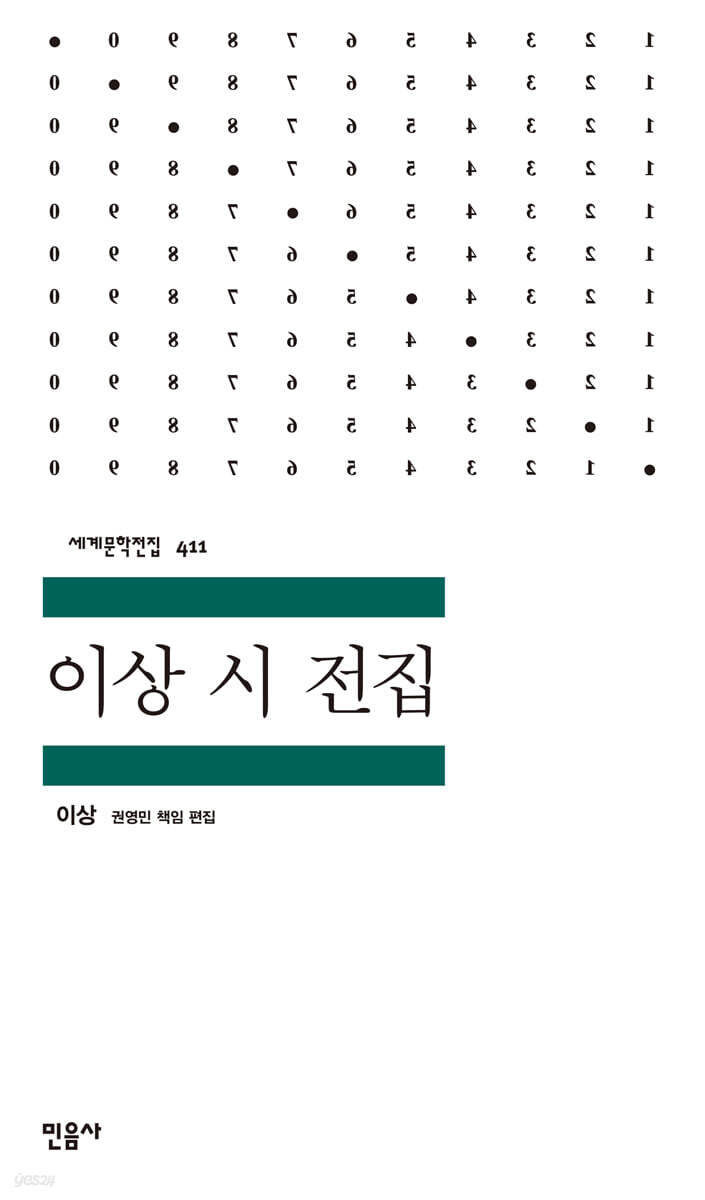
The Complete Works of Yi Sang's Poetry, which gathers all of Yi Sang's poems and explores the possibilities of "visual poetry" (poetry of seeing) in an experimental and avant-garde literary format that is difficult to find a precedent for in the history of Korean literature, has been published by Minumsa as the 411th volume of the World Literature Collection.
This collection of poetry, compiled under the editorial responsibility of literary critic Kwon Young-min, includes not only Korean and Japanese poems published by Yi Sang during his lifetime, but also poems published after his death and unpublished poems.
In addition to detailed annotations on Lee Sang's poetry, the book also includes 'commentaries' for each work, which are the result of long-term research on Lee Sang's poetry, offering a clear perspective on the debate surrounding the interpretation of Lee Sang's poetry.
This collection of poetry, compiled under the editorial responsibility of literary critic Kwon Young-min, includes not only Korean and Japanese poems published by Yi Sang during his lifetime, but also poems published after his death and unpublished poems.
In addition to detailed annotations on Lee Sang's poetry, the book also includes 'commentaries' for each work, which are the result of long-term research on Lee Sang's poetry, offering a clear perspective on the debate surrounding the interpretation of Lee Sang's poetry.
- You can preview some of the book's contents.
Preview
index
Part 1 Korean poetry
Flower tree 12
Poem 15
1933, 6, 1 18
Mirror 21
Ordinary Commemoration 26
Exercise 32
Five senses
Poem No. 1, Issue 36
Poem No. 2, Issue 46
Poem No. 3, Issue 52
Poem No. 4, Issue 56
Poem No. 5, Issue 63
Poem No. 6, Issue 69
Poem No. 7, Issue 74
Poem No. 8, Issue 81
Poem No. 9, Issue 88
Poem No. 10, Issue 93
Poem No. 11, Issue 99
Poem No. 12, Issue 105
Poem No. 13, Issue 111
Poem No. 14, Issue 116
Poem No. 15, No. 122
So·Young·Wei·Je· 136
Official 143
G-153
Ji-bi - My Wife Whose Whereabouts Are Unknown - 157
reverse
Furnace 166
Morning 171
Home 174
Reverse 177
Route 181
Extra Appliances 186
Myeonggyeong 196
Ranch 202
Critical
Gold 208
Pursuit 214
Sinking 217
Cliff 220
Baekhwa 223
Family background 226
Location 229
Prostitution 232
Life 237
Internal 240
Six Relatives 243
Detail 246
I WED A TOOY BRIDE 252
Pa-cheop 257
Untitled 271
Untitled (Strange) 275
Part 2 Japanese Poetry
Strange Reversible Reaction 280
Fragmented Landscape 290
▽Euiyuhee 298
Beard 306
BOITEUX?BOITEUSE 322
Fasting - 331
Bird's eye view
2 people… … 1… … 340
2 people… … 2… … 344
Neurotic Obese Triangle 348
LE URINE 353
Face 364
Exercise 371
Confession of a Madwoman 376
Box office hit angel 390
Trigonometric design diagram
Memorandum on Goods 1 406
Memorandum on the Line 2 416
Memorandum on the Line 3 426
Memorandum on Goods 4 431
Memorandum on the Line 5 436
Memorandum on the Line 6 446
Memorandum on Goods 7 457
Architectural infinite hexahedron
AU MAGA S IN DE N O U V E AUTES 468
Yeolha Map No. 2 479
Diagnosis 0:1 483
Twenty-two Years 489
Publication Act 496
Mr. Cha's Departure 508
ESQUISSE- 518
Cheongnyeong 526
One Night 531
538 inches
Street 541
Suin's Small Garden 545
Six-Family Chairperson 549
Internal Medicine 553
Untitled 558 on the Bone Pieces
Furniture Cold 562
566 in the morning
Last 570
Commentary on the work 573
Author's Chronology 594
Reference 602
Flower tree 12
Poem 15
1933, 6, 1 18
Mirror 21
Ordinary Commemoration 26
Exercise 32
Five senses
Poem No. 1, Issue 36
Poem No. 2, Issue 46
Poem No. 3, Issue 52
Poem No. 4, Issue 56
Poem No. 5, Issue 63
Poem No. 6, Issue 69
Poem No. 7, Issue 74
Poem No. 8, Issue 81
Poem No. 9, Issue 88
Poem No. 10, Issue 93
Poem No. 11, Issue 99
Poem No. 12, Issue 105
Poem No. 13, Issue 111
Poem No. 14, Issue 116
Poem No. 15, No. 122
So·Young·Wei·Je· 136
Official 143
G-153
Ji-bi - My Wife Whose Whereabouts Are Unknown - 157
reverse
Furnace 166
Morning 171
Home 174
Reverse 177
Route 181
Extra Appliances 186
Myeonggyeong 196
Ranch 202
Critical
Gold 208
Pursuit 214
Sinking 217
Cliff 220
Baekhwa 223
Family background 226
Location 229
Prostitution 232
Life 237
Internal 240
Six Relatives 243
Detail 246
I WED A TOOY BRIDE 252
Pa-cheop 257
Untitled 271
Untitled (Strange) 275
Part 2 Japanese Poetry
Strange Reversible Reaction 280
Fragmented Landscape 290
▽Euiyuhee 298
Beard 306
BOITEUX?BOITEUSE 322
Fasting - 331
Bird's eye view
2 people… … 1… … 340
2 people… … 2… … 344
Neurotic Obese Triangle 348
LE URINE 353
Face 364
Exercise 371
Confession of a Madwoman 376
Box office hit angel 390
Trigonometric design diagram
Memorandum on Goods 1 406
Memorandum on the Line 2 416
Memorandum on the Line 3 426
Memorandum on Goods 4 431
Memorandum on the Line 5 436
Memorandum on the Line 6 446
Memorandum on Goods 7 457
Architectural infinite hexahedron
AU MAGA S IN DE N O U V E AUTES 468
Yeolha Map No. 2 479
Diagnosis 0:1 483
Twenty-two Years 489
Publication Act 496
Mr. Cha's Departure 508
ESQUISSE- 518
Cheongnyeong 526
One Night 531
538 inches
Street 541
Suin's Small Garden 545
Six-Family Chairperson 549
Internal Medicine 553
Untitled 558 on the Bone Pieces
Furniture Cold 562
566 in the morning
Last 570
Commentary on the work 573
Author's Chronology 594
Reference 602
Detailed image

Into the book
There is no sound in the mirror
There can't be a world that is that quiet.
◇
I have ears even in the mirror
You have two ears that can't hear what I say.
◇
The me in the mirror is left-handed
A left-handed person who doesn't know how to shake hands - who doesn't know how to shake hands
◇
Because of the mirror, I can't touch myself in the mirror.
If it weren't for the mirror, how could I have even seen myself in it?
◇
I don't have a mirror now, but I always see myself in the mirror.
I don't know much about it, but I'll focus on this lonely business.
◇
The me in the mirror is the opposite of the real me.
They look quite similar again
I am very sad because I cannot examine myself in the mirror.
---From "Mirror"
13 children are running down the road.
(The road is a dead end.)
The first child is said to be scary.
Even the second child is scary, you say.
Even the third child is scary, you say.
Even the fourth child is scary, you say.
Even the fifth child is scary.
Even the sixth child is scary.
Even the seventh child is scary.
Even the 8th child is scary.
Even the 9th child is scary.
Even the 10th child is scary.
The 11th child is said to be scary.
Even the 12th child is said to be scary.
Even the 13th child is said to be scary.
The 13 children were just children who were scared and frightened. (It would have been better if there were no other circumstances.)
It's okay if one of them is a scary child.
It's okay if two of them are scary kids.
It would be nice if two of the children among them were scared children.
Even if one of them is a scared child, that's fine.
(Even a narrow alley is suitable.)
It's okay if 13 kids don't run down the road.
---From "The Five Senses Poem No. 1"
I see a dying butterfly on a torn wallpaper. It is a secret communication channel that is relegated to the realm of the living. One day, I see a dying butterfly on a beard in the middle of a mirror. The butterfly, its wings drooping, drinks the poor dew that floats on my breath. I seal the communication channel with my palm and say, “When I die, the butterfly will fly away just as I sit down and stand up.” I never let these words escape.
---From "Ogamdo Poetry No. 10"
○ Jibi 3
There is no nameplate in this room. This time, the dog barks in that direction. Like a mockery, my wife's shoes, which she has taken off, look like they are about to walk away, with an expression of emptiness like mine. I close the door to this room and go out. Only then does the dog bark sadly in this direction for the last time.
---From "Ji-bi"
The reason the door won't open no matter how hard I pull on it is because there's not enough life inside. The night nags me with its harsh scolding. I'm quite the nuisance in front of the nameplate of my house. I enter the night and feel like a bear. My family, please open a corner of the window so I can enter. A blade hangs from the roof, and on its sharp points, moonlight shines like a needle. My house must be suffering. And someone must be stamping a difficult seal. It must be ruining its lifespan and being pawned. I just hung on to the doorknob like a chain. To open the door that wouldn't open.
---From "Reverse Assumption"
The flower is invisible. The flower is fragrant. The fragrance is in full bloom. I dig a grave there. The grave is also invisible. I sit down in the invisible grave. I lie down. The flower is fragrant again. The flower is invisible. The fragrance is in full bloom. I forget and dig a grave there again. The grave is invisible. I go into the invisible grave, forgetting the flower for a moment. I really lie down. Ah. The flower is fragrant again. The invisible flower - the invisible flower.
---From "Critical Cliff"
Arbitrary radius member (common belief about past participle)
A straight line connecting a point inside a circle and a point outside the circle
Temporal influence of two types of existence
(We are indifferent about this)
Did the straight line kill the circle?
---From "Strange Reversible Reaction"
I see a hungry face.
Why is there a hungry face under that shiny hair?
Where did that man come from?
Where did that man come from?
---From "Bird's-Eye Face"
1+3
3+1
3+1 1+3
1+3 3+1
1+3 1+3
3+1 3+1
3+1
1+3
Point A on the ship
Point B on the ship
Point C on the ship
---From “Memorandum on the Triangular Design Line 1”
Running into the future and seeing the past, running into the past and seeing the future? Running into the future is not the same as running into the past, and running into the future is running into the past.
You who fear the expanding universe, live in the past, and run to the future faster than a ray of light.
---From “Memorandum 5 on the Triangular Design Line”
The dew doesn't know... The goldfish that doesn't know the sea and Leah are embroidered.
This is a small garden created by Suin.
Why don't the clouds come into the room?
The dew is already crying as it touches the window pane.
The order of the seasons has also come to an end.
The height of the mountain peak does not match the height of the mountain peak.
I want to give up my sins.
I want to throw away my sins
---From "The Small Garden Made by Suin"
An apple fell.
The earth was in so much pain that it felt like it was going to break.
last.
No spirit has sprouted yet.
There can't be a world that is that quiet.
◇
I have ears even in the mirror
You have two ears that can't hear what I say.
◇
The me in the mirror is left-handed
A left-handed person who doesn't know how to shake hands - who doesn't know how to shake hands
◇
Because of the mirror, I can't touch myself in the mirror.
If it weren't for the mirror, how could I have even seen myself in it?
◇
I don't have a mirror now, but I always see myself in the mirror.
I don't know much about it, but I'll focus on this lonely business.
◇
The me in the mirror is the opposite of the real me.
They look quite similar again
I am very sad because I cannot examine myself in the mirror.
---From "Mirror"
13 children are running down the road.
(The road is a dead end.)
The first child is said to be scary.
Even the second child is scary, you say.
Even the third child is scary, you say.
Even the fourth child is scary, you say.
Even the fifth child is scary.
Even the sixth child is scary.
Even the seventh child is scary.
Even the 8th child is scary.
Even the 9th child is scary.
Even the 10th child is scary.
The 11th child is said to be scary.
Even the 12th child is said to be scary.
Even the 13th child is said to be scary.
The 13 children were just children who were scared and frightened. (It would have been better if there were no other circumstances.)
It's okay if one of them is a scary child.
It's okay if two of them are scary kids.
It would be nice if two of the children among them were scared children.
Even if one of them is a scared child, that's fine.
(Even a narrow alley is suitable.)
It's okay if 13 kids don't run down the road.
---From "The Five Senses Poem No. 1"
I see a dying butterfly on a torn wallpaper. It is a secret communication channel that is relegated to the realm of the living. One day, I see a dying butterfly on a beard in the middle of a mirror. The butterfly, its wings drooping, drinks the poor dew that floats on my breath. I seal the communication channel with my palm and say, “When I die, the butterfly will fly away just as I sit down and stand up.” I never let these words escape.
---From "Ogamdo Poetry No. 10"
○ Jibi 3
There is no nameplate in this room. This time, the dog barks in that direction. Like a mockery, my wife's shoes, which she has taken off, look like they are about to walk away, with an expression of emptiness like mine. I close the door to this room and go out. Only then does the dog bark sadly in this direction for the last time.
---From "Ji-bi"
The reason the door won't open no matter how hard I pull on it is because there's not enough life inside. The night nags me with its harsh scolding. I'm quite the nuisance in front of the nameplate of my house. I enter the night and feel like a bear. My family, please open a corner of the window so I can enter. A blade hangs from the roof, and on its sharp points, moonlight shines like a needle. My house must be suffering. And someone must be stamping a difficult seal. It must be ruining its lifespan and being pawned. I just hung on to the doorknob like a chain. To open the door that wouldn't open.
---From "Reverse Assumption"
The flower is invisible. The flower is fragrant. The fragrance is in full bloom. I dig a grave there. The grave is also invisible. I sit down in the invisible grave. I lie down. The flower is fragrant again. The flower is invisible. The fragrance is in full bloom. I forget and dig a grave there again. The grave is invisible. I go into the invisible grave, forgetting the flower for a moment. I really lie down. Ah. The flower is fragrant again. The invisible flower - the invisible flower.
---From "Critical Cliff"
Arbitrary radius member (common belief about past participle)
A straight line connecting a point inside a circle and a point outside the circle
Temporal influence of two types of existence
(We are indifferent about this)
Did the straight line kill the circle?
---From "Strange Reversible Reaction"
I see a hungry face.
Why is there a hungry face under that shiny hair?
Where did that man come from?
Where did that man come from?
---From "Bird's-Eye Face"
1+3
3+1
3+1 1+3
1+3 3+1
1+3 1+3
3+1 3+1
3+1
1+3
Point A on the ship
Point B on the ship
Point C on the ship
---From “Memorandum on the Triangular Design Line 1”
Running into the future and seeing the past, running into the past and seeing the future? Running into the future is not the same as running into the past, and running into the future is running into the past.
You who fear the expanding universe, live in the past, and run to the future faster than a ray of light.
---From “Memorandum 5 on the Triangular Design Line”
The dew doesn't know... The goldfish that doesn't know the sea and Leah are embroidered.
This is a small garden created by Suin.
Why don't the clouds come into the room?
The dew is already crying as it touches the window pane.
The order of the seasons has also come to an end.
The height of the mountain peak does not match the height of the mountain peak.
I want to give up my sins.
I want to throw away my sins
---From "The Small Garden Made by Suin"
An apple fell.
The earth was in so much pain that it felt like it was going to break.
last.
No spirit has sprouted yet.
---From "The Last"
Publisher's Review
Lee Sang, the poet and artist who sought to transcend modernity through poetry
Experimental and creative 'visual poetry', Korean and Japanese poetry that is more than just two mirror-like selves
The secrets of "The Five Senses" and "The Infinite Hexahedron of Architecture," as revealed through the keen eye of literary critic Kwon Young-min.
■ Lee Sang, who created modernity in Korean literature through sensual and formative ‘visual poetry.’
How should we, living in the modern era, understand Lee Sang's poetry?
“There is no sound in the mirror.
“There is no world that is so quiet.”
― From "Mirror"
The Complete Works of Yi Sang's Poetry, which gathers all of Yi Sang's poems and explores the possibilities of "visual poetry" (poetry of seeing) with an experimental and prescient literary formative language that is difficult to find a precedent for in the history of Korean literature, has been published by Minumsa as the 411th volume of the World Literature Collection.
This collection of poetry, compiled under the editorial responsibility of literary critic Kwon Young-min, includes not only Korean and Japanese poems published by Yi Sang during his lifetime, but also poems published after his death and unpublished poems.
In addition to detailed annotations on Lee Sang's poetry, the book also includes 'commentaries' for each work, which are the result of long-term research on Lee Sang's poetry, offering a clear perspective on the debate surrounding the interpretation of Lee Sang's poetry.
How much do we know about the ideal?
Because of his short life and dramatic personal history, including his work as an architect at the Government-General of Korea, his unusual conduct and womanizing, his diagnosis with tuberculosis, his meeting and separation from Geumhong, and his death in Tokyo, and the focus on his external aspects such as genius, madman, and modern boy, some have labeled him a genius of the past or an avant-garde experimentalist.
Furthermore, some argue that he was an anti-traditionalist who rejected the 19th century, or that he was influenced by the New Sensationalist poetry movement that arose in Japan in the 1920s… … Despite the numerous interpretations and annotations, no one can deny that the nature of Lee Sang’s poetry cannot be defined within a single framework.
Even now, idealistic literature is confined to the realm of personal, isolated creative activity.
How should we understand the above poem?
Lee Sang is an artist who was aware of the changes in cultural conditions surrounding the sensory perception of objects early on.
He was interested in art from a young age and learned the basic principles of modern painting. While studying architecture at Gyeongseong Higher Technical School, he gained a deep understanding of physics and geometry, which have driven modern technological civilization.
And he develops a peculiar interest in films, which are beginning to be noticed as a new art form.
The wide-ranging interest and knowledge he possessed in all areas of art are clearly evident in every corner of the literature he left behind.
What is noteworthy here is that modern science, technology, and civilization underwent groundbreaking development and change mainly during the late 19th century and early 20th century.
It was during this period that Edison invented 'practical carbon electricity', Roentgen discovered radiation called X-rays, movies were made, gasoline-powered cars first appeared, and the Wright brothers took to the skies in an airplane.
All these new inventions and creations, occurring simultaneously, formed the material basis for a new human life.
Lee Sang rejects the conventional method of starting and opens up a new world of poetry with unconventional techniques and statements.
Lee Sang is an artist who was aware of the cultural conditions surrounding the sensory perception of objects early on.
At the turn of the century, Freud's psychoanalysis, Einstein's theory of relativity, and Cubism and stream of consciousness techniques emerged in the field of art. Lee Sang incorporated the transitional situation between scientific civilization and art into his own sensual and formative poetic language.
All of these poetic signs have abstract properties and, through the effect of ‘defamiliarization,’ alienate readers from the inner space of the text.
The most important characteristic that can be confirmed in the above poem is the poetic pursuit of modernity.
Lee Sang's ingenious technique of exploring self-consciousness through sensual language and unconventional techniques, and of depicting everyday experiences while drawing images within the world of poetry, is a weapon against outdated art and a testimony to his own short life.
An architect who dreams of becoming a painter, 'flies' with poetry and novels.
Japanese poetry and serial poems that became the starting point of Lee Sang's poetry
“The temporal influence of two types of existence
(We are indifferent about this)
“Did the straight line kill the circle?”
― From “Strange Reversible Reaction”
During the Japanese colonial period, Lee Sang published twenty-eight poems written in Japanese in [Chosun and Architecture], the journal of the Joseon Architectural Association.
These works, excluding six works including “Strange Reversible Reaction,” which was first published in [Chosun and Architecture] in July 1931, are composed of three series of poems, “Bird’s-eye View,” “Triangular Design,” and “Architectural Infinite Hexahedron.”
This serial method continued with “Five Senses” in 1934 and became a formal characteristic of Lee Sang’s poetry.
This includes “Notes on Lines 1-7” which are serialized under the title “Triangle Design Plan”, “Strange Reversible Reaction”, and “Movement”.
These works utilize terms from mathematics and physics, and give new form to unique ideas about the development of geometry as a modern science and the emergence of new theories such as the theory of relativity, based on 'geometric imagination.'
Through this sense of form, Lee Sang discovered a new perspective on objects and created a 'triangular angle' that could capture their identity while also revealing the subject's transformation.
The above Japanese poems show a new awareness of the materiality of the body, or traces of a poetic experiment that reveals the materiality of the human body and creates an unfamiliar sense of the world of objects.
In addition, the poem "Publishing Law" is a representative example of a critical view of modern civilization and the oppression of the times, where forced censorship is rampant, expressed through text.
On the surface, this poem shows the process of constructing a text through the technical mechanisms of typography, but it cleverly hides within the text the censorship process of the Japanese police that controlled newspaper articles, along with the political realities of the colonial era.
■ "The Five Senses," a representative series of poems by Yi Sang
How to Understand Pathological Narcissism
“Why do I have to live with myself as my father, my father’s father, and my father’s father’s father all at once?”
― "Ogamdo Shije No. 2"
The serial poem "Five Senses" is a collection of poems from "Five Senses Poem No. 1" to "Five Senses Poem No. 15" that were serialized in the [Chosun Joongang Ilbo] in 1934. Although each work has its own uniqueness in terms of form and theme, they are grouped under the large title of "Five Senses."
The fifteen works included in “The Five Senses” display a variety of poetic compositions.
The poetic statement itself forms a confessional mood, and the structure and texture of the poetic imagery are very complex.
Each work is broadly divided into two series in terms of poetic orientation.
One is to express anxiety about human life and modern civilization through a new perspective that views things by making the external world the object of poetry.
The other takes one's inner world as the subject of poetry, suggesting everything from the exploration of self-consciousness to the agony of illness and the discovery of the materiality of the body.
And it expands the direction of its awareness beyond the scope of the poetic self to include discord and conflict with family.
The serial format of "Five Senses" can be said to pursue the rhetoric and aesthetics of "parallelism," designed to directly reveal heterogeneous emotional impulses.
The above is stated by conceptualizing one or two central propositions rather than giving specific explanations or sensory descriptions.
Because of these characteristics, “Ogamdo” is labeled as a representative difficult poem of Korea.
Among the above “Ogamdo” works, there are many that strongly reveal the tendency of self-absorption in the midst of the pain of pulmonary tuberculosis, and this can be confirmed in “Ogamdo Poetry No. 4,” “Ogamdo Poetry No. 5,” “Ogamdo Poetry No. 8,” “Ogamdo Poetry No. 9,” and “Ogamdo Poetry No. 15.”
How to understand the pathological narcissism common to these works has important implications for defining the character of “Ogamdo.”
This is because "Five Senses" is a work created in the pain of illness after Lee Sang retired from his position as an architectural engineer at the Government-General of Korea due to tuberculosis.
Freud used the term narcissism as a kind of psychopathological concept, saying that when a person discovers the reality of some pain inflicted on his body, he focuses his attention on himself.
Anyone who suffers from physical injury or illness wants to be free from that pain.
Therefore, they become almost compulsively absorbed in their own bodies, become frustrated by the pain, and suffer even greater mental pain.
Freud points out that the physical damage and pain caused by illness are immediately transformed into mentally administered pain.
In other words, mental pain works in a complex manner with physical pain.
Therefore, physical pain must always be a prerequisite for physical self-discovery.
We can see that the pain of illness and its symbolic representation found in the above poems are issues that belong to the essential realm of Lee Sang's literature.
The above poem presents a new challenge to the problem of perspective in viewing objects as objects.
Seeing an object does not simply mean recognizing the external form of an object present before one's eyes.
It is the process of understanding multiple fields that include the subject as an observer in the environment surrounding the subject along with the process of observing objects.
In order to accurately grasp the material sense of an object, Lee Sang finds unique perspectives and angles that can explain the overall shape, weight, color, and even properties of the object.
Through his understanding of the various fundamental theories that determined the era of machine civilization in the early 20th century, he utilized principles such as light, the dynamics of objects, structural mechanics, and geometry in the composition of his poetic texts, and he used techniques from the Surrealist movement, Dada movement, and Cubism, which were characteristic of Western modernist art, to create new images through his poetry.
The hot topic, "The Five Senses," is a new picture imagined to capture the identity of the constantly evolving world of technological civilization while also revealing the changes in the subject's consciousness.
■ A literary challenge to seeing objects and things
The above poem is a work of poetic pursuit of modernity.
An apple fell.
The earth was in so much pain that it felt like it was going to break.
last.
No spirit has sprouted yet.
― "The Last"
By adopting a more direct approach to objects, the ideal transforms not only the perception of objects but also the subject's perspective on them.
In fact, the ideal shows the possibility of a new perspective on things through all possible linguistic statements and spatial arrangements of symbols in the form of poetry.
The poem above is located at the center of the Korean modernism movement.
The most important characteristic that can be confirmed in his poetry is the poetic pursuit of modernity.
This is the tendency of poetry to reveal the poetic exploration of self-consciousness, the simultaneous realization of everyday experiences through the spatial composition of images, and a critical awareness of urban civilization based on the innovativeness of linguistic sense and technique.
However, Lee Sang does not stop here, but aims to transcend the modernity he pursues through his poetic creations.
The poem above depicts the illness and pain of the empirical self and the conflict with family on the surface of the text, while also gaining poetic figuration by deepening it into essential conceptual themes such as the meaning of human existence, the problem of life and death, and the problem of modern civilization and technology.
“The poem above proposes a new problem of concept in art, at the expense of poetic emotion.
While some have characterized this peculiar poetic form as an anti-artistic impulse, few have truly recognized that it was a weapon against old art.
The above poem is a rejection of everything established and a resistance against institutions and values that have become entrenched like conventions.
“This is why, when talking about new artistic experiments and creative challenges, I first present “The Five Senses.”
― Kwon Young-min, from “Work Commentary”
Experimental and creative 'visual poetry', Korean and Japanese poetry that is more than just two mirror-like selves
The secrets of "The Five Senses" and "The Infinite Hexahedron of Architecture," as revealed through the keen eye of literary critic Kwon Young-min.
■ Lee Sang, who created modernity in Korean literature through sensual and formative ‘visual poetry.’
How should we, living in the modern era, understand Lee Sang's poetry?
“There is no sound in the mirror.
“There is no world that is so quiet.”
― From "Mirror"
The Complete Works of Yi Sang's Poetry, which gathers all of Yi Sang's poems and explores the possibilities of "visual poetry" (poetry of seeing) with an experimental and prescient literary formative language that is difficult to find a precedent for in the history of Korean literature, has been published by Minumsa as the 411th volume of the World Literature Collection.
This collection of poetry, compiled under the editorial responsibility of literary critic Kwon Young-min, includes not only Korean and Japanese poems published by Yi Sang during his lifetime, but also poems published after his death and unpublished poems.
In addition to detailed annotations on Lee Sang's poetry, the book also includes 'commentaries' for each work, which are the result of long-term research on Lee Sang's poetry, offering a clear perspective on the debate surrounding the interpretation of Lee Sang's poetry.
How much do we know about the ideal?
Because of his short life and dramatic personal history, including his work as an architect at the Government-General of Korea, his unusual conduct and womanizing, his diagnosis with tuberculosis, his meeting and separation from Geumhong, and his death in Tokyo, and the focus on his external aspects such as genius, madman, and modern boy, some have labeled him a genius of the past or an avant-garde experimentalist.
Furthermore, some argue that he was an anti-traditionalist who rejected the 19th century, or that he was influenced by the New Sensationalist poetry movement that arose in Japan in the 1920s… … Despite the numerous interpretations and annotations, no one can deny that the nature of Lee Sang’s poetry cannot be defined within a single framework.
Even now, idealistic literature is confined to the realm of personal, isolated creative activity.
How should we understand the above poem?
Lee Sang is an artist who was aware of the changes in cultural conditions surrounding the sensory perception of objects early on.
He was interested in art from a young age and learned the basic principles of modern painting. While studying architecture at Gyeongseong Higher Technical School, he gained a deep understanding of physics and geometry, which have driven modern technological civilization.
And he develops a peculiar interest in films, which are beginning to be noticed as a new art form.
The wide-ranging interest and knowledge he possessed in all areas of art are clearly evident in every corner of the literature he left behind.
What is noteworthy here is that modern science, technology, and civilization underwent groundbreaking development and change mainly during the late 19th century and early 20th century.
It was during this period that Edison invented 'practical carbon electricity', Roentgen discovered radiation called X-rays, movies were made, gasoline-powered cars first appeared, and the Wright brothers took to the skies in an airplane.
All these new inventions and creations, occurring simultaneously, formed the material basis for a new human life.
Lee Sang rejects the conventional method of starting and opens up a new world of poetry with unconventional techniques and statements.
Lee Sang is an artist who was aware of the cultural conditions surrounding the sensory perception of objects early on.
At the turn of the century, Freud's psychoanalysis, Einstein's theory of relativity, and Cubism and stream of consciousness techniques emerged in the field of art. Lee Sang incorporated the transitional situation between scientific civilization and art into his own sensual and formative poetic language.
All of these poetic signs have abstract properties and, through the effect of ‘defamiliarization,’ alienate readers from the inner space of the text.
The most important characteristic that can be confirmed in the above poem is the poetic pursuit of modernity.
Lee Sang's ingenious technique of exploring self-consciousness through sensual language and unconventional techniques, and of depicting everyday experiences while drawing images within the world of poetry, is a weapon against outdated art and a testimony to his own short life.
An architect who dreams of becoming a painter, 'flies' with poetry and novels.
Japanese poetry and serial poems that became the starting point of Lee Sang's poetry
“The temporal influence of two types of existence
(We are indifferent about this)
“Did the straight line kill the circle?”
― From “Strange Reversible Reaction”
During the Japanese colonial period, Lee Sang published twenty-eight poems written in Japanese in [Chosun and Architecture], the journal of the Joseon Architectural Association.
These works, excluding six works including “Strange Reversible Reaction,” which was first published in [Chosun and Architecture] in July 1931, are composed of three series of poems, “Bird’s-eye View,” “Triangular Design,” and “Architectural Infinite Hexahedron.”
This serial method continued with “Five Senses” in 1934 and became a formal characteristic of Lee Sang’s poetry.
This includes “Notes on Lines 1-7” which are serialized under the title “Triangle Design Plan”, “Strange Reversible Reaction”, and “Movement”.
These works utilize terms from mathematics and physics, and give new form to unique ideas about the development of geometry as a modern science and the emergence of new theories such as the theory of relativity, based on 'geometric imagination.'
Through this sense of form, Lee Sang discovered a new perspective on objects and created a 'triangular angle' that could capture their identity while also revealing the subject's transformation.
The above Japanese poems show a new awareness of the materiality of the body, or traces of a poetic experiment that reveals the materiality of the human body and creates an unfamiliar sense of the world of objects.
In addition, the poem "Publishing Law" is a representative example of a critical view of modern civilization and the oppression of the times, where forced censorship is rampant, expressed through text.
On the surface, this poem shows the process of constructing a text through the technical mechanisms of typography, but it cleverly hides within the text the censorship process of the Japanese police that controlled newspaper articles, along with the political realities of the colonial era.
■ "The Five Senses," a representative series of poems by Yi Sang
How to Understand Pathological Narcissism
“Why do I have to live with myself as my father, my father’s father, and my father’s father’s father all at once?”
― "Ogamdo Shije No. 2"
The serial poem "Five Senses" is a collection of poems from "Five Senses Poem No. 1" to "Five Senses Poem No. 15" that were serialized in the [Chosun Joongang Ilbo] in 1934. Although each work has its own uniqueness in terms of form and theme, they are grouped under the large title of "Five Senses."
The fifteen works included in “The Five Senses” display a variety of poetic compositions.
The poetic statement itself forms a confessional mood, and the structure and texture of the poetic imagery are very complex.
Each work is broadly divided into two series in terms of poetic orientation.
One is to express anxiety about human life and modern civilization through a new perspective that views things by making the external world the object of poetry.
The other takes one's inner world as the subject of poetry, suggesting everything from the exploration of self-consciousness to the agony of illness and the discovery of the materiality of the body.
And it expands the direction of its awareness beyond the scope of the poetic self to include discord and conflict with family.
The serial format of "Five Senses" can be said to pursue the rhetoric and aesthetics of "parallelism," designed to directly reveal heterogeneous emotional impulses.
The above is stated by conceptualizing one or two central propositions rather than giving specific explanations or sensory descriptions.
Because of these characteristics, “Ogamdo” is labeled as a representative difficult poem of Korea.
Among the above “Ogamdo” works, there are many that strongly reveal the tendency of self-absorption in the midst of the pain of pulmonary tuberculosis, and this can be confirmed in “Ogamdo Poetry No. 4,” “Ogamdo Poetry No. 5,” “Ogamdo Poetry No. 8,” “Ogamdo Poetry No. 9,” and “Ogamdo Poetry No. 15.”
How to understand the pathological narcissism common to these works has important implications for defining the character of “Ogamdo.”
This is because "Five Senses" is a work created in the pain of illness after Lee Sang retired from his position as an architectural engineer at the Government-General of Korea due to tuberculosis.
Freud used the term narcissism as a kind of psychopathological concept, saying that when a person discovers the reality of some pain inflicted on his body, he focuses his attention on himself.
Anyone who suffers from physical injury or illness wants to be free from that pain.
Therefore, they become almost compulsively absorbed in their own bodies, become frustrated by the pain, and suffer even greater mental pain.
Freud points out that the physical damage and pain caused by illness are immediately transformed into mentally administered pain.
In other words, mental pain works in a complex manner with physical pain.
Therefore, physical pain must always be a prerequisite for physical self-discovery.
We can see that the pain of illness and its symbolic representation found in the above poems are issues that belong to the essential realm of Lee Sang's literature.
The above poem presents a new challenge to the problem of perspective in viewing objects as objects.
Seeing an object does not simply mean recognizing the external form of an object present before one's eyes.
It is the process of understanding multiple fields that include the subject as an observer in the environment surrounding the subject along with the process of observing objects.
In order to accurately grasp the material sense of an object, Lee Sang finds unique perspectives and angles that can explain the overall shape, weight, color, and even properties of the object.
Through his understanding of the various fundamental theories that determined the era of machine civilization in the early 20th century, he utilized principles such as light, the dynamics of objects, structural mechanics, and geometry in the composition of his poetic texts, and he used techniques from the Surrealist movement, Dada movement, and Cubism, which were characteristic of Western modernist art, to create new images through his poetry.
The hot topic, "The Five Senses," is a new picture imagined to capture the identity of the constantly evolving world of technological civilization while also revealing the changes in the subject's consciousness.
■ A literary challenge to seeing objects and things
The above poem is a work of poetic pursuit of modernity.
An apple fell.
The earth was in so much pain that it felt like it was going to break.
last.
No spirit has sprouted yet.
― "The Last"
By adopting a more direct approach to objects, the ideal transforms not only the perception of objects but also the subject's perspective on them.
In fact, the ideal shows the possibility of a new perspective on things through all possible linguistic statements and spatial arrangements of symbols in the form of poetry.
The poem above is located at the center of the Korean modernism movement.
The most important characteristic that can be confirmed in his poetry is the poetic pursuit of modernity.
This is the tendency of poetry to reveal the poetic exploration of self-consciousness, the simultaneous realization of everyday experiences through the spatial composition of images, and a critical awareness of urban civilization based on the innovativeness of linguistic sense and technique.
However, Lee Sang does not stop here, but aims to transcend the modernity he pursues through his poetic creations.
The poem above depicts the illness and pain of the empirical self and the conflict with family on the surface of the text, while also gaining poetic figuration by deepening it into essential conceptual themes such as the meaning of human existence, the problem of life and death, and the problem of modern civilization and technology.
“The poem above proposes a new problem of concept in art, at the expense of poetic emotion.
While some have characterized this peculiar poetic form as an anti-artistic impulse, few have truly recognized that it was a weapon against old art.
The above poem is a rejection of everything established and a resistance against institutions and values that have become entrenched like conventions.
“This is why, when talking about new artistic experiments and creative challenges, I first present “The Five Senses.”
― Kwon Young-min, from “Work Commentary”
GOODS SPECIFICS
- Publication date: August 19, 2022
- Page count, weight, size: 616 pages | 668g | 132*225*30mm
- ISBN13: 9788937464119
- ISBN10: 893746411X
You may also like
카테고리
korean


korean

![GQ KOREA Mark (Monthly): December [2025]](http://librairie.coreenne.fr/cdn/shop/files/8ef265dbbfbf186523ed75ba7319009d.jpg?v=1765340328&width=3840)


