

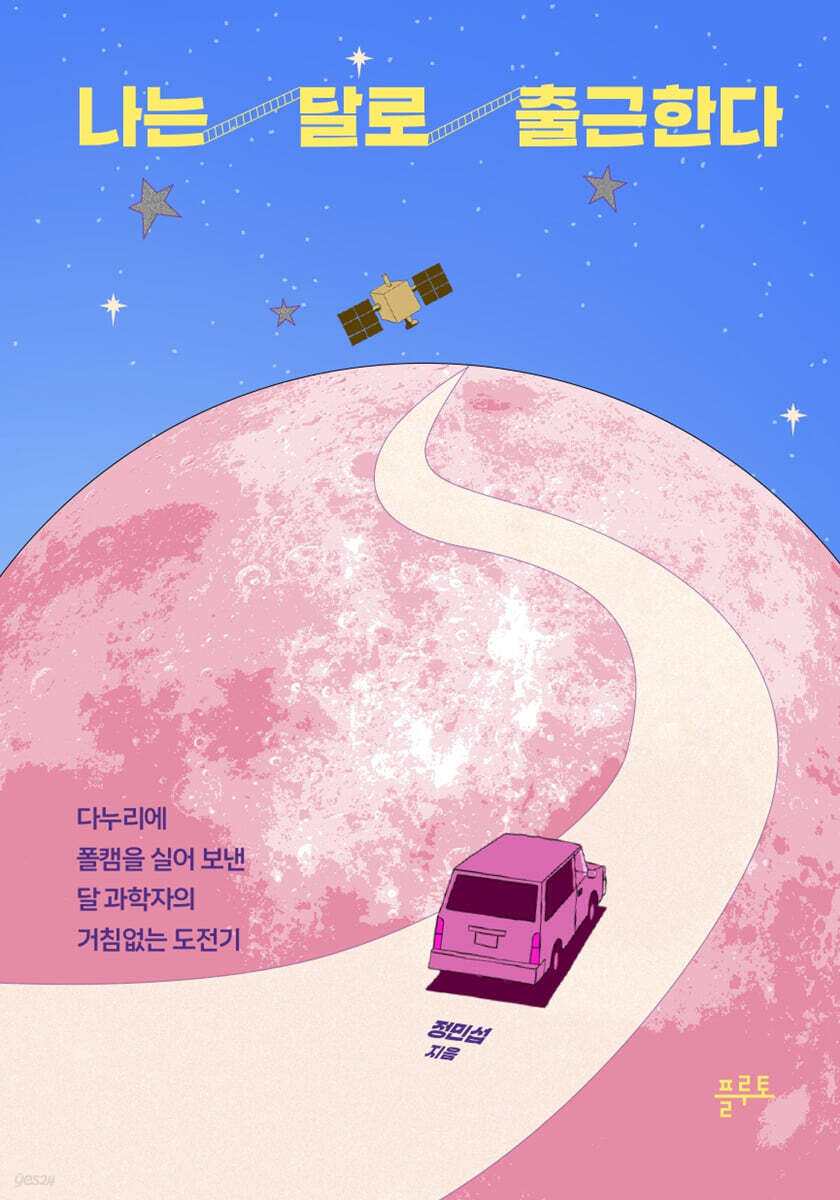
I commute to work on the moon
 |
Description
Book Introduction
"I Go to Work on the Moon" is a book that records the journey of a graduate student studying the moon in a country that had no lunar probes, becoming a lunar scientist, and the development process of Korea's first lunar probe, Danuri, and its payload, Polcam.
On June 21, 2022, the second launch of the Korean launch vehicle Nuri was successfully conducted at the Naro Space Center in Goheung-gun, Jeollanam-do.
Soon after, on August 5th, Korea's first lunar orbiter, Danuri, was successfully launched.
With the launch of Nuri and Danuri, our country became the seventh country in the world capable of launching satellites on its own.
Danuri is Korea's first probe to leave Earth and orbit the moon.
With the launch of Danuri, South Korea has gained the ability to escape Earth's gravity and reach its target location, as well as the ability to precisely control a satellite that can use the gravity of another celestial body to achieve orbital motion.
It also has communications capabilities that allow it to operate satellites 400,000 kilometers from Earth and download and analyze data obtained from them.
Danuri, which celebrated its third anniversary this year, is still orbiting the moon and performing observation missions.
Among the six scientific payloads mounted on Danuri is the world's first wide-field polarization camera (PolCam).
Polcam has mapped the entire moon and is currently creating a polarization map of the lunar surface by analyzing the direction in which objects scatter light (polarization).
The author of "I Go to Work on the Moon" says he didn't want to write a dry report about his experiences participating in a historic national project.
There are many stories hidden in it, such as the story of how he became one of less than ten lunar scientists in Korea, the time he spent balancing research and childcare as a husband and father of three, the difference between scientists and engineers and the importance of collaboration felt while working on the Polcam development team, the struggle to maintain the circular orbit and mission duration, and the author's DNA going into space because of nasal mucus that flowed into the Polcam.
Space is no longer a distant dream; it is becoming a reality.
Let's take a look at the development process of Danuri, Korea's first journey beyond Earth, as told by the author, who has now become a lunar scientist in a country with a lunar probe.
On June 21, 2022, the second launch of the Korean launch vehicle Nuri was successfully conducted at the Naro Space Center in Goheung-gun, Jeollanam-do.
Soon after, on August 5th, Korea's first lunar orbiter, Danuri, was successfully launched.
With the launch of Nuri and Danuri, our country became the seventh country in the world capable of launching satellites on its own.
Danuri is Korea's first probe to leave Earth and orbit the moon.
With the launch of Danuri, South Korea has gained the ability to escape Earth's gravity and reach its target location, as well as the ability to precisely control a satellite that can use the gravity of another celestial body to achieve orbital motion.
It also has communications capabilities that allow it to operate satellites 400,000 kilometers from Earth and download and analyze data obtained from them.
Danuri, which celebrated its third anniversary this year, is still orbiting the moon and performing observation missions.
Among the six scientific payloads mounted on Danuri is the world's first wide-field polarization camera (PolCam).
Polcam has mapped the entire moon and is currently creating a polarization map of the lunar surface by analyzing the direction in which objects scatter light (polarization).
The author of "I Go to Work on the Moon" says he didn't want to write a dry report about his experiences participating in a historic national project.
There are many stories hidden in it, such as the story of how he became one of less than ten lunar scientists in Korea, the time he spent balancing research and childcare as a husband and father of three, the difference between scientists and engineers and the importance of collaboration felt while working on the Polcam development team, the struggle to maintain the circular orbit and mission duration, and the author's DNA going into space because of nasal mucus that flowed into the Polcam.
Space is no longer a distant dream; it is becoming a reality.
Let's take a look at the development process of Danuri, Korea's first journey beyond Earth, as told by the author, who has now become a lunar scientist in a country with a lunar probe.
- You can preview some of the book's contents.
Preview
index
Recommendation
Author's Note
PART 1 The Road to the Moon
Chapter 1: Lunar Scientists from a Country Without a Lunar Probe
Astronomy, does it pay?
Suddenly you want me to do lunar science?
A lunar scientist from a country without a single lunar probe
Why there is no polarization map of the moon
Observatory by the lake
Chapter 2: Lunar Science: From the World's Oldest Observatory Warehouse
Go to Rick Observatory
Lunar Science Starts in the World's Best Observatory Warehouse
A day of over 40 hours
Wild animal attack
A noble person I met in Germany
Chapter 3: Dreaming of Lunar Exploration
The first presentation is the best
The Beginning of the Planetary Science Avengers
Chapter 4 We're Going to the Moon Too
South Korea Joins the Race to the Moon
Can we go to the moon in 3 years?
Sudden call for pre-registration letters of intent
A scientific payload research team without engineers
Selected for the Science Payload Competition
Danuri's payloads
PART 2 Space Exploration Science Payload PoleCam
Chapter 5: Entering the development of the pole cam
A new beginning at the Astronomical Observatory
Development of complex space exploration systems
First Danuri Researchers' Meeting
Science payloads, the crown jewel of space missions
Am I a scientist or an engineer?
Polcam's optical design decisions
The Difference Between Scientists and Engineers as Discovered During the Development of Polcam
I lost my beginner's mind
Are lunar scientists impure scientists?
Defend the orbit
Chapter 6 Until the day Danuri is launched
Weight, weight again
NASA's influence in space exploration
Test beyond test
My DNA went into space
The culmination of six years of development on the Polcam
Final rehearsal to ensure the safe delivery of the pole cam
Launch amid tension
First light, steamed buns?
Moon photos arrived! Camera 2 malfunction?
Beyond lunar exploration
Author's Note
PART 1 The Road to the Moon
Chapter 1: Lunar Scientists from a Country Without a Lunar Probe
Astronomy, does it pay?
Suddenly you want me to do lunar science?
A lunar scientist from a country without a single lunar probe
Why there is no polarization map of the moon
Observatory by the lake
Chapter 2: Lunar Science: From the World's Oldest Observatory Warehouse
Go to Rick Observatory
Lunar Science Starts in the World's Best Observatory Warehouse
A day of over 40 hours
Wild animal attack
A noble person I met in Germany
Chapter 3: Dreaming of Lunar Exploration
The first presentation is the best
The Beginning of the Planetary Science Avengers
Chapter 4 We're Going to the Moon Too
South Korea Joins the Race to the Moon
Can we go to the moon in 3 years?
Sudden call for pre-registration letters of intent
A scientific payload research team without engineers
Selected for the Science Payload Competition
Danuri's payloads
PART 2 Space Exploration Science Payload PoleCam
Chapter 5: Entering the development of the pole cam
A new beginning at the Astronomical Observatory
Development of complex space exploration systems
First Danuri Researchers' Meeting
Science payloads, the crown jewel of space missions
Am I a scientist or an engineer?
Polcam's optical design decisions
The Difference Between Scientists and Engineers as Discovered During the Development of Polcam
I lost my beginner's mind
Are lunar scientists impure scientists?
Defend the orbit
Chapter 6 Until the day Danuri is launched
Weight, weight again
NASA's influence in space exploration
Test beyond test
My DNA went into space
The culmination of six years of development on the Polcam
Final rehearsal to ensure the safe delivery of the pole cam
Launch amid tension
First light, steamed buns?
Moon photos arrived! Camera 2 malfunction?
Beyond lunar exploration
Detailed image

Into the book
The adults' reaction was not very enthusiastic.
Some asked with affectionate eyes, others with pitiful ones.
"Astronomy? Does that pay? I'd be happy if I studied hard and became a judge or prosecutor, or graduated from a good university and got a good job and a steady salary." Thirty percent of adults said this, 69 percent were indifferent, and only 1 percent truly supported my dream.
That 1 percent were my parents.
--- p.18
The moon has all the traces.
On the moon, it does not rain, the wind does not blow, there are no rivers or seas.
Thanks to this, traces that have once been created do not disappear and are preserved for a long time.
As if it were a backup of Earth's history.
It was fascinating because it was paradoxically the most dynamic field of study because it was so calm without rain, wind, rivers, or seas.
I had a pleasant conversation with my advisor for hours about research topics we could pursue, as outlined in the papers we had read over the past few days.
At the end of that conversation, I decided to become a lunar scientist.
--- p.24
Somehow, it seemed like this time our country would really build a probe and send it to the moon.
This is because all the leading presidential candidates strongly advocated for lunar exploration, and the media gave it extensive coverage, heightening national interest.
Above all, news continued to emerge that Japan had succeeded not only in lunar exploration but also in asteroid exploration, a task that required a high level of technical difficulty, and that it was continuously carrying out space exploration missions.
As the achievements of Japan, our eternal rival, in space exploration became known, the need for lunar exploration arose nationwide.
When the US explores Pluto, we say, "That's amazing," but when Japan does it, South Korea says, "What are we doing?"
Afterwards, the Korea Pathfinder Lunar Orbiter (KPLO) project for the Korean lunar exploration test vehicle (Danuri) officially began in September 2014 after completing a preliminary feasibility study.
--- p.89~90
The Polcam proposed by our team is the world's first lunar orbit polarimetric camera.
Polarization data is useful data that can provide information on the particle size, roughness, and porosity (the proportion of empty space within rocks or soil) of the lunar surface, and when it was first proposed, it received much welcome and interest from many overseas researchers.
The polarization camera will enable research on the evolution of the lunar surface and the space environment, and as it is the first observation device of its kind, it is a scientific payload expected to yield significant scientific results.
--- p.111~112
Any space exploration mission begins with deciding what information to obtain from space.
This process is led by scientists.
Scientists consider what scientific equipment they need to obtain information about the subject of their exploration, and this becomes the goal of the mission.
The data collected by scientific instruments are the result of exploration missions.
The collected data will reveal scientific facts about the subject of exploration and provide a foundation for conducting future space exploration in a more precise and advanced manner.
So, the probe's scientific payload is the beginning and goal of the mission, as well as its result and future.
Of course, no matter how excellent the scientific payload is that can perform a scientific mission, it is of no use if the probe cannot reach its target.
Engineers create the foundation upon which this exploration mission can be undertaken.
Science is like a flower that grows on the foundation of engineering.
Science cannot flourish and flourish if engineering is not strong and abundant.
Moreover, engineering starts from scientific facts.
Without a theoretical knowledge of quantum mechanics, we would not have been able to understand the principles of quantum computer development today.
In other words, science and engineering are in a symbiotic relationship, each dependent on the other.
--- p.140~141
The probe development team, with a heavy heart, asked the science payload development team to consider an elliptical orbit mission.
However, the satellite's orbit is determined by the purpose of the exploration mission.
In other words, if the orbit changes, the missions that can be performed also change, and if Danuri changes to an elliptical orbit, all scientific payloads will not be able to achieve their mission objectives.
In fact, an analysis of the effects of elliptical orbits on all of Danuri's payloads concluded that the mission would fail.
The probe development team had to find a way to maintain the circular orbit again.
Ultimately, this problem was solved by changing the lunar transfer orbit, which will be explained later, to conserve fuel, and maintain the original circular orbit at an altitude of 100 kilometers.
--- p.181
After finishing testing the first camera of the polecam, I got up to test the second camera.
To loosen the bolts that secure the camera to the light source, I had to loosen the bolts further back to allow the other camera to see the light source.
As I bent down, something dripped down from my mask.
For a moment, my body froze.
Looking down, I saw mucus seeping through the mask and into the inside of the Polcam's flight model.
Panicked, I unplugged the polecam and wiped it with optical tissue and alcohol.
However, the part that had seeped into the complex structure could not be wiped away.
After assessing the situation, I contacted Dr. Bong-Gon Moon, a system engineer, and explained the situation.
The doctor came running and checked the condition.
Fortunately, it did not penetrate to the electronic circuit board, and only the inside of the aluminum case and the gaps were contaminated.
If something goes wrong with the operation, it could add hundreds of millions of won to the cost and delay the schedule by several months.
The meeting was called because of a runny nose.
Dr. Choi Young-jun, Dr. Moon Bong-gon, and I sat down to discuss the problem of runny nose.
I felt a surge of self-loathing as I explained the current situation, which started with rhinitis symptoms and how the mucus inside the mask started to drip down.
--- p.204
The observation time was so short that I didn't even have time to calm my nervous mind before the data processing completion message appeared.
I opened the image right away and saw the Earth and the moon shining brightly in the shape of a steamed bun in the darkness of space.
The first signal from Polcam, sent from a distance of 700,000 kilometers from Earth, appeared on my computer monitor for the first time.
I had assumed the polecam would work properly, but after actually checking it, the small worry that had lingered in my mind even after the successful launch was finally alleviated.
--- p.228~229
Our country has become the seventh country in the world to send a satellite to the moon, and has entered the space exploration race in earnest.
In step with this, the government opened the National Aeronautics and Space Administration, a space exploration agency similar to NASA, and opened the door to a full-fledged era of space exploration.
The development of the industrial world is even more dazzling.
In the early days of the Danuri project, there were only a handful of domestic companies with experience handling space payloads.
Now, startups are developing their own space launch vehicles and lunar exploration rovers, and large domestic companies are also actively entering the space industry.
Through Danuri, our country's space exploration ecosystem has sown countless human and material seeds.
However, for these seeds to fully sprout and grow into large, sturdy trees that support the nation, much attention and effort is needed.
The most important thing is persistence.
Some asked with affectionate eyes, others with pitiful ones.
"Astronomy? Does that pay? I'd be happy if I studied hard and became a judge or prosecutor, or graduated from a good university and got a good job and a steady salary." Thirty percent of adults said this, 69 percent were indifferent, and only 1 percent truly supported my dream.
That 1 percent were my parents.
--- p.18
The moon has all the traces.
On the moon, it does not rain, the wind does not blow, there are no rivers or seas.
Thanks to this, traces that have once been created do not disappear and are preserved for a long time.
As if it were a backup of Earth's history.
It was fascinating because it was paradoxically the most dynamic field of study because it was so calm without rain, wind, rivers, or seas.
I had a pleasant conversation with my advisor for hours about research topics we could pursue, as outlined in the papers we had read over the past few days.
At the end of that conversation, I decided to become a lunar scientist.
--- p.24
Somehow, it seemed like this time our country would really build a probe and send it to the moon.
This is because all the leading presidential candidates strongly advocated for lunar exploration, and the media gave it extensive coverage, heightening national interest.
Above all, news continued to emerge that Japan had succeeded not only in lunar exploration but also in asteroid exploration, a task that required a high level of technical difficulty, and that it was continuously carrying out space exploration missions.
As the achievements of Japan, our eternal rival, in space exploration became known, the need for lunar exploration arose nationwide.
When the US explores Pluto, we say, "That's amazing," but when Japan does it, South Korea says, "What are we doing?"
Afterwards, the Korea Pathfinder Lunar Orbiter (KPLO) project for the Korean lunar exploration test vehicle (Danuri) officially began in September 2014 after completing a preliminary feasibility study.
--- p.89~90
The Polcam proposed by our team is the world's first lunar orbit polarimetric camera.
Polarization data is useful data that can provide information on the particle size, roughness, and porosity (the proportion of empty space within rocks or soil) of the lunar surface, and when it was first proposed, it received much welcome and interest from many overseas researchers.
The polarization camera will enable research on the evolution of the lunar surface and the space environment, and as it is the first observation device of its kind, it is a scientific payload expected to yield significant scientific results.
--- p.111~112
Any space exploration mission begins with deciding what information to obtain from space.
This process is led by scientists.
Scientists consider what scientific equipment they need to obtain information about the subject of their exploration, and this becomes the goal of the mission.
The data collected by scientific instruments are the result of exploration missions.
The collected data will reveal scientific facts about the subject of exploration and provide a foundation for conducting future space exploration in a more precise and advanced manner.
So, the probe's scientific payload is the beginning and goal of the mission, as well as its result and future.
Of course, no matter how excellent the scientific payload is that can perform a scientific mission, it is of no use if the probe cannot reach its target.
Engineers create the foundation upon which this exploration mission can be undertaken.
Science is like a flower that grows on the foundation of engineering.
Science cannot flourish and flourish if engineering is not strong and abundant.
Moreover, engineering starts from scientific facts.
Without a theoretical knowledge of quantum mechanics, we would not have been able to understand the principles of quantum computer development today.
In other words, science and engineering are in a symbiotic relationship, each dependent on the other.
--- p.140~141
The probe development team, with a heavy heart, asked the science payload development team to consider an elliptical orbit mission.
However, the satellite's orbit is determined by the purpose of the exploration mission.
In other words, if the orbit changes, the missions that can be performed also change, and if Danuri changes to an elliptical orbit, all scientific payloads will not be able to achieve their mission objectives.
In fact, an analysis of the effects of elliptical orbits on all of Danuri's payloads concluded that the mission would fail.
The probe development team had to find a way to maintain the circular orbit again.
Ultimately, this problem was solved by changing the lunar transfer orbit, which will be explained later, to conserve fuel, and maintain the original circular orbit at an altitude of 100 kilometers.
--- p.181
After finishing testing the first camera of the polecam, I got up to test the second camera.
To loosen the bolts that secure the camera to the light source, I had to loosen the bolts further back to allow the other camera to see the light source.
As I bent down, something dripped down from my mask.
For a moment, my body froze.
Looking down, I saw mucus seeping through the mask and into the inside of the Polcam's flight model.
Panicked, I unplugged the polecam and wiped it with optical tissue and alcohol.
However, the part that had seeped into the complex structure could not be wiped away.
After assessing the situation, I contacted Dr. Bong-Gon Moon, a system engineer, and explained the situation.
The doctor came running and checked the condition.
Fortunately, it did not penetrate to the electronic circuit board, and only the inside of the aluminum case and the gaps were contaminated.
If something goes wrong with the operation, it could add hundreds of millions of won to the cost and delay the schedule by several months.
The meeting was called because of a runny nose.
Dr. Choi Young-jun, Dr. Moon Bong-gon, and I sat down to discuss the problem of runny nose.
I felt a surge of self-loathing as I explained the current situation, which started with rhinitis symptoms and how the mucus inside the mask started to drip down.
--- p.204
The observation time was so short that I didn't even have time to calm my nervous mind before the data processing completion message appeared.
I opened the image right away and saw the Earth and the moon shining brightly in the shape of a steamed bun in the darkness of space.
The first signal from Polcam, sent from a distance of 700,000 kilometers from Earth, appeared on my computer monitor for the first time.
I had assumed the polecam would work properly, but after actually checking it, the small worry that had lingered in my mind even after the successful launch was finally alleviated.
--- p.228~229
Our country has become the seventh country in the world to send a satellite to the moon, and has entered the space exploration race in earnest.
In step with this, the government opened the National Aeronautics and Space Administration, a space exploration agency similar to NASA, and opened the door to a full-fledged era of space exploration.
The development of the industrial world is even more dazzling.
In the early days of the Danuri project, there were only a handful of domestic companies with experience handling space payloads.
Now, startups are developing their own space launch vehicles and lunar exploration rovers, and large domestic companies are also actively entering the space industry.
Through Danuri, our country's space exploration ecosystem has sown countless human and material seeds.
However, for these seeds to fully sprout and grow into large, sturdy trees that support the nation, much attention and effort is needed.
The most important thing is persistence.
--- p.236
Publisher's Review
As we follow the journey of a researcher who started out on the bare ground in a time when even the profession of lunar scientist was unfamiliar, we come to realize how intense and beautiful the process of turning a dream into reality is.
Kang Sung-joo, astrophysicist and science communicator
Follow the vivid story of a determined lunar scientist who, if something doesn't exist, creates it, and if it can't be done, makes it happen. Let's run to the observatory rooftop, the parking lot where wild animals appear, and the clean room where tears and other things flow.
Sim Chae-kyung, astronomer and director of the Planetary Exploration Center at the Korea Astronomy and Space Science Institute
Knowing that it is never easy, it is always exciting to witness the process of 'dream-making' demonstrated by those who have grasped the easily scattered dreams with both hands.
Because the experience of following such a journey together always leads to a sense of being.
Harihara_Lee Eun-hee, science communicator
In the history of space exploration, a country without a single lunar probe
Setting a new milestone!
The year 2022 is a very significant year in the history of our country's space development and exploration.
On June 21, the second test launch of the Korean launch vehicle Nuri was successful at the Naro Space Center in Goheung-gun, Jeollanam-do.
On August 5, Korea successfully launched its first lunar orbiter, Danuri.
With the launch of Nuri and Danuri, our country became the seventh country in the world capable of launching satellites on its own.
Danuri holds a very important meaning in our country's space exploration plan.
Danuri is Korea's first probe to leave Earth and a satellite orbiting the moon.
Through Danuri, Korea has secured the ability to escape Earth's gravity and reach a target location, and the ability to precisely control a satellite that can orbit using the gravity of celestial bodies other than Earth.
It also has the communications capability to operate satellites 400,000 kilometers away from Earth and download and analyze data obtained from them.
Danuri is still functioning well beyond its intended one-year lunar exploration mission, with its mission scheduled to end in March 2028 with an impact on the lunar surface.
Danuri carries a total of six scientific payloads that perform specific scientific missions.
Among them, there is the world's first wide-field polarization camera, or PolCam, developed by the Korea Astronomy and Space Science Institute.
Meanwhile, Polcam has completed a complete map of the Moon and is currently creating a polarization map of the lunar surface by analyzing the direction in which objects scatter light (polarization).
The author of "I Go to Work on the Moon" is a lunar scientist who participated in the development team for the Polcam and sent it to the moon.
The moon is once again becoming a stage for humanity.
The United States is pursuing the Artemis program, which will send humans to the moon for the first time since the Apollo program, and India has become the first country in the world to land an unmanned probe on the moon's south pole.
Russia and Japan are also sending landers to the lunar surface one after another.
The author says that as a scientist who participated in the development of Korea's first lunar probe, Danuri, he wanted to share the process with readers.
However, this book is not a simple and dry report.
Hidden here are countless stories of a scientist's joys and sorrows.
I sent the pole cam to Danuri
A Lunar Scientist's Tearful and Unstoppable Journey
Since I was in middle school, whenever someone asked me what my dream was, I always answered, "To be an astronomer."
After graduating from the university's astronomy department, he went on to graduate school to study galaxy simulation and computer simulation.
Then, after reading a paper recommended by his advisor and recommending lunar science research, he felt a new fascination with the moon and decided to become a lunar scientist, one of less than ten people in Korea.
Seeing that there is little research on polarization, the author takes up the topic of research on analyzing data by observing the lunar surface using polarization.
Afterwards, as a graduate student at the Korean Astronomical Society, he presented the results of his research on how lunar swirls (areas of relatively strong magnetic fields on the lunar surface with almost no magnetic field) are created using the particle size of the lunar surface.
The announcement that day changed the author's life drastically.
Dr. Choi Young-jun of the Korea Astronomy and Space Science Institute, who had been gathering researchers related to lunar exploration because he felt the need for it, came to visit after the presentation.
They meet regularly to begin working on making a polarimetric camera for lunar exploration a reality.
In September 2014, the Korean lunar exploration test lunar orbiter (Danuri) project was officially launched, and in January 2016, the Korea Astronomy and Space Science Institute's Polcam was selected as the scientific payload to be mounted on Danuri.
Polcam is a lunar orbit polarimetric camera.
Polarimetric cameras can be used to study the evolution of the lunar surface and the space environment by providing useful information such as grain size, roughness, and porosity (the proportion of empty space within rocks or soil) of the lunar surface.
The scientific goals of the camera evolved from the author's research topic.
From this point on, the development of Polcam took place over six years, a process of trial and error and struggle for the author and development team.
When I moved to the Korea Astronomy and Space Science Institute to fully devote myself to developing the polecam, I encountered my first hurdle.
At the time, the author was a graduate student and a married father of three children.
While the author was engrossed in his research, his wife, who had been raising their three children alone, collapsed.
From that day on, I started looking for ways to help raise my children, even if it was just a little, and I adapted by working at dawn.
The Polcam development team experiences communication problems due to differences between scientists and engineers.
A representative example is the problem of recording observation (shooting) time of the pole cam.
Observation time is extremely important because it will soon be converted to observation position.
Scientists thought the shooting time was the moment the camera shutter was pressed, while electronic engineers thought it was the moment after the shutter was pressed that the image information was compressed, which caused errors in the device.
The author says that as time went on and he worked together to solve problems, he came to understand the fundamental differences between scientists and engineers, and he learned a lot from collaborating with researchers from various fields.
One day, I received an email from the probe development team asking me to analyze the problems that would occur with the polcam if Danuri's mission orbit were changed from a circular orbit to an elliptical orbit.
Danuri is an artificial satellite that orbits the moon at an altitude of 100 kilometers above the lunar surface.
On the other hand, the elliptical orbit continuously changes its distance from the lunar surface, from 100 kilometers when it is close to the surface to 300 kilometers when it is far away.
If the distance keeps changing like this, the camera of the probe, which is set to a mission altitude of 100 kilometers, becomes extremely inefficient.
There was much discussion about this issue, and it was decided to maintain the original circular orbit at an altitude of 100 kilometers.
Who could have imagined something like this would happen? Space probes require extremely high standards of cleanliness and controlled environments, so they are manufactured and stored in clean rooms.
However, while testing the camera in a clean room, an emergency situation occurred where the author's nasal mucus ran down his mask and seeped into the inside of the camera.
An emergency meeting is held over a runny nose, and only after the pole cam is disassembled and cleaned internally and all functions are confirmed to be working properly can we feel relieved.
Perhaps the author's mucous membrane or DNA is orbiting somewhere in the Polcam.
In December 2020, the Polcam development team successfully delivered Polcam to the Korea Aerospace Research Institute.
And on August 5, 2022, it entered lunar orbit aboard SpaceX Falcon 9 from the Cape Canaveral Space Force Station in Florida, USA.
On November 28, about four months after launch, the historic first light of Polcam occurred.
Danuri is still carrying out the lunar orbit mission that has been a long-cherished dream of our country's scientists.
Polcam is also faithfully carrying out his duties.
“Polcam will transmit polarized images of the lunar surface every day until Danuri is no longer functioning.
And through the scientific data sent by Polcam, we will discover the truth that God has hidden in the universe, one by one.”
A lunar scientist from a country that had never had a lunar probe has finally become the scientist who sent a satellite to the moon.
"I Go to Work on the Moon" will thrill our hearts through the journey of a scientist who runs relentlessly toward his dream.
Beyond the Moon to the planets of our solar system
If scientists continue to send satellites,
Only seven countries in the world have sent scientific probes to the moon.
Having the technology to go to the moon means having the ability to send probes anywhere in the solar system.
Through Danuri, we have secured the ability to explore deep space.
However, Danuri is only the beginning of our country's space exploration.
"I Go to Work on the Moon" emphasizes that the most important thing in growing a seed sown in Danuri into a giant tree is sustainability.
The United States, India, and Russia are excellent examples of how important sustainability is in space exploration.
The United States has made continuous efforts to ensure that the technologies developed since the Apollo program do not disappear.
As a result, it became an overwhelming space exploration powerhouse.
India has continued to invest steadily in space exploration despite its GDP being only about one-twelfth of ours.
As a result, India has successfully sent lunar probes three times and became the first country in the world to send a lander to the lunar south pole.
Russia is a great example for us.
Once a leader in space exploration, successfully launching the world's first artificial satellite, the first manned spaceflight, and the first lunar probe, it lost out in the space race with the United States and cut itself off from exploration, resulting in its failure to land on the moon in 2024, a success it had achieved 50 years earlier.
For our country's space exploration to advance beyond the moon, we must continue to have scientists who send satellites to Mars, Jupiter, Saturn, Uranus, and Neptune.
It will not be easy to fully mobilize the nation's capabilities and capital for space exploration like the United States.
Fortunately, while developing Danuri, the number of scientists studying lunar science and companies actively entering the space industry increased.
To further expand our human and material foundation, continued attention and investment are needed to ensure we don't lose what we've achieved so far.
"I Go to Work on the Moon" contains the author's hope that this book will serve as a stepping stone to spark and sustain people's interest in space exploration.
Kang Sung-joo, astrophysicist and science communicator
Follow the vivid story of a determined lunar scientist who, if something doesn't exist, creates it, and if it can't be done, makes it happen. Let's run to the observatory rooftop, the parking lot where wild animals appear, and the clean room where tears and other things flow.
Sim Chae-kyung, astronomer and director of the Planetary Exploration Center at the Korea Astronomy and Space Science Institute
Knowing that it is never easy, it is always exciting to witness the process of 'dream-making' demonstrated by those who have grasped the easily scattered dreams with both hands.
Because the experience of following such a journey together always leads to a sense of being.
Harihara_Lee Eun-hee, science communicator
In the history of space exploration, a country without a single lunar probe
Setting a new milestone!
The year 2022 is a very significant year in the history of our country's space development and exploration.
On June 21, the second test launch of the Korean launch vehicle Nuri was successful at the Naro Space Center in Goheung-gun, Jeollanam-do.
On August 5, Korea successfully launched its first lunar orbiter, Danuri.
With the launch of Nuri and Danuri, our country became the seventh country in the world capable of launching satellites on its own.
Danuri holds a very important meaning in our country's space exploration plan.
Danuri is Korea's first probe to leave Earth and a satellite orbiting the moon.
Through Danuri, Korea has secured the ability to escape Earth's gravity and reach a target location, and the ability to precisely control a satellite that can orbit using the gravity of celestial bodies other than Earth.
It also has the communications capability to operate satellites 400,000 kilometers away from Earth and download and analyze data obtained from them.
Danuri is still functioning well beyond its intended one-year lunar exploration mission, with its mission scheduled to end in March 2028 with an impact on the lunar surface.
Danuri carries a total of six scientific payloads that perform specific scientific missions.
Among them, there is the world's first wide-field polarization camera, or PolCam, developed by the Korea Astronomy and Space Science Institute.
Meanwhile, Polcam has completed a complete map of the Moon and is currently creating a polarization map of the lunar surface by analyzing the direction in which objects scatter light (polarization).
The author of "I Go to Work on the Moon" is a lunar scientist who participated in the development team for the Polcam and sent it to the moon.
The moon is once again becoming a stage for humanity.
The United States is pursuing the Artemis program, which will send humans to the moon for the first time since the Apollo program, and India has become the first country in the world to land an unmanned probe on the moon's south pole.
Russia and Japan are also sending landers to the lunar surface one after another.
The author says that as a scientist who participated in the development of Korea's first lunar probe, Danuri, he wanted to share the process with readers.
However, this book is not a simple and dry report.
Hidden here are countless stories of a scientist's joys and sorrows.
I sent the pole cam to Danuri
A Lunar Scientist's Tearful and Unstoppable Journey
Since I was in middle school, whenever someone asked me what my dream was, I always answered, "To be an astronomer."
After graduating from the university's astronomy department, he went on to graduate school to study galaxy simulation and computer simulation.
Then, after reading a paper recommended by his advisor and recommending lunar science research, he felt a new fascination with the moon and decided to become a lunar scientist, one of less than ten people in Korea.
Seeing that there is little research on polarization, the author takes up the topic of research on analyzing data by observing the lunar surface using polarization.
Afterwards, as a graduate student at the Korean Astronomical Society, he presented the results of his research on how lunar swirls (areas of relatively strong magnetic fields on the lunar surface with almost no magnetic field) are created using the particle size of the lunar surface.
The announcement that day changed the author's life drastically.
Dr. Choi Young-jun of the Korea Astronomy and Space Science Institute, who had been gathering researchers related to lunar exploration because he felt the need for it, came to visit after the presentation.
They meet regularly to begin working on making a polarimetric camera for lunar exploration a reality.
In September 2014, the Korean lunar exploration test lunar orbiter (Danuri) project was officially launched, and in January 2016, the Korea Astronomy and Space Science Institute's Polcam was selected as the scientific payload to be mounted on Danuri.
Polcam is a lunar orbit polarimetric camera.
Polarimetric cameras can be used to study the evolution of the lunar surface and the space environment by providing useful information such as grain size, roughness, and porosity (the proportion of empty space within rocks or soil) of the lunar surface.
The scientific goals of the camera evolved from the author's research topic.
From this point on, the development of Polcam took place over six years, a process of trial and error and struggle for the author and development team.
When I moved to the Korea Astronomy and Space Science Institute to fully devote myself to developing the polecam, I encountered my first hurdle.
At the time, the author was a graduate student and a married father of three children.
While the author was engrossed in his research, his wife, who had been raising their three children alone, collapsed.
From that day on, I started looking for ways to help raise my children, even if it was just a little, and I adapted by working at dawn.
The Polcam development team experiences communication problems due to differences between scientists and engineers.
A representative example is the problem of recording observation (shooting) time of the pole cam.
Observation time is extremely important because it will soon be converted to observation position.
Scientists thought the shooting time was the moment the camera shutter was pressed, while electronic engineers thought it was the moment after the shutter was pressed that the image information was compressed, which caused errors in the device.
The author says that as time went on and he worked together to solve problems, he came to understand the fundamental differences between scientists and engineers, and he learned a lot from collaborating with researchers from various fields.
One day, I received an email from the probe development team asking me to analyze the problems that would occur with the polcam if Danuri's mission orbit were changed from a circular orbit to an elliptical orbit.
Danuri is an artificial satellite that orbits the moon at an altitude of 100 kilometers above the lunar surface.
On the other hand, the elliptical orbit continuously changes its distance from the lunar surface, from 100 kilometers when it is close to the surface to 300 kilometers when it is far away.
If the distance keeps changing like this, the camera of the probe, which is set to a mission altitude of 100 kilometers, becomes extremely inefficient.
There was much discussion about this issue, and it was decided to maintain the original circular orbit at an altitude of 100 kilometers.
Who could have imagined something like this would happen? Space probes require extremely high standards of cleanliness and controlled environments, so they are manufactured and stored in clean rooms.
However, while testing the camera in a clean room, an emergency situation occurred where the author's nasal mucus ran down his mask and seeped into the inside of the camera.
An emergency meeting is held over a runny nose, and only after the pole cam is disassembled and cleaned internally and all functions are confirmed to be working properly can we feel relieved.
Perhaps the author's mucous membrane or DNA is orbiting somewhere in the Polcam.
In December 2020, the Polcam development team successfully delivered Polcam to the Korea Aerospace Research Institute.
And on August 5, 2022, it entered lunar orbit aboard SpaceX Falcon 9 from the Cape Canaveral Space Force Station in Florida, USA.
On November 28, about four months after launch, the historic first light of Polcam occurred.
Danuri is still carrying out the lunar orbit mission that has been a long-cherished dream of our country's scientists.
Polcam is also faithfully carrying out his duties.
“Polcam will transmit polarized images of the lunar surface every day until Danuri is no longer functioning.
And through the scientific data sent by Polcam, we will discover the truth that God has hidden in the universe, one by one.”
A lunar scientist from a country that had never had a lunar probe has finally become the scientist who sent a satellite to the moon.
"I Go to Work on the Moon" will thrill our hearts through the journey of a scientist who runs relentlessly toward his dream.
Beyond the Moon to the planets of our solar system
If scientists continue to send satellites,
Only seven countries in the world have sent scientific probes to the moon.
Having the technology to go to the moon means having the ability to send probes anywhere in the solar system.
Through Danuri, we have secured the ability to explore deep space.
However, Danuri is only the beginning of our country's space exploration.
"I Go to Work on the Moon" emphasizes that the most important thing in growing a seed sown in Danuri into a giant tree is sustainability.
The United States, India, and Russia are excellent examples of how important sustainability is in space exploration.
The United States has made continuous efforts to ensure that the technologies developed since the Apollo program do not disappear.
As a result, it became an overwhelming space exploration powerhouse.
India has continued to invest steadily in space exploration despite its GDP being only about one-twelfth of ours.
As a result, India has successfully sent lunar probes three times and became the first country in the world to send a lander to the lunar south pole.
Russia is a great example for us.
Once a leader in space exploration, successfully launching the world's first artificial satellite, the first manned spaceflight, and the first lunar probe, it lost out in the space race with the United States and cut itself off from exploration, resulting in its failure to land on the moon in 2024, a success it had achieved 50 years earlier.
For our country's space exploration to advance beyond the moon, we must continue to have scientists who send satellites to Mars, Jupiter, Saturn, Uranus, and Neptune.
It will not be easy to fully mobilize the nation's capabilities and capital for space exploration like the United States.
Fortunately, while developing Danuri, the number of scientists studying lunar science and companies actively entering the space industry increased.
To further expand our human and material foundation, continued attention and investment are needed to ensure we don't lose what we've achieved so far.
"I Go to Work on the Moon" contains the author's hope that this book will serve as a stepping stone to spark and sustain people's interest in space exploration.
GOODS SPECIFICS
- Date of issue: August 25, 2025
- Page count, weight, size: 240 pages | 340g | 147*210*15mm
- ISBN13: 9791188569847
- ISBN10: 1188569848
You may also like
카테고리
korean


korean

![GQ KOREA Mark (Monthly): December [2025]](http://librairie.coreenne.fr/cdn/shop/files/8ef265dbbfbf186523ed75ba7319009d.jpg?v=1765340328&width=3840)


