

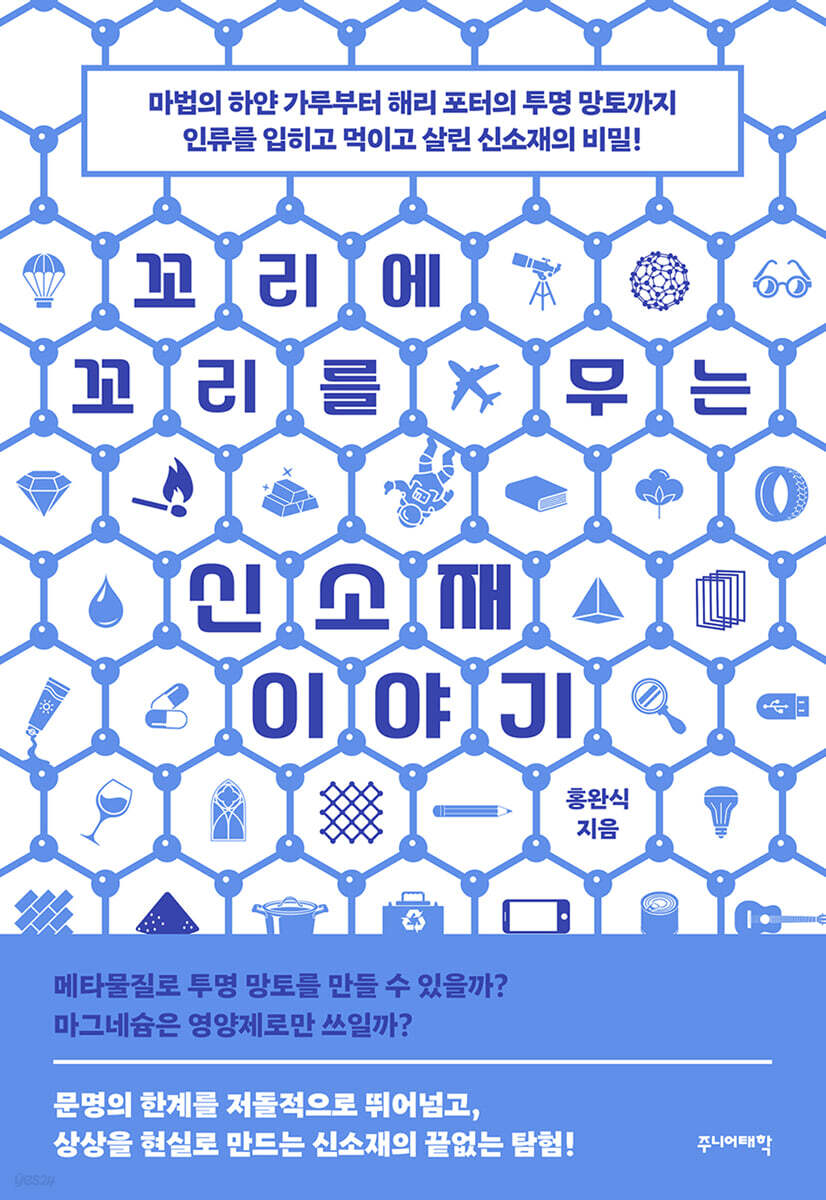
A story of new materials that keeps on going
 |
Description
Book Introduction
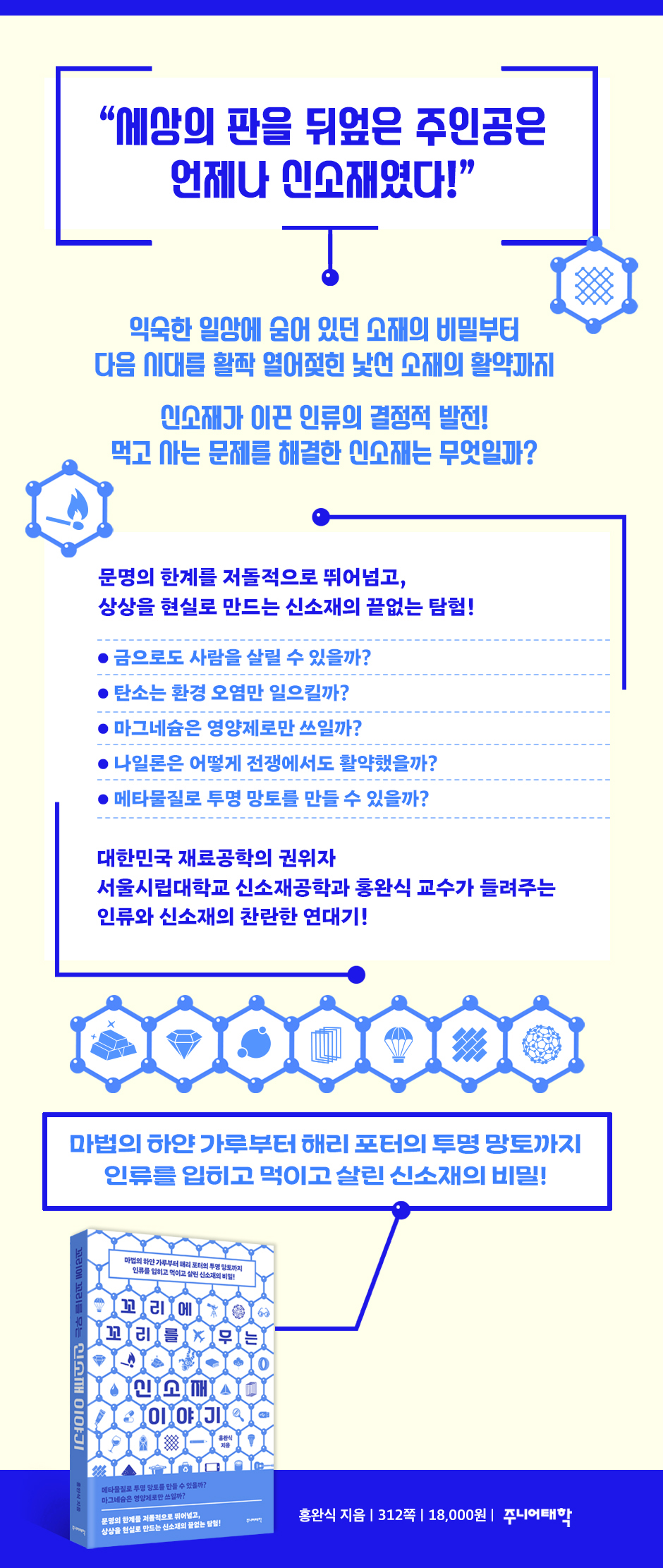
“The protagonist who turned the world upside down has always been a new material!”
A decisive advancement for humanity driven by new materials!
What new material will solve the problem of making a living?
From magic white powder to Harry Potter's invisibility cloak
The secret of the new material that clothes, feeds, and sustains humanity!
As civilization has developed, there has always been a new material at its center.
From stone, iron, glass, plastic, semiconductors, and even metamaterials, the development of new materials has been a revolution that has transformed human life.
Materials have changed not only the simple materials of objects, but also the way humans live and think.
From the smartphones we hold in our hands, the clothes we wear, the cars and airplanes we drive, and even the instruments in our operating rooms and space probes, new materials have become the foundation of almost every aspect of civilization enjoyed by humanity today.
《A Tale of New Materials That Keeps on Going》 easily and vividly unfolds all the stories about materials, from everyday materials around us to dramatic materials that changed human civilization.
Join Professor Hong Wan-sik of the Department of Materials Science and Engineering at Seoul City University, an authority on materials science in Korea, as we explore the fascinating science and history behind familiar materials. Through Q&A, we learn how new materials have changed the world and how they will change it in the future.
This multi-faceted science textbook, which crosses science, history, and art, will help you see the world through a new lens: "materials."
A decisive advancement for humanity driven by new materials!
What new material will solve the problem of making a living?
From magic white powder to Harry Potter's invisibility cloak
The secret of the new material that clothes, feeds, and sustains humanity!
As civilization has developed, there has always been a new material at its center.
From stone, iron, glass, plastic, semiconductors, and even metamaterials, the development of new materials has been a revolution that has transformed human life.
Materials have changed not only the simple materials of objects, but also the way humans live and think.
From the smartphones we hold in our hands, the clothes we wear, the cars and airplanes we drive, and even the instruments in our operating rooms and space probes, new materials have become the foundation of almost every aspect of civilization enjoyed by humanity today.
《A Tale of New Materials That Keeps on Going》 easily and vividly unfolds all the stories about materials, from everyday materials around us to dramatic materials that changed human civilization.
Join Professor Hong Wan-sik of the Department of Materials Science and Engineering at Seoul City University, an authority on materials science in Korea, as we explore the fascinating science and history behind familiar materials. Through Q&A, we learn how new materials have changed the world and how they will change it in the future.
This multi-faceted science textbook, which crosses science, history, and art, will help you see the world through a new lens: "materials."
- You can preview some of the book's contents.
Preview
index
In publishing a book
Standard periodic table
Chapter 1: There is no humanity without materials
Can you farm with salt?
Was gunpowder only dangerous?
How did humans come to turn poop into fertilizer?
How Oil Could Conquer Space
Can gold save a person?
Are diamonds forever?
Chapter 2 For food
How did humans start fire on their own?
Is carbon good or bad for the environment?
How do annotations make other materials stand out?
How Aluminum Conquered the Sky
Is magnesium only used as a nutritional supplement?
Chapter 3: Showtime with a new outfit
How Cotton Sparked the Industrial Revolution
How Nylon Won the War
How does leather transform through tanning?
Chapter 4: The Protagonists Who Built Houses and Founded Cities
Why is wood called the mother of materials?
How Concrete Sustained the Roman Empire
How Calcium Became the Backbone of Humanity and Civilization
Chapter 5: Speaking with Materials, Remembering with Materials
How Paper Sparked the Information Revolution
Can a piece of glass become culture?
Why Semiconductors Became a Symbol of Advanced Technology
How did humans come to love the color blue?
Chapter 6: The Future Embedded in Materials
How Lithium Ushered in the Electric Vehicle Era
How Titanium, Lighter Than Iron, Became a Giant
Could metamaterials be used to create an invisibility cloak?
Standard periodic table
Chapter 1: There is no humanity without materials
Can you farm with salt?
Was gunpowder only dangerous?
How did humans come to turn poop into fertilizer?
How Oil Could Conquer Space
Can gold save a person?
Are diamonds forever?
Chapter 2 For food
How did humans start fire on their own?
Is carbon good or bad for the environment?
How do annotations make other materials stand out?
How Aluminum Conquered the Sky
Is magnesium only used as a nutritional supplement?
Chapter 3: Showtime with a new outfit
How Cotton Sparked the Industrial Revolution
How Nylon Won the War
How does leather transform through tanning?
Chapter 4: The Protagonists Who Built Houses and Founded Cities
Why is wood called the mother of materials?
How Concrete Sustained the Roman Empire
How Calcium Became the Backbone of Humanity and Civilization
Chapter 5: Speaking with Materials, Remembering with Materials
How Paper Sparked the Information Revolution
Can a piece of glass become culture?
Why Semiconductors Became a Symbol of Advanced Technology
How did humans come to love the color blue?
Chapter 6: The Future Embedded in Materials
How Lithium Ushered in the Electric Vehicle Era
How Titanium, Lighter Than Iron, Became a Giant
Could metamaterials be used to create an invisibility cloak?
Detailed image
Into the book
Salt is a general term for substances that dissolve in water and then remain as solid components on the bottom after the water evaporates.
'Nitrate' and 'carbonate', which we learn about in middle school science class, all fall into this category, and humans have been collecting and using these salts from nature since prehistoric times.
--- p.27
When oxygen is removed from potassium nitrate, what's left? Nitrogen and potassium.
But doesn't this combination sound familiar? You probably learned in elementary school science class that the three most essential fertilizers for plant growth are nitrogen, phosphorus, and potassium.
It is also called 'NPK', taking the first letter of each element's symbol.
Among these, the elements that plants need most are nitrogen and potassium, so potassium nitrate is an ideal fertilizer.
--- p.49
Internal combustion engines produce energy differently from steam engines, which burn fuel in a boiler outside the engine.
That's why steam engines are also called external combustion engines.
On the other hand, internal combustion engines inject fuel directly into the engine and burn the fuel to obtain energy.
It has the advantage of being able to move quickly because the fuel and air meet and explode, pushing the piston to move.
The invention of the internal combustion engine gave rise to a series of new forms of transportation, including automobiles, motorcycles, submarines, and airplanes.
--- p.66
The purpose of various petrochemical products was to replace natural materials and prevent the indiscriminate destruction of nature.
Thanks to the use of plastic film instead of paper and foam resin instead of wood, mankind has been able to preserve the lush forests.
Fuel consumption has also been reduced thanks to reinforced plastics replacing metal.
Moreover, since the invention of plastic, there is a positive aspect in that air pollution caused by friction and wear and water pollution caused by wastewater generation have decreased.
--- p.72~73
To understand the etymology of carrot, we must first understand the tree.
There is a tree called 'carob' that grows in regions ranging from Southern Europe to the Middle East.
In the famous story of the Prodigal Son in the New Testament, it appears translated as 'mouse pod tree'.
The fruit of this tree is called kirat in Arabic and keration in Greek.
The fruit is very uniform in size and has been used throughout Europe since ancient times as a weight in a balance scale for weighing jewels.
In other words, the carob tree fruit is the origin of the word carat.
--- p.78
Lab-grown diamonds can have their color and other characteristics altered at will, and their size and quality can be maintained consistently, depending on how the "growing" process is controlled.
Diamond conducts heat five times better than metal and has excellent semiconductor properties.
Therefore, lab-grown diamonds are used in semiconductor devices that operate at high temperatures, LEDs for ultraviolet light, and radiation detection materials.
By implementing functions that were previously impossible with other materials using diamonds made with cutting-edge technology, we are pioneering a new industrial field.
--- p.92
The 'friction match' we are familiar with was developed in 1826 by the British pharmacist John Walker.
A chance accident led to the development of matches.
At that time, Walker was researching a convenient way to make fire.
As usual, he mixed potassium chlorate (formerly called potassium chlorate) and antimony sulfide and applied it to the cloth.
Then, he forgot about the cloth near the stove, and accidentally brushed it against the heated surface of the stove, igniting a fire.
This anecdote was the beginning of friction matches.
--- p.104
Should we use carbon, or should we not? How should we view carbon? All of this debate stems from confusion stemming from the use of unclear terms.
Misunderstandings arise because various materials containing carbon, carbon dioxide, and fossil fuels are all lumped together as carbon.
--- p.122
When magnesium burns, it emits bright light, but the temperature also rises to over 3000 degrees.
Flares utilize this heat.
Heat-seeking missiles detect and follow the heat of jet engine exhaust.
The missile uses this principle in reverse, mistaking the flare for an aircraft and changing course.
That's why this is also called a 'decoy'.
In addition to this, magnesium is a useful material for military purposes, being used in flashbangs, incendiary bombs, etc.
--- p.155
Cotton is the most widely cultivated plant outside of food crops, and has been historically very important.
Cotton can be made by using the hairs that grow when cotton plants produce seeds.
Combining yarns made from twisted cotton allows us to create a wide range of garments that can adapt to almost any climate in the world.
Cotton is one of the natural fibers that appeared the latest in human history, but today it accounts for about half of all clothing materials and close to 90 percent of natural fibers.
--- p.164
Leather products are often called 'pihyeon', where 'pi' means rawhide and 'hyeok' means tanned leather.
The word 'tanning', which refers to tanning the skin through sunbathing, also comes from here.
A literal translation would be 'tanning my skin'.
It's the complete opposite of the modern concept of beauty as a way to look healthy.
Originally, tanning meant the roughening of the skin caused by working in the hot sun.
In Shakespeare's time, it was even used as a metaphor for 'taking beauty and freshness away from youth.'
--- p.190
Calcium has a variety of effects on the body.
Even the fossils we see in museums would not have been able to tell future generations about their existence without calcium.
If you look closely at the fossils, you can see that not only the bones but also other organs have not rotted away and their shapes remain.
This is because calcium carbonate dissolves in water and enters the tissues of the corpse, precipitating in the cell membranes.
--- p.223
Lithium has been utilized in combination with various substances.
Since 1843, lithium carbonate, which is made by combining lithium with carbon dioxide and oxygen, has been used as a treatment.
Lithium carbonate has been prescribed to treat everything from bladder stones to gout and rheumatism.
--- p.291
Titanium's surface reacts with oxygen as soon as it is exposed to air.
This reaction creates a very thin oxide film on the surface of titanium that is invisible to the naked eye.
However, this film is very dense and strong, so it prevents further oxidation reactions from occurring.
--- p.299
The uses for metamaterials are endless.
For example, when used in a car, you can avoid obstacles and reverse the car by looking at every corner behind you as if you were looking at the palm of your hand, even without a rear-view camera.
By making surgical tools and medical devices transparent, we will be able to perform surgeries more safely and accurately, allowing us to see the affected area clearly without any obstruction.
Instead of the convex or concave lenses used today, it would be possible to create a 'superlens' with a much higher magnification even with a completely flat shape.
Then, even people with poor eyesight will be able to wear glasses that are as thin as a sheet of paper and sleek, instead of thick and heavy glasses.
'Nitrate' and 'carbonate', which we learn about in middle school science class, all fall into this category, and humans have been collecting and using these salts from nature since prehistoric times.
--- p.27
When oxygen is removed from potassium nitrate, what's left? Nitrogen and potassium.
But doesn't this combination sound familiar? You probably learned in elementary school science class that the three most essential fertilizers for plant growth are nitrogen, phosphorus, and potassium.
It is also called 'NPK', taking the first letter of each element's symbol.
Among these, the elements that plants need most are nitrogen and potassium, so potassium nitrate is an ideal fertilizer.
--- p.49
Internal combustion engines produce energy differently from steam engines, which burn fuel in a boiler outside the engine.
That's why steam engines are also called external combustion engines.
On the other hand, internal combustion engines inject fuel directly into the engine and burn the fuel to obtain energy.
It has the advantage of being able to move quickly because the fuel and air meet and explode, pushing the piston to move.
The invention of the internal combustion engine gave rise to a series of new forms of transportation, including automobiles, motorcycles, submarines, and airplanes.
--- p.66
The purpose of various petrochemical products was to replace natural materials and prevent the indiscriminate destruction of nature.
Thanks to the use of plastic film instead of paper and foam resin instead of wood, mankind has been able to preserve the lush forests.
Fuel consumption has also been reduced thanks to reinforced plastics replacing metal.
Moreover, since the invention of plastic, there is a positive aspect in that air pollution caused by friction and wear and water pollution caused by wastewater generation have decreased.
--- p.72~73
To understand the etymology of carrot, we must first understand the tree.
There is a tree called 'carob' that grows in regions ranging from Southern Europe to the Middle East.
In the famous story of the Prodigal Son in the New Testament, it appears translated as 'mouse pod tree'.
The fruit of this tree is called kirat in Arabic and keration in Greek.
The fruit is very uniform in size and has been used throughout Europe since ancient times as a weight in a balance scale for weighing jewels.
In other words, the carob tree fruit is the origin of the word carat.
--- p.78
Lab-grown diamonds can have their color and other characteristics altered at will, and their size and quality can be maintained consistently, depending on how the "growing" process is controlled.
Diamond conducts heat five times better than metal and has excellent semiconductor properties.
Therefore, lab-grown diamonds are used in semiconductor devices that operate at high temperatures, LEDs for ultraviolet light, and radiation detection materials.
By implementing functions that were previously impossible with other materials using diamonds made with cutting-edge technology, we are pioneering a new industrial field.
--- p.92
The 'friction match' we are familiar with was developed in 1826 by the British pharmacist John Walker.
A chance accident led to the development of matches.
At that time, Walker was researching a convenient way to make fire.
As usual, he mixed potassium chlorate (formerly called potassium chlorate) and antimony sulfide and applied it to the cloth.
Then, he forgot about the cloth near the stove, and accidentally brushed it against the heated surface of the stove, igniting a fire.
This anecdote was the beginning of friction matches.
--- p.104
Should we use carbon, or should we not? How should we view carbon? All of this debate stems from confusion stemming from the use of unclear terms.
Misunderstandings arise because various materials containing carbon, carbon dioxide, and fossil fuels are all lumped together as carbon.
--- p.122
When magnesium burns, it emits bright light, but the temperature also rises to over 3000 degrees.
Flares utilize this heat.
Heat-seeking missiles detect and follow the heat of jet engine exhaust.
The missile uses this principle in reverse, mistaking the flare for an aircraft and changing course.
That's why this is also called a 'decoy'.
In addition to this, magnesium is a useful material for military purposes, being used in flashbangs, incendiary bombs, etc.
--- p.155
Cotton is the most widely cultivated plant outside of food crops, and has been historically very important.
Cotton can be made by using the hairs that grow when cotton plants produce seeds.
Combining yarns made from twisted cotton allows us to create a wide range of garments that can adapt to almost any climate in the world.
Cotton is one of the natural fibers that appeared the latest in human history, but today it accounts for about half of all clothing materials and close to 90 percent of natural fibers.
--- p.164
Leather products are often called 'pihyeon', where 'pi' means rawhide and 'hyeok' means tanned leather.
The word 'tanning', which refers to tanning the skin through sunbathing, also comes from here.
A literal translation would be 'tanning my skin'.
It's the complete opposite of the modern concept of beauty as a way to look healthy.
Originally, tanning meant the roughening of the skin caused by working in the hot sun.
In Shakespeare's time, it was even used as a metaphor for 'taking beauty and freshness away from youth.'
--- p.190
Calcium has a variety of effects on the body.
Even the fossils we see in museums would not have been able to tell future generations about their existence without calcium.
If you look closely at the fossils, you can see that not only the bones but also other organs have not rotted away and their shapes remain.
This is because calcium carbonate dissolves in water and enters the tissues of the corpse, precipitating in the cell membranes.
--- p.223
Lithium has been utilized in combination with various substances.
Since 1843, lithium carbonate, which is made by combining lithium with carbon dioxide and oxygen, has been used as a treatment.
Lithium carbonate has been prescribed to treat everything from bladder stones to gout and rheumatism.
--- p.291
Titanium's surface reacts with oxygen as soon as it is exposed to air.
This reaction creates a very thin oxide film on the surface of titanium that is invisible to the naked eye.
However, this film is very dense and strong, so it prevents further oxidation reactions from occurring.
--- p.299
The uses for metamaterials are endless.
For example, when used in a car, you can avoid obstacles and reverse the car by looking at every corner behind you as if you were looking at the palm of your hand, even without a rear-view camera.
By making surgical tools and medical devices transparent, we will be able to perform surgeries more safely and accurately, allowing us to see the affected area clearly without any obstruction.
Instead of the convex or concave lenses used today, it would be possible to create a 'superlens' with a much higher magnification even with a completely flat shape.
Then, even people with poor eyesight will be able to wear glasses that are as thin as a sheet of paper and sleek, instead of thick and heavy glasses.
--- p.309~310
Publisher's Review
Overcoming the crisis together and moving towards the future
A brilliant chronicle of humanity and new materials!
《The Story of New Materials That Continues》 introduces materials that have become major turning points in human history in an exciting way, divided into six themes: science, food, clothing, housing, communication, and future technology.
At the same time, it narratively explores the ripples the material has created on civilization.
The material is never a background, but rather a protagonist in history, vividly revealing that it was at the center of discoveries greater than inventions.
Chapter 1, “No Humanity Without Materials,” highlights the core materials that have been at the center of every advancement in civilization and science and technology.
Salt is a material for survival that has improved human hygiene, helped prevent leather from rotting, and allowed food to be stored.
Potassium, a key ingredient in gunpowder, is a tool of war and conquest, but it also forms the basis of advanced industries such as space exploration and mining.
Salts, especially potassium nitrate, have helped solve the world's food problem as fertilizer ingredients.
Petroleum has developed human transportation and laid the foundation for the invention of synthetic fibers and plastics.
It is the foundation of new materials that have enabled numerous chemical industries to flourish.
Gold and diamonds have long been considered symbols of wealth and power, but today they are essential materials for cutting-edge science, from electronics to precision engineering and even space equipment.
Although it has a beautiful exterior, it is actually at the forefront of science and technology.
Chapter 2, “For Food,” explores the food-related materials that support human survival and daily life.
Since humans began to use fire, food has been transformed into a form that is easier to digest and can absorb more energy.
Fire goes beyond simple cooking; it is the starting point of energy conversion.
Carbon is the main component of living things.
From charcoal and graphite to future key materials like carbon nanotubes and lithium-ion batteries, carbon is an essential element for humanity.
And the author accurately points out that the main culprit of the climate crisis is not 'carbon' itself, but 'greenhouse gases', and explains this scientifically.
Tin is an element that marked the beginning of the Bronze Age, and has always been a 'luxury supporting actor' at technological turning points.
Even today, it is widely used in everything from tin cans to glass windows.
Aluminum is a lightweight material used in everyday life, like the aluminum foil used to wrap food, but it has also made inroads into the aerospace industry.
It is the protagonist of the 'light revolution' that has realized almost all of humanity's expectations for metal.
Magnesium has a strong image as a health supplement, but it is actually a valuable material used in the military and aviation industries due to its flammability.
This chapter shows how human scientific progress has evolved from simple eating.
Chapter 3, “Showtime of Materials That Changed Our Apparel,” traces the history and evolution of textile materials that have transformed human lifestyles.
Textiles go beyond simply covering the body, weaving together technology, labor, culture, and power structures.
Its beginning is cotton.
The mass production of cotton and the development of spinning technology became the ignition devices for the Industrial Revolution.
However, the process of spinning cotton into thread and weaving it into clothing was very complicated.
This is also intertwined with the history of slavery and capitalism.
Nylon can be called the revolution of artificial fibers in the 20th century.
From stockings to military parachutes, strings to rackets, he is the 'superstar of chemical fibers', influencing the arts, sports, and military industries.
Leather is a survival skill that humans learned through coexistence with animals.
The 'tanning' technique, which hardens perishable leather using potassium nitrate or tannin and makes it usable for a long time, began thousands of years ago and has continued to the present day.
Leathers like Roughout are used in military combat boots and have proven their practicality and durability.
This chapter examines how humans have tamed natural materials, expressed themselves, and organized society through the material called 'cloth'.
Chapter 4, 'The Main Characters Who Built Houses and Established Cities,' examines the materials used in the spaces where humans reside and live.
As humans emerged from caves and began to establish their own spaces, they began to organize communities.
The material that became the first step was wood.
The author divides wood into hardwood and softwood according to its use and explains in detail the uses of wood, including for ships, houses, and even for fighter planes during World War II.
Concrete began as Roman concrete in ancient Rome and is now the backbone of modern civilization, supporting skyscrapers, large bridges, dams, and tunnels.
The author scientifically explains how concrete remains strong for thousands of years.
Another key player responsible for housing is calcium.
Calcium is not only an essential element for the human body, but it was also an ancient material used in the construction of pyramids as far back as 2500 BC.
It is also a key material for creating fresco murals.
It is the chemical properties of calcium that give concrete its strength and make ancient Roman architecture last.
These materials vividly demonstrate that housing is not simply a space, but a product of civilization where science and materials meet.
Chapter 5, “Speaking with Materials, Remembering with Materials,” focuses on materials that have played a crucial role in humanity’s accumulation of knowledge and information.
Paper obtained from trees is a material that stores human thoughts, beliefs, emotions, and skills.
The development of paper, from papyrus to bamboo paper and finally to modern printing paper, was the democratization of knowledge and the spark of revolution.
Clear glass was used for more than just vessels and windows; it was also used to make telescopes, microscopes, lenses, and eyeglasses.
From stained glass to fiber optics, glass has been utilized throughout the ages in both art and science.
Semiconductors have emerged as the core of all digital civilization from the late 20th century to the present day.
The transistor revolutionized the way we process and store information, and it soon became the foundation for computers, smartphones, and artificial intelligence.
Semiconductors have become a strategic resource that shakes the world order and economy.
Finally, we explore color.
Among them, blue is a striking example of how the history of materials influences human psychology, symbolism, and aesthetic sense.
To express the color blue, humans extracted ultramarine from a stone called lapis lazuli.
The rare blue pigment was used more than just paint; it was also a symbolic language of art, power, and faith.
In this way, materials such as paper, glass, semiconductors, and blue pigment have changed the way humans think, feel, and communicate.
The final chapter, Chapter 6, “The Future Embedded in Materials,” focuses on the process by which human imagination is realized through concrete technologies.
Lithium, the world's lightest metal, began as a treatment for mental illness and has since been used as fuel in hydrogen bombs.
Now, we are leading a new energy era with lithium-ion batteries, the heart of electric vehicles.
Titanium is strong and lightweight, and is used at the boundary between life and technology, such as in aircraft, artificial joints, and human implants.
Metamaterials are a new type of material that has been artificially designed to have properties that do not exist in nature.
Metamaterials, which can realize imaginations like invisibility cloaks, are rewriting the laws of physics.
Recklessly surpassing the limits of civilization,
Endless exploration of new materials that turn imagination into reality!
《A Story of New Materials that Follows the Path》 traces the footsteps of human civilization through materials.
This book provides an interesting glimpse into the world of materials that are difficult for young people to access.
By exploring human desires, social contexts, and cultural symbols surrounding the material, we solidify the foundation for convergent thinking.
This liberal arts book, which covers a wide range of academic disciplines, helps us understand the foundations upon which our daily lives are built.
As you follow the unfamiliar stories hidden within familiar materials, you will naturally come to understand why we need to know new materials and how they connect with our lives.
Above all, this book tells us what the most important thing for young people is, the 'sense of reading the world.'
In a society where technology is rapidly advancing and new jobs are constantly emerging, understanding materials and substances becomes the nutrient for scientific imagination and practice.
From everyday technologies like smartphones and electric cars to the climate crisis, space exploration, and artificial intelligence, new materials are always at the starting point of all change.
This book illuminates these hidden protagonists, helping readers see the world with a broader perspective and imagine their own future.
Understanding the material is the same as reading the world.
This book will be the most enjoyable and profound guide to take that first step.
A brilliant chronicle of humanity and new materials!
《The Story of New Materials That Continues》 introduces materials that have become major turning points in human history in an exciting way, divided into six themes: science, food, clothing, housing, communication, and future technology.
At the same time, it narratively explores the ripples the material has created on civilization.
The material is never a background, but rather a protagonist in history, vividly revealing that it was at the center of discoveries greater than inventions.
Chapter 1, “No Humanity Without Materials,” highlights the core materials that have been at the center of every advancement in civilization and science and technology.
Salt is a material for survival that has improved human hygiene, helped prevent leather from rotting, and allowed food to be stored.
Potassium, a key ingredient in gunpowder, is a tool of war and conquest, but it also forms the basis of advanced industries such as space exploration and mining.
Salts, especially potassium nitrate, have helped solve the world's food problem as fertilizer ingredients.
Petroleum has developed human transportation and laid the foundation for the invention of synthetic fibers and plastics.
It is the foundation of new materials that have enabled numerous chemical industries to flourish.
Gold and diamonds have long been considered symbols of wealth and power, but today they are essential materials for cutting-edge science, from electronics to precision engineering and even space equipment.
Although it has a beautiful exterior, it is actually at the forefront of science and technology.
Chapter 2, “For Food,” explores the food-related materials that support human survival and daily life.
Since humans began to use fire, food has been transformed into a form that is easier to digest and can absorb more energy.
Fire goes beyond simple cooking; it is the starting point of energy conversion.
Carbon is the main component of living things.
From charcoal and graphite to future key materials like carbon nanotubes and lithium-ion batteries, carbon is an essential element for humanity.
And the author accurately points out that the main culprit of the climate crisis is not 'carbon' itself, but 'greenhouse gases', and explains this scientifically.
Tin is an element that marked the beginning of the Bronze Age, and has always been a 'luxury supporting actor' at technological turning points.
Even today, it is widely used in everything from tin cans to glass windows.
Aluminum is a lightweight material used in everyday life, like the aluminum foil used to wrap food, but it has also made inroads into the aerospace industry.
It is the protagonist of the 'light revolution' that has realized almost all of humanity's expectations for metal.
Magnesium has a strong image as a health supplement, but it is actually a valuable material used in the military and aviation industries due to its flammability.
This chapter shows how human scientific progress has evolved from simple eating.
Chapter 3, “Showtime of Materials That Changed Our Apparel,” traces the history and evolution of textile materials that have transformed human lifestyles.
Textiles go beyond simply covering the body, weaving together technology, labor, culture, and power structures.
Its beginning is cotton.
The mass production of cotton and the development of spinning technology became the ignition devices for the Industrial Revolution.
However, the process of spinning cotton into thread and weaving it into clothing was very complicated.
This is also intertwined with the history of slavery and capitalism.
Nylon can be called the revolution of artificial fibers in the 20th century.
From stockings to military parachutes, strings to rackets, he is the 'superstar of chemical fibers', influencing the arts, sports, and military industries.
Leather is a survival skill that humans learned through coexistence with animals.
The 'tanning' technique, which hardens perishable leather using potassium nitrate or tannin and makes it usable for a long time, began thousands of years ago and has continued to the present day.
Leathers like Roughout are used in military combat boots and have proven their practicality and durability.
This chapter examines how humans have tamed natural materials, expressed themselves, and organized society through the material called 'cloth'.
Chapter 4, 'The Main Characters Who Built Houses and Established Cities,' examines the materials used in the spaces where humans reside and live.
As humans emerged from caves and began to establish their own spaces, they began to organize communities.
The material that became the first step was wood.
The author divides wood into hardwood and softwood according to its use and explains in detail the uses of wood, including for ships, houses, and even for fighter planes during World War II.
Concrete began as Roman concrete in ancient Rome and is now the backbone of modern civilization, supporting skyscrapers, large bridges, dams, and tunnels.
The author scientifically explains how concrete remains strong for thousands of years.
Another key player responsible for housing is calcium.
Calcium is not only an essential element for the human body, but it was also an ancient material used in the construction of pyramids as far back as 2500 BC.
It is also a key material for creating fresco murals.
It is the chemical properties of calcium that give concrete its strength and make ancient Roman architecture last.
These materials vividly demonstrate that housing is not simply a space, but a product of civilization where science and materials meet.
Chapter 5, “Speaking with Materials, Remembering with Materials,” focuses on materials that have played a crucial role in humanity’s accumulation of knowledge and information.
Paper obtained from trees is a material that stores human thoughts, beliefs, emotions, and skills.
The development of paper, from papyrus to bamboo paper and finally to modern printing paper, was the democratization of knowledge and the spark of revolution.
Clear glass was used for more than just vessels and windows; it was also used to make telescopes, microscopes, lenses, and eyeglasses.
From stained glass to fiber optics, glass has been utilized throughout the ages in both art and science.
Semiconductors have emerged as the core of all digital civilization from the late 20th century to the present day.
The transistor revolutionized the way we process and store information, and it soon became the foundation for computers, smartphones, and artificial intelligence.
Semiconductors have become a strategic resource that shakes the world order and economy.
Finally, we explore color.
Among them, blue is a striking example of how the history of materials influences human psychology, symbolism, and aesthetic sense.
To express the color blue, humans extracted ultramarine from a stone called lapis lazuli.
The rare blue pigment was used more than just paint; it was also a symbolic language of art, power, and faith.
In this way, materials such as paper, glass, semiconductors, and blue pigment have changed the way humans think, feel, and communicate.
The final chapter, Chapter 6, “The Future Embedded in Materials,” focuses on the process by which human imagination is realized through concrete technologies.
Lithium, the world's lightest metal, began as a treatment for mental illness and has since been used as fuel in hydrogen bombs.
Now, we are leading a new energy era with lithium-ion batteries, the heart of electric vehicles.
Titanium is strong and lightweight, and is used at the boundary between life and technology, such as in aircraft, artificial joints, and human implants.
Metamaterials are a new type of material that has been artificially designed to have properties that do not exist in nature.
Metamaterials, which can realize imaginations like invisibility cloaks, are rewriting the laws of physics.
Recklessly surpassing the limits of civilization,
Endless exploration of new materials that turn imagination into reality!
《A Story of New Materials that Follows the Path》 traces the footsteps of human civilization through materials.
This book provides an interesting glimpse into the world of materials that are difficult for young people to access.
By exploring human desires, social contexts, and cultural symbols surrounding the material, we solidify the foundation for convergent thinking.
This liberal arts book, which covers a wide range of academic disciplines, helps us understand the foundations upon which our daily lives are built.
As you follow the unfamiliar stories hidden within familiar materials, you will naturally come to understand why we need to know new materials and how they connect with our lives.
Above all, this book tells us what the most important thing for young people is, the 'sense of reading the world.'
In a society where technology is rapidly advancing and new jobs are constantly emerging, understanding materials and substances becomes the nutrient for scientific imagination and practice.
From everyday technologies like smartphones and electric cars to the climate crisis, space exploration, and artificial intelligence, new materials are always at the starting point of all change.
This book illuminates these hidden protagonists, helping readers see the world with a broader perspective and imagine their own future.
Understanding the material is the same as reading the world.
This book will be the most enjoyable and profound guide to take that first step.
GOODS SPECIFICS
- Date of issue: August 15, 2025
- Page count, weight, size: 312 pages | 535g | 148*215*19mm
- ISBN13: 9791168103696
- ISBN10: 116810369X
You may also like
카테고리
korean


korean

![GQ KOREA Mark (Monthly): December [2025]](http://librairie.coreenne.fr/cdn/shop/files/8ef265dbbfbf186523ed75ba7319009d.jpg?v=1765340328&width=3840)


