

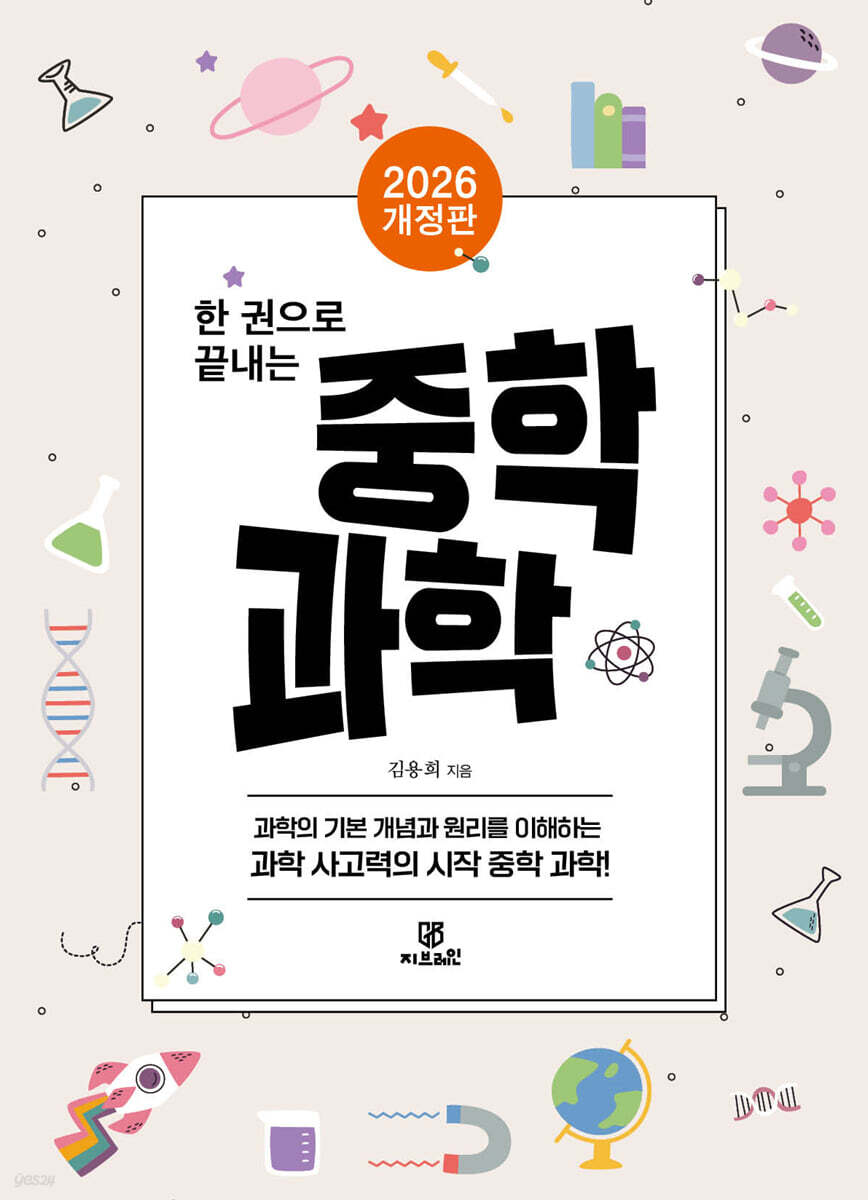
Middle School Science in One Volume
 |
Description
Book Introduction
Essential terms and basic concepts of middle school science and reflecting the 2025 revised curriculum
"Middle School Science in One Volume" 2026 Revised Edition!
Middle school science isn't just about knowledge; it's a core course that provides a solid foundation for all future scientific disciplines. Science isn't something you can simply memorize without understanding; it's crucial to understand concepts accurately, based on logical and systematic thinking.
Moreover, in modern society, science is one of the important keys to seeing the world and opening up the future.
"Complete Middle School Science in One Volume" easily explains the basic concepts and important theories of middle school science for grades 1 through 3, and is structured to help students understand unfamiliar terms and complex concepts in a logical flow.
Additionally, it reflects the newly revised science content for first year middle school students starting in 2025.
"Middle School Science in One Volume" 2026 Revised Edition!
Middle school science isn't just about knowledge; it's a core course that provides a solid foundation for all future scientific disciplines. Science isn't something you can simply memorize without understanding; it's crucial to understand concepts accurately, based on logical and systematic thinking.
Moreover, in modern society, science is one of the important keys to seeing the world and opening up the future.
"Complete Middle School Science in One Volume" easily explains the basic concepts and important theories of middle school science for grades 1 through 3, and is structured to help students understand unfamiliar terms and complex concepts in a logical flow.
Additionally, it reflects the newly revised science content for first year middle school students starting in 2025.
- You can preview some of the book's contents.
Preview
index
Author's Noteㆍ4
What is Science?ㆍ9
Chapter 1: The Elements That Make Up the Earth The Earth System
What is the Earth System? ㆍ16 Changes in the Geosphere ㆍ22 The Composition and Circulation of the Hydrosphere ㆍ44 Abstention and Our Lives ㆍ60
Chapter 2 Our Solar System and Our Galaxy
Solar Systemㆍ78 Our Galaxyㆍ109
Chapter 3: The World Biosphere, Where All Living Things Live
Cellsㆍ130 Photosynthesis in Plantsㆍ138 Growth and Reproductionㆍ147 Fertilization and Developmentㆍ156 Heredity and Evolutionㆍ164
Chapter 4 People
What's Happening in Our Bodies?ㆍ172 Sense Organs and the Nervous Systemㆍ188
Chapter 5: Materials that make up objects
Molecular Motion, 210 Composition of Matter, 226 Properties of Matter, 239 Chemical Reactions, 250 Electricity and Magnetism, 268
Chapter 6 Energy: The Ability to Do Physical Work
Heat, 284 Light, 295 Waves, 307 Force, 317 Work and Energy, 336
Reference book? 347 Image copyright? 348
What is Science?ㆍ9
Chapter 1: The Elements That Make Up the Earth The Earth System
What is the Earth System? ㆍ16 Changes in the Geosphere ㆍ22 The Composition and Circulation of the Hydrosphere ㆍ44 Abstention and Our Lives ㆍ60
Chapter 2 Our Solar System and Our Galaxy
Solar Systemㆍ78 Our Galaxyㆍ109
Chapter 3: The World Biosphere, Where All Living Things Live
Cellsㆍ130 Photosynthesis in Plantsㆍ138 Growth and Reproductionㆍ147 Fertilization and Developmentㆍ156 Heredity and Evolutionㆍ164
Chapter 4 People
What's Happening in Our Bodies?ㆍ172 Sense Organs and the Nervous Systemㆍ188
Chapter 5: Materials that make up objects
Molecular Motion, 210 Composition of Matter, 226 Properties of Matter, 239 Chemical Reactions, 250 Electricity and Magnetism, 268
Chapter 6 Energy: The Ability to Do Physical Work
Heat, 284 Light, 295 Waves, 307 Force, 317 Work and Energy, 336
Reference book? 347 Image copyright? 348
Detailed image

Publisher's Review
The core of the three years of middle school science
The concepts are easy to understand and the flow is organized accurately so that you can finish it in one volume.
Now, let's start with scientific thinking and lay the foundation for middle school science!
In this rapidly evolving era of artificial intelligence, space exploration, and biotechnology, we must now view science not as a simple subject but as the key to unlocking the future.
Society uses science to solve problems, discover new possibilities, and prepare for the next generation.
So where should we start? Middle school science education.
The new science curriculum for first-year middle school students, which will be implemented starting in 2025, requires students to have a broader perspective and deeper thinking skills.
The revised textbooks emphasize inquiry-based learning and problem-solving activities centered on scientific phenomena closely related to everyday life. Rather than simply listing knowledge, they introduce the scientific thinking process of thinking about why something is the way it is, conducting experiments, and interpreting the results. They also introduce the era of rapidly developing artificial intelligence.
〈Complete Middle School Science in One Volume〉 systematically organizes the main concepts of 1st, 2nd, and 3rd grades, as well as core concepts, terminology explanations, and concept-linked learning in line with the latest educational direction, allowing you to easily understand the flow of science in the 3rd year of middle school.
Middle school science is not limited to just learning the four fields of biology, chemistry, physics, and earth science.
It is precisely 'thinking training'.
The process of discovering problems through observation, analyzing their causes through experiments, and devising new solutions fosters students' logical thinking, critical analysis, and creative problem-solving skills.
These abilities become 'real skills' that can be used in various areas of life, not just academics.
Moreover, science is at the heart of the future world of work.
Most future jobs, including biotechnology, eco-friendly technology, aerospace, and data science, are born and developed on a scientific foundation.
The science we learn in middle school is not just about preparing for exams, but also about exploring what kind of future we will lead.
Therefore, the 2026 revised edition of "Complete Middle School Science in One Volume" will be a good guide for students who want to systematically organize scientific concepts in line with the revised curriculum, those who are interested in science but need guidance on where to start, or those who want to learn on their own and understand the entire middle school curriculum.
The concepts are easy to understand and the flow is organized accurately so that you can finish it in one volume.
Now, let's start with scientific thinking and lay the foundation for middle school science!
In this rapidly evolving era of artificial intelligence, space exploration, and biotechnology, we must now view science not as a simple subject but as the key to unlocking the future.
Society uses science to solve problems, discover new possibilities, and prepare for the next generation.
So where should we start? Middle school science education.
The new science curriculum for first-year middle school students, which will be implemented starting in 2025, requires students to have a broader perspective and deeper thinking skills.
The revised textbooks emphasize inquiry-based learning and problem-solving activities centered on scientific phenomena closely related to everyday life. Rather than simply listing knowledge, they introduce the scientific thinking process of thinking about why something is the way it is, conducting experiments, and interpreting the results. They also introduce the era of rapidly developing artificial intelligence.
〈Complete Middle School Science in One Volume〉 systematically organizes the main concepts of 1st, 2nd, and 3rd grades, as well as core concepts, terminology explanations, and concept-linked learning in line with the latest educational direction, allowing you to easily understand the flow of science in the 3rd year of middle school.
Middle school science is not limited to just learning the four fields of biology, chemistry, physics, and earth science.
It is precisely 'thinking training'.
The process of discovering problems through observation, analyzing their causes through experiments, and devising new solutions fosters students' logical thinking, critical analysis, and creative problem-solving skills.
These abilities become 'real skills' that can be used in various areas of life, not just academics.
Moreover, science is at the heart of the future world of work.
Most future jobs, including biotechnology, eco-friendly technology, aerospace, and data science, are born and developed on a scientific foundation.
The science we learn in middle school is not just about preparing for exams, but also about exploring what kind of future we will lead.
Therefore, the 2026 revised edition of "Complete Middle School Science in One Volume" will be a good guide for students who want to systematically organize scientific concepts in line with the revised curriculum, those who are interested in science but need guidance on where to start, or those who want to learn on their own and understand the entire middle school curriculum.
GOODS SPECIFICS
- Date of issue: July 8, 2025
- Page count, weight, size: 348 pages | 150*210*30mm
- ISBN13: 9788959798063
- ISBN10: 8959798061
You may also like
카테고리
korean


korean

![GQ KOREA Mark (Monthly): December [2025]](http://librairie.coreenne.fr/cdn/shop/files/8ef265dbbfbf186523ed75ba7319009d.jpg?v=1765340328&width=3840)


