

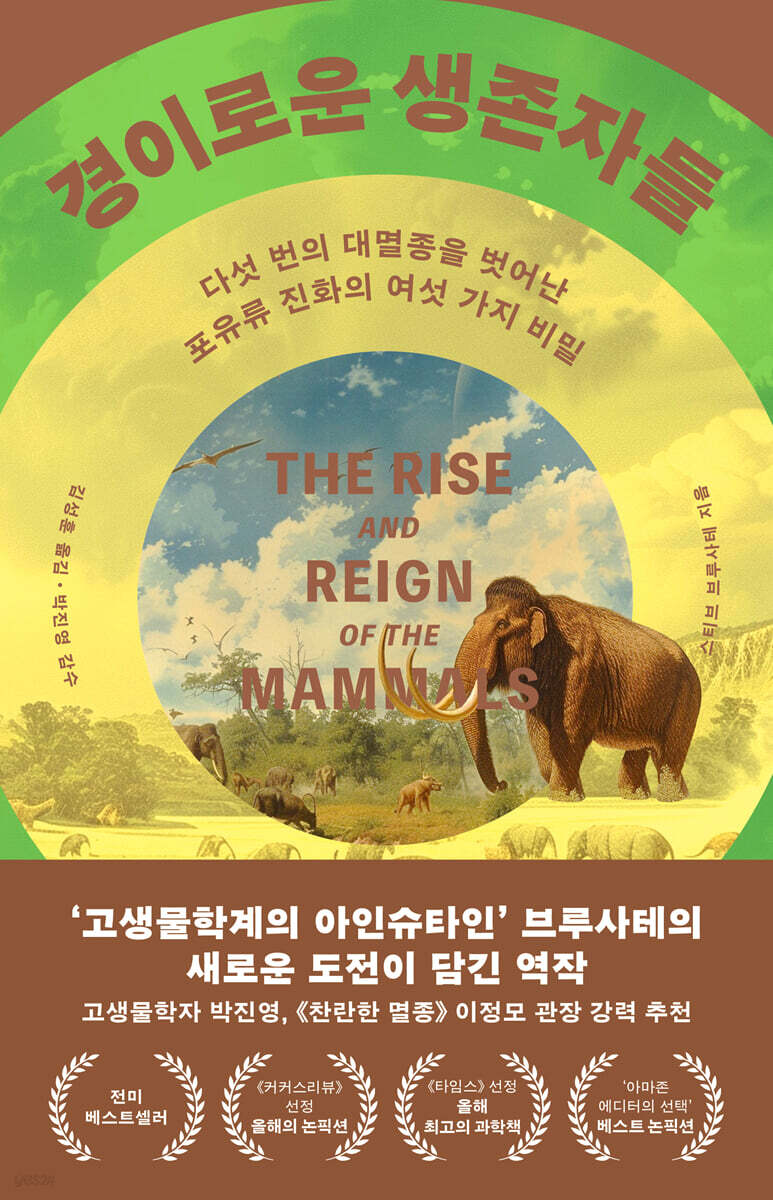
Amazing Survivors
 |
Description
Book Introduction
- A word from MD
- Mammals, including humans, live all over the world.
It's obvious now, but mammals didn't thrive from the beginning.
Unlike dinosaurs, which could not escape extinction, what is the secret to mammals' survival?
The evolution of mammals is summarized by introducing various animals such as giant whales and flying bats.
- Min-gyu Son, PD of Natural Sciences
The most beloved creature on Earth
The extinction and evolution of mammals is not over yet.
A 300 million-year splendid story of our journey to the roots of mammals.
The giant dinosaurs that dominated the Mesozoic Era could not escape the mass extinction caused by an asteroid impact.
And on Earth, where the large dinosaurs disappeared, mammals of all sizes and shapes began to fill the void at an incredible rate.
How did mammals survive the mass extinction that wiped out over 70 percent of all life? From tiny, hunched creatures living in hiding to the gigantic brains of humans, we explore the extinction and evolution of the most prolific mammal in Earth's history.
Five mass extinctions, including asteroid impacts, megavolcanic eruptions, and extreme climate changes that shifted between freezer and greenhouse, presented explosive evolutionary opportunities for mammals.
Our ancestors, who quickly transformed their bodies in times of crisis, surpassed even dinosaurs and left behind more than 6,000 species of 'amazing survivors'.
From the Carboniferous Period, when mammals diverged from reptiles, to the end of the Cretaceous Period, when dinosaurs became extinct, mammals remained small and hidden.
And as the Paleocene epoch began after the asteroid impact, mammals were ready to emerge from hiding, acquiring the "typical features" we know.
In particular, Brusatte considers the emergence of hair, mammary glands, temporal and jaw muscles, large brains, and large molars as key words, and analyzes the evolutionary process of each organ in depth using various fossils as evidence.
The process of finding the best answer using limited data, from ribs to teeth, from fine hair marks to traces of skin membranes, unfolds like a movie.
The extinction and evolution of mammals is not over yet.
A 300 million-year splendid story of our journey to the roots of mammals.
The giant dinosaurs that dominated the Mesozoic Era could not escape the mass extinction caused by an asteroid impact.
And on Earth, where the large dinosaurs disappeared, mammals of all sizes and shapes began to fill the void at an incredible rate.
How did mammals survive the mass extinction that wiped out over 70 percent of all life? From tiny, hunched creatures living in hiding to the gigantic brains of humans, we explore the extinction and evolution of the most prolific mammal in Earth's history.
Five mass extinctions, including asteroid impacts, megavolcanic eruptions, and extreme climate changes that shifted between freezer and greenhouse, presented explosive evolutionary opportunities for mammals.
Our ancestors, who quickly transformed their bodies in times of crisis, surpassed even dinosaurs and left behind more than 6,000 species of 'amazing survivors'.
From the Carboniferous Period, when mammals diverged from reptiles, to the end of the Cretaceous Period, when dinosaurs became extinct, mammals remained small and hidden.
And as the Paleocene epoch began after the asteroid impact, mammals were ready to emerge from hiding, acquiring the "typical features" we know.
In particular, Brusatte considers the emergence of hair, mammary glands, temporal and jaw muscles, large brains, and large molars as key words, and analyzes the evolutionary process of each organ in depth using various fossils as evidence.
The process of finding the best answer using limited data, from ribs to teeth, from fine hair marks to traces of skin membranes, unfolds like a movie.
- You can preview some of the book's contents.
Preview
index
Recommendation_ Jinyoung Park (paleontologist)
At the beginning of the book_ It's time to come out of hiding
1 Scaled creatures and coal swamps
2 New jaws of furry quadrupeds
3 Roads Not Taken by Giant Dinosaurs
4 Heroes of the Cretaceous Land Revolution
5 Worst Days in Earth's History
6 'Splendid Isolation' and the Experiment in Evolution
7 Walking Whales and Flying Mammals
8 The story of how a horse gave birth to a horse
9 Magnificent Animals That Survived the Ice Age
10 The only species that ponders its origins
Reviews_ Our Choice
Acknowledgements
References
Image source
Search
At the beginning of the book_ It's time to come out of hiding
1 Scaled creatures and coal swamps
2 New jaws of furry quadrupeds
3 Roads Not Taken by Giant Dinosaurs
4 Heroes of the Cretaceous Land Revolution
5 Worst Days in Earth's History
6 'Splendid Isolation' and the Experiment in Evolution
7 Walking Whales and Flying Mammals
8 The story of how a horse gave birth to a horse
9 Magnificent Animals That Survived the Ice Age
10 The only species that ponders its origins
Reviews_ Our Choice
Acknowledgements
References
Image source
Search
Detailed image
.jpg)
Into the book
The demise of the dinosaurs allowed these mammals to rise to prominence in ancient New Mexico and around the world.
But the history of mammals goes much deeper than that.
They, or rather we, originated around the same time as the dinosaurs, some 200 million years ago, when all landmasses were merged into a single supercontinent, scorching in the heat of a vast desert.
The earliest mammals have a much deeper heritage, reaching back to the damp coal swamps of about 325 million years ago.
--- p.28
The reptilian and mammalian lineages, namely the diapsids and synapsids, branched off from these amniotes like two brothers from the same parent.
This is not just a metaphor.
Indeed, new species, new groups, and new kingdoms evolve in this way.
Species are always changing according to changes in the environment.
This is evolution by natural selection, as Darwin said.
Sometimes populations of a species become separated from each other by floods, fires, newly formed mountain ranges, etc.
Each population will continue to change through natural selection, and if separated long enough, each will change in its own unique way, adapting to its different environments.
--- p.48
There were three destinies that awaited the water dragon.
The first was extinction.
This is what happened to the Gorgonops.
Gorgonops never got a chance to terrorize their Triassic prey with their saber-toothed fangs.
The second was survival but decline.
This is what happened to the dicynodonts.
Although dicynodonts managed to survive the destruction and re-diversify, they were unable to replicate their Permian success and gradually declined, ultimately meeting a tragic end in the next mass extinction at the end of the Triassic.
Third is survival and domination.
The canine walked this path.
Canines have endured volcanic eruptions, global warming, desiccation, monsoon rains, forest collapse, and ecosystems collapsing from within, silently recovering over five million years and becoming just as resilient in the process.
They continued to diversify during the remaining 50 million years of the Triassic, producing an incredible variety of species.
Among them, there were large species, small species, carnivorous species, and herbivorous species.
As one of these canine lineages gave rise to mammals, it developed more mammalian characteristics along the way.
--- p.93
There were two great survivors: mammals and dinosaurs.
Why dinosaurs survived remains an unsolved mystery and one of the greatest debates among dinosaur researchers.
This may have been due to the freedom from competition as crocodiles faced fewer competitors, the development of feathers that protected these dinosaurs from temperature fluctuations, or their rapid growth rate, which allowed them to mature quickly from egg to adult.
But in the case of mammals, it is easy to understand why they were prepared to withstand such a disaster.
They had the perfect combination of small stature, rapid growth, keen senses and intelligence, and the ability to hide in trees or caves.
Just as rats can survive in dark, closed subway tunnels, breathing in the toxic fumes, so too have mammals similar to Morganucodon continued to weather global warming.
--- p.142
Winning the game of evolutionary poker wasn't everything.
What to do with the money was also important.
Crocodiles, turtles, and frogs also survived, but never reached the heights that mammals did.
Those few mammals who received a royal flush did not let their good fortune go to waste.
There was something about them that allowed them to quickly surpass other surviving groups: their versatility, their ability to evolve, their wanderlust.
In just a few tens of thousands of years, some of these mammals were thriving as catastrophic species.
Some mammals spread out and filled the void left by extinction.
The animals that survived in the area and the species that migrated in interacted with each other and the environment, evolving and branching out into new species.
And the most important thing is that it has grown in size.
Mammals were thriving in Montana as temperatures stabilized and ecosystems recovered approximately 375,000 to 850,000 years after the asteroid impact.
--- p.254
Even as you read this, a blue whale is parting the ocean.
Blue whales have a nearly global range, with the exception of the northernmost part of the Arctic, so they travel to every ocean without exception.
The largest, older blue whales, can grow to over 30 meters in length and weigh between 100 and 110 tons.
It weighs at least 20 tons more than the maximum takeoff weight of a Boeing 737 airplane.
And it would weigh 30 to 40 tons more than the largest dinosaurs.
A mother blue whale gives birth to a three-ton calf the size of a speedboat.
This baby will weigh about 15 tons when it grows for about six months.
Adults can dive to depths of 315 meters, hold their breath for over an hour, and when they surface to breathe, they can shoot water from their blowholes as high as a two-story building.
With a single, inflatable mouthful, they can suck in enough water to fill a backyard swimming pool, and by gulping down water several times a day, they can filter out up to two tons of krill.
Krill are small crustaceans that look like shrimp, and blue whales eat them to provide energy for their metabolism.
Blue whales are intelligent and social animals.
Their low-pitched vocalizations are among the most powerful in the animal kingdom, and can travel 1,500 kilometers through the deep ocean.
--- p.336
Why did they spend so long clinging to their mothers during their adolescence? Smilodon babies are born with robust, muscular bodies, much like adults.
So there was no need to wait until they were fully grown.
But they were not born with sword teeth.
In fact, it took a full year for the baby canines to fully erupt.
And once the baby teeth fall out, the second permanent tooth, the canine, takes its place.
However, the teeth of these adults do not properly emerge until about three years of age, and sometimes even longer.
Without fully mature canines, juvenile Smilodon may not have been able to perform the hunting maneuvers of ambush, quickly pounce on prey, and precisely puncture its throat.
And perhaps this is a very specialized hunting style, so much so that they had to follow their mothers around for a long time, watching and learning before trying it themselves.
But the history of mammals goes much deeper than that.
They, or rather we, originated around the same time as the dinosaurs, some 200 million years ago, when all landmasses were merged into a single supercontinent, scorching in the heat of a vast desert.
The earliest mammals have a much deeper heritage, reaching back to the damp coal swamps of about 325 million years ago.
--- p.28
The reptilian and mammalian lineages, namely the diapsids and synapsids, branched off from these amniotes like two brothers from the same parent.
This is not just a metaphor.
Indeed, new species, new groups, and new kingdoms evolve in this way.
Species are always changing according to changes in the environment.
This is evolution by natural selection, as Darwin said.
Sometimes populations of a species become separated from each other by floods, fires, newly formed mountain ranges, etc.
Each population will continue to change through natural selection, and if separated long enough, each will change in its own unique way, adapting to its different environments.
--- p.48
There were three destinies that awaited the water dragon.
The first was extinction.
This is what happened to the Gorgonops.
Gorgonops never got a chance to terrorize their Triassic prey with their saber-toothed fangs.
The second was survival but decline.
This is what happened to the dicynodonts.
Although dicynodonts managed to survive the destruction and re-diversify, they were unable to replicate their Permian success and gradually declined, ultimately meeting a tragic end in the next mass extinction at the end of the Triassic.
Third is survival and domination.
The canine walked this path.
Canines have endured volcanic eruptions, global warming, desiccation, monsoon rains, forest collapse, and ecosystems collapsing from within, silently recovering over five million years and becoming just as resilient in the process.
They continued to diversify during the remaining 50 million years of the Triassic, producing an incredible variety of species.
Among them, there were large species, small species, carnivorous species, and herbivorous species.
As one of these canine lineages gave rise to mammals, it developed more mammalian characteristics along the way.
--- p.93
There were two great survivors: mammals and dinosaurs.
Why dinosaurs survived remains an unsolved mystery and one of the greatest debates among dinosaur researchers.
This may have been due to the freedom from competition as crocodiles faced fewer competitors, the development of feathers that protected these dinosaurs from temperature fluctuations, or their rapid growth rate, which allowed them to mature quickly from egg to adult.
But in the case of mammals, it is easy to understand why they were prepared to withstand such a disaster.
They had the perfect combination of small stature, rapid growth, keen senses and intelligence, and the ability to hide in trees or caves.
Just as rats can survive in dark, closed subway tunnels, breathing in the toxic fumes, so too have mammals similar to Morganucodon continued to weather global warming.
--- p.142
Winning the game of evolutionary poker wasn't everything.
What to do with the money was also important.
Crocodiles, turtles, and frogs also survived, but never reached the heights that mammals did.
Those few mammals who received a royal flush did not let their good fortune go to waste.
There was something about them that allowed them to quickly surpass other surviving groups: their versatility, their ability to evolve, their wanderlust.
In just a few tens of thousands of years, some of these mammals were thriving as catastrophic species.
Some mammals spread out and filled the void left by extinction.
The animals that survived in the area and the species that migrated in interacted with each other and the environment, evolving and branching out into new species.
And the most important thing is that it has grown in size.
Mammals were thriving in Montana as temperatures stabilized and ecosystems recovered approximately 375,000 to 850,000 years after the asteroid impact.
--- p.254
Even as you read this, a blue whale is parting the ocean.
Blue whales have a nearly global range, with the exception of the northernmost part of the Arctic, so they travel to every ocean without exception.
The largest, older blue whales, can grow to over 30 meters in length and weigh between 100 and 110 tons.
It weighs at least 20 tons more than the maximum takeoff weight of a Boeing 737 airplane.
And it would weigh 30 to 40 tons more than the largest dinosaurs.
A mother blue whale gives birth to a three-ton calf the size of a speedboat.
This baby will weigh about 15 tons when it grows for about six months.
Adults can dive to depths of 315 meters, hold their breath for over an hour, and when they surface to breathe, they can shoot water from their blowholes as high as a two-story building.
With a single, inflatable mouthful, they can suck in enough water to fill a backyard swimming pool, and by gulping down water several times a day, they can filter out up to two tons of krill.
Krill are small crustaceans that look like shrimp, and blue whales eat them to provide energy for their metabolism.
Blue whales are intelligent and social animals.
Their low-pitched vocalizations are among the most powerful in the animal kingdom, and can travel 1,500 kilometers through the deep ocean.
--- p.336
Why did they spend so long clinging to their mothers during their adolescence? Smilodon babies are born with robust, muscular bodies, much like adults.
So there was no need to wait until they were fully grown.
But they were not born with sword teeth.
In fact, it took a full year for the baby canines to fully erupt.
And once the baby teeth fall out, the second permanent tooth, the canine, takes its place.
However, the teeth of these adults do not properly emerge until about three years of age, and sometimes even longer.
Without fully mature canines, juvenile Smilodon may not have been able to perform the hunting maneuvers of ambush, quickly pounce on prey, and precisely puncture its throat.
And perhaps this is a very specialized hunting style, so much so that they had to follow their mothers around for a long time, watching and learning before trying it themselves.
--- p.479
Publisher's Review
“Almost the only book on the evolutionary history of mammals” _Jinyoung Park (paleontologist)
“A beautiful scientific epic that makes us realize where we came from and what kind of beings and world we share.”
Lee Jeong-mo (former director of the National Science Museum in Gwacheon)
“How do our mammalian family fly, walk,
To be able to part water and walk on two legs
“A story about evolution”
Neil Shubin (paleontologist, author of The Fish Within)
The most beloved creature on Earth
The extinction and evolution of mammals is not over yet.
A 300 million-year splendid story of our journey to the roots of mammals.
★ National Bestseller ★
★ Kirkus Reviews' Nonfiction Book of the Year ★
★ Selected as the best science book by The Times ★
★ 'Amazon Editor's Choice' Best Nonfiction ★
The giant dinosaurs that dominated the Mesozoic Era could not escape the mass extinction caused by an asteroid impact.
And on Earth, where the large dinosaurs disappeared, mammals of all sizes and shapes began to fill the void at an incredible rate.
How did mammals survive the mass extinction that wiped out over 70 percent of all life? From tiny, hunched creatures living in hiding to the gigantic brains of humans, we explore the extinction and evolution of the most prolific mammal in Earth's history.
Five mass extinctions, including asteroid impacts, megavolcanic eruptions, and extreme climate changes that shifted between freezer and greenhouse, presented explosive evolutionary opportunities for mammals.
Our ancestors, who quickly transformed their bodies in times of crisis, surpassed even dinosaurs and left behind more than 6,000 species of 'amazing survivors'.
When we say 'mammals', we usually think of them as having appeared after the extinction of dinosaurs, but in fact, the origins of mammals go back further than the birth of dinosaurs.
So Steve Brusatte, the 'Einstein of paleontology' and a brilliant 'science storyteller', takes us back 300 million years to the dawn of mammals.
And it shows the process by which a 'lizard' crawling out of a coal swamp developed the robust characteristics unique to mammals through the ecology of various fossil animals.
The nature of mammals, acquired through countless cycles of death and survival, is quite simple, yet surprisingly useful in surviving numerous catastrophes.
The Secret to Earth's Most Prolific Mammal's Survival
We always had the perfect pattern to overcome a crisis.
* The invention of the 'jaw muscle' of Archaeopteryx brought about a 'chewing revolution', and mammals gained a wider range of prey choices.
* Morganucodon's 'big brain' and 'mammary glands' are what made mammals 'mammals'.
They were supplied with energy through nutritious milk, and their brains, the 'high-speed processing center', were the final choice for evolution.
* The 'tall molars' of the Sua River enable them to grind not only hard insects but also grass finely and extract all the nutrients.
* As therapsids began to use their 'fur' to conserve heat, the essence of mammals, 'endotherms', emerged.
From the Carboniferous Period, when mammals diverged from reptiles, to the end of the Cretaceous Period, when dinosaurs became extinct, mammals remained small and hidden.
And as the Paleocene epoch began after the asteroid impact, mammals were ready to emerge from hiding, acquiring the "typical features" we know.
In particular, Brusatte considers the emergence of hair, mammary glands, temporal and jaw muscles, large brains, and large molars as key words, and analyzes the evolutionary process of each organ in depth using various fossils as evidence.
The process of finding the best answer using limited data, from ribs to teeth, from fine hair marks to traces of skin membranes, unfolds like a movie.
Mammals, who have spent tens of millions of years on a geologically turbulent Earth, with climates that alternate between hot and cold, continents colliding and then drifting apart, grasslands turning into deserts, and seas suddenly appearing, have eventually acquired evolutionary links and diverged into a vast array of species.
From extraordinary mammals that preyed on dinosaurs to deer that became blue whales
Interesting landscapes created by evolution
* Whales originally walked on the grasslands like deer, striding briskly on four legs.
* Elephants are related to aquatic animals such as manatees, rock hyraxes, ant-eating ground hogs, and elephant shrews.
* Bats are the only mammals capable of powered flight, and they have not changed much from their ancestors.
* The discovery of the Callicotherium, which looked like a cross between a horse and a gorilla, puzzled Darwin.
《The Amazing Survivors》 introduces not only the history of mammals, but also fascinating creatures that represented each era and examples of extreme evolution.
And it vividly tells the story of the strange encounters and relationships between different mammals, and the interactions between animals and their environment.
We encounter intense moments of life, such as the existence of gravity-defying giant mammals like woolly mammoths, rhinos weighing over 20 tons, armadillos the size of cars, and whales that walked on four legs, as well as the reason for the emergence of extremely ferocious predators like thunder beasts, saber-toothed cats, and dire wolves, and the population strategies of furry quadrupeds that lived by digging underground and small mammals that spread their thin skin to fly in the sky.
In addition, we look into the secrets left by a now-extinct being to the species living in the present, and the beginnings of 'future evolution'.
Telling the Story of Life from Desert Fossils
A paleontologist's arduous research site
The beauty of this book is that it offers an unfiltered look into the research lives of paleontologists who travel the world in search of mammalian fossils.
To recover the secrets, paleontologists travel to deserts all over the world, wherever fossils can be found.
Now, with cutting-edge equipment like X-rays, CT scans, MRI scans, and precision rock blasting techniques, we can achieve surprising results from new perspectives, but the beginning always began with a single bone fragment obtained by a large research team digging through the ground under the hot sun.
The author vividly unfolds the story using over 120 diverse images, ranging from photographs of the most important sites, to delicate illustrations scientifically verifying extinct animals, and materials that provide information at a glance.
It also provides readers with food for thought by showing various experiments utilizing the latest technology, including research on the brains of fossil animals, news of the restoration of extinct animals such as the dire wolf, and considerations on cloning life.
Are we facing the sixth mass extinction?
The Human Species: The Smartest Mammal on Earth
Brusatte's bold challenge was to shift his field of study from dinosaurs, which he had devoted his entire life to, to mammals.
He notes that this is because the question of how the human species is influencing the Earth's climate has never been more urgent.
And then he asks a question.
"Will mammals face a sixth mass extinction? How much time do we have?" Paleontologists have a short and powerful answer: "It's our choice."
In addition, Brusatte says that unlike our ancestors who had to helplessly face mass extinction, 'humans can choose the direction of the Earth's future.'
The message of 300 million years, engraved in our bones by the countless creatures that appear in this book and now exist only as fossils, is none other than 'life.'
The author says that humans' power to change the Earth's environment is also a legacy of our mammalian ancestors.
And we, the resilient mammals, once again offer hope that we can adapt to our environment and survive.
Although the human species has only a short time in evolutionary history, we have the intelligence to navigate the path between survival and extinction, something no previous life form has been able to do.
So, we will survive in the end with the tenacious wisdom left behind by 300 million years.
It contains a journey that sweeps through mammalian evolution.
Brusatte's deep knowledge of the fossil record gave rise to a rich tapestry of mammalian lineage, woven thread by thread.
The intertwined strands occasionally penetrate and emerge from the picture, and sometimes disappear altogether when they reach the end of extinction, but the remaining threads will forever show off their brilliant light and fill the gaps.
_《Science》
It's a beautiful story.
It is a sophisticated and bold piece of writing.
A vivid world is drawn from small fossils.
The mammals seen through his eyes are every bit as fascinating as the reptiles that gave birth to them.
When Jurassic Park first opened in 1993, it inspired a generation of budding student archaeologists.
Brusate is one of them.
After this lovely book, don't be surprised if budding paleontologists focus on mouse-sized mammals rather than Megalosaurus.
_"times"
Five stars! Travel back in time to discover the origins of life in this captivating book. More astonishing than science fiction.
_"line"
This book is also a thriller.
It contains the good fortune that led to the birth of modern mammals, including humans, the twists of evolutionary fate, and the catastrophe that nearly brought about their destruction.
From the discovery of ancient rodents and primates that crossed vast distances from Africa to South America on logs, to the story that whales have navels and elephants can look in mirrors, the fascinating stories unfold boldly and quickly.
_《The Guardian》
“A beautiful scientific epic that makes us realize where we came from and what kind of beings and world we share.”
Lee Jeong-mo (former director of the National Science Museum in Gwacheon)
“How do our mammalian family fly, walk,
To be able to part water and walk on two legs
“A story about evolution”
Neil Shubin (paleontologist, author of The Fish Within)
The most beloved creature on Earth
The extinction and evolution of mammals is not over yet.
A 300 million-year splendid story of our journey to the roots of mammals.
★ National Bestseller ★
★ Kirkus Reviews' Nonfiction Book of the Year ★
★ Selected as the best science book by The Times ★
★ 'Amazon Editor's Choice' Best Nonfiction ★
The giant dinosaurs that dominated the Mesozoic Era could not escape the mass extinction caused by an asteroid impact.
And on Earth, where the large dinosaurs disappeared, mammals of all sizes and shapes began to fill the void at an incredible rate.
How did mammals survive the mass extinction that wiped out over 70 percent of all life? From tiny, hunched creatures living in hiding to the gigantic brains of humans, we explore the extinction and evolution of the most prolific mammal in Earth's history.
Five mass extinctions, including asteroid impacts, megavolcanic eruptions, and extreme climate changes that shifted between freezer and greenhouse, presented explosive evolutionary opportunities for mammals.
Our ancestors, who quickly transformed their bodies in times of crisis, surpassed even dinosaurs and left behind more than 6,000 species of 'amazing survivors'.
When we say 'mammals', we usually think of them as having appeared after the extinction of dinosaurs, but in fact, the origins of mammals go back further than the birth of dinosaurs.
So Steve Brusatte, the 'Einstein of paleontology' and a brilliant 'science storyteller', takes us back 300 million years to the dawn of mammals.
And it shows the process by which a 'lizard' crawling out of a coal swamp developed the robust characteristics unique to mammals through the ecology of various fossil animals.
The nature of mammals, acquired through countless cycles of death and survival, is quite simple, yet surprisingly useful in surviving numerous catastrophes.
The Secret to Earth's Most Prolific Mammal's Survival
We always had the perfect pattern to overcome a crisis.
* The invention of the 'jaw muscle' of Archaeopteryx brought about a 'chewing revolution', and mammals gained a wider range of prey choices.
* Morganucodon's 'big brain' and 'mammary glands' are what made mammals 'mammals'.
They were supplied with energy through nutritious milk, and their brains, the 'high-speed processing center', were the final choice for evolution.
* The 'tall molars' of the Sua River enable them to grind not only hard insects but also grass finely and extract all the nutrients.
* As therapsids began to use their 'fur' to conserve heat, the essence of mammals, 'endotherms', emerged.
From the Carboniferous Period, when mammals diverged from reptiles, to the end of the Cretaceous Period, when dinosaurs became extinct, mammals remained small and hidden.
And as the Paleocene epoch began after the asteroid impact, mammals were ready to emerge from hiding, acquiring the "typical features" we know.
In particular, Brusatte considers the emergence of hair, mammary glands, temporal and jaw muscles, large brains, and large molars as key words, and analyzes the evolutionary process of each organ in depth using various fossils as evidence.
The process of finding the best answer using limited data, from ribs to teeth, from fine hair marks to traces of skin membranes, unfolds like a movie.
Mammals, who have spent tens of millions of years on a geologically turbulent Earth, with climates that alternate between hot and cold, continents colliding and then drifting apart, grasslands turning into deserts, and seas suddenly appearing, have eventually acquired evolutionary links and diverged into a vast array of species.
From extraordinary mammals that preyed on dinosaurs to deer that became blue whales
Interesting landscapes created by evolution
* Whales originally walked on the grasslands like deer, striding briskly on four legs.
* Elephants are related to aquatic animals such as manatees, rock hyraxes, ant-eating ground hogs, and elephant shrews.
* Bats are the only mammals capable of powered flight, and they have not changed much from their ancestors.
* The discovery of the Callicotherium, which looked like a cross between a horse and a gorilla, puzzled Darwin.
《The Amazing Survivors》 introduces not only the history of mammals, but also fascinating creatures that represented each era and examples of extreme evolution.
And it vividly tells the story of the strange encounters and relationships between different mammals, and the interactions between animals and their environment.
We encounter intense moments of life, such as the existence of gravity-defying giant mammals like woolly mammoths, rhinos weighing over 20 tons, armadillos the size of cars, and whales that walked on four legs, as well as the reason for the emergence of extremely ferocious predators like thunder beasts, saber-toothed cats, and dire wolves, and the population strategies of furry quadrupeds that lived by digging underground and small mammals that spread their thin skin to fly in the sky.
In addition, we look into the secrets left by a now-extinct being to the species living in the present, and the beginnings of 'future evolution'.
Telling the Story of Life from Desert Fossils
A paleontologist's arduous research site
The beauty of this book is that it offers an unfiltered look into the research lives of paleontologists who travel the world in search of mammalian fossils.
To recover the secrets, paleontologists travel to deserts all over the world, wherever fossils can be found.
Now, with cutting-edge equipment like X-rays, CT scans, MRI scans, and precision rock blasting techniques, we can achieve surprising results from new perspectives, but the beginning always began with a single bone fragment obtained by a large research team digging through the ground under the hot sun.
The author vividly unfolds the story using over 120 diverse images, ranging from photographs of the most important sites, to delicate illustrations scientifically verifying extinct animals, and materials that provide information at a glance.
It also provides readers with food for thought by showing various experiments utilizing the latest technology, including research on the brains of fossil animals, news of the restoration of extinct animals such as the dire wolf, and considerations on cloning life.
Are we facing the sixth mass extinction?
The Human Species: The Smartest Mammal on Earth
Brusatte's bold challenge was to shift his field of study from dinosaurs, which he had devoted his entire life to, to mammals.
He notes that this is because the question of how the human species is influencing the Earth's climate has never been more urgent.
And then he asks a question.
"Will mammals face a sixth mass extinction? How much time do we have?" Paleontologists have a short and powerful answer: "It's our choice."
In addition, Brusatte says that unlike our ancestors who had to helplessly face mass extinction, 'humans can choose the direction of the Earth's future.'
The message of 300 million years, engraved in our bones by the countless creatures that appear in this book and now exist only as fossils, is none other than 'life.'
The author says that humans' power to change the Earth's environment is also a legacy of our mammalian ancestors.
And we, the resilient mammals, once again offer hope that we can adapt to our environment and survive.
Although the human species has only a short time in evolutionary history, we have the intelligence to navigate the path between survival and extinction, something no previous life form has been able to do.
So, we will survive in the end with the tenacious wisdom left behind by 300 million years.
It contains a journey that sweeps through mammalian evolution.
Brusatte's deep knowledge of the fossil record gave rise to a rich tapestry of mammalian lineage, woven thread by thread.
The intertwined strands occasionally penetrate and emerge from the picture, and sometimes disappear altogether when they reach the end of extinction, but the remaining threads will forever show off their brilliant light and fill the gaps.
_《Science》
It's a beautiful story.
It is a sophisticated and bold piece of writing.
A vivid world is drawn from small fossils.
The mammals seen through his eyes are every bit as fascinating as the reptiles that gave birth to them.
When Jurassic Park first opened in 1993, it inspired a generation of budding student archaeologists.
Brusate is one of them.
After this lovely book, don't be surprised if budding paleontologists focus on mouse-sized mammals rather than Megalosaurus.
_"times"
Five stars! Travel back in time to discover the origins of life in this captivating book. More astonishing than science fiction.
_"line"
This book is also a thriller.
It contains the good fortune that led to the birth of modern mammals, including humans, the twists of evolutionary fate, and the catastrophe that nearly brought about their destruction.
From the discovery of ancient rodents and primates that crossed vast distances from Africa to South America on logs, to the story that whales have navels and elephants can look in mirrors, the fascinating stories unfold boldly and quickly.
_《The Guardian》
GOODS SPECIFICS
- Date of issue: June 25, 2025
- Page count, weight, size: 624 pages | 1,016g | 145*225*38mm
- ISBN13: 9791171714421
- ISBN10: 1171714424
You may also like
카테고리
korean


korean

![GQ KOREA Mark (Monthly): December [2025]](http://librairie.coreenne.fr/cdn/shop/files/8ef265dbbfbf186523ed75ba7319009d.jpg?v=1765340328&width=3840)


