

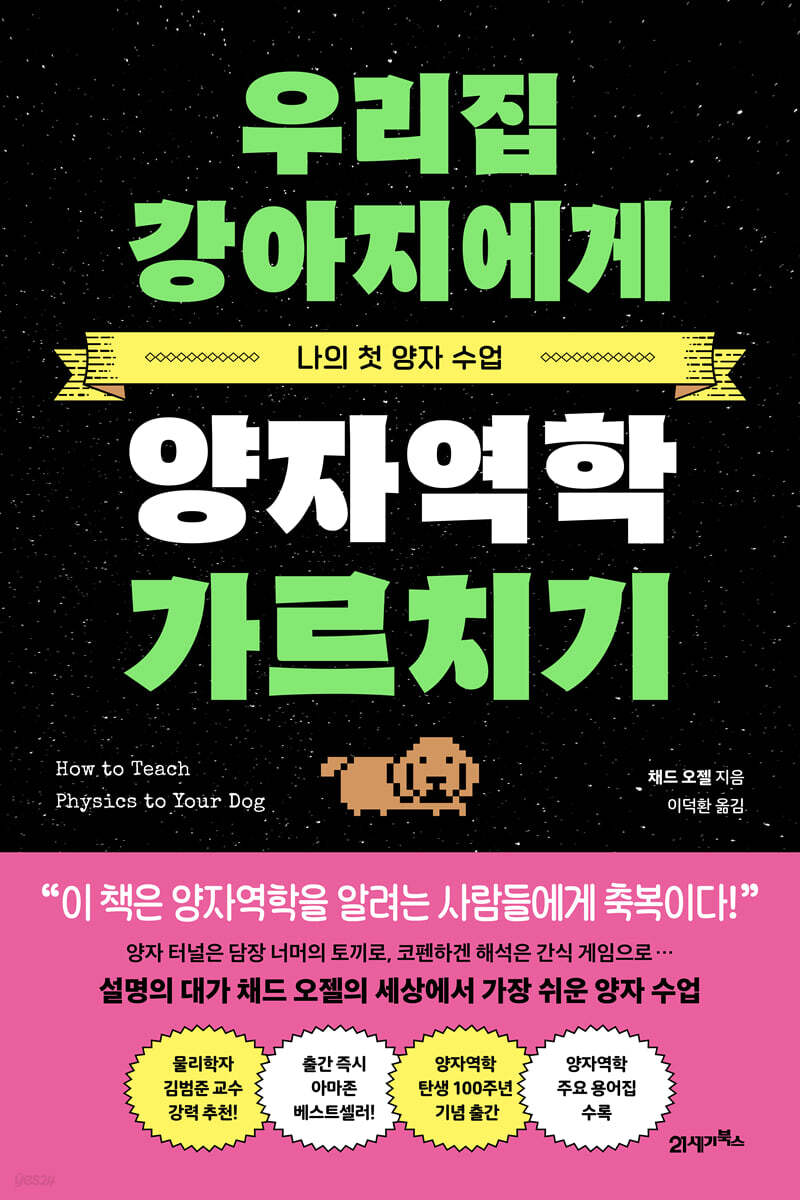
Teaching Quantum Mechanics to My Dog
 |
Description
Book Introduction
An Amazon bestseller immediately after publication!
Highly recommended by Professor Kim Beom-jun!
“This book is a blessing to those who want to learn quantum mechanics!”
The World's Easiest Quantum Lesson from Master Explainer Chad Ozel
The year 2025 marks the 100th anniversary of the publication of the paper on matrix mechanics, which revolutionized modern physics.
This paper, published by Werner Heisenberg in 1925, opened the door to quantum mechanics, and over the next 100 years, quantum mechanics has made remarkable progress and has deeply permeated every aspect of our daily lives.
The principles of quantum mechanics are hidden behind the cutting-edge technologies we use every day, such as smartphones, computers, MRIs, lasers, and semiconductors.
Quantum mechanics has become so central to modern civilization that it is now difficult to find someone who has not heard the word 'quantum'.
In keeping with this trend, a proper understanding of quantum mechanics is no longer the exclusive domain of scientists, but is becoming a necessary knowledge for everyone.
To commemorate the United Nations' designation of 2025 as the International Year of Quantum Science, we are publishing physicist Chad Orzel's book, Teaching Quantum Mechanics to Your Dog.
This book explains the complex and often difficult concepts of quantum physics in an easy and fun way through delightful conversations between the author and his beloved dog, Emmy.
Like the 'Schrödinger's Cat Paradox', the core principles of quantum mechanics, which are often mentioned in dramas and movies but are actually difficult to understand, will be naturally accepted as you follow Amy's absurd questions and the author's kind explanations.
Key concepts of quantum mechanics, such as wave-particle duality, the uncertainty principle, quantum entanglement, and the tunneling effect, are explained using everyday metaphors and humor, making it accessible even to readers unfamiliar with science.
Readers of this book will not simply learn the concepts of quantum mechanics, but will also experience a new joy in "understanding" science and the fun of questioning and exploring through conversations between Amy and the author.
Open the mysterious door to the quantum world with the world's easiest quantum mechanics lesson, "Teaching Quantum Mechanics to Your Dog."
Highly recommended by Professor Kim Beom-jun!
“This book is a blessing to those who want to learn quantum mechanics!”
The World's Easiest Quantum Lesson from Master Explainer Chad Ozel
The year 2025 marks the 100th anniversary of the publication of the paper on matrix mechanics, which revolutionized modern physics.
This paper, published by Werner Heisenberg in 1925, opened the door to quantum mechanics, and over the next 100 years, quantum mechanics has made remarkable progress and has deeply permeated every aspect of our daily lives.
The principles of quantum mechanics are hidden behind the cutting-edge technologies we use every day, such as smartphones, computers, MRIs, lasers, and semiconductors.
Quantum mechanics has become so central to modern civilization that it is now difficult to find someone who has not heard the word 'quantum'.
In keeping with this trend, a proper understanding of quantum mechanics is no longer the exclusive domain of scientists, but is becoming a necessary knowledge for everyone.
To commemorate the United Nations' designation of 2025 as the International Year of Quantum Science, we are publishing physicist Chad Orzel's book, Teaching Quantum Mechanics to Your Dog.
This book explains the complex and often difficult concepts of quantum physics in an easy and fun way through delightful conversations between the author and his beloved dog, Emmy.
Like the 'Schrödinger's Cat Paradox', the core principles of quantum mechanics, which are often mentioned in dramas and movies but are actually difficult to understand, will be naturally accepted as you follow Amy's absurd questions and the author's kind explanations.
Key concepts of quantum mechanics, such as wave-particle duality, the uncertainty principle, quantum entanglement, and the tunneling effect, are explained using everyday metaphors and humor, making it accessible even to readers unfamiliar with science.
Readers of this book will not simply learn the concepts of quantum mechanics, but will also experience a new joy in "understanding" science and the fun of questioning and exploring through conversations between Amy and the author.
Open the mysterious door to the quantum world with the world's easiest quantum mechanics lesson, "Teaching Quantum Mechanics to Your Dog."
- You can preview some of the book's contents.
Preview
index
Recommendation_Encountering the World Without Preconceptions
Introduction: Why Explain Physics to Your Dog: An Introduction to Quantum Physics
Chapter 1: Which Way? Both Ways: Particle-Wave Duality
Particles and Waves Around Us: Classical Physics | Waves in Everyday Life: Light and Sound | The Birth of Quantums: Light as Particles | Interfering Electrons: Particles as Waves | Everything is Made of Waves: Interference of Molecules
Chapter 2: Where Are My Bones?: Heisenberg's Uncertainty Principle
Heisenberg's Microscopic World: Semiclassical Arguments | Creating Quantum Particles: Probability Waves | The Limits of Reality: The Uncertainty Principle | Evidence of Uncertainty: Zero-Point Energy
Chapter 3: Schrödinger's Dog: The Copenhagen Interpretation
What is a wavefunction? An interpretation of quantum mechanics | Superposition and polarization: A look | Reversing photon measurements: The quantum eraser | Seeing is everything: The Copenhagen interpretation
Chapter 4: Multiple Worlds, Multiple Cookies: Interpreting the Multiverse
And then the measurement happens: The Copenhagen Problem | There's no collapse: Hugh Everett's many-worlds interpretation | The wave function scatters: decoherence | Environmental influences: decoherence and measurement | The real world: The phenomenon of decoherence and its interpretation
Chapter 5: Is It Still There?: The Quantum Zeno Effect
Stuck Here: Zeno's Paradox | The Watching Pot and the Measured Atom: The Quantum Zeno Effect | Measuring Without Looking: Quantum Interrogation
Chapter 6: No More Digging: Quantum Tunneling
The Ability to Do Work: Energy | Following the Returning Wavefunction: Quantum Ball | Not There: Passing Through Obstacles and Tunneling | Examining a Single Atom: Scanning Tunneling Microscopy
Chapter 7: Barking from afar: Quantum Entanglement
Sleeping puppies fooling each other: Entanglement and correlation | Is quantum mechanics incomplete?: The EPR debate | "I don't know" and "I can't know": Local hidden variables | Resolution of the debate: Bell's theorem | The EPR choice: Predicting local hidden variables | The Bohr choice: Quantum mechanical predictions | Laboratory tests and loopholes: The Aspe experiment
Chapter 8: Shoot Me a Rabbit: Quantum Teleportation
Remote copying: Classical 'teleportation' | No cloning: The quantum limit | The magic compass: A classical metaphor for quantum teleportation | Send me a photon: Quantum teleportation | Teleportation across the Danube: Experimental proof | What's it for?: Applications of teleportation
Chapter 9: Cheese Bunny: Virtual Particles and Quantum Electrodynamics
Counting Takes Time: Energy-Time Uncertainty | When Humans Distance Themselves…: Virtual Particles | Every Picture Tells a Story: Feynman Diagrams and QED | The Most Thoroughly Tested Theory in History: Experimental Confirmation of QED
Chapter 10: There Are Demonic Squirrels: The Misuse of Quantum Physics
A Free "Quantum" Lunch: Free Energy | The Path to Health: "Quantum Therapy" | Ghost Therapy via Entanglement: "Teletherapy" | Beware the Demon Squirrel: Quantum Physics Is Not Magic
Acknowledgements
Translator's Note: 100 Years of Quantum Mechanics: The Mysteries of the Microscopic World Embedded in Everyday Life
Recommended Reading | Key Terms | Index of People
Introduction: Why Explain Physics to Your Dog: An Introduction to Quantum Physics
Chapter 1: Which Way? Both Ways: Particle-Wave Duality
Particles and Waves Around Us: Classical Physics | Waves in Everyday Life: Light and Sound | The Birth of Quantums: Light as Particles | Interfering Electrons: Particles as Waves | Everything is Made of Waves: Interference of Molecules
Chapter 2: Where Are My Bones?: Heisenberg's Uncertainty Principle
Heisenberg's Microscopic World: Semiclassical Arguments | Creating Quantum Particles: Probability Waves | The Limits of Reality: The Uncertainty Principle | Evidence of Uncertainty: Zero-Point Energy
Chapter 3: Schrödinger's Dog: The Copenhagen Interpretation
What is a wavefunction? An interpretation of quantum mechanics | Superposition and polarization: A look | Reversing photon measurements: The quantum eraser | Seeing is everything: The Copenhagen interpretation
Chapter 4: Multiple Worlds, Multiple Cookies: Interpreting the Multiverse
And then the measurement happens: The Copenhagen Problem | There's no collapse: Hugh Everett's many-worlds interpretation | The wave function scatters: decoherence | Environmental influences: decoherence and measurement | The real world: The phenomenon of decoherence and its interpretation
Chapter 5: Is It Still There?: The Quantum Zeno Effect
Stuck Here: Zeno's Paradox | The Watching Pot and the Measured Atom: The Quantum Zeno Effect | Measuring Without Looking: Quantum Interrogation
Chapter 6: No More Digging: Quantum Tunneling
The Ability to Do Work: Energy | Following the Returning Wavefunction: Quantum Ball | Not There: Passing Through Obstacles and Tunneling | Examining a Single Atom: Scanning Tunneling Microscopy
Chapter 7: Barking from afar: Quantum Entanglement
Sleeping puppies fooling each other: Entanglement and correlation | Is quantum mechanics incomplete?: The EPR debate | "I don't know" and "I can't know": Local hidden variables | Resolution of the debate: Bell's theorem | The EPR choice: Predicting local hidden variables | The Bohr choice: Quantum mechanical predictions | Laboratory tests and loopholes: The Aspe experiment
Chapter 8: Shoot Me a Rabbit: Quantum Teleportation
Remote copying: Classical 'teleportation' | No cloning: The quantum limit | The magic compass: A classical metaphor for quantum teleportation | Send me a photon: Quantum teleportation | Teleportation across the Danube: Experimental proof | What's it for?: Applications of teleportation
Chapter 9: Cheese Bunny: Virtual Particles and Quantum Electrodynamics
Counting Takes Time: Energy-Time Uncertainty | When Humans Distance Themselves…: Virtual Particles | Every Picture Tells a Story: Feynman Diagrams and QED | The Most Thoroughly Tested Theory in History: Experimental Confirmation of QED
Chapter 10: There Are Demonic Squirrels: The Misuse of Quantum Physics
A Free "Quantum" Lunch: Free Energy | The Path to Health: "Quantum Therapy" | Ghost Therapy via Entanglement: "Teletherapy" | Beware the Demon Squirrel: Quantum Physics Is Not Magic
Acknowledgements
Translator's Note: 100 Years of Quantum Mechanics: The Mysteries of the Microscopic World Embedded in Everyday Life
Recommended Reading | Key Terms | Index of People
Detailed image
.jpg)
Into the book
Modern life would be impossible without quantum mechanics.
For example, if we had not understood the quantum mechanical nature of electrons, we would not be able to create the semiconductor chips that power today's computers.
If we hadn't understood the quantum nature of light and atoms, we wouldn't have been able to create lasers that send signals over fiber-optic communication lines.
The impact of quantum theory on science goes beyond mere practicality.
Quantum theory has also enabled physicists to tackle philosophical problems.
Quantum physics has revealed the limits of what we can know about the universe and the properties of all matter in it.
Thanks to this, we were able to completely reexamine the nature of existence at the most fundamental level.
--- p.15, "Preface: Why Explain Physics to Dogs - An Introduction to Quantum Physics"
In our daily lives, we experience two representative types of waves: light and sound.
Although both are wave phenomena, they have completely different characteristics.
A detailed understanding of that difference sheds some light (please excuse the homonym) on why a dog cannot pass through both sides of a tree at the same time.
Sound waves are pressure waves that propagate through the air.
When a dog barks, the air forced through its mouth creates vibrations that travel in all directions.
When those vibrations reach another dog, the sound waves cause the dog's eardrums to vibrate, which is converted into signals that the brain recognizes as sound.
When the second dog starts barking, more waves are created, annoying people nearby.
--- p.36~37, 「Chapter 1.
Which way? Both ways: Particle-wave duality.
Most philosophical problems in quantum mechanics concern the “interpretation” of the theory.
Such problems only arise in quantum mechanics.
In fact, classical physics does not require a separate interpretation.
In classical physics, which predicts the position, velocity, and acceleration of an object, it is known precisely what these quantities mean and how to measure them.
There is also a direct and intuitive connection between theory and the reality we observe.
But quantum mechanics is not like that.
There are mathematical equations that govern the theory, compute wave functions, and predict behavior, but it is not clear what the wave function means.
To connect the wavefunction we calculate with the quantity we measure in an experiment, we need an additional explanation, or “interpretation.”
--- p.94~95, 「Chapter 3.
Schrödinger's Dog: The Copenhagen Interpretation
In the dog-walking example, a long-range interferometer would be equivalent to sending two dogs to opposite sides of Central Park.
The longer the route, the more likely it is that your dog will spend time chasing squirrels, dropping food, and playing with poop along the way.
The two puppies can no longer run at the same speed.
Depending on what happens in between, it can get faster or slower.
The order in which the two puppies arrive depends not only on the length of the route, but also on what happens along the way.
The same thing happens with light.
Light passing through the interferometer occasionally interacts with air atoms or molecules.
--- p.145, Chapter 4.
"Multiple Worlds, Multiple Cookies: A Multiverse Interpretation"
“Quantum teleportation” is probably the most well-known application of the nonlocal correlations described in the previous chapter.
The name alone conjures up a multitude of imaginations, bringing to mind science fiction like Star Trek, where objects are instantly transported from one place to another.
An object that starts at A disappears with a soft explosion and then reappears at B, far away.
But compared to what we've seen in science fiction, real-world quantum teleportation seems disappointing.
Quantum teleportation is the transfer of the quantum state of an object from one place to another, rather than the object itself.
Moreover, because information has to travel from one place to another, the speed of travel is slower than that of light.
--- p.240, Chapter 8.
Shoot Me a Rabbit: Quantum Teleportation
“In such a Feynman diagram, photons exhibit all kinds of electrical or magnetic interactions.
“That means that such a shape describes the process by which electrons interact with other electrons or with protons, and such interactions are always happening.”
"great.
But I have no idea what you're talking about."
“Well, in QED, interactions are discussed as exchanges of particles.
The reason two electrons repel each other is because one electron transmits a photon to the other electron.
This means that a photon emitted by one electron is transferred to another electron and absorbed.
Absorption and emission cause changes in momentum, and we see these changes as a force that pushes the two particles away from each other.”
For example, if we had not understood the quantum mechanical nature of electrons, we would not be able to create the semiconductor chips that power today's computers.
If we hadn't understood the quantum nature of light and atoms, we wouldn't have been able to create lasers that send signals over fiber-optic communication lines.
The impact of quantum theory on science goes beyond mere practicality.
Quantum theory has also enabled physicists to tackle philosophical problems.
Quantum physics has revealed the limits of what we can know about the universe and the properties of all matter in it.
Thanks to this, we were able to completely reexamine the nature of existence at the most fundamental level.
--- p.15, "Preface: Why Explain Physics to Dogs - An Introduction to Quantum Physics"
In our daily lives, we experience two representative types of waves: light and sound.
Although both are wave phenomena, they have completely different characteristics.
A detailed understanding of that difference sheds some light (please excuse the homonym) on why a dog cannot pass through both sides of a tree at the same time.
Sound waves are pressure waves that propagate through the air.
When a dog barks, the air forced through its mouth creates vibrations that travel in all directions.
When those vibrations reach another dog, the sound waves cause the dog's eardrums to vibrate, which is converted into signals that the brain recognizes as sound.
When the second dog starts barking, more waves are created, annoying people nearby.
--- p.36~37, 「Chapter 1.
Which way? Both ways: Particle-wave duality.
Most philosophical problems in quantum mechanics concern the “interpretation” of the theory.
Such problems only arise in quantum mechanics.
In fact, classical physics does not require a separate interpretation.
In classical physics, which predicts the position, velocity, and acceleration of an object, it is known precisely what these quantities mean and how to measure them.
There is also a direct and intuitive connection between theory and the reality we observe.
But quantum mechanics is not like that.
There are mathematical equations that govern the theory, compute wave functions, and predict behavior, but it is not clear what the wave function means.
To connect the wavefunction we calculate with the quantity we measure in an experiment, we need an additional explanation, or “interpretation.”
--- p.94~95, 「Chapter 3.
Schrödinger's Dog: The Copenhagen Interpretation
In the dog-walking example, a long-range interferometer would be equivalent to sending two dogs to opposite sides of Central Park.
The longer the route, the more likely it is that your dog will spend time chasing squirrels, dropping food, and playing with poop along the way.
The two puppies can no longer run at the same speed.
Depending on what happens in between, it can get faster or slower.
The order in which the two puppies arrive depends not only on the length of the route, but also on what happens along the way.
The same thing happens with light.
Light passing through the interferometer occasionally interacts with air atoms or molecules.
--- p.145, Chapter 4.
"Multiple Worlds, Multiple Cookies: A Multiverse Interpretation"
“Quantum teleportation” is probably the most well-known application of the nonlocal correlations described in the previous chapter.
The name alone conjures up a multitude of imaginations, bringing to mind science fiction like Star Trek, where objects are instantly transported from one place to another.
An object that starts at A disappears with a soft explosion and then reappears at B, far away.
But compared to what we've seen in science fiction, real-world quantum teleportation seems disappointing.
Quantum teleportation is the transfer of the quantum state of an object from one place to another, rather than the object itself.
Moreover, because information has to travel from one place to another, the speed of travel is slower than that of light.
--- p.240, Chapter 8.
Shoot Me a Rabbit: Quantum Teleportation
“In such a Feynman diagram, photons exhibit all kinds of electrical or magnetic interactions.
“That means that such a shape describes the process by which electrons interact with other electrons or with protons, and such interactions are always happening.”
"great.
But I have no idea what you're talking about."
“Well, in QED, interactions are discussed as exchanges of particles.
The reason two electrons repel each other is because one electron transmits a photon to the other electron.
This means that a photon emitted by one electron is transferred to another electron and absorbed.
Absorption and emission cause changes in momentum, and we see these changes as a force that pushes the two particles away from each other.”
--- p.286, Chapter 9.
Cheese Rabbit: Virtual Particles and Quantum Electrodynamics
Cheese Rabbit: Virtual Particles and Quantum Electrodynamics
Publisher's Review
“Quantum mechanics, which was so complicated, has finally become mine!”
An introductory book to quantum mechanics that instantly clarifies the complexities of the invisible world through conversations with companion dogs!
These days, the word "quantum mechanics" appears frequently in news, dramas, movies, and even everyday conversations, but it's difficult to readily answer the question, "What on earth is it?"
Because it is about explaining what happens in the invisible microscopic world, quantum mechanics has been considered a difficult subject, often involving complex formulas and abstract theories.
But this book breaks down that wall in a unique way.
Physicist Chad Ozel unpacks key concepts, from particle-wave duality to the uncertainty principle, through engaging conversations with his dog, Emmy.
This book, which suggests “how to think like a dog,” overturns the human perspective trapped in common sense and allows us to see the world through the eyes of a curious dog.
Amy thinks of wave diffraction when she hits a tree while trying to catch a rabbit, and discusses Heisenberg's uncertainty principle when she can't find a bone.
These conversations, which transform everyday scenes into scientific metaphors, excel at simplifying complexity.
Readers naturally enter the world of quantum mechanics by following the puppy's innocent questions.
Understanding Quantum Mechanics Without Equations
A groundbreaking, imaginative explanation of 10 key words that delve into the core of modern physics.
This book goes beyond simple theoretical explanations to encompass experiments and philosophical considerations.
From Young's double-slit experiment to Schrödinger's cat thought experiment and quantum entanglement, the book systematically covers the major topics of quantum physics across ten chapters.
He has an outstanding ability to explain quantum entanglement and the quantum Zeno effect, which have recently been gaining attention, using minimal formulas and puppy metaphors.
By following this process, you will go beyond simple knowledge transfer and encounter the essence of scientific thinking.
Even complex concepts are reconstructed in everyday life, such as the Copenhagen interpretation that “measurement determines reality,” which was always confusing no matter how much it was explained, being explained through Amy’s snack hiding game.
In particular, the unique way in which concepts such as 'probability waves' and 'wave functions' are explained by connecting them to Amy's snack quest helps readers understand by intuitively analogizing the invisible microscopic world.
In this way, the author chose an intuitive metaphor instead of complex mathematical proof as a way to show us the microscopic world.
For example, the quantum tunneling phenomenon, where a dog teleports through a fence instead of going through it, is reinterpreted as "bone finding without having to dig."
This approach, through analogies, naturally demonstrates the theory's practical applicability and demonstrates that quantum mechanics underpins modern technologies, from lasers to semiconductors.
Storytelling skills that shine even brighter in newly emerging fields
A classic for quantum mechanics beginners that spawned the book-reading dog meme on social media!
This book, which became an Amazon bestseller when it was first published in 2009 and gave birth to the meme "Teaching Physics to Dogs," still maintains a unique position in bookstores with over a thousand Amazon reviews.
It is the result of the author's expertise (as a physics professor) and humorous storytelling.
In particular, the 'Schrödinger's Dog' parody leaves a deep impression on readers by explaining the quantum superposition state, and with its insight ahead of its time and unchanging popular appeal, it has established itself as a classic for readers at the introductory level of quantum mechanics.
What is noteworthy is that, despite being written in 2009, this book covers all the core concepts of quantum mechanics, including quantum entanglement, quantum tunneling, and the Zeno effect, which have recently received increasing attention.
Reflecting the latest research trends and discussions in the scientific community, the author broadly covers not only the fundamental principles of quantum mechanics but also key theories that form the foundation for future technologies such as quantum computing and quantum cryptography.
This allows readers to naturally understand how quantum mechanics is being applied and developed at the forefront of modern science and technology, beyond simple basic concepts.
For all of us living in an era of technological innovation brought about by quantum mechanics, quantum mechanics is no longer 'someone else's story.'
Published to commemorate the 100th anniversary of the birth of quantum mechanics, "Teaching Quantum Mechanics to My Dog" lowers the barrier to quantum mechanics for those who find science difficult, and spreads waves of fun and intellectual enjoyment from a new method of explanation to those already fascinated.
For students, parents, teachers, and employees interested in quantum mechanics, this will provide a solid foundation for understanding the principles of cutting-edge technology and preparing for the future.
“Unknown terms such as quantum entanglement, quantum space travel, and virtual particles are explained in the author’s characteristically humorous style.
Readers who have previously avoided popular explanations of physics will find this book a real delight.”
- Publisher's Weekly
“It’s hard to imagine a better way to introduce basic quantum physics to people who are weak in math and science.”
-Ray Olson, Booklist review
An introductory book to quantum mechanics that instantly clarifies the complexities of the invisible world through conversations with companion dogs!
These days, the word "quantum mechanics" appears frequently in news, dramas, movies, and even everyday conversations, but it's difficult to readily answer the question, "What on earth is it?"
Because it is about explaining what happens in the invisible microscopic world, quantum mechanics has been considered a difficult subject, often involving complex formulas and abstract theories.
But this book breaks down that wall in a unique way.
Physicist Chad Ozel unpacks key concepts, from particle-wave duality to the uncertainty principle, through engaging conversations with his dog, Emmy.
This book, which suggests “how to think like a dog,” overturns the human perspective trapped in common sense and allows us to see the world through the eyes of a curious dog.
Amy thinks of wave diffraction when she hits a tree while trying to catch a rabbit, and discusses Heisenberg's uncertainty principle when she can't find a bone.
These conversations, which transform everyday scenes into scientific metaphors, excel at simplifying complexity.
Readers naturally enter the world of quantum mechanics by following the puppy's innocent questions.
Understanding Quantum Mechanics Without Equations
A groundbreaking, imaginative explanation of 10 key words that delve into the core of modern physics.
This book goes beyond simple theoretical explanations to encompass experiments and philosophical considerations.
From Young's double-slit experiment to Schrödinger's cat thought experiment and quantum entanglement, the book systematically covers the major topics of quantum physics across ten chapters.
He has an outstanding ability to explain quantum entanglement and the quantum Zeno effect, which have recently been gaining attention, using minimal formulas and puppy metaphors.
By following this process, you will go beyond simple knowledge transfer and encounter the essence of scientific thinking.
Even complex concepts are reconstructed in everyday life, such as the Copenhagen interpretation that “measurement determines reality,” which was always confusing no matter how much it was explained, being explained through Amy’s snack hiding game.
In particular, the unique way in which concepts such as 'probability waves' and 'wave functions' are explained by connecting them to Amy's snack quest helps readers understand by intuitively analogizing the invisible microscopic world.
In this way, the author chose an intuitive metaphor instead of complex mathematical proof as a way to show us the microscopic world.
For example, the quantum tunneling phenomenon, where a dog teleports through a fence instead of going through it, is reinterpreted as "bone finding without having to dig."
This approach, through analogies, naturally demonstrates the theory's practical applicability and demonstrates that quantum mechanics underpins modern technologies, from lasers to semiconductors.
Storytelling skills that shine even brighter in newly emerging fields
A classic for quantum mechanics beginners that spawned the book-reading dog meme on social media!
This book, which became an Amazon bestseller when it was first published in 2009 and gave birth to the meme "Teaching Physics to Dogs," still maintains a unique position in bookstores with over a thousand Amazon reviews.
It is the result of the author's expertise (as a physics professor) and humorous storytelling.
In particular, the 'Schrödinger's Dog' parody leaves a deep impression on readers by explaining the quantum superposition state, and with its insight ahead of its time and unchanging popular appeal, it has established itself as a classic for readers at the introductory level of quantum mechanics.
What is noteworthy is that, despite being written in 2009, this book covers all the core concepts of quantum mechanics, including quantum entanglement, quantum tunneling, and the Zeno effect, which have recently received increasing attention.
Reflecting the latest research trends and discussions in the scientific community, the author broadly covers not only the fundamental principles of quantum mechanics but also key theories that form the foundation for future technologies such as quantum computing and quantum cryptography.
This allows readers to naturally understand how quantum mechanics is being applied and developed at the forefront of modern science and technology, beyond simple basic concepts.
For all of us living in an era of technological innovation brought about by quantum mechanics, quantum mechanics is no longer 'someone else's story.'
Published to commemorate the 100th anniversary of the birth of quantum mechanics, "Teaching Quantum Mechanics to My Dog" lowers the barrier to quantum mechanics for those who find science difficult, and spreads waves of fun and intellectual enjoyment from a new method of explanation to those already fascinated.
For students, parents, teachers, and employees interested in quantum mechanics, this will provide a solid foundation for understanding the principles of cutting-edge technology and preparing for the future.
“Unknown terms such as quantum entanglement, quantum space travel, and virtual particles are explained in the author’s characteristically humorous style.
Readers who have previously avoided popular explanations of physics will find this book a real delight.”
- Publisher's Weekly
“It’s hard to imagine a better way to introduce basic quantum physics to people who are weak in math and science.”
-Ray Olson, Booklist review
GOODS SPECIFICS
- Date of issue: May 21, 2025
- Page count, weight, size: 348 pages | 470g | 140*210*22mm
- ISBN13: 9791173573002
- ISBN10: 1173573003
You may also like
카테고리
korean


korean

![GQ KOREA Mark (Monthly): December [2025]](http://librairie.coreenne.fr/cdn/shop/files/8ef265dbbfbf186523ed75ba7319009d.jpg?v=1765340328&width=3840)


