

My first periodic table study
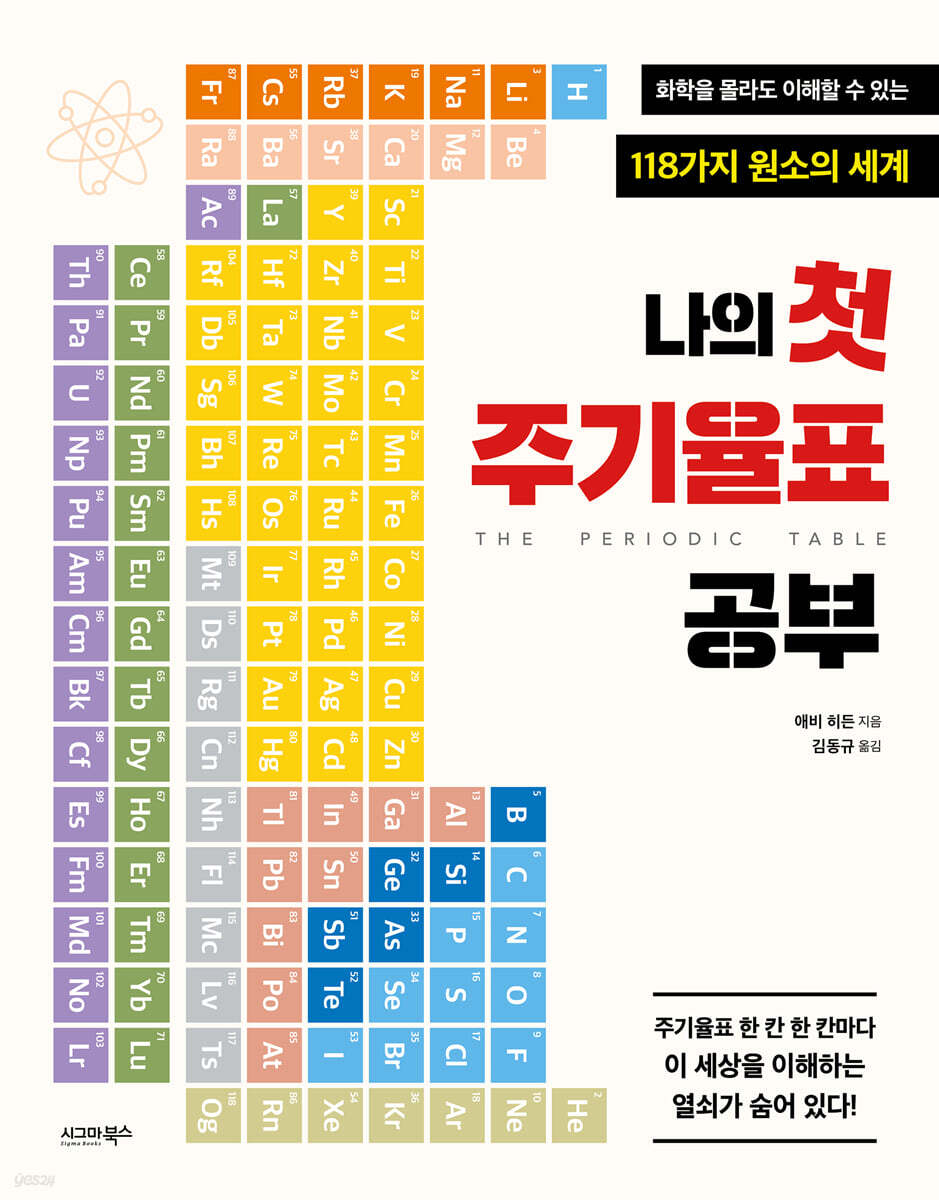 |
Description
Book Introduction
Just 118 elements explain everything around us!
A microcosm of the world, the periodic table: a colorful story of elements unfolding on the surface.
The periodic table is often considered the exclusive domain of chemistry majors and is considered unrelated to us.
However, the periodic table is very closely related to our lives in that it shows the 118 materials that make up everything on Earth.
In other words, the periodic table could soon become the fundamental key to understanding the world we live in.
From common elements like carbon, oxygen, gold, and iron to exotic elements like tennessine and oganesson, which exist only in laboratories, this book compiles the fascinating discovery, characteristics, and uses of each element. Discover the mysterious and surprising stories hidden within each cell of the periodic table.
A microcosm of the world, the periodic table: a colorful story of elements unfolding on the surface.
The periodic table is often considered the exclusive domain of chemistry majors and is considered unrelated to us.
However, the periodic table is very closely related to our lives in that it shows the 118 materials that make up everything on Earth.
In other words, the periodic table could soon become the fundamental key to understanding the world we live in.
From common elements like carbon, oxygen, gold, and iron to exotic elements like tennessine and oganesson, which exist only in laboratories, this book compiles the fascinating discovery, characteristics, and uses of each element. Discover the mysterious and surprising stories hidden within each cell of the periodic table.
- You can preview some of the book's contents.
Preview
index
introduction
Hydrogen / Helium / Lithium / Beryllium / Boron / Carbon / Nitrogen / Oxygen / Fluorine / Neon / Sodium / Magnesium / Aluminum / Silicon / Phosphorus / Sulfur / Chlorine / Argon / Potassium / Calcium / Scandium / Titanium / Vanadium / Chromium / Manganese / Iron / Cobalt / Nickel / Copper / Zinc / Gallium / Germanium / Arsenic / Selenium / Bromine / Krypton / Rubidium / Strontium / Yttrium / Zirconium / Niobium / Molybdenum / Technetium / Ruthenium / Rhodium / Palladium / Silver / Cadmium / Indium / Tin / Antimony / Tellurium / Iodine / Xenon / Cesium / Barium / Lanthanum / Cerium / Praseodymium / Neodymium / Promethium / Samarium / Europium / Gadolinium / Terbium / Dysprosium / Holmium / Erbium / Thulium / Ytterbium / Lutetium / Hafnium / Tantalum / Tungsten / Rhenium / Osmium / Iridium / Platinum / Gold / Mercury / Thallium / Lead / Bismuth / Polonium / Astatine / Radon / Francium / Radium / Actinium / Thorium / Protactinium / Uranium / Neptunium / Plutonium / Americium / Curium / Berkelium / Californium / Einsteinium / Fermium / Mendelevium / Nobelium / Lawrencium / Rutherfordium / Dubnium / Seaborgium / Bohrium / Hassium / Meitnerium / Darmstadtium / Roentgenium / Copernicium / Nihonium / Flerovium / Moscovium / Livermorium / Tennessine / Oganesson
Browse / Photo Credits
Hydrogen / Helium / Lithium / Beryllium / Boron / Carbon / Nitrogen / Oxygen / Fluorine / Neon / Sodium / Magnesium / Aluminum / Silicon / Phosphorus / Sulfur / Chlorine / Argon / Potassium / Calcium / Scandium / Titanium / Vanadium / Chromium / Manganese / Iron / Cobalt / Nickel / Copper / Zinc / Gallium / Germanium / Arsenic / Selenium / Bromine / Krypton / Rubidium / Strontium / Yttrium / Zirconium / Niobium / Molybdenum / Technetium / Ruthenium / Rhodium / Palladium / Silver / Cadmium / Indium / Tin / Antimony / Tellurium / Iodine / Xenon / Cesium / Barium / Lanthanum / Cerium / Praseodymium / Neodymium / Promethium / Samarium / Europium / Gadolinium / Terbium / Dysprosium / Holmium / Erbium / Thulium / Ytterbium / Lutetium / Hafnium / Tantalum / Tungsten / Rhenium / Osmium / Iridium / Platinum / Gold / Mercury / Thallium / Lead / Bismuth / Polonium / Astatine / Radon / Francium / Radium / Actinium / Thorium / Protactinium / Uranium / Neptunium / Plutonium / Americium / Curium / Berkelium / Californium / Einsteinium / Fermium / Mendelevium / Nobelium / Lawrencium / Rutherfordium / Dubnium / Seaborgium / Bohrium / Hassium / Meitnerium / Darmstadtium / Roentgenium / Copernicium / Nihonium / Flerovium / Moscovium / Livermorium / Tennessine / Oganesson
Browse / Photo Credits
Detailed image
.jpg)
Into the book
As of the time of writing this book, the total number of elements officially recognized by the International Union of Pure and Applied Chemistry (IUPAC) is 118.
Among them, elements 1 to 94 exist naturally on Earth, but elements 95 to 118 are substances synthesized through nuclear reactions under laboratory conditions.
If another element is discovered, the existing periodic table will be expanded, and there are still conflicting theories about how to arrange these newly discovered elements.
One thing is clear: scientists are working hard to make these new discoveries.
So, one day, the current periodic table will be expanded.
--- From the "Introduction"
The name helium comes from the Greek word helios, meaning sun.
This element was formed along with hydrogen and nitrogen during the Big Bang.
Helium is the second most abundant element in the universe, making up about 24% of the total mass of all elements in the universe.
The combined mass of hydrogen and helium accounts for 99% of the mass of the universe observed so far.
--- From "Helium"
In fact, silicon and the silicone we know are different! Strictly speaking, silicon is the name of a synthetic polymer, and silicon is the material used as its raw material.
Silicone, a synthetic polymer, is generally colorless and oily or rubber-like in appearance and is widely used as a sealant, adhesive, and electrical and thermal insulator.
In the medical field, it is used in implants, contact lenses, and scar treatments.
--- From "Silicon"
Because of its color, cobalt was not only used in paintings, glassware, and ceramics, but was also added to glass bottles to protect their contents from sunlight.
Even today, colorful compounds of this element produce colors such as cobalt green, cobalt violet, cobalt yellow, and cerulean blue (made famous by Meryl Streep in The Devil Wears Prada).
Other commercial applications include lithium-ion batteries, high-strength metal alloys, and electroplating.
--- "Cobalt
The amount of gold mined from Earth so far is estimated to be between 178,100 and 212,582 tonnes, with estimated reserves of about 59,000 tonnes.
The remaining approximately 20 million tons of gold exist in a diluted state in the world's oceans, and people have long been searching for ways to extract it.
However, no feasible method has been found to date.
--- From "Gold"
At the time the research was being conducted, the dangers of radioactivity were not fully known, so Marie Curie herself ended up being exposed to radiation far beyond the safe range.
The cause of her death in 1934 was asthenic anemia, also believed to be the result of prolonged exposure to radiation.
The lab notebook she used is still radioactive and is still stored in a lead box.
--- From "Radium"
As with all elements at the end of the periodic table, roentgenium was called by its position before it was officially discovered.
Element 111 also had a Latin name for its number, which happened to be 'unununium', which sounded rather nice, and its chemical symbol was Uuu.
Among them, elements 1 to 94 exist naturally on Earth, but elements 95 to 118 are substances synthesized through nuclear reactions under laboratory conditions.
If another element is discovered, the existing periodic table will be expanded, and there are still conflicting theories about how to arrange these newly discovered elements.
One thing is clear: scientists are working hard to make these new discoveries.
So, one day, the current periodic table will be expanded.
--- From the "Introduction"
The name helium comes from the Greek word helios, meaning sun.
This element was formed along with hydrogen and nitrogen during the Big Bang.
Helium is the second most abundant element in the universe, making up about 24% of the total mass of all elements in the universe.
The combined mass of hydrogen and helium accounts for 99% of the mass of the universe observed so far.
--- From "Helium"
In fact, silicon and the silicone we know are different! Strictly speaking, silicon is the name of a synthetic polymer, and silicon is the material used as its raw material.
Silicone, a synthetic polymer, is generally colorless and oily or rubber-like in appearance and is widely used as a sealant, adhesive, and electrical and thermal insulator.
In the medical field, it is used in implants, contact lenses, and scar treatments.
--- From "Silicon"
Because of its color, cobalt was not only used in paintings, glassware, and ceramics, but was also added to glass bottles to protect their contents from sunlight.
Even today, colorful compounds of this element produce colors such as cobalt green, cobalt violet, cobalt yellow, and cerulean blue (made famous by Meryl Streep in The Devil Wears Prada).
Other commercial applications include lithium-ion batteries, high-strength metal alloys, and electroplating.
--- "Cobalt
The amount of gold mined from Earth so far is estimated to be between 178,100 and 212,582 tonnes, with estimated reserves of about 59,000 tonnes.
The remaining approximately 20 million tons of gold exist in a diluted state in the world's oceans, and people have long been searching for ways to extract it.
However, no feasible method has been found to date.
--- From "Gold"
At the time the research was being conducted, the dangers of radioactivity were not fully known, so Marie Curie herself ended up being exposed to radiation far beyond the safe range.
The cause of her death in 1934 was asthenic anemia, also believed to be the result of prolonged exposure to radiation.
The lab notebook she used is still radioactive and is still stored in a lead box.
--- From "Radium"
As with all elements at the end of the periodic table, roentgenium was called by its position before it was officially discovered.
Element 111 also had a Latin name for its number, which happened to be 'unununium', which sounded rather nice, and its chemical symbol was Uuu.
--- From "Roentgenium"
Publisher's Review
Each and every column of the periodic table
The key to understanding this world is hidden there.
In March 1869, Russian chemist Dmitry Mendeleev first published the 'Periodic Table', which organized elements by common properties, at the Russian Chemical Society.
At that time, there were a total of 63 elements, including hydrogen with atomic number 1, but Mendeleev left blank spaces in the periodic table, predicting the existence of elements that had not yet been discovered.
The periodic table, which was initially sparse, surprisingly began to fill in the blanks one by one as the remaining elements were discovered.
It was proven that the composition method predicted by Mendeleev was correct.
In this way, Mendeleev's periodic table became established as a major foundation of chemistry in that it showed the properties and relationships of all elements existing in the world like a map.
As of 2025, the periodic table consists of a total of 118 elements.
Elements 1 through 94 are elements that exist naturally on Earth, and elements 95 through 118 are substances that were artificially synthesized in a laboratory.
If you are unfamiliar with chemistry, you will likely be taken aback by the unfamiliar symbols and their unique arrangement when you first look at the periodic table.
However, if you encounter the basic concepts of the periodic table and the interesting stories behind each element introduced in this book, you will experience the experience of gradually opening your eyes to the periodic table, which used to be like an indecipherable code.
You will feel it again.
The periodic table is a scientific product that most easily and beautifully represents the world of elements, and indeed the entire universe.
Suhelibebunuric acid… Stop memorizing superficial things!
A periodic table guide that captures both the story and the core.
Let's go on a fun elemental journey even if you don't know how to draw!
“Suhelibebunuric acid…” If you studied science in school, you would have heard this element memorization technique at least once.
The concepts of elements and the periodic table are first learned in the first year of middle school, but most of the way to acquire the content is purely memorization to quickly put it in one's head.
However, if you think about the fact that this universe is made up of only 118 elements, you will realize that the 'suhelibebun carbonitric acid' that you memorized without much thought actually contains an infinite number of stories.
"My First Periodic Table Study" is a periodic table guidebook that captures both the story and the core, while also providing the fascinating story behind each of the 118 elements and not missing any essential information.
First, the introduction to “My First Periodic Table Study” provides guidance on how to read the periodic table.
'Group' refers to a vertical column of the periodic table, and 'period' refers to a horizontal row of the periodic table, which are arranged according to specific rules, such as the number of outermost electrons or the number of electron shells.
Meanwhile, each element can be divided into four 'blocks' based on the electron orbitals of the atoms that make up the element, or they can be classified into ten 'categories' based on the common characteristics of the elements.
In this text, we introduce 118 elements, numbered according to their atomic number, that is, the number of protons per atom of the element.
Starting with hydrogen (H), which has the simplest structure among all elements, it covers everything from natural elements such as helium (He), aluminum (Al), iron (Fe), and iodine (I) to artificially created elements such as einsteinium (Es), tennessine (Ts), and oganesson (Og), literally covering the A to Z of the elements in one book.
It is organized in a full-color layout so that you can see at a glance the basic information such as melting point, boiling point, density, and appearance of each element, as well as the origin and use of the name, photos to aid understanding, and even the location on the periodic table.
Reading the periodic table is like understanding the universe surrounding us through a scientific lens.
Whether you've always been interested in chemistry and elements or are completely new to chemistry, "My First Periodic Table Study" will be your first key to systematically understanding this uncertain world.
The key to understanding this world is hidden there.
In March 1869, Russian chemist Dmitry Mendeleev first published the 'Periodic Table', which organized elements by common properties, at the Russian Chemical Society.
At that time, there were a total of 63 elements, including hydrogen with atomic number 1, but Mendeleev left blank spaces in the periodic table, predicting the existence of elements that had not yet been discovered.
The periodic table, which was initially sparse, surprisingly began to fill in the blanks one by one as the remaining elements were discovered.
It was proven that the composition method predicted by Mendeleev was correct.
In this way, Mendeleev's periodic table became established as a major foundation of chemistry in that it showed the properties and relationships of all elements existing in the world like a map.
As of 2025, the periodic table consists of a total of 118 elements.
Elements 1 through 94 are elements that exist naturally on Earth, and elements 95 through 118 are substances that were artificially synthesized in a laboratory.
If you are unfamiliar with chemistry, you will likely be taken aback by the unfamiliar symbols and their unique arrangement when you first look at the periodic table.
However, if you encounter the basic concepts of the periodic table and the interesting stories behind each element introduced in this book, you will experience the experience of gradually opening your eyes to the periodic table, which used to be like an indecipherable code.
You will feel it again.
The periodic table is a scientific product that most easily and beautifully represents the world of elements, and indeed the entire universe.
Suhelibebunuric acid… Stop memorizing superficial things!
A periodic table guide that captures both the story and the core.
Let's go on a fun elemental journey even if you don't know how to draw!
“Suhelibebunuric acid…” If you studied science in school, you would have heard this element memorization technique at least once.
The concepts of elements and the periodic table are first learned in the first year of middle school, but most of the way to acquire the content is purely memorization to quickly put it in one's head.
However, if you think about the fact that this universe is made up of only 118 elements, you will realize that the 'suhelibebun carbonitric acid' that you memorized without much thought actually contains an infinite number of stories.
"My First Periodic Table Study" is a periodic table guidebook that captures both the story and the core, while also providing the fascinating story behind each of the 118 elements and not missing any essential information.
First, the introduction to “My First Periodic Table Study” provides guidance on how to read the periodic table.
'Group' refers to a vertical column of the periodic table, and 'period' refers to a horizontal row of the periodic table, which are arranged according to specific rules, such as the number of outermost electrons or the number of electron shells.
Meanwhile, each element can be divided into four 'blocks' based on the electron orbitals of the atoms that make up the element, or they can be classified into ten 'categories' based on the common characteristics of the elements.
In this text, we introduce 118 elements, numbered according to their atomic number, that is, the number of protons per atom of the element.
Starting with hydrogen (H), which has the simplest structure among all elements, it covers everything from natural elements such as helium (He), aluminum (Al), iron (Fe), and iodine (I) to artificially created elements such as einsteinium (Es), tennessine (Ts), and oganesson (Og), literally covering the A to Z of the elements in one book.
It is organized in a full-color layout so that you can see at a glance the basic information such as melting point, boiling point, density, and appearance of each element, as well as the origin and use of the name, photos to aid understanding, and even the location on the periodic table.
Reading the periodic table is like understanding the universe surrounding us through a scientific lens.
Whether you've always been interested in chemistry and elements or are completely new to chemistry, "My First Periodic Table Study" will be your first key to systematically understanding this uncertain world.
GOODS SPECIFICS
- Date of issue: April 22, 2025
- Page count, weight, size: 228 pages | 540g | 170*217*12mm
- ISBN13: 9791168623453
- ISBN10: 1168623456
You may also like
카테고리
korean


korean

![GQ KOREA Mark (Monthly): December [2025]](http://librairie.coreenne.fr/cdn/shop/files/8ef265dbbfbf186523ed75ba7319009d.jpg?v=1765340328&width=3840)


