

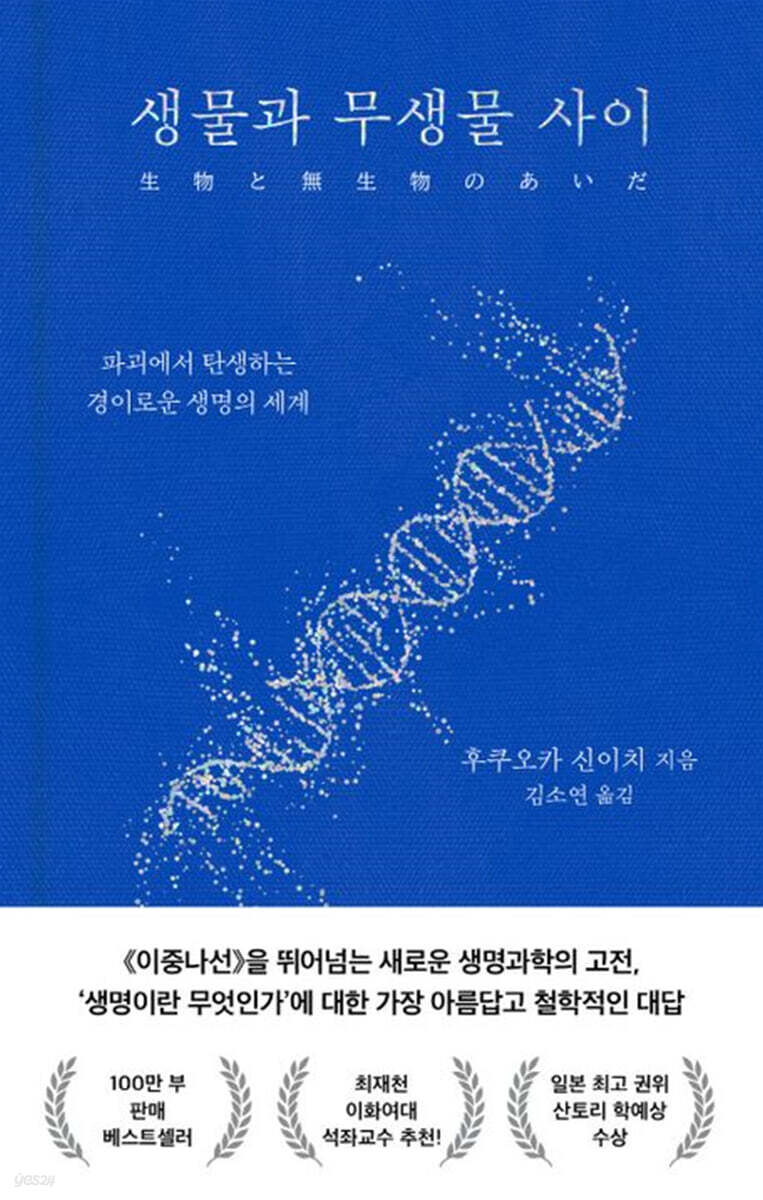
Between living and non-living things
 |
Description
Book Introduction
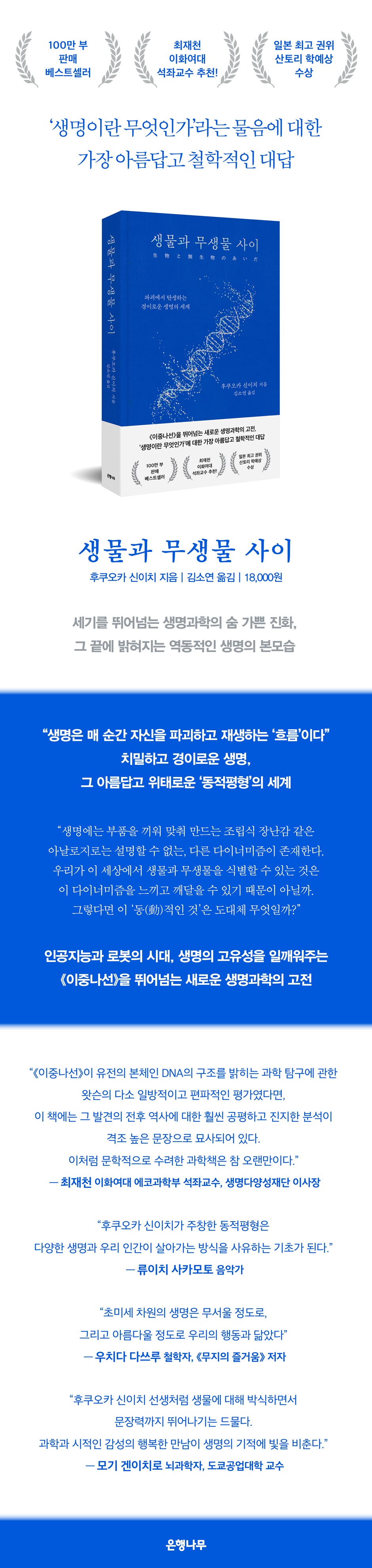
★Japan's bestseller with over 1 million copies sold
★Recommended by Choi Jae-cheon, Professor Emeritus at Ewha Womans University
★Winner of Japan's most prestigious Suntory Academic Award
“Life is a constantly changing flow.”
A New Classic in Life Science Beyond The Double Helix
The most beautiful and philosophical answer to the question, "What is life?"
The breathtaking evolution of life sciences spanning centuries,
The true nature of dynamic life revealed at the end
“Life is a self-replicating system.” This was the statement that was considered the answer to the question “What is life?” throughout the 20th century.
However, the author directly refutes this statement by looking at the development of life sciences in the 20th century.
Life is neither a self-replicating nor a 'system'.
"Between the Living and the Inanimate" combines the perspectives of science, philosophy, and literature to offer a new answer to the perennial question of life science—"What is life?"—and the weighty question of the meaning of life.
The author, who has dedicated himself to life science research at Rockefeller University and Harvard University, travels through the breathtaking history of life sciences and uncovers the stories of the "hidden heroes" who have quietly dedicated themselves to research in the shadows of scientific history. He also examines what distinguishes living things from inanimate objects, along with the changing perspectives on life.
"Between the Living and the Inanimate" is a fascinating science book, "literarily beautiful" (Choi Jae-cheon), that explores the journey of a boy who embarks on a career as a scientist, questioning "What is life?" and discovers the answer. It also explores the history of life sciences over a century and leads to a new philosophy of life.
The author's "dynamic equilibrium" view of life, which views life not as a single object but as a "dynamic flow of repeated destruction and creation," suggests the essence and uniqueness of life in an era where human genes are manipulated like machine parts and artificial intelligence seeks to replace humans.
"Between the Living and the Inanimate" is evaluated as "a new classic of life science that surpasses "The Double Helix"" and has rewritten the history of science textbooks with its rigor and meticulousness that only a scientist exploring the essence of life can show, a philosophical view of life that captures the unique beauty and potential of "life," and a mysterious structure that breathlessly advances toward the truth of the essence of life.
The "dynamic equilibrium" view of life, which combines science and philosophy presented in this book, has inspired people in various fields, including fellow scientists, musician Ryuichi Sakamoto, novelist Banana Yoshimoto, and actress Yu Aoi.
★Recommended by Choi Jae-cheon, Professor Emeritus at Ewha Womans University
★Winner of Japan's most prestigious Suntory Academic Award
“Life is a constantly changing flow.”
A New Classic in Life Science Beyond The Double Helix
The most beautiful and philosophical answer to the question, "What is life?"
The breathtaking evolution of life sciences spanning centuries,
The true nature of dynamic life revealed at the end
“Life is a self-replicating system.” This was the statement that was considered the answer to the question “What is life?” throughout the 20th century.
However, the author directly refutes this statement by looking at the development of life sciences in the 20th century.
Life is neither a self-replicating nor a 'system'.
"Between the Living and the Inanimate" combines the perspectives of science, philosophy, and literature to offer a new answer to the perennial question of life science—"What is life?"—and the weighty question of the meaning of life.
The author, who has dedicated himself to life science research at Rockefeller University and Harvard University, travels through the breathtaking history of life sciences and uncovers the stories of the "hidden heroes" who have quietly dedicated themselves to research in the shadows of scientific history. He also examines what distinguishes living things from inanimate objects, along with the changing perspectives on life.
"Between the Living and the Inanimate" is a fascinating science book, "literarily beautiful" (Choi Jae-cheon), that explores the journey of a boy who embarks on a career as a scientist, questioning "What is life?" and discovers the answer. It also explores the history of life sciences over a century and leads to a new philosophy of life.
The author's "dynamic equilibrium" view of life, which views life not as a single object but as a "dynamic flow of repeated destruction and creation," suggests the essence and uniqueness of life in an era where human genes are manipulated like machine parts and artificial intelligence seeks to replace humans.
"Between the Living and the Inanimate" is evaluated as "a new classic of life science that surpasses "The Double Helix"" and has rewritten the history of science textbooks with its rigor and meticulousness that only a scientist exploring the essence of life can show, a philosophical view of life that captures the unique beauty and potential of "life," and a mysterious structure that breathlessly advances toward the truth of the essence of life.
The "dynamic equilibrium" view of life, which combines science and philosophy presented in this book, has inspired people in various fields, including fellow scientists, musician Ryuichi Sakamoto, novelist Banana Yoshimoto, and actress Yu Aoi.
- You can preview some of the book's contents.
Preview
index
prolog
Chapter 1: 66th Street, York Avenue, New York
Chapter 2: The Unsung Hero
Chapter 3 Four Alphabet
Chapter 4: Chargaff's Puzzle
Chapter 5: The Nobel Prize-Winning Surfer
Chapter 6: The Shadow of DNA
Chapter 7: Opportunity Comes Only to Those Who Are Prepared
Chapter 8: When Atoms Create Order
Chapter 9: What is Dynamic Equilibrium?
Chapter 10: A Light Kiss of Protein
Chapter 11: The Inside Inside Is the Outside
Chapter 12: Dynamism of the Cell Membrane
Chapter 13: Giving Form to the Membrane
Chapter 14: Number, Timing, and Knockout Mouse
Chapter 15: The Irreversible Origami Called Time
Epilogue
Translator's Note
Chapter 1: 66th Street, York Avenue, New York
Chapter 2: The Unsung Hero
Chapter 3 Four Alphabet
Chapter 4: Chargaff's Puzzle
Chapter 5: The Nobel Prize-Winning Surfer
Chapter 6: The Shadow of DNA
Chapter 7: Opportunity Comes Only to Those Who Are Prepared
Chapter 8: When Atoms Create Order
Chapter 9: What is Dynamic Equilibrium?
Chapter 10: A Light Kiss of Protein
Chapter 11: The Inside Inside Is the Outside
Chapter 12: Dynamism of the Cell Membrane
Chapter 13: Giving Form to the Membrane
Chapter 14: Number, Timing, and Knockout Mouse
Chapter 15: The Irreversible Origami Called Time
Epilogue
Translator's Note
Detailed image
Into the book
Even if one type of component or one piece is completely removed using gene knockout technology, a compensatory action occurs to fill in the missing part in some way, and if the whole is in harmony, no malfunction occurs.
Life has important properties that cannot be explained by analogy, which is like assembling a toy by fitting together parts.
There is a different dynamism here.
Isn't it because we can feel and realize this dynamism that we can distinguish between living and non-living things in this world?
So then, what exactly is this ‘dynamic thing’?
--- From the "Prologue"
A virus is something that wanders between living and non-living things.
If life is defined as 'self-replicating', then viruses are definitely living things.
The way viruses attach themselves to cells and use their systems to replicate is no different from that of parasites.
However, when we look at the individual virus particles, they are nothing more than inorganic, hard, mechanical objects, and we do not feel any movement as a living thing.
--- From "Unpraised Heroes"
To put it another way, you could say it is the texture of research.
This is a feeling on a completely different level than intuition or a flash of wisdom.
People often say that discoveries and inventions are the result of a momentary flash of brilliance or serendipity, but I disagree.
Rather, the senses work as a negative in the research field.
Intuitions like “This must be it!” are often the product of latent preconceptions or simple schematization, and are often far from or different from the natural world.
As for the transforming agent, it is a product of intuition to think that it cannot be just DNA with a simple structure, but must be a complex protein.
--- From "The Four Alphabet"
Scientists are usually obsessed with their own ideas.
For example, when data comes out that is different from what you thought, you first think that the observation method must be wrong.
I don't think my thoughts are wrong.
Therefore, observations (or experiments) are repeated to obtain data that matches one's thoughts.
But most of the thoughts he was so obsessed with were illusions.
Therefore, matching data cannot be obtained.
Then most of them become even more obsessed.
Just as the gap widens to get the marble out, the endless experiment is repeated, just like that gap widens even further.
This is actually why research takes so much time.
When a hypothesis and experimental data do not match, you may think that the hypothesis is correct but there was a problem with the experiment and you did not obtain the data you expected, or you may think that the data that supports the hypothesis is not obtained because the hypothesis was incorrect in the first place.
A scientist's ability is judged by how he thinks.
Because on the surface, both situations are similar in that the experiments are not conducted properly.
The minimum condition for being intellectual is whether or not one is capable of self-doubt.
--- From "Shagaff's Puzzle"
The shell is clearly a product of the shell's DNA.
But the texture we feel when we look at the seashell now is something different from a 'copy'.
Pebbles and seashells are also natural formations created by atoms coming together.
They are all beautiful.
But the luster of small shells has a beauty that does not exist in pebbles.
It is a beauty that order creates, a beauty that only dynamic things can produce.
--- From "When Atoms Create Order"
We often say, “You’re still the same,” when greeting a friend we haven’t seen in a long time, but if we haven’t seen each other for six months or even a year, we become completely different people on a molecular level, and we become so different.
Because there are no atoms or molecules inside you that were once part of you.
We feel that the body is an individual entity, isolated from the outside world.
However, at the molecular level, this is not necessarily the case.
We living organisms are just 'lumps' of molecules that just so happen to be denser.
And it is being replaced at a rapid pace.
The flow itself is proof that it is 'alive' and if it does not always absorb molecules from the outside, the molecules that escape will not match the resin.
--- From "What is Dynamic Equilibrium"
The law of increasing entropy applies to the components that make up living things without exception.
Polymers break down when they are oxidized.
The aggregate is dispersed and the reaction is not constant.
Proteins are damaged and their properties change.
But if the system can always rebuild faster than the rate at which such chaos accumulates, by deliberately breaking down the components that will eventually collapse, then the system will end up dumping its increasing entropy outside the system.
In other words, the only way to resist the law of increasing entropy is not to strengthen the durability and structure of the system, but rather to leave the system itself to the flow.
In other words, only flow has the function of discharging entropy that inevitably occurs within living organisms.
--- From "What is Dynamic Equilibrium"
Even though they are all attached to the same zelkova tree, each branch has a different appearance.
A branch nests in a spot with just one choice, and once it grows, it neither changes its shape nor returns to where it came from.
The cell division and network expansion that occur within the zelkova tree, as well as the dynamic equilibrium, are acts that flow leisurely over time and are also one-time events.
However, since all zelkova trees look like zelkova trees, we can easily misunderstand the uniqueness of each zelkova tree as a kind of reproducibility.
But there is potential for individual time there.
Life has important properties that cannot be explained by analogy, which is like assembling a toy by fitting together parts.
There is a different dynamism here.
Isn't it because we can feel and realize this dynamism that we can distinguish between living and non-living things in this world?
So then, what exactly is this ‘dynamic thing’?
--- From the "Prologue"
A virus is something that wanders between living and non-living things.
If life is defined as 'self-replicating', then viruses are definitely living things.
The way viruses attach themselves to cells and use their systems to replicate is no different from that of parasites.
However, when we look at the individual virus particles, they are nothing more than inorganic, hard, mechanical objects, and we do not feel any movement as a living thing.
--- From "Unpraised Heroes"
To put it another way, you could say it is the texture of research.
This is a feeling on a completely different level than intuition or a flash of wisdom.
People often say that discoveries and inventions are the result of a momentary flash of brilliance or serendipity, but I disagree.
Rather, the senses work as a negative in the research field.
Intuitions like “This must be it!” are often the product of latent preconceptions or simple schematization, and are often far from or different from the natural world.
As for the transforming agent, it is a product of intuition to think that it cannot be just DNA with a simple structure, but must be a complex protein.
--- From "The Four Alphabet"
Scientists are usually obsessed with their own ideas.
For example, when data comes out that is different from what you thought, you first think that the observation method must be wrong.
I don't think my thoughts are wrong.
Therefore, observations (or experiments) are repeated to obtain data that matches one's thoughts.
But most of the thoughts he was so obsessed with were illusions.
Therefore, matching data cannot be obtained.
Then most of them become even more obsessed.
Just as the gap widens to get the marble out, the endless experiment is repeated, just like that gap widens even further.
This is actually why research takes so much time.
When a hypothesis and experimental data do not match, you may think that the hypothesis is correct but there was a problem with the experiment and you did not obtain the data you expected, or you may think that the data that supports the hypothesis is not obtained because the hypothesis was incorrect in the first place.
A scientist's ability is judged by how he thinks.
Because on the surface, both situations are similar in that the experiments are not conducted properly.
The minimum condition for being intellectual is whether or not one is capable of self-doubt.
--- From "Shagaff's Puzzle"
The shell is clearly a product of the shell's DNA.
But the texture we feel when we look at the seashell now is something different from a 'copy'.
Pebbles and seashells are also natural formations created by atoms coming together.
They are all beautiful.
But the luster of small shells has a beauty that does not exist in pebbles.
It is a beauty that order creates, a beauty that only dynamic things can produce.
--- From "When Atoms Create Order"
We often say, “You’re still the same,” when greeting a friend we haven’t seen in a long time, but if we haven’t seen each other for six months or even a year, we become completely different people on a molecular level, and we become so different.
Because there are no atoms or molecules inside you that were once part of you.
We feel that the body is an individual entity, isolated from the outside world.
However, at the molecular level, this is not necessarily the case.
We living organisms are just 'lumps' of molecules that just so happen to be denser.
And it is being replaced at a rapid pace.
The flow itself is proof that it is 'alive' and if it does not always absorb molecules from the outside, the molecules that escape will not match the resin.
--- From "What is Dynamic Equilibrium"
The law of increasing entropy applies to the components that make up living things without exception.
Polymers break down when they are oxidized.
The aggregate is dispersed and the reaction is not constant.
Proteins are damaged and their properties change.
But if the system can always rebuild faster than the rate at which such chaos accumulates, by deliberately breaking down the components that will eventually collapse, then the system will end up dumping its increasing entropy outside the system.
In other words, the only way to resist the law of increasing entropy is not to strengthen the durability and structure of the system, but rather to leave the system itself to the flow.
In other words, only flow has the function of discharging entropy that inevitably occurs within living organisms.
--- From "What is Dynamic Equilibrium"
Even though they are all attached to the same zelkova tree, each branch has a different appearance.
A branch nests in a spot with just one choice, and once it grows, it neither changes its shape nor returns to where it came from.
The cell division and network expansion that occur within the zelkova tree, as well as the dynamic equilibrium, are acts that flow leisurely over time and are also one-time events.
However, since all zelkova trees look like zelkova trees, we can easily misunderstand the uniqueness of each zelkova tree as a kind of reproducibility.
But there is potential for individual time there.
--- From "The Irreversible Origami Called Time"
Publisher's Review
The discovery of DNA, the 'blueprint of life' that ushered in the era of life sciences.
The 'Hidden Heroes' Unrecorded in the History of Great Discovery
The groundbreaking discovery that DNA, the body of genes, has a 'double helix structure capable of self-replication' made the 20th century an era of life science.
Watson and Crick were awarded the 1962 Nobel Prize in Physiology or Medicine for first announcing these facts, and are still praised as heroes who opened the era of life science.
But rather than honoring their achievements, the author traces the history of numerous 'discoveries' that occurred before their 'announcements'.
It was Oswald Avery who first discovered that 'DNA is the essence of genes'.
He was a passionate scientist who shook test tubes, manipulated glass pipettes, and conducted experiments himself until he was in his sixties.
People at Rockefeller University, who admired his sincerity and humility, unanimously said, "Avery's failure to receive the Nobel Prize was the most unfair thing in the history of science, and Watson and Crick were nothing more than spoiled grandchildren riding on Avery's back."
Meanwhile, there was a scientist who provided Watson and Crick with a crucial clue to elucidating the structure of DNA: X-ray researcher Rosalind Franklin.
She faithfully drew the picture of DNA based solely on observations, without allowing any logical leaps and excluding intuition.
Although they got closest to understanding the truth about DNA through that silent experiment, Watson and Crick obtained observation data on Franklin's DNA through illegal means and combined their own research with it to announce it as the 'discovery of the century'.
She had her discoveries stolen, lost her fame as a scientist, and unfortunately died at an early age.
In this way, the author focuses on the stories of the "unsung" hidden heroes, showing that the advancement of life sciences was not only achieved by those who first published papers and enjoyed the "glory of discoverers."
Furthermore, the sincerity and humility that Avery and Franklin displayed, without being obsessed with fame and reward, and the scientific rigor that was not immersed in their own prejudices, suggest that it was they who ushered in the era of life science.
He argues that science is not merely a tool for uncovering objective truths about nature, but rather a product of human effort to silently pursue the truth.
He pursues the answer to the question, "What is life?" and captures the human beauty that can only be appreciated by closely observing the "texture of research," including the "achievements of science" as well as the pure spirit of inquiry, noble efforts, frustrations, and overcoming behind them.
“Why doesn’t life ‘break down’ even when ‘parts’ break?”
The essence of life revealed within the limits of a mechanistic view of life
The definition of life, created by the discovery of the double helix structure of DNA, that “life is a self-replicating system” has become the dominant proposition in life science research.
Living things are considered machines made up of various parts created according to DNA information, and 20th century life science, obsessed with this mechanistic view of life, seeks to elucidate the principles of life through experiments that involve cutting and pasting parts of DNA through microscopic 'surgical operations.'
The author, who was moved by the mystery of a pupa hatching into a butterfly and dreamed of becoming a second Fabre while collecting lizard eggs, also manipulates the 'parts' of the 'life machine' at the forefront of life science.
He is dedicated to creating a 'knockout mouse' that lacks the GP2 gene, a 'part' of the pancreas, by manipulating its DNA to learn about its function.
Just as removing the sound-producing component from a television results in no sound, removing the GP2 gene would result in a corresponding 'breakdown', which would reveal the function of GP2.
When he finally created a knockout mouse lacking the GP2 gene, he was filled with the thrill of having uncovered a secret about life.
However, knockout mice lacking the GP2 gene are born healthy and live about two years like other mice before dying. Despite lacking the GP2 gene, the knockout mice experienced no problems throughout their lives.
Why doesn't life "break down" even when "parts" are removed? The author intuitively senses this bitter failure, frustrated by it.
Right here lies the 'essence of life'.
In other words, life is something fundamentally different from a machine made up of 'parts' that perform functions.
“We should not be discouraged by the fact that nothing happened to mice missing one gene, but rather astonished by the fact that nothing happened.
“We must admire the flexible adaptability and natural resilience of dynamic equilibrium.”
_In the text
“Life is a flow that destroys itself and regenerates itself at every moment.”
The dense and wondrous world of life, its beautiful and precarious "dynamic equilibrium."
The author departs from Watson and Crick, who proved the mechanistic view of life, and focuses on Rudolf Schönheimer, a scientist who preceded the discovery of the DNA double helix by a decade.
Schönheimer develops the theory that life is not a "molecular machine made up of parts like a toy assembly," but a "dynamic flow" that discards and regenerates parts of itself at every moment.
Just as cells in our bodies die and are created simultaneously, life is a 'flow' that is always renewing its balance.
So even if the GP2 gene is missing, even if some part is missing, the flow of life flexibly changes to fill in the missing part and maintains the harmony of the whole, so it does not 'break down'.
Unlike a machine, a fixed entity in which parts and functions correspond one-to-one, life exists as a single flow with dynamism.
The reason we don't perceive toys and machines, or even robots and artificial intelligence, as living things is because we can feel and realize the dynamism of life.
Life is a flow in dynamic equilibrium.
The proteins that make up life begin to break down the moment they are created.
This is the only way for life to maintain order.
But how can life maintain its original equilibrium while constantly being destroyed? The answer lies in the complementarity inherent in the shape of proteins.
Life is sustained by the intricate complementarity of its internal forms, which maintain a dynamic equilibrium in a constant flux.
_In the text
The author adds the concept of 'time' to Schönheimer's theory.
Life is a one-way street on the time axis, maintaining a precarious balance from the moment of its birth.
Unlike machines, life is constantly changing due to the 'irreversible origami called time'.
Thanks to this, it is a flexible being that does not break down like a machine even if a single part is lost, but at the same time, it is a precarious being that can lose its balance and die even with a small external intervention.
The author calls this view of life ‘dynamic equilibrium.’
The dynamic equilibrium view of life goes beyond refuting the limitations of the mechanistic view of life, namely the error that life follows its blueprint, and proves the uniqueness and individuality of the individual.
All life is a unique flow that maintains its own 'balance' from the moment of birth, and nature is a larger, organic flow created by countless flows of life.
So, at the end of this long quest, the author, and we, cannot help but confess this.
“There is nothing we can do but bow before the flow of nature and describe life as it is.”
The 'Hidden Heroes' Unrecorded in the History of Great Discovery
The groundbreaking discovery that DNA, the body of genes, has a 'double helix structure capable of self-replication' made the 20th century an era of life science.
Watson and Crick were awarded the 1962 Nobel Prize in Physiology or Medicine for first announcing these facts, and are still praised as heroes who opened the era of life science.
But rather than honoring their achievements, the author traces the history of numerous 'discoveries' that occurred before their 'announcements'.
It was Oswald Avery who first discovered that 'DNA is the essence of genes'.
He was a passionate scientist who shook test tubes, manipulated glass pipettes, and conducted experiments himself until he was in his sixties.
People at Rockefeller University, who admired his sincerity and humility, unanimously said, "Avery's failure to receive the Nobel Prize was the most unfair thing in the history of science, and Watson and Crick were nothing more than spoiled grandchildren riding on Avery's back."
Meanwhile, there was a scientist who provided Watson and Crick with a crucial clue to elucidating the structure of DNA: X-ray researcher Rosalind Franklin.
She faithfully drew the picture of DNA based solely on observations, without allowing any logical leaps and excluding intuition.
Although they got closest to understanding the truth about DNA through that silent experiment, Watson and Crick obtained observation data on Franklin's DNA through illegal means and combined their own research with it to announce it as the 'discovery of the century'.
She had her discoveries stolen, lost her fame as a scientist, and unfortunately died at an early age.
In this way, the author focuses on the stories of the "unsung" hidden heroes, showing that the advancement of life sciences was not only achieved by those who first published papers and enjoyed the "glory of discoverers."
Furthermore, the sincerity and humility that Avery and Franklin displayed, without being obsessed with fame and reward, and the scientific rigor that was not immersed in their own prejudices, suggest that it was they who ushered in the era of life science.
He argues that science is not merely a tool for uncovering objective truths about nature, but rather a product of human effort to silently pursue the truth.
He pursues the answer to the question, "What is life?" and captures the human beauty that can only be appreciated by closely observing the "texture of research," including the "achievements of science" as well as the pure spirit of inquiry, noble efforts, frustrations, and overcoming behind them.
“Why doesn’t life ‘break down’ even when ‘parts’ break?”
The essence of life revealed within the limits of a mechanistic view of life
The definition of life, created by the discovery of the double helix structure of DNA, that “life is a self-replicating system” has become the dominant proposition in life science research.
Living things are considered machines made up of various parts created according to DNA information, and 20th century life science, obsessed with this mechanistic view of life, seeks to elucidate the principles of life through experiments that involve cutting and pasting parts of DNA through microscopic 'surgical operations.'
The author, who was moved by the mystery of a pupa hatching into a butterfly and dreamed of becoming a second Fabre while collecting lizard eggs, also manipulates the 'parts' of the 'life machine' at the forefront of life science.
He is dedicated to creating a 'knockout mouse' that lacks the GP2 gene, a 'part' of the pancreas, by manipulating its DNA to learn about its function.
Just as removing the sound-producing component from a television results in no sound, removing the GP2 gene would result in a corresponding 'breakdown', which would reveal the function of GP2.
When he finally created a knockout mouse lacking the GP2 gene, he was filled with the thrill of having uncovered a secret about life.
However, knockout mice lacking the GP2 gene are born healthy and live about two years like other mice before dying. Despite lacking the GP2 gene, the knockout mice experienced no problems throughout their lives.
Why doesn't life "break down" even when "parts" are removed? The author intuitively senses this bitter failure, frustrated by it.
Right here lies the 'essence of life'.
In other words, life is something fundamentally different from a machine made up of 'parts' that perform functions.
“We should not be discouraged by the fact that nothing happened to mice missing one gene, but rather astonished by the fact that nothing happened.
“We must admire the flexible adaptability and natural resilience of dynamic equilibrium.”
_In the text
“Life is a flow that destroys itself and regenerates itself at every moment.”
The dense and wondrous world of life, its beautiful and precarious "dynamic equilibrium."
The author departs from Watson and Crick, who proved the mechanistic view of life, and focuses on Rudolf Schönheimer, a scientist who preceded the discovery of the DNA double helix by a decade.
Schönheimer develops the theory that life is not a "molecular machine made up of parts like a toy assembly," but a "dynamic flow" that discards and regenerates parts of itself at every moment.
Just as cells in our bodies die and are created simultaneously, life is a 'flow' that is always renewing its balance.
So even if the GP2 gene is missing, even if some part is missing, the flow of life flexibly changes to fill in the missing part and maintains the harmony of the whole, so it does not 'break down'.
Unlike a machine, a fixed entity in which parts and functions correspond one-to-one, life exists as a single flow with dynamism.
The reason we don't perceive toys and machines, or even robots and artificial intelligence, as living things is because we can feel and realize the dynamism of life.
Life is a flow in dynamic equilibrium.
The proteins that make up life begin to break down the moment they are created.
This is the only way for life to maintain order.
But how can life maintain its original equilibrium while constantly being destroyed? The answer lies in the complementarity inherent in the shape of proteins.
Life is sustained by the intricate complementarity of its internal forms, which maintain a dynamic equilibrium in a constant flux.
_In the text
The author adds the concept of 'time' to Schönheimer's theory.
Life is a one-way street on the time axis, maintaining a precarious balance from the moment of its birth.
Unlike machines, life is constantly changing due to the 'irreversible origami called time'.
Thanks to this, it is a flexible being that does not break down like a machine even if a single part is lost, but at the same time, it is a precarious being that can lose its balance and die even with a small external intervention.
The author calls this view of life ‘dynamic equilibrium.’
The dynamic equilibrium view of life goes beyond refuting the limitations of the mechanistic view of life, namely the error that life follows its blueprint, and proves the uniqueness and individuality of the individual.
All life is a unique flow that maintains its own 'balance' from the moment of birth, and nature is a larger, organic flow created by countless flows of life.
So, at the end of this long quest, the author, and we, cannot help but confess this.
“There is nothing we can do but bow before the flow of nature and describe life as it is.”
GOODS SPECIFICS
- Date of issue: April 14, 2025
- Format: Hardcover book binding method guide
- Page count, weight, size: 304 pages | 125*200*30mm
- ISBN13: 9791167375438
- ISBN10: 1167375432
You may also like
카테고리
korean


korean

![GQ KOREA Mark (Monthly): December [2025]](http://librairie.coreenne.fr/cdn/shop/files/8ef265dbbfbf186523ed75ba7319009d.jpg?v=1765340328&width=3840)


