

Van Gogh's Time Discovered by Astronomy
 |
Description
Book Introduction
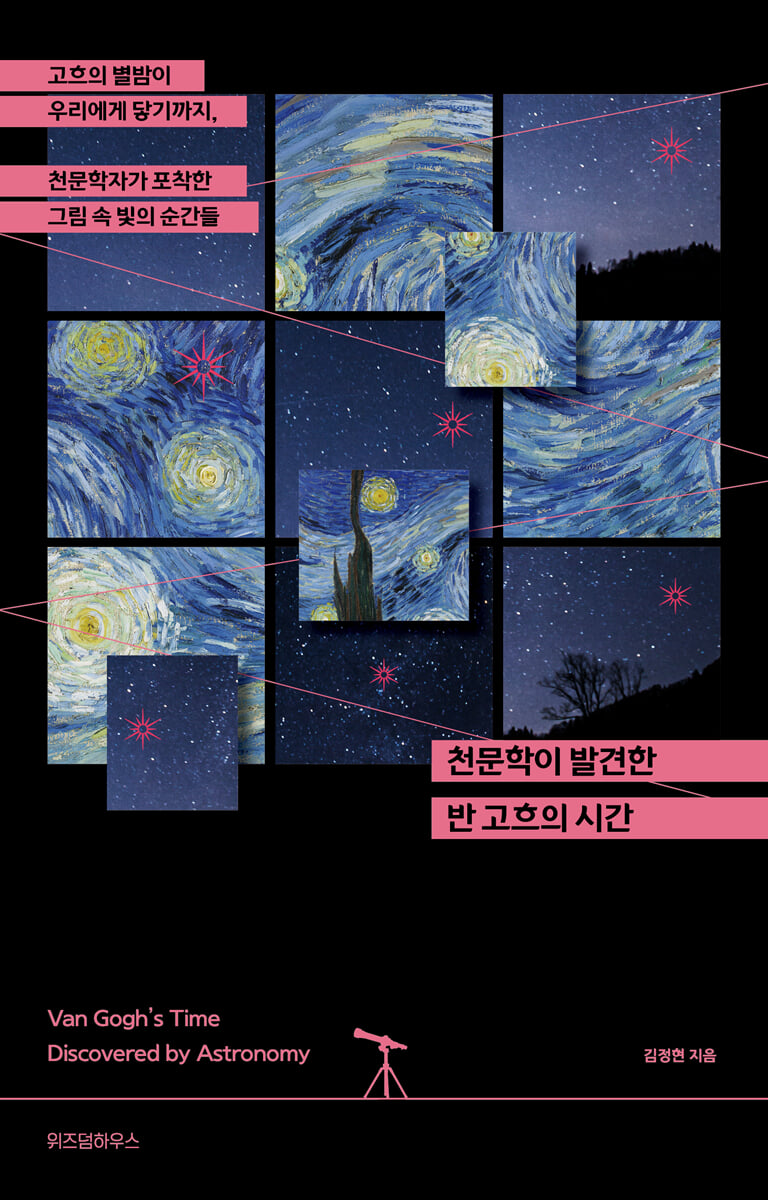
A vivid record of an astronomer's exploration of the night sky in Van Gogh's paintings.
To open a new chapter of discussion that overturns existing studies on Van Gogh, the author persistently pursues the 'star'.
Additionally, by gradually solving the mysteries contained in the night sky in “Starry Night,” we raise objections to the point in time at which the artwork was created, something that no one had ever questioned before.
The fresh perspective of reading the astronomer's paintings and his extensive knowledge of the celestial bodies combine to illuminate the 'immortal painter' in a colorful way.
To open a new chapter of discussion that overturns existing studies on Van Gogh, the author persistently pursues the 'star'.
Additionally, by gradually solving the mysteries contained in the night sky in “Starry Night,” we raise objections to the point in time at which the artwork was created, something that no one had ever questioned before.
The fresh perspective of reading the astronomer's paintings and his extensive knowledge of the celestial bodies combine to illuminate the 'immortal painter' in a colorful way.
- You can preview some of the book's contents.
Preview
index
At the beginning of the book
1.
Preparing to meet Van Gogh through astronomy
ㆍThe Starry Night and AriesㆍConditions of an Impressive ConstellationㆍUnderstanding TimeㆍMovement of the MoonㆍLet's Go to Saint-RémiㆍReproducing the Landscapes Van Gogh Saw
2.
The Birth of Van Gogh
ㆍVincent's Family HistoryㆍStarting Work at Goupil GalleryㆍBetween Faith and RealityㆍThe Artist's Path Discovered in the Darkest HourㆍThe Artist and His PatronㆍVan Gogh's Next Destination
3.
unfinished painter
ㆍTo the international city of AntwerpㆍA chance to showcase your paintingsㆍOpen your eyes to colorㆍPainters who paint the nightㆍThe star-filled night sky of Provence
4.
Analysis of "Cafe Terrace at Night"
ㆍAnalysis of the geography and topography of the work, a star with a unique colorㆍWhat constellation is depicted?
5.
Analysis of "Starry Night Over the Rhone"
ㆍThe ground and the night sky seen from different perspectivesㆍThe northern sky, the movement of starsㆍThe angle of the landscape
6.
Yellow House Time
ㆍThe Painters' CommunityㆍThe Yellow House and "The Painter on the Road to Tarascon"ㆍThe Common Life of Van Gogh and GauguinㆍThe Van Gogh Brothers' CollectionㆍThe Breakup with Gauguin and the First EpilepsyㆍThe End of the Yellow House
7.
Immersion into the painting
ㆍThe Exile of Saint-Paul de MussoleauㆍThe July 1889 AttackㆍThe Birth of a MasterㆍThe Last WinterㆍLeaving Provence
8.
Exploring the night sky in Saint-Rémy
ㆍVincent's RoomㆍMorning StarㆍSimulation of the Moon and VenusㆍIs It Really Only June 19, 1889?
9.
Scene from July 22, 1889
ㆍConditions for the Birth of "Starry Night"ㆍJuly Night SkyㆍVan Gogh's Unique SaintsㆍGaps in the CanvasㆍSecond Field Trip
10.
Jin Byeol in Auvers
The Last Star, The Last Moon, The Last of Life, The Story After
List of References and Figures
1.
Preparing to meet Van Gogh through astronomy
ㆍThe Starry Night and AriesㆍConditions of an Impressive ConstellationㆍUnderstanding TimeㆍMovement of the MoonㆍLet's Go to Saint-RémiㆍReproducing the Landscapes Van Gogh Saw
2.
The Birth of Van Gogh
ㆍVincent's Family HistoryㆍStarting Work at Goupil GalleryㆍBetween Faith and RealityㆍThe Artist's Path Discovered in the Darkest HourㆍThe Artist and His PatronㆍVan Gogh's Next Destination
3.
unfinished painter
ㆍTo the international city of AntwerpㆍA chance to showcase your paintingsㆍOpen your eyes to colorㆍPainters who paint the nightㆍThe star-filled night sky of Provence
4.
Analysis of "Cafe Terrace at Night"
ㆍAnalysis of the geography and topography of the work, a star with a unique colorㆍWhat constellation is depicted?
5.
Analysis of "Starry Night Over the Rhone"
ㆍThe ground and the night sky seen from different perspectivesㆍThe northern sky, the movement of starsㆍThe angle of the landscape
6.
Yellow House Time
ㆍThe Painters' CommunityㆍThe Yellow House and "The Painter on the Road to Tarascon"ㆍThe Common Life of Van Gogh and GauguinㆍThe Van Gogh Brothers' CollectionㆍThe Breakup with Gauguin and the First EpilepsyㆍThe End of the Yellow House
7.
Immersion into the painting
ㆍThe Exile of Saint-Paul de MussoleauㆍThe July 1889 AttackㆍThe Birth of a MasterㆍThe Last WinterㆍLeaving Provence
8.
Exploring the night sky in Saint-Rémy
ㆍVincent's RoomㆍMorning StarㆍSimulation of the Moon and VenusㆍIs It Really Only June 19, 1889?
9.
Scene from July 22, 1889
ㆍConditions for the Birth of "Starry Night"ㆍJuly Night SkyㆍVan Gogh's Unique SaintsㆍGaps in the CanvasㆍSecond Field Trip
10.
Jin Byeol in Auvers
The Last Star, The Last Moon, The Last of Life, The Story After
List of References and Figures
Detailed image
.jpg)
Into the book
In fact, many Van Gogh researchers and myself, a professional astronomer, feel the same way.
Does it really matter what kind of sky this painting was created from? That's why I never even considered applying this painting to the actual night sky.
Then one day, through the research of several art historians and astronomers who studied “Starry Night,” it was discovered that the star in the painting was known as Aries.
As expected, someone looked into what kind of sky this work depicts.
Astronomers naturally want to look at a star and try to figure out which constellation it is by solving the puzzle.
It may seem like a simple curiosity, but that interest, which began in ancient times, eventually became an essential technology for the numerous artificial satellites and space probes that fly through space.
--- p.16
Having spent my entire life looking at the stars, it seemed only natural to me that the waning moon in the dark night sky could only be seen in the eastern sky.
Therefore, it was naturally inferred that the direction in which “Starry Night” was drawn was east.
Then, I thought that the village visible at the bottom center of the painting must naturally be in the east, so I searched the map for the Abbey of Saint-Paul-de-Moussole, known as the place where “Starry Night” was painted, and I was excited to learn that the village was facing north.
--- p.58
The first painting in which Vincent included stars was Portrait of Eugène Boch (Poet).
When I first saw this piece without any background knowledge, I would not have guessed that the petals in the background were stars.
But it was only after reading this letter that I realized that the eight protruding rays of light, which looked like flower petals, were intended to symbolize bright stars.
As Vincent left in his letter, the background is expressed in a dark ultramarine color like the night sky, and around it are drawn stars that are close to white, stars that are greenish, and stars that are pinkish.
--- p.181
What was it like to paint "Cafe Terrace at Night"? Essentially, the streetlights and cafe lighting in the city center are the central themes of this work.
So, although it was night, the surroundings would have been quite bright, so it would have been possible to distinguish the paints on the canvas or palette even without a portable gas lamp.
Since the mid-19th century, gas lighting has been widely used in urban areas and homes.
Afterwards, in the late 19th century, it played an important role in lighting streets and commercial spaces in industrialized cities, and it is said that wealthy houses installed gas lights similar to today's electric lights.
Vincent also installed gas lights in the yellow house around October 21st, just before Gauguin arrived, at a cost of 25 francs.
The 'huge yellow lamp' in the work mentioned in the letter to Bill is also likely a large gas lamp.
--- p.207
For the purpose of tracking down "Starry Night," it doesn't matter exactly which room he was in.
But what matters is which direction he looks.
The view from the window of the recreated room was exactly to the east.
The trees in the landscape Vincent saw are now over 130 years old, but the stars he saw then still linger in his mind.
I was confident that I could trace the eastern dawn sky that Vincent had seen.
After inspecting the scene, I looked around the replicated room and his room window caught my eye.
If Vincent had captured the scene of “Starry Night” in this structure, it would have been difficult to see the moon in the southern night sky on June 19, 1889.
--- p.358
The Moon provides more evidence than we might think, as it moves through the greatest angle per hour of any celestial body visible from Earth (excluding asteroids, comets, and artificial objects).
Any star that rises over a spire somewhere in the east tonight will rise about four minutes earlier tomorrow night, but the moon, as we have already seen, rises on average 50 minutes later each day.
Therefore, the scene where the moon meets a specific point becomes strong evidence for calculating that time.
If you add stars to the background, you can tell the time almost perfectly.
--- p.373
What shape of moon best complements the stars? A bright moon obscures the stars, so if you're envisioning a scene where the stars and moon harmonize, the moonlight should be as dark as possible.
When a 'slender moon' such as a crescent or waning moon is in the sky, especially when a bright planet like Venus shines next to it, many people feel a sense of dreaminess and mystery.
--- p.421
The crescent moon, which is half bright and half dark, can represent the coexistence of opposing concepts such as light and dark, consciousness and unconsciousness, good and evil, and is a metaphor for his polarity or balance between madness and sanity.
Furthermore, although the crescent moon has not yet reached its full phase, it is moving in a growing direction, symbolizing aspirations and expectations for the future.
So he would have wanted to paint more pictures to become a great painter.
Vincent's waning moon in "O Charbonnage," painted in the painful October of 1878, ends with the first quarter moon of June 1890, twelve years later.
Does it really matter what kind of sky this painting was created from? That's why I never even considered applying this painting to the actual night sky.
Then one day, through the research of several art historians and astronomers who studied “Starry Night,” it was discovered that the star in the painting was known as Aries.
As expected, someone looked into what kind of sky this work depicts.
Astronomers naturally want to look at a star and try to figure out which constellation it is by solving the puzzle.
It may seem like a simple curiosity, but that interest, which began in ancient times, eventually became an essential technology for the numerous artificial satellites and space probes that fly through space.
--- p.16
Having spent my entire life looking at the stars, it seemed only natural to me that the waning moon in the dark night sky could only be seen in the eastern sky.
Therefore, it was naturally inferred that the direction in which “Starry Night” was drawn was east.
Then, I thought that the village visible at the bottom center of the painting must naturally be in the east, so I searched the map for the Abbey of Saint-Paul-de-Moussole, known as the place where “Starry Night” was painted, and I was excited to learn that the village was facing north.
--- p.58
The first painting in which Vincent included stars was Portrait of Eugène Boch (Poet).
When I first saw this piece without any background knowledge, I would not have guessed that the petals in the background were stars.
But it was only after reading this letter that I realized that the eight protruding rays of light, which looked like flower petals, were intended to symbolize bright stars.
As Vincent left in his letter, the background is expressed in a dark ultramarine color like the night sky, and around it are drawn stars that are close to white, stars that are greenish, and stars that are pinkish.
--- p.181
What was it like to paint "Cafe Terrace at Night"? Essentially, the streetlights and cafe lighting in the city center are the central themes of this work.
So, although it was night, the surroundings would have been quite bright, so it would have been possible to distinguish the paints on the canvas or palette even without a portable gas lamp.
Since the mid-19th century, gas lighting has been widely used in urban areas and homes.
Afterwards, in the late 19th century, it played an important role in lighting streets and commercial spaces in industrialized cities, and it is said that wealthy houses installed gas lights similar to today's electric lights.
Vincent also installed gas lights in the yellow house around October 21st, just before Gauguin arrived, at a cost of 25 francs.
The 'huge yellow lamp' in the work mentioned in the letter to Bill is also likely a large gas lamp.
--- p.207
For the purpose of tracking down "Starry Night," it doesn't matter exactly which room he was in.
But what matters is which direction he looks.
The view from the window of the recreated room was exactly to the east.
The trees in the landscape Vincent saw are now over 130 years old, but the stars he saw then still linger in his mind.
I was confident that I could trace the eastern dawn sky that Vincent had seen.
After inspecting the scene, I looked around the replicated room and his room window caught my eye.
If Vincent had captured the scene of “Starry Night” in this structure, it would have been difficult to see the moon in the southern night sky on June 19, 1889.
--- p.358
The Moon provides more evidence than we might think, as it moves through the greatest angle per hour of any celestial body visible from Earth (excluding asteroids, comets, and artificial objects).
Any star that rises over a spire somewhere in the east tonight will rise about four minutes earlier tomorrow night, but the moon, as we have already seen, rises on average 50 minutes later each day.
Therefore, the scene where the moon meets a specific point becomes strong evidence for calculating that time.
If you add stars to the background, you can tell the time almost perfectly.
--- p.373
What shape of moon best complements the stars? A bright moon obscures the stars, so if you're envisioning a scene where the stars and moon harmonize, the moonlight should be as dark as possible.
When a 'slender moon' such as a crescent or waning moon is in the sky, especially when a bright planet like Venus shines next to it, many people feel a sense of dreaminess and mystery.
--- p.421
The crescent moon, which is half bright and half dark, can represent the coexistence of opposing concepts such as light and dark, consciousness and unconsciousness, good and evil, and is a metaphor for his polarity or balance between madness and sanity.
Furthermore, although the crescent moon has not yet reached its full phase, it is moving in a growing direction, symbolizing aspirations and expectations for the future.
So he would have wanted to paint more pictures to become a great painter.
Vincent's waning moon in "O Charbonnage," painted in the painful October of 1878, ends with the first quarter moon of June 1890, twelve years later.
--- p.477
Publisher's Review
There are still secrets in "Starry Night" that have not been revealed yet.
The final clue that sheds new light on the paintings and life of the "immortal painter" is "star."
An astronomer's persistent pursuit spanning over 100 years
★ Korea's first ★
Our astronomer opens discussion on the 'creation period' of Van Gogh's paintings!
Van Gogh's stars and planets, moon and sun contain stories he saw, felt and couldn't resist telling.
When we examine the paintings that have been passed down to us across time and space through the lens of astronomy, a new interpretation of the immortal artist opens up.
This book can be said to be Van Gogh's 'real night sky exploration' with an astronomer.
The author personally visits the sky that Van Gogh most wanted to capture, encounters the summer constellation of the Great Triangle in “Cafe Terrace at Night,” sees the Big Dipper in “Starry Night Over the Rhone,” and satisfies his curiosity by counting the brightest stars in “Starry Night.”
In particular, by meticulously examining existing research on “Starry Night” and the materials left behind by Van Gogh, the book objectively reveals the secrets hidden in the master’s painting by utilizing scientific tools (astronomical simulation, measuring the angle of the sky, time conversion, etc.).
The astronomical exploration of the night sky in these works ultimately leads us into van Gogh's most intimate moments.
At the same time, it leads us to interpret “Starry Night” from a perspective that no one has attempted before.
As the astronomer reconstructs the stars and moon in the painting into reality, the world of Van Gogh, which we know so well, becomes surprisingly colorful.
And through this, you will encounter the most brilliant time of the immortal master, Van Gogh.
The creation date of the work, which no one has ever doubted
In search of the mystery left to us by “Starry Night”
ㆍIs the star in the picture Aries, as has been known so far?
ㆍAre Van Gogh's stars and moons imaginary patterns?
ㆍWhere did he actually draw the picture?
ㆍThe village in the painting cannot be seen from the window of the sanatorium where Van Gogh stayed.
ㆍI saw a moon that was almost full, but was it really a crescent moon?
ㆍOn the day the painting is believed to have been drawn, the sky was full of clouds.
Art historians and astronomers around the world studying van Gogh examine the positions of celestial bodies in the painting, surviving records, and changes in painting style.
And the results are used as a basis for estimating the time at which a work was painted.
In 1984, art historian Albert Boim suggested to the academic community that The Starry Night was painted sometime between June 18 and 19, 1889, and the date was later confirmed as June 19 by renowned Vincent van Gogh scholar Jan Hülsker.
And for over 40 years, everyone has considered this date to be the correct date.
Here, our astronomer, who has spent his life observing the stars, offers a new opinion that will astonish Van Gogh researchers and set the academic world abuzz.
He raised an objection to the famous painting period of "Starry Night," which was so obvious that no one even thought to question it.
To make it verifiable, as with existing research methods, we first found all the original records, including letters left by Van Gogh.
We thoroughly reviewed relevant papers and refined the stellar simulations that previous scholars had used as a basis using the latest software and observatories across the country.
And through several field trips, the author examines the landscape and sky he sees through scientific eyes.
The author's conclusion, reached after six years of verification to resolve a question that began with curiosity about stars, was that the constellation in the picture could not be the constellation Aries, which is considered to be the established theory.
Accordingly, we establish and argue the hypothesis that the painting was drawn around late July, not June 19th.
This work is significant not only for "Starry Night" but also for providing a starting point for a new interpretation of Van Gogh's work and for leading to a shift in thinking.
The Secret of Starlight in Van Gogh's Paintings
Finding new clues unearthed by the 'Astronomy Detective'
This book is both an astronomer's research notes on solving the mystery of the stars in "Starry Night" and a compilation of numerous materials from around the world, all about Van Gogh.
The author, who can be called an 'astronomy detective', searches through over 2,000 paintings and 903 letters left by Van Gogh to find clues related to 'Starry Night' and celestial bodies.
In this research process, Vincent van Gogh is reborn as a three-dimensional figure who is not just a 'mad genius', but a person who walks along the Rhone River with a canvas in hand, runs up the rocky hill of Saint-Rémy, and turns gas lights on and off to gaze at the stars in order to capture the night sky.
Also noteworthy in 『Van Gogh's Time Discovered by Astronomy』 are approximately 110 works by Van Gogh and his contemporaries, 60 celestial photographs of the universe, and various illustrations to aid understanding.
This guides the reader to look at the sky in the work and the real night sky seen by Van Gogh together through a simulation device.
Moreover, by utilizing a camera lens, it recreates Van Gogh's vision, allowing the reader to observe the scenery of Saint-Rémy and the Rhone River from the same perspective as the author.
The author has taken pains to ensure that the reader can appreciate the works of masters and even learn the fundamentals of astronomy by freely utilizing visual materials from various fields.
Van Gogh's Sun and Moon, Astronomy Through Stars and Planets
As a skilled 'astronomical communicator', the author provides an interesting account of the celestial bodies that appear in his paintings and while explaining Van Gogh's life.
Common knowledge about the moon, such as the full moon of Chuseok, the first full moon of the lunar year, the blue moon, the super moon, and how to read the lunar phases, is naturally incorporated.
By analyzing “Starry Night on the Rhone” and “Cafe Terrace at Night,” we will help you find constellations by season, learn about the location and scientific meaning of the North Star, and even provide tips for easy astronomical observation that can be done in everyday life.
And, for Korean readers who love Van Gogh, we did not leave out information on when we can see the sky in Korea that is exactly like the one in “Starry Night.”
Van Gogh's star prompted astronomers to ask questions that no one had considered before, confined to the existing framework.
And the journey to satisfy the curiosity of the 'Astronomy Detective' led to a full-scale study of Van Gogh, a work that shook up our common sense about the immortal master.
The author's meticulous analysis of Van Gogh's life and works will appeal to readers interested in science with its refreshingly provable method, while those seeking a new interpretation of Van Gogh will enjoy reading his paintings from a unique perspective.
The final clue that sheds new light on the paintings and life of the "immortal painter" is "star."
An astronomer's persistent pursuit spanning over 100 years
★ Korea's first ★
Our astronomer opens discussion on the 'creation period' of Van Gogh's paintings!
Van Gogh's stars and planets, moon and sun contain stories he saw, felt and couldn't resist telling.
When we examine the paintings that have been passed down to us across time and space through the lens of astronomy, a new interpretation of the immortal artist opens up.
This book can be said to be Van Gogh's 'real night sky exploration' with an astronomer.
The author personally visits the sky that Van Gogh most wanted to capture, encounters the summer constellation of the Great Triangle in “Cafe Terrace at Night,” sees the Big Dipper in “Starry Night Over the Rhone,” and satisfies his curiosity by counting the brightest stars in “Starry Night.”
In particular, by meticulously examining existing research on “Starry Night” and the materials left behind by Van Gogh, the book objectively reveals the secrets hidden in the master’s painting by utilizing scientific tools (astronomical simulation, measuring the angle of the sky, time conversion, etc.).
The astronomical exploration of the night sky in these works ultimately leads us into van Gogh's most intimate moments.
At the same time, it leads us to interpret “Starry Night” from a perspective that no one has attempted before.
As the astronomer reconstructs the stars and moon in the painting into reality, the world of Van Gogh, which we know so well, becomes surprisingly colorful.
And through this, you will encounter the most brilliant time of the immortal master, Van Gogh.
The creation date of the work, which no one has ever doubted
In search of the mystery left to us by “Starry Night”
ㆍIs the star in the picture Aries, as has been known so far?
ㆍAre Van Gogh's stars and moons imaginary patterns?
ㆍWhere did he actually draw the picture?
ㆍThe village in the painting cannot be seen from the window of the sanatorium where Van Gogh stayed.
ㆍI saw a moon that was almost full, but was it really a crescent moon?
ㆍOn the day the painting is believed to have been drawn, the sky was full of clouds.
Art historians and astronomers around the world studying van Gogh examine the positions of celestial bodies in the painting, surviving records, and changes in painting style.
And the results are used as a basis for estimating the time at which a work was painted.
In 1984, art historian Albert Boim suggested to the academic community that The Starry Night was painted sometime between June 18 and 19, 1889, and the date was later confirmed as June 19 by renowned Vincent van Gogh scholar Jan Hülsker.
And for over 40 years, everyone has considered this date to be the correct date.
Here, our astronomer, who has spent his life observing the stars, offers a new opinion that will astonish Van Gogh researchers and set the academic world abuzz.
He raised an objection to the famous painting period of "Starry Night," which was so obvious that no one even thought to question it.
To make it verifiable, as with existing research methods, we first found all the original records, including letters left by Van Gogh.
We thoroughly reviewed relevant papers and refined the stellar simulations that previous scholars had used as a basis using the latest software and observatories across the country.
And through several field trips, the author examines the landscape and sky he sees through scientific eyes.
The author's conclusion, reached after six years of verification to resolve a question that began with curiosity about stars, was that the constellation in the picture could not be the constellation Aries, which is considered to be the established theory.
Accordingly, we establish and argue the hypothesis that the painting was drawn around late July, not June 19th.
This work is significant not only for "Starry Night" but also for providing a starting point for a new interpretation of Van Gogh's work and for leading to a shift in thinking.
The Secret of Starlight in Van Gogh's Paintings
Finding new clues unearthed by the 'Astronomy Detective'
This book is both an astronomer's research notes on solving the mystery of the stars in "Starry Night" and a compilation of numerous materials from around the world, all about Van Gogh.
The author, who can be called an 'astronomy detective', searches through over 2,000 paintings and 903 letters left by Van Gogh to find clues related to 'Starry Night' and celestial bodies.
In this research process, Vincent van Gogh is reborn as a three-dimensional figure who is not just a 'mad genius', but a person who walks along the Rhone River with a canvas in hand, runs up the rocky hill of Saint-Rémy, and turns gas lights on and off to gaze at the stars in order to capture the night sky.
Also noteworthy in 『Van Gogh's Time Discovered by Astronomy』 are approximately 110 works by Van Gogh and his contemporaries, 60 celestial photographs of the universe, and various illustrations to aid understanding.
This guides the reader to look at the sky in the work and the real night sky seen by Van Gogh together through a simulation device.
Moreover, by utilizing a camera lens, it recreates Van Gogh's vision, allowing the reader to observe the scenery of Saint-Rémy and the Rhone River from the same perspective as the author.
The author has taken pains to ensure that the reader can appreciate the works of masters and even learn the fundamentals of astronomy by freely utilizing visual materials from various fields.
Van Gogh's Sun and Moon, Astronomy Through Stars and Planets
As a skilled 'astronomical communicator', the author provides an interesting account of the celestial bodies that appear in his paintings and while explaining Van Gogh's life.
Common knowledge about the moon, such as the full moon of Chuseok, the first full moon of the lunar year, the blue moon, the super moon, and how to read the lunar phases, is naturally incorporated.
By analyzing “Starry Night on the Rhone” and “Cafe Terrace at Night,” we will help you find constellations by season, learn about the location and scientific meaning of the North Star, and even provide tips for easy astronomical observation that can be done in everyday life.
And, for Korean readers who love Van Gogh, we did not leave out information on when we can see the sky in Korea that is exactly like the one in “Starry Night.”
Van Gogh's star prompted astronomers to ask questions that no one had considered before, confined to the existing framework.
And the journey to satisfy the curiosity of the 'Astronomy Detective' led to a full-scale study of Van Gogh, a work that shook up our common sense about the immortal master.
The author's meticulous analysis of Van Gogh's life and works will appeal to readers interested in science with its refreshingly provable method, while those seeking a new interpretation of Van Gogh will enjoy reading his paintings from a unique perspective.
GOODS SPECIFICS
- Date of issue: March 12, 2025
- Page count, weight, size: 520 pages | 834g | 144*225*30mm
- ISBN13: 9791171713912
- ISBN10: 1171713916
You may also like
카테고리
korean


korean

![GQ KOREA Mark (Monthly): December [2025]](http://librairie.coreenne.fr/cdn/shop/files/8ef265dbbfbf186523ed75ba7319009d.jpg?v=1765340328&width=3840)


