

Anatomy lectures that are as fun to read as a novel
 |
Description
Book Introduction
Full of history and metaphorical stories
Anatomy lecture
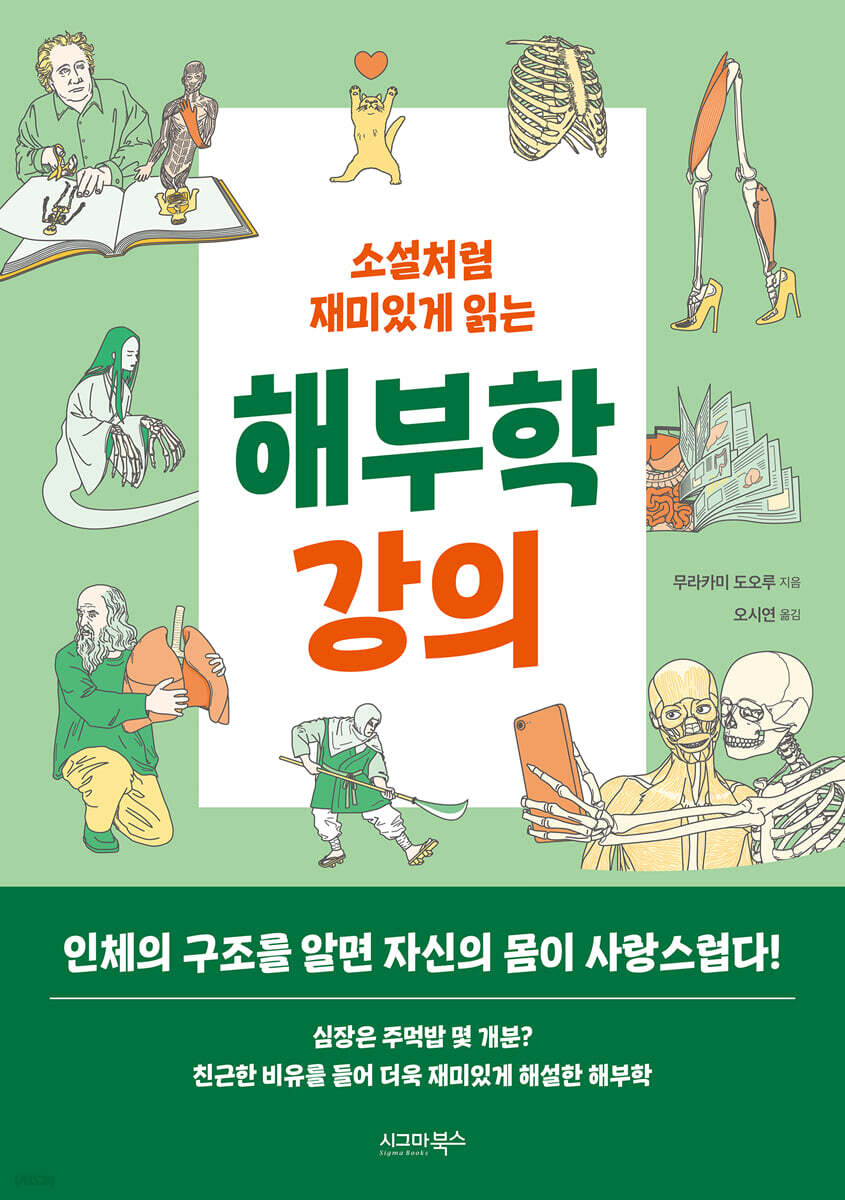
This book explains the anatomy of the human body with friendly explanations and illustrations.
In Chapter 1, we explain the concept of anatomy and then dissect our body step by step, starting with the back, arms, chest, stomach, legs, and head.
Human body illustrations are placed in appropriate places to help you understand.
This book contains the parts that the author, who teaches anatomy, thought about while lecturing to make teaching easier for students.
Anatomy lecture
This book explains the anatomy of the human body with friendly explanations and illustrations.
In Chapter 1, we explain the concept of anatomy and then dissect our body step by step, starting with the back, arms, chest, stomach, legs, and head.
Human body illustrations are placed in appropriate places to help you understand.
This book contains the parts that the author, who teaches anatomy, thought about while lecturing to make teaching easier for students.
- You can preview some of the book's contents.
Preview
index
Entering
Chapter 1: Let's Start Anatomy
1 What anatomy is that?
2. There are two fields of anatomy.
3 Anatomy Textbooks
4 Anatomical positions, planes, and directions
5. Incision and Preview
6 Use scissors, not a scalpel
7th Consecration
8 Bioethics and Anatomy Practice
9 The skeletal system that supports the body
10 Muscle systems that move the body
11 The nervous system, the body's information manager
12 The cardiovascular system transports blood
Chapter 2, etc.
1 human skeleton specimen
2 spine and thoracic cage
3 Peel the skin
The 4th back muscle is the arm muscles and the dorsiflexor muscles
5. The spinal canal, spinal cord, and caudate nucleus
Chapter 3 Arms
1 Look at the skeleton of the arm
2 Fascia and intravenous injection
3. Deltoid muscle and muscle injection
4. Rotator cuff
5 Nerve bundles - brachial plexus
6 Deep fascia and compartments of the arm
7. Abdominal muscles
8. The triceps brachii muscle and the radial nerve
9 There are many muscles in the forearm.
10 Different Muscles That Move Your Hands
11 Measure your pulse
Chapter 4: Overview of Human Development
1 From spouse to modification
The fate of two cells diverges
3 It becomes human in shape
Chapter 5: Chest
1 The chest is like a birdcage
2 Avoiding Chest Pains
3 Pectoral muscles and VAN
4 Think about your muscles and breathing
5. It's a thorax, but do you remember topology?
6 Negative pressure in the chest, positive pressure in the abdomen
7 Open the chest wall
8 Let's take a look at the lungs
9 Let's take a look at the heart
10 vertical columns (median)
Chapter 6: Ship
1x skeleton
2. Standard for the back wall
3. I am concerned about the subcutaneous fat in my abdomen.
4 fascinating abdominal muscles
5 Solving the Mystery of the Groin
6 Development of the digestive tract and peritoneum
7 Let's take a look inside the ship
8. Examine the inside of the abdomen
9. Feel the intestines
10th place is bagpipe shape
11 The small intestine is slightly longer than the width of 12 fingers.
12 Interest digests, neutralizes, and regulates
13 The empty and ileal portions of the small intestine
14. The intestines and the tail of the intestines
Chapter 15: Occurrence and Pain Associated with Arteries and Nerves
16 Standards for the rectum
17 Portal vein
18 Silent Liver
19 Kidneys and Adrenals
20 The adrenal glands are not accessories.
21. Abdominal aorta and thoracic lymphatic duct
22 Foramina of the psoas major, lumbar plexus, and diaphragm
Chapter 7 Pelvis and Perineum
1 The pelvis supports the internal organs and legs.
2 The perineum is wider than the 'perineum'
3 The pelvis is the beginning and end of a person.
Chapter 8 Bridge
1. Lock the leg skeleton
2 Monroe Walk and Pulmonary Muscles
3 Divide the thigh into three parts.
4 Calf bursts and crying
5 Traces of hands remaining on the feet
Chapter 9 Head and Neck
1 The skull is a puzzle piece
2 The neck is not simply a connecting organ between the head and the torso.
3 If you look closely, beauty is just a layer of skin
4 The head and neck are cut off
5 Headless snails and human heads
6. Examine the cross-section of the head and neck.
7 Inside and outside the dura mater
8. Get a pimple in your eye
9 The ears listen and the eyes turn.
In conclusion
Chapter 1: Let's Start Anatomy
1 What anatomy is that?
2. There are two fields of anatomy.
3 Anatomy Textbooks
4 Anatomical positions, planes, and directions
5. Incision and Preview
6 Use scissors, not a scalpel
7th Consecration
8 Bioethics and Anatomy Practice
9 The skeletal system that supports the body
10 Muscle systems that move the body
11 The nervous system, the body's information manager
12 The cardiovascular system transports blood
Chapter 2, etc.
1 human skeleton specimen
2 spine and thoracic cage
3 Peel the skin
The 4th back muscle is the arm muscles and the dorsiflexor muscles
5. The spinal canal, spinal cord, and caudate nucleus
Chapter 3 Arms
1 Look at the skeleton of the arm
2 Fascia and intravenous injection
3. Deltoid muscle and muscle injection
4. Rotator cuff
5 Nerve bundles - brachial plexus
6 Deep fascia and compartments of the arm
7. Abdominal muscles
8. The triceps brachii muscle and the radial nerve
9 There are many muscles in the forearm.
10 Different Muscles That Move Your Hands
11 Measure your pulse
Chapter 4: Overview of Human Development
1 From spouse to modification
The fate of two cells diverges
3 It becomes human in shape
Chapter 5: Chest
1 The chest is like a birdcage
2 Avoiding Chest Pains
3 Pectoral muscles and VAN
4 Think about your muscles and breathing
5. It's a thorax, but do you remember topology?
6 Negative pressure in the chest, positive pressure in the abdomen
7 Open the chest wall
8 Let's take a look at the lungs
9 Let's take a look at the heart
10 vertical columns (median)
Chapter 6: Ship
1x skeleton
2. Standard for the back wall
3. I am concerned about the subcutaneous fat in my abdomen.
4 fascinating abdominal muscles
5 Solving the Mystery of the Groin
6 Development of the digestive tract and peritoneum
7 Let's take a look inside the ship
8. Examine the inside of the abdomen
9. Feel the intestines
10th place is bagpipe shape
11 The small intestine is slightly longer than the width of 12 fingers.
12 Interest digests, neutralizes, and regulates
13 The empty and ileal portions of the small intestine
14. The intestines and the tail of the intestines
Chapter 15: Occurrence and Pain Associated with Arteries and Nerves
16 Standards for the rectum
17 Portal vein
18 Silent Liver
19 Kidneys and Adrenals
20 The adrenal glands are not accessories.
21. Abdominal aorta and thoracic lymphatic duct
22 Foramina of the psoas major, lumbar plexus, and diaphragm
Chapter 7 Pelvis and Perineum
1 The pelvis supports the internal organs and legs.
2 The perineum is wider than the 'perineum'
3 The pelvis is the beginning and end of a person.
Chapter 8 Bridge
1. Lock the leg skeleton
2 Monroe Walk and Pulmonary Muscles
3 Divide the thigh into three parts.
4 Calf bursts and crying
5 Traces of hands remaining on the feet
Chapter 9 Head and Neck
1 The skull is a puzzle piece
2 The neck is not simply a connecting organ between the head and the torso.
3 If you look closely, beauty is just a layer of skin
4 The head and neck are cut off
5 Headless snails and human heads
6. Examine the cross-section of the head and neck.
7 Inside and outside the dura mater
8. Get a pimple in your eye
9 The ears listen and the eyes turn.
In conclusion
Detailed image

Into the book
There is also a field called artistic anatomy.
There is a proverb that says, 'Beauty is but skin-deep.'
I mean, appearance isn't important, but if you want to draw the human body realistically, you have to imagine the structures under the skin and draw them.
It is said that Leonardo da Vinci dissected more than 30 human bodies in his lifetime.
Michelangelo also explored human anatomy and eventually became able to draw any pose realistically from memory.
Art anatomy deals primarily with the skeleton and muscles, as it is intended to describe form and movement.
--- From "Chapter 1_Let's Start Anatomy"
The spine is the vertebrae located in the chest and is characterized by the ribs being attached to it.
The spine shares a common basic shape with all the vertebrae.
If you start with the spine, the rest will be easy to understand.
First, there is the vertebral body in the front, which is shaped like a round column.
Behind this is a ring of bones called the vertebral arch.
The space created by the vertebrae and rings is the vertebral foramen.
--- From "Chapter 2_etc."
There are many muscles attached to the shoulder blade.
These muscles support the shoulder blade above the rib cage and move the humerus along with the shoulder joint.
The shoulder blade has various projections and depressions where the muscles attach.
The lower angle, inner corner, and lateral corner can be checked by touch.
The superior angle and superior corner are hidden in the trapezius muscle and are difficult to see from the outside.
--- From "Chapter 3_Eight"
The skeleton defines where the chest begins and ends.
That skeleton is called the thoracic cage.
The thoracic cage is made up of three types of bones: 12 thoracic vertebrae, 12 pairs of ribs and costal cartilages, and the sternum.
These combine to form a cage-like shape.
There is a hole in the upper surface of the chest cage.
This is called the thoracic gate and is surrounded by the first rib, the sternum, and the first thoracic vertebra.
This is the border between the chest and neck.
“There is a large hole in the lower surface of the thorax called the inferior thoracic aperture, which is closed by a diaphragm.”
--- From "Chapter 5_Chest"
When viewed from the surface of the body, the abdomen is located between the chest and the legs.
That is, the upper border is the costal arch, xiphoid process, and thorax, and the lower border is from the iliac crest to the pubic symphysis.
From there, the lower part forms a bridge.
The abdominal cavity is wider than this.
Because the diaphragm is a convex dome shape, the stomach is inside the thoracic cage.
The abdominal cavity is continuous with the pelvic cavity below.
The demarcation line is located at that border.
It extends in an arched shape from the prominence of the upper sacrum to the pubic symphysis.
Above the dividing line, the iliac bones spread out like a large cup and support the internal organs of the abdomen.
Below the dividing line, the hip bones (hip bones, pubis, ischium), sacrum, and coccyx form the bony walls to create the pelvic cavity.
--- From "Chapter 6_Pear"
The fusion of the sacrum and the hip bone is called the pelvis.
Think of the open tulip shape of a pachinko machine.
The open petal portion is called the greater pelvis and becomes part of the abdominal wall, supporting the internal organs of the abdominal cavity.
The part where the pachinko ball goes in is called the lesser pelvis, and it is a tunnel surrounded by bones that forms the pelvic cavity.
The internal organs of the pelvis, such as the bladder, uterus, ovaries, and rectum, are located here.
The boundary between the greater and lesser pelvis is called the superior pelvic gate.
This place is called a bow line because it is shaped like a peak.
The lower part of the pelvis, the inferior pelvic gate, is closed by ligaments and muscles and supports the anus and external genitalia.
--- From “Chapter 7_Pelvis and Perineum”
As a bone at the beginning of the leg, the scapula has joints and muscle attachment points.
There are also gaps through which blood vessels and nerves pass, connecting the pelvis to the legs.
The first thing that stands out is the bowl-like depression on the outer surface of the sacrum.
This is the glenoid fossa of the hip joint.
This is where the head of the femur (femur) comes in.
This is also the intersection of the iliac, pubic, and ischial bones.
There is a cut-off portion below the articular surface, and the femoral head ligament passes through this area.
--- From "Chapter 8_Bridge"
The skull is made up of several parts combined.
The lower jaw moves at the temporomandibular joint, and the tongue bone moves at the temporomandibular joint, connected to ligaments and muscles.
The rest are all sutured shut so they don't move.
The bones are interlocked and connected in jagged curves like a jigsaw puzzle.
The skull, whether viewed as a whole or in sections, has a complex shape with holes, tubes, and protrusions.
Here, we will first broadly classify the skull into two types.
These are the skull and facial bones.
The brain is contained within the skull.
If the brain is a capsule that pops out of a claw machine, the rounded cap at the top is called the skull.
The facial bones lie in front of the skull and house various organs and sense organs.
There is a proverb that says, 'Beauty is but skin-deep.'
I mean, appearance isn't important, but if you want to draw the human body realistically, you have to imagine the structures under the skin and draw them.
It is said that Leonardo da Vinci dissected more than 30 human bodies in his lifetime.
Michelangelo also explored human anatomy and eventually became able to draw any pose realistically from memory.
Art anatomy deals primarily with the skeleton and muscles, as it is intended to describe form and movement.
--- From "Chapter 1_Let's Start Anatomy"
The spine is the vertebrae located in the chest and is characterized by the ribs being attached to it.
The spine shares a common basic shape with all the vertebrae.
If you start with the spine, the rest will be easy to understand.
First, there is the vertebral body in the front, which is shaped like a round column.
Behind this is a ring of bones called the vertebral arch.
The space created by the vertebrae and rings is the vertebral foramen.
--- From "Chapter 2_etc."
There are many muscles attached to the shoulder blade.
These muscles support the shoulder blade above the rib cage and move the humerus along with the shoulder joint.
The shoulder blade has various projections and depressions where the muscles attach.
The lower angle, inner corner, and lateral corner can be checked by touch.
The superior angle and superior corner are hidden in the trapezius muscle and are difficult to see from the outside.
--- From "Chapter 3_Eight"
The skeleton defines where the chest begins and ends.
That skeleton is called the thoracic cage.
The thoracic cage is made up of three types of bones: 12 thoracic vertebrae, 12 pairs of ribs and costal cartilages, and the sternum.
These combine to form a cage-like shape.
There is a hole in the upper surface of the chest cage.
This is called the thoracic gate and is surrounded by the first rib, the sternum, and the first thoracic vertebra.
This is the border between the chest and neck.
“There is a large hole in the lower surface of the thorax called the inferior thoracic aperture, which is closed by a diaphragm.”
--- From "Chapter 5_Chest"
When viewed from the surface of the body, the abdomen is located between the chest and the legs.
That is, the upper border is the costal arch, xiphoid process, and thorax, and the lower border is from the iliac crest to the pubic symphysis.
From there, the lower part forms a bridge.
The abdominal cavity is wider than this.
Because the diaphragm is a convex dome shape, the stomach is inside the thoracic cage.
The abdominal cavity is continuous with the pelvic cavity below.
The demarcation line is located at that border.
It extends in an arched shape from the prominence of the upper sacrum to the pubic symphysis.
Above the dividing line, the iliac bones spread out like a large cup and support the internal organs of the abdomen.
Below the dividing line, the hip bones (hip bones, pubis, ischium), sacrum, and coccyx form the bony walls to create the pelvic cavity.
--- From "Chapter 6_Pear"
The fusion of the sacrum and the hip bone is called the pelvis.
Think of the open tulip shape of a pachinko machine.
The open petal portion is called the greater pelvis and becomes part of the abdominal wall, supporting the internal organs of the abdominal cavity.
The part where the pachinko ball goes in is called the lesser pelvis, and it is a tunnel surrounded by bones that forms the pelvic cavity.
The internal organs of the pelvis, such as the bladder, uterus, ovaries, and rectum, are located here.
The boundary between the greater and lesser pelvis is called the superior pelvic gate.
This place is called a bow line because it is shaped like a peak.
The lower part of the pelvis, the inferior pelvic gate, is closed by ligaments and muscles and supports the anus and external genitalia.
--- From “Chapter 7_Pelvis and Perineum”
As a bone at the beginning of the leg, the scapula has joints and muscle attachment points.
There are also gaps through which blood vessels and nerves pass, connecting the pelvis to the legs.
The first thing that stands out is the bowl-like depression on the outer surface of the sacrum.
This is the glenoid fossa of the hip joint.
This is where the head of the femur (femur) comes in.
This is also the intersection of the iliac, pubic, and ischial bones.
There is a cut-off portion below the articular surface, and the femoral head ligament passes through this area.
--- From "Chapter 8_Bridge"
The skull is made up of several parts combined.
The lower jaw moves at the temporomandibular joint, and the tongue bone moves at the temporomandibular joint, connected to ligaments and muscles.
The rest are all sutured shut so they don't move.
The bones are interlocked and connected in jagged curves like a jigsaw puzzle.
The skull, whether viewed as a whole or in sections, has a complex shape with holes, tubes, and protrusions.
Here, we will first broadly classify the skull into two types.
These are the skull and facial bones.
The brain is contained within the skull.
If the brain is a capsule that pops out of a claw machine, the rounded cap at the top is called the skull.
The facial bones lie in front of the skull and house various organs and sense organs.
--- From "Chapter 9_Head and Neck"
Publisher's Review
Make it more fun with a friendly analogy
Anatomy explained!
What is anatomy? Dissection refers to the examination of the structure of a living organism by cutting open or dissecting its body, while anatomy is the discipline that compiles and organizes the knowledge gained in this way.
Strictly speaking, this book only deals with the anatomy of the human body.
Various parts of our body are still working to read like this.
The muscles that move the eyes to follow the letters from left to right and top to bottom are especially busy.
The best way to learn anatomy is to actually dissect a human body, but to do that you have to become a medical student, read thousands of pages of textbooks, and endure countless labs and exams.
Instead, let's try a little bit of indirect experience with this book.
The world of the human body as told by an anatomist
From the standpoint of anatomy
Let's take a look at the human body!
Everyone gets sick or hurt.
In the end, you will die and there is no way to avoid it.
I'd like to say that I know my body best, but it would be nice if I could 'explain it with solid logic.'
Anatomy helps us to be 'solid' here.
Knowing about the human body can help you understand the world a little better.
Knowing anatomy will help you understand humans and the world better.
The human world is made up of the human body, and one's own body serves as a medium of connection.
Let's learn about ourselves by learning about the human body through anatomy!
Anatomy explained!
What is anatomy? Dissection refers to the examination of the structure of a living organism by cutting open or dissecting its body, while anatomy is the discipline that compiles and organizes the knowledge gained in this way.
Strictly speaking, this book only deals with the anatomy of the human body.
Various parts of our body are still working to read like this.
The muscles that move the eyes to follow the letters from left to right and top to bottom are especially busy.
The best way to learn anatomy is to actually dissect a human body, but to do that you have to become a medical student, read thousands of pages of textbooks, and endure countless labs and exams.
Instead, let's try a little bit of indirect experience with this book.
The world of the human body as told by an anatomist
From the standpoint of anatomy
Let's take a look at the human body!
Everyone gets sick or hurt.
In the end, you will die and there is no way to avoid it.
I'd like to say that I know my body best, but it would be nice if I could 'explain it with solid logic.'
Anatomy helps us to be 'solid' here.
Knowing about the human body can help you understand the world a little better.
Knowing anatomy will help you understand humans and the world better.
The human world is made up of the human body, and one's own body serves as a medium of connection.
Let's learn about ourselves by learning about the human body through anatomy!
GOODS SPECIFICS
- Date of issue: December 5, 2024
- Page count, weight, size: 458 pages | 618g | 148*210*23mm
- ISBN13: 9791168622920
- ISBN10: 1168622921
You may also like
카테고리
korean


korean

![GQ KOREA Mark (Monthly): December [2025]](http://librairie.coreenne.fr/cdn/shop/files/8ef265dbbfbf186523ed75ba7319009d.jpg?v=1765340328&width=3840)


