

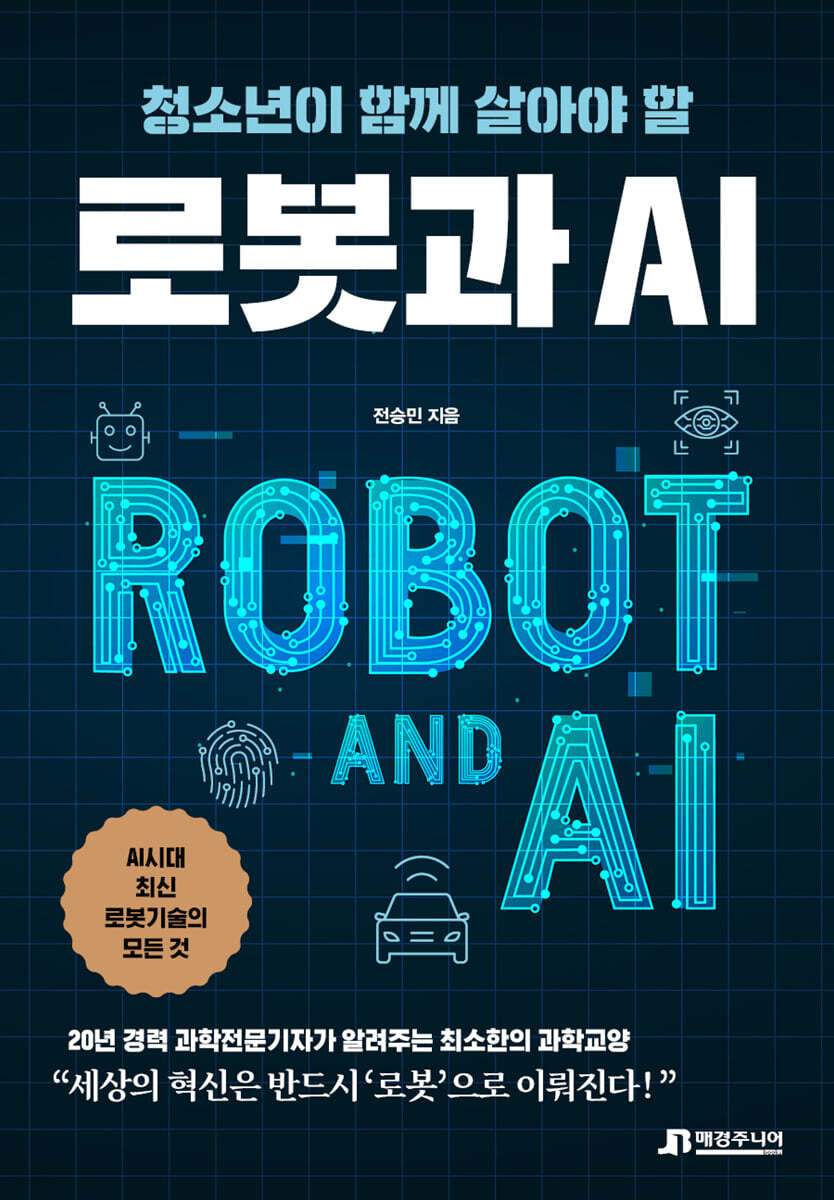
Robots and AI that young people will have to live with
 |
Description
Book Introduction
“Can I wear the movie Iron Man suit?”
“A robot will be your homeroom teacher?”
“How far has robotics technology come in reality?”
The key to unlocking the future lies in the combination of robots and AI!
The real robot story that teenagers want to know the most!
A book titled "Robots and AI Youth Will Need to Live With" has been published, which explores the key keyword for a glimpse into the future, "robotics technology," from the perspective of youth.
The author, a bestselling science author and science journalist, explains the realities of robots and AI in detail in a way that teenagers can easily understand.
The author clearly and simply categorizes complex types of robots, such as 'mobile robots', 'work robots', and 'walking and assistive robots', based on his unique insight. He also presents a warm and humane future by covering the latest trends in autonomous driving technology, drone technology, and wearable robots, to see how robots will change the world in the future.
The author also asserts a resounding "no" to the question many people are curious about: "Will AI take away human jobs?" from his expert perspective.
As our youth will undoubtedly be the key players in the coming era of robots, we present various ways to proactively and creatively utilize robots and AI to take things one step further.
"I'm convinced that the world will inevitably change through robots. If AI wants to assist humans in any task, robots will inevitably be needed.
“AI that meets robots will be able to work in the real world.”
“A robot will be your homeroom teacher?”
“How far has robotics technology come in reality?”
The key to unlocking the future lies in the combination of robots and AI!
The real robot story that teenagers want to know the most!
A book titled "Robots and AI Youth Will Need to Live With" has been published, which explores the key keyword for a glimpse into the future, "robotics technology," from the perspective of youth.
The author, a bestselling science author and science journalist, explains the realities of robots and AI in detail in a way that teenagers can easily understand.
The author clearly and simply categorizes complex types of robots, such as 'mobile robots', 'work robots', and 'walking and assistive robots', based on his unique insight. He also presents a warm and humane future by covering the latest trends in autonomous driving technology, drone technology, and wearable robots, to see how robots will change the world in the future.
The author also asserts a resounding "no" to the question many people are curious about: "Will AI take away human jobs?" from his expert perspective.
As our youth will undoubtedly be the key players in the coming era of robots, we present various ways to proactively and creatively utilize robots and AI to take things one step further.
"I'm convinced that the world will inevitably change through robots. If AI wants to assist humans in any task, robots will inevitably be needed.
“AI that meets robots will be able to work in the real world.”
- You can preview some of the book's contents.
Preview
index
Chapter 1: Why You Need to Know About Robots
1.
Robot = AI + Machine Device
Why are robots becoming popular again?
- Don't think of robots and AI as separate entities.
- The meaning of the word 'robot'
2.
There are different types of 'robots'
Mobile robots that need attention right now
- 'Working robots' suitable for industry
- How useful are walking and assistive robots?
3.
Conditions for building a robot
- Two ways to create AI and two ways to create robots
- Electric motor vs. hydraulic device
Understanding Neural Communication Between AI and Robots
[Find Out] Can Robots Rebel Against Humans?
Chapter 2: How Robots Will Change the World
1.
Robots transform industry
How will mobile robots transform industry?
Autonomous driving technology that will bring about a global logistics revolution.
- The emergence and future of collaborative robots
2.
Robots Revolutionize Society
- 'Robots' are everywhere
- Future society transformed by drones
The Future Changing with 'Fully Autonomous Vehicles'
3.
Robots Helping Humans
How far will the 'Iron Man Robot' become a reality?
Wearable robots for the socially disadvantaged
- Surgical robot = a tool to assist doctors
4.
Robots replace humans
Beyond disaster sites, into everyday life… … ‘Humanoid robots’ are coming.
A versatile worker that can go anywhere, the 'four-legged robot'
[Find Out] Are AI and Robots Taking Away Jobs?
Chapter 3: The Age of Robots: Who Will Be the Stars?
1. How to utilize AI and robots in work
- Why 'self' and 'will' are more important than anything else
- Robots can't beat humans in 'dexterity'
- Language skills are the foundation of future society.
2.
Don't be fooled by the "creativity narrative"
- AI is already more creative than you… … What matters is execution and drive.
- No profession has disappeared in human history... ... You don't have to be a technician.
3.
Are robots human slaves or friends?
- Can we make a killer robot?
Why we need to teach robots 'ethics'
[Learn] Conditions for Building a 'Robot Powerhouse Korea'
1.
Robot = AI + Machine Device
Why are robots becoming popular again?
- Don't think of robots and AI as separate entities.
- The meaning of the word 'robot'
2.
There are different types of 'robots'
Mobile robots that need attention right now
- 'Working robots' suitable for industry
- How useful are walking and assistive robots?
3.
Conditions for building a robot
- Two ways to create AI and two ways to create robots
- Electric motor vs. hydraulic device
Understanding Neural Communication Between AI and Robots
[Find Out] Can Robots Rebel Against Humans?
Chapter 2: How Robots Will Change the World
1.
Robots transform industry
How will mobile robots transform industry?
Autonomous driving technology that will bring about a global logistics revolution.
- The emergence and future of collaborative robots
2.
Robots Revolutionize Society
- 'Robots' are everywhere
- Future society transformed by drones
The Future Changing with 'Fully Autonomous Vehicles'
3.
Robots Helping Humans
How far will the 'Iron Man Robot' become a reality?
Wearable robots for the socially disadvantaged
- Surgical robot = a tool to assist doctors
4.
Robots replace humans
Beyond disaster sites, into everyday life… … ‘Humanoid robots’ are coming.
A versatile worker that can go anywhere, the 'four-legged robot'
[Find Out] Are AI and Robots Taking Away Jobs?
Chapter 3: The Age of Robots: Who Will Be the Stars?
1. How to utilize AI and robots in work
- Why 'self' and 'will' are more important than anything else
- Robots can't beat humans in 'dexterity'
- Language skills are the foundation of future society.
2.
Don't be fooled by the "creativity narrative"
- AI is already more creative than you… … What matters is execution and drive.
- No profession has disappeared in human history... ... You don't have to be a technician.
3.
Are robots human slaves or friends?
- Can we make a killer robot?
Why we need to teach robots 'ethics'
[Learn] Conditions for Building a 'Robot Powerhouse Korea'
Detailed image

Into the book
The limits of the 'cool robot' were quickly reached.
People no longer find robots that can walk, run, and jump over obstacles in a set setting fascinating, and eventually they start to look at them with apathy.
It's difficult to pinpoint the exact time period, but roughly speaking, from the early to mid-2010s until recently, people's interest in robots has decreased significantly for about 10 years.
There have been several international competitions that had great significance in the meantime, and robotics engineers have continuously developed various types of robots, but despite this, the popularity(?) of 'robots' in society has been gradually weakening.
'Yes, robots look cool, but what are you going to do with them?' The answers that professional roboticists can come up with are very limited.
In some special situations (e.g., nuclear accident recovery sites, spacecraft piloting, etc.), robots were extremely useful and essential, but they were still a field that had little relevance to the general public.
--- p.21 「Chapter 1 '1.
From "Robot = AI + Machine Device"
To understand robots, we also need to know about the 'actuators' that actually move the robot.
In English, it is written as Actuator.
It may seem a little difficult, but just think of it as a 'muscle' attached to the human body.
Our bodies can perform various movements because they move joints by lengthening and contracting the muscles attached to the bones.
The same goes for robots.
You need to attach devices to replace muscles all over your body.
This device is one of the most important parts when building a robot.
It wouldn't be wrong to say that robotics is the study of how to move the arms, legs, and torso of a robot naturally using the power from the actuator.
--- p.71 「Chapter 1 '3.
From “Conditions for Building a Robot”
The robot Kiva remembers the locations of all items, and when a person orders it to retrieve an item, it goes to the warehouse and retrieves not just one item, but the entire shelf containing that item.
Then, an Amazon employee working in the warehouse would take the item from the shelf, scan the barcode, put it in a box, and send it out.
Then the robot puts the shelf back in place.
According to foreign news, as of 2020, there are 200,000 Kiva robots operating in Amazon warehouses.
In the past, if you ordered a package from the United States, it would take about three days just to prepare and ship the item.
Because all the work of picking items from the warehouse, packing them, and shipping them out had to be done by people.
However, it often took more than a week for the item to be delivered to the customer's home via courier.
But Amazon's Prime service has reduced the time it takes to prepare a shipment from three days to four hours, thanks to Kiva robots.
--- p.98 「Chapter 2 '1.
From "Changing the Robot Industry"
Drones are no longer limited to delivering goods or food, but have now reached the stage of carrying ‘people’.
This is the story of urban air mobility (UAM), also known as air taxis.
It is a small aircraft that uses an electric motor and can carry up to 7 to 8 people.
Since it uses a motor instead of an engine and a battery instead of a fuel tank, it is not wrong to think of it as a common drone made large enough for a person to ride on.
This raises the issue of battery efficiency itself, but the recent rapid advancements in battery-related technology have become the key to commercialization.
Long-range electric aircraft are still technically impossible, but short-distance flights are possible without any problems.
--- p.125 「Chapter 2 '2.
From "Robots, Revolutionizing Society"
Among the wearable robots developed to date, many have reached the level of practical use.
The most powerful known is the Guardian XO, developed by American robotics company Sarcos (full name Sarcos Technology and Robotics Corporation).
This robot is a new development of the XOS robot, which was originally developed for military purposes. The XOS was developed up to the second version (XOS-2), and in fact, I remember that the XOS's motor skills were superior to those of the Guardian XO.
Wearing this robot allows you to exert about 17 times the strength of an average adult male.
People no longer find robots that can walk, run, and jump over obstacles in a set setting fascinating, and eventually they start to look at them with apathy.
It's difficult to pinpoint the exact time period, but roughly speaking, from the early to mid-2010s until recently, people's interest in robots has decreased significantly for about 10 years.
There have been several international competitions that had great significance in the meantime, and robotics engineers have continuously developed various types of robots, but despite this, the popularity(?) of 'robots' in society has been gradually weakening.
'Yes, robots look cool, but what are you going to do with them?' The answers that professional roboticists can come up with are very limited.
In some special situations (e.g., nuclear accident recovery sites, spacecraft piloting, etc.), robots were extremely useful and essential, but they were still a field that had little relevance to the general public.
--- p.21 「Chapter 1 '1.
From "Robot = AI + Machine Device"
To understand robots, we also need to know about the 'actuators' that actually move the robot.
In English, it is written as Actuator.
It may seem a little difficult, but just think of it as a 'muscle' attached to the human body.
Our bodies can perform various movements because they move joints by lengthening and contracting the muscles attached to the bones.
The same goes for robots.
You need to attach devices to replace muscles all over your body.
This device is one of the most important parts when building a robot.
It wouldn't be wrong to say that robotics is the study of how to move the arms, legs, and torso of a robot naturally using the power from the actuator.
--- p.71 「Chapter 1 '3.
From “Conditions for Building a Robot”
The robot Kiva remembers the locations of all items, and when a person orders it to retrieve an item, it goes to the warehouse and retrieves not just one item, but the entire shelf containing that item.
Then, an Amazon employee working in the warehouse would take the item from the shelf, scan the barcode, put it in a box, and send it out.
Then the robot puts the shelf back in place.
According to foreign news, as of 2020, there are 200,000 Kiva robots operating in Amazon warehouses.
In the past, if you ordered a package from the United States, it would take about three days just to prepare and ship the item.
Because all the work of picking items from the warehouse, packing them, and shipping them out had to be done by people.
However, it often took more than a week for the item to be delivered to the customer's home via courier.
But Amazon's Prime service has reduced the time it takes to prepare a shipment from three days to four hours, thanks to Kiva robots.
--- p.98 「Chapter 2 '1.
From "Changing the Robot Industry"
Drones are no longer limited to delivering goods or food, but have now reached the stage of carrying ‘people’.
This is the story of urban air mobility (UAM), also known as air taxis.
It is a small aircraft that uses an electric motor and can carry up to 7 to 8 people.
Since it uses a motor instead of an engine and a battery instead of a fuel tank, it is not wrong to think of it as a common drone made large enough for a person to ride on.
This raises the issue of battery efficiency itself, but the recent rapid advancements in battery-related technology have become the key to commercialization.
Long-range electric aircraft are still technically impossible, but short-distance flights are possible without any problems.
--- p.125 「Chapter 2 '2.
From "Robots, Revolutionizing Society"
Among the wearable robots developed to date, many have reached the level of practical use.
The most powerful known is the Guardian XO, developed by American robotics company Sarcos (full name Sarcos Technology and Robotics Corporation).
This robot is a new development of the XOS robot, which was originally developed for military purposes. The XOS was developed up to the second version (XOS-2), and in fact, I remember that the XOS's motor skills were superior to those of the Guardian XO.
Wearing this robot allows you to exert about 17 times the strength of an average adult male.
--- p.144 「Chapter 2 '3.
From "Robots Helping Humans"
From "Robots Helping Humans"
Publisher's Review
In the era of AI and robots, the main characters are our youth!
Could we actually wear the Iron Man suit we saw in the movies? Will the robots that attack or assist humans, as depicted in science fiction, actually come to fruition? Self-driving car technology is advancing by the day, but when will we be able to drive one?
There are many books that explain the basic principles of robotics and AI, but they don't explain exactly what people are curious about: how the world will change in the future.
The author, a bestselling author who has worked as a science journalist for over 20 years, points out this point and talks about the current level of scientific and technological development and robots in this book.
The author asserts that 'the world will inevitably change through robots' because when AI wants to help humans with something, robots are definitely needed.
AI without robots is just a machine that calculates what humans tell it to do and shows the results.
AI meets robots and works in the real world, changing the world.
This is why our youth, the future leaders, must pay attention to robots and AI.
As we enter a new era, it's time to understand AI and robotics and how to utilize them intelligently.
◆ Essential Robot Knowledge 1.
Robots are a combination of AI and mechanical devices.
Although the emergence and development of robots with various capabilities that can replace humans began a long time ago, the emergence of AI has truly activated robotics technology.
The key is how well the two systems can collaborate to harmoniously connect one another by developing the robot's body and integrating AI into it.
In the current era of the 4th Industrial Revolution, we must closely watch whether 'AI can jump out of the computer'. A great revolution will occur when AI operating outside of the computer wears robot clothes and begins to replace human work.
If this technology is applied to industry, the impact will be so great that it could lead to the creation of fully autonomous factories without any human intervention.
In this book, the author defines a robot as 'an independent mechanical device capable of performing tasks ordered by humans under the control of AI or an automated program.'
Robots, along with AI, are a major driver of innovation, and understanding the characteristics of robots has become an essential skill for young people living in this era.
In the future, robots and AI will merge into one, leading to a world where 'most work is done in place of humans.'
◆ Essential Robot Knowledge 2.
What kind of robots have been developed so far?
There are countless robots in the world.
However, not many people know exactly what kind of robots have been created so far.
The author first explains the criteria for defining a robot.
According to the International Federation of Robotics (IFR), robots are classified into three types: professional service robots, personal service robots, and manufacturing robots, and within each of these, there are three types of robots, for a total of nine types.
However, based on the author's unique insight and perspective, considering the current era, he categorizes them into three types: mobile robots, work robots, and walking and assistive robots.
There are dozens of interesting robots that appear in this book, including 'humanoid robots' that walk on two legs like humans and do backflips, 'drones' that move autonomously without humans on board, 'collaborative robots' that are designed to assist and work together in the same space as humans, 'wearable robots' that wear like Iron Man suits and receive assistance with physical functions, 'swarm robots' that communicate with each other and move as one body, 'GTP (Goods To Person)' mobile robots that move large quantities of items in factories or warehouses, 'indoor delivery robots' and 'outdoor delivery robots' that deliver items to people inside and outside buildings, 'surgical robots' that help doctors perform better surgeries, 'parking robots' that automatically park cars in parking lots and bring them out, 'UAM (Urban Air Mobility)' air taxis that transport people in drones through the air, and 'autonomous vehicles' that recognize their surroundings and get to their destinations on their own without a driver.
◆ Essential Robot Knowledge 3.
Robots can't take away human jobs.
What sets humans apart from other living beings and machines is that they possess a high level of self-awareness, which inevitably leads to a sense of will and purpose.
This point can be said to be the polar opposite between robots, which move mechanically according to thorough calculations, and humans.
There are bound to be fundamental differences between human thinking and AI judgment, and between human behavior and robot behavior.
As AI robots become more widespread, the number of jobs that can replace humans is increasing, which means that skills acquired through short-term training or simple repetition are becoming less competitive.
In other words, the more new jobs are created, the more training and education they require, and the more likely it is that they will involve directing and supervising the work of robots or other people.
This useful technology, which can automate many tasks in place of humans, allows us to distinguish between what tasks we should delegate and what tasks we should focus on.
What we need to focus on now is what we want to do, or what we're doing, will mean in the future world of AI and robotics, and what capabilities we need to develop.
In the coming era, only those who make the most of their unique human characteristics will establish themselves as powerful protagonists of the era.
Beyond the era of people who pursue only reason and talents who think only of emotions, we live in an era of so-called "integrated" talents armed with strong language skills, empathy, and emotion on top of a strong rational foundation.
Could we actually wear the Iron Man suit we saw in the movies? Will the robots that attack or assist humans, as depicted in science fiction, actually come to fruition? Self-driving car technology is advancing by the day, but when will we be able to drive one?
There are many books that explain the basic principles of robotics and AI, but they don't explain exactly what people are curious about: how the world will change in the future.
The author, a bestselling author who has worked as a science journalist for over 20 years, points out this point and talks about the current level of scientific and technological development and robots in this book.
The author asserts that 'the world will inevitably change through robots' because when AI wants to help humans with something, robots are definitely needed.
AI without robots is just a machine that calculates what humans tell it to do and shows the results.
AI meets robots and works in the real world, changing the world.
This is why our youth, the future leaders, must pay attention to robots and AI.
As we enter a new era, it's time to understand AI and robotics and how to utilize them intelligently.
◆ Essential Robot Knowledge 1.
Robots are a combination of AI and mechanical devices.
Although the emergence and development of robots with various capabilities that can replace humans began a long time ago, the emergence of AI has truly activated robotics technology.
The key is how well the two systems can collaborate to harmoniously connect one another by developing the robot's body and integrating AI into it.
In the current era of the 4th Industrial Revolution, we must closely watch whether 'AI can jump out of the computer'. A great revolution will occur when AI operating outside of the computer wears robot clothes and begins to replace human work.
If this technology is applied to industry, the impact will be so great that it could lead to the creation of fully autonomous factories without any human intervention.
In this book, the author defines a robot as 'an independent mechanical device capable of performing tasks ordered by humans under the control of AI or an automated program.'
Robots, along with AI, are a major driver of innovation, and understanding the characteristics of robots has become an essential skill for young people living in this era.
In the future, robots and AI will merge into one, leading to a world where 'most work is done in place of humans.'
◆ Essential Robot Knowledge 2.
What kind of robots have been developed so far?
There are countless robots in the world.
However, not many people know exactly what kind of robots have been created so far.
The author first explains the criteria for defining a robot.
According to the International Federation of Robotics (IFR), robots are classified into three types: professional service robots, personal service robots, and manufacturing robots, and within each of these, there are three types of robots, for a total of nine types.
However, based on the author's unique insight and perspective, considering the current era, he categorizes them into three types: mobile robots, work robots, and walking and assistive robots.
There are dozens of interesting robots that appear in this book, including 'humanoid robots' that walk on two legs like humans and do backflips, 'drones' that move autonomously without humans on board, 'collaborative robots' that are designed to assist and work together in the same space as humans, 'wearable robots' that wear like Iron Man suits and receive assistance with physical functions, 'swarm robots' that communicate with each other and move as one body, 'GTP (Goods To Person)' mobile robots that move large quantities of items in factories or warehouses, 'indoor delivery robots' and 'outdoor delivery robots' that deliver items to people inside and outside buildings, 'surgical robots' that help doctors perform better surgeries, 'parking robots' that automatically park cars in parking lots and bring them out, 'UAM (Urban Air Mobility)' air taxis that transport people in drones through the air, and 'autonomous vehicles' that recognize their surroundings and get to their destinations on their own without a driver.
◆ Essential Robot Knowledge 3.
Robots can't take away human jobs.
What sets humans apart from other living beings and machines is that they possess a high level of self-awareness, which inevitably leads to a sense of will and purpose.
This point can be said to be the polar opposite between robots, which move mechanically according to thorough calculations, and humans.
There are bound to be fundamental differences between human thinking and AI judgment, and between human behavior and robot behavior.
As AI robots become more widespread, the number of jobs that can replace humans is increasing, which means that skills acquired through short-term training or simple repetition are becoming less competitive.
In other words, the more new jobs are created, the more training and education they require, and the more likely it is that they will involve directing and supervising the work of robots or other people.
This useful technology, which can automate many tasks in place of humans, allows us to distinguish between what tasks we should delegate and what tasks we should focus on.
What we need to focus on now is what we want to do, or what we're doing, will mean in the future world of AI and robotics, and what capabilities we need to develop.
In the coming era, only those who make the most of their unique human characteristics will establish themselves as powerful protagonists of the era.
Beyond the era of people who pursue only reason and talents who think only of emotions, we live in an era of so-called "integrated" talents armed with strong language skills, empathy, and emotion on top of a strong rational foundation.
GOODS SPECIFICS
- Date of issue: November 4, 2024
- Page count, weight, size: 264 pages | 153*220*20mm
- ISBN13: 9791164847242
You may also like
카테고리
korean


korean

![GQ KOREA Mark (Monthly): December [2025]](http://librairie.coreenne.fr/cdn/shop/files/8ef265dbbfbf186523ed75ba7319009d.jpg?v=1765340328&width=3840)


