

The classics of physics
 |
Description
Book Introduction
110th anniversary of the birth of general relativity!
A clear explanation from the founder of string theory
Susskind has a remarkable ability to tenaciously dig into the physical essence and core of a phenomenon.
Readers will find themselves on a fantastic intellectual roller coaster ride simply by surrendering their minds to Susskind's guidance.
- Lee Jong-pil (translator, professor at Konkuk University)
For those who want to know more deeply about the actual structure of the universe
A famous YouTube lecture with 30 million views!
General relativity is not easy.
difficult.
You should also be somewhat familiar with math.
So it's good to have a great teacher and guide.
Leonard Susskind, the author of this book, is your best bet as a guide.
Not only is he one of the greatest living physicists, he has also been at the center of decades-long debates related to general relativity, such as the loss of information in black holes.
- In the text
Albert Einstein's special theory of relativity, which made humanity realize that time and space are inextricably linked.
After ten years of research, he succeeded in generalizing this theory to spacetime containing massive objects, starting from the very simple principle that acceleration and constant gravity are equal.
It is the General Theory of Relativity, which was published on November 25, 1915 and will soon celebrate its 110th anniversary.
General relativity, which attributes the nature of gravity to the geometry of spacetime rather than the power of a Creator or a mysterious force at a distance, has been a pillar of modern physics, along with quantum mechanics, for over a century.
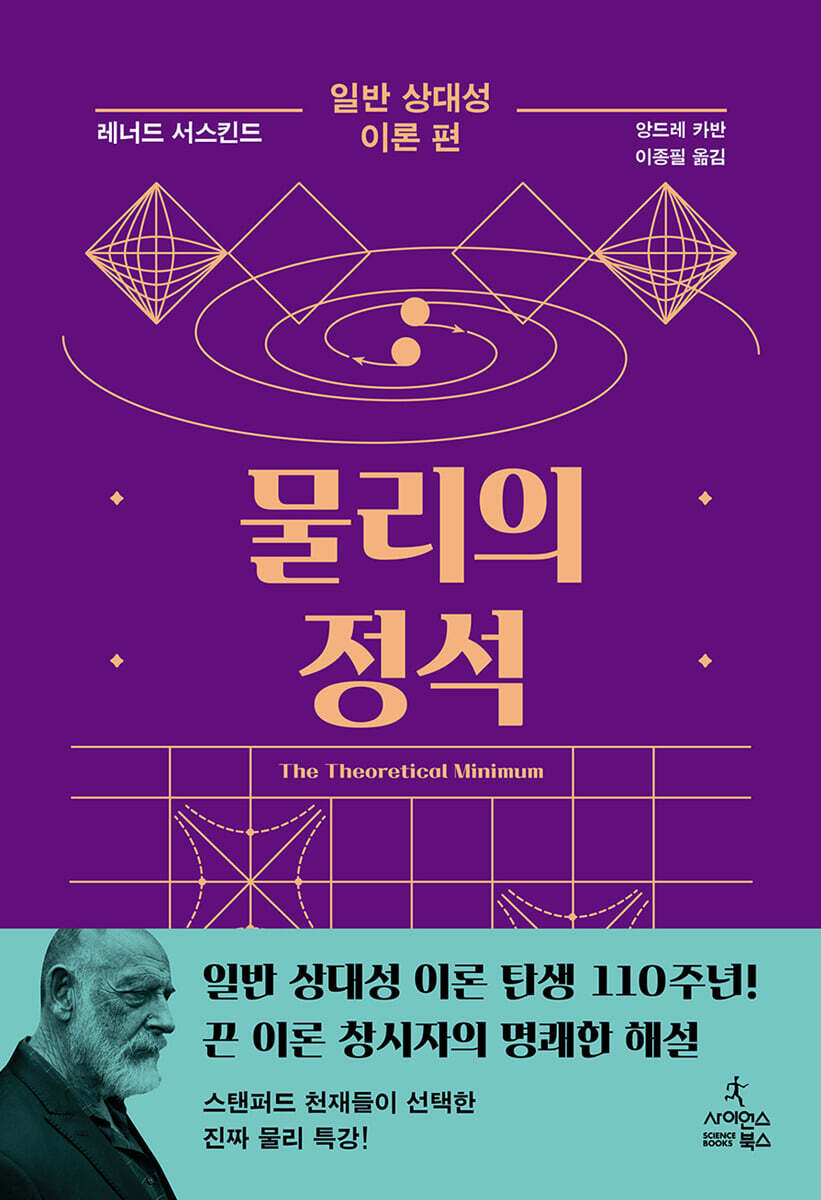
『General Relativity: The Theoretical Minimum』, a new book published by Science Books in July 2024, is a book that comprehensively and penetratingly explains this theory, which is considered a monumental achievement in the history of human intelligence but has never been attempted directly, from the perspective of a master by Leonard Susskind, the founder of string theory and a giant in the field of physics on par with Stephen Hawking.
Leonard Susskind has been a professor of theoretical physics at Stanford University since 1973, contributing to a variety of fields including quantum optics, elementary particle physics, condensed matter physics, and the theory of gravity. Since 2007, he has been giving a series of publicly available YouTube lectures called "Theoretical Minimum."
This lecture series, created for the general public who want to study modern physics and cosmology but do not have a teacher to ask and learn from, and whose intellectual curiosity cannot be fully satisfied with popular textbooks, consists of 138 videos in total, including 6 core courses (classical mechanics, quantum mechanics, special relativity and classical field theory, general relativity, cosmology, and statistical mechanics) and 9 additional courses, and as of June 2024, it has exceeded 30 million cumulative views.
The "Physics Essentials" series is a collection of core courses from this series of lectures.
This series, which was introduced to Korea in 2017 with 『Physics Essentials: Classical Mechanics』, has already sold over 40,000 copies through word of mouth among science and math enthusiasts, calling it “a real physics lecture selected by Stanford geniuses.”
"The Essentials of Physics: General Relativity" is the latest work that follows "The Essentials of Physics: Special Relativity and Classical Field Theory" published in 2022. André Cabannes, a lecturer in mathematics at MIT who received his PhD in statistics from Stanford University and the translator of the French edition of the "The Essentials of Physics" series, participated as a new co-author.
This book, which covers general relativity while maintaining the same method and logic as its predecessor, which was selected as a "Best Book" by the Wall Street Journal, is a truly classic work for anyone seeking a deeper understanding of the actual structure of the universe.
A clear explanation from the founder of string theory
Susskind has a remarkable ability to tenaciously dig into the physical essence and core of a phenomenon.
Readers will find themselves on a fantastic intellectual roller coaster ride simply by surrendering their minds to Susskind's guidance.
- Lee Jong-pil (translator, professor at Konkuk University)
For those who want to know more deeply about the actual structure of the universe
A famous YouTube lecture with 30 million views!
General relativity is not easy.
difficult.
You should also be somewhat familiar with math.
So it's good to have a great teacher and guide.
Leonard Susskind, the author of this book, is your best bet as a guide.
Not only is he one of the greatest living physicists, he has also been at the center of decades-long debates related to general relativity, such as the loss of information in black holes.
- In the text
Albert Einstein's special theory of relativity, which made humanity realize that time and space are inextricably linked.
After ten years of research, he succeeded in generalizing this theory to spacetime containing massive objects, starting from the very simple principle that acceleration and constant gravity are equal.
It is the General Theory of Relativity, which was published on November 25, 1915 and will soon celebrate its 110th anniversary.
General relativity, which attributes the nature of gravity to the geometry of spacetime rather than the power of a Creator or a mysterious force at a distance, has been a pillar of modern physics, along with quantum mechanics, for over a century.
『General Relativity: The Theoretical Minimum』, a new book published by Science Books in July 2024, is a book that comprehensively and penetratingly explains this theory, which is considered a monumental achievement in the history of human intelligence but has never been attempted directly, from the perspective of a master by Leonard Susskind, the founder of string theory and a giant in the field of physics on par with Stephen Hawking.
Leonard Susskind has been a professor of theoretical physics at Stanford University since 1973, contributing to a variety of fields including quantum optics, elementary particle physics, condensed matter physics, and the theory of gravity. Since 2007, he has been giving a series of publicly available YouTube lectures called "Theoretical Minimum."
This lecture series, created for the general public who want to study modern physics and cosmology but do not have a teacher to ask and learn from, and whose intellectual curiosity cannot be fully satisfied with popular textbooks, consists of 138 videos in total, including 6 core courses (classical mechanics, quantum mechanics, special relativity and classical field theory, general relativity, cosmology, and statistical mechanics) and 9 additional courses, and as of June 2024, it has exceeded 30 million cumulative views.
The "Physics Essentials" series is a collection of core courses from this series of lectures.
This series, which was introduced to Korea in 2017 with 『Physics Essentials: Classical Mechanics』, has already sold over 40,000 copies through word of mouth among science and math enthusiasts, calling it “a real physics lecture selected by Stanford geniuses.”
"The Essentials of Physics: General Relativity" is the latest work that follows "The Essentials of Physics: Special Relativity and Classical Field Theory" published in 2022. André Cabannes, a lecturer in mathematics at MIT who received his PhD in statistics from Stanford University and the translator of the French edition of the "The Essentials of Physics" series, participated as a new co-author.
This book, which covers general relativity while maintaining the same method and logic as its predecessor, which was selected as a "Best Book" by the Wall Street Journal, is a truly classic work for anyone seeking a deeper understanding of the actual structure of the universe.
- You can preview some of the book's contents.
Preview
index
Introduction 1 Leonard Susskind 7
Preface 2 André Caban 10
Lecture 1: Equivalence Principle and Tensor Analysis 15
Lecture 2: Tensor Mathematics 97
3rd lecture Flatness and Curvature 145
Geodesics and Gravity 201
Lecture 5: Measurement of Gravitational Fields 269
Black Hole 319, Episode 6
Lesson 7: Falling into a Black Hole 377
Formation of the Black Hole 423
Lecture 9: Einstein's Field Equations 471
Lecture 10: Gravitational Waves 527
Translator's Note: The Joy of Discovering Beauty in Knowledge, Vol. 583
Search 587
Preface 2 André Caban 10
Lecture 1: Equivalence Principle and Tensor Analysis 15
Lecture 2: Tensor Mathematics 97
3rd lecture Flatness and Curvature 145
Geodesics and Gravity 201
Lecture 5: Measurement of Gravitational Fields 269
Black Hole 319, Episode 6
Lesson 7: Falling into a Black Hole 377
Formation of the Black Hole 423
Lecture 9: Einstein's Field Equations 471
Lecture 10: Gravitational Waves 527
Translator's Note: The Joy of Discovering Beauty in Knowledge, Vol. 583
Search 587
Detailed image

Publisher's Review
Einstein's equations
The only book that will enable you to lead yourself!
Einstein published his work in November 1915, after ten years of effort to extend the principle of relativity to the framework of acceleration and to construct a theory that took gravity into account in a new way.
Unlike the special theory of relativity, which was completed through the efforts of many people, the general theory of relativity is essentially the work of one person.
We will begin our study of general relativity right where Einstein began.
Einstein's thinking pattern was to start with really simple, basic facts that almost a child could understand and then deduce incredibly far-reaching consequences.
I think that starting from the simplest thing and then inferring the results is also the best method in education.
- In the text
In "The Essentials of Physics: General Relativity," the two authors guide readers through ten lectures into the bizarre world of how objects with mass warp light and spacetime.
In Lecture 1, “The Equivalence Principle and Tensor Analysis,” we lay the foundation.
First, it explains the equivalence principle, which is the starting point and core of the general theory of relativity, which states that gravity is in some sense the same as acceleration, and shows how this principle results in the inevitable bending of light rays by heavy objects.
Lecture 2, “Tensor Mathematics,” is devoted to tensor mathematics.
This is because in the general theory of relativity, where the reference frame must be changed frequently, the tensor equation is the method of connecting the coordinates of one reference frame to the coordinates of another reference frame.
Because tensor equations have the remarkable property that if they hold in one reference frame, they hold in all other reference frames, much of general relativity is expressed as tensor equations.
Lecture 3, "Flatness and Curvature," Lecture 4, "Geodesics and Gravity," and Lecture 5, "Measuring the Gravitational Field," are the beginning of the general theory of relativity lectures, and cover Riemannian geometry, where the square of the distance between two points is always positive, and Minkowski geometry, where the square of the distance between two events in spacetime can be positive, zero, or negative.
Simply put, gravity can be said to be the geometry of Minkowski spacetime.
The main characters of Chapters 6, 7, and 8 are black holes, which are somewhat familiar to us through the movies “Event Horizon” and “Interstellar,” as can be seen in the chapter titles “Black Hole,” “Falling into a Black Hole,” and “The Formation of a Black Hole,” yet are still a fearsome entity.
The reason the two authors focus on black holes is not so much because they are an interesting astronomical phenomenon in and of themselves, but because they are a very peculiar case of the equivalent of a Newtonian point mass in Minkowski spacetime.
However, spacetime near a black hole behaves more strangely than Newtonian space near a point mass.
A good understanding of black holes, the measurements they produce, their event horizons, time and gravity near the horizon, and how people inside and outside of black holes communicate are prerequisites for understanding general relativity.
In Chapter 9, "Einstein's Field Equations," the highlight of Volume 4, we finally synthesize what we have learned so far and directly derive the Einstein field equations that describe the general theory of relativity.
In the final lecture, "Gravitational Waves," we will learn a simple application case for predicting gravitational waves, which are tremors in space-time and a new window for humans to view the universe.
Throughout this process, readers have the opportunity to understand on their own by solving the 'practice problems' placed throughout the book.
There is a world of difference between simply seeing and understanding something and solving a problem yourself using only your knowledge and imagination on a blank sheet of paper.
By solving problems until your hands, not your head, become accustomed to them, you can better understand the physical situation and develop a sense of calculating by moving your hands directly.
Even if you happen to get lost along the way, the booklet 『Physics Essentials Solutions: General Relativity』, which contains solutions to the practice problems in the book and the problems left for the reader to solve during the lectures, supervised by the translator, Professor Jongpil Lee, will help you.
『Physics Essentials Solutions: General Relativity』 will be printed in a limited edition of 2,000 copies and provided to those who purchase four copies. After that, it will be available for download as a PDF file from the Science Books website along with the solutions for the previous volume.
One of the major differences between this fourth volume and the previous ones is the "Questions and Answers" section included in lectures 7, 9, and 10.
This section, which contains questions and answers from the audience during the actual "Minimum Theory" lecture, is less systematic than the lecture content, but serves to provide a refreshing solution to the questions and curiosities that those studying general relativity may actually experience in a different way than the "practice problems."
In knowledge
The joy of discovering beauty
Solving the equations of general relativity is always an unpleasant task.
We won't do that here.
Even calculating simple things would fill up the page.
And that's probably not terribly useful.
To learn this subject, you really have to sit down and do your own calculations and solve equations.
On the other hand, the principles are simple.
It's easy enough to explain what we get when we solve the equation.
We will talk.
By writing down the equation and then writing down the solution.
― In the text
General relativity, which extends the principles of special relativity to the general case of accelerated motion and understands the nature of gravity in terms of the geometry of space-time, is considered by many physicists to be the most beautiful theory in terms of its necessity and completeness, and Einstein's field equations, which are the core of the theory, are also considered the most beautiful equations among many physics equations.
The problem is that, unfortunately, ordinary people who do not major in physics are frustrated by the wall of numbers and equations and have difficulty experiencing this beauty.
To address this, Susskind and Caban, instead of resorting to tricks like metaphors and popular explanations that can easily be misinterpreted, guide readers along the "orthodox" path, directly deriving Einstein's field equations, without wasting space on equation solutions, and extracting only the essential points with the skill of a master, allowing them to fully appreciate its beauty.
If you are still unsure whether you can enjoy general relativity, Professor Jongpil Lee of the Sangheo College of Liberal Arts at Konkuk University, who has been translating the Korean version of "The Essentials of Physics" for seven years, will be another 'guarantee check'.
This is because he is a theoretical physicist who translated Susskind's popular science book, "Black Hole Wars," and is an authority on popularizing the theory of relativity in Korea, having introduced the theory of relativity in various ways, including the 2009 project "Solving Einstein's Field Equations" for the general public, which was even published as a book, and the 2015 EBS "Understanding the Theory of Relativity" star lecturer special lecture.
The combined efforts of many to share the wonders and joys of modern physics across time and space have now brought Korean readers the opportunity to experience a fantastic intellectual roller coaster ride and the thrill of discovering beauty in knowledge.
Are you ready for the "Physics Essentials" series, which continues with "General Relativity: Cosmology" (Volume 5), which explores the origin and development of the universe, and "Statistical Mechanics" (Volume 6), which links the microscopic properties of individual atoms to the macroscopic properties of everyday matter? All you need is a little courage to surrender to Susskind's guidance.
In the fourth book in their "Physics Essentials" series, Leonard Susskind and former MIT mathematics instructor André Caban explain Einstein's general theory of relativity and the mathematics behind it in ten densely detailed "lectures."
―Publisher's Weekly
Susskind's secret is to send physics beginners into a training ground of mathematics and history, so that the path to following the "Physics Essentials" becomes natural and ultimately easier.
It is a work that shines with wit and insight.
―Nature
Susskind has a knack for meticulously explaining each step of applying equations to physical phenomena and explaining why the mathematics works the way it does.
―Science News
To you, who once dreamed of becoming a scientist but eventually chose a different career and still remains curious about how the universe works, we dedicate the "Physics Essentials" series.
―The Wall Street Journal
A book that contains all the mathematics necessary to deeply understand general relativity, made easier than textbooks.
―American Amazon Reader Review
The only book that will enable you to lead yourself!
Einstein published his work in November 1915, after ten years of effort to extend the principle of relativity to the framework of acceleration and to construct a theory that took gravity into account in a new way.
Unlike the special theory of relativity, which was completed through the efforts of many people, the general theory of relativity is essentially the work of one person.
We will begin our study of general relativity right where Einstein began.
Einstein's thinking pattern was to start with really simple, basic facts that almost a child could understand and then deduce incredibly far-reaching consequences.
I think that starting from the simplest thing and then inferring the results is also the best method in education.
- In the text
In "The Essentials of Physics: General Relativity," the two authors guide readers through ten lectures into the bizarre world of how objects with mass warp light and spacetime.
In Lecture 1, “The Equivalence Principle and Tensor Analysis,” we lay the foundation.
First, it explains the equivalence principle, which is the starting point and core of the general theory of relativity, which states that gravity is in some sense the same as acceleration, and shows how this principle results in the inevitable bending of light rays by heavy objects.
Lecture 2, “Tensor Mathematics,” is devoted to tensor mathematics.
This is because in the general theory of relativity, where the reference frame must be changed frequently, the tensor equation is the method of connecting the coordinates of one reference frame to the coordinates of another reference frame.
Because tensor equations have the remarkable property that if they hold in one reference frame, they hold in all other reference frames, much of general relativity is expressed as tensor equations.
Lecture 3, "Flatness and Curvature," Lecture 4, "Geodesics and Gravity," and Lecture 5, "Measuring the Gravitational Field," are the beginning of the general theory of relativity lectures, and cover Riemannian geometry, where the square of the distance between two points is always positive, and Minkowski geometry, where the square of the distance between two events in spacetime can be positive, zero, or negative.
Simply put, gravity can be said to be the geometry of Minkowski spacetime.
The main characters of Chapters 6, 7, and 8 are black holes, which are somewhat familiar to us through the movies “Event Horizon” and “Interstellar,” as can be seen in the chapter titles “Black Hole,” “Falling into a Black Hole,” and “The Formation of a Black Hole,” yet are still a fearsome entity.
The reason the two authors focus on black holes is not so much because they are an interesting astronomical phenomenon in and of themselves, but because they are a very peculiar case of the equivalent of a Newtonian point mass in Minkowski spacetime.
However, spacetime near a black hole behaves more strangely than Newtonian space near a point mass.
A good understanding of black holes, the measurements they produce, their event horizons, time and gravity near the horizon, and how people inside and outside of black holes communicate are prerequisites for understanding general relativity.
In Chapter 9, "Einstein's Field Equations," the highlight of Volume 4, we finally synthesize what we have learned so far and directly derive the Einstein field equations that describe the general theory of relativity.
In the final lecture, "Gravitational Waves," we will learn a simple application case for predicting gravitational waves, which are tremors in space-time and a new window for humans to view the universe.
Throughout this process, readers have the opportunity to understand on their own by solving the 'practice problems' placed throughout the book.
There is a world of difference between simply seeing and understanding something and solving a problem yourself using only your knowledge and imagination on a blank sheet of paper.
By solving problems until your hands, not your head, become accustomed to them, you can better understand the physical situation and develop a sense of calculating by moving your hands directly.
Even if you happen to get lost along the way, the booklet 『Physics Essentials Solutions: General Relativity』, which contains solutions to the practice problems in the book and the problems left for the reader to solve during the lectures, supervised by the translator, Professor Jongpil Lee, will help you.
『Physics Essentials Solutions: General Relativity』 will be printed in a limited edition of 2,000 copies and provided to those who purchase four copies. After that, it will be available for download as a PDF file from the Science Books website along with the solutions for the previous volume.
One of the major differences between this fourth volume and the previous ones is the "Questions and Answers" section included in lectures 7, 9, and 10.
This section, which contains questions and answers from the audience during the actual "Minimum Theory" lecture, is less systematic than the lecture content, but serves to provide a refreshing solution to the questions and curiosities that those studying general relativity may actually experience in a different way than the "practice problems."
In knowledge
The joy of discovering beauty
Solving the equations of general relativity is always an unpleasant task.
We won't do that here.
Even calculating simple things would fill up the page.
And that's probably not terribly useful.
To learn this subject, you really have to sit down and do your own calculations and solve equations.
On the other hand, the principles are simple.
It's easy enough to explain what we get when we solve the equation.
We will talk.
By writing down the equation and then writing down the solution.
― In the text
General relativity, which extends the principles of special relativity to the general case of accelerated motion and understands the nature of gravity in terms of the geometry of space-time, is considered by many physicists to be the most beautiful theory in terms of its necessity and completeness, and Einstein's field equations, which are the core of the theory, are also considered the most beautiful equations among many physics equations.
The problem is that, unfortunately, ordinary people who do not major in physics are frustrated by the wall of numbers and equations and have difficulty experiencing this beauty.
To address this, Susskind and Caban, instead of resorting to tricks like metaphors and popular explanations that can easily be misinterpreted, guide readers along the "orthodox" path, directly deriving Einstein's field equations, without wasting space on equation solutions, and extracting only the essential points with the skill of a master, allowing them to fully appreciate its beauty.
If you are still unsure whether you can enjoy general relativity, Professor Jongpil Lee of the Sangheo College of Liberal Arts at Konkuk University, who has been translating the Korean version of "The Essentials of Physics" for seven years, will be another 'guarantee check'.
This is because he is a theoretical physicist who translated Susskind's popular science book, "Black Hole Wars," and is an authority on popularizing the theory of relativity in Korea, having introduced the theory of relativity in various ways, including the 2009 project "Solving Einstein's Field Equations" for the general public, which was even published as a book, and the 2015 EBS "Understanding the Theory of Relativity" star lecturer special lecture.
The combined efforts of many to share the wonders and joys of modern physics across time and space have now brought Korean readers the opportunity to experience a fantastic intellectual roller coaster ride and the thrill of discovering beauty in knowledge.
Are you ready for the "Physics Essentials" series, which continues with "General Relativity: Cosmology" (Volume 5), which explores the origin and development of the universe, and "Statistical Mechanics" (Volume 6), which links the microscopic properties of individual atoms to the macroscopic properties of everyday matter? All you need is a little courage to surrender to Susskind's guidance.
In the fourth book in their "Physics Essentials" series, Leonard Susskind and former MIT mathematics instructor André Caban explain Einstein's general theory of relativity and the mathematics behind it in ten densely detailed "lectures."
―Publisher's Weekly
Susskind's secret is to send physics beginners into a training ground of mathematics and history, so that the path to following the "Physics Essentials" becomes natural and ultimately easier.
It is a work that shines with wit and insight.
―Nature
Susskind has a knack for meticulously explaining each step of applying equations to physical phenomena and explaining why the mathematics works the way it does.
―Science News
To you, who once dreamed of becoming a scientist but eventually chose a different career and still remains curious about how the universe works, we dedicate the "Physics Essentials" series.
―The Wall Street Journal
A book that contains all the mathematics necessary to deeply understand general relativity, made easier than textbooks.
―American Amazon Reader Review
GOODS SPECIFICS
- Date of issue: June 30, 2024
- Format: Hardcover book binding method guide
- Page count, weight, size: 600 pages | 776g | 133*197*32mm
- ISBN13: 9791192908939
- ISBN10: 1192908937
You may also like
카테고리
korean


korean

![GQ KOREA Mark (Monthly): December [2025]](http://librairie.coreenne.fr/cdn/shop/files/8ef265dbbfbf186523ed75ba7319009d.jpg?v=1765340328&width=3840)


