

Nuclear Knowledge for General Education
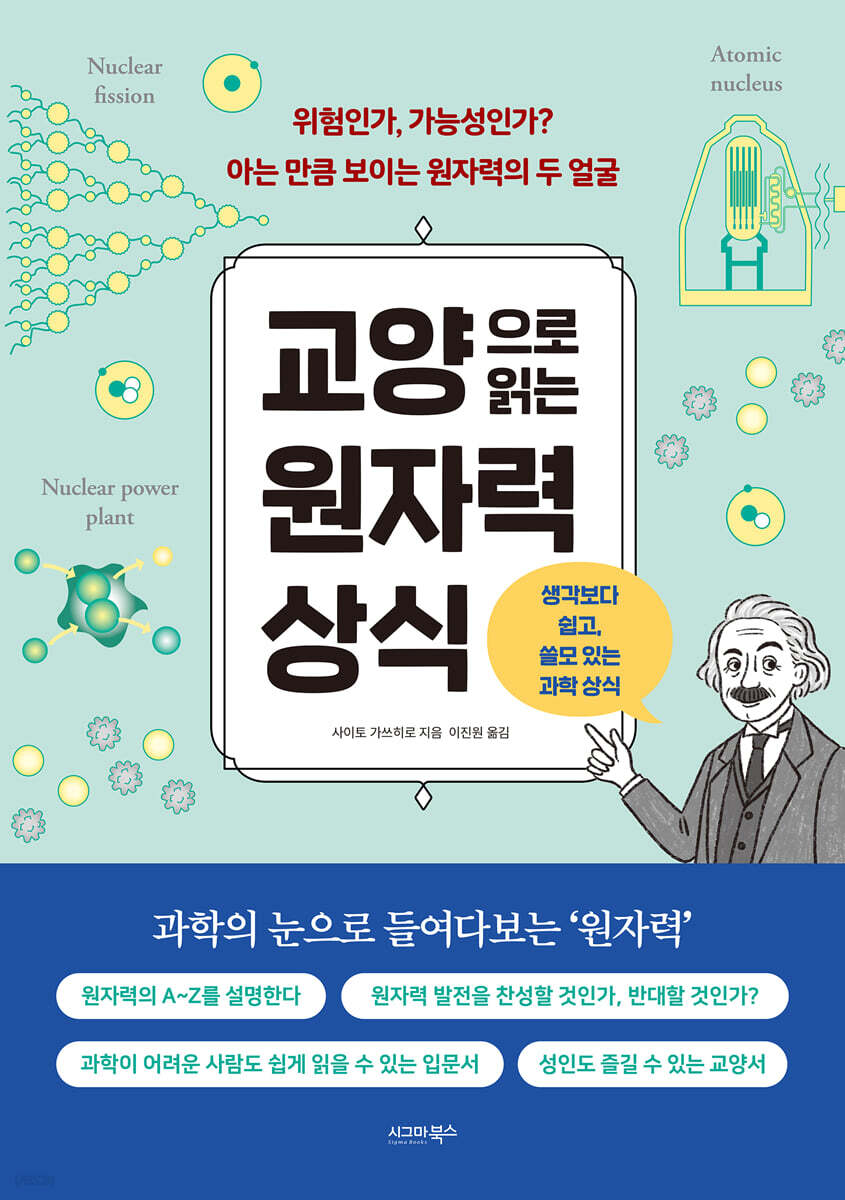 |
Description
Book Introduction
Risk or possibility?
The Two Faces of Nuclear Power: The More You Know
All matter that makes up the universe is made up of atoms.
The nucleus at the center of the atom creates enormous reaction energy through 'nuclear reaction', which is 'atomic power'.
Nuclear energy has great value when used peacefully.
Nuclear power has been highlighted as a new energy source that can complement the limitations of existing fossil fuels, such as global warming and climate change.
By acquiring the technology of nuclear power about 80 years ago, mankind was able to achieve unprecedented abundance and convenience.
But unfortunately, mankind first used this nuclear energy to create a weapon of destruction: the 'atomic bomb'.
There are many dark stories of humanity related to nuclear power, such as nuclear accidents, nuclear wars, and radioactive contamination.
This series of events has sparked serious global debate about whether nuclear power is still a viable energy source.
In this way, nuclear power is like a double-edged sword that carries both risks and possibilities.
This book is a general education textbook for everyone that systematically and easily addresses theoretical and technical questions such as "What is nuclear power?", "Why is nuclear power dangerous?", and "How can nuclear power help?"
Should you support or oppose nuclear power? This is a question for readers to carefully consider and decide for themselves.
I would be very happy if this book could help you make that decision.
The Two Faces of Nuclear Power: The More You Know
All matter that makes up the universe is made up of atoms.
The nucleus at the center of the atom creates enormous reaction energy through 'nuclear reaction', which is 'atomic power'.
Nuclear energy has great value when used peacefully.
Nuclear power has been highlighted as a new energy source that can complement the limitations of existing fossil fuels, such as global warming and climate change.
By acquiring the technology of nuclear power about 80 years ago, mankind was able to achieve unprecedented abundance and convenience.
But unfortunately, mankind first used this nuclear energy to create a weapon of destruction: the 'atomic bomb'.
There are many dark stories of humanity related to nuclear power, such as nuclear accidents, nuclear wars, and radioactive contamination.
This series of events has sparked serious global debate about whether nuclear power is still a viable energy source.
In this way, nuclear power is like a double-edged sword that carries both risks and possibilities.
This book is a general education textbook for everyone that systematically and easily addresses theoretical and technical questions such as "What is nuclear power?", "Why is nuclear power dangerous?", and "How can nuclear power help?"
Should you support or oppose nuclear power? This is a question for readers to carefully consider and decide for themselves.
I would be very happy if this book could help you make that decision.
- You can preview some of the book's contents.
Preview
index
Introduction: Nuclear Power Through the Eyes of Science
Chapter 1.
How did the history of nuclear energy begin?
01 The Curies Who Opened the Door to the Atomic Age
02 Two major theories that shaped the history of the 20th century
03 E=mc2 represents colossal energy
Chapter 2.
Can nuclear reactions solve the energy problem?
04 Chemical Energy and Renewable Energy
05 Explosive energy and explosives needed in modern society
06 Nuclear Energy Uses: Where is the nuclear fission reaction used?
07 Nuclear Energy Uses: Hydrogen Bombs and Space
08 How can nuclear reactions be used peacefully?
Chapter 3.
Before understanding nuclear energy, let's learn about atoms and the nucleus.
09 What structure does an atom have?
10 What is the structure of the nucleus?
11 The universe began with the Big Bang and was created through nuclear fusion.
12 Under what conditions does nuclear fission occur?
13 Radiation is released through nuclear decay reactions.
Chapter 4.
What you need to know about radiation
14 Radiation and radioactivity are different.
15 Radiation that pours down on us every day
16 Changes in the nucleus are the source of Earth's energy.
17 How does radiation affect the human body?
18 Radiation essential to modern medicine
Chapter 5.
Examining the structure of nuclear power generation
19 The reactor of a nuclear power plant is like the boiler of a thermal power plant.
20 Current nuclear power generation uses only nuclear fission reactions.
21 Current nuclear fuel is dominated by uranium
22 The role of control materials in suppressing nuclear explosions
23 The role of moderators in slowing down the speed of neutrons
24 Water is a coolant that kills two birds with one stone.
Chapter 6.
Taking apart the inside of a nuclear reactor
What does the inside of a reactor containment vessel look like?
26 The role of auxiliary facilities in preventing radiation accidents
27 Different types of reactors depending on the classification method
Chapter 7.
What does nuclear power have to do with the environment?
28 How will we deal with the spent nuclear fuel that is bound to be generated?
29 How can spent nuclear fuel be safely reprocessed?
30 What considerations does nuclear power have for the environment?
31 How can we mitigate the risks of radiation?
Chapter 8.
A nuclear reactor accident that shook the world in history
32 Early nuclear reactor accidents occurred in military experimental reactors.
The Three Mile Island nuclear power plant accident brought the severity of the damage to the world's attention.
34 How did the Chernobyl accident happen?
The Fukuryu Maru incident, which resulted from the US military's hydrogen bomb test
The nuclear-powered ship Mutsu's accident, a journey of twists and turns
37 The Tokaimura criticality accident caused by poor work practices
The accident at the fast breeder reactor 'Monju' shattered dreams.
The Fukushima Daiichi Nuclear Power Plant accident on March 11, 2011
40 To prepare for unexpected events such as war and terrorism
Chapter 9.
How will nuclear power evolve in the future?
41 Fuel breeding structure of a fast breeder reactor
42 Development of Thorium Reactors: Advantages and Challenges
43 From the first generation in the 1950s to the next generation of nuclear reactors
44 The metabolism of a nuclear reactor that is finally reaching the end of its lifespan
45 What is the future of nuclear power?
Chapter 10.
Is nuclear fusion the ultimate energy card that will hold humanity's future?
46 Nuclear fusion reactions in the sun and hydrogen bombs
47 Completion of a nuclear fusion reactor, which will take another 30 years
Types and structures of nuclear fusion reactors capable of withstanding fuel temperatures of 48 billion degrees Celsius
A massive international project has been launched to realize a 49-nuclear fusion reactor.
Chapter 1.
How did the history of nuclear energy begin?
01 The Curies Who Opened the Door to the Atomic Age
02 Two major theories that shaped the history of the 20th century
03 E=mc2 represents colossal energy
Chapter 2.
Can nuclear reactions solve the energy problem?
04 Chemical Energy and Renewable Energy
05 Explosive energy and explosives needed in modern society
06 Nuclear Energy Uses: Where is the nuclear fission reaction used?
07 Nuclear Energy Uses: Hydrogen Bombs and Space
08 How can nuclear reactions be used peacefully?
Chapter 3.
Before understanding nuclear energy, let's learn about atoms and the nucleus.
09 What structure does an atom have?
10 What is the structure of the nucleus?
11 The universe began with the Big Bang and was created through nuclear fusion.
12 Under what conditions does nuclear fission occur?
13 Radiation is released through nuclear decay reactions.
Chapter 4.
What you need to know about radiation
14 Radiation and radioactivity are different.
15 Radiation that pours down on us every day
16 Changes in the nucleus are the source of Earth's energy.
17 How does radiation affect the human body?
18 Radiation essential to modern medicine
Chapter 5.
Examining the structure of nuclear power generation
19 The reactor of a nuclear power plant is like the boiler of a thermal power plant.
20 Current nuclear power generation uses only nuclear fission reactions.
21 Current nuclear fuel is dominated by uranium
22 The role of control materials in suppressing nuclear explosions
23 The role of moderators in slowing down the speed of neutrons
24 Water is a coolant that kills two birds with one stone.
Chapter 6.
Taking apart the inside of a nuclear reactor
What does the inside of a reactor containment vessel look like?
26 The role of auxiliary facilities in preventing radiation accidents
27 Different types of reactors depending on the classification method
Chapter 7.
What does nuclear power have to do with the environment?
28 How will we deal with the spent nuclear fuel that is bound to be generated?
29 How can spent nuclear fuel be safely reprocessed?
30 What considerations does nuclear power have for the environment?
31 How can we mitigate the risks of radiation?
Chapter 8.
A nuclear reactor accident that shook the world in history
32 Early nuclear reactor accidents occurred in military experimental reactors.
The Three Mile Island nuclear power plant accident brought the severity of the damage to the world's attention.
34 How did the Chernobyl accident happen?
The Fukuryu Maru incident, which resulted from the US military's hydrogen bomb test
The nuclear-powered ship Mutsu's accident, a journey of twists and turns
37 The Tokaimura criticality accident caused by poor work practices
The accident at the fast breeder reactor 'Monju' shattered dreams.
The Fukushima Daiichi Nuclear Power Plant accident on March 11, 2011
40 To prepare for unexpected events such as war and terrorism
Chapter 9.
How will nuclear power evolve in the future?
41 Fuel breeding structure of a fast breeder reactor
42 Development of Thorium Reactors: Advantages and Challenges
43 From the first generation in the 1950s to the next generation of nuclear reactors
44 The metabolism of a nuclear reactor that is finally reaching the end of its lifespan
45 What is the future of nuclear power?
Chapter 10.
Is nuclear fusion the ultimate energy card that will hold humanity's future?
46 Nuclear fusion reactions in the sun and hydrogen bombs
47 Completion of a nuclear fusion reactor, which will take another 30 years
Types and structures of nuclear fusion reactors capable of withstanding fuel temperatures of 48 billion degrees Celsius
A massive international project has been launched to realize a 49-nuclear fusion reactor.
Detailed image
.jpg)
Into the book
Marie Curie devoted herself to research with all her passion until her death in France in 1934.
Currently, her cause of death is believed to be aplastic anemia caused by long-term radiation exposure.
However, since the dangers of radiation were not well known at the time, she is said to have carried the test tube containing the radioactive element in her pocket.
Marie Curie likely suffered from a number of illnesses caused by radiation exposure, including blindness due to cataracts.
However, she is said to have never admitted to any deterioration in her health due to radiation exposure.
--- 「Chapter 1.
From “How did the history of nuclear power begin?”
The major nuclear reactions are nuclear fission and nuclear fusion.
The atomic bomb is a bomb that uses nuclear fission reaction, and the hydrogen bomb, which we will look at later, is a bomb that uses nuclear fusion reaction.
Both the atomic bomb and the hydrogen bomb are often referred to in the same context as 'nuclear bombs', as they both utilize nuclear reactions.
However, the principles of the two bombs are completely opposite, and the energy generated is also significantly different.
--- 「Chapter 2.
From "Can nuclear reactions solve the energy problem?"
The ability or property of a radioactive substance to emit radiation is called ‘radioactivity.’
Radiation is matter or energy, and when it collides with living things, it can cause fatal damage to them.
However, since radiation is an 'ability/property', it is not a 'substance' that can cause harm.
This relationship may be easier to understand if we use a baseball analogy.
'Radioactive material' is a pitcher.
The ball thrown by the pitcher is 'radiation'.
The pitcher's talent and ability as a pitcher is 'radioactive'.
A dead ball is something that hurts when hit, and it is impossible for the 'pitcher's ability' to hit and hurt someone.
--- Chapter 3.
From “Let’s learn about atoms and nuclei before understanding nuclear power”
The Earth is bombarded with cosmic rays from space.
This cosmic radiation is identical to radiation.
Cosmic radiation, which mainly consists of gamma rays and neutron rays, is very harmful to the human body, but the Earth's atmosphere, especially the ozone layer in the high stratosphere, absorbs and blocks it.
The ozone layer is the Earth's natural barrier.
Without shields like the ozone layer, life on Earth would not be possible.
Not only that, but life would never have been born in the first place.
--- 「Chapter 4.
From "What You Need to Know About Radiation"
A nuclear reactor is equivalent to a boiler, and the difference between a nuclear reactor and a boiler is whether a 'nuclear reaction' or a 'chemical reaction' is used to create steam.
In other words, the only difference is that while a boiler uses the combustion energy generated by burning carbon fuel, that is, 'chemical energy', to create steam, a nuclear reactor uses 'nuclear power', which is nuclear energy based on nuclear fission, as its energy.
--- Chapter 5.
From “Looking at the Structure of Nuclear Power Generation”
Nuclear power plants produce energy as well as fission products.
These fission products are radioactive substances with strong radioactivity, emitting strong radiation.
Therefore, in nuclear reactors, care must be taken to ensure that neither radioactive materials nor radiation leak to the outside.
A device that blocks radioactive materials or radiation inside a nuclear reactor from leaking to the outside environment is generally called a shielding device.
Shielding devices consist of multiple layers and can be broadly divided into pressure vessels and containment vessels.
--- 「Chapter 6.
From "Dissecting the Inside of a Nuclear Reactor"
The amount of carbon dioxide emitted per kWh (kilowatt hour) by nuclear power generation is significantly less than that of coal-fired, oil-fired, and LNG-fired power generation.
It is similar to natural energy such as solar or wind power.
Additionally, nuclear power plants do not produce NOx or SOx.
In that sense, it can be called clean energy.
While possessing such excellent environmental suitability, nuclear power generation generates radiation and radioactive materials, so strict management and handling are always required to ensure that it does not affect the surrounding environment.
--- Chapter 7.
From “What does nuclear power have to do with the environment?”
There were four nuclear reactors in Chernobyl, and the accident occurred in reactor number 4.
After the accident, Unit 4 was filled with concrete, but recently, the concrete has weakened due to radiation, so a plan to cover it with another layer of concrete is being considered.
Even now, entry is prohibited within 30km of the reactor.
Radiation levels had been dropping recently, but they rose again in February 2022 when Russian forces invaded Chernobyl, Ukraine.
It is said that this is because the ground was dug up when the tram passed near the reactor, exposing buried radioactive materials to the surface.
--- Chapter 8.
From "Nuclear Reactor Accidents in History That Shook the World"
After witnessing the tragedy of the Fukushima Daiichi nuclear power plant accident in 2011, the world seemed to have turned its back on nuclear power.
However, as the problem of global warming and climate change becomes more serious due to the increase in carbon dioxide produced by fossil fuels, there has been a recent movement to use nuclear power again.
The vulnerability of renewable energy, which was expected to replace nuclear power, and the exodus of Russian energy due to the Ukrainian crisis are spurring this movement.
--- Chapter 9.
From “How will nuclear power generation evolve in the future?”
Reactions that extract energy from the nucleus include nuclear fission reactions and nuclear fusion reactions.
Nuclear fusion reactors use this nuclear fusion reaction to extract heat and use it to generate electricity.
As we have seen, the energy that can be obtained from a nuclear fusion reaction is much greater than the energy that can be obtained from a nuclear fission reaction.
Nuclear fusion reactors may be the trump card that will shoulder humanity's future energy burden.
Currently, her cause of death is believed to be aplastic anemia caused by long-term radiation exposure.
However, since the dangers of radiation were not well known at the time, she is said to have carried the test tube containing the radioactive element in her pocket.
Marie Curie likely suffered from a number of illnesses caused by radiation exposure, including blindness due to cataracts.
However, she is said to have never admitted to any deterioration in her health due to radiation exposure.
--- 「Chapter 1.
From “How did the history of nuclear power begin?”
The major nuclear reactions are nuclear fission and nuclear fusion.
The atomic bomb is a bomb that uses nuclear fission reaction, and the hydrogen bomb, which we will look at later, is a bomb that uses nuclear fusion reaction.
Both the atomic bomb and the hydrogen bomb are often referred to in the same context as 'nuclear bombs', as they both utilize nuclear reactions.
However, the principles of the two bombs are completely opposite, and the energy generated is also significantly different.
--- 「Chapter 2.
From "Can nuclear reactions solve the energy problem?"
The ability or property of a radioactive substance to emit radiation is called ‘radioactivity.’
Radiation is matter or energy, and when it collides with living things, it can cause fatal damage to them.
However, since radiation is an 'ability/property', it is not a 'substance' that can cause harm.
This relationship may be easier to understand if we use a baseball analogy.
'Radioactive material' is a pitcher.
The ball thrown by the pitcher is 'radiation'.
The pitcher's talent and ability as a pitcher is 'radioactive'.
A dead ball is something that hurts when hit, and it is impossible for the 'pitcher's ability' to hit and hurt someone.
--- Chapter 3.
From “Let’s learn about atoms and nuclei before understanding nuclear power”
The Earth is bombarded with cosmic rays from space.
This cosmic radiation is identical to radiation.
Cosmic radiation, which mainly consists of gamma rays and neutron rays, is very harmful to the human body, but the Earth's atmosphere, especially the ozone layer in the high stratosphere, absorbs and blocks it.
The ozone layer is the Earth's natural barrier.
Without shields like the ozone layer, life on Earth would not be possible.
Not only that, but life would never have been born in the first place.
--- 「Chapter 4.
From "What You Need to Know About Radiation"
A nuclear reactor is equivalent to a boiler, and the difference between a nuclear reactor and a boiler is whether a 'nuclear reaction' or a 'chemical reaction' is used to create steam.
In other words, the only difference is that while a boiler uses the combustion energy generated by burning carbon fuel, that is, 'chemical energy', to create steam, a nuclear reactor uses 'nuclear power', which is nuclear energy based on nuclear fission, as its energy.
--- Chapter 5.
From “Looking at the Structure of Nuclear Power Generation”
Nuclear power plants produce energy as well as fission products.
These fission products are radioactive substances with strong radioactivity, emitting strong radiation.
Therefore, in nuclear reactors, care must be taken to ensure that neither radioactive materials nor radiation leak to the outside.
A device that blocks radioactive materials or radiation inside a nuclear reactor from leaking to the outside environment is generally called a shielding device.
Shielding devices consist of multiple layers and can be broadly divided into pressure vessels and containment vessels.
--- 「Chapter 6.
From "Dissecting the Inside of a Nuclear Reactor"
The amount of carbon dioxide emitted per kWh (kilowatt hour) by nuclear power generation is significantly less than that of coal-fired, oil-fired, and LNG-fired power generation.
It is similar to natural energy such as solar or wind power.
Additionally, nuclear power plants do not produce NOx or SOx.
In that sense, it can be called clean energy.
While possessing such excellent environmental suitability, nuclear power generation generates radiation and radioactive materials, so strict management and handling are always required to ensure that it does not affect the surrounding environment.
--- Chapter 7.
From “What does nuclear power have to do with the environment?”
There were four nuclear reactors in Chernobyl, and the accident occurred in reactor number 4.
After the accident, Unit 4 was filled with concrete, but recently, the concrete has weakened due to radiation, so a plan to cover it with another layer of concrete is being considered.
Even now, entry is prohibited within 30km of the reactor.
Radiation levels had been dropping recently, but they rose again in February 2022 when Russian forces invaded Chernobyl, Ukraine.
It is said that this is because the ground was dug up when the tram passed near the reactor, exposing buried radioactive materials to the surface.
--- Chapter 8.
From "Nuclear Reactor Accidents in History That Shook the World"
After witnessing the tragedy of the Fukushima Daiichi nuclear power plant accident in 2011, the world seemed to have turned its back on nuclear power.
However, as the problem of global warming and climate change becomes more serious due to the increase in carbon dioxide produced by fossil fuels, there has been a recent movement to use nuclear power again.
The vulnerability of renewable energy, which was expected to replace nuclear power, and the exodus of Russian energy due to the Ukrainian crisis are spurring this movement.
--- Chapter 9.
From “How will nuclear power generation evolve in the future?”
Reactions that extract energy from the nucleus include nuclear fission reactions and nuclear fusion reactions.
Nuclear fusion reactors use this nuclear fusion reaction to extract heat and use it to generate electricity.
As we have seen, the energy that can be obtained from a nuclear fusion reaction is much greater than the energy that can be obtained from a nuclear fission reaction.
Nuclear fusion reactors may be the trump card that will shoulder humanity's future energy burden.
--- 「Chapter 10.
From "Is nuclear fusion the ultimate energy card that will carry the future of humanity?"
From "Is nuclear fusion the ultimate energy card that will carry the future of humanity?"
Publisher's Review
Explaining the A to Z of nuclear energy!
Nuclear Power Through the Eyes of Science
What images come to mind when you think of "nuclear power," "nuclear," or "radiation"? Most likely, negative images like "scary" or "dangerous" come to mind first.
But it's hard to find someone who can accurately explain why nuclear power is scary and dangerous.
This book is a scientific textbook that explores the overall theory and technology of nuclear energy from a neutral perspective, including what nuclear energy is, why it is dangerous, and why it is beneficial to our lives.
Not only does it explain in detail the principles and structure of nuclear power generation, it also clearly explains concepts that many people are confused about, such as ‘radioactivity’, ‘radiation’, ‘nuclear fission’, and ‘nuclear fusion’.
We are also comprehensively reviewing nuclear-related accidents that have occurred around the world to date.
Additionally, we will be able to examine the future of nuclear power generation and the challenges facing humanity in relation to nuclear power.
“Are you for or against nuclear power?
“I would be very happy if this book could help you make that decision.”
Katsuhiro Saito, a doctor of science and author of numerous scientific books, emphasizes that the core of this book is not whether one should support or oppose the use of nuclear power.
This book neither supports nor opposes the use of nuclear energy.
I'm just interested in nuclear power.
Therefore, you will not find any content in this book that 'emphasizes the fear of nuclear power' or 'emphasizes the advantages of nuclear power'.
I simply wanted to faithfully explain the general knowledge related to nuclear energy, including its principles, history, pros and cons, and future prospects.
Whether you are for or against the use of nuclear energy is something you must think about and decide for yourself.
This book only provides the material for that judgment.
Through 『Nuclear Knowledge for General Education』, readers will be able to encounter two new faces of nuclear energy that they had not previously known.
The only goal of this book is for many people to read it and then decide their own position.
Is nuclear power a risk or a possibility for you? The answer lies with each and every reader of this book.
Nuclear Power Through the Eyes of Science
What images come to mind when you think of "nuclear power," "nuclear," or "radiation"? Most likely, negative images like "scary" or "dangerous" come to mind first.
But it's hard to find someone who can accurately explain why nuclear power is scary and dangerous.
This book is a scientific textbook that explores the overall theory and technology of nuclear energy from a neutral perspective, including what nuclear energy is, why it is dangerous, and why it is beneficial to our lives.
Not only does it explain in detail the principles and structure of nuclear power generation, it also clearly explains concepts that many people are confused about, such as ‘radioactivity’, ‘radiation’, ‘nuclear fission’, and ‘nuclear fusion’.
We are also comprehensively reviewing nuclear-related accidents that have occurred around the world to date.
Additionally, we will be able to examine the future of nuclear power generation and the challenges facing humanity in relation to nuclear power.
“Are you for or against nuclear power?
“I would be very happy if this book could help you make that decision.”
Katsuhiro Saito, a doctor of science and author of numerous scientific books, emphasizes that the core of this book is not whether one should support or oppose the use of nuclear power.
This book neither supports nor opposes the use of nuclear energy.
I'm just interested in nuclear power.
Therefore, you will not find any content in this book that 'emphasizes the fear of nuclear power' or 'emphasizes the advantages of nuclear power'.
I simply wanted to faithfully explain the general knowledge related to nuclear energy, including its principles, history, pros and cons, and future prospects.
Whether you are for or against the use of nuclear energy is something you must think about and decide for yourself.
This book only provides the material for that judgment.
Through 『Nuclear Knowledge for General Education』, readers will be able to encounter two new faces of nuclear energy that they had not previously known.
The only goal of this book is for many people to read it and then decide their own position.
Is nuclear power a risk or a possibility for you? The answer lies with each and every reader of this book.
GOODS SPECIFICS
- Date of issue: July 8, 2024
- Page count, weight, size: 300 pages | 504g | 148*210*17mm
- ISBN13: 9791168622623
- ISBN10: 116862262X
You may also like
카테고리
korean


korean

![GQ KOREA Mark (Monthly): December [2025]](http://librairie.coreenne.fr/cdn/shop/files/8ef265dbbfbf186523ed75ba7319009d.jpg?v=1765340328&width=3840)


