

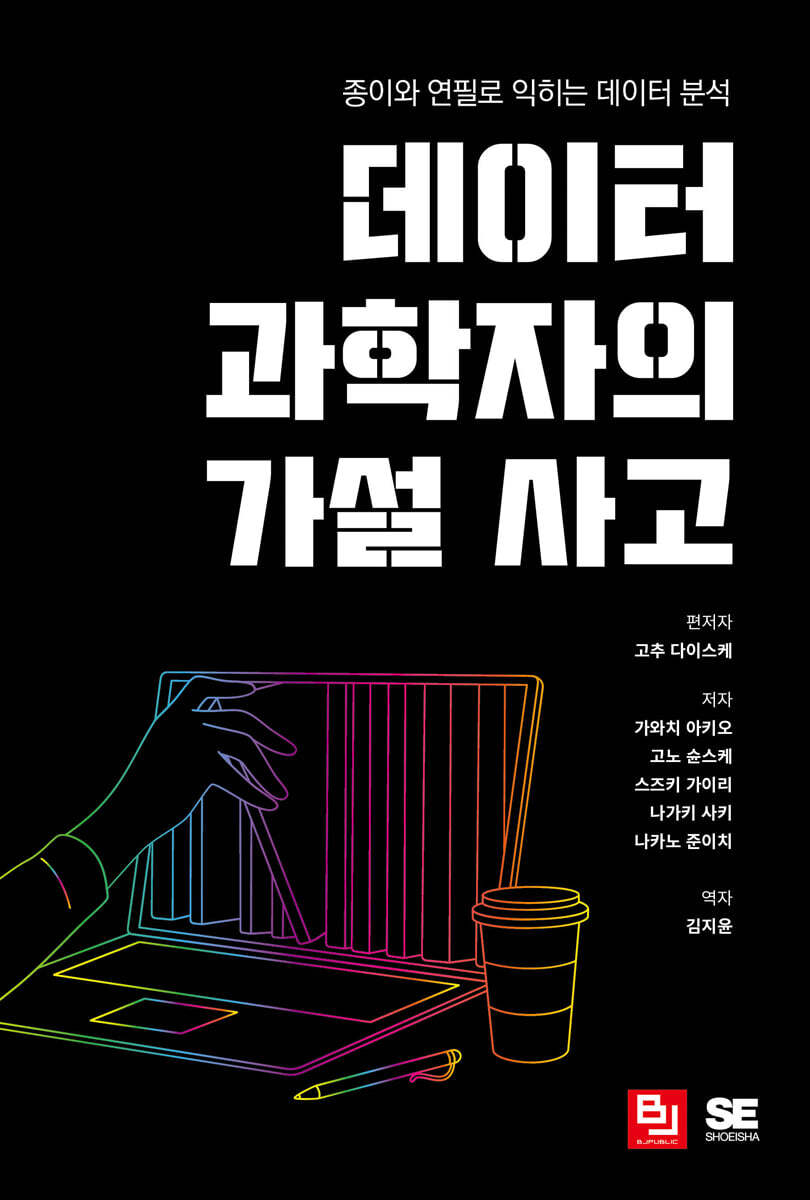
Data Scientist's Hypothesis Thinking
 |
Description
Book Introduction
“Learn how to think like a data scientist without using programming jargon.”
The ability to read and analyze data has become a basic skill that everyone must acquire.
However, some people give up on studying because of programming languages such as Python and R.
This book teaches data scientist thinking using only paper and pencil, without complex calculations, Excel, or programming languages.
Easily understand fundamental data concepts and experience the data scientist's thinking process firsthand by solving 40 quizzes.
The ability to read and analyze data has become a basic skill that everyone must acquire.
However, some people give up on studying because of programming languages such as Python and R.
This book teaches data scientist thinking using only paper and pencil, without complex calculations, Excel, or programming languages.
Easily understand fundamental data concepts and experience the data scientist's thinking process firsthand by solving 40 quizzes.
- You can preview some of the book's contents.
Preview
index
Entering
About the Author
Beta Reader
How to Use This Book
Chapter 1: Data Literacy Required in the Digital Age
1-1.
The advent of the digital age
The Role of Big Data in the DX Era
Realizing Society 5.0
1-2.
Data literacy is an essential skill for future workers.
Literacy skills like "reading, writing, and arithmetic" in the digital age
Data Literacy for All College and High School Students
New hires have better data literacy
Column: DX Literacy Every Office Worker Should Acquire
1-3.
Let's learn data literacy
Data Literacy that Office Workers Need to Acquire
column: What is a data scientist?
Chapter 2: Developing the Power to Read Data
2-1.
Let's read the data while thinking!
Quiz 1: Learn how to view data in a purposeful way.
Quiz 2: Learn how to identify data characteristics and trends.
Quiz 3: Learn how to find insights in data.
2-2.
Let's get a grasp of the overall trend!
Representative values of data: mean, mode, median
Quiz 4: Learn how to calculate the mean, mode, and median.
Quiz 5: Learn the relationship between the mean and the data distribution.
Check the data distribution
column: width of the histogram
In real society, the mean is often not equal to the mode.
Most Japanese people have an income of 5.523 million yen?
Most generations have saved 17.91 million yen?
2-3.
Let's check the details of the data!
Quiz 6: Learn about disparity and outliers.
Non-existent data (missing values)
2-4.
Let's understand the relationships between data!
Quiz 7: Learn the relationship between two sets of data.
Relationship between two data: Correlation
Correlation and causation
Quiz 8: Learn about correlation and causality.
How should we view the correlation?
Chapter 3: Developing the Power to Explain Data
3-1.
Let's visualize the data!
Quiz 1: Learn Appropriate Graph Representations
Appropriate graphic representation
column: When visualizing time series data, a line graph?
column: Data scientists don't use pie charts?
Quiz 2: Learn Inappropriate Graph Representations
3-2.
What does it mean to compare data?
Quiz 3: Learn how to set appropriate comparison targets.
Setting an appropriate comparison target
Four Views to Compare Data
Quiz 4: Learn how to compare points in time.
Quiz 5: Learn how to compare with others.
Decomposition by multiplication
Decomposition by addition
3-3.
Finding challenges in data
Quizzes 6-9: Learn the order in which tasks are found in data.
The order in which tasks are identified from sales data
The sales increase effect of 3x points DAY
The effect of sports day sales increase
Chapter 4: Developing the Power to Classify Data
4-1.
Let's group data with similar characteristics!
Quiz 1: Learn the meaning of dividing data into groups.
Meaning of dividing data into groups
Think of solutions for each group
column: Identifying potential customer needs
Judgment that the data features are similar
Quiz 2: Learn the distance between data.
Quiz 3: Learn the precautions when calculating distance.
column: data with different scales
4-2.
Let's classify data according to its purpose!
Quiz 4: Learn perspectives for classifying data.
The difficulty of data classification
4-3.
Let's classify the data mechanically!
Quiz 5: Learn the Center of the Group
How to classify data: k-means method
column: Initial value problem of k-means method
4-4.
Let's experience data classification!
Quizzes 6-8: Learn the order in which data is classified.
Chapter 5: Developing the Power to Discover Laws in Data
5-1.
Discovering laws in data!
Quiz 1: Learn how to discover rules in data.
Quiz 2: Learn how to apply the laws you discovered.
Characteristics of discrimination problems
5-2.
Decision tree model for solving discrimination problems
Quiz 3: Learn how to build a decision tree model.
Grow a decision tree model
Quiz 4: Learn how to use decision tree models to predict outcomes.
5-3.
Let's evaluate the accuracy of the discrimination problem!
Quiz 5: Learn how to evaluate discrimination problems.
Organize into a 2×2 cross table
Evaluating the accuracy of the discrimination problem
Which is more important, fit or recall?
5-4.
Let's use the decision tree model!
Quiz 6: Learn the steps to solve discriminant problems by discovering rules in data.
Chapter 6: Developing the Power to Predict by Looking at Data
6-1.
Let's check the relationship between numerical data!
Quiz 1: Learn how to check relationships in numerical data.
Quiz 2: Learn how to deal with situations where the relationships in your numerical data don't narrow down.
Check the relationship with data other than numbers
Quiz 3: Learn how to identify relationships with non-numerical data.
6-2.
Be careful with interpolation and extrapolation!
Quiz 4: Learn about interpolation and extrapolation, which are important to consider when predicting based on data.
When can and cannot the relationships discovered by looking at the data be applied?
Example of prediction by extrapolation
6-3.
Beware of data bias!
Quiz 5: Learn what to watch out for when your data is skewed.
Ensure that the data is free of bias
Grocery store campaign fails
6-4.
Pay attention to the time change!
Quiz 6: Learn about trends and periodicity in time series data.
Time series data can reveal a variety of fluctuations.
6-5.
Let's look at the data and make predictions!
Quizzes 7-9: Learn the order in which data is viewed and predicted.
Chapter 7: Leveraging Data Literacy at Work
7-1.
Harness the power of reading data
An Example of Leveraging the Power of Data Reading: Survey Research
A Case Study of Harnessing the Power of Data: Market Analysis
7-2.
Harness the power of data to explain
A Case Study of Harnessing the Power of Data to Explain It: Sales Analysis
A Case Study: Leveraging the Power of Data to Explain It: Quality Management
7-3.
Harness the power of data classification
An Example of Leveraging the Power of Data Classification: Customer Segmentation
A Case Study: Leveraging the Power of Data Classification: Store Clustering
7-4.
Harness the power of discovering rules in data
A Case Study of Harnessing the Power of Discovering Laws in Data: Equipment Anomalies
A Case Study: Harnessing the Power of Uncovering Laws in Data: Customer Churn
7-5.
Harness the power of data to make predictions.
A Case Study of Leveraging the Power of Data-Based Prediction: Product Demand Forecasting
An example of leveraging the power of data analysis and prediction: Predicting ridership.
Conclusion
References
About the Author
Beta Reader
How to Use This Book
Chapter 1: Data Literacy Required in the Digital Age
1-1.
The advent of the digital age
The Role of Big Data in the DX Era
Realizing Society 5.0
1-2.
Data literacy is an essential skill for future workers.
Literacy skills like "reading, writing, and arithmetic" in the digital age
Data Literacy for All College and High School Students
New hires have better data literacy
Column: DX Literacy Every Office Worker Should Acquire
1-3.
Let's learn data literacy
Data Literacy that Office Workers Need to Acquire
column: What is a data scientist?
Chapter 2: Developing the Power to Read Data
2-1.
Let's read the data while thinking!
Quiz 1: Learn how to view data in a purposeful way.
Quiz 2: Learn how to identify data characteristics and trends.
Quiz 3: Learn how to find insights in data.
2-2.
Let's get a grasp of the overall trend!
Representative values of data: mean, mode, median
Quiz 4: Learn how to calculate the mean, mode, and median.
Quiz 5: Learn the relationship between the mean and the data distribution.
Check the data distribution
column: width of the histogram
In real society, the mean is often not equal to the mode.
Most Japanese people have an income of 5.523 million yen?
Most generations have saved 17.91 million yen?
2-3.
Let's check the details of the data!
Quiz 6: Learn about disparity and outliers.
Non-existent data (missing values)
2-4.
Let's understand the relationships between data!
Quiz 7: Learn the relationship between two sets of data.
Relationship between two data: Correlation
Correlation and causation
Quiz 8: Learn about correlation and causality.
How should we view the correlation?
Chapter 3: Developing the Power to Explain Data
3-1.
Let's visualize the data!
Quiz 1: Learn Appropriate Graph Representations
Appropriate graphic representation
column: When visualizing time series data, a line graph?
column: Data scientists don't use pie charts?
Quiz 2: Learn Inappropriate Graph Representations
3-2.
What does it mean to compare data?
Quiz 3: Learn how to set appropriate comparison targets.
Setting an appropriate comparison target
Four Views to Compare Data
Quiz 4: Learn how to compare points in time.
Quiz 5: Learn how to compare with others.
Decomposition by multiplication
Decomposition by addition
3-3.
Finding challenges in data
Quizzes 6-9: Learn the order in which tasks are found in data.
The order in which tasks are identified from sales data
The sales increase effect of 3x points DAY
The effect of sports day sales increase
Chapter 4: Developing the Power to Classify Data
4-1.
Let's group data with similar characteristics!
Quiz 1: Learn the meaning of dividing data into groups.
Meaning of dividing data into groups
Think of solutions for each group
column: Identifying potential customer needs
Judgment that the data features are similar
Quiz 2: Learn the distance between data.
Quiz 3: Learn the precautions when calculating distance.
column: data with different scales
4-2.
Let's classify data according to its purpose!
Quiz 4: Learn perspectives for classifying data.
The difficulty of data classification
4-3.
Let's classify the data mechanically!
Quiz 5: Learn the Center of the Group
How to classify data: k-means method
column: Initial value problem of k-means method
4-4.
Let's experience data classification!
Quizzes 6-8: Learn the order in which data is classified.
Chapter 5: Developing the Power to Discover Laws in Data
5-1.
Discovering laws in data!
Quiz 1: Learn how to discover rules in data.
Quiz 2: Learn how to apply the laws you discovered.
Characteristics of discrimination problems
5-2.
Decision tree model for solving discrimination problems
Quiz 3: Learn how to build a decision tree model.
Grow a decision tree model
Quiz 4: Learn how to use decision tree models to predict outcomes.
5-3.
Let's evaluate the accuracy of the discrimination problem!
Quiz 5: Learn how to evaluate discrimination problems.
Organize into a 2×2 cross table
Evaluating the accuracy of the discrimination problem
Which is more important, fit or recall?
5-4.
Let's use the decision tree model!
Quiz 6: Learn the steps to solve discriminant problems by discovering rules in data.
Chapter 6: Developing the Power to Predict by Looking at Data
6-1.
Let's check the relationship between numerical data!
Quiz 1: Learn how to check relationships in numerical data.
Quiz 2: Learn how to deal with situations where the relationships in your numerical data don't narrow down.
Check the relationship with data other than numbers
Quiz 3: Learn how to identify relationships with non-numerical data.
6-2.
Be careful with interpolation and extrapolation!
Quiz 4: Learn about interpolation and extrapolation, which are important to consider when predicting based on data.
When can and cannot the relationships discovered by looking at the data be applied?
Example of prediction by extrapolation
6-3.
Beware of data bias!
Quiz 5: Learn what to watch out for when your data is skewed.
Ensure that the data is free of bias
Grocery store campaign fails
6-4.
Pay attention to the time change!
Quiz 6: Learn about trends and periodicity in time series data.
Time series data can reveal a variety of fluctuations.
6-5.
Let's look at the data and make predictions!
Quizzes 7-9: Learn the order in which data is viewed and predicted.
Chapter 7: Leveraging Data Literacy at Work
7-1.
Harness the power of reading data
An Example of Leveraging the Power of Data Reading: Survey Research
A Case Study of Harnessing the Power of Data: Market Analysis
7-2.
Harness the power of data to explain
A Case Study of Harnessing the Power of Data to Explain It: Sales Analysis
A Case Study: Leveraging the Power of Data to Explain It: Quality Management
7-3.
Harness the power of data classification
An Example of Leveraging the Power of Data Classification: Customer Segmentation
A Case Study: Leveraging the Power of Data Classification: Store Clustering
7-4.
Harness the power of discovering rules in data
A Case Study of Harnessing the Power of Discovering Laws in Data: Equipment Anomalies
A Case Study: Harnessing the Power of Uncovering Laws in Data: Customer Churn
7-5.
Harness the power of data to make predictions.
A Case Study of Leveraging the Power of Data-Based Prediction: Product Demand Forecasting
An example of leveraging the power of data analysis and prediction: Predicting ridership.
Conclusion
References
Publisher's Review
"A Data Scientist's Hypothetical Thinking: Easily Learned by Anyone"
To survive in a rapidly changing digital society, workers must acquire data literacy (the ability to read data, explain data, handle data, classify data, discover rules in data, and predict data).
However, many people give up on data science before even starting due to the barrier of programming languages such as Python or R.
To prevent this from happening, we've created a book that lets you experience the thought process of a data scientist—without programming languages, just paper and pencil.
This book will teach you how data scientists approach data through their thought processes.
We invite you to experience the thought process of a data scientist firsthand by taking the 40 quizzes in this book.
The structure of this book is as follows:
Chapter 1 explains digital literacy, which will be an essential skill in the future digital society.
In Chapter 2, you will learn the data reading skills that office workers need to master.
In Chapter 3, you will learn the power of explaining data.
In Chapter 4, you will learn the power of classifying data.
In Chapter 5, you will learn the power of discovering laws.
In Chapter 6, you will learn the power of looking at data and making predictions.
Through a variety of topics and real-world examples, readers can gain a deep understanding of data science, from introductory to advanced.
I recommend this book.
- Anyone who works in data-related fields and wants to understand the thinking of a data scientist
- Those who want to learn the skills to read data
- People who want to look at data and think logically
- For those who don't know what data to look at
To survive in a rapidly changing digital society, workers must acquire data literacy (the ability to read data, explain data, handle data, classify data, discover rules in data, and predict data).
However, many people give up on data science before even starting due to the barrier of programming languages such as Python or R.
To prevent this from happening, we've created a book that lets you experience the thought process of a data scientist—without programming languages, just paper and pencil.
This book will teach you how data scientists approach data through their thought processes.
We invite you to experience the thought process of a data scientist firsthand by taking the 40 quizzes in this book.
The structure of this book is as follows:
Chapter 1 explains digital literacy, which will be an essential skill in the future digital society.
In Chapter 2, you will learn the data reading skills that office workers need to master.
In Chapter 3, you will learn the power of explaining data.
In Chapter 4, you will learn the power of classifying data.
In Chapter 5, you will learn the power of discovering laws.
In Chapter 6, you will learn the power of looking at data and making predictions.
Through a variety of topics and real-world examples, readers can gain a deep understanding of data science, from introductory to advanced.
I recommend this book.
- Anyone who works in data-related fields and wants to understand the thinking of a data scientist
- Those who want to learn the skills to read data
- People who want to look at data and think logically
- For those who don't know what data to look at
GOODS SPECIFICS
- Date of issue: February 8, 2024
- Page count, weight, size: 272 pages | 152*225*20mm
- ISBN13: 9791165922566
- ISBN10: 1165922568
You may also like
카테고리
korean


korean

![GQ KOREA Mark (Monthly): December [2025]](http://librairie.coreenne.fr/cdn/shop/files/8ef265dbbfbf186523ed75ba7319009d.jpg?v=1765340328&width=3840)


