

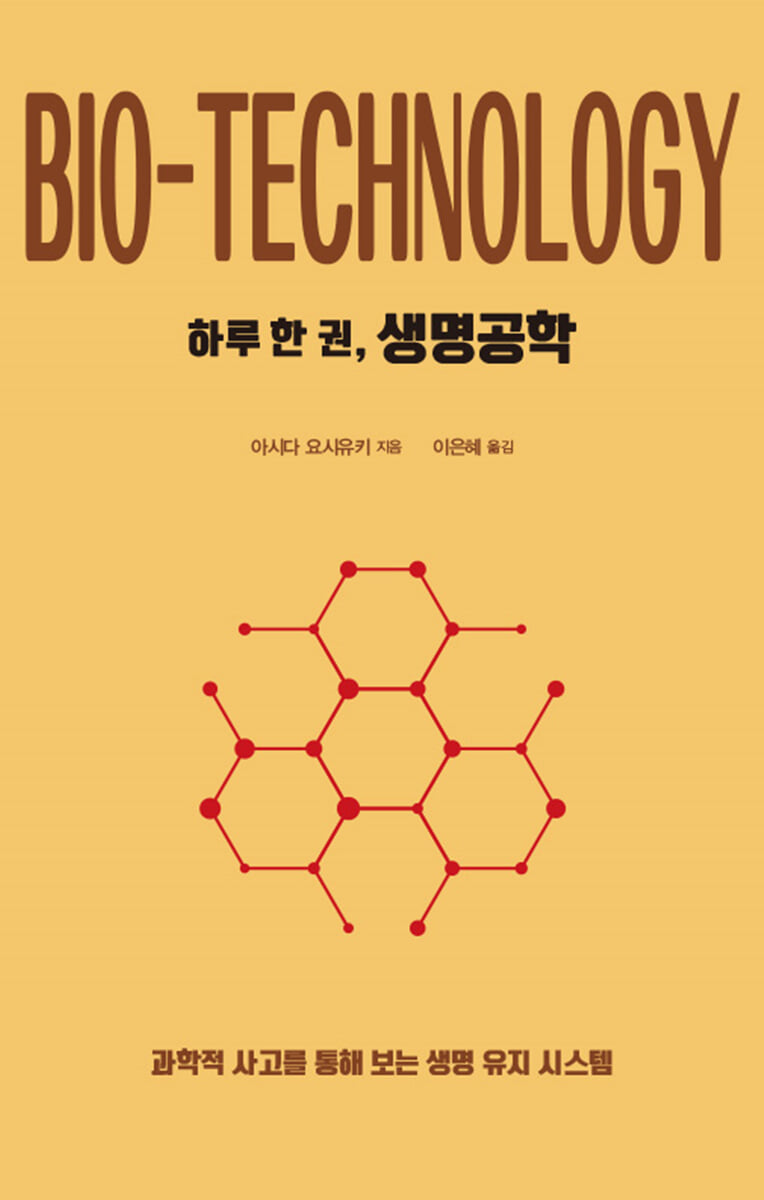
One book a day, biotechnology
 |
Description
Book Introduction
There is no end to learning, and there are so many mysteries in the world.
It's okay if you don't know, but if you learn, you'll enter the world of 'everyday science', which is much more sophisticated!
“How did my hair become curly?”
“Is it true that alcohol cannot be broken down?”
“What is the principle behind DNA used in paternity testing?”
As you explore scientific theories, you will come to know.
Science is very interesting, but it is too profound to approach.
For this reason, we turn our backs on math and science as soon as we graduate from school.
Some say it looks fun but is too difficult, while others ask why they should know something they can't use.
So I prepared.
It looks fun, but I've never really used "science" before. Could it be possible for "science," which seems useful only on a space station, and "everyday life," which is my today and tomorrow, to coexist?
In fact, we live in a world of science without even knowing it.
Let's take a look at 'My Scientific Daily Life' that I didn't even know about through the One Book a Day series.
A new world may unfold.
Additionally, we have brought 'mathematics', the language for understanding science, into the realm of everyday life and organized it so that it can be learned very easily in simple language.
While you can get by without knowing anything, let's explore the vastly more sophisticated realm of "everyday science"! With a little effort, you can easily grasp it anywhere, anytime, and enjoy the immense joy of knowledge.
"One Book a Day, Biotechnology" explains the genome, the basic system of DNA and genes, which was once considered difficult.
Based on a basic understanding of proteins and scientific thinking, it explains the principles of how the systems that make up all living things, including humans, are created.
It even delicately addresses the issue of safety, which has recently become a hot topic due to genetic modification, and logically provides a perspective on what standards consumers should have when understanding radioactive materials and genetic modification.
It also includes a checklist to assess your awareness of genetics and an author's note to help you think about it in terms of real life.
If you've always been interested but haven't been able to easily approach complex concepts, let's read along with a book that explains the basic concepts step by step.
It's okay if you don't know, but if you learn, you'll enter the world of 'everyday science', which is much more sophisticated!
“How did my hair become curly?”
“Is it true that alcohol cannot be broken down?”
“What is the principle behind DNA used in paternity testing?”
As you explore scientific theories, you will come to know.
Science is very interesting, but it is too profound to approach.
For this reason, we turn our backs on math and science as soon as we graduate from school.
Some say it looks fun but is too difficult, while others ask why they should know something they can't use.
So I prepared.
It looks fun, but I've never really used "science" before. Could it be possible for "science," which seems useful only on a space station, and "everyday life," which is my today and tomorrow, to coexist?
In fact, we live in a world of science without even knowing it.
Let's take a look at 'My Scientific Daily Life' that I didn't even know about through the One Book a Day series.
A new world may unfold.
Additionally, we have brought 'mathematics', the language for understanding science, into the realm of everyday life and organized it so that it can be learned very easily in simple language.
While you can get by without knowing anything, let's explore the vastly more sophisticated realm of "everyday science"! With a little effort, you can easily grasp it anywhere, anytime, and enjoy the immense joy of knowledge.
"One Book a Day, Biotechnology" explains the genome, the basic system of DNA and genes, which was once considered difficult.
Based on a basic understanding of proteins and scientific thinking, it explains the principles of how the systems that make up all living things, including humans, are created.
It even delicately addresses the issue of safety, which has recently become a hot topic due to genetic modification, and logically provides a perspective on what standards consumers should have when understanding radioactive materials and genetic modification.
It also includes a checklist to assess your awareness of genetics and an author's note to help you think about it in terms of real life.
If you've always been interested but haven't been able to easily approach complex concepts, let's read along with a book that explains the basic concepts step by step.
- You can preview some of the book's contents.
Preview
index
Entering
Introduction: Explanation of Basic Terms
Awareness Survey on Genetically Modified Foods
Glossary of Basic Terms - DNA, Genes, and Genomes
Chapter 1: Fundamentals of Life Science
1-1 Macro Biology - What is a Biology?
What is life?
Classification of living things - based on cells
What is paper?
Classification of living things - based on individuals
Life on Earth and its evolution
Author's Note: A Mysterious Story of Evolution
Author's Note: Bacteria and Viruses
1-2 Fundamentals of Molecular Biology and Cell Biology
DNA
Location of genes
What is a genome?
Information contained in genes
Author's Note: Genomes and Genes
Cell Types and Mitosis - Cell Division with Two Sets of Genomes
Living cells - cells with one set of genomes
Meiosis - the process of forming germ cells
Fertilization and embryonic development
Method of transmitting genetic information
Author's Note: Why is reproduction necessary?
1-3 Microbiology - The Life Cycle of a Gene
Chemical substances that make up living things
Creation of DNA
The double helix structure of DNA
DNA replication process during cell division
Amino acids - the building blocks of proteins
protein structure
Proteins produced through genetic information
RNA structure and function, genetic code codons
Codons and tRNA
Transcription - synthesis of mRNA
Translation - Protein Synthesis
Destination of the synthesized protein
Author's Note: Does taking collagen and hyaluronic acid really work?
Mutations - the driving force of evolution
Mutations - Diseases related to genetic mutations
Cellular Diversity - Why Different Cells Come From the Same Genome
Somatic cells with different genomes - surprisingly scarred DNA
Specific structure of genes 1-4
cytochrome c gene
Molecular Biology Phylogeny - Evolution Through Nucleotide Sequences
Insulin gene - post-translational modification
sickle cell anemia
Principles of Genetic Disease - Recessive and Dominant Inheritance
Aldehyde dehydrogenase gene - a single nucleotide difference can change the amount of alcohol consumed
Genes that determine blood type
Blood Type Molecular Biology
Author's Note: Blood Type and Personality
Author's Note: Why Base Sequences Change
Chapter 1 Summary
Chapter 2 Biotechnology
2-1 Biotechnology and Bioengineering Basics
Recombinant DNA Experiments Using E. coli - A Revolution That Began in the 1970s
Tools used in bio experiments
Polymerase Chain Reaction - A Revolution That Began in the 1980s
PCR applied in all fields
The Key to PCR: Designing Specific Primers
How to amplify specific DNA fragments using PCR
How to isolate and identify DNA fragments - agarose gel electrophoresis
How to Determine a Base Sequence - Sanger Sequencing
Author's Note: Bioinformatics
Author's Note: Genome Analysis for Just $100
DNA-based identification methods
Author's Note: Cartagena Law - Regulation of the Use of Genetically Modified Organisms
2-2 Plant Biotechnology
Hydroponic cultivation of vegetables
Plant breeding - pre-Genetically modified technology
Traditional vegetables
Author's Note: Is natural safe, artificial dangerous?
Status of genetically modified crops in Japan
Agrobacterium method - the most commonly used gene introduction method
pest-resistant genetically modified plants
pesticide-resistant genetically modified crops
Problems with the manufacturing process of genetically modified foods
Author's Note: Labeling of Genetically Modified Foods
Author's Note: The Potential Containment of Genetically Modified Foods and Hype
The Difference Between Genomes and Genes - The Difference Between Classical and Recombinant Gene Technology
Is genetic engineering blasphemous?
Genomes and Genes vs. Baseball
Dogs and Genes - The Limits of One Gene
Author's Note: Notation for 'Genetically Modified'
2-3 Animal and Human Biotechnology
clone
Fertilized egg cloning
Applications of Cloned Animals - Animal Cloning Technology
Hybrid - Leopon
Chimera - a creature with multiple genomes
Use of embryonic stem cells
The emergence of iPS cells (induced pluripotent stem cells)
Regenerative medicine using iPS cells
Author's Note: Clones in Novels
Author's Note: The Discovery of iPS Cells and Knockout Mice
Cloned Humans and Omnipotence, Pluripotency, and Unipotency
Major reference books
Introduction: Explanation of Basic Terms
Awareness Survey on Genetically Modified Foods
Glossary of Basic Terms - DNA, Genes, and Genomes
Chapter 1: Fundamentals of Life Science
1-1 Macro Biology - What is a Biology?
What is life?
Classification of living things - based on cells
What is paper?
Classification of living things - based on individuals
Life on Earth and its evolution
Author's Note: A Mysterious Story of Evolution
Author's Note: Bacteria and Viruses
1-2 Fundamentals of Molecular Biology and Cell Biology
DNA
Location of genes
What is a genome?
Information contained in genes
Author's Note: Genomes and Genes
Cell Types and Mitosis - Cell Division with Two Sets of Genomes
Living cells - cells with one set of genomes
Meiosis - the process of forming germ cells
Fertilization and embryonic development
Method of transmitting genetic information
Author's Note: Why is reproduction necessary?
1-3 Microbiology - The Life Cycle of a Gene
Chemical substances that make up living things
Creation of DNA
The double helix structure of DNA
DNA replication process during cell division
Amino acids - the building blocks of proteins
protein structure
Proteins produced through genetic information
RNA structure and function, genetic code codons
Codons and tRNA
Transcription - synthesis of mRNA
Translation - Protein Synthesis
Destination of the synthesized protein
Author's Note: Does taking collagen and hyaluronic acid really work?
Mutations - the driving force of evolution
Mutations - Diseases related to genetic mutations
Cellular Diversity - Why Different Cells Come From the Same Genome
Somatic cells with different genomes - surprisingly scarred DNA
Specific structure of genes 1-4
cytochrome c gene
Molecular Biology Phylogeny - Evolution Through Nucleotide Sequences
Insulin gene - post-translational modification
sickle cell anemia
Principles of Genetic Disease - Recessive and Dominant Inheritance
Aldehyde dehydrogenase gene - a single nucleotide difference can change the amount of alcohol consumed
Genes that determine blood type
Blood Type Molecular Biology
Author's Note: Blood Type and Personality
Author's Note: Why Base Sequences Change
Chapter 1 Summary
Chapter 2 Biotechnology
2-1 Biotechnology and Bioengineering Basics
Recombinant DNA Experiments Using E. coli - A Revolution That Began in the 1970s
Tools used in bio experiments
Polymerase Chain Reaction - A Revolution That Began in the 1980s
PCR applied in all fields
The Key to PCR: Designing Specific Primers
How to amplify specific DNA fragments using PCR
How to isolate and identify DNA fragments - agarose gel electrophoresis
How to Determine a Base Sequence - Sanger Sequencing
Author's Note: Bioinformatics
Author's Note: Genome Analysis for Just $100
DNA-based identification methods
Author's Note: Cartagena Law - Regulation of the Use of Genetically Modified Organisms
2-2 Plant Biotechnology
Hydroponic cultivation of vegetables
Plant breeding - pre-Genetically modified technology
Traditional vegetables
Author's Note: Is natural safe, artificial dangerous?
Status of genetically modified crops in Japan
Agrobacterium method - the most commonly used gene introduction method
pest-resistant genetically modified plants
pesticide-resistant genetically modified crops
Problems with the manufacturing process of genetically modified foods
Author's Note: Labeling of Genetically Modified Foods
Author's Note: The Potential Containment of Genetically Modified Foods and Hype
The Difference Between Genomes and Genes - The Difference Between Classical and Recombinant Gene Technology
Is genetic engineering blasphemous?
Genomes and Genes vs. Baseball
Dogs and Genes - The Limits of One Gene
Author's Note: Notation for 'Genetically Modified'
2-3 Animal and Human Biotechnology
clone
Fertilized egg cloning
Applications of Cloned Animals - Animal Cloning Technology
Hybrid - Leopon
Chimera - a creature with multiple genomes
Use of embryonic stem cells
The emergence of iPS cells (induced pluripotent stem cells)
Regenerative medicine using iPS cells
Author's Note: Clones in Novels
Author's Note: The Discovery of iPS Cells and Knockout Mice
Cloned Humans and Omnipotence, Pluripotency, and Unipotency
Major reference books
Into the book
DNA is the name of a chemical compound made up of four 'bases': adenine, guanine, cytosine, and thymine.
Depending on the order and length of these four bases, or the 'base sequence', compounds with various structures are created.
'Genetic information' refers to the base sequence of DNA like this.
Also, protein is the name of a compound made up of amino acids linked together, and is responsible for many biological functions.
Among genetic information, the part that transfers amino acid information to ‘RNA (ribonucleic acid)’ (transcription) and determines the ‘amino acid sequence’ of a protein is a gene.
--- p.14
The bell is not fixed.
Over time, 'mutations' can occur, causing the entire population, or parts of it, to change and create new species.
Whether a new species survives depends on 'natural selection', which is evolution.
Since life emerged on Earth 3.8 billion years ago, various species have evolved.
There are even claims that 99.99 percent of the species that once inhabited the Earth are already extinct, as the number of species that went extinct during evolution is far greater than the number of species that survive to this day.
When we compare the number of extinct species with the number of living species that we previously thought were diverse, we realize how small the number of species actually is.
Among them, there are quite a few species that humans have driven to extinction.
--- p.30
Protein synthesis occurs through the processes of transcription and translation, and there are three types of RNA involved in transcription and translation.
Transcription is the process by which messenger RNA (mRNA) is synthesized from the genetic region of DNA and occurs within the nucleus.
Additionally, the translation process involving ribosomal RNA (rRNA) and transfer RNA (tRNA) takes place in ribosomes in the cytoplasm.
Ribosomes are particles composed of rRNA and numerous ribosomal proteins and do not have a membrane structure.
Translation is the process of reading the codon information of mRNA in the ribosome and combining amino acids carried by tRNA according to that information to synthesize a protein, and it always starts from the initiation codon, AUG.
Therefore, protein synthesis begins with methionine, one of the amino acids, and ends with one of the stop codons, UAA, UAG, or UGA.
So far, no exceptions to this rule have been found, so it is known as a universal rule that applies to everyone from E. coli to humans.
--- p.70
Viral infection can also result in foreign genes being inserted into the host's genome.
Normally, only the genetic information of the parent cell is transferred during cell division, but viruses multiply by exploiting the property of digging into the host genome, so when a virus attacks, the viral genome is inserted into the host genome.
In addition, genes that move around within the genome, called 'transposons', can also be induced by environmental factors.
Additionally, in cells involved in immunity, such as antibody-producing cells, recombination of antibody-producing genes occurs at the genomic level.
Although somatic cells are said to be cloned cells of fertilized eggs, the genomic DNA within them is surprisingly full of scars.
--- p.92
If a person with the AA genotype drinks alcohol in one gulp, he or she may lose his or her life.
Therefore, forcing such a person to drink alcohol is no different from attempted murder.
Of course, in reality it would be negligent homicide, but unfortunately, if the person who drank it dies, it would be murder (negligent homicide).
Be careful, because if you force someone who cannot drink to drink, you can be charged with coercion; if you do not stop someone from forcing someone to drink, you can be charged with aiding and abetting bodily harm; and if you neglect a drunk colleague, you can be charged with abandonment.
As you know, genes are inherited from parents.
It is unlikely that a mutation will occur during growth and suddenly change the a gene into an A gene.
Whether you are good at drinking or not is recorded in your genes from birth.
So, remember that just because someone who can't drink alcohol trains doesn't mean they'll start drinking well, and just because they can't drink doesn't mean they lack willpower.
--- p.108
Regarding genes, we introduced five types of human genes.
I've intentionally presented the boring base and amino acid sequences to show the full picture of the gene, but there's no need to interpret the specific meaning of the sequences.
The reason I showed the entire sequence was to make it clear that even a single, very small mutation can result in a wide range of phenotypic differences when viewed as a whole.
The five base sequences introduced in this book add up to a total of 9,716.
The human genome is said to be made up of approximately 3 billion bases and contains more than 20,000 genes.
The base sequences presented in this book may seem long, but in fact they represent only 1/310,000th of the human genome.
The genome is a vast amount of information that we cannot even imagine.
--- p.118
This time, we'll look at "DNA testing," a method frequently used in criminal investigations, paternity tests, and determining violations of food labeling obligations.
When identifying individuals, we use repetitive sequences that are frequently found in the genome.
Genetic regions account for about 1 percent of the genome, while duplicated and repetitive sequences account for 53 percent of the remaining regions.
Additionally, a closer look at a single repeat sequence within the genome reveals that the number of repeats varies from person to person.
By selecting several repeating regions with individual differences and finding out how many times each is repeated, we can identify the individual.
Of course, PCR is used in this case as well.
--- p.142
Please don't misunderstand, I'm not saying that all phenotypes are simply determined by a single gene.
Most of them involve multiple genes.
Moreover, genes related to abilities or personality, such as 'genes that show musical talent' or 'genes that determine optimistic personality', have not yet been discovered, and it may be difficult to discover them in the future.
Depending on the order and length of these four bases, or the 'base sequence', compounds with various structures are created.
'Genetic information' refers to the base sequence of DNA like this.
Also, protein is the name of a compound made up of amino acids linked together, and is responsible for many biological functions.
Among genetic information, the part that transfers amino acid information to ‘RNA (ribonucleic acid)’ (transcription) and determines the ‘amino acid sequence’ of a protein is a gene.
--- p.14
The bell is not fixed.
Over time, 'mutations' can occur, causing the entire population, or parts of it, to change and create new species.
Whether a new species survives depends on 'natural selection', which is evolution.
Since life emerged on Earth 3.8 billion years ago, various species have evolved.
There are even claims that 99.99 percent of the species that once inhabited the Earth are already extinct, as the number of species that went extinct during evolution is far greater than the number of species that survive to this day.
When we compare the number of extinct species with the number of living species that we previously thought were diverse, we realize how small the number of species actually is.
Among them, there are quite a few species that humans have driven to extinction.
--- p.30
Protein synthesis occurs through the processes of transcription and translation, and there are three types of RNA involved in transcription and translation.
Transcription is the process by which messenger RNA (mRNA) is synthesized from the genetic region of DNA and occurs within the nucleus.
Additionally, the translation process involving ribosomal RNA (rRNA) and transfer RNA (tRNA) takes place in ribosomes in the cytoplasm.
Ribosomes are particles composed of rRNA and numerous ribosomal proteins and do not have a membrane structure.
Translation is the process of reading the codon information of mRNA in the ribosome and combining amino acids carried by tRNA according to that information to synthesize a protein, and it always starts from the initiation codon, AUG.
Therefore, protein synthesis begins with methionine, one of the amino acids, and ends with one of the stop codons, UAA, UAG, or UGA.
So far, no exceptions to this rule have been found, so it is known as a universal rule that applies to everyone from E. coli to humans.
--- p.70
Viral infection can also result in foreign genes being inserted into the host's genome.
Normally, only the genetic information of the parent cell is transferred during cell division, but viruses multiply by exploiting the property of digging into the host genome, so when a virus attacks, the viral genome is inserted into the host genome.
In addition, genes that move around within the genome, called 'transposons', can also be induced by environmental factors.
Additionally, in cells involved in immunity, such as antibody-producing cells, recombination of antibody-producing genes occurs at the genomic level.
Although somatic cells are said to be cloned cells of fertilized eggs, the genomic DNA within them is surprisingly full of scars.
--- p.92
If a person with the AA genotype drinks alcohol in one gulp, he or she may lose his or her life.
Therefore, forcing such a person to drink alcohol is no different from attempted murder.
Of course, in reality it would be negligent homicide, but unfortunately, if the person who drank it dies, it would be murder (negligent homicide).
Be careful, because if you force someone who cannot drink to drink, you can be charged with coercion; if you do not stop someone from forcing someone to drink, you can be charged with aiding and abetting bodily harm; and if you neglect a drunk colleague, you can be charged with abandonment.
As you know, genes are inherited from parents.
It is unlikely that a mutation will occur during growth and suddenly change the a gene into an A gene.
Whether you are good at drinking or not is recorded in your genes from birth.
So, remember that just because someone who can't drink alcohol trains doesn't mean they'll start drinking well, and just because they can't drink doesn't mean they lack willpower.
--- p.108
Regarding genes, we introduced five types of human genes.
I've intentionally presented the boring base and amino acid sequences to show the full picture of the gene, but there's no need to interpret the specific meaning of the sequences.
The reason I showed the entire sequence was to make it clear that even a single, very small mutation can result in a wide range of phenotypic differences when viewed as a whole.
The five base sequences introduced in this book add up to a total of 9,716.
The human genome is said to be made up of approximately 3 billion bases and contains more than 20,000 genes.
The base sequences presented in this book may seem long, but in fact they represent only 1/310,000th of the human genome.
The genome is a vast amount of information that we cannot even imagine.
--- p.118
This time, we'll look at "DNA testing," a method frequently used in criminal investigations, paternity tests, and determining violations of food labeling obligations.
When identifying individuals, we use repetitive sequences that are frequently found in the genome.
Genetic regions account for about 1 percent of the genome, while duplicated and repetitive sequences account for 53 percent of the remaining regions.
Additionally, a closer look at a single repeat sequence within the genome reveals that the number of repeats varies from person to person.
By selecting several repeating regions with individual differences and finding out how many times each is repeated, we can identify the individual.
Of course, PCR is used in this case as well.
--- p.142
Please don't misunderstand, I'm not saying that all phenotypes are simply determined by a single gene.
Most of them involve multiple genes.
Moreover, genes related to abilities or personality, such as 'genes that show musical talent' or 'genes that determine optimistic personality', have not yet been discovered, and it may be difficult to discover them in the future.
--- p.181
Publisher's Review
There is no end to learning, and there are so many mysteries in the world!
It's okay if you don't know, but let's enter the world of 'everyday science', which is much more sophisticated if you learn.
Were the physics, chemistry, and biology I learned really that difficult? Why did I have to learn calculus and geometry, which I hated so much?
Will the day ever come when I can apply it in my daily life? If you've been harboring such a question somewhere in your heart, consider opening up the "One Book a Day" series.
One book of knowledge that will change your tomorrow, the One Book a Day series!
The One Book a Day series is a collection of science books that explore the practical aspects of science that we can utilize in our daily lives.
We have tried to make the content as easy to read and understand as possible, using illustrations, tables, and helpful explanations, so that even people who are not familiar with science can read and understand it.
For example, how to be much more scientific in your efforts, how to get the seeds you bought yesterday to germinate as quickly as possible, and even why sick building syndrome occurs.
Scientific explanations of things you might encounter in everyday life.
This book is not about difficult or incomprehensible content, but rather about solving problems closely related to our lives through science and thinking together about how to view them.
There is no end to learning and there are so many amazing things in the world.
How wonderful would it be if we could analyze certain phenomena in our daily lives through a scientific lens? And do it simply, in a single book.
And having that perspective means we have one more weapon for survival as we go through life.
These weapons will give us the power to deal with any phenomenon wisely.
Discover a variety of topics and categories to suit your tastes!
Books fit easily in one hand, knowledge deep in your mind! Made small enough to fit in one hand for easy reading anytime, anywhere.
As you explore the world of science, written by a team of proven writers on each topic, you may find yourself immersed in a world viewed through numbers and knowledge.
It is composed of only very easy and fun content so that you can read it little by little on the subway, bus, or during breaks.
You can look forward to my analytical view of the world.
The topics are also organized into various categories such as physics, chemistry, biology, earth science, and mathematics, so it is suitable for reading only the books that suit my taste.
How can I become a genius and head to the world of first-class people? What is the chemical substance that causes 'real madness' created by humans?
I also like random questions like this.
Let's scientifically explain not only the world we simply perceive, but also the invisible phenomena of the world.
Because science is practice, not theory!
The basic structure of all living things is the 'cell'
As the controversy over radiation has intensified recently, the impression of the word 'gene' has also become negative.
However, the basic structure of all living things is made up of cells.
That is, it is composed of genes.
This book mainly deals with 'genome' and 'DNA', which are used in a similar sense to 'gene', and deals with how the system that constitutes and maintains life operates.
Meanwhile, we can compare how the compositions of humans and other creatures differ and how similar they are, and think about which ones were adopted and which ones became extinct as the environment changed.
Rather than blindly misunderstanding and rejecting genes, a scientific understanding of the principles that make up living things will be more helpful in adapting to the environment we will face in the future.
It's okay if you don't know, but let's enter the world of 'everyday science', which is much more sophisticated if you learn.
Were the physics, chemistry, and biology I learned really that difficult? Why did I have to learn calculus and geometry, which I hated so much?
Will the day ever come when I can apply it in my daily life? If you've been harboring such a question somewhere in your heart, consider opening up the "One Book a Day" series.
One book of knowledge that will change your tomorrow, the One Book a Day series!
The One Book a Day series is a collection of science books that explore the practical aspects of science that we can utilize in our daily lives.
We have tried to make the content as easy to read and understand as possible, using illustrations, tables, and helpful explanations, so that even people who are not familiar with science can read and understand it.
For example, how to be much more scientific in your efforts, how to get the seeds you bought yesterday to germinate as quickly as possible, and even why sick building syndrome occurs.
Scientific explanations of things you might encounter in everyday life.
This book is not about difficult or incomprehensible content, but rather about solving problems closely related to our lives through science and thinking together about how to view them.
There is no end to learning and there are so many amazing things in the world.
How wonderful would it be if we could analyze certain phenomena in our daily lives through a scientific lens? And do it simply, in a single book.
And having that perspective means we have one more weapon for survival as we go through life.
These weapons will give us the power to deal with any phenomenon wisely.
Discover a variety of topics and categories to suit your tastes!
Books fit easily in one hand, knowledge deep in your mind! Made small enough to fit in one hand for easy reading anytime, anywhere.
As you explore the world of science, written by a team of proven writers on each topic, you may find yourself immersed in a world viewed through numbers and knowledge.
It is composed of only very easy and fun content so that you can read it little by little on the subway, bus, or during breaks.
You can look forward to my analytical view of the world.
The topics are also organized into various categories such as physics, chemistry, biology, earth science, and mathematics, so it is suitable for reading only the books that suit my taste.
How can I become a genius and head to the world of first-class people? What is the chemical substance that causes 'real madness' created by humans?
I also like random questions like this.
Let's scientifically explain not only the world we simply perceive, but also the invisible phenomena of the world.
Because science is practice, not theory!
The basic structure of all living things is the 'cell'
As the controversy over radiation has intensified recently, the impression of the word 'gene' has also become negative.
However, the basic structure of all living things is made up of cells.
That is, it is composed of genes.
This book mainly deals with 'genome' and 'DNA', which are used in a similar sense to 'gene', and deals with how the system that constitutes and maintains life operates.
Meanwhile, we can compare how the compositions of humans and other creatures differ and how similar they are, and think about which ones were adopted and which ones became extinct as the environment changed.
Rather than blindly misunderstanding and rejecting genes, a scientific understanding of the principles that make up living things will be more helpful in adapting to the environment we will face in the future.
GOODS SPECIFICS
- Date of issue: October 31, 2023
- Page count, weight, size: 208 pages | 130*200*13mm
- ISBN13: 9791169837361
You may also like
카테고리
korean


korean

![GQ KOREA Mark (Monthly): December [2025]](http://librairie.coreenne.fr/cdn/shop/files/8ef265dbbfbf186523ed75ba7319009d.jpg?v=1765340328&width=3840)


