

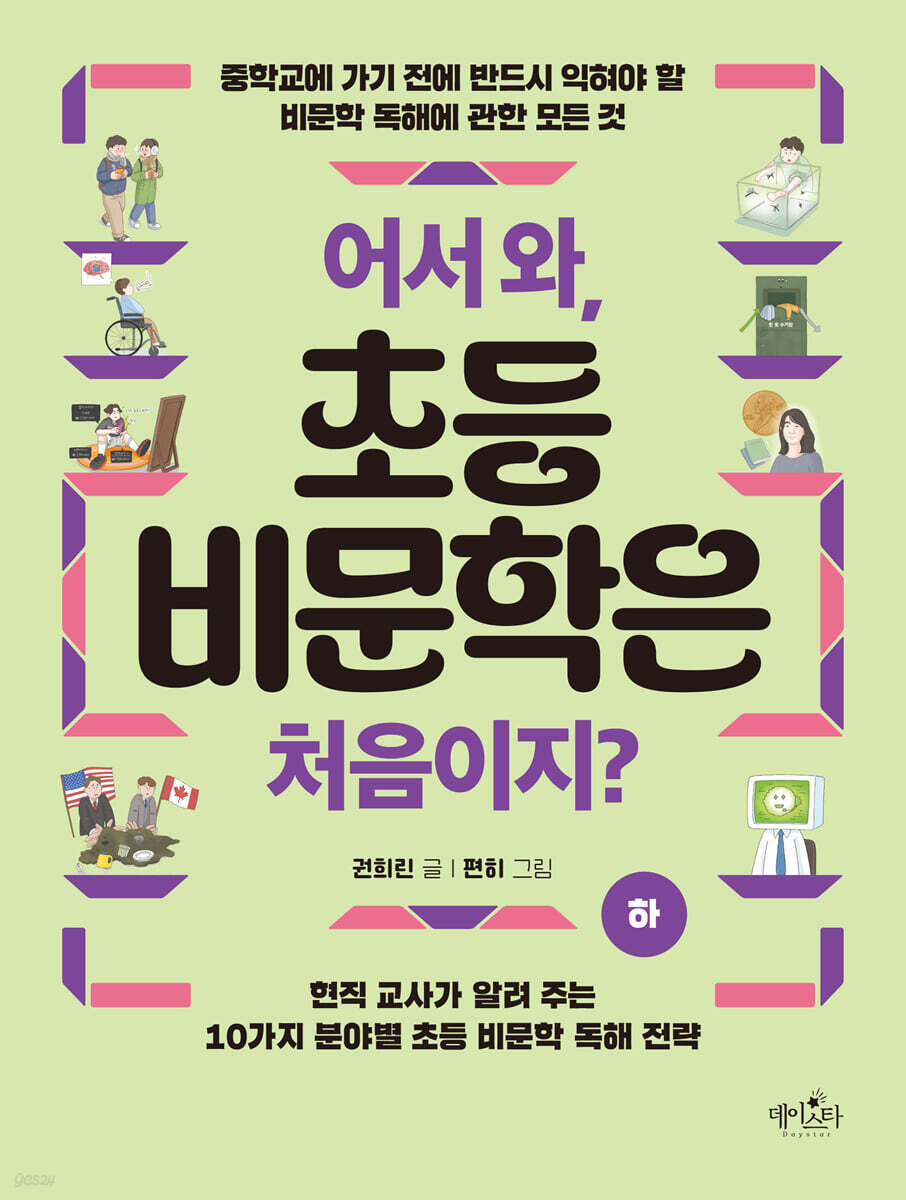
Welcome, is this your first time at elementary non-fiction? (Part 2)
 |
Description
Book Introduction
“The beginning of all subjects is non-literature reading comprehension,
“If you raise it now, you will be able to write any article later!”
A child who reads a text but doesn't know what it's about,
A child who gets a headache when reading long texts,
For children who are more familiar with YouTube videos than text
A Basic Strategy for Completing Non-Fiction Reading
This book is a non-fiction training book written by a current teacher based on his extensive teaching experience to help children develop reading habits that enable them to think and express themselves independently.
This isn't just a reading comprehension book for solving problems; it cultivates critical thinking skills through worldly topics. Covering a variety of real-world topics, including AI textbooks, the four-day workweek, the environment, history, and philosophy, it helps children learn how to "read the world through words."
All texts are written in short, clear sentences suitable for elementary school students, and after reading, readers naturally experience the process of finding the main points, making connections, and organizing their thoughts.
It is a structure designed so that reading power expands into thinking power, and thinking power expands into expressive power.
Through this, children go beyond simply reading text and experience the process of understanding the information in the text, organizing its structure, and expressing their thoughts in their own words.
If you accumulate enough reading experience in elementary school, you will gain the confidence to read and understand longer texts without fear when you come to middle school.
“If you raise it now, you will be able to write any article later!”
A child who reads a text but doesn't know what it's about,
A child who gets a headache when reading long texts,
For children who are more familiar with YouTube videos than text
A Basic Strategy for Completing Non-Fiction Reading
This book is a non-fiction training book written by a current teacher based on his extensive teaching experience to help children develop reading habits that enable them to think and express themselves independently.
This isn't just a reading comprehension book for solving problems; it cultivates critical thinking skills through worldly topics. Covering a variety of real-world topics, including AI textbooks, the four-day workweek, the environment, history, and philosophy, it helps children learn how to "read the world through words."
All texts are written in short, clear sentences suitable for elementary school students, and after reading, readers naturally experience the process of finding the main points, making connections, and organizing their thoughts.
It is a structure designed so that reading power expands into thinking power, and thinking power expands into expressive power.
Through this, children go beyond simply reading text and experience the process of understanding the information in the text, organizing its structure, and expressing their thoughts in their own words.
If you accumulate enough reading experience in elementary school, you will gain the confidence to read and understand longer texts without fear when you come to middle school.
- You can preview some of the book's contents.
Preview
index
prolog
Chapter 1 Environment
1.
The Inconvenient Truth About Used Clothing Collection Boxes
2.
Bananas are on the verge of extinction because of the lack of 'this'
3.
Can you make a hot pack with tangerine peel?
4.
The main culprit behind the climate crisis on our dinner tables is 'food miles.'
5.
Vegetarianism that protects animal rights and the environment
6.
Countries that can't stand it anymore are refusing to import plastic waste.
7.
Countries disappearing one by one due to rising sea levels
8.
Fast fashion threatens the environment and human rights
Chapter 2 Science
1.
Is it possible to restore the dinosaurs from Jurassic Park in real life?
2.
Humans as Test Subjects? A Clash of Science and Ethics
3.
Why are bones more likely to break in space?
4.
Stop mosquitoes with mosquitoes! Genetically engineered mosquitoes that prevent diseases.
5. If AI draws pictures, will the Earth get hotter?
6.
The secret to fruit that doesn't rot even after being stored for a long time is edible coating.
7.
Iron Man's JARVIS Becomes Reality? Smart Glasses
8.
The Secret Behind Lotus Leaves: The Original Waterproofing Effect
Chapter 3 Technology
1.
Deepfakes: A New AI-Powered Crime
2.
A future made more convenient by wearable robots that can be put on and taken off.
3.
Can I become 'friends' with ChatGPT?
4. Jobs that AI will eliminate and jobs that will go hand in hand with AI.
5.
Can you move a wheelchair just by thinking about it?
6.
The Future of Clean Energy: Hydrogen Energy
7.
The Trolley Dilemma: The Most Fatal Flaw in Self-Driving Cars
8.
The Era of Private Space Development and Space Debris
Chapter 4 Culture
1.
Han Kang becomes the first Asian woman to win the Nobel Prize in Literature.
2.
Facial recognition for a single performance? The problem of facial recognition and data leaks.
3. Idols in the AI Era: Otherworld Idols and Playb
4.
Short and exciting short-form videos, but what about focus?
5.
A single dot for 3.5 billion won? Misconceptions about modern art.
6.
The Light and Shadow of Fandom Culture
7.
Is it okay to eat spicy and stimulating food every day?
8.
With the short-form craze, songs are also becoming short-form?
Chapter 5 Economy
1.
The Economic Impact of Fandom: Swiftnomics
2.
From Ali to Temu: The Rapid Growth of Chinese Shopping Platforms
3.
How much does a YouTuber with 1 million subscribers make per month?
4.
What happens when the exchange rate rises?
5.
The Economics of Daejeon, the City of Flour, and Seongsim Church
6.
Flying taxis? Commercialization of UAM is just around the corner!
7.
The sharing economy: a world where sharing becomes more important than ownership.
8.
Higher prices increase demand? The Veblen effect.
Chapter 1 Environment
1.
The Inconvenient Truth About Used Clothing Collection Boxes
2.
Bananas are on the verge of extinction because of the lack of 'this'
3.
Can you make a hot pack with tangerine peel?
4.
The main culprit behind the climate crisis on our dinner tables is 'food miles.'
5.
Vegetarianism that protects animal rights and the environment
6.
Countries that can't stand it anymore are refusing to import plastic waste.
7.
Countries disappearing one by one due to rising sea levels
8.
Fast fashion threatens the environment and human rights
Chapter 2 Science
1.
Is it possible to restore the dinosaurs from Jurassic Park in real life?
2.
Humans as Test Subjects? A Clash of Science and Ethics
3.
Why are bones more likely to break in space?
4.
Stop mosquitoes with mosquitoes! Genetically engineered mosquitoes that prevent diseases.
5. If AI draws pictures, will the Earth get hotter?
6.
The secret to fruit that doesn't rot even after being stored for a long time is edible coating.
7.
Iron Man's JARVIS Becomes Reality? Smart Glasses
8.
The Secret Behind Lotus Leaves: The Original Waterproofing Effect
Chapter 3 Technology
1.
Deepfakes: A New AI-Powered Crime
2.
A future made more convenient by wearable robots that can be put on and taken off.
3.
Can I become 'friends' with ChatGPT?
4. Jobs that AI will eliminate and jobs that will go hand in hand with AI.
5.
Can you move a wheelchair just by thinking about it?
6.
The Future of Clean Energy: Hydrogen Energy
7.
The Trolley Dilemma: The Most Fatal Flaw in Self-Driving Cars
8.
The Era of Private Space Development and Space Debris
Chapter 4 Culture
1.
Han Kang becomes the first Asian woman to win the Nobel Prize in Literature.
2.
Facial recognition for a single performance? The problem of facial recognition and data leaks.
3. Idols in the AI Era: Otherworld Idols and Playb
4.
Short and exciting short-form videos, but what about focus?
5.
A single dot for 3.5 billion won? Misconceptions about modern art.
6.
The Light and Shadow of Fandom Culture
7.
Is it okay to eat spicy and stimulating food every day?
8.
With the short-form craze, songs are also becoming short-form?
Chapter 5 Economy
1.
The Economic Impact of Fandom: Swiftnomics
2.
From Ali to Temu: The Rapid Growth of Chinese Shopping Platforms
3.
How much does a YouTuber with 1 million subscribers make per month?
4.
What happens when the exchange rate rises?
5.
The Economics of Daejeon, the City of Flour, and Seongsim Church
6.
Flying taxis? Commercialization of UAM is just around the corner!
7.
The sharing economy: a world where sharing becomes more important than ownership.
8.
Higher prices increase demand? The Veblen effect.
Detailed image

Into the book
A British foundation said that 47 million tonnes of clothing waste is generated worldwide every year, and 87% of it is simply thrown away.
Used clothes collected in our country are also sent to Southeast Asia and Africa, but some of them are said to be illegally incinerated or landfilled.
--- p.17
Bananas are one of the most popular fruits in the world.
But did you know that these bananas can become diseased and disappear?
--- p.21
Food miles refers to the distance food travels from the place of production to the table.
For example, Australian beef travels about 6,000 miles to get to us, and American oranges travel about 8,000 miles.
Food from such far away may contain preservatives to maintain freshness or use a lot of fuel, which can cause environmental pollution.
--- p.29
Human-induced response testing is an experiment in which pathogens are intentionally introduced into the human body to study disease.
These experiments can help create vaccines or discover the cause of diseases, but they must be done with caution because they can have a significant impact on human life and health.
--- p.57
AI is a wonderful technology that makes our lives more convenient, but we must also make efforts to use it wisely so that it does not harm the Earth.
Wisdom is needed to ensure that technology and nature can coexist.
--- p.67
Deepfake is a technology that uses AI technology to manipulate a person's face or voice to make it look real.
Originally used for special effects in movies and TV shows, these days it is increasingly being used for fake news and crime.
--- p.85
The trolley dilemma refers to a situation where a train with a broken brake system must choose between five people on the designated track and one person on the track that will be changed if the train changes direction. Self-driving cars may also face a similar situation.
This issue is very difficult to decide because it is not simply a matter of numbers, but of human lives and ethical values.
--- p.109
While FacePass is an innovative system, it has several drawbacks, including privacy leaks, technical malfunctions, and a lack of choice.
To protect people's personal information and privacy, it is important to collect personal information only when absolutely necessary and manage it appropriately.
--- p.123
One of the reasons K-pop has become so popular worldwide is because of its fandom culture.
Not only does it promote K-pop globally, it also energizes people and provides emotional stability.
--- p.139
Cherrysumer is a portmanteau of 'cherry picker' and 'consumer', and refers to people who carefully select and consume only products that align with their values and beliefs.
Cherrysumers are not just consumers who buy expensive items, but also consumers who spend carefully to protect the values they believe in.
Used clothes collected in our country are also sent to Southeast Asia and Africa, but some of them are said to be illegally incinerated or landfilled.
--- p.17
Bananas are one of the most popular fruits in the world.
But did you know that these bananas can become diseased and disappear?
--- p.21
Food miles refers to the distance food travels from the place of production to the table.
For example, Australian beef travels about 6,000 miles to get to us, and American oranges travel about 8,000 miles.
Food from such far away may contain preservatives to maintain freshness or use a lot of fuel, which can cause environmental pollution.
--- p.29
Human-induced response testing is an experiment in which pathogens are intentionally introduced into the human body to study disease.
These experiments can help create vaccines or discover the cause of diseases, but they must be done with caution because they can have a significant impact on human life and health.
--- p.57
AI is a wonderful technology that makes our lives more convenient, but we must also make efforts to use it wisely so that it does not harm the Earth.
Wisdom is needed to ensure that technology and nature can coexist.
--- p.67
Deepfake is a technology that uses AI technology to manipulate a person's face or voice to make it look real.
Originally used for special effects in movies and TV shows, these days it is increasingly being used for fake news and crime.
--- p.85
The trolley dilemma refers to a situation where a train with a broken brake system must choose between five people on the designated track and one person on the track that will be changed if the train changes direction. Self-driving cars may also face a similar situation.
This issue is very difficult to decide because it is not simply a matter of numbers, but of human lives and ethical values.
--- p.109
While FacePass is an innovative system, it has several drawbacks, including privacy leaks, technical malfunctions, and a lack of choice.
To protect people's personal information and privacy, it is important to collect personal information only when absolutely necessary and manage it appropriately.
--- p.123
One of the reasons K-pop has become so popular worldwide is because of its fandom culture.
Not only does it promote K-pop globally, it also energizes people and provides emotional stability.
--- p.139
Cherrysumer is a portmanteau of 'cherry picker' and 'consumer', and refers to people who carefully select and consume only products that align with their values and beliefs.
Cherrysumers are not just consumers who buy expensive items, but also consumers who spend carefully to protect the values they believe in.
--- p.183
Publisher's Review
“Welcome, is this your first time in elementary non-fiction?”
For children who are afraid and find reading difficult
A non-fiction reading comprehension training book that lays the foundation for elementary school thinking skills.
Looking at elementary school students these days, there are many who cannot properly understand or organize the content of books or textbooks even when reading them.
This is because there is a lack of practice in finding key sentences and points.
Children who are accustomed to reading books that only contain pictures or short texts lose concentration and have difficulty reading when they see slightly longer texts.
For these elementary school students, 『Welcome, Is This Your First Time with Elementary Non-Fiction?』 was published.
This series, consisting of two volumes, is designed to help students build the foundation for reading non-fiction, which is essential before entering middle school, starting in elementary school.
Non-literary reading comprehension is a core skill that forms the basis for learning not only Korean language but also all subjects, including social studies, science, history, and art.
Written by a practicing teacher, this book covers ten fields and covers a wide range of interesting topics, from current issues to philosophy, the environment, and historical stories, ensuring you'll never be bored.
Children who read this book will not only broaden their understanding of the world through writing on a variety of topics that relate to their own lives, but will also naturally practice grasping the central point of the text and summarizing it through a structure that helps them read and think independently.
It doesn't end with reading,
Step-by-step learning at elementary level that allows you to think, express, and expand.
Completing the Foundations of Non-Fiction Reading
"Welcome, First Time to Elementary Non-Fiction?" is more than just a reading practice book; it's a multi-faceted reading comprehension textbook that expands your thinking and expressive skills.
As the name 'Training Book' suggests, it is structured well.
For each passage, specific reading strategies are presented, including key paragraph structure, finding the central sentence, and summarizing practice.
In the 'Analyze Smartly' stage, you will understand the logical development, in 'Think Freely', you will connect the topic of the text to your own experiences, and in 'Read Extendedly', you will explore related people and events to expand your background knowledge.
This series of courses is a systematic thinking training step that can be practiced at the elementary level, and has a structure that both teachers and parents can trust.
The goal of this book is not simply to improve reading comprehension in the Korean language.
It is about building the foundation of literacy and thinking skills, which are the foundation of all learning, by being able to select the core without losing focus even in complex texts, and to organize thoughts and construct meaning on one's own.
The ability to read, organize thoughts, and express them confidently is essential not only for future learning but also for communicating with others and understanding the world.
Children who have experienced proper training in elementary school can grasp the topic, summarize the main points, and develop their own thoughts when faced with any long text after middle school.
In that sense, this book, which is infused with the experiences of current teachers, will serve as the first step toward such growth.
For children who are afraid and find reading difficult
A non-fiction reading comprehension training book that lays the foundation for elementary school thinking skills.
Looking at elementary school students these days, there are many who cannot properly understand or organize the content of books or textbooks even when reading them.
This is because there is a lack of practice in finding key sentences and points.
Children who are accustomed to reading books that only contain pictures or short texts lose concentration and have difficulty reading when they see slightly longer texts.
For these elementary school students, 『Welcome, Is This Your First Time with Elementary Non-Fiction?』 was published.
This series, consisting of two volumes, is designed to help students build the foundation for reading non-fiction, which is essential before entering middle school, starting in elementary school.
Non-literary reading comprehension is a core skill that forms the basis for learning not only Korean language but also all subjects, including social studies, science, history, and art.
Written by a practicing teacher, this book covers ten fields and covers a wide range of interesting topics, from current issues to philosophy, the environment, and historical stories, ensuring you'll never be bored.
Children who read this book will not only broaden their understanding of the world through writing on a variety of topics that relate to their own lives, but will also naturally practice grasping the central point of the text and summarizing it through a structure that helps them read and think independently.
It doesn't end with reading,
Step-by-step learning at elementary level that allows you to think, express, and expand.
Completing the Foundations of Non-Fiction Reading
"Welcome, First Time to Elementary Non-Fiction?" is more than just a reading practice book; it's a multi-faceted reading comprehension textbook that expands your thinking and expressive skills.
As the name 'Training Book' suggests, it is structured well.
For each passage, specific reading strategies are presented, including key paragraph structure, finding the central sentence, and summarizing practice.
In the 'Analyze Smartly' stage, you will understand the logical development, in 'Think Freely', you will connect the topic of the text to your own experiences, and in 'Read Extendedly', you will explore related people and events to expand your background knowledge.
This series of courses is a systematic thinking training step that can be practiced at the elementary level, and has a structure that both teachers and parents can trust.
The goal of this book is not simply to improve reading comprehension in the Korean language.
It is about building the foundation of literacy and thinking skills, which are the foundation of all learning, by being able to select the core without losing focus even in complex texts, and to organize thoughts and construct meaning on one's own.
The ability to read, organize thoughts, and express them confidently is essential not only for future learning but also for communicating with others and understanding the world.
Children who have experienced proper training in elementary school can grasp the topic, summarize the main points, and develop their own thoughts when faced with any long text after middle school.
In that sense, this book, which is infused with the experiences of current teachers, will serve as the first step toward such growth.
GOODS SPECIFICS
- Date of issue: November 20, 2025
- Page count, weight, size: 184 pages | 402g | 170*225*12mm
- ISBN13: 9791168273658
- ISBN10: 116827365X
- KC Certification: Certification Type: Conformity Confirmation
You may also like
카테고리
korean


korean

![ELLE 엘르 스페셜 에디션 A형 : 12월 [2025]](http://librairie.coreenne.fr/cdn/shop/files/b8e27a3de6c9538896439686c6b0e8fb.jpg?v=1766436872&width=3840)


