

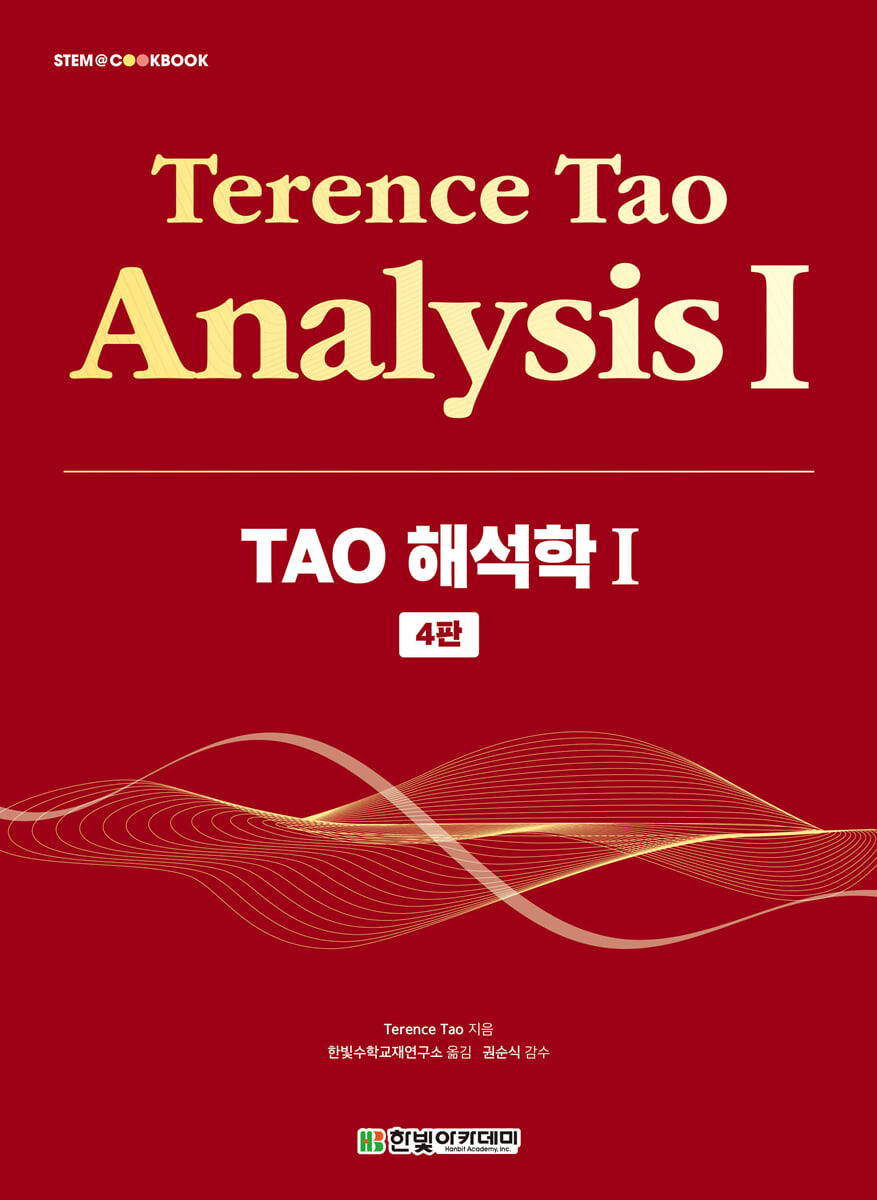
TAO Hermeneutics 1
 |
Description
Book Introduction
A study method for analysis suggested by Terence Tao, the greatest living genius mathematician.
Analysis is the first mathematics major that undergraduates encounter and is also the foundational discipline for other mathematics majors.
This book is designed to be used in a one-semester course in hermeneutics.
This book thoroughly prepares you to confidently handle mathematical proofs by returning to the natural number system and building up concepts step by step.
[TAO Analysis I (4th Edition)] covers everything from the foundations of mathematics to Riemann integrals, and is closely linked to [TAO Analysis II (4th Edition)], which covers metric spaces, uniform convergence, power series, multivariable functions, and Lebesgue integrals.
Analysis is the first mathematics major that undergraduates encounter and is also the foundational discipline for other mathematics majors.
This book is designed to be used in a one-semester course in hermeneutics.
This book thoroughly prepares you to confidently handle mathematical proofs by returning to the natural number system and building up concepts step by step.
[TAO Analysis I (4th Edition)] covers everything from the foundations of mathematics to Riemann integrals, and is closely linked to [TAO Analysis II (4th Edition)], which covers metric spaces, uniform convergence, power series, multivariable functions, and Lebesgue integrals.
- You can preview some of the book's contents.
Preview
index
Chapter 1: Introduction to Hermeneutics
1.1 What is hermeneutics?
1.2 Why study hermeneutics?
Chapter 2: Back to Basics: Natural Numbers
2.1 Peano axioms
2.2 Addition
2.3 Multiplication
Chapter 3 Set Theory
3.1 Basics of Set Theory
3.2 Russell's Paradox
3.3 Function
3.4 Up and down
3.5 Cartesian product
3.6 Set size
Chapter 4 Integers and Rational Numbers
4.1 Integer
4.2 Rational numbers
4.3 Absolute value and powers
4.4 Intervals between rational numbers
Chapter 5 Connectivity
5.1 Cauchy sequence
5.2 Equivalents of the Cauchy sequence
5.3 Composition of errors
5.4 Order of errors
5.5 Least upper bound property
5.6 Real Numbers Exponentiated I
Chapter 6 Limits of Sequences
6.1 Convergence and Limit Rules
6.2 Extended real number system
6.3 Upper and lower bounds of a sequence
6.4 Upper limit, lower limit, and accumulation point
6.5 Various extreme examples
6.6 Subsequences
6.7 Real Numbers Exponentiated Ⅱ
Chapter 7 Series
7.1 Finite series
7.2 Infinite series
7.3 Sum of non-negative numbers
7.4 Rearrangement series
7.5 Root Judgment and Non-Judgment Methods
Chapter 8 Infinite Sets
8.1 Additivity
8.2 Sum of infinite sets
8.3 Uncountable sets
8.4 Axiom of Choice
8.5 Ordered sets
Chapter 9 Continuous Functions in R
9.1 Subsets of the real line
9.2 Operations on real-valued functions
9.3 Limits of functions
9.4 Continuous functions
9.5 Left and right limits
9.6 Maximum Principle
9.7 Median Theorem
9.8 Monotonic functions
9.9 Equal Continuous
9.10 Limits at Infinity
Chapter 10 Differentiation of Functions
10.1 Basic Definitions
10.2 Maxima, Minima, and Derivatives
10.3 Monotonic functions and derivatives
10.4 Inverse functions and derivatives
10.5 L'Hopital's Rule
Chapter 11 Riemann Integral
11.1 Split
11.2 Functions that are constant for each piece
11.3 Riemann upper and lower integrals
11.4 Basic properties of the Riemann integral
11.5 Riemann integrability of continuous functions
11.6 Riemann integrability of monotonic functions
11.7 Non-Riemann integrable functions
11.8 Riemann-Stieltszes integral
11.9 Fundamental Theorem of Differential and Integral Calculus
11.10 Applications of the Fundamental Theorem of Differential and Integral Calculus
Appendix A: Foundations of Mathematical Logic
A.1 Mathematical propositions
A.2 Implications
A.3 Proof Structure
A.4 Variables and Quantifiers
A.5 Nested quantifiers
A.6 Examples of proofs and quantifiers
Equation A.7
Appendix B Decimal System
B.1 Decimal representation of natural numbers
B.2 Decimal numbers as real numbers
1.1 What is hermeneutics?
1.2 Why study hermeneutics?
Chapter 2: Back to Basics: Natural Numbers
2.1 Peano axioms
2.2 Addition
2.3 Multiplication
Chapter 3 Set Theory
3.1 Basics of Set Theory
3.2 Russell's Paradox
3.3 Function
3.4 Up and down
3.5 Cartesian product
3.6 Set size
Chapter 4 Integers and Rational Numbers
4.1 Integer
4.2 Rational numbers
4.3 Absolute value and powers
4.4 Intervals between rational numbers
Chapter 5 Connectivity
5.1 Cauchy sequence
5.2 Equivalents of the Cauchy sequence
5.3 Composition of errors
5.4 Order of errors
5.5 Least upper bound property
5.6 Real Numbers Exponentiated I
Chapter 6 Limits of Sequences
6.1 Convergence and Limit Rules
6.2 Extended real number system
6.3 Upper and lower bounds of a sequence
6.4 Upper limit, lower limit, and accumulation point
6.5 Various extreme examples
6.6 Subsequences
6.7 Real Numbers Exponentiated Ⅱ
Chapter 7 Series
7.1 Finite series
7.2 Infinite series
7.3 Sum of non-negative numbers
7.4 Rearrangement series
7.5 Root Judgment and Non-Judgment Methods
Chapter 8 Infinite Sets
8.1 Additivity
8.2 Sum of infinite sets
8.3 Uncountable sets
8.4 Axiom of Choice
8.5 Ordered sets
Chapter 9 Continuous Functions in R
9.1 Subsets of the real line
9.2 Operations on real-valued functions
9.3 Limits of functions
9.4 Continuous functions
9.5 Left and right limits
9.6 Maximum Principle
9.7 Median Theorem
9.8 Monotonic functions
9.9 Equal Continuous
9.10 Limits at Infinity
Chapter 10 Differentiation of Functions
10.1 Basic Definitions
10.2 Maxima, Minima, and Derivatives
10.3 Monotonic functions and derivatives
10.4 Inverse functions and derivatives
10.5 L'Hopital's Rule
Chapter 11 Riemann Integral
11.1 Split
11.2 Functions that are constant for each piece
11.3 Riemann upper and lower integrals
11.4 Basic properties of the Riemann integral
11.5 Riemann integrability of continuous functions
11.6 Riemann integrability of monotonic functions
11.7 Non-Riemann integrable functions
11.8 Riemann-Stieltszes integral
11.9 Fundamental Theorem of Differential and Integral Calculus
11.10 Applications of the Fundamental Theorem of Differential and Integral Calculus
Appendix A: Foundations of Mathematical Logic
A.1 Mathematical propositions
A.2 Implications
A.3 Proof Structure
A.4 Variables and Quantifiers
A.5 Nested quantifiers
A.6 Examples of proofs and quantifiers
Equation A.7
Appendix B Decimal System
B.1 Decimal representation of natural numbers
B.2 Decimal numbers as real numbers
Detailed image

Publisher's Review
A different approach to hermeneutics than traditional textbooks! An introductory book on hermeneutics that provides a rigorous understanding of mathematical concepts.
There are many books on the market on the subject of hermeneutics.
Typically, the course begins with a definition of limit using the epsilon-delta (ε-δ) argument and then revisits differential and integral calculus. However, despite being the first major subject taught in mathematics and mathematics education departments, not many students understand the analysis textbook. Terence Tao, who taught analysis at UCLA, raised questions about this point.
In typical lectures, it is assumed that students already 'know' the basic concepts, but I noticed that in reality, those students do not clearly understand the concepts.
The book that emerged from these considerations is [TAO Hermeneutics I (4th Edition)].
The author explains in his own easy-to-understand and friendly style how to derive rigorous logic from familiar concepts.
If you study with [TAO Analysis II (4th Edition)], you will be able to clearly understand various concepts, starting from the basics of mathematics to the general topics of analysis.
There are many books on the market on the subject of hermeneutics.
Typically, the course begins with a definition of limit using the epsilon-delta (ε-δ) argument and then revisits differential and integral calculus. However, despite being the first major subject taught in mathematics and mathematics education departments, not many students understand the analysis textbook. Terence Tao, who taught analysis at UCLA, raised questions about this point.
In typical lectures, it is assumed that students already 'know' the basic concepts, but I noticed that in reality, those students do not clearly understand the concepts.
The book that emerged from these considerations is [TAO Hermeneutics I (4th Edition)].
The author explains in his own easy-to-understand and friendly style how to derive rigorous logic from familiar concepts.
If you study with [TAO Analysis II (4th Edition)], you will be able to clearly understand various concepts, starting from the basics of mathematics to the general topics of analysis.
GOODS SPECIFICS
- Date of issue: July 9, 2023
- Page count, weight, size: 420 pages | 188*257*30mm
- ISBN13: 9791156646662
- ISBN10: 1156646669
You may also like
카테고리
korean


korean

![GQ KOREA Mark (Monthly): December [2025]](http://librairie.coreenne.fr/cdn/shop/files/8ef265dbbfbf186523ed75ba7319009d.jpg?v=1765340328&width=3840)


