

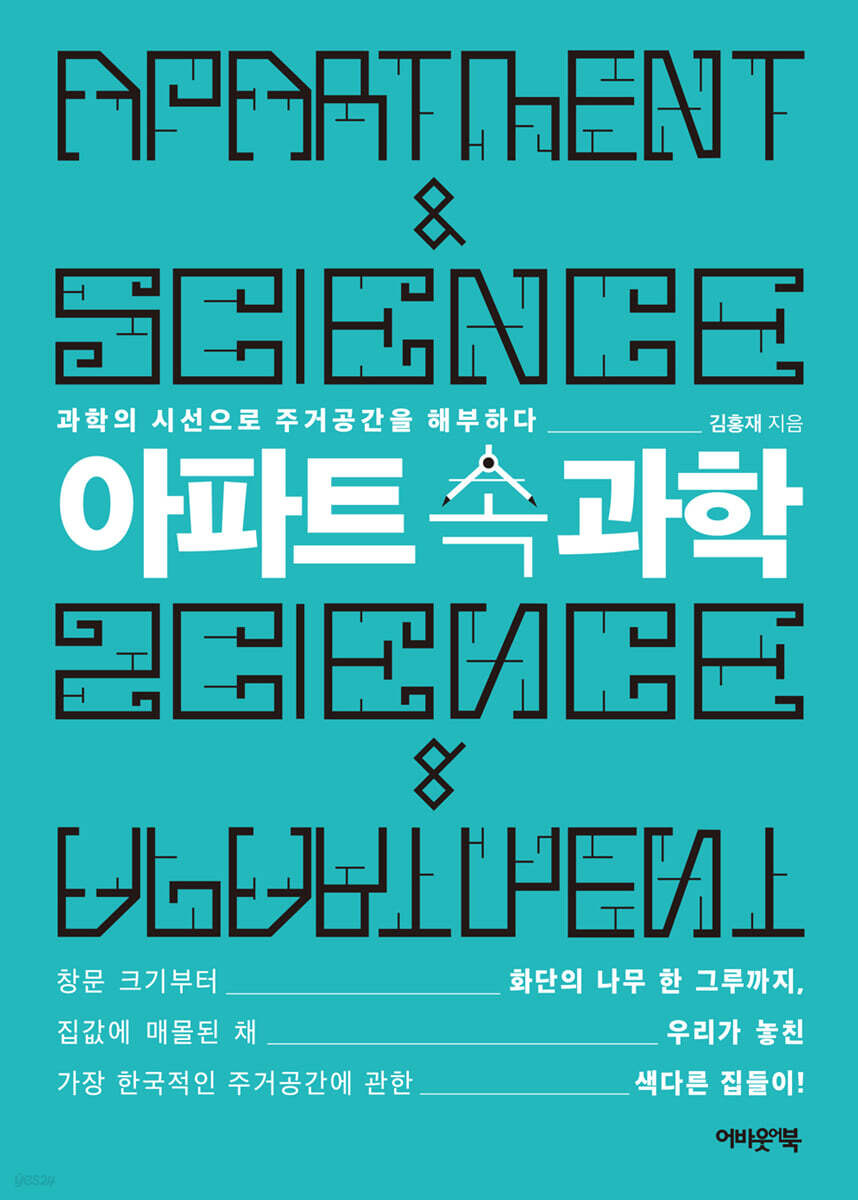
Science in the Apartment
 |
Description
Book Introduction
From the size of the window to the size of a tree in the flower bed,
What we missed while being obsessed with house prices
A scientific collection of the most Korean residential spaces
More than half of the people in our country live in apartments.
Also, two-thirds of all housing units are apartments.
Apartments are the living spaces that truly represent Korea.
An apartment where more than half of the population lives, and one that one would want to own even if it meant gathering one's soul.
How much do we know about such apartments?
Even people who can talk for hours about home prices can't give a proper answer when asked about the scientific foundations on which apartments are built.
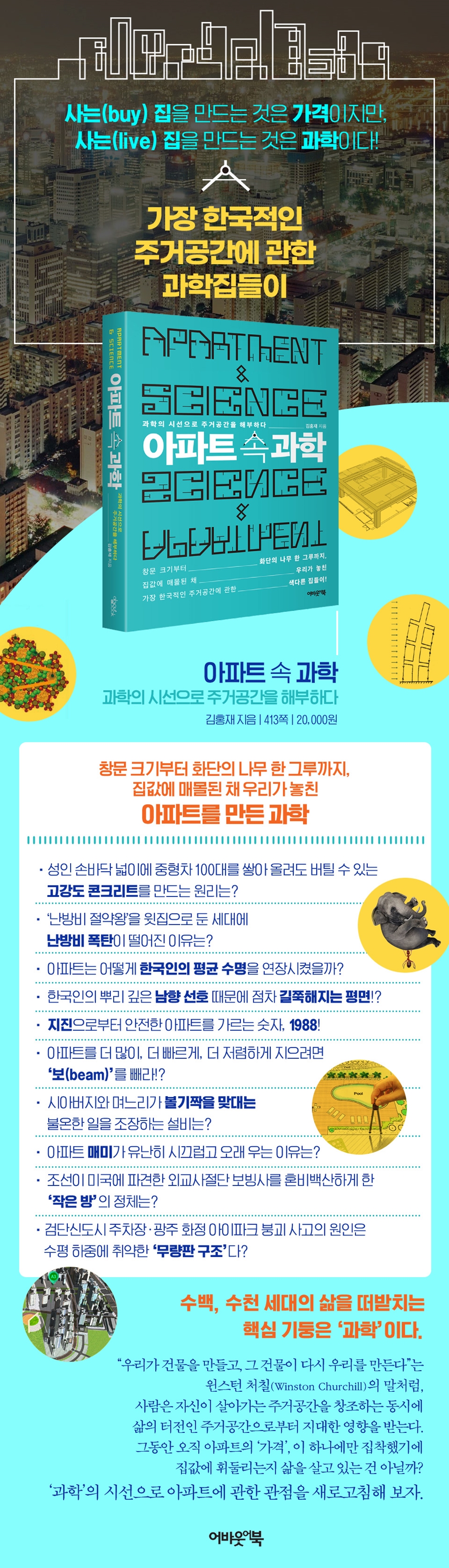
Why is the lifespan of apartments in our country so much shorter than in other countries? Why can't even ultra-high-priced apartments worth over 6 billion won be free from noise between floors? Why did sick house syndrome suddenly emerge in our country in the early 2000s? What effect do these soaring apartments have on our bodies and minds? What caused the Gwangju apartment collapse that took the lives of six workers? The core pillar that supports the lives of hundreds and thousands of generations is 'science.'
Nanoscience is hidden in the concrete that forms the bones and flesh of the apartment, computational fluid dynamics is hidden in the wind that flows between the buildings, and materials engineering is hidden in the walls and floors that increase thermal efficiency and reduce noise between floors.
Today, countless academic achievements are contained in apartments.
We invite you to a unique housewarming party where we explore every nook and cranny of the apartment through a scientific lens.
What we missed while being obsessed with house prices
A scientific collection of the most Korean residential spaces
More than half of the people in our country live in apartments.
Also, two-thirds of all housing units are apartments.
Apartments are the living spaces that truly represent Korea.
An apartment where more than half of the population lives, and one that one would want to own even if it meant gathering one's soul.
How much do we know about such apartments?
Even people who can talk for hours about home prices can't give a proper answer when asked about the scientific foundations on which apartments are built.
Why is the lifespan of apartments in our country so much shorter than in other countries? Why can't even ultra-high-priced apartments worth over 6 billion won be free from noise between floors? Why did sick house syndrome suddenly emerge in our country in the early 2000s? What effect do these soaring apartments have on our bodies and minds? What caused the Gwangju apartment collapse that took the lives of six workers? The core pillar that supports the lives of hundreds and thousands of generations is 'science.'
Nanoscience is hidden in the concrete that forms the bones and flesh of the apartment, computational fluid dynamics is hidden in the wind that flows between the buildings, and materials engineering is hidden in the walls and floors that increase thermal efficiency and reduce noise between floors.
Today, countless academic achievements are contained in apartments.
We invite you to a unique housewarming party where we explore every nook and cranny of the apartment through a scientific lens.
- You can preview some of the book's contents.
Preview
index
Preface | You're Invited to a Science Housewarming
Chapter 1.
Home, Sweet Home! Generation
1F.
Five areas that refer to one apartment
[ On the Balcony ] Calculating Apartment Size Without a Unit Converter
2F.
A study of the space needed to live a human life in 59㎡ and 84㎡.
[ On the Balcony ] A Gosiwon, a place where others become hell
3F.
A plane that evolves by projecting 'N lives'
[ On the Balcony ] "Grow the kitchen! Shrink the bedroom!" Transformer Apartment
4F.
The impact of Korea's deep-rooted preference for south-facing apartments
[ On the Balcony ] The Benefits of a 20-Minute Sun Shower a Day
5F.
Our home is attacking our bodies!
[ On the Balcony ] Baking the air in your apartment to get rid of sick house syndrome
6F.
Creative science that breathes life into space
[ On the Balcony ] Smart windows that automatically adjust from sunlight to rainwater
7F.
A kitchen transformation achieved through a reversal of routine
[ On the Balcony ] A space where a disturbing incident occurs where a father-in-law and daughter-in-law butt heads.
8F.
Storage for everything you need in life, from memories to odds and ends.
[ On the Balcony ] Is there a hidden space in my house that I don't know about?
9F.
Inter-floor noise that turns neighbors into enemies
[ On the Balcony ] Why are cicadas in apartments so noisy?
10F.
Why heating costs vary so much even in the same apartment
[ On the Balcony ] There are apartments with low management fees.
Chapter 2.
Buildings, the vessels that contain our lives
11F.
The bones and flesh of the apartment, concrete
[ On the Balcony ] How much concrete is needed to build an apartment?
12F.
Building structure affects everything from safety to inter-floor noise.
[ On the Balcony ] Defense of the Flat-Slab Structure Suspected as the Cause of the Collapse
13F.
What happens beyond the fence for a thousand days?
[ On the Balcony ] The Avengers of Construction Sites: Tower Cranes
14F.
The science of ups and downs that led to the vertical revolution of cities
[ On the Balcony ] How to Survive a Falling Elevator: Lie Down, No Matter What
15F.
Energy diet in apartments: not an option, but a necessity.
[ On the Balcony ] An era where you earn money as much as you save energy.
16F.
The emergence of apartments with a variety of colors, from uniform to unique.
[ On the Balcony ] Color design with 'consideration'
17F.
How Apartments Extended Koreans' Life Expectancy
[ On the Balcony ] A piggy bank in an era where water must be spent like money.
18F.
The science of apartments that protect our homes and lives from the evils of fire.
[ On the Balcony ] Fire Prevention Tips to Protect Everyone's Life
19F.
Higher and Higher, the Golden Age of High-Rise Buildings
[ On the Balcony ] A man-made place where you can stand at the top, the penthouse.
20F.
When and how do apartments age?
[ On the Balcony ] An apartment that dreams of living to 100 years old
Chapter 3.
A complex that aims for loose solidarity
21F.
High-density residential development: a cure or a curse?
[ On the Balcony ] Apartments that drove the development of public transportation
22F.
Research on crime prevention spaces
[ On the Balcony ] Tips for Dealing with Apartment Crime
23F.
Concrete jungles are a thing of the past, and apartments dream of becoming the "lungs of the city."
[ On the Balcony ] Tree Care Tips for an Apartment Where Nature Welcomes You All Year Long
24F.
A world of community, where residents become neighbors, and complexes become neighborhoods.
[ On the Balcony ] Tips for Creating a Highly Satisfying Community Facility
25F.
Why the wind should blow through your apartment complex
[ On the Balcony ] Building wind, a new type of disaster caused by high-rise buildings
26F.
How do apartments control our bodies and minds?
[ On the Balcony ] Etiquette for Living with Other Species
27F.
Underground parking lot, from A to Z
[ On the Balcony ] The long journey to find a parking spot is a thing of the past. Smarter parking lot systems are becoming more common.
28F.
Garbage disposal, more convenient and cleaner
[ On the Balcony ] A ghost story about trash floating around a new apartment building
29F.
Remodeling an apartment that turns back time
[ On the Balcony ] Reconstruction or Remodeling: Which is Better?
30F.
My Happy Smart Home
[ On the Balcony ] Light and Shadow in the Smart Era
References
Chapter 1.
Home, Sweet Home! Generation
1F.
Five areas that refer to one apartment
[ On the Balcony ] Calculating Apartment Size Without a Unit Converter
2F.
A study of the space needed to live a human life in 59㎡ and 84㎡.
[ On the Balcony ] A Gosiwon, a place where others become hell
3F.
A plane that evolves by projecting 'N lives'
[ On the Balcony ] "Grow the kitchen! Shrink the bedroom!" Transformer Apartment
4F.
The impact of Korea's deep-rooted preference for south-facing apartments
[ On the Balcony ] The Benefits of a 20-Minute Sun Shower a Day
5F.
Our home is attacking our bodies!
[ On the Balcony ] Baking the air in your apartment to get rid of sick house syndrome
6F.
Creative science that breathes life into space
[ On the Balcony ] Smart windows that automatically adjust from sunlight to rainwater
7F.
A kitchen transformation achieved through a reversal of routine
[ On the Balcony ] A space where a disturbing incident occurs where a father-in-law and daughter-in-law butt heads.
8F.
Storage for everything you need in life, from memories to odds and ends.
[ On the Balcony ] Is there a hidden space in my house that I don't know about?
9F.
Inter-floor noise that turns neighbors into enemies
[ On the Balcony ] Why are cicadas in apartments so noisy?
10F.
Why heating costs vary so much even in the same apartment
[ On the Balcony ] There are apartments with low management fees.
Chapter 2.
Buildings, the vessels that contain our lives
11F.
The bones and flesh of the apartment, concrete
[ On the Balcony ] How much concrete is needed to build an apartment?
12F.
Building structure affects everything from safety to inter-floor noise.
[ On the Balcony ] Defense of the Flat-Slab Structure Suspected as the Cause of the Collapse
13F.
What happens beyond the fence for a thousand days?
[ On the Balcony ] The Avengers of Construction Sites: Tower Cranes
14F.
The science of ups and downs that led to the vertical revolution of cities
[ On the Balcony ] How to Survive a Falling Elevator: Lie Down, No Matter What
15F.
Energy diet in apartments: not an option, but a necessity.
[ On the Balcony ] An era where you earn money as much as you save energy.
16F.
The emergence of apartments with a variety of colors, from uniform to unique.
[ On the Balcony ] Color design with 'consideration'
17F.
How Apartments Extended Koreans' Life Expectancy
[ On the Balcony ] A piggy bank in an era where water must be spent like money.
18F.
The science of apartments that protect our homes and lives from the evils of fire.
[ On the Balcony ] Fire Prevention Tips to Protect Everyone's Life
19F.
Higher and Higher, the Golden Age of High-Rise Buildings
[ On the Balcony ] A man-made place where you can stand at the top, the penthouse.
20F.
When and how do apartments age?
[ On the Balcony ] An apartment that dreams of living to 100 years old
Chapter 3.
A complex that aims for loose solidarity
21F.
High-density residential development: a cure or a curse?
[ On the Balcony ] Apartments that drove the development of public transportation
22F.
Research on crime prevention spaces
[ On the Balcony ] Tips for Dealing with Apartment Crime
23F.
Concrete jungles are a thing of the past, and apartments dream of becoming the "lungs of the city."
[ On the Balcony ] Tree Care Tips for an Apartment Where Nature Welcomes You All Year Long
24F.
A world of community, where residents become neighbors, and complexes become neighborhoods.
[ On the Balcony ] Tips for Creating a Highly Satisfying Community Facility
25F.
Why the wind should blow through your apartment complex
[ On the Balcony ] Building wind, a new type of disaster caused by high-rise buildings
26F.
How do apartments control our bodies and minds?
[ On the Balcony ] Etiquette for Living with Other Species
27F.
Underground parking lot, from A to Z
[ On the Balcony ] The long journey to find a parking spot is a thing of the past. Smarter parking lot systems are becoming more common.
28F.
Garbage disposal, more convenient and cleaner
[ On the Balcony ] A ghost story about trash floating around a new apartment building
29F.
Remodeling an apartment that turns back time
[ On the Balcony ] Reconstruction or Remodeling: Which is Better?
30F.
My Happy Smart Home
[ On the Balcony ] Light and Shadow in the Smart Era
References
Detailed image
Into the book
“The key to super concrete is to reduce the ‘porosity.’
Porosity refers to the percentage of empty space in the entire hardened concrete.
The lower the void ratio, the more weight the concrete can support.
In other words, the compressive strength increases.
As the porosity decreases, the concrete is less affected by external substances and its lifespan also increases.
Super concrete uses fillers smaller than 1 micrometer and special admixtures in nanometer sizes to reduce voids.
As a result, the void ratio of super concrete is less than 2%, which is more than five times less than that of regular concrete.”
---From "The Bones and Flesh of the Apartment, Concrete (p. 155)"
“As the wall-type structure gained explosive popularity, more than 98% of apartments built in Korea in the 2000s were built with the wall-type structure, and even in the 2020s, nine out of ten apartments built will adopt the wall-type structure.
(Omitted) Although the wall-type structure is used exclusively in apartments, this structure is not omnipotent.
The wall-type structure cannot touch the load-bearing walls that cover the apartment floor plan, so residents cannot change the floor plan and it is difficult to remodel when it becomes old.
From a structural mechanics perspective, it is burdensome to build more than 40 stories high.
Additionally, there is a problem of vulnerability to inter-floor noise because noise generated on the upper floor is transmitted directly to the lower floor through the load-bearing walls that are present everywhere.”
---From “Building Structure” that Affects Everything from Safety to Inter-floor Noise (pp. 161-162)
“Experts say that the reason cicadas, which should be singing during the day, continue to sing nonstop at night is because the streetlights installed throughout the apartment complex are too bright.
Cicadas usually start singing around 5 a.m. and stop singing around 8 p.m.
However, in brightly lit cities at night, they cry for 3 to 4 hours longer.
Additionally, cicadas are insects that are quite sensitive to temperature.
Apartment complexes lacking green space create urban heat islands, keeping cicadas awake.
(Omitted) Sycamore and cherry trees are trees that grow well even in harsh environments and grow very quickly.
To quickly complete the landscaping, many plane trees and cherry trees were planted in each apartment complex.
The problem is that both trees are favorites of cicadas (the ones that make the loudest noises).”
Porosity refers to the percentage of empty space in the entire hardened concrete.
The lower the void ratio, the more weight the concrete can support.
In other words, the compressive strength increases.
As the porosity decreases, the concrete is less affected by external substances and its lifespan also increases.
Super concrete uses fillers smaller than 1 micrometer and special admixtures in nanometer sizes to reduce voids.
As a result, the void ratio of super concrete is less than 2%, which is more than five times less than that of regular concrete.”
---From "The Bones and Flesh of the Apartment, Concrete (p. 155)"
“As the wall-type structure gained explosive popularity, more than 98% of apartments built in Korea in the 2000s were built with the wall-type structure, and even in the 2020s, nine out of ten apartments built will adopt the wall-type structure.
(Omitted) Although the wall-type structure is used exclusively in apartments, this structure is not omnipotent.
The wall-type structure cannot touch the load-bearing walls that cover the apartment floor plan, so residents cannot change the floor plan and it is difficult to remodel when it becomes old.
From a structural mechanics perspective, it is burdensome to build more than 40 stories high.
Additionally, there is a problem of vulnerability to inter-floor noise because noise generated on the upper floor is transmitted directly to the lower floor through the load-bearing walls that are present everywhere.”
---From “Building Structure” that Affects Everything from Safety to Inter-floor Noise (pp. 161-162)
“Experts say that the reason cicadas, which should be singing during the day, continue to sing nonstop at night is because the streetlights installed throughout the apartment complex are too bright.
Cicadas usually start singing around 5 a.m. and stop singing around 8 p.m.
However, in brightly lit cities at night, they cry for 3 to 4 hours longer.
Additionally, cicadas are insects that are quite sensitive to temperature.
Apartment complexes lacking green space create urban heat islands, keeping cicadas awake.
(Omitted) Sycamore and cherry trees are trees that grow well even in harsh environments and grow very quickly.
To quickly complete the landscaping, many plane trees and cherry trees were planted in each apartment complex.
The problem is that both trees are favorites of cicadas (the ones that make the loudest noises).”
---From "Why Apartment Cicadas Cry So Loudly (page 129)"
Publisher's Review
· It can support 100 mid-sized cars stacked on the width of an adult's palm.
How is high-strength concrete made?
· Why did the household with the 'heating savings king' upstairs get hit with a huge heating bill?
· How did apartments extend the average lifespan of Koreans?
· Due to the deep-rooted preference for a south-facing orientation among Koreans, floor plans are becoming increasingly elongated!?
· The number that marks an apartment safe from earthquakes, 1988!
· To build more apartments, faster, and cheaper, remove the 'beam'!?
· What is the facility that encourages the unsavory act of a father-in-law and daughter-in-law butting heads?
· Why do cicadas in apartments sing so loudly and for so long?
· What is the true nature of the earthquake that sent the diplomatic mission dispatched by Joseon to the United States into a state of panic?
◎ Building a house to buy has a price,
Building a home to live in is a science!
If we redefine the residential space where most Koreans live and which best embodies the Korean way of life as 'Hanok (韓屋),' then the house that best fits the Hanok today is the 'apartment.'
More than half of the people in our country live in apartments, and two-thirds of all housing units are apartments.
Just half a century ago, apartments were a very unfamiliar form of housing for Koreans.
According to the 1970 Population and Housing Census (now Population and Housing Census), apartments accounted for only 0.8% of all housing units.
Considering that a house's lifespan is several decades, this is truly an astonishing speed.
And that's not all.
Korea is the only country in the world that publishes weekly apartment price trends and where all economic entities closely monitor price trends.
In Korea, an apartment is the ultimate possession that people want to own even if it means straining their souls.
An apartment complex where hundreds or thousands of households share schools, hospitals, shopping centers, parks, etc. is also another name for a 'neighborhood.'
Apartments are an inseparable part of Korean life.
But how much do we really know about apartments?
Even people who can talk for hours about home prices can't give a proper answer when asked about the scientific foundations on which apartments are built.
Why is the lifespan of apartments in Korea so much shorter than in other countries? Why can't even ultra-high-priced apartments worth over 6 billion won be free from noise between floors? Why did sick house syndrome suddenly emerge in Korea in the early 2000s? What effect do these soaring apartments have on our bodies and minds? What caused the Gwangju apartment collapse that took the lives of six workers? The key to solving countless questions about apartments lies in science.
◎ The science that created the most Korean living space
Apartments are a product of urbanization and industrialization.
The first apartments were insula, built 2,000 years ago in Rome to be rented to common people.
As the Roman Empire expanded with people flocking in from all over the world, the city responded to the housing shortage by building multi-story insulae on narrow land.
The architect who created the prototype of the modern apartment was Le Corbusier.
He designed a system of high-rise apartment buildings to provide affordable and comfortable living spaces for the many people who lost their homes during World War II.
The 'Unité d'Habitation', built in Marseille, France in 1952, embodies his ideal.
Unite d'Habitation was an innovative housing complex housing 337 families in a single reinforced concrete building.
However, Le Corbusier's plan to create a complex by building several buildings of the same type was not realized due to strong criticism such as 'madhouse' and 'hotbed of mental illness'.
The country where Le Corbusier's apartment model has been most successfully established is Korea.
In the 1950s, Korea suffered from a severe housing shortage as people flocked to the cities in search of jobs after many houses were destroyed by the war.
Apartments were the best way for poor countries to quickly provide mass housing.
In just half a century since the first complex-type apartment was built in Mapo, Seoul in 1962, Korea has achieved a housing revolution where more than half of the population now lives in apartments.
The city has built a fast and convenient public transportation system and has raised the water supply rate to nearly 100% based on high-density, high-rise apartments.
Why has Korea, the only country in the world where high-density, high-rise apartments have become so successful? Apartments are a form of housing developed to accommodate as many people as possible in a small space.
So in many countries, apartments are limited to being a form of collective housing in urban areas where people can live cheaply.
On the other hand, Korea was different, as the residential environment improved and developed around apartments.
As time passed, the gap in living environments inside and outside apartments widened further.
Now in Korea, apartments are a residential space that many people want to own and live in.
Over 60 years have passed since the apartment housing model was adopted, and the underlying concepts and floor plans have changed significantly.
The typical floor plan of a Korean apartment, with the living room centered around the bedrooms and kitchen, is a modified version of the floor plan of a Hanok, which arranges space around a yard.
Korean apartments can be said to be a unique type of architecture that does not exist in any other country in the world.
The same goes for the science that created our apartments.
The science behind Korean housing culture is also making unique advancements, such as bringing the kitchen, which had long been separated from the main living space, into the center of the house, reflecting the Korean people's preference for a south-facing orientation in apartment buildings, building buildings vertically high despite installing heavy-duty ondol, and developing high-strength concrete to keep pace with the trend toward high-rise buildings.
◎ From the size of the window to a single tree in the flower bed,
"Science Housewarming" explores every corner of an apartment through a scientific lens.
The material that corresponds to the bones and flesh of an apartment is concrete.
Concrete is an old building material that has been used since ancient Roman times, and is the most widely used substance by humans after water.
As apartment buildings get taller, developing high-strength concrete is becoming increasingly important.
Lotte World Tower, completed in 2016, used ultra-high-strength concrete of 150 MPa (megapascals).
150MPa is the strength that can withstand 100 mid-sized cars stacked on the width of an adult's palm.
What is the principle of increasing the strength of concrete?
The most commonly adopted architectural structure in Unira Apartments is the ‘wall structure.’
The wall-type structure installs thick load-bearing walls in various places like honeycomb partitions, allowing the floor to be raised directly without horizontal support beams.
The biggest advantage of a wall-type structure is its economy.
Because there is no need for a slab, less construction materials are required and the lower floor height allows for a shorter construction period.
This fits the interests of construction companies who want to build more, faster, and cheaper, and almost all apartments in our country are built with a wall structure.
However, the wall-type structure is the biggest culprit in shortening the average lifespan of Korean apartments and making inter-floor noise a common problem in apartments.
Summer's uninvited guests, cicadas.
But it feels like the cicadas are particularly noisier in the apartment.
In fact, according to a survey by the Seoul Metropolitan Government's Institute of Public Health and Environment, cicadas were found to be more noisy in apartment complexes than in parks, and their cries were said to be nearly 10% louder during tropical nights than during non-tropical nights.
◎ The apartment is a 'place of integration' where achievements from various fields of study converge.
Louis Isadore Kahn, a representative architect of the 20th century, said, “To create a building is to create a life.”
Architects must consider not only the outer shell of a building, but also the life that will be contained within it.
Because architecture is about creating spaces for people to live in.
The twists and turns that the toilet went through before it became a fixture in apartments show why the exploration of human nature is important in architecture.
Mapo Apartment (1962) was the first apartment to have a toilet installed.
At the time, there were no domestic toilet manufacturers, so all toilets were imported from Japan and installed.
The toilet, which was more convenient than the traditional toilet in every way, was not welcomed for an absurd reason.
Some generations refused to use the toilet, saying, “It’s annoying to see fathers-in-law and daughters-in-law butting heads.”
Moreover, in the 1960s, most people used newspaper as toilet paper, so toilets would clog every day, and it is said that toilets were a huge headache in the household.
Architecture that does not properly understand human life has no place.
'Convergence', where various disciplines cross boundaries and a grand integration of knowledge is achieved, is not far away.
The apartment is a 'place of integration' where various fields of study can freely converge.
Even the brightness of the lighting in an underground parking lot must be decided after considering both physiology and criminal psychology.
Planning the appropriate density of residential areas requires a balanced analysis based on both economics and psychology.
Today, numerous academic achievements in physics, chemistry, biotechnology, geology, engineering, psychology, aesthetics, and other fields are contained in apartments.
As Winston Churchill said, “We shape our buildings, and then our buildings shape us,” people create the spaces in which they live, and at the same time, they are greatly influenced by the spaces in which they live.
If we only chase price, apartments will shake our lives with their exorbitant price tags.
A diverse understanding of the apartments we live in can enhance our spatial awareness and become a valuable intellectual asset for the children who will grow up in them.
We invite you to a unique housewarming party where we explore every nook and cranny of the apartment through a scientific lens, from the size of the windows to the individual trees in the flower beds.
How is high-strength concrete made?
· Why did the household with the 'heating savings king' upstairs get hit with a huge heating bill?
· How did apartments extend the average lifespan of Koreans?
· Due to the deep-rooted preference for a south-facing orientation among Koreans, floor plans are becoming increasingly elongated!?
· The number that marks an apartment safe from earthquakes, 1988!
· To build more apartments, faster, and cheaper, remove the 'beam'!?
· What is the facility that encourages the unsavory act of a father-in-law and daughter-in-law butting heads?
· Why do cicadas in apartments sing so loudly and for so long?
· What is the true nature of the earthquake that sent the diplomatic mission dispatched by Joseon to the United States into a state of panic?
◎ Building a house to buy has a price,
Building a home to live in is a science!
If we redefine the residential space where most Koreans live and which best embodies the Korean way of life as 'Hanok (韓屋),' then the house that best fits the Hanok today is the 'apartment.'
More than half of the people in our country live in apartments, and two-thirds of all housing units are apartments.
Just half a century ago, apartments were a very unfamiliar form of housing for Koreans.
According to the 1970 Population and Housing Census (now Population and Housing Census), apartments accounted for only 0.8% of all housing units.
Considering that a house's lifespan is several decades, this is truly an astonishing speed.
And that's not all.
Korea is the only country in the world that publishes weekly apartment price trends and where all economic entities closely monitor price trends.
In Korea, an apartment is the ultimate possession that people want to own even if it means straining their souls.
An apartment complex where hundreds or thousands of households share schools, hospitals, shopping centers, parks, etc. is also another name for a 'neighborhood.'
Apartments are an inseparable part of Korean life.
But how much do we really know about apartments?
Even people who can talk for hours about home prices can't give a proper answer when asked about the scientific foundations on which apartments are built.
Why is the lifespan of apartments in Korea so much shorter than in other countries? Why can't even ultra-high-priced apartments worth over 6 billion won be free from noise between floors? Why did sick house syndrome suddenly emerge in Korea in the early 2000s? What effect do these soaring apartments have on our bodies and minds? What caused the Gwangju apartment collapse that took the lives of six workers? The key to solving countless questions about apartments lies in science.
◎ The science that created the most Korean living space
Apartments are a product of urbanization and industrialization.
The first apartments were insula, built 2,000 years ago in Rome to be rented to common people.
As the Roman Empire expanded with people flocking in from all over the world, the city responded to the housing shortage by building multi-story insulae on narrow land.
The architect who created the prototype of the modern apartment was Le Corbusier.
He designed a system of high-rise apartment buildings to provide affordable and comfortable living spaces for the many people who lost their homes during World War II.
The 'Unité d'Habitation', built in Marseille, France in 1952, embodies his ideal.
Unite d'Habitation was an innovative housing complex housing 337 families in a single reinforced concrete building.
However, Le Corbusier's plan to create a complex by building several buildings of the same type was not realized due to strong criticism such as 'madhouse' and 'hotbed of mental illness'.
The country where Le Corbusier's apartment model has been most successfully established is Korea.
In the 1950s, Korea suffered from a severe housing shortage as people flocked to the cities in search of jobs after many houses were destroyed by the war.
Apartments were the best way for poor countries to quickly provide mass housing.
In just half a century since the first complex-type apartment was built in Mapo, Seoul in 1962, Korea has achieved a housing revolution where more than half of the population now lives in apartments.
The city has built a fast and convenient public transportation system and has raised the water supply rate to nearly 100% based on high-density, high-rise apartments.
Why has Korea, the only country in the world where high-density, high-rise apartments have become so successful? Apartments are a form of housing developed to accommodate as many people as possible in a small space.
So in many countries, apartments are limited to being a form of collective housing in urban areas where people can live cheaply.
On the other hand, Korea was different, as the residential environment improved and developed around apartments.
As time passed, the gap in living environments inside and outside apartments widened further.
Now in Korea, apartments are a residential space that many people want to own and live in.
Over 60 years have passed since the apartment housing model was adopted, and the underlying concepts and floor plans have changed significantly.
The typical floor plan of a Korean apartment, with the living room centered around the bedrooms and kitchen, is a modified version of the floor plan of a Hanok, which arranges space around a yard.
Korean apartments can be said to be a unique type of architecture that does not exist in any other country in the world.
The same goes for the science that created our apartments.
The science behind Korean housing culture is also making unique advancements, such as bringing the kitchen, which had long been separated from the main living space, into the center of the house, reflecting the Korean people's preference for a south-facing orientation in apartment buildings, building buildings vertically high despite installing heavy-duty ondol, and developing high-strength concrete to keep pace with the trend toward high-rise buildings.
◎ From the size of the window to a single tree in the flower bed,
"Science Housewarming" explores every corner of an apartment through a scientific lens.
The material that corresponds to the bones and flesh of an apartment is concrete.
Concrete is an old building material that has been used since ancient Roman times, and is the most widely used substance by humans after water.
As apartment buildings get taller, developing high-strength concrete is becoming increasingly important.
Lotte World Tower, completed in 2016, used ultra-high-strength concrete of 150 MPa (megapascals).
150MPa is the strength that can withstand 100 mid-sized cars stacked on the width of an adult's palm.
What is the principle of increasing the strength of concrete?
The most commonly adopted architectural structure in Unira Apartments is the ‘wall structure.’
The wall-type structure installs thick load-bearing walls in various places like honeycomb partitions, allowing the floor to be raised directly without horizontal support beams.
The biggest advantage of a wall-type structure is its economy.
Because there is no need for a slab, less construction materials are required and the lower floor height allows for a shorter construction period.
This fits the interests of construction companies who want to build more, faster, and cheaper, and almost all apartments in our country are built with a wall structure.
However, the wall-type structure is the biggest culprit in shortening the average lifespan of Korean apartments and making inter-floor noise a common problem in apartments.
Summer's uninvited guests, cicadas.
But it feels like the cicadas are particularly noisier in the apartment.
In fact, according to a survey by the Seoul Metropolitan Government's Institute of Public Health and Environment, cicadas were found to be more noisy in apartment complexes than in parks, and their cries were said to be nearly 10% louder during tropical nights than during non-tropical nights.
◎ The apartment is a 'place of integration' where achievements from various fields of study converge.
Louis Isadore Kahn, a representative architect of the 20th century, said, “To create a building is to create a life.”
Architects must consider not only the outer shell of a building, but also the life that will be contained within it.
Because architecture is about creating spaces for people to live in.
The twists and turns that the toilet went through before it became a fixture in apartments show why the exploration of human nature is important in architecture.
Mapo Apartment (1962) was the first apartment to have a toilet installed.
At the time, there were no domestic toilet manufacturers, so all toilets were imported from Japan and installed.
The toilet, which was more convenient than the traditional toilet in every way, was not welcomed for an absurd reason.
Some generations refused to use the toilet, saying, “It’s annoying to see fathers-in-law and daughters-in-law butting heads.”
Moreover, in the 1960s, most people used newspaper as toilet paper, so toilets would clog every day, and it is said that toilets were a huge headache in the household.
Architecture that does not properly understand human life has no place.
'Convergence', where various disciplines cross boundaries and a grand integration of knowledge is achieved, is not far away.
The apartment is a 'place of integration' where various fields of study can freely converge.
Even the brightness of the lighting in an underground parking lot must be decided after considering both physiology and criminal psychology.
Planning the appropriate density of residential areas requires a balanced analysis based on both economics and psychology.
Today, numerous academic achievements in physics, chemistry, biotechnology, geology, engineering, psychology, aesthetics, and other fields are contained in apartments.
As Winston Churchill said, “We shape our buildings, and then our buildings shape us,” people create the spaces in which they live, and at the same time, they are greatly influenced by the spaces in which they live.
If we only chase price, apartments will shake our lives with their exorbitant price tags.
A diverse understanding of the apartments we live in can enhance our spatial awareness and become a valuable intellectual asset for the children who will grow up in them.
We invite you to a unique housewarming party where we explore every nook and cranny of the apartment through a scientific lens, from the size of the windows to the individual trees in the flower beds.
GOODS SPECIFICS
- Date of issue: July 3, 2023
- Page count, weight, size: 413 pages | 654g | 150*210*23mm
- ISBN13: 9791192229249
- ISBN10: 119222924X
You may also like
카테고리
korean


korean

![GQ KOREA Mark (Monthly): December [2025]](http://librairie.coreenne.fr/cdn/shop/files/8ef265dbbfbf186523ed75ba7319009d.jpg?v=1765340328&width=3840)


