

A true story of logic told by a mathematician
 |
Description
Book Introduction
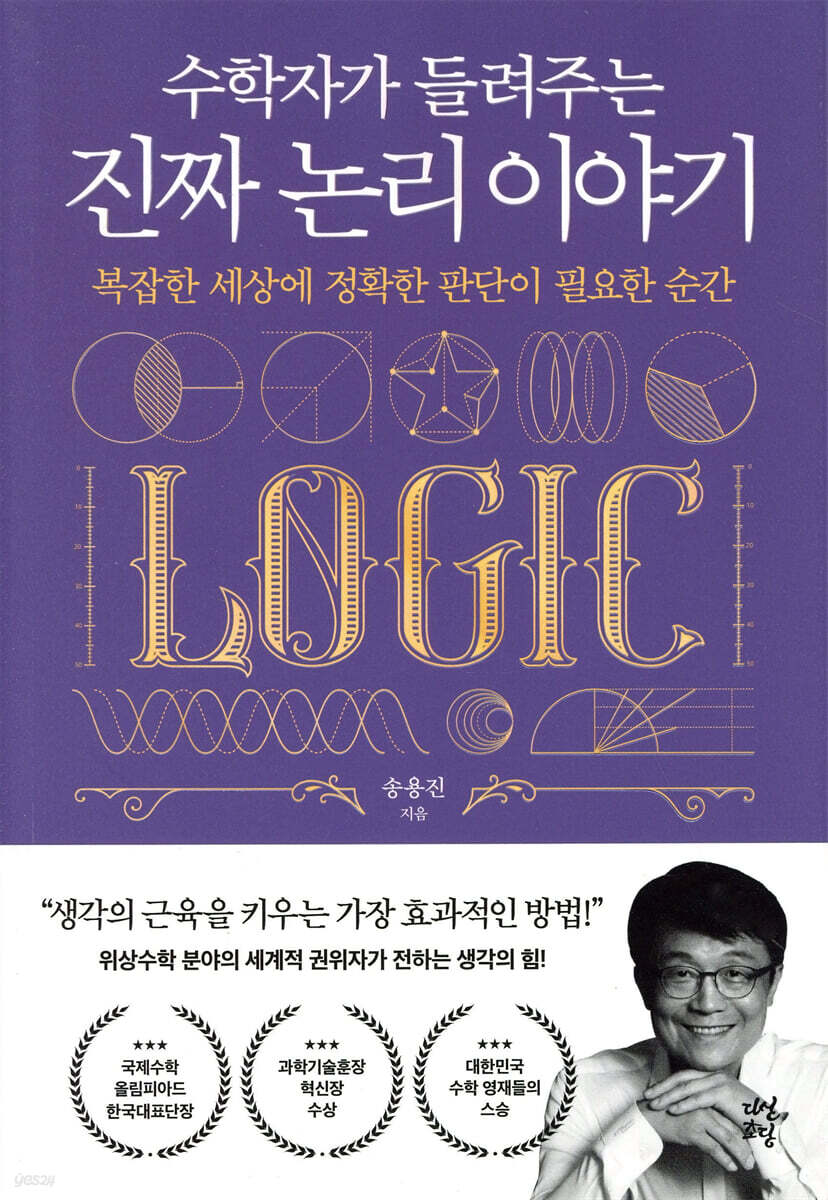
“The most effective way to develop your thinking muscles!”
The power of thought from a world-renowned authority in topology!
A feast of intellectual giants, from Aristotle to Alan Turing!
The author of this book, Professor Song Yong-jin of Inha University, served as the head or vice-head of the Korean delegation to the International Mathematical Olympiad for over 20 years, contributing to Korea's two first-place finishes.
Having taught subjects such as mathematical logic, argumentation, and set theory at a university for a long time, the author realized that students were particularly weak in logical thinking, and that their minds suddenly stopped working when they encountered logic.
And I also learned that the reason is not because the students are stupid, but because they don't have the opportunity to become familiar with logic.
This book is structured so that anyone with even the slightest interest in logic can easily acquire 'various useful knowledge related to logic' and become familiar with it.
Most of the books on logic we have seen so far are either books for young students studying Korean language or difficult and formal logic textbooks for college students majoring in philosophy.
However, this book is a unique popular logic book that takes advantage of the strengths of mathematicians and writes about real logic.
The power of thought from a world-renowned authority in topology!
A feast of intellectual giants, from Aristotle to Alan Turing!
The author of this book, Professor Song Yong-jin of Inha University, served as the head or vice-head of the Korean delegation to the International Mathematical Olympiad for over 20 years, contributing to Korea's two first-place finishes.
Having taught subjects such as mathematical logic, argumentation, and set theory at a university for a long time, the author realized that students were particularly weak in logical thinking, and that their minds suddenly stopped working when they encountered logic.
And I also learned that the reason is not because the students are stupid, but because they don't have the opportunity to become familiar with logic.
This book is structured so that anyone with even the slightest interest in logic can easily acquire 'various useful knowledge related to logic' and become familiar with it.
Most of the books on logic we have seen so far are either books for young students studying Korean language or difficult and formal logic textbooks for college students majoring in philosophy.
However, this book is a unique popular logic book that takes advantage of the strengths of mathematicians and writes about real logic.
index
To begin with
Part 1: Why Logic?
01 Becoming familiar with logic
Logic is learned with the body, not the head / The beginning of logical thinking: acknowledging what needs to be acknowledged / Judgment and discernment: essential abilities for modern people / Students need not be anxious about the future
02 The Virtue of Accuracy
The person who teaches, the person who teaches / The difficulty of the Korean language / The difficulty due to Chinese characters
03 Arguing and pointing out
Becoming familiar with criticism / Intellectual culture / Minor injustices encountered around us
Part 2 Logical Thinking
04 Fundamentals of Logic
Mathematics and Logic in Greece and Arabia / Propositions and Arguments / The Beginning of Logic: 'All' and 'Some'
05 Logic and Mathematics Learned in School
We don't learn sets in school / Math is inherently difficult / Accepting new concepts / How to be good at debating
06 Logic and Mathematics
Logic, Set Theory, Foundations of Mathematics / The Power of Symbols / Examples of Logical Thinking
07 Paradox Story
Zeno's paradox / Russell's paradox / Berry's paradox / St. Petersburg paradox / Banach-Tarski paradox
08 Six Types of Errors
Fallacy of hasty generalization / Fallacy of dichotomous logic / Fallacy due to confusion between necessary and sufficient conditions / Fallacy due to incorrect assumptions / Fallacy of confirmation bias / Fallacy due to lack of scientific literacy
Part 3: The Development of Modern Logic
09 The Beginning of a New Logic
Developments in 19th-Century Germany / Gottlob Frege / Giuseppe Peano / Bertrand Russell
10 Development of mathematical logic
Four Characteristics of the New Logic / Cantor on Infinity / Logicism, Formalism, and Intuitionism / Gödel's Incompleteness Theorem and the Collapse of Formalism
11 Modern Logic
The Great Logician Tarski / ZF Axioms and the Axiom of Choice / Turing Machines and Computability
Part 4: Mathematics and Logic
A collection of 12 elements
To understand a set, you must first know its symbols / The set of all subsets, the power set
13 Infinite Understanding
To understand infinity, you must first understand functions. / Infinite sets also have large and small sets. / Cantor's theorem, the core of infinite set theory. / Irrational numbers are more numerous than rational numbers. / Union argument.
Search
Part 1: Why Logic?
01 Becoming familiar with logic
Logic is learned with the body, not the head / The beginning of logical thinking: acknowledging what needs to be acknowledged / Judgment and discernment: essential abilities for modern people / Students need not be anxious about the future
02 The Virtue of Accuracy
The person who teaches, the person who teaches / The difficulty of the Korean language / The difficulty due to Chinese characters
03 Arguing and pointing out
Becoming familiar with criticism / Intellectual culture / Minor injustices encountered around us
Part 2 Logical Thinking
04 Fundamentals of Logic
Mathematics and Logic in Greece and Arabia / Propositions and Arguments / The Beginning of Logic: 'All' and 'Some'
05 Logic and Mathematics Learned in School
We don't learn sets in school / Math is inherently difficult / Accepting new concepts / How to be good at debating
06 Logic and Mathematics
Logic, Set Theory, Foundations of Mathematics / The Power of Symbols / Examples of Logical Thinking
07 Paradox Story
Zeno's paradox / Russell's paradox / Berry's paradox / St. Petersburg paradox / Banach-Tarski paradox
08 Six Types of Errors
Fallacy of hasty generalization / Fallacy of dichotomous logic / Fallacy due to confusion between necessary and sufficient conditions / Fallacy due to incorrect assumptions / Fallacy of confirmation bias / Fallacy due to lack of scientific literacy
Part 3: The Development of Modern Logic
09 The Beginning of a New Logic
Developments in 19th-Century Germany / Gottlob Frege / Giuseppe Peano / Bertrand Russell
10 Development of mathematical logic
Four Characteristics of the New Logic / Cantor on Infinity / Logicism, Formalism, and Intuitionism / Gödel's Incompleteness Theorem and the Collapse of Formalism
11 Modern Logic
The Great Logician Tarski / ZF Axioms and the Axiom of Choice / Turing Machines and Computability
Part 4: Mathematics and Logic
A collection of 12 elements
To understand a set, you must first know its symbols / The set of all subsets, the power set
13 Infinite Understanding
To understand infinity, you must first understand functions. / Infinite sets also have large and small sets. / Cantor's theorem, the core of infinite set theory. / Irrational numbers are more numerous than rational numbers. / Union argument.
Search
Detailed image

Into the book
Logic and rationality begin with 'acknowledging what needs to be acknowledged.'
We need an attitude of accepting facts as facts, and an attitude of acknowledging when someone says something true.
Even if the situation unfolding before your eyes is unfavorable to you, you need to have an attitude of acknowledging what needs to be acknowledged and of admitting your mistakes without making excuses.
Unreasonable judgments or actions often occur when these basic principles are not properly observed.
Just as logical thinking skills can be improved through repeated practice, like in mathematics, the attitude of recognizing and accepting what is right can also be developed through habituation and practice.
When debating, there are many people who do not accept what the other person says even though it is correct and there is no room for refutation.
However, if you want to be evaluated well in the discussion, you must show an attitude of acknowledging what needs to be acknowledged.
Even if someone says something right, if the conclusion differs from your own opinion, you often say, “That person speaks well,” and refuse to acknowledge that person’s opinion.
In our country, there is a tendency not to like people who are good at talking.
In America, people who are good at speaking are highly regarded, but in our country, they are not regarded so highly.
In this respect, the cultures of the two countries are quite different.
---From "Part 1, "Why Logic?", pp. 24-25"
Logic is the study of the processes and methods of reasoning and argumentation.
Argumentation is the process of determining whether something is true or false based on existing knowledge.
A proposition is a sentence that has objectivity and can be judged as true or false.
Inference refers to deriving another proposition or judgment based on one proposition or judgment.
In logic, a process called argumentation is used to determine whether a proposition or inference is true or false.
The classical propositional logic (or sentence logic), which examines the truth or falsity of propositions, was pioneered by Frege and others along with the use of symbols, and is called predicate logic.
Since it is convenient to use 'logical symbols' when describing a sentence or judging the truth of the sentence's content, symbols are used extensively in modern logic.
So this new predicate logic is also called symbolic logic.
It would be too much to introduce all the symbols used in symbolic logic, so here I will introduce only a few key symbols.
These symbols appear frequently in purely mathematical sentences, and when using them, it is often easier to express them in English (European) grammar than in Korean grammar.
---From “Part 2, Logical Thinking, pp. 82-83”
Let's look at an example of a misunderstanding that arises from a lack of understanding of the linguistic meaning in mathematics.
There is a famous problem called the 'problem of constructing a trisection of an angle'.
This problem was already solved in 1837 when Pierre Wantzel of France showed that there was no way to construct it, but many people are still trying to solve it.
Surprisingly, many people have tried to find a way to trisect any angle using only a straightedge and a compass, or claim to have already found one.
This is an incident that occurs because they do not understand the difference between the statement “there is no way to divide it into thirds” and “they cannot find a way to divide it into thirds.”
I have received emails from two engineering professors asking me to review their solutions to trisection problems.
There are many people like that in foreign countries, and they are called trisectors.
There was once a man who claimed to have discovered a method for calculating pi and harassed Seoul National University mathematics professors. When the professors refused to respond, he spent a large sum of money on advertising and published his proof in a major daily newspaper.
The transcendence of π was already proven in 1882 by Ferdinand von Lindemann (1852-1939) of Germany, and therefore π is a transcendental number and cannot be constructed (construction means that it is a number that is a root of a polynomial, i.e. an algebraic number), so mathematics professors would not even look at the construction method he presented.
In fact, the person who claimed to have discovered the construction of π did not construct the true value of π, but rather an approximation to it.
---From “Part 2, Logical Thinking, pp. 131-132”
New developments in logic began in the late 19th century, primarily by German mathematicians.
This new logic can be called modern logic.
Classical logic, represented by Aristotle's logic, has long served as the basis for various academic disciplines in Europe and Arabia in a form similar to rhetoric.
In Europe, logic, like other disciplines, had not made much progress for a long time under the absolute authority of religion. However, with the dawn of a new era of awakening in Europe, it made groundbreaking progress.
Descartes made groundbreaking advances in mathematics in the 17th century by inventing the coordinate plane and literal calculations, but I believe that Descartes's true contribution to mathematics and science was his presentation of a new philosophy of science that sought truth through pure human reason (without relying on the church).
So, in my history of mathematics lectures, I introduce Descartes to my students as the person who made the greatest contribution to the development of mathematics in history.
If we look only at the achievements related to mathematical content, there are more Euler, Gauss, etc. than Descartes, but I think that at the time, in Europe, the question of what philosophy to base academic research on was more important.
Logic began to develop in the 18th century with the help of Hume and Thomas Reid (1710-1796) from Scotland and Kant from Germany.
As a new philosophical spirit matured, exploring the truth of this world and the values of life pursued by humans through pure human reason, logic naturally laid the foundation for new developments.
---From “Part 3, “Development of Modern Logic,” pp. 195-296”
However, Hilbert's dream of constructing formalistic mathematics was shattered when the young Austrian mathematician Kurt Gödel announced the incompleteness theorem in 1931.
Gödel's incompleteness theorem consists of two theorems.
First Theorem: If any arithmetic axiom system is consistent (consistent), then there are propositions that are true but cannot be proven.
That is, it is not perfect.
Second Theorem: If any axiom system of arithmetic is consistent (consistent), then it cannot be deduced from the axiom system that the axiom system itself is consistent.
The meaning of 'completeness' and 'consistency' was explained earlier when discussing Hilbert's formalism.
It is not easy for the general public to understand the proof of Gödel's incompleteness theorem.
Readers can simply understand that 'there is no such thing as a perfect arithmetic system.'
However, the incompleteness theorem does not mean that logic has become less important in mathematics, but rather that the completeness of the logical system has been destroyed.
Rather, it had the effect of focusing the world's attention on the mystery of logic.
We need an attitude of accepting facts as facts, and an attitude of acknowledging when someone says something true.
Even if the situation unfolding before your eyes is unfavorable to you, you need to have an attitude of acknowledging what needs to be acknowledged and of admitting your mistakes without making excuses.
Unreasonable judgments or actions often occur when these basic principles are not properly observed.
Just as logical thinking skills can be improved through repeated practice, like in mathematics, the attitude of recognizing and accepting what is right can also be developed through habituation and practice.
When debating, there are many people who do not accept what the other person says even though it is correct and there is no room for refutation.
However, if you want to be evaluated well in the discussion, you must show an attitude of acknowledging what needs to be acknowledged.
Even if someone says something right, if the conclusion differs from your own opinion, you often say, “That person speaks well,” and refuse to acknowledge that person’s opinion.
In our country, there is a tendency not to like people who are good at talking.
In America, people who are good at speaking are highly regarded, but in our country, they are not regarded so highly.
In this respect, the cultures of the two countries are quite different.
---From "Part 1, "Why Logic?", pp. 24-25"
Logic is the study of the processes and methods of reasoning and argumentation.
Argumentation is the process of determining whether something is true or false based on existing knowledge.
A proposition is a sentence that has objectivity and can be judged as true or false.
Inference refers to deriving another proposition or judgment based on one proposition or judgment.
In logic, a process called argumentation is used to determine whether a proposition or inference is true or false.
The classical propositional logic (or sentence logic), which examines the truth or falsity of propositions, was pioneered by Frege and others along with the use of symbols, and is called predicate logic.
Since it is convenient to use 'logical symbols' when describing a sentence or judging the truth of the sentence's content, symbols are used extensively in modern logic.
So this new predicate logic is also called symbolic logic.
It would be too much to introduce all the symbols used in symbolic logic, so here I will introduce only a few key symbols.
These symbols appear frequently in purely mathematical sentences, and when using them, it is often easier to express them in English (European) grammar than in Korean grammar.
---From “Part 2, Logical Thinking, pp. 82-83”
Let's look at an example of a misunderstanding that arises from a lack of understanding of the linguistic meaning in mathematics.
There is a famous problem called the 'problem of constructing a trisection of an angle'.
This problem was already solved in 1837 when Pierre Wantzel of France showed that there was no way to construct it, but many people are still trying to solve it.
Surprisingly, many people have tried to find a way to trisect any angle using only a straightedge and a compass, or claim to have already found one.
This is an incident that occurs because they do not understand the difference between the statement “there is no way to divide it into thirds” and “they cannot find a way to divide it into thirds.”
I have received emails from two engineering professors asking me to review their solutions to trisection problems.
There are many people like that in foreign countries, and they are called trisectors.
There was once a man who claimed to have discovered a method for calculating pi and harassed Seoul National University mathematics professors. When the professors refused to respond, he spent a large sum of money on advertising and published his proof in a major daily newspaper.
The transcendence of π was already proven in 1882 by Ferdinand von Lindemann (1852-1939) of Germany, and therefore π is a transcendental number and cannot be constructed (construction means that it is a number that is a root of a polynomial, i.e. an algebraic number), so mathematics professors would not even look at the construction method he presented.
In fact, the person who claimed to have discovered the construction of π did not construct the true value of π, but rather an approximation to it.
---From “Part 2, Logical Thinking, pp. 131-132”
New developments in logic began in the late 19th century, primarily by German mathematicians.
This new logic can be called modern logic.
Classical logic, represented by Aristotle's logic, has long served as the basis for various academic disciplines in Europe and Arabia in a form similar to rhetoric.
In Europe, logic, like other disciplines, had not made much progress for a long time under the absolute authority of religion. However, with the dawn of a new era of awakening in Europe, it made groundbreaking progress.
Descartes made groundbreaking advances in mathematics in the 17th century by inventing the coordinate plane and literal calculations, but I believe that Descartes's true contribution to mathematics and science was his presentation of a new philosophy of science that sought truth through pure human reason (without relying on the church).
So, in my history of mathematics lectures, I introduce Descartes to my students as the person who made the greatest contribution to the development of mathematics in history.
If we look only at the achievements related to mathematical content, there are more Euler, Gauss, etc. than Descartes, but I think that at the time, in Europe, the question of what philosophy to base academic research on was more important.
Logic began to develop in the 18th century with the help of Hume and Thomas Reid (1710-1796) from Scotland and Kant from Germany.
As a new philosophical spirit matured, exploring the truth of this world and the values of life pursued by humans through pure human reason, logic naturally laid the foundation for new developments.
---From “Part 3, “Development of Modern Logic,” pp. 195-296”
However, Hilbert's dream of constructing formalistic mathematics was shattered when the young Austrian mathematician Kurt Gödel announced the incompleteness theorem in 1931.
Gödel's incompleteness theorem consists of two theorems.
First Theorem: If any arithmetic axiom system is consistent (consistent), then there are propositions that are true but cannot be proven.
That is, it is not perfect.
Second Theorem: If any axiom system of arithmetic is consistent (consistent), then it cannot be deduced from the axiom system that the axiom system itself is consistent.
The meaning of 'completeness' and 'consistency' was explained earlier when discussing Hilbert's formalism.
It is not easy for the general public to understand the proof of Gödel's incompleteness theorem.
Readers can simply understand that 'there is no such thing as a perfect arithmetic system.'
However, the incompleteness theorem does not mean that logic has become less important in mathematics, but rather that the completeness of the logical system has been destroyed.
Rather, it had the effect of focusing the world's attention on the mystery of logic.
---From “Part 3, “Development of Modern Logic,” pp. 243-244”
Publisher's Review
Intellectual culture, Zeno's paradox, and Russell's paradox
Part 1 of the book talks about our country's culture, where logic is not valued.
The author gives an example of an 'intellectual culture' that points out the other person's mistakes.
The United States, the United Kingdom, and Japan have much stronger intellectual cultures than ours.
While studying abroad in the United States, the author saw people lining up and realized the difference in cultural standards.
At that time, at McDonald's, if someone skipped the line and just walked up to the register, the employee taking their order would immediately glare at them and yell at them to get in line.
Because intellectual culture has become so commonplace, it was impossible not to stand in line.
There was a similar experience in England.
When I was staying in England for a long time, I bought a bicycle at a bicycle shop because public transportation was inconvenient.
And as I was leaving the store and riding my new bike diagonally across the wide sidewalk for about 20 meters to the road, a gentleman suddenly came running up to me shouting.
Even if it was only for a few seconds, the author was criticized for riding a bicycle on the sidewalk instead of the road.
People who grew up in a country with such a strong intellectual culture cannot help but strive for accuracy, but we are lacking in this area.
Part 2 introduces the history of mathematics and logic from ancient Greece and Arabia, and discusses the very basics of logical thinking.
We also introduce five historically important and famous paradoxes in logic.
Let me give you just two examples of those paradoxes.
First is Zeno's paradox.
In this paradox, Zeno presented the argument that 'the motion of a substance is merely an illusion, and in fact it is at rest (at every moment)'. Let's explain the paradox using a running story.
When Olympius runs, he must cross the halfway point of the distance to the finish, then the halfway point of the remaining distance, then the halfway point of that remaining distance, and so on, over and over again.
So Olympius gets closer to the finish line, but he doesn't reach it.
This paradox is that the process of reaching the halfway point of the remaining distance to the finish line must be repeated 'infinitely' to reach the finish line, but it is concluded that it is impossible to reach the finish line by only examining the 'finite' number of processes.
Ultimately, it is an error that arose from ‘trying to explain infinite phenomena with finite thinking.’
Here is Russell's paradox.
The most famous example used to explain Russell's paradox is the 'barber's paradox'.
There is a barber in a certain village.
The barber said, “I shave the beards of every villager who doesn’t shave his own.”
Then who will cut the barber's own beard?
(ⅰ) If you shave yourself, it contradicts the fact that you only shave those who do not shave themselves.
(ⅱ) If you don't shave yourself, it contradicts the statement that you will shave everyone who doesn't shave themselves.
An example of a contradiction arising from negative statements about oneself, like Russell's paradox, is the 'liar paradox'.
Epimenides, the ancient Greek philosopher and poet, is said to have said:
“All Cretans are liars.” The problem is that Epimenides, who said this, was himself a Cretan.
So, is Epimenides' statement true or false? First, we need to refine this simple sentence as follows:
So, let's rephrase this as, "Everything Cretans say is wrong."
Then this statement cannot be true.
For if this is true, then it is false, for it was said by Epimenides, a Cretan.
The Giants Who Shaped Modern Logic, From Cantor to Tarski
Part 3 explains the development and significance of modern logic and analytic philosophy, achieved by the greatest geniuses of the time, including Cantor, Hilbert, Frege, Russell, Whitehead, Wittgenstein, Gödel, and Tarski, from the late 19th century to the early 20th century.
Logic, which has been the foundation of all academic disciplines for over 2,000 years, began to develop into a more independent and systematic field of study in the late 19th century, led by German mathematicians.
Frege argued that mathematical concepts, even numbers, should be defined according to a complete and concrete logic.
He also sought to create a formal (mainly symbolic) language for logical description, and to derive a system of arithmetic from logic.
Cantor, the founder of set theory, showed that the concept of 'infinity', which had long been taboo in mathematics and logic, could be logically handled, and naturally showed how important a concept set is in logic.
Systematic and rigorous modern logic is also called mathematical logic or symbolic logic.
This is to distinguish it from classical logic shared by philosophers and mathematicians.
Mathematical logic is based on set theory, which includes mathematical concepts such as sets, operations, functions, and infinity, so it is a subject that is difficult for those without such background knowledge to understand.
So logic was naturally divided into mathematical logic studied by mathematicians and logic studied by philosophers.
Although logic is an essential discipline for philosophers and linguists, as it provides important background knowledge for the study of philosophy and linguistics, the study of modern logic as an independent academic field in its own right ultimately fell to mathematicians.
It is similar to the fact that statistics is essential knowledge for social science research such as economics, so it is mandatory to take a subject called statistics to become a social scientist, but it is the job of a statistician to specialize in statistics itself.
Within mathematics, logic is also called 'foundations of mathematics'.
This is because logic has developed over the past 100 years with the goal of establishing the best foundation for mathematics based on Hilbert's formalist philosophy.
However, the foundational theory of mathematics has a significant flaw.
The point is that there is no logically perfect arithmetic system.
In 1931, the young Austrian mathematician Gödel surprised the world by announcing the 'incompleteness theorem' and became as famous as Einstein.
The greatest mathematicians of the time, such as Hilbert, Peano, and Russell, who pioneered modern logic, attempted to construct a perfect logical system.
But Gödel showed that it was impossible.
When this incompleteness theorem was announced, a new paradigm called quantum mechanics was beginning to become mainstream in physics, and Heisenberg's uncertainty principle was already known, so intellectuals at the time came to have a new worldview: "There is no such thing as complete and certain truth in the world."
This has a huge impact not only on natural sciences but also on disciplines such as philosophy and economics.
It is ironic that logic, which pursues perfection and rigor, has developed to lay a good foundation for mathematics, but has also proven through logic that a logically perfect foundation for mathematics itself cannot exist.
Although the world of logic is not perfect, and mathematicians do not rely solely on logic, many logicians around the world are still actively researching to find a good foundation for mathematics.
Most mathematicians, consciously or unconsciously, follow the direction of mathematical formalism pursued by Hilbert.
Even though we know that there is no ultimate goal at the end of that road that mathematicians seek, we continue to follow it believing that it is the right direction.
Part 4 explains basic concepts and symbols used in mathematics, such as union, intersection, functions, and sequences, as well as mathematical induction, and introduces how such concepts are used in propositions and arguments.
It also explains how the concept of infinity can be logically dealt with through Cantor's set theory.
Here, infinity means an infinite set, meaning 'a set with infinitely many elements'.
In infinity, there is a big infinity and a small infinity.
It also explains why there are more irrational numbers than rational numbers among real numbers, how much larger infinity is larger than smaller infinity, and what problems arise when there are too many elements in a set.
Logic Lessons for Balance in Our Lives
When we talk about logic, we tend to think of it as just a tool used in arguments.
But the real logic is to refine your own thinking.
Even if you are prone to making mistakes due to being swayed by emotions, if you have good logical training through reasoning, you can find a clue to solving the problem and a good balance.
This book is especially necessary for our society, where emotional culture is developed but logical culture is weak.
I recommend readers to read it.
Part 1 of the book talks about our country's culture, where logic is not valued.
The author gives an example of an 'intellectual culture' that points out the other person's mistakes.
The United States, the United Kingdom, and Japan have much stronger intellectual cultures than ours.
While studying abroad in the United States, the author saw people lining up and realized the difference in cultural standards.
At that time, at McDonald's, if someone skipped the line and just walked up to the register, the employee taking their order would immediately glare at them and yell at them to get in line.
Because intellectual culture has become so commonplace, it was impossible not to stand in line.
There was a similar experience in England.
When I was staying in England for a long time, I bought a bicycle at a bicycle shop because public transportation was inconvenient.
And as I was leaving the store and riding my new bike diagonally across the wide sidewalk for about 20 meters to the road, a gentleman suddenly came running up to me shouting.
Even if it was only for a few seconds, the author was criticized for riding a bicycle on the sidewalk instead of the road.
People who grew up in a country with such a strong intellectual culture cannot help but strive for accuracy, but we are lacking in this area.
Part 2 introduces the history of mathematics and logic from ancient Greece and Arabia, and discusses the very basics of logical thinking.
We also introduce five historically important and famous paradoxes in logic.
Let me give you just two examples of those paradoxes.
First is Zeno's paradox.
In this paradox, Zeno presented the argument that 'the motion of a substance is merely an illusion, and in fact it is at rest (at every moment)'. Let's explain the paradox using a running story.
When Olympius runs, he must cross the halfway point of the distance to the finish, then the halfway point of the remaining distance, then the halfway point of that remaining distance, and so on, over and over again.
So Olympius gets closer to the finish line, but he doesn't reach it.
This paradox is that the process of reaching the halfway point of the remaining distance to the finish line must be repeated 'infinitely' to reach the finish line, but it is concluded that it is impossible to reach the finish line by only examining the 'finite' number of processes.
Ultimately, it is an error that arose from ‘trying to explain infinite phenomena with finite thinking.’
Here is Russell's paradox.
The most famous example used to explain Russell's paradox is the 'barber's paradox'.
There is a barber in a certain village.
The barber said, “I shave the beards of every villager who doesn’t shave his own.”
Then who will cut the barber's own beard?
(ⅰ) If you shave yourself, it contradicts the fact that you only shave those who do not shave themselves.
(ⅱ) If you don't shave yourself, it contradicts the statement that you will shave everyone who doesn't shave themselves.
An example of a contradiction arising from negative statements about oneself, like Russell's paradox, is the 'liar paradox'.
Epimenides, the ancient Greek philosopher and poet, is said to have said:
“All Cretans are liars.” The problem is that Epimenides, who said this, was himself a Cretan.
So, is Epimenides' statement true or false? First, we need to refine this simple sentence as follows:
So, let's rephrase this as, "Everything Cretans say is wrong."
Then this statement cannot be true.
For if this is true, then it is false, for it was said by Epimenides, a Cretan.
The Giants Who Shaped Modern Logic, From Cantor to Tarski
Part 3 explains the development and significance of modern logic and analytic philosophy, achieved by the greatest geniuses of the time, including Cantor, Hilbert, Frege, Russell, Whitehead, Wittgenstein, Gödel, and Tarski, from the late 19th century to the early 20th century.
Logic, which has been the foundation of all academic disciplines for over 2,000 years, began to develop into a more independent and systematic field of study in the late 19th century, led by German mathematicians.
Frege argued that mathematical concepts, even numbers, should be defined according to a complete and concrete logic.
He also sought to create a formal (mainly symbolic) language for logical description, and to derive a system of arithmetic from logic.
Cantor, the founder of set theory, showed that the concept of 'infinity', which had long been taboo in mathematics and logic, could be logically handled, and naturally showed how important a concept set is in logic.
Systematic and rigorous modern logic is also called mathematical logic or symbolic logic.
This is to distinguish it from classical logic shared by philosophers and mathematicians.
Mathematical logic is based on set theory, which includes mathematical concepts such as sets, operations, functions, and infinity, so it is a subject that is difficult for those without such background knowledge to understand.
So logic was naturally divided into mathematical logic studied by mathematicians and logic studied by philosophers.
Although logic is an essential discipline for philosophers and linguists, as it provides important background knowledge for the study of philosophy and linguistics, the study of modern logic as an independent academic field in its own right ultimately fell to mathematicians.
It is similar to the fact that statistics is essential knowledge for social science research such as economics, so it is mandatory to take a subject called statistics to become a social scientist, but it is the job of a statistician to specialize in statistics itself.
Within mathematics, logic is also called 'foundations of mathematics'.
This is because logic has developed over the past 100 years with the goal of establishing the best foundation for mathematics based on Hilbert's formalist philosophy.
However, the foundational theory of mathematics has a significant flaw.
The point is that there is no logically perfect arithmetic system.
In 1931, the young Austrian mathematician Gödel surprised the world by announcing the 'incompleteness theorem' and became as famous as Einstein.
The greatest mathematicians of the time, such as Hilbert, Peano, and Russell, who pioneered modern logic, attempted to construct a perfect logical system.
But Gödel showed that it was impossible.
When this incompleteness theorem was announced, a new paradigm called quantum mechanics was beginning to become mainstream in physics, and Heisenberg's uncertainty principle was already known, so intellectuals at the time came to have a new worldview: "There is no such thing as complete and certain truth in the world."
This has a huge impact not only on natural sciences but also on disciplines such as philosophy and economics.
It is ironic that logic, which pursues perfection and rigor, has developed to lay a good foundation for mathematics, but has also proven through logic that a logically perfect foundation for mathematics itself cannot exist.
Although the world of logic is not perfect, and mathematicians do not rely solely on logic, many logicians around the world are still actively researching to find a good foundation for mathematics.
Most mathematicians, consciously or unconsciously, follow the direction of mathematical formalism pursued by Hilbert.
Even though we know that there is no ultimate goal at the end of that road that mathematicians seek, we continue to follow it believing that it is the right direction.
Part 4 explains basic concepts and symbols used in mathematics, such as union, intersection, functions, and sequences, as well as mathematical induction, and introduces how such concepts are used in propositions and arguments.
It also explains how the concept of infinity can be logically dealt with through Cantor's set theory.
Here, infinity means an infinite set, meaning 'a set with infinitely many elements'.
In infinity, there is a big infinity and a small infinity.
It also explains why there are more irrational numbers than rational numbers among real numbers, how much larger infinity is larger than smaller infinity, and what problems arise when there are too many elements in a set.
Logic Lessons for Balance in Our Lives
When we talk about logic, we tend to think of it as just a tool used in arguments.
But the real logic is to refine your own thinking.
Even if you are prone to making mistakes due to being swayed by emotions, if you have good logical training through reasoning, you can find a clue to solving the problem and a good balance.
This book is especially necessary for our society, where emotional culture is developed but logical culture is weak.
I recommend readers to read it.
GOODS SPECIFICS
- Date of issue: June 1, 2023
- Page count, weight, size: 316 pages | 145*210*30mm
- ISBN13: 9791130699745
- ISBN10: 1130699749
You may also like
카테고리
korean


korean

![GQ KOREA Mark (Monthly): December [2025]](http://librairie.coreenne.fr/cdn/shop/files/8ef265dbbfbf186523ed75ba7319009d.jpg?v=1765340328&width=3840)


