

Small but Amazing Ways Adults Use Their Brains
 |
Description
Book Introduction
As we grow older, we must also change how we use our brains.
A Brain MRI Expert Explains "Study Methods Just for Adults"
The 'tremendous' impact of 'small' changes in daily life on the brain!
It's a common belief that brain function declines as we age, just as our physical abilities decline.
However, Toshinori Kato, author of “Small but Amazing Ways to Use the Adult Brain,” refutes this preconception with neuromedical evidence.
Although the number of brain cells certainly decreases with age, the networks between brain cells continue to expand and the connections become closer.
The part of the brain responsible for understanding can only be considered "adult" when you reach your thirties, and your analytical and judgmental abilities reach their peak after your forties.
That is, the brain does not stop growing even as we age.
If you feel a decline in brain function after your 30s, it is not because the brain itself has aged, but because the way you use your brain has become outdated.
The brain, which is constantly growing, must change its usage to fit its changing structure in order to demonstrate its full potential.
"Small but Amazing How Adults Use Their Brains" presents simple brain usage methods that can be easily implemented in everyday life for adults who are relearning and preparing for new challenges for various reasons such as promotions, job changes, and side jobs.
This easy-to-read book, with its delightful illustrations, will give you the opportunity to make a 'huge' difference in your career with 'small' efforts.
A Brain MRI Expert Explains "Study Methods Just for Adults"
The 'tremendous' impact of 'small' changes in daily life on the brain!
It's a common belief that brain function declines as we age, just as our physical abilities decline.
However, Toshinori Kato, author of “Small but Amazing Ways to Use the Adult Brain,” refutes this preconception with neuromedical evidence.
Although the number of brain cells certainly decreases with age, the networks between brain cells continue to expand and the connections become closer.
The part of the brain responsible for understanding can only be considered "adult" when you reach your thirties, and your analytical and judgmental abilities reach their peak after your forties.
That is, the brain does not stop growing even as we age.
If you feel a decline in brain function after your 30s, it is not because the brain itself has aged, but because the way you use your brain has become outdated.
The brain, which is constantly growing, must change its usage to fit its changing structure in order to demonstrate its full potential.
"Small but Amazing How Adults Use Their Brains" presents simple brain usage methods that can be easily implemented in everyday life for adults who are relearning and preparing for new challenges for various reasons such as promotions, job changes, and side jobs.
This easy-to-read book, with its delightful illustrations, will give you the opportunity to make a 'huge' difference in your career with 'small' efforts.
- You can preview some of the book's contents.
Preview
index
Entering
The elders have a wonderful way of studying.
Adults have their own study methods.
The middle-aged brain actually has greater potential.
You can set your own best record with an adult brain.
Chapter 1: The Amazing User's Manual for the Adult Brain
The brain is lazy and easily bored, so it's easy to be brainwashed.
The brain's prime is from the late 40s to the 50s.
The key to improving brain power is teamwork among brain cells.
Understanding the characteristics of the eight brain regions
Brain Brain Colleagues
Brain productivity rises and falls depending on how the environment is created.
When you become an adult, reset your study methods from your student days.
The CEO's brain decides whether to save or kill information.
The relationship between the thinking and understanding systems determines brain performance.
Create an environment where the brain regions that lack stamina and are lazy can easily work.
The emotional and communication systems play an important role in improving memory.
To collect better information from the motor, visual, and auditory brain regions
The brain has highways and regular roads.
Depending on how you use your brain, you can become good at even the most awkward tasks.
People who think quickly have developed brain highways.
Chapter 2: Amazing Memory Enhancement Methods for the Adult Brain
When you become an adult, you won't be able to memorize it all.
No matter how many times I flag and underline it, it won't be memorized.
The brain remembers important life-or-death crises and information.
Memory is instantly improved through emotions.
The hippocampus is fooled by positive emotions like excitement and excitement.
When you understand and say, "Aha, I get it!", it sticks in your memory.
Information that comes in repeatedly is transferred to long-term memory.
Reviewing immediately after studying improves memory retention.
When reviewing, start from the middle of the textbook.
Chapter 3: Awesome Learning Methods That Motivate the Adult Brain
We only see and hear what we like.
I gradually become familiar with the knowledge I want to memorize.
Flip through the reference book and start with the parts you already know.
Instead of studying for two hours a day, study for 10 minutes for 12 days.
Connect your brain with the knowledge you want to memorize with 'Review Notes'
Brain warm-up exercises can help you recall old memories more easily.
75 hours of immersion changes how your brain works.
Study with the steps of outputting information in mind.
Express your feelings about the content you want to memorize.
Chapter 4: A Great Study Method Using the Brain's Features
Women are better at studying auditorily, while men are better at studying visually.
Am I visual or auditory?
Auditory training using audible reading is essential.
An effective study method when you want to study again through reading.
People who don't have time study by listening before going to bed.
Walking improves the brain's ability to process information.
Don't look at your smartphone after reviewing before bed
Chapter 5: The Art of Amazing Habits that Enhance Adult Brain Power
The brain loves deadlines
A change of perspective for the brain that gets bored easily
Imitating someone who is good at something will speed up your learning.
Before starting to study, I flip through my reference book for five minutes.
Study briefly in the morning and let it solidify into your memory throughout the day.
Prioritize what interests you over study methods recommended by others.
Spend more time organizing incorrect answers than solving problems
When dopamine is released, the rate of memory consolidation increases.
The best time to study is right after finishing work.
When you lose focus while studying, give your visual brain a rest.
'Holiday blues' are evidence that the brain is undergoing 'positive changes.'
Let's go to work at a different time than usual in the morning.
Try brushing your teeth with your non-dominant hand.
Eye training to move your eyes, which have become stiff due to smartphone use
Change the location of your smartphone apps to prevent your brain from becoming lazy.
Going out
Brain User Manual by Age
The elders have a wonderful way of studying.
Adults have their own study methods.
The middle-aged brain actually has greater potential.
You can set your own best record with an adult brain.
Chapter 1: The Amazing User's Manual for the Adult Brain
The brain is lazy and easily bored, so it's easy to be brainwashed.
The brain's prime is from the late 40s to the 50s.
The key to improving brain power is teamwork among brain cells.
Understanding the characteristics of the eight brain regions
Brain Brain Colleagues
Brain productivity rises and falls depending on how the environment is created.
When you become an adult, reset your study methods from your student days.
The CEO's brain decides whether to save or kill information.
The relationship between the thinking and understanding systems determines brain performance.
Create an environment where the brain regions that lack stamina and are lazy can easily work.
The emotional and communication systems play an important role in improving memory.
To collect better information from the motor, visual, and auditory brain regions
The brain has highways and regular roads.
Depending on how you use your brain, you can become good at even the most awkward tasks.
People who think quickly have developed brain highways.
Chapter 2: Amazing Memory Enhancement Methods for the Adult Brain
When you become an adult, you won't be able to memorize it all.
No matter how many times I flag and underline it, it won't be memorized.
The brain remembers important life-or-death crises and information.
Memory is instantly improved through emotions.
The hippocampus is fooled by positive emotions like excitement and excitement.
When you understand and say, "Aha, I get it!", it sticks in your memory.
Information that comes in repeatedly is transferred to long-term memory.
Reviewing immediately after studying improves memory retention.
When reviewing, start from the middle of the textbook.
Chapter 3: Awesome Learning Methods That Motivate the Adult Brain
We only see and hear what we like.
I gradually become familiar with the knowledge I want to memorize.
Flip through the reference book and start with the parts you already know.
Instead of studying for two hours a day, study for 10 minutes for 12 days.
Connect your brain with the knowledge you want to memorize with 'Review Notes'
Brain warm-up exercises can help you recall old memories more easily.
75 hours of immersion changes how your brain works.
Study with the steps of outputting information in mind.
Express your feelings about the content you want to memorize.
Chapter 4: A Great Study Method Using the Brain's Features
Women are better at studying auditorily, while men are better at studying visually.
Am I visual or auditory?
Auditory training using audible reading is essential.
An effective study method when you want to study again through reading.
People who don't have time study by listening before going to bed.
Walking improves the brain's ability to process information.
Don't look at your smartphone after reviewing before bed
Chapter 5: The Art of Amazing Habits that Enhance Adult Brain Power
The brain loves deadlines
A change of perspective for the brain that gets bored easily
Imitating someone who is good at something will speed up your learning.
Before starting to study, I flip through my reference book for five minutes.
Study briefly in the morning and let it solidify into your memory throughout the day.
Prioritize what interests you over study methods recommended by others.
Spend more time organizing incorrect answers than solving problems
When dopamine is released, the rate of memory consolidation increases.
The best time to study is right after finishing work.
When you lose focus while studying, give your visual brain a rest.
'Holiday blues' are evidence that the brain is undergoing 'positive changes.'
Let's go to work at a different time than usual in the morning.
Try brushing your teeth with your non-dominant hand.
Eye training to move your eyes, which have become stiff due to smartphone use
Change the location of your smartphone apps to prevent your brain from becoming lazy.
Going out
Brain User Manual by Age
Detailed image
Into the book
When introducing study methods suitable for adults, there is something that everyone says in common.
“As we age, our brain declines just as our physical strength declines.
My memory is worse than when I was a student… … .
So it takes time to make knowledge your own.” But this statement is wrong from the very first sentence.
Your brain is in better 'condition' than it was when you were a student.
Now that you're an adult, it might actually be the best time to study.
Just as strength training can improve muscle strength at any age, stimulating the brain to grow can improve brain function regardless of age.
--- p.11
If you're making excuses like that and studying the same way you did as a student, you're wasting your time.
Because the way I used my brain until I was in high school and the way I used my brain as an adult are completely different.
Unfortunately, as adults, even if we study the same way we did as students, we won't get the same results as the time we put into it.
--- p.23
But that alone is not enough.
No matter how abundant the number of brain cells is, if the network of information transmission circuits connecting the brain cells is weak, the brain cannot function functionally.
What improves brain power is not the development of brain cells, but the development of networks.
--- p.45
But there are also downsides to this.
In reality, don't we use regular roads instead of highways, except when we need to get somewhere close in a hurry or go somewhere far away?
However, the brain that originally likes to dawdle becomes accustomed to using the highway-like brain area for more than eight hours a day, and this becomes the standard, so it does not want to use the regular road that requires slow driving rather than the highway.
Eventually, the public roads that are no longer in use gradually become desolate and even bumpy.
--- p.79
When studying, many people flag important pages or underline important words or sentences with a highlighter.
Unfortunately, this method is not effective for the adult brain because the brain system has changed since we were students.
For adults, flagging or underlining only gives them the feeling of having studied, but they cannot properly remember what they have studied.
Because there are fewer brain areas that are active.
--- p.96
Of course, there will be those who say that it is impossible to enjoy something you don't like.
On page 39, we talked about the nature of the brain, which is fundamentally prone to being deceived.
Of course, it would be best if you could enjoy and like doing things you don't like, but that's okay if you don't.
You just have to trick your brain into thinking it's fun.
--- p.109
The brain has a tendency to remember the beginning and end of what it has studied better.
Conversely, this also means that I don't remember the middle part very well.
Therefore, when reviewing, if you consciously change the order and review from the middle, you will be able to remember everything you studied without missing anything.
--- p.124
This is because information about everyday scenes is not input with the assumption that it will be output.
To be able to recall what was there, you need to recognize what you saw as information, understand it, remember it, and then pass the information on to the brain area responsible for output.
This kind of brain linkage play is the key to improving brain function.
--- p.162-163
Boldly change the app layout you've become accustomed to.
Because we open the app several times a day, our brains are trained automatically even when we don't want to.
If you move your eyes vigorously, asking yourself, "Where did I put that app?", your visual, comprehension, and thinking brain regions will be greatly stimulated.
“As we age, our brain declines just as our physical strength declines.
My memory is worse than when I was a student… … .
So it takes time to make knowledge your own.” But this statement is wrong from the very first sentence.
Your brain is in better 'condition' than it was when you were a student.
Now that you're an adult, it might actually be the best time to study.
Just as strength training can improve muscle strength at any age, stimulating the brain to grow can improve brain function regardless of age.
--- p.11
If you're making excuses like that and studying the same way you did as a student, you're wasting your time.
Because the way I used my brain until I was in high school and the way I used my brain as an adult are completely different.
Unfortunately, as adults, even if we study the same way we did as students, we won't get the same results as the time we put into it.
--- p.23
But that alone is not enough.
No matter how abundant the number of brain cells is, if the network of information transmission circuits connecting the brain cells is weak, the brain cannot function functionally.
What improves brain power is not the development of brain cells, but the development of networks.
--- p.45
But there are also downsides to this.
In reality, don't we use regular roads instead of highways, except when we need to get somewhere close in a hurry or go somewhere far away?
However, the brain that originally likes to dawdle becomes accustomed to using the highway-like brain area for more than eight hours a day, and this becomes the standard, so it does not want to use the regular road that requires slow driving rather than the highway.
Eventually, the public roads that are no longer in use gradually become desolate and even bumpy.
--- p.79
When studying, many people flag important pages or underline important words or sentences with a highlighter.
Unfortunately, this method is not effective for the adult brain because the brain system has changed since we were students.
For adults, flagging or underlining only gives them the feeling of having studied, but they cannot properly remember what they have studied.
Because there are fewer brain areas that are active.
--- p.96
Of course, there will be those who say that it is impossible to enjoy something you don't like.
On page 39, we talked about the nature of the brain, which is fundamentally prone to being deceived.
Of course, it would be best if you could enjoy and like doing things you don't like, but that's okay if you don't.
You just have to trick your brain into thinking it's fun.
--- p.109
The brain has a tendency to remember the beginning and end of what it has studied better.
Conversely, this also means that I don't remember the middle part very well.
Therefore, when reviewing, if you consciously change the order and review from the middle, you will be able to remember everything you studied without missing anything.
--- p.124
This is because information about everyday scenes is not input with the assumption that it will be output.
To be able to recall what was there, you need to recognize what you saw as information, understand it, remember it, and then pass the information on to the brain area responsible for output.
This kind of brain linkage play is the key to improving brain function.
--- p.162-163
Boldly change the app layout you've become accustomed to.
Because we open the app several times a day, our brains are trained automatically even when we don't want to.
If you move your eyes vigorously, asking yourself, "Where did I put that app?", your visual, comprehension, and thinking brain regions will be greatly stimulated.
--- p.232~233
Publisher's Review
Your brain doesn't age
The problem is the 'brain usage' you insist on!
Regardless of age group, ‘job change’ and ‘side job’ have become key words that describe today’s society.
Just as it is important to maintain a work-life balance, increasing one's self-worth and boldly taking on new challenges are also important topics for today's adults.
However, once you actually start taking on challenges and preparing, you often feel that your memory, concentration, and learning ability have clearly declined compared to your early 20s when your mind was more active.
At times like that, most people quickly think, 'I guess I'm getting old too.'
However, this idea is a rather hasty judgment.
The brain doesn't just decline in function with age.
The adult brain is more mature than the brain of a student, and can perform higher-order functions such as understanding, thinking, and judgment more effectively.
Although the number of brain cells continues to decrease after infancy, as we age and our brain structure changes to that of an adult, the network between brain cells actually becomes more dense.
But if the brain doesn't age as we age, what causes the decline in brain function we experience as adults?
The problem is that we are using our brain in a way that does not fit its changed structure.
A student's brain and an adult's brain are different in structure and function.
Even if you use your brain in a simple memorization manner like you did when you were a student, the adult brain does not move as the owner wants.
If you are an adult who wants to go one step further, you must first change how you use your brain.
By maximizing the network between brain functions, you can become more capable than you were when you were younger.
How to Use the Adult Brain, Explained in Easy-to-Use Mode by a Brain Expert
Efficient Brain Habits for Busy Professionals
Author Toshinori Kato is a developmental neuroscientist and internist who discovered brain activity measurement technology currently used in over 700 facilities worldwide. He has diagnosed and treated the brains of over ten thousand people, from children to the elderly.
He independently developed a brain MRI image analysis technique and established a 'brain school' and a brain clinic to help many people train their brains. He uses the concept of 'brain address', which he established, to simply explain the structure of the brain.
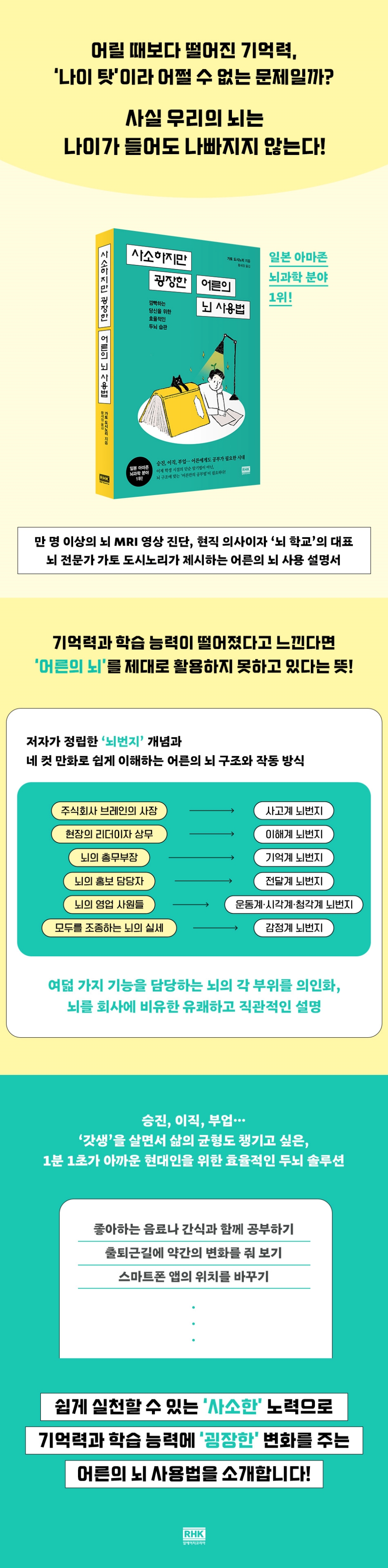
Brain regions are a concept that classifies each part of the brain according to its function. In 『Small but Amazing How to Use the Adult Brain』, the 'adult brain' is explained using a total of eight brain regions.
The roles and relationships of each brain region are like positions or departments in a company, and in the book, the brain regions are personified and compared to companies to help readers understand.
Additionally, it is important to utilize emotions to keep the adult brain functioning well.
When we feel happy, new information is better remembered.
The four-panel cartoons and illustrations included in the book add a little fun to keep the brain from getting bored during the process of preparing for lifelong growth.
Just as collaboration between departments impacts a company's performance, close connections between brain regions are key to leveraging the adult brain.
The author's suggested methods for adults also begin with small changes in daily life that can strengthen the networks between brain regions.
It doesn't take a lot of effort to nurture the adult brain and enhance intellectual abilities.
This book suggests 'small' methods for modern people who find it difficult to invest large amounts of time, such as rearranging the layout of smartphone apps or making small changes to their commute.
In fact, the author says that the desire to challenge new things and the desire to learn something are very good nutrients for the adult brain.
If you're ready for an energy drink for your brain, you can gradually embody the simple tips suggested in this book and build a brain that never ages.
Keep this in mind.
Your brain has nothing left to do but grow!
The problem is the 'brain usage' you insist on!
Regardless of age group, ‘job change’ and ‘side job’ have become key words that describe today’s society.
Just as it is important to maintain a work-life balance, increasing one's self-worth and boldly taking on new challenges are also important topics for today's adults.
However, once you actually start taking on challenges and preparing, you often feel that your memory, concentration, and learning ability have clearly declined compared to your early 20s when your mind was more active.
At times like that, most people quickly think, 'I guess I'm getting old too.'
However, this idea is a rather hasty judgment.
The brain doesn't just decline in function with age.
The adult brain is more mature than the brain of a student, and can perform higher-order functions such as understanding, thinking, and judgment more effectively.
Although the number of brain cells continues to decrease after infancy, as we age and our brain structure changes to that of an adult, the network between brain cells actually becomes more dense.
But if the brain doesn't age as we age, what causes the decline in brain function we experience as adults?
The problem is that we are using our brain in a way that does not fit its changed structure.
A student's brain and an adult's brain are different in structure and function.
Even if you use your brain in a simple memorization manner like you did when you were a student, the adult brain does not move as the owner wants.
If you are an adult who wants to go one step further, you must first change how you use your brain.
By maximizing the network between brain functions, you can become more capable than you were when you were younger.
How to Use the Adult Brain, Explained in Easy-to-Use Mode by a Brain Expert
Efficient Brain Habits for Busy Professionals
Author Toshinori Kato is a developmental neuroscientist and internist who discovered brain activity measurement technology currently used in over 700 facilities worldwide. He has diagnosed and treated the brains of over ten thousand people, from children to the elderly.
He independently developed a brain MRI image analysis technique and established a 'brain school' and a brain clinic to help many people train their brains. He uses the concept of 'brain address', which he established, to simply explain the structure of the brain.
Brain regions are a concept that classifies each part of the brain according to its function. In 『Small but Amazing How to Use the Adult Brain』, the 'adult brain' is explained using a total of eight brain regions.
The roles and relationships of each brain region are like positions or departments in a company, and in the book, the brain regions are personified and compared to companies to help readers understand.
Additionally, it is important to utilize emotions to keep the adult brain functioning well.
When we feel happy, new information is better remembered.
The four-panel cartoons and illustrations included in the book add a little fun to keep the brain from getting bored during the process of preparing for lifelong growth.
Just as collaboration between departments impacts a company's performance, close connections between brain regions are key to leveraging the adult brain.
The author's suggested methods for adults also begin with small changes in daily life that can strengthen the networks between brain regions.
It doesn't take a lot of effort to nurture the adult brain and enhance intellectual abilities.
This book suggests 'small' methods for modern people who find it difficult to invest large amounts of time, such as rearranging the layout of smartphone apps or making small changes to their commute.
In fact, the author says that the desire to challenge new things and the desire to learn something are very good nutrients for the adult brain.
If you're ready for an energy drink for your brain, you can gradually embody the simple tips suggested in this book and build a brain that never ages.
Keep this in mind.
Your brain has nothing left to do but grow!
GOODS SPECIFICS
- Date of issue: May 26, 2023
- Page count, weight, size: 252 pages | 312g | 128*188*16mm
- ISBN13: 9788925576473
- ISBN10: 8925576473
You may also like
카테고리
korean


korean

![GQ KOREA Mark (Monthly): December [2025]](http://librairie.coreenne.fr/cdn/shop/files/8ef265dbbfbf186523ed75ba7319009d.jpg?v=1765340328&width=3840)


