

Completing Korean Language Concepts (Study Book)
 |
Description
Book Introduction
『Complete Korean Concepts』, which allows you to perfectly learn the core concepts required for Korean language classes and exams.
Covers all essential Korean language concepts.
It covers the essential concepts of poetry, prose, grammar, and reading.
Provides a wealth of examples and a variety of activities.
You can easily understand the meaning of a concept through examples that clearly illustrate the concept.
Problems can be identified and applied immediately.
You can get a feel for the real thing by solving various verification problems and practice problems.
* This textbook is a learning material for students to learn the concepts of Korean.
Covers all essential Korean language concepts.
It covers the essential concepts of poetry, prose, grammar, and reading.
Provides a wealth of examples and a variety of activities.
You can easily understand the meaning of a concept through examples that clearly illustrate the concept.
Problems can be identified and applied immediately.
You can get a feel for the real thing by solving various verification problems and practice problems.
* This textbook is a learning material for students to learn the concepts of Korean.
- You can preview some of the book's contents.
Preview
index
[Ⅰ Poetry Literature]
01 Speaker
1) Poetic speaker
2) The poetic speaker's emotions
3) The poetic speaker's attitude
4) The tone of the poetic speaker
Practical problems solved with concepts
02 Rhyme
1) Rhyme
2) Appearance ratio
3) Implied rate
4) Method of forming rhyme
Practical problems solved with concepts
03 Image
1) Image
2) Sensory imagery
3) Other images
Practical problems solved with concepts
04 Expression
1) Expression of poetry
2) Analogy
3) Change cycle
4) Emphasize
5) Symbol
6) Material
Practical problems solved with concepts
05 Award presentation method
1) Award presentation method
2) Changes in time
3) Movement of space and gaze
4) Seonkyunghujeong
5) Introduction, development, climax, and conclusion
6) Sumisang-eung
7) Change of awards
8) Repetition of similar structures
9) Enumeration of targets
10) Layered emphasis
11) Contrast
Practical problems solved with concepts
06 Understanding Classical Poetry
1) Branches of classical poetry ①
2) Branches of classical poetry ② - Sijo
3) Branches of classical poetry ③ - Lyrics
Practical problems solved with concepts
07 Perspectives on Appreciating Literary Works
1) Perspectives on appreciating literary works
2) Intrinsic perspective
3) External perspective
Practical problems solved with concepts
[Ⅱ Prose Literature]
01 Narrator and Point of View
1) Narrator and point of view
2) Distance according to viewpoint
3) How to present characters
4) Narrator's intervention
5) Narrative style
Practical problems solved with concepts
02 Characters
1) Character
2) Character types according to role
3) Types of characters according to importance
4) Character types according to personality changes
5) Types of characters according to their representativeness
Practical problems solved with concepts
03 Conflict
1) Conflict
2) Internal conflict
3) External conflict
Practical problems solved with concepts
04 Background
1) Background
2) Background function
Practical problems solved with concepts
05 Composition
1) Composition
2) Composition over time
3) Different types of configurations
4) Various terms of composition
06 Understanding Classic Novels
1) Characteristics of classic novels
2) Types of classic novels
3) Concept words of classical novels
Practical problems solved with concepts
07 Understanding the play and essay
1) Play
2) Scenario
3) Essay
Practical problems solved with concepts
[Ⅲ Grammar]
01 Phoneme
1) Phonology
2) Phonological changes
3) Replacement
4) Elimination
5) Abbreviation
6) Addition
Practical problems solved with concepts
02 Parts of speech
1) Part of speech
2) Noun
3) Verbs
4) Modifiers
5) Relationship words
6) Independence speech
Practical problems solved with concepts
03 Morphemes and Words
1) Root
2) Affixes
3) Morpheme
4) Words
5) Semantic relationships between words
Practical problems solved with concepts
Sentence 04
1) Sentence
2) Sentence elements
3) Main ingredients
4) Accessory components
5) Independent components
6) Sentence structure
7) Connected sentences
8) The sentence "Han Eun-sun"
Practical problems solved with concepts
05 Grammar Elements
1) Concluding expression
2) Honorific expressions
3) Tense
4) In terms of movement
5) Causative expressions
6) Passive expressions
7) Negative expressions
Practical problems solved with concepts
06 Accurate sentence expressions and grammar norms
1) Accurate sentence expression
2) Korean spelling
Practical problems solved with concepts
07 The evolution of the Korean language
1) Periodization of Korean language history
2) Ancient Korean
3) Middle Korean
4) Modern Korean
Practical problems solved with concepts
[Ⅳ Reading]
Sentence 01
1) Sentence
2) Sentence relationships
Paragraph 02
1) Paragraph relationships and composition principles
2) The main paragraph
3) Auxiliary paragraph
03 Narrative style
1) Narrative style
2) Description
3) Static explanation method
4) Dynamic explanation method
5) Description
6) Argument
04 Reading principles through introduction terms
1) Introduction
2) Various texts
Practical problems solved with concepts
01 Speaker
1) Poetic speaker
2) The poetic speaker's emotions
3) The poetic speaker's attitude
4) The tone of the poetic speaker
Practical problems solved with concepts
02 Rhyme
1) Rhyme
2) Appearance ratio
3) Implied rate
4) Method of forming rhyme
Practical problems solved with concepts
03 Image
1) Image
2) Sensory imagery
3) Other images
Practical problems solved with concepts
04 Expression
1) Expression of poetry
2) Analogy
3) Change cycle
4) Emphasize
5) Symbol
6) Material
Practical problems solved with concepts
05 Award presentation method
1) Award presentation method
2) Changes in time
3) Movement of space and gaze
4) Seonkyunghujeong
5) Introduction, development, climax, and conclusion
6) Sumisang-eung
7) Change of awards
8) Repetition of similar structures
9) Enumeration of targets
10) Layered emphasis
11) Contrast
Practical problems solved with concepts
06 Understanding Classical Poetry
1) Branches of classical poetry ①
2) Branches of classical poetry ② - Sijo
3) Branches of classical poetry ③ - Lyrics
Practical problems solved with concepts
07 Perspectives on Appreciating Literary Works
1) Perspectives on appreciating literary works
2) Intrinsic perspective
3) External perspective
Practical problems solved with concepts
[Ⅱ Prose Literature]
01 Narrator and Point of View
1) Narrator and point of view
2) Distance according to viewpoint
3) How to present characters
4) Narrator's intervention
5) Narrative style
Practical problems solved with concepts
02 Characters
1) Character
2) Character types according to role
3) Types of characters according to importance
4) Character types according to personality changes
5) Types of characters according to their representativeness
Practical problems solved with concepts
03 Conflict
1) Conflict
2) Internal conflict
3) External conflict
Practical problems solved with concepts
04 Background
1) Background
2) Background function
Practical problems solved with concepts
05 Composition
1) Composition
2) Composition over time
3) Different types of configurations
4) Various terms of composition
06 Understanding Classic Novels
1) Characteristics of classic novels
2) Types of classic novels
3) Concept words of classical novels
Practical problems solved with concepts
07 Understanding the play and essay
1) Play
2) Scenario
3) Essay
Practical problems solved with concepts
[Ⅲ Grammar]
01 Phoneme
1) Phonology
2) Phonological changes
3) Replacement
4) Elimination
5) Abbreviation
6) Addition
Practical problems solved with concepts
02 Parts of speech
1) Part of speech
2) Noun
3) Verbs
4) Modifiers
5) Relationship words
6) Independence speech
Practical problems solved with concepts
03 Morphemes and Words
1) Root
2) Affixes
3) Morpheme
4) Words
5) Semantic relationships between words
Practical problems solved with concepts
Sentence 04
1) Sentence
2) Sentence elements
3) Main ingredients
4) Accessory components
5) Independent components
6) Sentence structure
7) Connected sentences
8) The sentence "Han Eun-sun"
Practical problems solved with concepts
05 Grammar Elements
1) Concluding expression
2) Honorific expressions
3) Tense
4) In terms of movement
5) Causative expressions
6) Passive expressions
7) Negative expressions
Practical problems solved with concepts
06 Accurate sentence expressions and grammar norms
1) Accurate sentence expression
2) Korean spelling
Practical problems solved with concepts
07 The evolution of the Korean language
1) Periodization of Korean language history
2) Ancient Korean
3) Middle Korean
4) Modern Korean
Practical problems solved with concepts
[Ⅳ Reading]
Sentence 01
1) Sentence
2) Sentence relationships
Paragraph 02
1) Paragraph relationships and composition principles
2) The main paragraph
3) Auxiliary paragraph
03 Narrative style
1) Narrative style
2) Description
3) Static explanation method
4) Dynamic explanation method
5) Description
6) Argument
04 Reading principles through introduction terms
1) Introduction
2) Various texts
Practical problems solved with concepts
Detailed image
Publisher's Review
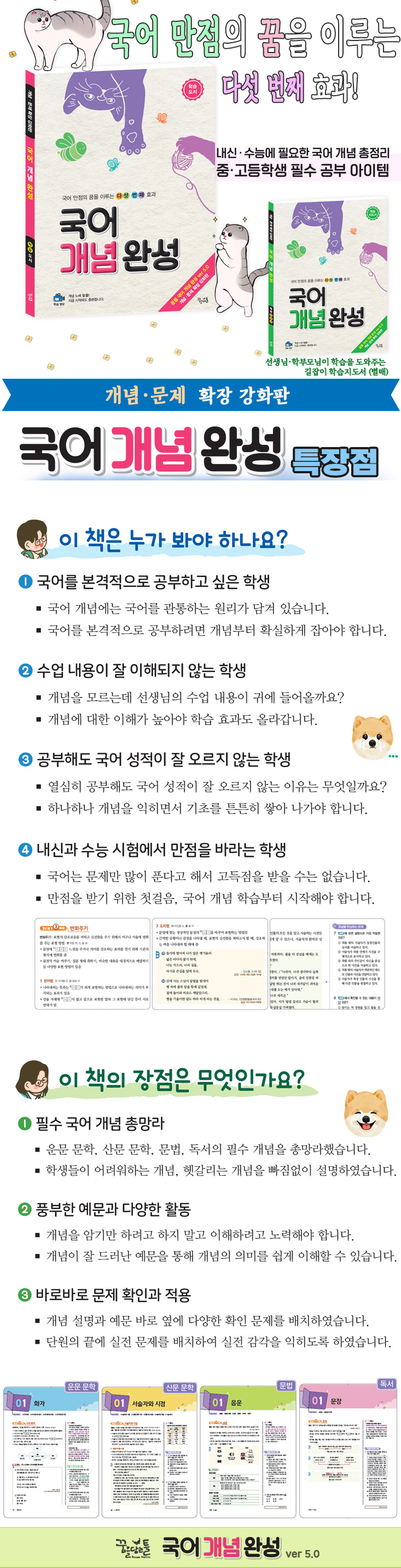
[Who should read this book?]
① Students who want to study Korean in earnest
- The concept of the Korean language contains the principles that permeate the Korean language.
- If you want to study Korean seriously, you must first have a firm grasp of the concepts.
② Students who do not understand the class content well
- I don't know the concepts, but will I still be able to understand the teacher's lecture?
- The higher the understanding of the concept, the more effective the learning will be.
③ Students whose Korean language grades do not improve despite studying
- Why don't my Korean grades improve even though I study hard?
- You must build a solid foundation by learning each concept one by one.
④ Students who want to get perfect scores on their school records and college entrance exams
- You can't get a high score in Korean just by solving a lot of problems.
- The first step to getting a perfect score is to start by learning Korean language concepts.
[How to Use the Textbook to Complete the Concept]
▶ Summary of concept meaning and significance
- The meaning and significance of essential concepts are explained in detail.
- Additional concepts that you need to know are comprehensively organized into ‘Concept Magnifier’, ‘Concept Magnifier’, and ‘Concept Plus’.
- Learn the concepts by filling in the blanks yourself.
▶ Learning concepts through activities
- The literature and reading units provide examples related to the concepts, and the grammar units provide case studies to help students learn the concepts.
- Check how the concept is implemented in examples (use cases).
- You must develop the ability to understand concepts and examples (cases) together and apply the concepts you have studied to other examples (cases).
▶ Problems that complete the concept
- Confirmation problems applying the concept are placed right next to the concept and example sentences.
- You need to fully internalize the concept by solving various types of problems.
- When you get a question wrong, review the concept and examples.
▶ Practical problems solved with concepts
- At the end of each unit, practice problems based on internal and external exam questions are provided.
- Get a feel for the real thing by solving problems within a set time limit.
- When you get a question wrong, go back and study the concept and examples (case studies) repeatedly.
① Students who want to study Korean in earnest
- The concept of the Korean language contains the principles that permeate the Korean language.
- If you want to study Korean seriously, you must first have a firm grasp of the concepts.
② Students who do not understand the class content well
- I don't know the concepts, but will I still be able to understand the teacher's lecture?
- The higher the understanding of the concept, the more effective the learning will be.
③ Students whose Korean language grades do not improve despite studying
- Why don't my Korean grades improve even though I study hard?
- You must build a solid foundation by learning each concept one by one.
④ Students who want to get perfect scores on their school records and college entrance exams
- You can't get a high score in Korean just by solving a lot of problems.
- The first step to getting a perfect score is to start by learning Korean language concepts.
[How to Use the Textbook to Complete the Concept]
▶ Summary of concept meaning and significance
- The meaning and significance of essential concepts are explained in detail.
- Additional concepts that you need to know are comprehensively organized into ‘Concept Magnifier’, ‘Concept Magnifier’, and ‘Concept Plus’.
- Learn the concepts by filling in the blanks yourself.
▶ Learning concepts through activities
- The literature and reading units provide examples related to the concepts, and the grammar units provide case studies to help students learn the concepts.
- Check how the concept is implemented in examples (use cases).
- You must develop the ability to understand concepts and examples (cases) together and apply the concepts you have studied to other examples (cases).
▶ Problems that complete the concept
- Confirmation problems applying the concept are placed right next to the concept and example sentences.
- You need to fully internalize the concept by solving various types of problems.
- When you get a question wrong, review the concept and examples.
▶ Practical problems solved with concepts
- At the end of each unit, practice problems based on internal and external exam questions are provided.
- Get a feel for the real thing by solving problems within a set time limit.
- When you get a question wrong, go back and study the concept and examples (case studies) repeatedly.
GOODS SPECIFICS
- Publication date: September 15, 2022
- Page count, weight, size: 312 pages | 220*297*30mm
- ISBN13: 9788963919621
- ISBN10: 8963919625
You may also like
카테고리
korean


korean

![GQ KOREA Mark (Monthly): December [2025]](http://librairie.coreenne.fr/cdn/shop/files/8ef265dbbfbf186523ed75ba7319009d.jpg?v=1765340328&width=3840)


