

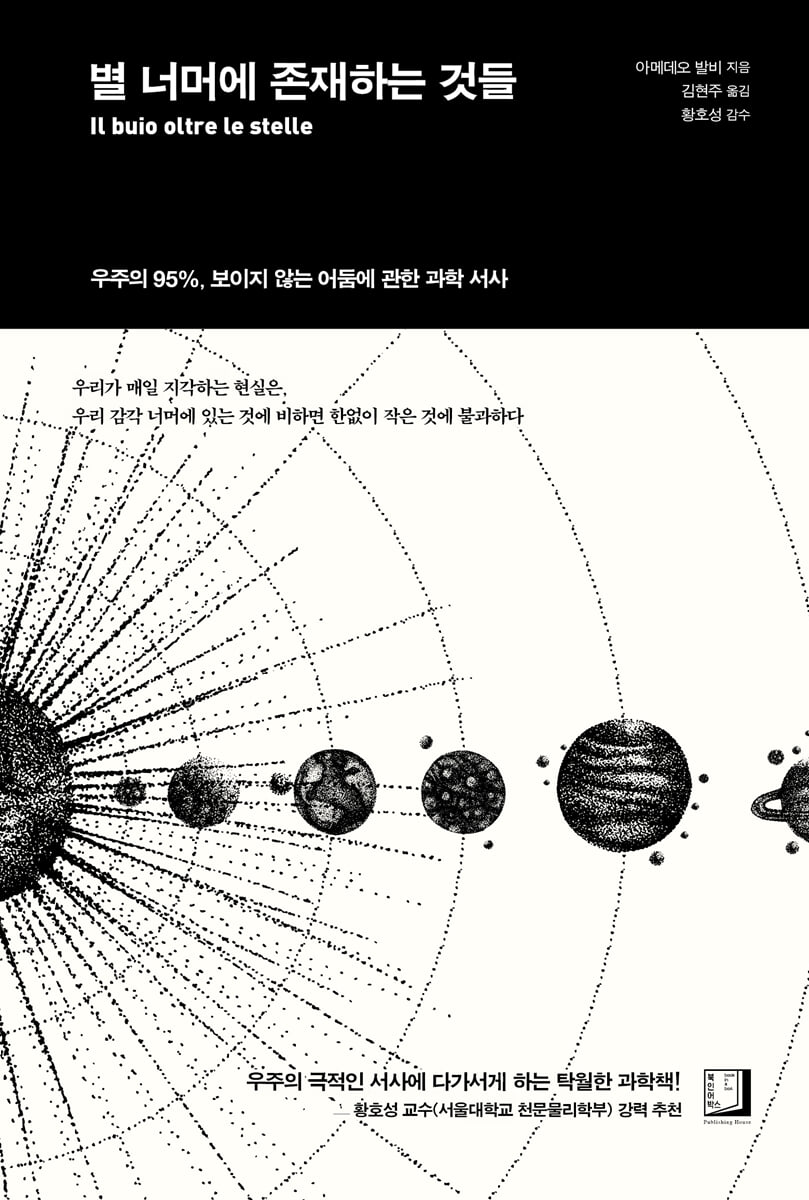
Things that exist beyond the stars
 |
Description
Book Introduction
Starting with “Why is the night sky dark?”
The most elegant and intelligent debate in the universe surrounding 'light' and 'darkness'!
"Last Horizon" by Amedeo Balbi: A Story of the Deep Darkness, 95% of the Universe Beyond the Stars
“To approach dark matter and dark energy, we must understand the difficult-to-imagine starting point of the universe, where the macroscopic world where gravity is crucial and the microscopic world where gravity is ignored are combined, and then consider countless cosmic scenarios that exist only within the equations, which the author explains excellently.” ─ Hwang Ho-seong, Professor, Department of Physics and Astronomy, Seoul National University
Who said Stephen Hawking was the only one who could popularize science? This book is simply compelling, even compared to other excellent science books.
“This kind of writing ability is only possible when you ‘control’ the material.” ─ National Geographic Magazine
This is a new book by Professor Amedeo Balbi, one of Italy's top astrophysicists who first discovered the anisotropy of the cosmic microwave background radiation and confirmed that the structure of the universe is a Euclidean (flat) structure, and who has been particularly active in the fields of cosmology and astrobiology. It traces the mysteries and controversies surrounding dark matter and dark energy, which are estimated to make up 95% of the universe.
For decades, the existence of the "dark element" has been strongly predicted, but only circumstantial evidence has been accumulated, and its definitive nature has not been proven, putting it in jeopardy.
The standard model of cosmology, which culminated in the Big Bang and is based on general relativity, is under threat as the discovery of mysterious particles that seemed likely to be dark matter is delayed and the physical conundrum surrounding dark energy remains unresolved.
The field of cosmology appears to be going through a period of great turmoil, with skepticism emerging about the theory of gravity and even pseudosciences such as 'intelligent design,' 'the anthropic principle,' and 'the flat earth theory' poking fun at its weak links.
However, the authors point out that the dark component, which is the foundation of the standard cosmological model, remains a plausible alternative to explain the universe, and observations support this.
However, it is the duty of science to examine whether there is a possibility that something is missing or whether there are any incorrect assumptions regarding the dark component, and this requires reflective verification.
This book goes back to the beginning, as scientists of the past did, to reconsider the properties of what is invisible beyond the 'event horizon', and captures the process of discovery and debate that has unfolded since then.
The starting point is a very simple question: “Why is the night sky dark?”
Perhaps, starting from this question, we were able to understand the origin and expansion of the universe, guess the existence of dark matter, and even infer the existence of invisible dark energy by asking, “Why is there no space without anything?”
If you pursue the darkness of the universe, symbolized by the dark element, you will be able to enjoy a beautiful universe where metaphor and intuition intersect.
The most elegant and intelligent debate in the universe surrounding 'light' and 'darkness'!
"Last Horizon" by Amedeo Balbi: A Story of the Deep Darkness, 95% of the Universe Beyond the Stars
“To approach dark matter and dark energy, we must understand the difficult-to-imagine starting point of the universe, where the macroscopic world where gravity is crucial and the microscopic world where gravity is ignored are combined, and then consider countless cosmic scenarios that exist only within the equations, which the author explains excellently.” ─ Hwang Ho-seong, Professor, Department of Physics and Astronomy, Seoul National University
Who said Stephen Hawking was the only one who could popularize science? This book is simply compelling, even compared to other excellent science books.
“This kind of writing ability is only possible when you ‘control’ the material.” ─ National Geographic Magazine
This is a new book by Professor Amedeo Balbi, one of Italy's top astrophysicists who first discovered the anisotropy of the cosmic microwave background radiation and confirmed that the structure of the universe is a Euclidean (flat) structure, and who has been particularly active in the fields of cosmology and astrobiology. It traces the mysteries and controversies surrounding dark matter and dark energy, which are estimated to make up 95% of the universe.
For decades, the existence of the "dark element" has been strongly predicted, but only circumstantial evidence has been accumulated, and its definitive nature has not been proven, putting it in jeopardy.
The standard model of cosmology, which culminated in the Big Bang and is based on general relativity, is under threat as the discovery of mysterious particles that seemed likely to be dark matter is delayed and the physical conundrum surrounding dark energy remains unresolved.
The field of cosmology appears to be going through a period of great turmoil, with skepticism emerging about the theory of gravity and even pseudosciences such as 'intelligent design,' 'the anthropic principle,' and 'the flat earth theory' poking fun at its weak links.
However, the authors point out that the dark component, which is the foundation of the standard cosmological model, remains a plausible alternative to explain the universe, and observations support this.
However, it is the duty of science to examine whether there is a possibility that something is missing or whether there are any incorrect assumptions regarding the dark component, and this requires reflective verification.
This book goes back to the beginning, as scientists of the past did, to reconsider the properties of what is invisible beyond the 'event horizon', and captures the process of discovery and debate that has unfolded since then.
The starting point is a very simple question: “Why is the night sky dark?”
Perhaps, starting from this question, we were able to understand the origin and expansion of the universe, guess the existence of dark matter, and even infer the existence of invisible dark energy by asking, “Why is there no space without anything?”
If you pursue the darkness of the universe, symbolized by the dark element, you will be able to enjoy a beautiful universe where metaphor and intuition intersect.
- You can preview some of the book's contents.
Preview
index
Recommendation _ Why is the night sky dark?
Preface to the Korean edition
introduction
I
Looking into the darkness
Scrutando nel buio
1 No photons are wasted
2 The Paradox of the Dark Night Sky
3 Expanded view
4 Fossil Light
5 Beyond the Darkness
II
dark matter
Scrutando nel buio
6 The universe is flat
7 There is missing material
8 A World of Nothing
9 Mysterious Particles
10 Lots of clues, but no culprit
III
The Fifth Element
Scrutando nel buio
11 Einstein's Mistakes
12 acceleration
13 empty space
14 Uncertain Fate
15 How to Interpret Darkness
Preface to the Korean edition
introduction
I
Looking into the darkness
Scrutando nel buio
1 No photons are wasted
2 The Paradox of the Dark Night Sky
3 Expanded view
4 Fossil Light
5 Beyond the Darkness
II
dark matter
Scrutando nel buio
6 The universe is flat
7 There is missing material
8 A World of Nothing
9 Mysterious Particles
10 Lots of clues, but no culprit
III
The Fifth Element
Scrutando nel buio
11 Einstein's Mistakes
12 acceleration
13 empty space
14 Uncertain Fate
15 How to Interpret Darkness
Detailed image
.jpg)
Into the book
Of all the problems that modern cosmology faces, the most important and pressing is undoubtedly the challenge of confronting dark matter and dark energy, which appear to be the primary constituents of our universe.
If these two elements are not filled soon, it is a gap that could lead us to a situation where we cannot help but raise serious questions about some of the physical theories we have used to interpret the universe.
We can say that we are travelers observing the view outside the window while flying at night.
The landscape that unfolds beneath us is dominated by things we can only guess at.
Sometimes artificial lights appear to be arranged in a clearly ordered cluster, but the darkness of the land or vast expanse of sea upon which they fall is not.
---「p.
23, from “Preface”
There are fewer stars in the sky visible to the naked eye than you might think.
The exact number varies depending on observing conditions, but even at peak viewing times, there are only about 3,000 in our hemisphere (and the opposite hemisphere, too).
Most stars appear to be clustered around our galaxy, which has an irregular, luminous band at its edge.
The rest of the night sky is completely dark.
In the spatial dimension, it is not light but darkness that dominates the night sky.
And if you think about it, it was the magnificent sight of that starry dome, its countless tiny twinkling dots standing out against the stark black background, that gave birth to astronomy and made the study of the universe possible.
---「pp.
35~36, from “No Photon Is Wasted”
Many of the questions that stump scientists or lead to enormous leaps in knowledge are surprisingly simple.
These are questions that seem so silly or obvious that most people just scoff at them, but thinkers have been pondering them for years, decades, even centuries.
Albert Einstein (1879-1955) is said to have been plagued by a question that bothered him for years, like a thorn in his flesh, after he studied the laws of electromagnetism in his teenage years.
The question was, what would light look like if you could travel right next to it at the speed of light?
---「p.
58, from “The Paradox of the Dark Night Sky”
The universe is mostly empty and dark.
Our species was able to survive and evolve because it arose on an unusual island of small, damp rocks with suitable environmental conditions orbiting a medium-sized star.
Life on Earth is completely dependent on the energy that the sun pours into empty space every moment in the form of electromagnetic waves.
About half of this energy is concentrated in wavelengths ranging from 380 nanometers (a nanometer is one billionth of a meter) to 760 nanometers.
So it's not entirely accidental that we evolved visual apparatus that can respond within that narrow range of wavelengths.
---「p.
83, from “Expanded View”
Sunlight doesn't just come from afar, it comes from a very long time ago, when our ancestors were just beginning to communicate and roam the savannah as the light from the sun's center began to move toward us.
However, sunlight is not the only light that must travel through time and space to reach Earth.
There is light that started further away, much earlier, when the universe was completely different from what it is now.
It has traveled so long that it is now invisible, and its photons are too old to be detected by our eyes, but they are light that can be collected and studied in some way.
---「p.
108, from “Fossil Light”
The fact that the speed of light is finite means that when we look into the distant universe, we are looking back into the distant past of the universe.
As our research explores ever-more distant regions of space, the frontiers of our knowledge are expanding not only toward the cosmic horizon, but also toward the temporal limits of cosmic history.
As we delve deeper into the darkness of space, we observe life in the universe from ever-deeper times, and we approach a time much closer to the Big Bang.
As they build increasingly powerful instruments, modern astronomers have become like ancient sentries, climbing high towers to extend their gaze to ever-more distant regions.
And looking so far ahead, we go back in time.
Some of humanity's best observational outposts are not located along our coasts, but hover above us.
---「p.
129, from “Beyond the Darkness”
Because of the rapid inflation, the universe was predicted to be flat, but this could not be explained in any other way.
And the absence of curvature observed in the W-MAP experiment, following the boomerang and maxima, strongly supported this theory.
While it was natural that the theories of Alan Guth and the inflation model were highly regarded, the Euclidean appearance of the geometry of the universe on the other hand was quite disconcerting.
Throughout the 20th century, when astrophysicists calculated the mass of all objects observable by telescopes, the results were surprisingly low.
That is, all observable mass combined would not amount to 1 percent of the critical density.
But if the universe is flat, there must be an explanation for where all the missing matter is hidden, as undoubtedly observed in the cosmic microwave background.
In other words, the universe seemed too dark to astrophysicists.
---「p.
170, from “The Universe is Flat”
In fact, it's not that difficult to imagine that not all matter in the universe emits enough light (or some other form of electromagnetic radiation) to be visible.
For example, we know that in addition to stars, there is a lot of dust inside spiral galaxies.
On a very clear night, you can see the effects of this dust, which appears as dark bands that streak the area where the Milky Way is visible.
However, dust on the disk cannot be used to explain the irregularities in the rotation curve.
As we have already established, we need a dark component spread across the spherical halo.
---「p.
185, from “There is a missing substance”
What is the universe made of? We don't know for sure, but we can certainly say that the elements we're familiar with—the substances we encounter most often—are extremely rare in the universe as a whole.
What's even more annoying is that there's a risk that these rare elements might not exist at all.
In fact, there is a question that has been raised for quite some time, but we still do not have a complete answer.
The question is, 'Why is there something rather than nothing?'
---「p.
209, from “The World of Nothing”
Towards the end of the 20th century, thanks to observations by astronomers and advances in cosmology, physicists concluded that atoms were not the only type of matter in the universe.
In fact, these materials alone could not adequately explain the overall geometry of the universe or the way its structure is held together by gravity.
A new hypothesis was needed, and as is often the case in these cases, to move in a direction never before explored, we had to start from what we knew.
What do we know about dark matter? Can we find a single cause that explains the vast number of anomalous results from cosmological observations? It's akin to a criminal investigation, where we must use the information we've gathered to narrow down the list of likely suspects.
Like other types of matter, dark matter can be thought of as being made up of elementary particles.
So what types of properties would this hypothetical particle have?
---「pp.
218~219, from “The Mysterious Particle”
There is no way out.
When we use existing physical laws to interpret astrophysical observations and only examine directly observable matter, the situation rarely fits together.
Most astrophysicists believe that an inevitable consequence of this discrepancy is that there is so much strange stuff in the universe that we cannot see and about which we know virtually nothing.
This thinking may preserve existing laws of physics, but it also acknowledges that some people may feel uncomfortable with a new theory without direct evidence and propose alternative solutions.
Of course, the problem is that there are only a handful of physicists who have chosen that path.
---「p.
244, from "There are many clues, but no culprit"
The cosmological constant, a mathematical trick introduced to stabilize an unstable universe, seemed to have no reason to exist any longer.
It was a waste of knowledge that did not help the history of the concept, and Albert Einstein himself most regretted introducing this constant.
In his 1945 book, The Meaning of Relativity, Einstein stated, “The introduction of a cosmological constant into the gravitational equation is possible from the point of view of relativity, but must be discarded for the sake of logical simplicity.
(…) If Hubble's expansion law had been known when the general theory of relativity was being developed, the cosmological constant would never have been introduced.
“Introducing this term into the field equations today seems even more inappropriate, because the only existing justification for it—that of leading to a natural solution to the cosmological problem—has failed,” he wrote.
---「p.
289, from "Einstein's Mistake"
Given physically well-defined models, the mission of observational cosmology seemed quite clear in the 1930s.
To explain the overall evolution of the universe over time (from the moment after the Big Bang to the present, and to projected future times), all that was needed was to connect the physical parameters in the cosmological model to observations of the actual universe.
What makes the inflationary model, which improves on general relativity, so attractive is that it depends on only two unknown quantities.
Both of these quantities should, in principle, be definable through astrophysical measurements.
---「p.
290, from "Acceleration"
To classical scientists, vacuum was defined by subtraction.
That is, when all matter was removed from the spatial domain, what remained was a vacuum.
Creating a vacuum in the real world is a very difficult problem, but in the laboratory, it is simplified by sucking gas out of the container as efficiently as possible.
The idea that a perfect vacuum could be achieved seemed practically impossible, merely an ideal goal to strive for.
Then, anyway, space would remain permeated with ether, which cannot be destroyed or eliminated, down to the very last tiny region.
---「pp.
318, from “Empty Space”
Although science has only recently begun to develop a clearer view of the physical conditions under which the evolution of the observable universe began, the origin of all things has long been a subject that has fascinated humanity.
But a consistent debate for centuries has been the question of its symmetry, namely the ultimate fate of the universe.
If the universe ends, when and how will it end? We've now begun to understand, to some extent, the state of the universe in its early evolution. We can explore the depths of space, push to its boundaries, and even go back in time, observing galaxies formed at various stages of its life, including distant quasars and the early remnants of the massive island universes that make up the current cosmic framework.
---「pp.
338-339, from “Uncertain Fate”
Cosmologists must once again follow the same path as physicists studying fundamental interactions to understand the cause of the universe's accelerating expansion.
The answer to the vacuum energy problem is actually found in a much more universal problem that has puzzled even the brightest minds on Earth for decades.
The solution would be to formulate a theory that would deal with all known interactions within a unified framework, perhaps explaining why the fundamental physical parameters have the values they do (the so-called Theory of Everything, TOE).
It is clear that this is an extremely difficult task at present, as there are no definitive results.
If these two elements are not filled soon, it is a gap that could lead us to a situation where we cannot help but raise serious questions about some of the physical theories we have used to interpret the universe.
We can say that we are travelers observing the view outside the window while flying at night.
The landscape that unfolds beneath us is dominated by things we can only guess at.
Sometimes artificial lights appear to be arranged in a clearly ordered cluster, but the darkness of the land or vast expanse of sea upon which they fall is not.
---「p.
23, from “Preface”
There are fewer stars in the sky visible to the naked eye than you might think.
The exact number varies depending on observing conditions, but even at peak viewing times, there are only about 3,000 in our hemisphere (and the opposite hemisphere, too).
Most stars appear to be clustered around our galaxy, which has an irregular, luminous band at its edge.
The rest of the night sky is completely dark.
In the spatial dimension, it is not light but darkness that dominates the night sky.
And if you think about it, it was the magnificent sight of that starry dome, its countless tiny twinkling dots standing out against the stark black background, that gave birth to astronomy and made the study of the universe possible.
---「pp.
35~36, from “No Photon Is Wasted”
Many of the questions that stump scientists or lead to enormous leaps in knowledge are surprisingly simple.
These are questions that seem so silly or obvious that most people just scoff at them, but thinkers have been pondering them for years, decades, even centuries.
Albert Einstein (1879-1955) is said to have been plagued by a question that bothered him for years, like a thorn in his flesh, after he studied the laws of electromagnetism in his teenage years.
The question was, what would light look like if you could travel right next to it at the speed of light?
---「p.
58, from “The Paradox of the Dark Night Sky”
The universe is mostly empty and dark.
Our species was able to survive and evolve because it arose on an unusual island of small, damp rocks with suitable environmental conditions orbiting a medium-sized star.
Life on Earth is completely dependent on the energy that the sun pours into empty space every moment in the form of electromagnetic waves.
About half of this energy is concentrated in wavelengths ranging from 380 nanometers (a nanometer is one billionth of a meter) to 760 nanometers.
So it's not entirely accidental that we evolved visual apparatus that can respond within that narrow range of wavelengths.
---「p.
83, from “Expanded View”
Sunlight doesn't just come from afar, it comes from a very long time ago, when our ancestors were just beginning to communicate and roam the savannah as the light from the sun's center began to move toward us.
However, sunlight is not the only light that must travel through time and space to reach Earth.
There is light that started further away, much earlier, when the universe was completely different from what it is now.
It has traveled so long that it is now invisible, and its photons are too old to be detected by our eyes, but they are light that can be collected and studied in some way.
---「p.
108, from “Fossil Light”
The fact that the speed of light is finite means that when we look into the distant universe, we are looking back into the distant past of the universe.
As our research explores ever-more distant regions of space, the frontiers of our knowledge are expanding not only toward the cosmic horizon, but also toward the temporal limits of cosmic history.
As we delve deeper into the darkness of space, we observe life in the universe from ever-deeper times, and we approach a time much closer to the Big Bang.
As they build increasingly powerful instruments, modern astronomers have become like ancient sentries, climbing high towers to extend their gaze to ever-more distant regions.
And looking so far ahead, we go back in time.
Some of humanity's best observational outposts are not located along our coasts, but hover above us.
---「p.
129, from “Beyond the Darkness”
Because of the rapid inflation, the universe was predicted to be flat, but this could not be explained in any other way.
And the absence of curvature observed in the W-MAP experiment, following the boomerang and maxima, strongly supported this theory.
While it was natural that the theories of Alan Guth and the inflation model were highly regarded, the Euclidean appearance of the geometry of the universe on the other hand was quite disconcerting.
Throughout the 20th century, when astrophysicists calculated the mass of all objects observable by telescopes, the results were surprisingly low.
That is, all observable mass combined would not amount to 1 percent of the critical density.
But if the universe is flat, there must be an explanation for where all the missing matter is hidden, as undoubtedly observed in the cosmic microwave background.
In other words, the universe seemed too dark to astrophysicists.
---「p.
170, from “The Universe is Flat”
In fact, it's not that difficult to imagine that not all matter in the universe emits enough light (or some other form of electromagnetic radiation) to be visible.
For example, we know that in addition to stars, there is a lot of dust inside spiral galaxies.
On a very clear night, you can see the effects of this dust, which appears as dark bands that streak the area where the Milky Way is visible.
However, dust on the disk cannot be used to explain the irregularities in the rotation curve.
As we have already established, we need a dark component spread across the spherical halo.
---「p.
185, from “There is a missing substance”
What is the universe made of? We don't know for sure, but we can certainly say that the elements we're familiar with—the substances we encounter most often—are extremely rare in the universe as a whole.
What's even more annoying is that there's a risk that these rare elements might not exist at all.
In fact, there is a question that has been raised for quite some time, but we still do not have a complete answer.
The question is, 'Why is there something rather than nothing?'
---「p.
209, from “The World of Nothing”
Towards the end of the 20th century, thanks to observations by astronomers and advances in cosmology, physicists concluded that atoms were not the only type of matter in the universe.
In fact, these materials alone could not adequately explain the overall geometry of the universe or the way its structure is held together by gravity.
A new hypothesis was needed, and as is often the case in these cases, to move in a direction never before explored, we had to start from what we knew.
What do we know about dark matter? Can we find a single cause that explains the vast number of anomalous results from cosmological observations? It's akin to a criminal investigation, where we must use the information we've gathered to narrow down the list of likely suspects.
Like other types of matter, dark matter can be thought of as being made up of elementary particles.
So what types of properties would this hypothetical particle have?
---「pp.
218~219, from “The Mysterious Particle”
There is no way out.
When we use existing physical laws to interpret astrophysical observations and only examine directly observable matter, the situation rarely fits together.
Most astrophysicists believe that an inevitable consequence of this discrepancy is that there is so much strange stuff in the universe that we cannot see and about which we know virtually nothing.
This thinking may preserve existing laws of physics, but it also acknowledges that some people may feel uncomfortable with a new theory without direct evidence and propose alternative solutions.
Of course, the problem is that there are only a handful of physicists who have chosen that path.
---「p.
244, from "There are many clues, but no culprit"
The cosmological constant, a mathematical trick introduced to stabilize an unstable universe, seemed to have no reason to exist any longer.
It was a waste of knowledge that did not help the history of the concept, and Albert Einstein himself most regretted introducing this constant.
In his 1945 book, The Meaning of Relativity, Einstein stated, “The introduction of a cosmological constant into the gravitational equation is possible from the point of view of relativity, but must be discarded for the sake of logical simplicity.
(…) If Hubble's expansion law had been known when the general theory of relativity was being developed, the cosmological constant would never have been introduced.
“Introducing this term into the field equations today seems even more inappropriate, because the only existing justification for it—that of leading to a natural solution to the cosmological problem—has failed,” he wrote.
---「p.
289, from "Einstein's Mistake"
Given physically well-defined models, the mission of observational cosmology seemed quite clear in the 1930s.
To explain the overall evolution of the universe over time (from the moment after the Big Bang to the present, and to projected future times), all that was needed was to connect the physical parameters in the cosmological model to observations of the actual universe.
What makes the inflationary model, which improves on general relativity, so attractive is that it depends on only two unknown quantities.
Both of these quantities should, in principle, be definable through astrophysical measurements.
---「p.
290, from "Acceleration"
To classical scientists, vacuum was defined by subtraction.
That is, when all matter was removed from the spatial domain, what remained was a vacuum.
Creating a vacuum in the real world is a very difficult problem, but in the laboratory, it is simplified by sucking gas out of the container as efficiently as possible.
The idea that a perfect vacuum could be achieved seemed practically impossible, merely an ideal goal to strive for.
Then, anyway, space would remain permeated with ether, which cannot be destroyed or eliminated, down to the very last tiny region.
---「pp.
318, from “Empty Space”
Although science has only recently begun to develop a clearer view of the physical conditions under which the evolution of the observable universe began, the origin of all things has long been a subject that has fascinated humanity.
But a consistent debate for centuries has been the question of its symmetry, namely the ultimate fate of the universe.
If the universe ends, when and how will it end? We've now begun to understand, to some extent, the state of the universe in its early evolution. We can explore the depths of space, push to its boundaries, and even go back in time, observing galaxies formed at various stages of its life, including distant quasars and the early remnants of the massive island universes that make up the current cosmic framework.
---「pp.
338-339, from “Uncertain Fate”
Cosmologists must once again follow the same path as physicists studying fundamental interactions to understand the cause of the universe's accelerating expansion.
The answer to the vacuum energy problem is actually found in a much more universal problem that has puzzled even the brightest minds on Earth for decades.
The solution would be to formulate a theory that would deal with all known interactions within a unified framework, perhaps explaining why the fundamental physical parameters have the values they do (the so-called Theory of Everything, TOE).
It is clear that this is an extremely difficult task at present, as there are no definitive results.
---「p.
358, from “How to Interpret Darkness”
358, from “How to Interpret Darkness”
Publisher's Review
“How do humans, who depend solely on sunlight, perceive ‘darkness’?”
Amedeo Balbi Asks About the "95%" Who Disappeared Beyond the Stars
This is a new book by Professor Amede Balbi, one of Italy's leading astrophysicists who first discovered the anisotropy of the cosmic microwave background radiation and confirmed that the structure of the universe is a Euclidean (flat) structure, and who is particularly active in the fields of cosmology and astrobiology. It is an interesting book that traces the mysteries and controversies surrounding dark matter and dark energy, which are estimated to make up 95% of the universe.
In this book, the author diagnoses that the standard model of cosmology, which reached its peak with the Big Bang based on the theory of general relativity, is under threat as the discovery of WIMPs, which were believed to be strongholds of dark matter, becomes uncertain and the physical difficulty of the value of vacuum energy, which is assumed to be dark energy, remains unresolved.
While reasonable alternative theories to the standard cosmological model, such as modified Newtonian mechanics, are emerging, even pseudosciences such as 'intelligent design,' 'the anthropic principle,' and 'the flat earth theory' are invading, exploiting its weak links, and the sanctuary of cosmology is facing a period of great challenge.
However, the author points out that the estimation of dark components (dark matter and dark energy) was not simply a product of scientists' imagination, but was inevitably born in the process of humanity understanding the darkness beyond starlight, and strongly suspects that pseudoscience is taking advantage of the absence of direct evidence to trivialize science by relying on agnosticism based on the 'unobservability'.
This is a typical side effect that occurs when scientific progress is somewhat slow.
So, by going back to the beginning of all this and reconsidering the birth of dark matter and dark energy, we take the time to consider whether we missed anything, whether there were calculation errors or three entirely different possibilities, faithfully following the principle of scientific openness.
As for the darkness that exists beyond the stars, it is to go back to the beginning, as all scientists of the past have done, and to reconsider the unknown darkness that fills the universe.
Understanding the nature of darkness is crucial for reestablishing a cosmology in crisis, and more importantly, it provides a clue to understanding the 95% of the universe we still don't know about.
The process unfolds in a thrilling way, reminiscent of a fierce psychological battle between suspect and investigator over a series of alibis, allowing readers to deduce the dark elements together as observers rather than mere recipients of science.
Starting with “Why is the night sky dark?”
The most elegant and intelligent debate in the universe, surrounding 'light' and 'darkness'!
Until just a few centuries ago, the first observers who looked up at the sky and began to draw constellations could not have imagined what lay hidden behind the tiny stars visible to the naked eye.
Since then, with the dazzling progress of science, mankind has achieved astonishing results, and by exploring the farthest reaches of the universe, has come to obtain a very satisfactory picture of the overall structure of the universe and the systems that govern its origin and evolution.
But we still know too little about the universe to say that we know it at all.
Astronomers have only understood the physical properties of 5% of the universe, leaving the remaining 95% unidentified.
Dark matter and dark energy are suspected, albeit indirectly, as strong suspects, but decades later, they are still in crisis, unable to obtain conclusive evidence to prove their suspicions.
According to what has been discovered so far, dark matter is in the form of particles that mix well with ordinary matter, and among the four known forces in nature (gravity, electromagnetism, strong nuclear force, and weak nuclear force), it interacts only through gravity.
So even though it seems like we can quickly find out where it is, it's difficult to determine its identity because it doesn't react to light.
Also, dark energy is thought to be spread throughout the universe in the form of energy rather than particles, and surprisingly, it is known to exert a repulsive force.
It is thought that this repulsive force is causing the rate at which the universe is expanding to accelerate, i.e., causing an accelerating expansion.
Many scholars agree on the necessity of dark energy because it explains various observational results well, but the biggest problem is that it is not known what this veiled energy is.
So why hasn't there been any concrete evidence for all this? And why, despite the passage of time, does it seem more confusing than clear? Isn't the assumption that it interacts solely with gravity an overly far-fetched scenario? Since it's invisible, isn't it impossible to detect with physical instruments? Could there be a different set of physical laws, distinct from the ones we know about gravity? Just as general relativity, a remarkable form of logic and harmony, arises from the ground up, can the dark matter also stand on an unquestionable theoretical foundation in a realm where gravity and quantum mechanics coexist? Or is it simply a phantom imagining of matter and energy as entities that never existed in the first place? This book captures the process of finding answers to all these questions.
“Who said only Stephen Hawking could popularize science?”
Amedeo Balbi's most beautiful popular science book on 'The Darkness of the Universe'!
The fact that it has been over 40 years since the existence of dark matter and dark energy was predicted may seem like a serious flaw.
But it could also be the impatience of humanity, which can only expect a short lifespan of less than a century at most.
The two scientific revolutions of the 17th and 20th centuries, represented by Newton and Einstein, also occurred only in the relatively recent past, in terms of cosmic time.
We're still confused, but we're gaining new tools we didn't have before (like the discovery of gravitational waves).
The day will come when the truth about these two will be revealed, but until then, it may be more fun to speculate on all the possibilities.
It's like struggling for days to put together a jigsaw puzzle, only to look back on the difficult times later when you see the beautiful finished picture.
Fortunately, Professor Amedeo Balbi, the author of this book, serves as an excellent guide for readers seeking to understand the nature of darkness beyond the stars.
To borrow a recommendation from Professor Hwang Ho-seong of the Department of Astronomy and Physics at Seoul National University, “For the general public to approach dark matter and dark energy, they must understand the unimaginable starting point of the universe, where the macroscopic world, where gravity is decisive, and the microscopic world, where gravity is negligible, are combined. Then, they must consider the countless cosmic scenarios that exist only within the equations. The author explains this brilliantly.”
Author Amedeo Balbi is renowned as one of the few scientists who has consistently published science books for the general public while remaining active in the field of astrophysics and cosmology research.
Perhaps for this reason, rather than providing a direct explanation of the concept, it helps readers understand the trajectory of thought that astronomers of the past took by raising the question of 'why', and helps readers naturally approach the reality of the universe.
Perhaps the author's scientific writing is more philosophical than philosophy itself, and more historical than history, making space exploration, which can sometimes seem dry, truly epic.
Maybe that's why this book feels more elegant.
Identifying the dark components, symbolized by dark matter and dark energy, is a crucial task that will allow us to understand the remaining 95 percent of what we still do not know, and will confirm whether the foundation of our knowledge of the origin and structure of the universe is correct.
Readers will also have the opportunity to take a step closer to the mysteries of the vast universe by understanding the mysterious, strange, and elusive "world of darkness."
Amedeo Balbi Asks About the "95%" Who Disappeared Beyond the Stars
This is a new book by Professor Amede Balbi, one of Italy's leading astrophysicists who first discovered the anisotropy of the cosmic microwave background radiation and confirmed that the structure of the universe is a Euclidean (flat) structure, and who is particularly active in the fields of cosmology and astrobiology. It is an interesting book that traces the mysteries and controversies surrounding dark matter and dark energy, which are estimated to make up 95% of the universe.
In this book, the author diagnoses that the standard model of cosmology, which reached its peak with the Big Bang based on the theory of general relativity, is under threat as the discovery of WIMPs, which were believed to be strongholds of dark matter, becomes uncertain and the physical difficulty of the value of vacuum energy, which is assumed to be dark energy, remains unresolved.
While reasonable alternative theories to the standard cosmological model, such as modified Newtonian mechanics, are emerging, even pseudosciences such as 'intelligent design,' 'the anthropic principle,' and 'the flat earth theory' are invading, exploiting its weak links, and the sanctuary of cosmology is facing a period of great challenge.
However, the author points out that the estimation of dark components (dark matter and dark energy) was not simply a product of scientists' imagination, but was inevitably born in the process of humanity understanding the darkness beyond starlight, and strongly suspects that pseudoscience is taking advantage of the absence of direct evidence to trivialize science by relying on agnosticism based on the 'unobservability'.
This is a typical side effect that occurs when scientific progress is somewhat slow.
So, by going back to the beginning of all this and reconsidering the birth of dark matter and dark energy, we take the time to consider whether we missed anything, whether there were calculation errors or three entirely different possibilities, faithfully following the principle of scientific openness.
As for the darkness that exists beyond the stars, it is to go back to the beginning, as all scientists of the past have done, and to reconsider the unknown darkness that fills the universe.
Understanding the nature of darkness is crucial for reestablishing a cosmology in crisis, and more importantly, it provides a clue to understanding the 95% of the universe we still don't know about.
The process unfolds in a thrilling way, reminiscent of a fierce psychological battle between suspect and investigator over a series of alibis, allowing readers to deduce the dark elements together as observers rather than mere recipients of science.
Starting with “Why is the night sky dark?”
The most elegant and intelligent debate in the universe, surrounding 'light' and 'darkness'!
Until just a few centuries ago, the first observers who looked up at the sky and began to draw constellations could not have imagined what lay hidden behind the tiny stars visible to the naked eye.
Since then, with the dazzling progress of science, mankind has achieved astonishing results, and by exploring the farthest reaches of the universe, has come to obtain a very satisfactory picture of the overall structure of the universe and the systems that govern its origin and evolution.
But we still know too little about the universe to say that we know it at all.
Astronomers have only understood the physical properties of 5% of the universe, leaving the remaining 95% unidentified.
Dark matter and dark energy are suspected, albeit indirectly, as strong suspects, but decades later, they are still in crisis, unable to obtain conclusive evidence to prove their suspicions.
According to what has been discovered so far, dark matter is in the form of particles that mix well with ordinary matter, and among the four known forces in nature (gravity, electromagnetism, strong nuclear force, and weak nuclear force), it interacts only through gravity.
So even though it seems like we can quickly find out where it is, it's difficult to determine its identity because it doesn't react to light.
Also, dark energy is thought to be spread throughout the universe in the form of energy rather than particles, and surprisingly, it is known to exert a repulsive force.
It is thought that this repulsive force is causing the rate at which the universe is expanding to accelerate, i.e., causing an accelerating expansion.
Many scholars agree on the necessity of dark energy because it explains various observational results well, but the biggest problem is that it is not known what this veiled energy is.
So why hasn't there been any concrete evidence for all this? And why, despite the passage of time, does it seem more confusing than clear? Isn't the assumption that it interacts solely with gravity an overly far-fetched scenario? Since it's invisible, isn't it impossible to detect with physical instruments? Could there be a different set of physical laws, distinct from the ones we know about gravity? Just as general relativity, a remarkable form of logic and harmony, arises from the ground up, can the dark matter also stand on an unquestionable theoretical foundation in a realm where gravity and quantum mechanics coexist? Or is it simply a phantom imagining of matter and energy as entities that never existed in the first place? This book captures the process of finding answers to all these questions.
“Who said only Stephen Hawking could popularize science?”
Amedeo Balbi's most beautiful popular science book on 'The Darkness of the Universe'!
The fact that it has been over 40 years since the existence of dark matter and dark energy was predicted may seem like a serious flaw.
But it could also be the impatience of humanity, which can only expect a short lifespan of less than a century at most.
The two scientific revolutions of the 17th and 20th centuries, represented by Newton and Einstein, also occurred only in the relatively recent past, in terms of cosmic time.
We're still confused, but we're gaining new tools we didn't have before (like the discovery of gravitational waves).
The day will come when the truth about these two will be revealed, but until then, it may be more fun to speculate on all the possibilities.
It's like struggling for days to put together a jigsaw puzzle, only to look back on the difficult times later when you see the beautiful finished picture.
Fortunately, Professor Amedeo Balbi, the author of this book, serves as an excellent guide for readers seeking to understand the nature of darkness beyond the stars.
To borrow a recommendation from Professor Hwang Ho-seong of the Department of Astronomy and Physics at Seoul National University, “For the general public to approach dark matter and dark energy, they must understand the unimaginable starting point of the universe, where the macroscopic world, where gravity is decisive, and the microscopic world, where gravity is negligible, are combined. Then, they must consider the countless cosmic scenarios that exist only within the equations. The author explains this brilliantly.”
Author Amedeo Balbi is renowned as one of the few scientists who has consistently published science books for the general public while remaining active in the field of astrophysics and cosmology research.
Perhaps for this reason, rather than providing a direct explanation of the concept, it helps readers understand the trajectory of thought that astronomers of the past took by raising the question of 'why', and helps readers naturally approach the reality of the universe.
Perhaps the author's scientific writing is more philosophical than philosophy itself, and more historical than history, making space exploration, which can sometimes seem dry, truly epic.
Maybe that's why this book feels more elegant.
Identifying the dark components, symbolized by dark matter and dark energy, is a crucial task that will allow us to understand the remaining 95 percent of what we still do not know, and will confirm whether the foundation of our knowledge of the origin and structure of the universe is correct.
Readers will also have the opportunity to take a step closer to the mysteries of the vast universe by understanding the mysterious, strange, and elusive "world of darkness."
GOODS SPECIFICS
- Date of issue: May 8, 2023
- Format: Hardcover book binding method guide
- Page count, weight, size: 380 pages | 566g | 128*188*25mm
- ISBN13: 9791197617065
- ISBN10: 119761706X
You may also like
카테고리
korean


korean

![GQ KOREA Mark (Monthly): December [2025]](http://librairie.coreenne.fr/cdn/shop/files/8ef265dbbfbf186523ed75ba7319009d.jpg?v=1765340328&width=3840)


